Nature : What polio’s UK presence means for global health

What polio’s UK presence means for global health
A form of polio derived from the vaccine is probably circulating in the United Kingdom, highlighting the ongoing need for polio vaccination worldwide.

UK health officials are urging people to make sure they are vaccinated against polio, after several sewage samples in London tested positive for the poliovirus towards the end of June.

The UK Health Security Agency (UKHSA), a public-health body, said a poliovirus strain was detected during routine surveillance of waste water in February. A mutated version of the same strain was picked up again in the following months, the agency added, suggesting the virus has spread between individuals, allowing it to evolve.

This virus is called vaccine-derived poliovirus. It is a strain of (weakened) poliovirus that would have originally been found in oral polio vaccines, but has changed over time to behave more like a wild type, or naturally occurring, poliovirus. Vaccine-derived poliovirus can spread through faeces or respiratory secretions. On rare occasions, it can infect the nervous system, causing paralysis and breathing problems in unvaccinated people.

No people with symptoms of polio — including paralysis — have been reported so far, but health authorities are asking doctors to look out for, and report, any symptoms of the disease.

The last case of wild polio contracted in the United Kingdom was in 1984, and the country was declared polio-free in 2003, but the virus still circulates in some parts of the world. Nature explores what the resurgence of polio in the country means.

Why is there polio circulating in London sewers?
Traces of unrelated vaccine-like polioviruses are found every year in UK sewage samples. These detections typically occur when people vaccinated in other countries with a weakened form of the poliovirus return or travel to the country and shed the weakened live virus in their stool for a few weeks.

However, the viruses detected since February are different. They were related to one another and contained mutations suggesting that the virus was spreading from person to person — probably through poor hand hygiene.

According to the UKHSA, there might have been some spread between “closely linked individuals” who are now shedding the poliovirus strain in their faeces. “Investigations will aim to establish if any community transmission is occurring,” the agency said in a press release.

Should people be alarmed?
Scientists say that, at the moment, there’s no reason to panic. The form of virus that was detected in waste water poses a low risk to health: vaccination easily prevents the disease it causes.

Children are routinely vaccinated against polio. According to the World Health Organization (WHO) Global Polio Eradication Initiative (GPEI), 86% of people in London are vaccinated against polio. However, a drop in vaccination uptake during the COVID-19 pandemic could allow the virus to keep circulating. A report this year by the UKHSA found that, in parts of west London, only 35% of teenagers had received their polio booster in 2020–21.

The COVID-19 pandemic has hindered routine vaccinations, which include polio immunization, says Kathleen O’Reilly, an epidemiologist at the London School of Hygiene & Tropical Medicine. The primary course of immunization against polio is combined with vaccinations against other diseases, such as tetanus and whooping cough, so children who missed their polio vaccination are probably vulnerable to other infectious diseases, O’Reilly says. “In some communities, [children] might have also missed the measles vaccine, so this is an early warning of other vaccine-preventable diseases potentially being a problem.”

The detection of vaccine-derived poliovirus in London, she adds, emphasizes the need to invest in vaccination efforts and the importance of wastewater surveillance.

Is polio on the rise globally?
Although wild polio is declining, with only Afghanistan and Pakistan still reporting cases, there have been several outbreaks of the vaccine-derived form of the virus in recent years — with a peak in 2020, when more than 1,100 cases of vaccine-derived polio were reported.

At the beginning of the COVID-19 pandemic, the GPEI paused its polio-eradication activities for a few months, says Michel Zaffran, who retired as head of the GPEI last year. “During that time, the viruses were able to circulate undetected,” he says.

Since 2021, however, the number of vaccine-derived polio cases has been declining. In the past year, 18 countries have reported at least one case of vaccine-derived polio. Regions including south central Somalia and northern Nigeria are outbreak hotspots, says Oliver Rosenbauer, communications officer at the GPEI. “That’s also where you have the highest proportion of children who have never been immunized,” he says.

Because outbreaks can be brought under control with immunization, countries should continue to vaccinate as many people as possible, Rosenbauer says.

How can polio be wiped out worldwide?
The world has spent more than US$17 billion over three decades in an effort to eradicate the virus through vaccination campaigns. In late 2020, the WHO granted emergency approval to a modified vaccine, called nOPV2, to stop outbreaks of circulating vaccine-derived poliovirus in African and East Mediterranean countries. The virus in that vaccine has been genetically engineered to prevent it from becoming harmful.

According to the GPEI, more than 300 million doses of nOPV2 have been administered in 15 countries since March 2021. The vaccine “is a tool that we are all very excited about”, says Ananda Bandyopadhyay, a public-health epidemiologist who conducts polio research at the Bill & Melinda Gates Foundation in Seattle, Washington.

The new vaccine successfully ended a polio outbreak that left 34 children paralysed in Tajikistan. But “a vaccine is of no use if it is sitting in a vial”, says Bandyopadhyay, who co-leads the nOPV2 working group at the GPEI. “What really makes a difference is vaccination coverage.”

Global polio-eradication campaigns face challenges including vaccine hesitancy, political unrest and a lack of adequate health infrastructure. To end polio, Bandyopadhyay says, the global community should provide support for low-income countries to buy vaccines, enhance surveillance and enable front-line health workers to deliver vaccines to every child.

Until polio is wiped out worldwide, all countries are at risk of a resurgence, he says. “Polio can be a plane ride away, if it is out there somewhere.”
FT : Germany draws up law to take stakes in struggling gas importers

Germany draws up law to take stakes in struggling gas importers
Berlin moves to tackle fallout from surging energy prices in wake of Russia’s invasion of Ukraine

The German government has drafted a law that allows it to take stakes in companies crippled by the soaring cost of imported gas as tensions with Russia threaten to plunge the country’s power sector into crisis.

The law, which could be passed by the German parliament as early as this week, would clear a path for the government to bail out Uniper, the largest importer of Russian gas into Germany.

The amended energy law would also allow importers to pass on the higher costs of the gas they are procuring on spot markets to all their customers, and so avoid insolvency.

“Gas has become a scarce commodity and in the current situation we have to make all options available in case of an emergency, and to once again expand our toolbox,” an official said, explaining the measures.

The aim, officials say, is to avoid a repeat of 2008 when the collapse of Lehman Brothers cascaded through the whole financial market, helping to trigger a global crisis.

Germany’s energy sector has been in turmoil since mid-June when Russia’s state-controlled gas exporter Gazprom reduced flows of gas through the Nord Stream 1 pipeline under the Baltic Sea by 60 per cent.

NS1 will undergo scheduled maintenance between July 11 and July 21, and many in the government fear that gas flows might not resume after the repairs are completed as the economic war between Russia and Germany escalates.

Officials have already warned that gas might have to be rationed to industrial customers this winter if Germany fails to fill gas storage facilities quickly enough ahead of the cold season.

Deprived of Gazprom supplies, importers have been forced to procure gas on the spot market at much higher prices. However, they have been unable to pass on these higher costs to their customers, most of whom receive their gas under long-term contracts that are not open to renegotiation.

“If energy companies can’t pay the high prices or fulfil their contracts, they face financial difficulties up to and including insolvency,” the official said. “But if [they] collapse, that could trigger a serious breakdown of the whole market, right along the supply chain to the end consumer.”

Uniper, which issued a profit warning last week and said it was in talks with the government about a bailout, is so far the highest-profile casualty of the crisis.

It said the talks concerned “stabilisation measures” which could include guarantees, an increase in the current credit facility it was granted at the start of the year by the state-owned bank KfW, or the state taking a stake in the company.

Most analysts believe Berlin will bail out Uniper, with a package expected to amount to around €9bn. The rescue deal could be modelled on the relief provided to airline Lufthansa during the pandemic.

Under the proposed amendments to the energy law, the German state would be able to take stakes in troubled companies “of critical infrastructure in the energy sector”, just as it did in banks affected by the global financial crisis and during the Covid-19 pandemic. As part of the Lufthansa bailout the state took a 20 per cent stake in the airline.

The amended law also includes a new “price adjustment” mechanism designed to “maintain supply chains as long as possible and prevent cascade effects”, the official said. It would essentially allow companies to pass on the additional costs of procuring gas on spot markets by imposing a levy on all their gas customers.

MisesInstitute : Here We Go Again: The Fed Is Causing Another Recession

Here We Go Again: The Fed Is Causing Another Recession

07/02/2022Jon Wolfenbarger
Cause of the Boom-Bust Business Cycle
The primary cause of the recurring “boom and bust” business cycle is central banks like the Federal Reserve creating money out of thin air. This was first explained by Austrian economist Ludwig von Mises over a century ago. His student F.A. Hayek won the 1974 Nobel Prize in economics for his work on this theory, which is now known as Austrian business cycle theory.
The basic outline of Austrian business cycle theory is as follows:
  1. the government “central bank” (in the US, it is the Federal Reserve or “Fed”) creates money out of thin air (they effectively “print it,” although typically in the form of digital entries now), usually by buying Treasury bills or bonds from commercial banks, which then …
  2. is deposited in commercial banks which, through the process of fractional reserve banking (where banks are legally allowed to keep only a fraction, such as 10 percent, of their deposits in cash reserves), create even more money out of thin air to lend to their customers, which then …
  3. leads to lower interest rates than would prevail in a free market without a central bank and fractional reserve banks legally creating money out of thin air, which then …
  4. causes businesses and consumers to borrow the newly created money to invest in long-term projects such as mines, factories, houses, etc., since the profitability of those investments appears higher now with a lower cost of capital, which then …
  5. leads to the unsustainable “boom” phase of the business cycle where scarce capital is misallocated to unsustainable investments since the real resources of raw materials, equipment and labor needed to finish these long-term projects are not physically available; while paper money may literally grow on trees, the actual scarce resources needed to create goods and services do not (printing money does not create the goods needed for profitable investment—if it did, Zimbabwe would be the wealthiest country in the world and we could all stop working, saving and investing); then …
  6. the higher money supply leads to higher price inflation, which raises production costs and usually causes the central bank to slow the growth rate of money supply and raise interest rates to try to lower inflation (if they do not, it will eventually lead to hyperinflation, which effectively destroys a functioning currency and economy), which then …
  7. leads to the “bust” phase of the business cycle, where the unsustainable investments are proven to be unprofitable and must be liquidated to allocate capital to the most productive uses that meet consumer desires.
As this theory shows, the dreaded boom and bust business cycle is not inherent in a free market economy. It is caused by the legal privilege granted to central and fractional reserve commercial banks to create money out of thin air. As Mises summarized:
True, governments can reduce the rate of interest in the short run. They can issue additional paper money. They can open the way to credit expansion by the banks. They can thus create an artificial boom and the appearance of prosperity. But such a boom is bound to collapse soon or late and to bring about a depression.
Fed Panicked Over Covid
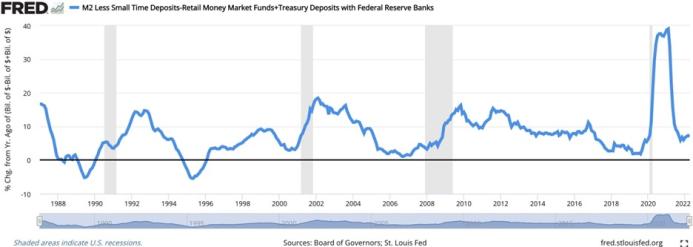
As a result of the stock market crash and global economic collapse caused by government covid policies in early 2020, the Fed panicked and aggressively increased the money supply by 40 percent, more than double the increase in the money supply in prior recessions, as shown below (which is the “Austrian money supply,” calculated as M2 less small time deposits and retail money market funds plus Treasury deposits at the Fed).
This massive money creation resulted in the highest inflation rates in over forty years, with the latest CPI report showing inflation at 8.6 percent, well above the Fed’s 2 percent target. And now that money supply growth has slowed substantially to only 7 percent —and the Fed-controlled monetary base (currency plus bank reserves at the Fed) is now declining 2.6 percent year over year — the economy is starting to slow.
Recession Signs Are Mounting…
Economic growth has already weakened substantially. US gross domestic product fell 1.4 percent in the first quarter of 2022 and the Atlanta Fed is now estimating 0.0 percent GDP growth in the second quarter.
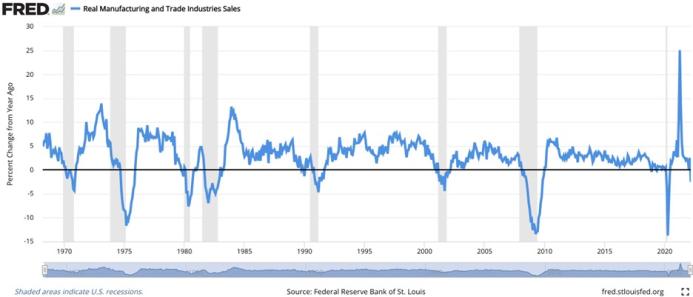
Real personal income is down 3.5 percent year over year, and was down 17 percent in March, the biggest decline in over sixty years. Real manufacturing and trade sales are now down 2.5 percent year over year. This broad sales measure only declines in recessionary periods, as shown below (recessionary periods are shaded gray).
Interest rates have been skyrocketing due to high inflation and slower money supply growth. The ten-year Treasury yield increased from 1.19 percent last summer to 3.25 percent now, while the two-year Treasury yield increased from 0.13 percent last summer to 3.17 percent now. The thirty-year fixed mortgage rate has risen from 2.77 percent last summer to 5.78 percent now, which is causing a collapse in mortgage applications and homebuilder sentiment.
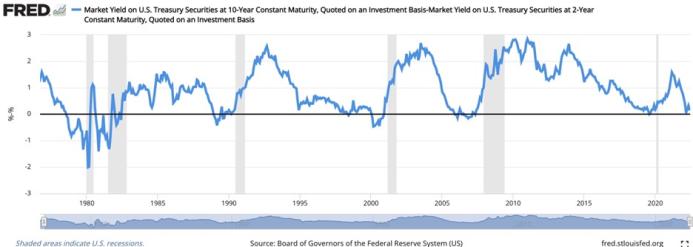
The “yield curve” spread between the ten-year and two-year Treasury yields has now flattened to only 0.08 percent. This spread “inverted” briefly a couple of months ago when the two-year yield rose above the ten-year yield. It could easily invert again soon. As shown below, a flattish or inverted yield curve spread between the ten-year and two-year Treasury yields has occurred before every recession in recent decades.
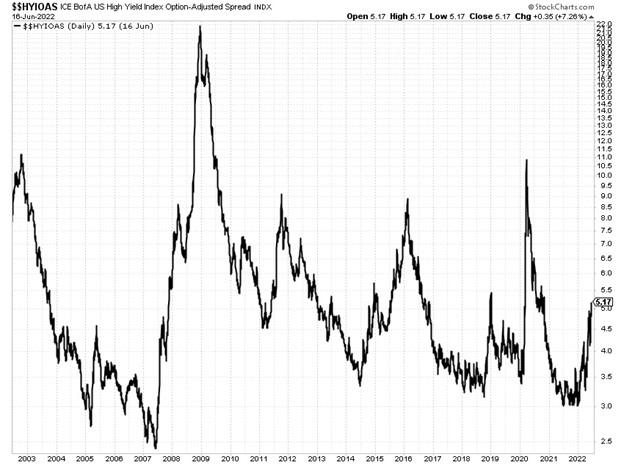
The spread between high-yield “junk” corporate bonds and Treasury yields has risen to the highest levels since the covid panic of 2020, as junk bond investors start to price in the risk of a recession, as shown below.
Copper is known as “Dr. Copper” for its ability to predict recessions due to its sensitivity to the economy. Copper prices have fallen 20 percent in the past three months.
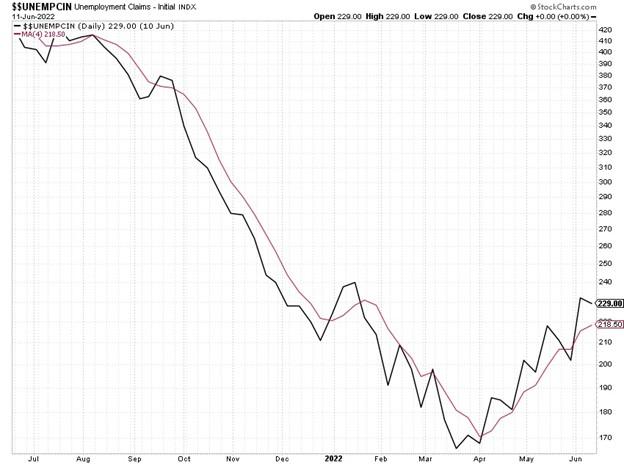
Initial unemployment claims are the best leading indicator of employment. They have been rising steadily for the past three months, as shown below (weekly claims are the black line and the four-week moving average is the red line).
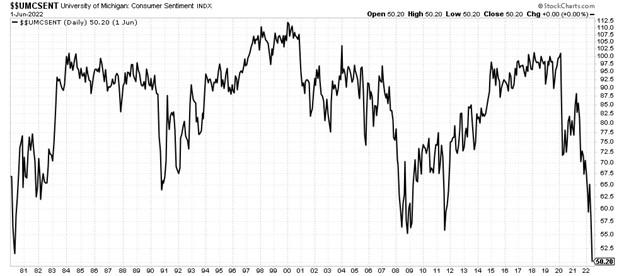
The University of Michigan Consumer Sentiment survey has fallen to the lowest levels in over forty years, as shown below.
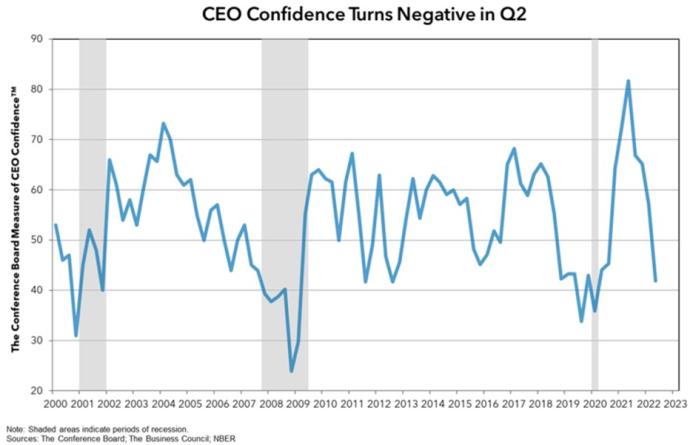
Similarly, The Conference Board CEO Confidence survey has fallen to recessionary levels, as shown below.
Proven leading economic indices have weakened to recessionary levels. The Economic Cycle Research Institute’s Weekly Leading Index, which leads the US economy by at least six months, has declined from a high of around +28 percent last year to –6.3 percent now. This highly regarded economic forecasting firm has recently gone public with their forecast for a coming recession.
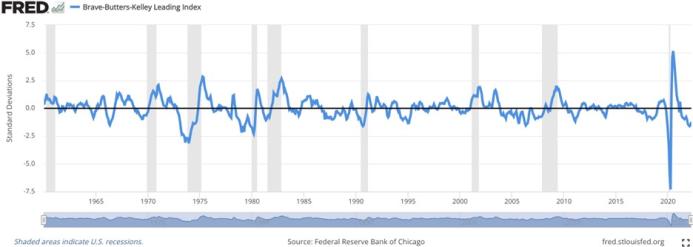
The Brave-Butters-Kelley Leading Index has fallen well below the –1 threshold that signals with 86 percent accuracy that a recession is likely to start within eight months, as shown below.
Now the Fed Is Trying to Crash Financial Markets and Cause a Recession
Normally, the Fed would be slashing interest rates and printing money to try to prevent a recession and stock bear market at this point, which they tried and failed to do in the early 2000s Tech Bust and 2008–09 Great Recession.
But instead, the Fed is being forced to hike rates aggressively to try to bring inflation down. They already hiked the Fed Funds rate to 1.50 percent to 1.75 percent and will need to hike at least 1.50 percent more to catch up to the two-year Treasury yield.
The Fed is explicitly saying they want to lower bond, stock and housing prices and raise unemployment. They say they can do all of that without causing a recession. That is clearly a fantasy.
As Bill Dudley, former president of the New York Fed and vice chairman of the Fed’s Federal Open Market Committee, has said in recent months:
The Fed’s application of its framework has left it behind the curve in controlling inflation. This, in turn, has made a hard landing virtually inevitable…. To create sufficient economic slack to restrain inflation, the Fed will have to tighten enough to push the unemployment rate higher…. Getting inflation down will be costly, in terms of jobs and economic growth…. Investors should pay closer attention to what Powell has said: Financial conditions need to tighten. If this doesn’t happen on its own (which seems unlikely), the Fed will have to shock markets to achieve the desired response. This would mean hiking the federal funds rate considerably higher than currently anticipated. One way or another, to get inflation under control, the Fed will need to push bond yields higher and stock prices lower…. So far, financial conditions really haven’t tightened very much…. The Fed has to push up the unemployment rate, when the Fed has done that in the past, it has always resulted in a recession…. It is very unlikely that a year from now we will be at this level of bond yields this low and this level of stock prices this high.
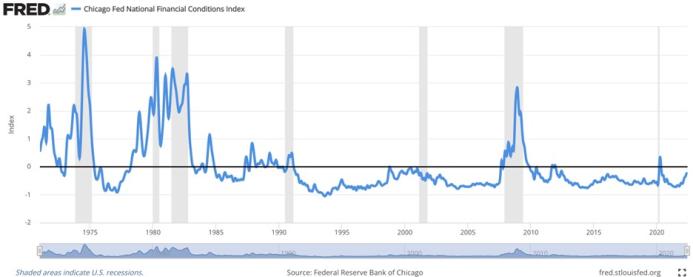
As shown below, despite the stock and bond bear markets, financial conditions remain very easy, according to the Chicago Fed National Financial Conditions Index.
Conclusion
If the Fed succeeds in tightening financial conditions enough to try to maintain their reputation as an “inflation fighter” (i.e., trying to lower the inflation they created in the first place), this will likely be the biggest government-caused economic catastrophe since the Great Depression, as we predicted here last year.

>>> American Pride Hits New Low

American Pride Hits New Low

Americans’ pride in their country has steadily fallen since Gallup started conducting a survey on the subject in 2001.
You will find more infographics at Statista
Now, as Statista's Katharian Buchholz reports, national pride in the U.S. has plummeted to an all-time low, as the fewest respondents in the history of the poll said they were extremely proud to be an American. The measure dropped to just 38 percent upon Gallup's latest survey in June 2022.
Adding up those Americans who felt extremely or just very proud of their country, the measure fell from 69 percent in 2021 to 65 percent in 2022. This is still 2 percentage point above an all-time low of 63 percent in 2020.
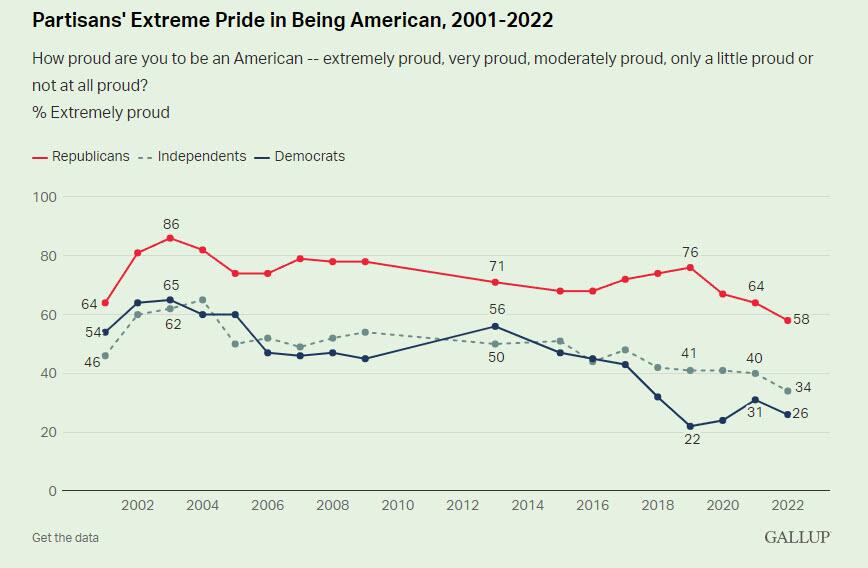
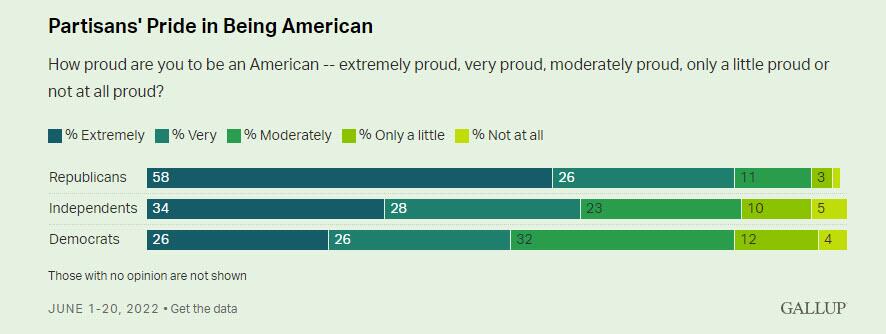
In terms of partisanship, Democrats have predictably seen the largest drop in national pride. Only 26 percent of Democrats responded that they were extremely proud of their country in 2022 – down five points from 2021 and 30 points since 2013. But Republicans were also affected, losing 18 percentage points since a recent high of 76 percent extremely proud respondents in 2019, landing at 58 percent saying they were extremely proud of America in 2022.
National pride, like many other topics in the U.S., has become intertwined in political polarization, having culminated in a record 54-point gap in feelings of extreme pride between Republicans and Democrats in 2019.
The survey also shows that older Americans are more likely to have extreme pride in the U.S. when compared with younger ones, while men are also much more likely than women to show extreme national pride.

FT : ECB set for greener ‘tilt’ in €386bn corporate bond portfolio

ECB set for greener ‘tilt’ in €386bn corporate bond portfolio
Plan to transform holdings will limit share of bonds with high carbon footprint bank accepts as collateral

The European Central Bank will shift the corporate bonds it owns and accepts as collateral away from the most carbon-intensive companies, going further than most big rate-setting authorities but disappointing activists eager to see stronger measures.

Announcing plans to “tilt” its €386bn portfolio of corporate bonds away from companies with “a poorer climate performance”, the ECB said it “aims to gradually decarbonise its corporate bond holdings” in line with the 2015 Paris Agreement to limit global warming.

The central bank said it would also limit the share of non-financial corporate bonds with a “high carbon footprint” it accepts as collateral from individual counterparties, while requiring climate risk disclosure to hit certain levels before an asset or loan is accepted as collateral.

ECB president Christine Lagarde, who has made fighting climate change a key focus of her leadership, said: “Within our mandate, we are taking further concrete steps to incorporate climate change into our monetary policy operations.”

She added “there will be more steps” in future to align the ECB’s activities with the Paris Agreement to limit global warming to 1.5C since pre-industrial times. Temperatures have already risen at least 1.1C.

The plan is more expansive than those announced by the Bank of England, which said last year it would refocus its corporate bond holdings on greener companies, and Sweden’s Riksbank, which said last week it would only buy the bonds of companies that disclosed their climate risks sufficiently.

However, campaigners expressed disappointment that the ECB had not gone further. Greenpeace finance expert Mauricio Vargas said the measures announced on Monday were “overdue”, adding that the ECB “should actively sell the bonds of companies, like the big fossil fuel groups, that are not aligned with the goals of the Paris Agreement”.

Stanislas Jourdan, executive director of campaign group Positive Money Europe, said he was “quite encouraged” by the ECB’s planned carbon-based limits on its collateral system, which he said “signals a move towards a near-exclusion of certain high carbon assets”.

The ECB first announced plans to shift its corporate bond purchases and collateral rules away from heavy carbon-emitting companies last year when it presented the results of a strategy review. It has been criticised by some observers for focusing on green issues when they say it should have concentrated more on preventing inflation in the eurozone from hitting a high of more than quadruple its 2 per cent target.

The ECB on Monday defended the measures, however, saying they “aim to better take into account climate-related financial risk in the eurosystem balance sheet and, with reference to our secondary objective, support the green transition of the economy in line with the EU’s climate neutrality objectives”.

The shift in its corporate bond portfolio will come into force in October and will only affect how it reinvests the proceeds of maturing bonds it already owns after it stopped expanding its balance sheet last week.

Corporate bonds make up less than 8 per cent of the overall €4.95tn of assets the ECB has bought under its quantitative easing policy, most of which are sovereign bonds.

The carbon-based collateral limits on individual counterparties will come into force “before the end of 2024” and apply only to the assets issued by non-financial companies, which make up less than 3 per cent of the total collateral held by the ECB, after valuation adjustments, at the end of March.

The ECB added that it would consider climate risks when adjusting the value of corporate bonds using accounting “haircuts” from this year. It will also push rating agencies to be more transparent and ambitious in how they assess climate risk at the companies they analyse.

The new disclosure requirements for assets to qualify as collateral will only come into effect once the EU’s corporate sustainability reporting directive is fully implemented as expected in 2026, it said.

FT : Germany warns of ‘historic challenge’ as trade slides into deficit

Germany warns of ‘historic challenge’ as trade slides into deficit
Soaring energy prices and trading disruption push balance €1bn into the red for May

Germany’s political and business leaders warned that the country was facing its biggest economic crisis for decades as soaring energy prices and disruptions to trade pushed the country into a monthly trade deficit in goods for the first time in more than 30 years.

The rise in energy prices increased the cost of imports to Europe’s largest economy in May, while global trade disruption weighed down exports, causing a $1bn deficit — the first since 1991. The figures contrasted with years in which Germany’s manufacturing exports drove the country’s growth and made it the powerhouse of the EU economy.

Warning on Monday that Germany faced a “historic challenge”, chancellor Olaf Scholz added that “the crisis won’t pass in a few months” because Russia’s war in Ukraine “has changed everything, and supply chains are still disrupted by the pandemic”.

The sanctions imposed on Moscow by western countries have also hit trade, along with China’s coronavirus lockdowns, squeezing demand for goods from Germany’s export-focused economy.

Scholz was speaking after talks with trade union leaders, economists and employers’ groups aimed at tackling the cost of living crisis.

Rainer Dulger, head of the Confederation of German Employers’ Associations, said after Monday’s meeting held by Scholz that Germany was facing the “toughest economic and social crisis since reunification”.

“Difficult years lie ahead of us,” he added. “We can no longer take for granted the continuous economic growth that we experienced before the Covid-19 pandemic and the Ukraine war.”

Imports increased 2.7 per cent to €126.7bn from April to May while month-on-month exports fell 0.5 per cent to €125.8bn, according to data released on Monday by the federal statistical agency.

“Germany’s trade surplus has now evaporated, thanks mainly to soaring
imports, offsetting otherwise decent momentum in exports,” said Claus Vistesen, an economist at Pantheon Macroeconomics. He added that he
expected the country to continue running a trade deficit over the summer.

May’s fall in overall German exports was partly because of a 2.8 per cent monthly drop in exports to other EU countries, while imports from those countries increased 2.5 per cent. Exports to the US increased 5.7 per cent and those to China were up 0.5 per cent, but exports to the UK fell 2.5 per cent.

“In the past. Germany could always rely on strong exports to revive the economy and today’s numbers show the trade balance will not return as a positive element for growth for at least the next couple of years,” said Carsten Brzeski, head of macro research at ING.

Economists expect high energy prices and weak exports to hit German growth this year. ING is forecasting German gross domestic product will shrink in the second quarter and Brzeski said: “There is a high probability that Germany and the rest of the euro area will enter recession this year.”

Dulger said companies “don’t know which fire to put out first”. He said there was a “shortage of skilled workers, material and staff, and supply chains are in tatters. It will remain a challenge to keep firms open.”

Prices of German imports rose more than 30 per cent in the year to May — reflecting soaring energy and commodity prices — while export prices rose almost 16 per cent. While trade data is reported on a nominal basis, the data is adjusted for inflation when calculating GDP.

German exports to Russia recovered some of their recent falls, rising almost 30 per cent from the previous month to €1bn, but they remain less than half the level of a year ago. German imports from Russia fell almost 10 per cent to €3.3bn. Moscow has cut the supply of natural gas to Germany in recent weeks, raising fears of shortages that could force some industrial production to be shut down.

Many German companies announced they were severing ties with Russia after the EU imposed sanctions on thousands of Russian individuals and businesses. Brussels plans to ban EU imports of Russian oil as part of a sixth package of sanctions against Moscow.

There has been a similar deterioration in the trade balance of the overall eurozone, which had a trade deficit in goods of €32.4bn in April, a reversal from a surplus of €14.9bn a year earlier. Eurozone trade figures for May are due to be released on July 15.

FT : Bundesbank boss warns against ‘fatal’ assumptions in ECB crisis tool

Bundesbank boss warns against ‘fatal’ assumptions in ECB crisis tool
Nagel’s comments reflect concerns over plan to counter divergence in eurozone borrowing costs

The head of Germany’s Bundesbank has warned it will be “virtually impossible” to decide if a divergence of borrowing costs between eurozone countries is justified, arguing it would be “fatal” for governments to rely on the European Central Bank’s support.

Joachim Nagel’s comments in a speech on Monday were the first sign of serious disagreement at the ECB over its plan to develop a new asset purchase tool to counter any “unwarranted” surge in the bond yields of more vulnerable countries once it starts raising interest rates. 

Nagel said “it would be fatal if governments were to assume that the eurosystem will ultimately be ready to assure favourable financing terms for the member states”, and that rate-setters could find themselves in “dire straits” legally over the tool.

The comments by Germany’s central bank chief reflect rising concern among more stable northern European countries that the ECB risks overstepping its mark to keep bond yields low for more indebted southern member-states. Some policymakers worry that if governments are not encouraged to rein in spending it could undermine the ECB’s effort to tackle high inflation.

Since the ECB announced plans to start raising rates this month, bond yields of weaker countries like Italy have soared faster than those for more stable countries like Germany, prompting it to accelerate work on a “new anti-fragmentation instrument”. 

It is against EU law for the central bank to finance governments and Nagel said the ECB would have to put enough safeguards in place to avoid straying into “monetary financing”.

The central bank has defended its earlier bond-buying against numerous legal challenges in Germany, but this could be harder now without the justification of fighting excessively low inflation. 

The ECB worries that a bond market panic could push up weaker countries’ borrowing costs to a level that tips them into a financial crisis. It believes a new tool to counter this risk is justified as it would preserve its ability to transmit monetary policy evenly to all 19 members of the single currency bloc.

The difference, or spread, between German 10-year government borrowing costs and those of Italy has doubled from 1 percentage point a year ago to around 2 percentage points in recent weeks.

Nagel, however, cautioned against “using monetary policy instruments to limit risk premia, as it is virtually impossible to establish for sure whether or not a widened spread is fundamentally justified”.

“One can easily find oneself in dire straits,” he said, adding “it is clear that unusual monetary policy measures to combat fragmentation can be justified only in exceptional circumstances and under narrowly defined conditions”.

Since Nagel took over at the Bundesbank at the start of the year, he has become increasingly concerned as eurozone inflation has shot up to a record level of 8.6 per cent. He said the ECB, of which he is a member of the governing council, should “concentrate all of our efforts on combating this high level of inflation”.

The German central banker set out a number of parameters for any new instrument by the ECB, including that it be “strictly temporary” and be designed in a way that it did not hamper its efforts to bring inflation back down to its target. He added that it should provide governments with “sufficient incentives” to achieve sustainable debt levels.

Such a tool should be “predicated on comprehensive and regular analyses covering a broad set of indicators” and only be used if interest rate spreads are “the result of excesses in financial markets”, he added.

FT : US probe concludes unintentional Israeli fire killed Al Jazeera journalist

US probe concludes unintentional Israeli fire killed Al Jazeera journalist
Report on Shireen Abu Akleh’s death comes a week before Joe Biden’s Middle East trip

The US state department said on Monday that unintentional Israeli gunfire “was likely responsible for the death” of a prominent Palestinian-American journalist shot dead in the occupied West Bank earlier this year.

Shireen Abu Akleh, who worked for the Al Jazeera network and was a household name across the Middle East, was killed while covering an Israeli military raid in Jenin on May 11.

Palestinian officials have blamed Israeli soldiers for her death, while Al Jazeera accused Israel of “deliberately targeting and killing our colleague”. Israeli officials have rejected any suggestion Abu Akleh was killed deliberately, and said she could have been hit by either Palestinian or Israeli fire during the shootout.

On Monday, the state department said that after reviewing Israeli and Palestinian investigations into the shooting, the US Security co-ordinator (USSC) had concluded that “gunfire from IDF (Israel Defense Forces) positions was likely responsible for the death of Shireen Abu Akleh”.

However, it added that there was “no reason to believe that this was intentional but rather the result of tragic circumstances during an IDF-led military operation against factions of Palestinian Islamic Jihad . . . which followed a series of terrorist attacks in Israel”.

Palestinian officials last week handed the bullet that killed Abu Akleh to US officials, paving the way for its examination this weekend.

However, the state department said that despite an “extremely detailed forensic analysis”, it had not been possible to reach a “definitive conclusion” on the bullet’s origin as it was too badly damaged.

The announcement drew a furious response from Abu Akleh’s family, which expressed incredulity that the probe had not been able to determine the origin of the bullet. They also took issue with the conclusion that the killing — which sparked outrage around the world and cast a spotlight on Israeli operations in the West Bank — had been an accident.

“[The] pronouncement that the killing was not intentional but rather the result of a purported Israeli counter-terrorism raid gone wrong . . . is frankly insulting to Shireen’s memory and ignores the history and context of the brutal and violent nature of what is now the longest military occupation in modern history,” the family wrote in a statement.

The IDF said it had ordered a continuation of the probe into the incident “using all available means”, and that a decision on whether to initiate a criminal investigation would be made once its probe was complete.

The state department’s announcement — which follows a statement last month by the UN human rights office that the shot that killed Abu Akleh came from the direction of Israeli forces — comes a week before US President Joe Biden is due to visit Israel as part of a trip to the Middle East.

The Biden administration has faced pressure from US lawmakers to bring about a conclusion to the investigation before his arrival in Israel.

Last month, 24 Democratic senators led by Maryland Senator Chris Van Hollen sent a letter to the Biden administration urging the US to get involved in the investigation.

The state department said that it would “remain engaged with Israel and the Palestinian Authority on next steps” in the case, and that it “urge[d] accountability”.

FT : Property magnate Cevdet Caner joins Aggregate as chief exec

Property magnate Cevdet Caner joins Aggregate as chief executive
Austrian investor also to acquire 20 per cent stake in struggling real estate group

Austrian property magnate Cevdet Caner has been named as chief executive of Aggregate Holdings, in a surprise move that will also see him take a 20 per cent stake in the company linked to allegations facing Adler, one of Germany’s biggest real estate groups.

Luxembourg-based Aggregate was once the largest shareholder in Adler, a real estate group that owns 27,500 flats in north and western Germany.

Adler has been under intense scrutiny since short-selling group Viceroy Research last year published a report accusing the group of widespread fraud and inappropriate related-party transactions connected to Aggregate and Caner. Caner, Adler and Aggregate have denied all the allegations.

A forensic audit by KPMG into the allegations commissioned by Adler found extensive evidence that Caner had significant involvement in strategic decisions and the recruitment of executives despite having no formal role at Adler.

The investigation also uncovered that Caner was paid €12.6mn for undocumented “advisory services” in two M&A transactions, while Adler also bought some of Aggregate’s bonds in an undisclosed transaction. Adler said that the KPMG investigation had found no evidence of fraud.

The appointment of Caner as CEO of Aggregate comes as rising interest rates deepen the challenges for the indebted group.

In a statement Caner said that he was “excited to lead the planning and implementation of the next stage of Aggregate’s strategy.”

Until the deal with Caner, Aggregate was entirely owned by its founder Günther Walcher. Aggregate, which remains a significant shareholder in Adler, did not provide any details of the transaction with Caner.

Caner, who presided over Germany’s second-largest property group bankruptcy when his Level One group failed in 2008, has so far been an adviser working “on a deal-by-deal basis on matters of sourcing, transactions and financing”, Aggregate said in a statement.

At the end of last year, Aggregate had €4.5bn of net debt, and its bonds are trading at around a third of their face value.

Walcher said on Monday that with “the major disruptions in global markets set to continue, there will be tremendous opportunities in the European real estate sector.”

Former Deutsche Bank executive Michael Cohrs, who headed the lender’s investment bank until 2010, and Luciano Gabriel, chair of PSP Swiss Property, will join a new advisory board that is designed to give Aggregate “constant access to world-class strategic advice.”

Shares in Adler have fallen by more than 80 per cent over the past 12 months, a slide accelerated after KPMG in February refused to sign off on the property developer’s accounts and in May ditched the group as a client.

Aggregate’s stake in Adler fell to 6.1 per cent in February after the remainder of its holding, which was pledged as collateral for a €250mn loan, was seized after it failed to service a margin call.

Adler chair Stefan Kirsten told Börsen-Zeitung in an interview last week that the wind down of the company was one option that was being explored.