(ZH) "The Damage Could Be Huge": Chinese Banks Tumble, Swept Up In Mortgage Nonp

"The Damage Could Be Huge": Chinese Banks Tumble, Swept Up In Mortgage Nonpayment Scandal As Borrowers Revolt

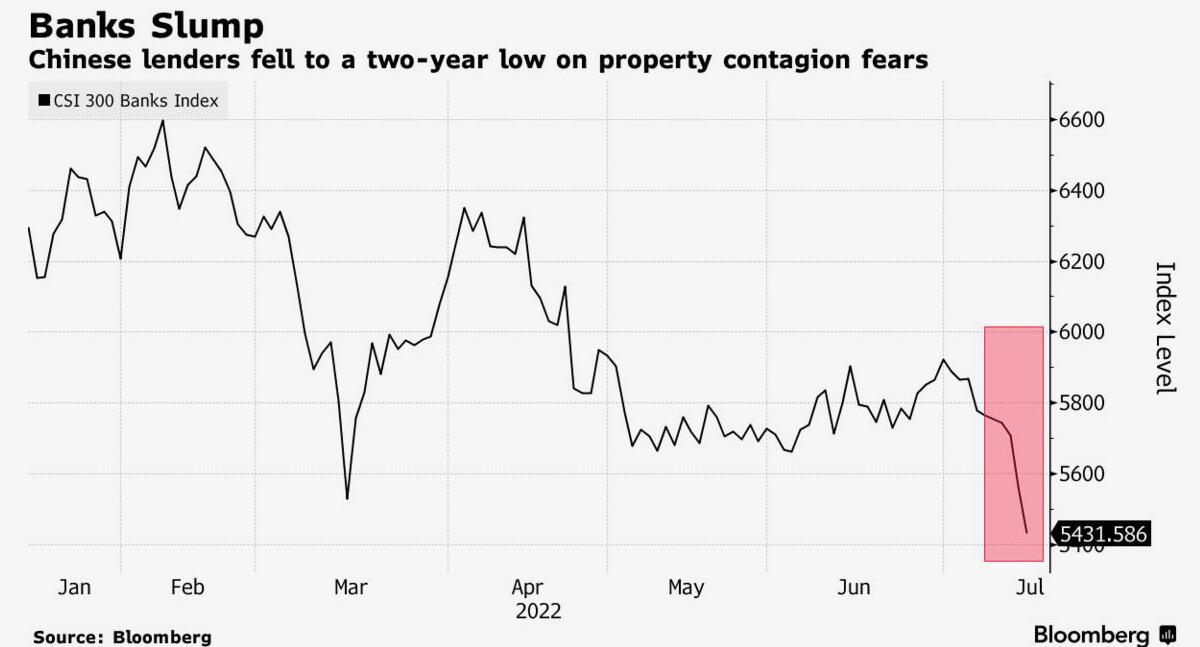
On Friday, shares of China’s banks extended their slide to a two-year low amid fears widespread mortgage non-payments would spark contagion within the banking sector (see "China On Verge Of Violent Debt Jubilee As "Disgruntled" Homebuyers Refuse To Pay Their Mortgages") even after the local banking and insurance regulator said it will maintain continuity and stability of financing policies for the real estate sector.
China Central Television said on its WeChat page that the regulator will guide financial institutions to participate in risk disposals based on market conditions, after researcher China Real Estate Information Corp. reported that home buyers had stopped mortgage payments on at least 100 projects in more than 50 cities as of Wednesday, spurring concerns that the quality of home loans is in rapid decline and could culminate in a 2007-like credit/housing bubble blow up.
Still, as Bloomberg Markets Live reporter Ye Xie writes, the grassroots movement of Chinese homebuyers boycotting mortgage payments isn’t exactly akin to the US subprime crisis of 2008. That said, no matter what Beijing does to address the latest chapter in China’s housing crisis drama, banks are likely to share the burden.
In the wake of a surging number of homebuyers who refuse to pay mortgages on construction projects that have stalled, China’s banking regulators said Thursday that they are coordinating with other agencies to support local governments in working to ensure the delivery of housing units. Separately, Bloomberg reported that policy makers held emergency meetings with banks to discuss the issue amid concern that it may worsen.
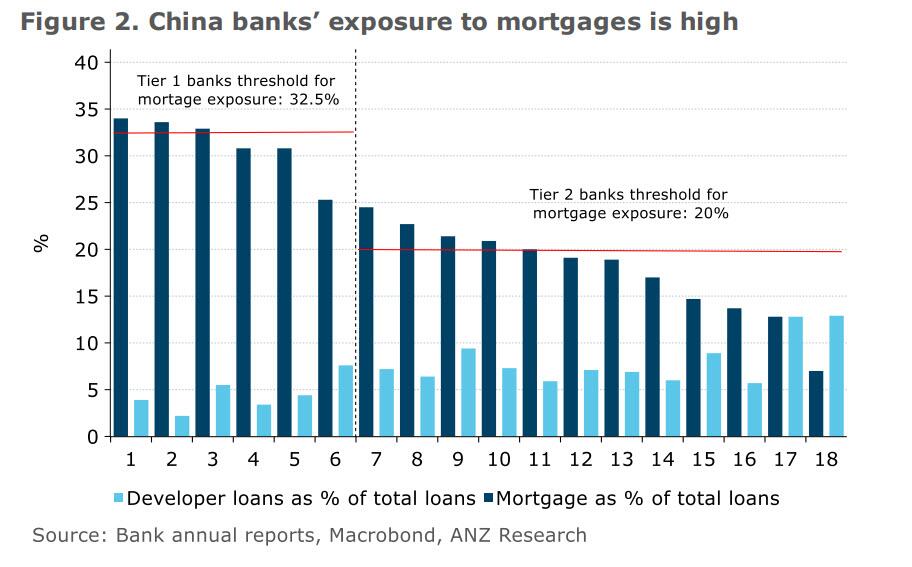
The boycotts raise the risk of mortgage defaults, a new set of troubles for banks that are already squeezed by exposure to ailing property developers. Mortgages make up almost 20% of total bank loans outstanding, amounting to about 39 trillion yuan ($5.8 trillion).
In a rather panicked note from Morgan Stanley economist Zhipeng Cai (available to pro subscribers), he addresses the topic of widespread mortgage nonpayment and writes that "we estimate 188mn sqm (1.7mn units) are at risk. We expect local governments will be urged to help completion, but a national bazooka solution remains difficult in near term."
His warning: "Non-linearity is the key to watch."
To others, however, such as Xie, this is an exaggeration. According to the Bloomberg reporter, "it’s reasonable to argue that this is unlikely the start of something as bad as the US subprime crisis. Unlike lending to developers, mortgages have been regarded as the safest assets on banks’ balance sheets, as Betty Wang, an economist at ANZ, pointed out. Mortgage defaults have been rare, and rising home prices over the years have increased the value of banks’ collateral."
Some data: the average non-performing mortgage-loan ratio of the six largest banks, which accounted for 68% of China’s total home loans, was only 0.38% in 2021, compared with an NPL ratio of 2.73% for developers, according to Wang’s calculations.
Of course, all of this assumes that the current mortgage-boycott movement can be quickly nipped in the bud. If not, the potential damage could be huge. Nomura’s economist Lu Ting and his colleagues estimated that about 4.4 trillion yuan worth of mortgages made between the end of 2020 and March of 2022 may be tied to those home projects that have been stalled or slow in being built.
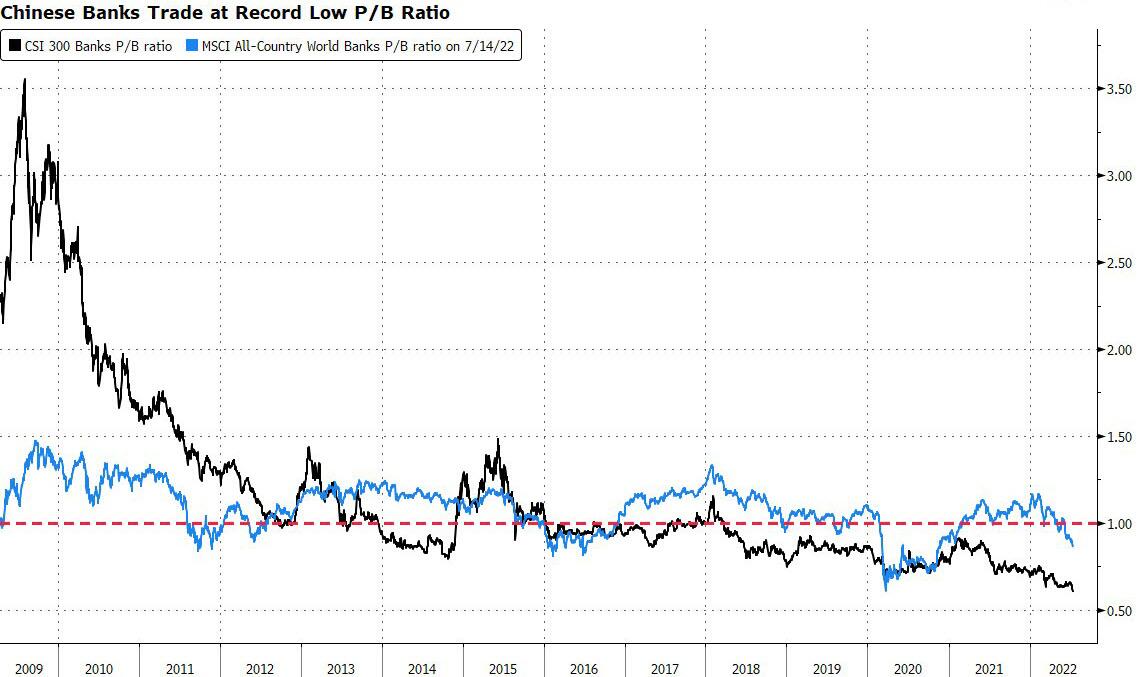
Understandably, Chinese banks have gotten hammered in recent days. The CSI bank index fell more than 4% over the past two days to the lowest since March 2020. Their price-to-book ratio has dropped to an all-time low of 0.61, suggesting investors believe a significant part of the banking system’s assets are impaired.
At the same time, the CSI 300 Financials Index slipped as much as 1.2% on Friday, and is set for an 11th session of declines. Of course, the worse it gets, the more likely Beijing will have no choice but to unleash a powerful releveraging bazooka, even if it has to do so kicking and screaming.
Indeed, as Xie correctly concludes, "the government is likely to step in sooner rather than later as the mortgage boycotts start to undermine social stability. Either banks have to chip in to provide cheap funds for developers to complete projects, or they have to allow homebuyers to delay their payments. Neither is an attractive option."
What is the worst case scenario? Here we go back to the "non-linearity kicking in" case suggested by Morgan Stanley:
Home-buyer confidence weakens further from a low starting point, leading to further deterioration in property sales. This may force more developers, even relatively strong ones today, to suspend unfinished projects, furthering the downtrend. In the meantime, housing prices may continue to fall, exacerbating the downward spiral. Furthermore, the stress in the housing sector could spread to the broader economy, given the extensive inter-sector linkages, while being magnified by the financial system.
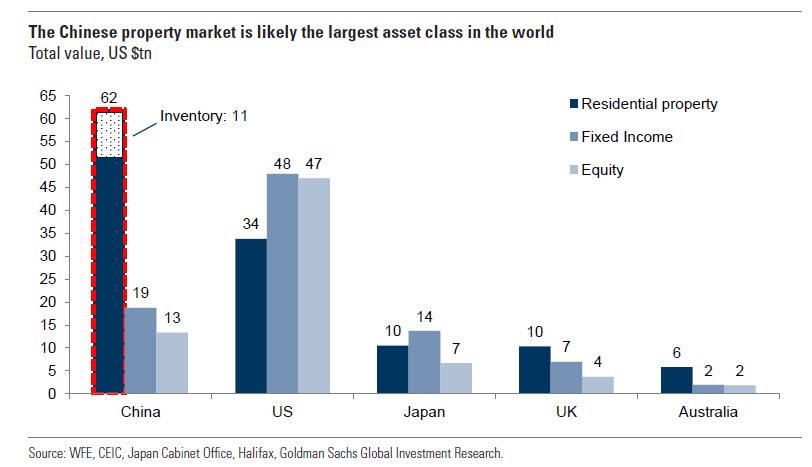
In short: a self-reinforcing downward cascade which ends in either a historical crash of the world's largest asset...
... or a state bailout. Here are the two most likely policy responses according to Morgan Stanley:
  • Damage control: Local governments will likely be called upon to mobilize resources on a by-project basis, possibly with the help of SOEs and LGFVs, to kick-start suspended projects, signaling to the public that housing completion is the over-arching priority. SOE developers may be encouraged to conduct M&A activities, taking over stalled projects.
  • Reining in systemic risk beyond the near term: Policy makers will likely need to send a clear and strong signal that they stand ready to be the "rescuer of the last resort" to rein in systemic risks. Plausible moves include more meaningful demand stimulus, more explicit guarantees on quality developers, or (less likely) a TARP-like program. Translation: a massive firehose of liquidity and credit is about to be unleashed.
One final though: similar to crypto lenders which generously handed out 20% DeFi interest until it all blew up spectacularly in one giant, cross-linked ponzi scheme, so China's 5%+ mortgage rates had been an extremely lucrative business for banks. It's now payback time.

>>> Stoxx 600 Pre-Market Indications

  • ASML (ASME TH) +2.2%
  • AstraZeneca (ZEG TH) +2.2%
  • Bawag (0B2 TH) +2.2%
    • Bawag Rated New Buy at Deutsche Bank; PT 73 euros
  • Equinor (DNQ TH) +1.5%
  • OMV (OMV TH) +1.5%
  • Infineon (IFX TH) +1.5%
  • Uniper (UN01 TH) +1.2%
    • Uniper Raised to Neutral at Goldman; PT 10 euros
    • Fortum Continuing Constructive Talks With German Government
  • Thyssenkrupp (TKA TH) +1.2%
  • Nokia (NOA3 TH) -0.4%
  • Vodafone (VODI TH) -0.5%
  • Investor AB (IVSD TH) -1.3%
  • Mowi (PND TH) -1.4%
  • Tomra (TMRA TH) -4.4%
    • Tomra 2Q Revenue Beats Estimates

>>> TradeGate Pre-Market Indications

DAX:
  • Infineon (IFX TH) +1.7%
  • Daimler Truck (DTG TH) +1.3%
  • E.On (EOAN TH) +1.2%
  • Deutsche Boerse (DB1 TH) +1%
MDAX:
  • Talanx (TLX TH) +1.6%
  • Uniper (UN01 TH) +1.2%
    • Fortum Continuing Constructive Talks With German Government
  • Rheinmetall (RHM TH) +1.2%
SDAX:
  • AUTO1 (AG1 TH) +2.6%
  • Schaeffler (SHA TH) +2.2%
  • Instone Real Estate (INS TH) +1.8%
  • Shop Apotheke (SAE TH) +1.7%
  • Salzgitter (SZG TH) +1.3%
  • About You (YOU TH) +1%
  • Draegerwerk (DRW3 TH) -4.4%
    • Draegerwerk Prelim 2Q Ebit Loss About EU77M

>>> What to look at today - 15th of July 2022

Asian stocks pared losses Friday and US equity futuresticked higher as investors assessed the outlook for Federal Reserve interest-rate hikes and the latest readings on China’s economy. MSCI Inc.’s Asian share gauge was steady as China climbed but Hong Kong retreated. Alibaba Group Holding Ltd. contributed to a slide in China tech following a report that it faces a probe linked to a data theft case. China’s second-quarter growth slowed on Covid lockdowns but consumption rallied in June as curbs eased. Officials refrained from injecting funds into the banking system and left borrowing costs unchanged. S&P 500, Nasdaq 100 and European equity futures gained after the US stock market came off Thursday’s session lows to close with a small loss. Treasuries edged up and the the yield curve between two-year and 10-year maturities remained inverted, something viewed as recession signal. The Bloomberg Dollar Spot Index dipped from a record high. Oil is poised to end the week below $100 a barrel for the first time since April. Traders are weighing up how hawkish the Fed must be to curb inflation. Bets on a one-percentage-point July rate hike have been scaled back after the latest commentary pointed toward 75 basis points. Ebbing liquidity threatens to stir more market volatility after steep losses for stocks and bonds in 2022. In the latest Fed comments, Governor Christopher Waller backed raising rates by 75 basis points this month, though he said he could go bigger if warranted by the data. St. Louis Fed President James Bullard echoed some of those comments, saying he favored hiking by the same amount. In a first flurry of US bank earnings, JPMorgan Chase & Co.’s earnings fell short of estimates and Morgan Stanley announced a plunge in investment-banking revenues. But the chiefs of both banks said they aren’t steering their firms toward shelter even as they see global events denting the economy. Meanwhile about $1.9 trillion of options are set to expire Friday, a even that could bring some volatility to markets.  US After Hours PINS +14.2% on WSJ report that activist Elliott Mgmt has built large stake; CDXS -21.3% and TXG -12.8% fall on weak guidance; RRGB +2.5% gets a new CEO

Nikkei +0.58% Hang Seng -1.66% CSI -0.41% Shanghai -0.36% Shenzen -0.20%

Eur$ 1.0026 CNH 6.7770 CNY 6.7653 JPY 139.04 GBP 1.1830 CHF 0.9828 RUB 60.0941 TRY 17.4669 WTI$ 96.34 +0.60% Gold 1,709.20 -0.04% BTC 20,500 -0.80% ETH 1,193.44 +0.05%

S&P +0.17% Nasdaq +0.25% EuroStoxx +0.88% FTSE +0.37% Dax +0.74% SMI +0.65%

Macro :
- Hedge Funds Saw $10 Billion Net Outflows in June, Citco Says
- Italy’s Prime Minister Mario Draghi Says He Will Resign
- *CHINA'S WANG SAYS CHINA-US TIES AT `CRITICAL' MOMENT: XINHUA

Keep an eye on :
- AXFO SS : Axfood 2Q Operating Profit Beats Estimates
- BRG NO : Borregaard 2Q Ebitda Beats Estimates
- BRAV SS : Bravida 2Q Net Sales Beats Estimates
- BRBY LN : Burberry 1Q Retail Sales Meets Estimates
- COOR SS : Coor 2Q Adjusted Ebita SEK172M
- DKSH SW : DKSH 1H Operating Profit Beats Estimates
- DRW3 GY : Draegerwerk Prelim 2Q Ebit Loss About EU77M
- EDP PL : EDP Says 1H Electricity Generation Rises 6%
- ELISA FH : Elisa 2Q Comparable Ebitda Meets Estimates
- EMSN SW : EMS-Chemie 1H Ebit Beats Estimates
- ERICB SS : Ericsson Gets Approval to Complete Purchase of Vonage
- GJF NO : Gjensidige 2Q Pretax Profit Beats Estimates
- GRNG SS : Granges 2Q Operating Profit Beats Estimates
- HUSQB SS : Husqvarna 2Q Adjusted Operating Profit Misses Estimates
- IBS PL : Ibersol Decides Not to Accept RBI’s Offer for Restaurants
- INWI SS : Inwido 2Q Net Sales Beats Estimates
- KEMIRA FH : Kemira 2Q Oper Ebitda Beats Estimates
- LIFCOB SS : Lifco 2Q Net Sales Beats Estimates
- MTRS SS : Munters 2Q Net Sales Beats Estimates
- NSKOG NO : Norske Skog 2Q Ebitda Beats Estimates
- ONCO SS : Oncopeptides Offering of 15.1m Shares Prices at SEK28.92/Share
- PNDXB SS : Pandox 2Q Property MGMT Income SEK858M Vs. SEK568M Y/y
- PGHN SW : Partners Group Assets Under Management $130.6B
- CFR SW : Richemont 1Q Sales at Constant Exchange Rates Beats Estimates
- RIO LN : Rio Tinto 2Q Mined Copper Production Misses Estimates
- ROG SW : Roche: 8-Yr APHINITY Study Shows Reduced Breast Cancer Risk
- SHOT SS : Scandic 2Q Adjusted Ebitda SEK1.08B
- SCHA NO : Schibsted 2Q Ebitda Misses Estimates
- SPM IM : Saipem Says Share Sale Ended With EU1.4B Subscribed
- SOW GY : Software AG Cuts FY Digital Business Bookings Forecast
- SOW GY : Software AG Promotes Benno Quade to COO
- TEL NO : Telenor Digi Sees Low Single Digit Decline for FY Normal Ebitda
- TOM NO : Tomra 2Q Revenue Beats Estimates
- TOM2 NA : TomTom 2Q Revenue Beats Estimates
- VOW GY : VW’s Battery Business Faces Supply-Chain Hurdles in Road to IPO
- XXL NO : XXL 2Q Ebitda Misses Estimates

>>> Europe : Brokers Upgrades & Downgrades - 15th of July 2022

>>> Up
* Novo Nordisk Raised to Overweight at Morgan Stanley
* Nyfosa Raised to Hold at SEB Equities; PT 90 kronor
* SEB Raised to Buy at Arctic Securities; PT 118 kronor
* Standard Chartered Raised to Buy at Investec; PT 610 pence
* Uniper Raised to Neutral at Goldman; PT 10 euros

>>> Down
* Admiral Cut to Underweight at JPMorgan; PT 1,750 pence
* Chemring Group Cut to Underweight at Barclays; PT 336 pence
* Cognor Holding SA Cut to Sell at Erste Group; PT 3.13 zloty
* Direct Line Cut to Neutral at JPMorgan; PT 240 pence
* EasyJet Cut to Underweight at JPMorgan; PT 310 pence
* Eurobank Cut to Neutral at Goldman; PT 92 euro cents
* HMS Networks Cut to Hold at Nordea
* SBB Cut to Hold at Nordea
* Senior Raised to Overweight at Barclays; PT 183 pence
* Wizz Air Cut to Reduce at HSBC; PT 1,350 pence

>>> Initation
* Abcam Maintained at Hold at Panmure Gordon
* Bawag Rated New Buy at Deutsche Bank; PT 73 euros
* Darktrace Rated New Buy at Stifel; PT 570 pence
* Dassault Aviation Reinstated Neutral at JPMorgan; PT 162 euros
* Exclusive Networks Rated New Buy at Stifel; PT 21.50 euros
* Siemens Energy Resumed Neutral at Citi; PT 16 euros
* Siemens Gamesa Resumed Neutral at Citi; PT 18.05 euros
* WithSecure Rated New Hold at Stifel; PT 2.60 euros

>>> Call
* Deutsche Telekom May Sell German Towers Only, Jefferies Says
* Direct Line Upgraded at Berenberg as Stock ‘Too Cheap to Ignore’
* Novo Nordisk Raised at MS on Blockbuster Obesity Opportunity
* Rio Tinto Drops After Outlook Warning; RBC Sees 2Q Output Miss
* Voestalpine Earnings Beat, Though Analysts Note Backward-Looking

FT : Omicron sub-variant BA.2.75 spreads across India and parts of Europe

Omicron sub-variant BA.2.75 spreads across India and parts of Europe
The strain has been detected in Germany, the Netherlands, Japan, the UK and the US

An Omicron sub-variant that is spreading rapidly in India and has been detected in several European countries may be better than other coronavirus strains at overcoming immunity provided by prior infection and vaccines.

BA.2.75, which has been nicknamed Centaurus, appeared to have mutated in a way that could indicate “major immune escape”, said the World Health Organization’s chief scientist Soumya Swaminathan, adding that it showed a “clear growth advantage” over other variants in India. Global health authorities issued a similar warning when the highly mutated Omicron variant emerged late last year.

The strain has been detected in a number of countries including Germany, Japan, the UK and the US. Dutch health authorities on Wednesday became the latest to announce they had detected the strain.

“We now have 169 sequences from 12 countries — the increase observed is despite the reduction of [samples] in [genomic sequencing platform] Gisaid,” said Swaminathan.

She stressed that it still was not known whether the variant was more severe, more transmissible and immune evasive, or only the latter. “Every future variant will have these advantages if it has to out compete previous strains,” she said. A growth advantage could be due to intrinsic qualities of the virus or to changes in population immunity.

The variant was first identified in India and the nickname Centaurus later circulated on Twitter. Global health authorities were not involved in providing a name. The WHO, which oversees the process, named Omicron and would not provide another for a sub-variant.

The strain’s advance comes as health authorities contend with a resurgence of the pandemic, largely fuelled by the BA.5 Omicron sub-variant. The WHO said it had seen an “increase in trend” in case reports over the past week, something that was “concerning” given the reduction in global coronavirus testing.

European health authorities this week recommended wider eligibility for second boosters, saying those over 60 and those who are immunocompromised should get one. US authorities had previously issued a similar call.

“Prudent governments are really looking at their plans,” said Mike Ryan, the WHO’s executive director for health emergencies, referring to authorities’ preparations for an expected surge in infections later this year.

Governments have also taken the unusual step of opening up second boosters to broader parts of their populations before Omicron-variant vaccines become available later this year.

The deployment of Omicron-variant shots has been backed by EU and US regulators as well as the WHO, as it appears likely that coronavirus will continue to evolve.

Peter English, a retired consultant in public health, said the spread of the variant called for caution.

“The virus is still transmitting, very widely. In doing so it is mutating. Some variants are fitter than previous variants — intrinsically more transmissible and/or better able to evade immune responses,” he said. “Immunity lasts less time than we had hoped, so people can be infected repeatedly, with cumulative damage.”

Current vaccines are modelled on the strain of coronavirus as it first emerged in Wuhan, China, more than two years ago. They continue to retain high levels of protection against severe disease, but their efficacy is waning as more time lapses from the first rounds of vaccinations and the virus continues to evolve.

The WHO’s Ryan compared the protection afforded by vaccines against Covid to a wall protecting a castle. “It gets weak, it gets cracks, there are holes in the wall,” he said, adding that immunological memory “fades over time”.

FT : Alan Howard’s adventures in cryptoland

Alan Howard’s adventures in cryptoland
Media-shy hedge fund billionaire has quietly been building a digital assets empire

Cryptocurrency-based trivia games, horseracing non-fungible tokens and privacy specialists are all part of a large and growing digital assets empire that media-shy hedge fund billionaire Alan Howard has quietly been building, according to analysis by the Financial Times.

Howard is an influential figure in the hedge fund industry thanks to the success of Brevan Howard Asset Management, the $23bn macro trading firm he co-founded. In recent years though, he has been slowly relinquishing some of his roles at the firm to become a major force in crypto venture capital in both Europe and the US.

The FT has compiled a list of 43 investments by Howard in crypto companies and projects — ranging from well-known businesses like exchange FTX, to a start-up incubator and smaller NFT projects — based on information from venture capital databases Crunchbase, PitchBook and Dealroom and public announcements.

Howard has made his investments over the past five years, sometimes alongside big private equity groups such as Tiger Global, SoftBank and Peter Thiel.

“It looks incredibly random until you put it on a map and then it looks incredibly strategic,” said a crypto company executive who had worked with Howard. “He wants to be involved in all facets of the industry.” 

Howard’s interest in cryptocurrencies began in 2017, according to people who have worked with him, and he has continued to invest in the sector despite the wild ups and downs in the market.

“He has a 10- to 15-year vision. While everyone was running out, he was running in,” the executive said of Howard’s decision to keep investing in companies during the 2018 crypto bust. The pace of these investments accelerated in the past two years, and has continued despite the brutal sell-off in recent months.

Howard, who declined to be interviewed for this article, has maintained a lower profile than other major crypto investors such as Galaxy Digital’s Mike Novogratz. However, he has invested alongside Galaxy on projects including the exchange Bullish Global and Derby Stars, which describes itself as “a horseracing metaverse game where players can breed, grow, build and trade”.


Industry executives say the breadth of Howard’s investment portfolio puts him alongside Galaxy and the Connecticut-based crypto conglomerate Digital Currency Group as a major force in the sector.

“They have very big ambitions in crypto,” said a crypto investor who has worked directly with Howard.

Howard has rarely spoken publicly about his hedge fund or crypto investments, although he did comment in an email interview published by crypto news website The Block in May.

Howard said crypto is “an important macro trend” but that because digital assets are still rather a new asset class “it’s most prudent to invest across the entire crypto ecosystem in a highly diversified manner”.

Hedge funds have become increasingly interested in crypto investment in recent years, the huge growth and returns attracting the attention of an industry that has sometimes struggled to make money over the past decade. Many hedge funds have also started trading crypto for this reason.

“Whilst we see a number of macro investment managers launching or considering the launch of a crypto fund . . . Alan Howard has invested more broadly, publicly and directly into the digital asset ecosystem, including middle and back office services and digital asset platforms,” said Quentin Thom, co-head at perfORM Due Diligence Services.

Howard, who got married last month in a lavish event on the shores of Lake Como, began stepping back from some of his hedge fund roles in 2019, when he handed over the position of chief executive of Brevan Howard to chief risk officer Aron Landy, although he continues to control the firm, according to regulatory filings.

This happened as Brevan Howard was making a strong recovery from a long run of poor performance when the firm’s master fund, which had previously never suffered a down year, lost money in three out of four calendar years between 2014 and 2017 and the firm’s assets plunged from $40bn to as low as $6bn.

Last year, Howard redeemed external investors in the AH fund he personally managed and which had made huge gains from the Italian bond shock in 2018. While he continues to have a trading book as part of the master fund, he rarely trades, said people familiar with the firm.

He is, however, still actively involved in Brevan Howard’s $1bn Digital Assets fund. “Alan is so focused on digital assets,” said one hedge fund investor.

A person familiar with Howard’s view said he is “heavily involved . . . in a variety of initiatives across Brevan Howard, including co-investing, strategy allocations and the crypto business through BH Digital”.

Howard told The Block in May that “BH Digital reflects my belief in the importance of investing across the entire ecosystem, regardless of instrument, in a diversified and well risk-managed way.”

His willingness to buy crypto assets directly contrasts with some other investors, who have preferred to buy equity stakes in companies operating in the crypto sector.

Howard has said that venture capital funding and investing directly in crypto tokens and currencies should be considered together because crypto projects often go public very early in their existence by selling tokens to investors.

With his venture capital investments, the list of deals also shows that in most crypto categories where Howard invests, he has tended to back more than one company and across the market.

For instance, he has invested in at least three exchanges and three custodians, companies that store digital assets for clients. He has also backed companies building crypto trading and portfolio management software, as well as several investment funds that are active in digital assets.

Other key parts of his crypto portfolio include Elwood, a trading software firm, start-up incubator WebN Group and Coremont Digital, the crypto- focused branch of the back-office company spun out of Brevan Howard. All three share a central London office with Brevan Howard.

Away from the companies that provide crypto market infrastructure, Howard has also made more niche investments. In November he invested in a fundraising by Iron Fish, a developer working on technology to enable completely private cryptocurrency transactions.

Howard is known for his long-term approach but his crypto portfolio has recorded a few exits. Newcastle-based crypto payments firm Bottlepay was sold to US crypto group NYDIG last year, while institutional trading platform Omniex was acquired by the Winklevoss twin’s Gemini group in January.

Howard’s personal stake in Elwood fell when the company raised $70mn in outside investment from backers including Goldman Sachs and Barclays at a roughly $500mn valuation. He did not take part in the round, but remains the majority owner.

He is also known as an art collector and is interested in “generative” digital art that has its roots in 1960s computer art. He promotes the sector through a monthly digital art salon in London.

Although the current market downturn has put off a lot of would-be crypto investors, it presents opportunities for patient, well-funded investors like Howard.

“In my opinion, he knows what he’s doing. He’s working with the brightest in the crypto industry and is very well advised,” said the investor who had worked with Howard.

“I wouldn’t be surprised to see him come out of the other side of this bear market as one of the biggest players alongside Galaxy. He’s positioning himself to take advantage of valuations.” 

FT : Celsius Network reveals $1.2bn shortfall in bankruptcy filing

Celsius Network reveals $1.2bn shortfall in bankruptcy filing
Crypto lender’s founder admits mistakes as digital asset group seeks court protection

Crypto lender Celsius Network has revealed a $1.2bn hole in its balance sheet caused by what chief executive Alex Mashinsky called “poor” investments and other “unanticipated” losses.

Celsius made the disclosure as it sought US bankruptcy protection this week after freezing customer funds in June, which made it the latest victim of the crash in crypto markets that has forced two other large companies into recent bankruptcy.

Mashinsky, who co-founded Celsius in 2017, laid bare the scale of the New Jersey-based company’s problems in a 61-page court filing on Thursday. It showed liabilities of $5.5bn, and assets of just $4.3bn.

The vast majority of the liabilities, $4.7bn, were attributed to Celsius users. The filing suggested they may face significant losses and blamed the company’s problems on a mixture of bad bets, market conditions and a failure to manage its rapid growth.

“The amount of digital assets on [Celsius’s] platform grew faster than the company was prepared to deploy. As a result, the company made what, in hindsight, proved to be certain poor asset deployment decisions,” Mashinsky wrote in the filing.

Celsius was one of a handful of crypto lenders that pulled in billions of dollars worth of assets from ordinary investors in recent years. It promised interest rates as high as 18 per cent on certain cryptocurrencies.

Canada’s second-largest pension fund, Caisse de dépôt et placement du Québec, and investment firm WestCap led a $600mn equity funding round last year that valued Celsius at $3bn.

The lender is the third big crypto company to file for bankruptcy, following crypto broker Voyager Digital and hedge fund Three Arrows Capital. All three have been hit by collapsing crypto asset prices and a freeze in credit in the market.

Mashinsky admitted a series of mistakes that had resulted in losses and detailed investments that had left Celsius unable to return money to customers as it suffered a bank run this year.

One was a $510mn loss discovered in 2021 when Celsius sought to recover collateral it had pledged to cover borrowings from an unnamed “private lending platform”. 

“The lender was unable to return the . . . collateral on a timely basis,” Mashinsky wrote. Some $440mn of that remains outstanding, he added.

Celsius also incurred losses of almost $100mn when collateral it had pledged to secure a loan from Tether — the stablecoin issuer that is an equity investor in Celsius — was liquidated by mutual agreement in recent months.

Mashinsky said about $1bn of Celsius’s funds were illiquid as they had been committed to the company’s bitcoin mining operation or invested in a version of the Ethereum network that has not been launched.

He suggested Celsius’s recovery plan could involve using bitcoin generated from its mining operations to “address its current cryptocurrency deficit”.

As well as admitting the company’s mistakes, he blamed “misinformation” in the media and on social media for encouraging customers to pull about $1bn worth of funds over five days in May.

Mashinsky said Celsius had been on its way to addressing its problems when the market turned this year.

“The company believes that it would have likely succeeded in the near future if the market had remained relatively stable.”