Gapping down
In reaction to earnings/guidance:
- ASH -1.5% (guidance), BAC -0.9%
Other news:
- AL -3% (announced long-term lease placements for six new Airbus (EADSY) A220-300 aircraft with TAAG Angola Airline)
- FNKO -2% (files for $100 mln mixed securities shelf offering; also files for 17,318,008 share common stock offering by selling shareholders)
- EVLO -0.9% (announces appointment of Marella Thorell as Chief Financial Officer)
- GSK -0.7% (completes demerger of Haleon and share consolidation of GSK)
- SOFI -0.6% (files for $1 bln mixed securities shelf offering)
Analyst comments:
- BL -2.4% (downgraded to Underperform from Neutral at BofA Securities)
- AEVA -2.2% (downgraded to Neutral from Overweight at Piper Sandler)
- EFC -1.4% (downgraded to Mkt Perform from Outperform at Keefe Bruyette)
- ACT -1% (downgraded to Mkt Perform from Outperform at Keefe Bruyette)
- EAT -0.8% (downgraded to Neutral from Buy at Goldman)
Gapping up
In reaction to earnings/guidance:
- ODP +4.7% (guidance) SYF +4.2%, GS +4.2%
Select Index ETFs showing strength:
- QQQ +1.2%, IWM +1.1%, DIA +1.1%, SPY +1%
Select semiconductor stocks trading higher:
- NVDA +2.8%, AMD +2.1%, MU +1.7%, SMH +1.6%, SWKS +1.4%, NXPI +1.3%, INTC +1.1%, STM +0.9%
Other news:
- QD +57.1% (Provides QD food progress report; as of July 18, 2022, the Company has 15 warehousing, assembly and packaging facilities)
- ADN +24.3% (announces that its Green HiPo project under the framework of the Important Projects of Common European Interest Hydrogen -- Technology, has now received official ratification from the European Commission of the European Union)
- ITHX +20.7% (shareholders approve previously announced business combination with Mondee Holdings II)
- APYX +10.3% (receives FDA 510(k) clearance for the use of Renuvion)
- ACTD +7% (receives shareholder approval for business combination with OPAL Fuels)
- IMCR +5% (announces $140 million private placement financing)
- PRMW +4.9% (announced that Primo Water North America, a wholly-owned subsidiary of Primo, has acquired Highland Mountain Water, located in Atlanta, Georgia)
- BA +3.8% (Delta Air Lines to modernize single-aisle fleet with up to 130 Boeing (BA) 737 MAX jets; also BA forecasts demand for more than 41K new airplanes by 2041)
- RYTM +3.6% (NICE recommends Rhythm's IMCIVREE (setmelanotide) for treating obesity and controlling hunger caused by POMC or LEPR deficiency)
- JD +3.5% (positive Barrons article)
- DNA +3.3% (announces collaboration with Sumitomo Chemical)
- CVNA +3.2% (Luxor increased passive stake to 5.9% (prior ~1.1%))
- KWEB +2.9% (positive Barrons article)
- BABA +2.8% (positive Barrons article)
- STLA +2.7% (agree on a share repurchase framework with Dongfeng Motor; implements asset-light approach to grow Jeep brand in China; negotiates termination of local joint venture with GAC Group)
- BALY +2.6% (Standard RI notifies of its election to tender 360,000 common shares in modified Dutch auction)
- BIDU +2.6% (positive Barrons article)
- CRNT +2.3% (Largest Ceragon Networks Shareholder Sends Letter to Board of Directors)
- ESTE +2.2% (files for 5,650,977 share common stock offering by selling shareholders; also files for 29,837,033 share common stock offering by selling shareholders)
- TCOM +2.2% (positive Barrons article)
- AER +1.8% (signs lease agreement with GOL Linhas Aereas Inteligentes)
Analyst comments:
- CHK +2.1% (initiated with a Buy at Goldman)
- CLNN +0.9% (initiated with a Buy at H.C. Wainwright)
- Enel (ENL TH) +4.7%
- Wienerberger (WIB TH) +2.2%
- Thyssenkrupp (TKA TH) +2%
- ASML (ASME TH) +1.8%
- Uniper (UN01 TH) +1.7%
- AstraZeneca (ZEG TH) +1.5%
- ING (INN1 TH) +1.2%
- Novo Nordisk (NOVC TH) +1.2%
- Zalando (ZAL TH) +1.2%
- BAE (BSP TH) -1.1%
- Delivery Hero (DHER TH) -1.3%
- Swedish Match (SWMC TH) -1.7%
- Just Eat Takeaway (T5W TH) -1.8%
- Deliveroo Cuts FY Global Gross Transaction Value Y/y Forecast
DAX:
- Vonovia (VNA TH) +1.4%
- BASF (BAS TH) +1.3%
- VW (VOW3 TH) +1.3%
- Covestro (1COV TH) +1.2%
- Zalando (ZAL TH) +1.2%
MDAX:
- Thyssenkrupp (TKA TH) +2.6%
- Uniper (UN01 TH) +2.5%
- What to Watch in Commodities: Gas, China, BHP, Alcoa, Oil
- Rheinmetall (RHM TH) +1.4%
- Commerzbank (CBK TH) +1.2%
- Lufthansa (LHA TH) +1.2%
- Evotec SE (EVT TH) -0.5%
- Delivery Hero (DHER TH) -0.8%
SDAX:
- Heidelberger Druck (HDD TH) +2.2%
- Deutz (DEZ TH) +1.8%
- ADTRAN Holdings Inc (QH9 TH) +1.8%
- flatexDEGIRO (FTK TH) +1.8%
- PVA TePla (TPE TH) +1.2%
- Kloeckner (KCO TH) -1%
- Hensoldt (HAG TH) -1.5%
Stocks and US equity futures rose Monday amid scaled back bets on how aggressively the Federal Reserve will hike interest rates and as investors assessed Chinese pledges to shore up economic growth. A gauge of Asian shares added more than 1%, boosted by a jump in Chinese technology firms. S&P 500, Nasdaq 100 and European contracts pushed higher following a Wall Street rally Friday. Japan is shut for a holiday. China’s central bank has indicated it will step up implementation of prudent monetary policy. Its banking regulator has asked lenders to provide credit to eligible developers so they can complete unfinished residential properties. China faces rising Covid cases, hobbling lockdowns and property-sector woesthat now span a boycott of mortgage payments on some unfinished projects. The dollar slipped, with a gauge of the greenback’s strength down from a record high. Faster inflation bolstered New Zealand’s currency. Oil fell as the market digests slowing demand and whether supply will be increased after President Joe Biden’s visit to Saudi Arabia.
Treasuries won’t trade in Asia due to the Japan break. Treasury futures edged up. Inversions on parts of the yield curve are a sign the bond market views the Fed’s tightening cycle against inflation as still tough enough to risk recession. Investors continue to be whipsawed by concerns over inflation and the potential for a US recession. At the same time, equity valuations have fallen back from pandemic-era peaks. Data last week showing a drop in long-term US inflation expectations eased some fears that elevated price pressures are becoming entrenched. Strong retail sales underscored a resilient economy despite monetary tightening.
Traders are back to expecting a 75 basis points July Fed rate hike, after last week flirting with the prospect of a 100 basis points move to hammer inflation. Still, the outlook remains troubling for many investors. The International Monetary Fund will cut its global economic growth outlook “substantially” in its next update as nations run out of options to tackle worsening risks. BTC is trading at 21,300.
Nikkei +0,54% Hang Seng +2,58% CSI +1,15% Shanghai +1,49% Shenzen +1,48%
Eur$ 1,0091 CNH 6,7522 CNY 6,7466 JPY 138,33 GBP 1,1884 RUB 57 TRY 17,3540 WTI$ 97,95 Gold 1,714.43 BTC 21,400 +2% ETH 1,415+2,5%
S&P +0,51% Nasdaq +0,89% EuroStoxx +0,78% FTSE +0,56% Dax +0,70% SMI +0,63%
Macro :
- White House Anticipates More Saudi Arabia Oil: Resources Wrap
- ECB Seeks Credibility as Recession Nears: MLIV Pulse
- Germany Expects Regional Gas Emergencies This Winter: Bild
- Italy Stocks May Be Active With Draghi’s Government on the Brink
Keep an eye on :
- AIR FP : Delta to Announce 100 Boeing Max 10 Planes Deal, Reuters Reports
- AIR FP : Boeing CEO ‘Comfortable’ About FAA Approving 787 Deliveries: FT
- ARCAD NA : Arcadis to Buy IBI Group for C$19.50 Per Share in Cash
- DFDS DC : DFDS Boosts FY Ebitda Pre-Items Forecast, Beats Estimates
- DNO NO : DNO Got $264.6M Net From Kurdistan Regional Government in 2Q
- ERM LN : *ASTORG, EPIRIS AGREE TO BUY EUROMONEY FOR 1,461P/SHARE IN CASH
- EOAN GY : EON, Igneo in High Speed Broadband JV to Spur German Rollout
- FINGB SS : Fingerprint Cards Reduces Staff Due to China Mobile Market Slump
- FLOW NA : Flow Traders Starts Venture Capital Unit With EU50M Commitment
- FGP LN : Cites speculation that I Squared is improving its offer ahead of a bidding deadline next week - Times
- GAM SW : GAM Sees CHF264M Non-Cash Impairment After AuM Fall In 1H
- LSEG LN : LSE’s Hoggett to Head UK Capital Markets Task Force, Sky Says
- MOWI NO : Mowi Sees 2Q Ebit Rising From a Year Earlier to About EU320M
- NDA SS : Nordea Bank 2Q Net Interest Income Matches Estimates
- NEL NO : Nel Gets Order for 200MW of Alkaline Electrolyzer Equipment
- PCELL SS : PowerCell Signs MOU With ZeroAvia for Fuel Cell Stacks Delivery
- PRU LN : Malaysia Said to Set 2023 Cutoff for Foreign Insurer Stake Sales
- RATOB SS : Ratos 2Q EPS SEK1.83 Vs. SEK1.84 Y/y
- RLF SW : Relief Therapeutics Pact Partner Resubmitts ACER-001 to FDA
- RBREW DC : Royal Unibrew to Buy Amsterdam Brewery W/ EV of DKK250M
- RR/ LN : Rolls-Royce Plans Engine Tests with Hydrogen
- SAN SM : *SPAIN MULLS IMPOSING TAX ON BANK FEES, INTERESTS: EL PAIS
- SOLB BB : Solvay to Raise FY Outlook As Pricing Helps Overcome Inflation
- TEL NO : Telenor Grameenphone 2Q Operating Profit Rises to NOK1.74B
- TSCO LN : Amazon Targets Tesco With Clubcard Price Match in Expansion Push
- UN01 GY : German Regulator Says Gas Prices May Have Stalled, Bild Reports
- VOD LN : Vodafone Sells NZ Mobile Tower Assets to PE Firms for NZ$1.7B
- ZURN SW : Malaysia Said to Set 2023 Cutoff for Foreign Insurer Stake Sales
>>> Up
* Addnode Group AB Raised to Buy at Handelsbanken
* Balder Raised to Buy at SEB Equities; PT 80 kronor
* CD Projekt Raised to Hold at HSBC; PT 97 zloty
* Heba Fastighets Raised to Hold at Handelsbanken
* Orkla Raised to Neutral at SpareBank; PT 82 kroner
* Pandox Raised to Buy at Handelsbanken
* Richter Raised to Buy at HSBC; PT 9,200 forint
>>> Down
* Admiral Cut to Underperform at Jefferies; PT 1,525 pence
* Bekaert Cut to Neutral at Oddo BHF; PT 44.50 euros
* Direct Line Cut to Hold at Jefferies; PT 215 pence
* Erste Cut to Equal-Weight at Morgan Stanley; PT 34 euros
* Home24 Cut to Hold at Berenberg; PT 3.10 euros
* Sats Cut to Neutral at SpareBank; PT 16 kroner
* Social Chain Cut to Hold at Berenberg; PT 5.60 euros
* TKH GDRs Cut to Neutral at Oddo BHF; PT 42 euros
>>> Initiation
* Jet2 Reinstated Buy at Panmure Gordon; PT 1,470 pence
* Nvidia Rated New Buy at TF Securities
>>> Call
* Admiral, Direct Line Cut at Jefferies on Rising Claims Inflation
* Erste Cut at Morgan Stanley as Pressure Builds on Earnings
* Nordea Stock Set for Neutral Open, Handelsbanken Says
Russian supply concerns weigh on plane makers’ Covid recovery
Despite new orders from airlines, aerospace groups face worries over inflation and the availability of important commodities
Large aircraft orders have been few and far between since the coronavirus pandemic caused the grounding of most of the global fleet — and triggered one of the worst crises for the industry in decades.
But, at the start of this month, a bulk order by China’s state airlines for close to 300 Airbus single-aisle A320neo aircraft, worth some $37bn — the first order by the country’s carriers since the start of the crisis — provided the latest sign that the industry is recovering and returning to health.
More aircraft orders are expected to be announced this week by both Boeing and Airbus when the industry gathers at the world’s second-biggest air show, at Farnborough in Hampshire, in the UK.
Both manufacturers — as well as a host of electric air taxi start-ups promising urban air mobility — will also showcase their environmental credentials as the industry seeks to deliver on a pledge to reach net zero emissions by 2050.
Entrepreneurs behind the likes of Joby Aviation, Vertical Aerospace and Lilium, which are targeting scaled deployment of their flying taxis between 2023 and 2025, will all be present. And Boeing’s joint venture, Wisk Aero, will make the European debut of its all-electric vertical take-off and landing air taxi at the show.
One notable absence from this year’s show, however, will be the Russian aircraft industry, in the wake of the country’s invasion of Ukraine. But the war has prompted western governments to reverse years of cuts to their defence budgets. Aerospace and defence executives will be discussing the longer-term implications for their businesses, amid expectations of more contracts.
Despite a more buoyant mood fuelled by recovering demand for new planes from airlines keen to renew their fleets, the industry still faces a challenging operating environment. Soaring inflation, and concerns over the supply of important commodities such as aluminium and titanium in the wake of Russia’s invasion of Ukraine, pose ongoing problems for manufacturers.
Titanium is used to make critical components for aircraft, including landing gear as well as fasteners to the pylons that join an engine to a wing. Both Boeing and Airbus have relied on Russia for a large proportion of their supply of the metal. Although titanium has so far been kept off EU and US sanctions lists against Russia, aircraft companies have tried to reduce their exposure and looked to source alternative supplies.
Uncertain availability of parts and of skilled labour have been among the top two concerns cited by industry executives in recent months, according to Dave Stewart, partner at consultancy firm Oliver Wyman.
Aerospace groups, he says, are facing a “double pinch of volatility” in supply, coming out of the pandemic. “The new normal is to be really agile and to understand the demands of your supply chain. That volatility, whether for parts or labour, is really a challenge for the industry.”
As a result, executives will be watching closely how Airbus — and its hundreds of suppliers — cope with the European company’s pledge to raise production of its best-selling A320 family of aircraft by 50 per cent, to a rate of 65 planes a month by next summer, and then 75 planes a month by 2025.
After slashing production during the pandemic, both Airbus and Boeing are having to respond to strong demand for their medium-sized jets.
Airbus plans to meet the higher output rates by increasing capacity at its existing industrial sites, including building a second final assembly line at its US operation in Mobile, Alabama.
Engine makers and aircraft leasing companies had pushed back against the company’s more aggressive “scenarios” last year. But Airbus has since agreed supply deals with engine makers Safran and MTU for delivery through 2024 — signalling an easing of tensions between the companies.
Even so, getting to the higher production rates will be a “real challenge,” says Kevin Michaels, managing director of Michigan-based consultancy AeroDynamic Advisory. “You’ve got bottlenecks all over the supply chain. In particular, the engine supply chain is really tight.”
Those constraints could yet increase once Boeing ramps-up production of its aircraft. Dave Calhoun, Boeing’s chief executive, recently said he expected the industry’s current supply chain issues to last until possibly late 2023.
The US company has continued to grapple with a series of production and certification issues around some of its models in the wake of two deadly crashes of its 737 Max single-aisle aircraft, its key money-spinner.
It told the FT that it is continuing to “make progress stabilising our 737 production rate at 31 planes a month”, adding that “we are balancing the need to increase the production rate to position us to support increasing demand longer-term”.
Asia, and notably China, where the domestic travel market has remained subdued due to ongoing Covid restrictions, remains the unknown factor in the industry’s recovery.
China is a critical market for Airbus and Boeing, accounting for some 25 per cent of the global aviation growth that the US company has forecast over the next decade.
This month’s order for Airbus planes from Chinese state airlines was the first since 2019. China Eastern Airlines said it would buy 100 of the popular single-aisle A320neo family of jets, Air China will take 64 of the aircraft, while its Shenzhen Airlines subsidiary is purchasing another 32. In addition, China Southern Airlines, a carrier Boeing has historically counted as its biggest customer in the country, said it will buy 96 A320neos, as well as lease additional planes.
But Michaels points out that China’s “air travel market has really lapsed”. What happens there next “is the big wild card to watch in all of this”.
Emmanuel Roman: ‘Markets are a very complicated Impressionist painting’
The famously literary Pimco chief on generational luck in finance, where you find ideas, and the art of investing in good times — and bad times
Please use the sharing tools found via the share button at the top or side of articles. Copying articles to share with others is a breach of FT.com T&Cs and Copyright Policy. Email licensing@ft.com to buy additional rights. Subscribers may share up to 10 or 20 articles per month using the gift article service. More information can be found at https://www.ft.com/tour.
Emmanuel “Manny” Roman is waiting for me at his table in Marino, an old Italian family restaurant in Hollywood. I am a few minutes late. If anyone has an excuse to be late, it is my guest, the chief executive of Pimco, the giant fund manager. It has some $2tn of assets under management and the markets are in turmoil. I am hotfoot, I explain, from the Getty Museum, on the far side of town.
With the same crisp precision that he might outline to investors his view on whether to stay invested in China or how much to worry about exposure to Russia — his answers, I learn later, are yes and not much — Roman rules on the merits of the Getty and the Los Angeles County Museum of Art. He then urges me to go to The Broad museum, though cautions it is “the collection of a very rich man so it’s incredibly predictable”.
I have come to LA to see another very rich man, but one whose tastes are anything but predictable. Roman is a cosmopolitan French financier who pre-2008 might have been dubbed a “Master of the Universe”. He is also a legendarily literary patron of the arts. I am keen to hear his thoughts on the global outlook at this turbulent time. But I also want to know how his worlds intersect — the world of trading and the world of ideas — if they do at all.
That morning’s front pages in the US are screaming warnings of recession. The decades-long bull run of the bond market which has served Pimco so well has been declared at an end. It is a critical moment for Pimco and for the 58-year-old Roman, who upped sticks from London six years ago, opting to live in LA rather than south of the city in conservative Newport Beach, where Pimco is based.
He is a picture of composure. In fact not once in our Lunch does he look at his phone. I am surprised, I say, he has not had to cancel. He deploys that half-smile that has disarmed so many — some to their cost — over the years. So do the movement of ideas and the movement of markets really come together, I ask? Roman doesn’t pause.
“They totally come together,” he says. “I think markets are a very complicated Impressionist painting. Different pieces contribute to the story.” He gives a whistle-stop tour of his philosophy. “By thinking through the various sectors, stories and people you meet you get a much more holistic picture of what is happening in the economy. Some of it is by data, some of it is by anecdotal stories, some it is by lateral thinking. They are all part of the picture.”
Marino is an oasis on a blazingly hot summer’s day. Mario Marino, one of the two brothers running the show, arrives with a delicate sponge-like cauliflower mushroom cooked in pistachio oil. It is exquisite. Roman signals his approval.
The last time I saw him was in his previous role as the chief executive of Man Group, one of the world’s biggest hedge fund managers, the then sponsor of the Booker Prize, when he presided over its award ceremonies. Publishers were startled to find this “hedgie” had not only read the shortlist but had strong opinions. I ask him to rule on the “Manny myth”: does he really read a new book a week?
The post-Volcker years have been very good for financial markets and for our generation. I call that generational luck
It all started when he was growing up in Paris’s bohemian Montparnasse quarter, he says, mostly raised by his artist father. “He painted, the house was full of books, there was no TV, no car, so what does a boy do when options are fairly limited? I read and I read and I read.” And even now, I ask, running his empire and with a young (second) family?
“The trick is to be able to go lowbrow when you are tired and there’s too many things in your life,” he says. “I always have unread thrillers to hand if I don’t have the energy to read anything interesting.” I say I have devoted myself to Russian classics since the invasion of Ukraine and am travelling with Tolstoy’s short stories. His eyes narrow.
“The Death of Ivan Ilyich . . . That didn’t put you in the best possible mood.” We alight on a shared treasure, A Swim in a Pond in the Rain, a reflection on the art of the 19th-century Russian short story by the American writer George Saunders. “That’s part of what Russia is,” he says, sweeping back to the pressing issues of the day. “There’s a cultural heritage and a pride and a sense of the empire. When you talk of an Impressionist picture, that’s part of it.”
Sal Marino pops over from the kitchen with the second antipasto, raw kingfish. Its centrepiece looks like a minuscule sliced unripe acorn. It is a “green almond”, available for just a month at the start of an almond’s life. “It’s a superfood,” enthuses Sal. It is, also, exquisite, though I do wonder if I am eating the nut equivalent of veal.
I probe Roman’s Impressionist argument about the importance of nuance in investing. Ultimately, if you are trading, is it not also about splashy confident decisions — and timing?
“People trade too much,” he replies. “In the next 12 months there’s going to be plenty of things to do because things break and they become cheap. The discipline is to say, right now not a lot is happening where we can do better than the market. Then all of a sudden it’s a totally different ballgame and you can deploy plenty of capital — and do it very well.
“So the pandemic, terrible as it was, gave a unique opportunity to invest money pretty well. It was a window where things became incredibly cheap. Same with 2008. Same with 2001.”
Where he does agree with me is on the role of timing. His career has coincided with years of loose monetary policy, ultra-low interest rates and quantitative easing, which have allowed firms such as Pimco to prosper despite the financial crisis and the pandemic.
“The post-Volcker years have been very good for financial markets and for our generation,” he says, referring to Paul Volcker, the Fed Reserve chair from 1979-1987 who was credited with ending high levels of inflation. “I call that generational luck.”
The big plays in his career have certainly been well-timed. After an 18-year stint at Goldman Sachs, he joined the swashbuckling hedge fund GLG in 2005, just as markets were reaching a peak, and then helped to prime it for a listing two years later, just before the crash of 2008. Two years later he orchestrated its sale to Man, which was very lucrative for him and his GLG colleagues but not for Man. It was soon clear it had overpaid. In a plot twist worthy of a Chekhov short story, Man had to take writedowns on the business, its chief executive headed to the sidelines . . . and Roman took the top job; the reverse takeover was complete.
It was his record as an unruffleable turnround agent at Man, where assets had risen 38 per cent in his three years in charge, that led to his 2016 appointment to run Pimco’s business and change the culture, with chief investment officer Dan Ivascyn running the money.
It was a troubled inheritance. Pimco’s longtime star, the “bond king” Bill Gross, who had been among the first to spot the trading potential of the bond market, had left in 2014 in a spectacular row. Pimco was known as a hard-charging place. Gross had loved to strut his stuff on the morning talk shows. Roman has kept a far lower public profile, but I am told he and Ivascyn brought a decisiveness after a period of drift. Pimco’s assets dropped precipitously in the 2010s after Gross left and in late 2020 returned to that level.
But does he listen enough? How do you avoid becoming too confident in your judgment, I ask?
“Overconfidence is one of the great sins of mankind — and fund managers,” he says. “It’s easy to build a narrative where you say I have seen this before.” Richard Thaler, the behavioural economist, a friend and a Pimco consultant, “constantly” reminds him “of the bias that all humans have”.
“It’s very hard to escape that sometimes . . . and that’s why thinking through portfolio construction and risk and debating it with people of different backgrounds and age groups is very important . . . And not just people in your own mould.”
His comments have an added relevance as Pimco’s leadership received a letter last year signed by 21 former and current female employees accusing the firm of abusive and discriminatory behaviour to women. Several have filed lawsuits against Pimco.
“It’s an ongoing investigation,” says Roman. “I believe we’ve done nothing wrong. We’ve done our own investigation, and we’ve commissioned a third-party report. What’s very hard to judge is what happened 10 years ago.
“What I try to do is focus on things under my control, which is to be incredibly focused on having a very diverse workforce. I argue that a diverse workforce stops groupthink. The bigger problem is a bunch of white middle-aged men who all think the same . . . and will hit the wall at the same time.”
Mario is back with our homemade gnocchi, cooked to perfection. He also bears two half glasses of an American-style French Sauvignon by Philippe Melka, the former winemaker from Petrus. Roman demurs at the idea of wine and then acquiesces; he did in his London years own one of the more famous cellars in the city.
Now, however, his life in LA with his second wife is very different. And it’s not just that his social life is more limited, his wine cellar is in storage and he has to watch his beloved Arsenal at unreasonable hours on TV. In 2021, a tumultuous year for bonds, Pimco’s third-party assets under management grew by around five per cent. But 2022 has been a shocker for the bond markets.
For Roman, it is inflation that keeps him awake at night. He seems sanguine about the shifting geopolitical tectonic plates, playing down Pimco’s exposure to Russia as “a very small factor in the overall picture”. In the context of emerging markets in general, he argues that predicting politics is a fool’s errand “unless you’re incredibly close to someone who makes the real decisions”. Pricing political risk, however, is a different matter, he says.
“The average yield of the big emerging market countries is 9 per cent instead of 4 per cent. That’s a reasonable argument to make.” As for China, “we are far less worried than other people. It’s a supertanker. Yes, they locked down, but they can push the accelerator and get to 4.5 per cent growth without too many problems.
“But the big existential risk for all fund managers is that something goes very wrong in the US. Because all of a sudden it’s not a small position. It’s a very big position. So housing for example is a near existential risk for everyone because it’s just so big and there are so many ramifications, the banks, the financial system and so on.”
Our main course arrives. Mario offers a crisp barrel-aged Chenin Blanc from the winemaker Arnaud Lambert. Roman sticks with his Sauvignon. I switch and am happier with that decision than the halibut: it is the first disappointment, overcooked we agree.
When I first plotted Lunch, I had imagined slipping to his homeland. Roman follows events there keenly. He is in despair about the travails of Emmanuel Macron.
“It’s highly disturbing that 43 per cent of the French people vote for a neo-fascist and she [Marine Le Pen] is. Macron’s super smart. He’s young, which is not his fault; and he rubs some people up the wrong way. I’m not sure I understand why.”
The more we talk, the more I find myself thinking of a Renoir portrait of a dandyish composer I had just seen at the Getty. Its bright blues and reds had seemed incongruous under the diamond-bright skies of LA — just as does the idea of this soigné Frenchman driving before dawn every day to Pimco’s HQ in Newport Beach, plotting how to stay one step ahead of the markets.
In the face of the bond rout, he inevitably faces renewed pressure to go the way of other big fund managers such as BlackRock and be more of a supermarket. Will he? His reply reminds me of Jeff Bezos’ early maxim: do what you are good at.
“We do a lot of things, everything from government bonds to municipalities to corporate bonds to high yield to private credit to real estate. But . . . we don’t want to be a supermarket. We want to do one thing.” Before he took the job, he and Ivascyn discussed the way ahead and agreed: “We’re not going to do things we don’t really know how to do or we’re not really good at.” The pair cut back a failed expansion into equities and put resources into alternative and private credit strategies that command higher fees.
Ultimately, however, his legacy may well be decided not by the markets but by a play which worked well for him at Man: an emphasis on technology. He has spent what one Pimco-watcher says is a “ton of money” on programmers and engineers in Austin, Texas. The theory is that instead of relying on analysts you turn to algorithms. But is he getting the return on the investment? Unsurprisingly he is bullish.
“We went from zero to 400 people in three years . . . I always say I’m afraid of underinvesting in tech rather than overspending. That’s why scale matters. The amount you have to spend on it is very big. It’s existential. It’s literally existential.”
Sal appears from the kitchen, with Mario and two saucers of elderberry blossom ice cream with royal Rainier cherry.
“Ooh la la,” says Roman.
I have one last go at trying to understand where Roman’s two worlds meet. Pimco is not a quoted company but is wholly owned by Allianz. This gives Roman’s investment managers great freedom, which is all very well when times are good . . . So where do investing ideas come from?
“You very rarely have one great idea,” he says. “You have hopefully a lot of great ideas that, put together in a portfolio, make a lot of sense. From time to time you have one great idea because things get so cheap it becomes an obvious situation . . . but most often markets don’t lead to an outcome where they become so cheap that you can buy them and buy them in size. A lot of the ideas come bottom up. They come sideways.”
We both need double espressos. I’m still not entirely sure if his two worlds intersect but the one does at least provide clues about the other. After I return to London I email him to check a few details and ask about his reading.
“The Murder Rule,” he replies. “Pretty good and more unpredictable than usual. What I need is a new Harry Bosch.” Thrillers by his bedside? Yes, a tricky time on the markets.
Fed Officials Preparing to Lift Interest Rates by Another 0.75 Percentage Point
Policy makers are leaning against full-point increase despite June inflation surge
Federal Reserve officials have signaled they are likely to raise interest rates by 0.75 percentage point later this month, for the second straight meeting, as part of an aggressive effort to combat high inflation.
Policy makers left the door open to a larger, full-percentage-point increase at the July 26-27 gathering. But some of them simultaneously poured cold water on the idea in recent interviews and public comments ahead of their premeeting quiet period, which began Saturday.
Some officials pointed to signs that economic activity was softening as they raise rates at a historically brisk pace. “You don’t want to overdo the rate increases. A 75-basis-point hike, folks, is huge,” Fed governor Christopher Waller said Thursday at a conference in Victor, Idaho. “Don’t say, ‘Because you’re not going 100, you’re not doing your job.’”
Before last week, officials had signaled they were leaning toward a 0.75-point, or 75-basis-point, increase this month. After another scorching inflation report was released Wednesday, however, they indicated they would consider a full-point increase.
“We knew this inflation report was going to be ugly, and it was. It was just uglier than we thought,” said Mr. Waller. But, he added, “we don’t want to make policy on one data point, and that’s kind of a critical thing.”
The Labor Department reported the consumer-price index rose 9.1% in June from a year before, a new four-decade high, and showed inflation pressures broadening across the economy.
Demand surged last year from the reopening of the economy and aggressive government stimulus. More recently, Russia’s war against Ukraine aggravated supply-chain disruptions and drove up energy and commodity prices.
Fed officials have raised interest rates at their past three meetings, beginning with a quarter-point increase in March. They followed with a half-point rise in May and a 0.75-point increase last month, the largest since 1994. The Fed hasn’t raised rates by a full percentage point since it began using the federal-funds rate as its primary policy-setting tool in the early 1990s.
Moving rates up too dramatically could cause unnecessary weakness in the economy, Atlanta Fed President Raphael Bostic said Friday at a forum hosted by the Tampa Bay Business Journal in Florida.
Other Fed officials have signaled unease with the recent acceleration in rate rises. “A rapid pace of rate increase brings about the risk of tightening policy more quickly than the economy and markets can adjust,” said Kansas City President Esther George last week.
Since the Fed surprised markets with a larger-than-anticipated 0.75-point rate rise last month, investors have responded in ways that reflect growing worries about recession. Oil and commodity prices have tumbled, and long-term bond yields have declined.
On Friday, a University of Michigan survey of consumers’ long-term inflation expectations fell to its lowest level in a year, which weakened the case for a 1-percentage-point rate rise. Fed officials keep a close watch on households’ and businesses’ expectations of future inflation because they believe such expectations can be self-fulfilling.
Market-based measures of future inflation have also drifted to their lowest levels since Russian President Vladimir Putin’s invasion of Ukraine in late February.
“They can take comfort from that,” said Laurence Meyer, a former Fed governor. “This takes the pressure off of them. I don’t think they want to go 100.”
Investors and some analysts began anticipating a one-percentage-point rate increase at the July meeting after last Wednesday’s inflation report, with interest-rate futures contracts implying an 80% probability later that day, according to CME Group.
“The markets may have gotten ahead of themselves,” Mr. Waller said on Thursday. By Friday, the market implied probability had fallen to less than 30%.
Jay Bryson, chief economist at Wells Fargo, was among those to call for the larger rate rise last week. But on Friday, he said the case had become less compelling. “It’ll be on the table, but trying to get a consensus or a supermajority to go for 100 seems a little bit aggressive,” he said.
Raising rates by a full percentage point could complicate how officials explain their policy strategy going forward. “If you are going to do 100, you better have a damned good story. They don’t have one now,” said Mr. Meyer, who runs the forecasting firm LH Meyer. Officials would have to clarify what had prompted another shift, and what would lead them to maintain an even more aggressive pace, for example.
A 0.75-point rate rise could allow officials to signal their ability to maintain that historically aggressive pace if demand and inflation stay hot or to moderate their increases if they see progress in slowing inflation and economic activity.
Officials could face more difficult decisions later this year over how much higher to push rates, especially if the economy shows more obvious signs of slowing, but with inflation still well above the Fed’s 2% target.
Richmond Fed President Tom Barkin said last week he is focused on raising rates above the inflation level that investors are expecting over the next two years. “Any particular 25-basis-point [change] is not nearly as important to me as the destination,” he said in an interview.
Stronger-than-anticipated inflation could change that destination, giving urgency to raise rates faster and higher than otherwise. St. Louis Fed President James Bullard said Friday he anticipates lifting the fed-funds rate to just below 4% by December, up from his previous projection of around 3.5%.
With another 0.75-point rate rise at the coming meeting, the Fed will have raised the fed-funds rate by as much in the past five months as its combined increases between 2015 and 2018. It would lift the rate to a range between 2.25% and 2.5%, closer to officials’ estimates of a neutral rate that neither stimulates nor restricts demand.
Officials are seeking to raise rates to levels that slow spending, investment and hiring by reducing demand. “They got back to neutral fast,” said Mr. Bryson of Wells Fargo. “Now it’s a question of how fast do they get into restrictive territory, and how restrictive do they get.”
Economists surveyed by The Wall Street Journal this month put the chance of a recession sometime in the next 12 months at 49%. Most of the 62 respondents expect the central bank to raise the fed-funds rate at least above 3.25% by the end of the year and to maintain it at or above that level through next year. Most expect the Fed’s first rate cut to occur by the end of 2023.
Fed Chairman Jerome Powell has said in recent public appearances that it will get harder for the Fed to bring down inflation without a recession if energy prices continue to rise or supply-chain bottlenecks don’t improve. Ideally, officials would slow growth enough to cool price pressures but not so much that the economy tips into a downturn.
“There’s no guarantee we can do that,” Mr. Powell said last month. “The pathways have gotten narrower.”
Comparing The Cost Of Living Around The World
The amount of money that’s needed to pay for day-to-day expenses like housing and food varies greatly from city to city. And some cities, like New York City, are known as especially expensive places to live.
So how do everyday expenses in New York City truly compare in costs to places like Beirut, Lebanon, or Bangalore, India?
This graphic by Victor Dépré (hypntic.data) uses 2022 data from Numbeo to compare the cost of living and purchasing power in 578 different cities around the world, using New York City as a benchmark for comparison.
The Cost of Living Index
Though New York City is widely recognized as one of the most expensive cities in the world, as Visual Capitalist's Carmen Ang details below, according to Numbeo - the world’s largest database of user-contributed data on cities and countries - there are a number of cities that are actually more expensive than the Big Apple.
Here’s a look at the comparative cost of living in 578 cities. For context, if a city has a cost of living index of 121, that means day-to-day expenses in it are 21% higher than New York’s, on average:

Bermuda’s capital city Hamilton ranks first on the list, with a cost of living that’s nearly 50% higher than New York’s.
Why is Hamilton so expensive? One reason is that nearly everything needs to be imported onto the tiny British archipelago—things like gas, groceries, and clothes—so it’s likely that prices in the territory are steep as a result.
Second on the list is Zurich, Switzerland, where expenses are roughly 30% higher than New York City. Food and beverages are particularly expensive in the region—according to the dataset, groceries are 58% more expensive than groceries in NYC, and restaurant prices are 55% higher.
However, it’s worth noting that while Zurich ranks high on the cost of living index, the city’s purchasing power is also strong, which we will dive into in the next section.
The Local Purchasing Power Index
Purchasing power is a metric that’s used to gauge the number of goods and services someone on an average salary can buy in that specific city.
Taking a look again at Zurich, consumers in the city have about 30% more purchasing power than New York City residents on average, despite having higher costs.
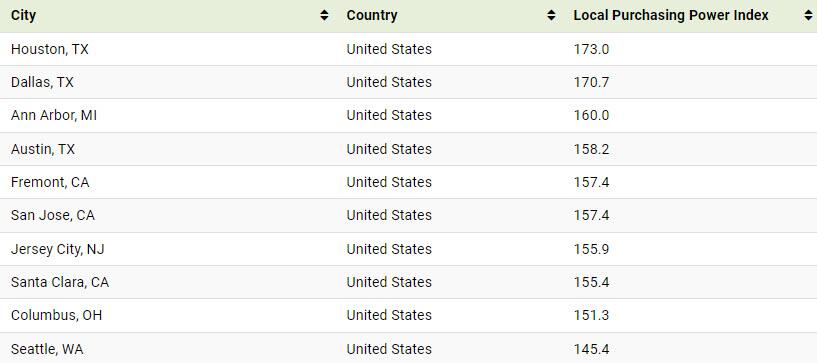
In contrast, the average consumer in Hamilton, Bermuda has a relatively low purchasing power. Based on the average net salary in the city, consumers can afford about 30% less than people in New York City.
Inflation Continues to Drive Prices Up
Amidst rising inflation and increased prices for consumer goods, cost of living has become top of mind for many people around the world.
Since late 2021, the world has been experiencing a cost of living crisis, largely because of pent-up demand following the COVID-19 pandemic, coupled with supply chain issues and the Russia-Ukraine conflict.
But according to UBS Chief Economist Paul Donovan, we’ve likely seen the worst of it, and inflation is likely to decrease across the globe in the second half of the year.