(ZH) iPhone Pro Delivery Wait-Times Surge After China Factory Chaos

iPhone Pro Delivery Wait-Times Surge After China Factory Chaos

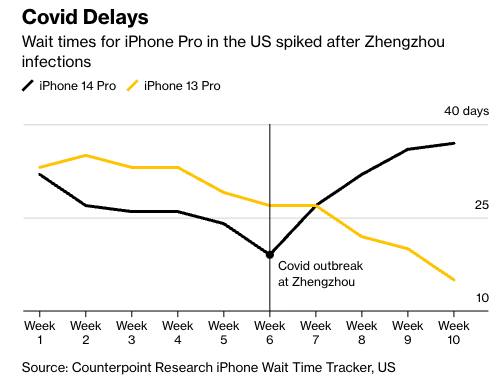
Counterpoint Research's new report on delivery times shows Apple's iPhone 14 Pro models are taking longer than ever to arrive in customer's hands because of zero Covid disruptions in China at a key manufacturing plant.
Customers buying Apple's most premium devices in the US this year can now expect to wait as long as 37 days, according to Counterpoint Research, which monitors delivery times every year. That's far higher than the predecessor iPhone 13 Pro family and longer than the initial launch of the current generation. Delivery days are "increasing significantly" for iPhone 14 Pro and Pro Max models across all markets, Counterpoint analysts said. -- Bloomberg
Source: Bloomberg
The main issue is zero Covid disruptions and unrest at Foxconn's massive iPhone factory in Zhengzhou, central China.
"The zero China Covid policy has been an absolute gut punch to Apple's supply chain with the Foxconn protests in Zhengzhou a black eye for both Apple and Foxconn.
"We estimate that Apple now has significant iPhone shortages that could take off roughly at least 5% of units in the quarter and potentially up to 10% depending on the next few weeks in China," Dan Ives of Wedbush Securities said.
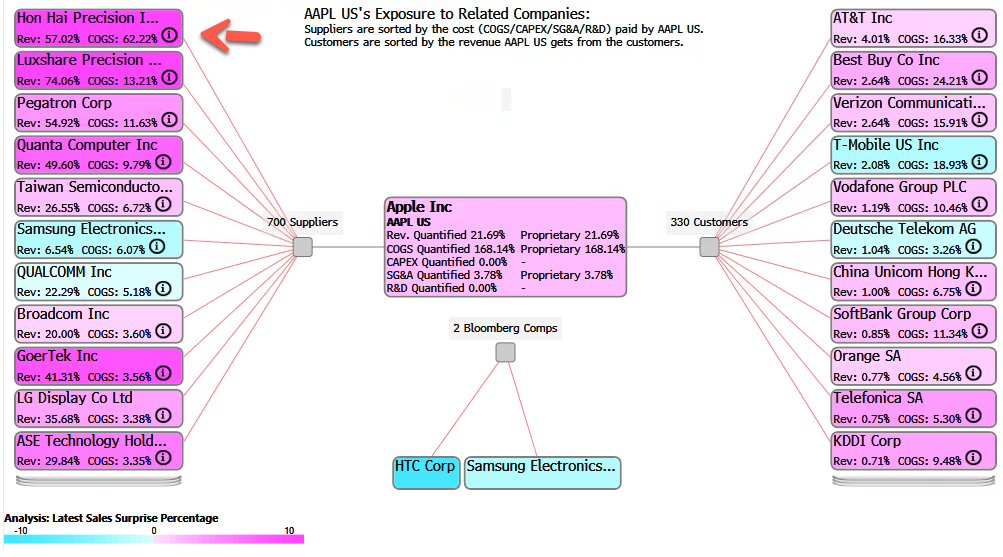
Bloomberg's breakdown of Apple's supply chain shows that Foxconn (Hon Hai Precision Industry Co., Ltd.) is a top supplier. Any manufacturing disruption in China could leave Apple, AT&T, Best Buy, and Verizon stores with limited supplies of the new iPhones.
On Monday, Bloomberg sources said Apple could wind up with a 6 million iPhone Pro production shortfall by the year's end, adding that the situation remains fluid and lost production numbers could change.
"It's unfortunate for Apple to be short of its flagship Pro series going into the holiday season, especially if buyers end up pivoting to a competing product.
"The good thing for Apple is that it has plenty of ecosystem stickiness to contain most of the leakage and satiate this demand in the following quarters," IDC's Bryan Ma said.
Wedbush's Ives said Apple stores could see iPhone Pro shortages of up to 35%-45% of typical inventory heading into December.
Apple is caught in production hell in China, with waning consumer demand for upgrading iPhones. Couple this all together, which might indicate revenue from its iPhone sales may slide this quarter.

FT : Norway postpones new oil and gas exploration licences until 2025

Norway postpones new oil and gas exploration licences until 2025
Domestic budget deal goes against Oslo’s promises to help Europe through energy crisis

Norway is postponing its next round of new oil and gas exploration licences by a further three years as part of a domestic political deal that cuts across its promises to do all it can to help Europe with its energy crisis.

The so-called 26th licencing round for new oil and gasfields, originally scheduled for this year, had already been delayed but will now not take place for the entire parliamentary period, which ends in September 2025, as part of a deal the centre-left Norwegian government struck with a leftwing party to pass its budget.

Norway is increasingly pushing itself as a reliable and democratic supplier to Europe. The country has displaced Russia as Europe’s biggest supplier of gas since Moscow’s full-scale invasion of Ukraine in February and is also western Europe’s biggest oil producer. But the deal struck on Tuesday goes against that rhetoric.

The Scandinavian country will still hand out licences in existing areas, which often allow oil and gas companies to expand production relatively quickly. But the 26th licencing round would be for new unexplored areas, many in the Arctic, which offer the same companies a higher-risk approach but with the prospects of bigger potential discoveries.

Oil minister Terje Aasland sought to play down the importance of the deal between the minority government and its Socialist Left (SV) support party, calling it “no drama”. Prime minister Jonas Gahr Støre said both the government and SV supported a “high and stable” level of activity in Norway’s petroleum industry.

But business and opposition politicians disagreed. Terje Halleland, energy spokesperson for the populist rightwing Progress party, said: “Tonight they will celebrate in Moscow. Putin’s regime is the only one served by the government and SV now restricting oil and gas exploration.”

He added: “The government cannot possibly have learnt anything at all for the serious security situation we are facing as a result of the energy policies pursued in Europe.”

Ståle Kyllingstad, chair of the Federation of Norwegian Industries, decried the move as “very, very sad”, adding: “It’s very worrying that the government is kowtowing to SV. The world and Europe needs energy, and we have to explore for more.”

The news came on the same day that Norwegian police decided it no longer needed the military to help it guard oil and gas installations. Armed forces from Norway and its Nato allies will continue to patrol offshore oil rigs as part of an effort to reassure the public, workers and European policymakers after the sabotage of the Nord Stream gas pipeline in September in international waters just outside Denmark and Sweden.

Norway has also been unnerved by a number of sightings of drones near to oil and gas installations. It is prosecuting several Russian citizens for flying recreational drones in different parts of the country, although not near such installations.

FT : Juventus: the peril of soaring ambitions and shallow pockets

Juventus: the peril of soaring ambitions and shallow pockets
The Italian football club’s finances look ropey even without disputed accounting

Football is great fun for star players and fans. Perhaps less so for investors in the sport. Given a flurry of high-profile deals in the sector, Juventus’s troubles provide a timely reminder.

The board of the Italian football club — majority owned by Exor, the Agnelli family’s listed vehicle — has resigned after an investigation into its accounting for players’ salaries and transfers. That, combined with financial losses, have reduced the market value to €700mn, down 35 per cent in the past year.

The investigation is still at a preliminary stage. Prosecutors allege that Juventus swapped players with other clubs at inflated values, producing fat capital gains with little or no money changing hands. Juventus is also alleged to have agreed to pay players back for most of their pandemic-related salary reductions without accounting for this to regulators’ satisfaction.

The club denies wrongdoing and has said it will amend accounts for 2022.

Juventus’s finances look ropey even without disputed accounting. The club has lost money in each of the past five years, for a total of €612mn. It has raised €700mn of fresh equity since 2019. This reflects the vicious spending cycle many European football clubs find themselves in.

To perform well, clubs must wrest star players from wealthy rivals. Juventus, for instance, acquired Cristiano Ronaldo from Real Madrid for a transfer fee of €100mn in 2018, paying him tens of millions annually on top.

Revenues, meanwhile reflect the popularity of the team’s home league. Italy’s Serie A teams make less than half the revenues of the Premier League, according to Deloitte. Worse, these Italian clubs, where Deloitte reckons players take home more than 80 per cent of the revenues, have collectively lost money in eight of the past 10 years.

This begs the question of whether public markets are the best home for football assets. Exor minority shareholders — saddled with an Agnelli family heirloom that looks increasingly like an albatross — might well agree.

>>> US Gapping down

Gapping down
In reaction to earnings/guidance
:

  • AZEK -5.9%, HIBB -5.7%, BNS -2.6%

Other news:

  • MIRM -9.8% (to discontinue the OHANA study of volixibat in intrahepatic cholestasis of pregnancy due to enrollment feasibility)
  • CS -3.3% (makes pillar 3 and regulatory disclosures for 3Q22)
  • SI -2.9% (issues statement regarding exposure to BlockFi)
  • USNA -2.5% (acquires Rise Bar and Oola)
  • ENFN -2.4% (CFO to resign; reiterates Q4 guidance)
  • SF -1.4% (reports October operating results)
  • ICHR -1.2% (names new COO)

Analyst comments:

  • ROKU -3.3% (downgraded to Sector Weight from Overweight at KeyBanc Capital Markets)
  • EVRG -1.2% (downgraded to Underperform from Outperform at Credit Suisse)
  • DRI -0.9% (downgraded to Neutral from Outperform at Robert Baird)

>>> US Gapping up

Gapping up
In reaction to earnings/guidance
:

  • BILI +10.4%, BZUN +4.3%, MCHP +2% (reiterates guidance)

Select rail stocks showing strength after reports President Biden wants Congress to pass legislation immediately to adopt the tentative agreement between railroad workers and operators:

  • CNI +1.4%, CP +1.3% (also upgraded to Buy from Hold at Deutsche Bank) NSC +0.8%, UNP +0.7%. 

Other news:

  • APEN +63.2% pollo Endosurgery to be acquired by Boston Scientific (BSX) for $10 per share)
  • BIDU +6.1% (to build world's largest fully driverless ride-hailing service area in 2023)
  • NXST +5.7% (replacing SABR in S&P MidCap 400)
  • SABR +2.9% (replacing FBC in S&P SmallCap 600)
  • BIGC +2.8% (merchant GMV increased 31% on Black Friday)
  • NUS +2.7% (replacing PBF in the S&P SmallCap 600)
  • BNGO +1.5% (to acquire Purigen Biosystems)

Analyst comments:

  • UPS +1.8% (upgraded to Buy from Hold at Deutsche Bank)