>>> TradeGate Pre-Market Indications

DAX:
  • Fresenius SE (FRE TH) +3.5%
  • Fresenius Medical (FME TH) +1.4%
    • Vifor Fresenius Says US Court Upholds Velphoro Patent Validity
  • Porsche SE (PAH3 TH) -1.1%
  • Zalando (ZAL TH) -1.1%
  • Airbus (AIR TH) -1.1%
  • E.On (EOAN TH) -1.3%
    • German Holdings Round-Up: Deutsche Telekom, E.On, Delivery Hero
  • Infineon (IFX TH) -1.8%
    • Rate-Sensitive Equities in Focus on ECB, as US Yields Near 3%
MDAX:
  • Commerzbank (CBK TH) -1.2%
  • Siemens Energy (ENR TH) -1.2%
  • TeamViewer (TMV TH) -1.2%
  • Uniper (UN01 TH) -1.4%
  • Aixtron (AIXA TH) -1.5%
SDAX:
  • Grenke (GLJ TH) +1.6%
  • Salzgitter (SZG TH) +1.5%
  • Instone Real Estate (INS TH) +1.4%
  • Heidelberger Druck (HDD TH) +1.2%
  • SAF-Holland SE (SFQ TH) -1.3%
  • Eckert & Ziegler (EUZ TH) -1.4%
  • CompuGroup (COP TH) -1.8%
  • Hochtief (HOT TH) -1.8%
  • PVA TePla (TPE TH) -4.8%

WWD : Stella McCartney Raises the Bar on Clean Beauty With New Skin Care Line

Stella McCartney Raises the Bar on Clean Beauty With New Skin Care Line
"I want less, and I want it to work,” said the designer, who took a minimalist approach to the ingredients and the packaging.

LONDON — After 16 years, Stella McCartney is taking another run at beauty with the launch of a clean skin care line called Stella, created in close collaboration with her minority partners LVMH Moët Hennessy Louis Vuitton.

True to McCartney’s minimalist mantra, the brand is launching with just three products: the Reset Cleanser, Alter-Care Serum and Restore Cream.

The new line is an ambitious project that wants to tick as many eco-boxes as possible, with the fewest number of products and ingredients.

“I am not that person who wants to buy into a million products for different areas of my face. I don’t want all of that stuff in my life,” said McCartney.

“I want less, and I want it to work. I want it to be honest and to complement my way of thinking, and of living life. I obviously wanted to do the cleanest skin care that we could do in luxury, the purest of the pure,” she added.

For the past three years McCartney and a dedicated team from LVMH worked on the formulations and packaging, with the products’ fresh, grassy scent developed by the perfumer Francis Kurkdjian. Clove leaf, pine resin and mentholated eucalyptus are the chief notes.

McCartney’s vision for the products was bound to a childhood spent in the Scottish outdoors, at her family’s farm on the Kintyre peninsula in western Scotland.

LVMH has set up a dedicated maison to host the collaboration. The maison sits within the group’s Luxury Beauty division, and aims to tackle the challenges inherent in building an ultra-clean, green collection.

“We want to raise the bar on sustainability in beauty,” said Stephane Delva, director of New Beauty Projects at LVMH Perfumes & Cosmetics.

Everything is cruelty-free, certified vegan and regulated.

The ingredients are sourced in northern Europe and made from upcycled food waste such as squalene, a byproduct of the olive oil industry; and cherry blossom extract, which is meant to function as an antioxidant. The skin care also includes organic rock samphire, which is said to be rich in unsaturated and saturated fatty acids, and phytosterols to smooth fine lines and wrinkles.

The packaging is a mix of the disposable, and long-lasting. The products come in squishy, baby food-style pouches that are made from wood waste and fit inside recycled glass bottles and jars.

When the pouches are spent, they can be thrown away, while the jars (which come with airtight pumps made from recycled plastic) live on, and they don’t get gunky.

The Restore cream, including the glass jar, costs $105, while the refill is $85. The Reset cleanser is $60, with the refill priced at $45. The Alter-Care serum costs $140, with the refill costing $110.

The brand has banned ingredients where the production or extraction process was considered to be polluting. It has also decided to ship, rather than fly, products to the U.S., meaning the carbon footprint of the collection has been slashed by more than a third. The brand has also eliminated any need for cotton pads, or single-dose samples.

The new line will be direct-to-consumer, and launches this month on stelllamccartneybeauty.com

McCartney will be supporting the NGO Wetlands International, donating one percent of the net sales of Stella skin care. The money will go toward peatlands, the largest carbon store on earth that covers around 23 percent of Scotland’s land mass.

She said that at LVMH there is a genuine passion for the future of the luxury industry,” adding that her beauty team at LVMH is pushing boundaries that she never thought were possible.

“They have been so hungry to find new ways, new solutions,” said the designer, who also serves as a special sustainability adviser to LVMH founder and chief Bernard Arnault and to the group’s executive committee members.

This isn’t McCartney’s first run at skin care, and she was eager to get back in the game after her first collection, Care, which launched in 2006 with YSL Beauté, was paused.

At the time McCartney was a pioneer in what is now known as clean beauty, and the first luxury fashion brand to take the organic route into skin care. Care had a cult following among consumers who were looking for natural alternatives beyond brands such as The Body Shop, Lush and Neal’s Yard Remedies.
>>> What to look at today - 22th of August 2022

An Asian stock gauge pared a slide Monday but remained in the red along with US equity futures as the Federal Reserve’s commitment to tighter monetary settings to quell inflation restrained investor sentiment. MSCI Inc.’s Asia-Pacific share index dipped less than 0.5% with losses evident in most major markets except for a smattering of gains in Hong Kong and China, where a move by banks to trim lending rates aided property developers. S&P 500, Nasdaq 100 and European contracts suffered declines and the dollar was near a more than one-month peak, signs of ongoing investor wariness. Sovereign-bonds in Australia and New Zealand dropped and Treasuries either held or extended a selloff from Friday. A jump in global shares from June’s bear-market lows has begun to cool, weighed down by repeated Fed warnings that interest rates are going higher. Troubling global economic developments, lately including power shortages in a Chinese industrial heartland, are also hanging over investors. In China, banks lowered the one-year and five-year loan prime rates on Monday in the slipstream of a decision by the nation’s central bank last week to cut a key policy rate.

Nikkei -0.47% Hang Seng -0.17% CSI +0.64% Shanghai +0.45% Shenzen +0.64%

Eur$ 1.0036 CNH 6.5445 CNY 6.8258 JPY 137.25 GBP 1.1832 CHF 0.9595 RUB 59.3966 TRY 18.1126 WTI$ 89.52 -1.38% Gold 1745 -0.15% BTC 21,460 -0.02% BTC 1,606 -0.65%

S&P -0.52% NAsdaq -0.64% EuroStoxx -0.35% FTSE -0.15% Dax -0.38% SMI +0.03%

Macro :
- German Minister Expects Russia to Further Reduce Gas Supplies
- Hedge Funds’ Bullish Commodity Bets Jump the Most in Two Years
- Saudi Arabia’s Booming and This Time It Isn’t Only About Oil
- Goldman’s Kostin Says Upside for Stocks Is Limited as Risks Rise

Keep an eye on :
- AED BB : Aedifica to Buy Four Care Properties in Dublin for About EU161m
- BOCH LN : Lone Star Possible Offer Rejected by Bank of Cyprus
- BIM FP : Biomerieux Gets FDA Breakthrough Designation for AST System
- BPE IM : BPER Banca Merger Plan With Carige and Monte Lucca Approved
- BSGR NA : B&S Group 1H Revenue EU983.2M Vs. EU823.6M Y/y
- DTE GY : T-Mobile Emerges as Hedge Fund Favorite With Stock on a Tear
- EVS BB : EVS Broadcast Equipment Wins 10-Year Contract Worth Over $50M
- IBE SM : Iberdrola Cancels Power Contracts in France on Price Rise: Echos
- INTER NA : CSC, Intertrust Obtain Regulatory M&A Nod in Singapore
- INTRUM SS : Intrum Names Andrés Rubio as Acting President as Engdahl Exits
- MMT FP : TF1, M6 Propose Remedies for Merger, Le Figaro Reports
- NVAX US : FDA Authorizes Novavax Covid Vaccine for People Aged 12-17
- DNORD DC : Norden CEO Jan Rindbo Sells 40,000 Shares for DKK16.6 Million
- PSH NA : Pershing Square Names Ryan Israel Chief Investment Officer
- RECSI NO : REC, Mississippi Silicon Sign MOU for Raw Material Supply
- ROG SW : Roche Develops Covid-19 Test That Detects Latest Subvariant
- SPM IM : Saipem, OSRL Sign Extension of Existing Services Agreement
- STG DC : Scandinavian Tobacco Revises FY Guidance, Cites Supply Chain (1)
- VIFN SW : Vifor Fresenius Says US Court Upholds Velphoro Patent Validity

>>> Europe : Brokers Upgrades & Downgrades - 22th of August 2022

>>> Up
* Apranga Raised to Buy at SEB Equities; PT 2.20 euros
* Netum Group Raised to Buy at Evli Bank; PT 4.50 euros

>>> Down
* ConvaTec Cut to Add at Peel Hunt; PT 250 pence
* Gem Diamonds Cut to Hold at Liberum; PT 40 pence
* Nibe Cut to Hold at ABG; PT 100 kronor
* Norden Cut to Hold at ABG; PT 470 kroner
* Petra Diamonds Cut to Hold at Liberum; PT 100 pence

>>> Initiation


>>> Call
* Goldman’s Kostin Says Upside for Stocks Is Limited as Risks Rise
* Gem Diamonds, Petra Diamonds Cut on Squeezed Cashflows: Liberum
* NatWest PT Hiked to Street-High at Jefferies on Strong Outlook

(ZH) Morgan Stanley: Cash Looks "Relatively Attractive" Right Now

Morgan Stanley: Cash Looks "Relatively Attractive" Right Now

By Andrew Sheets, Chief Cross-Asset Strategist for Morgan Stanley
Sunday Start: What If Holding Cash Is Just Efficient Asset Allocation?
Since mid-2009, a question that seems easy in hindsight and but felt difficult at the time was what to do with cash. On the one hand, it didn’t yield anything, and allocating to anything else usually did better. But the last 12 years have also been a period of profound pessimism – on the outlook for banking, Europe and long-term growth. The intensity of the GFC and the events that followed meant that in the darkest moments more than a few CFOs and investors likely mumbled a silent prayer: If we make it through this, we will never be caught without liquidity again.
Holding cash, in other words, was an explicitly defensive decision for much of the last 12 years. Of course it offered a worse return than anything else in the market. That was the point. Holding cash was the price of security, an insurance policy against that prevailing gloom. And like insurance, it could be expensive. USD cash underperformed both the S&P 500 and the US 10-year every year from 2010 to 2020 except two (2013 and 2018).
But the idea that holding cash means paying for insurance is no longer accurate. US 6-month T-bill yields (3.1%) are the highest since late 2007 and offer 157bp more than the dividends of the S&P 500, 21bp more than US 10-year Treasuries and just 60bp less than the US Aggregate Bond index. For USD investors, cash has ceased to be a material drag on a portfolio’s current yield.
The numbers may be less extreme in Europe, but still represent a change of regime. German 6-month bill yields, at +0.3%, are positive for the first time since 2014. For the last eight years, holding ‘cash’ in Europe cost a significant amount of money. Not anymore.
All of this has a number of implications.
  • First, we think that holding USD cash looks relatively attractive on a cross-asset basis. It offers a high current yield. It offers liquidity. If offers a better 12-month total return than our strategy forecasts imply for US equities, US Treasuries and either US IG or HY credit (with considerably less volatility). As a result, our Core+ optimized fixed income portfolios (see Cross-Asset Dispatches: AGG+ and CORE+ Optimal Fixed Income Portfolios: July 2022, July 29, 2022) are generally OW short-dated fixed income. USD cash also performs well versus other currencies; our FX strategists project further USD strength, especially against EUR, aided in part by the dollar’s attractive yield. One exception is EM sovereign debt, which should outperform cash, and which we’ve recently raised to OW (see Cross-Asset Dispatches: Bears Watching, August 5, 2022, and EM Sovereign Credit Strategy: Dialing Risk Up Another Notch, August 10, 2022).
  • Second, high yields on short-term safe assets create a risk of outflows that needs to be monitored, as it reduces the cost for investors to step out of the market. For the moment, we are more relaxed about outflows (see Cross-Asset Dispatches: More Relaxed about Outflows, July 29, 2022), given strong consumer finances, better recent cross-asset performance and the simple fact that terrible 1H performance didn’t trigger a rush for the proverbial exits.
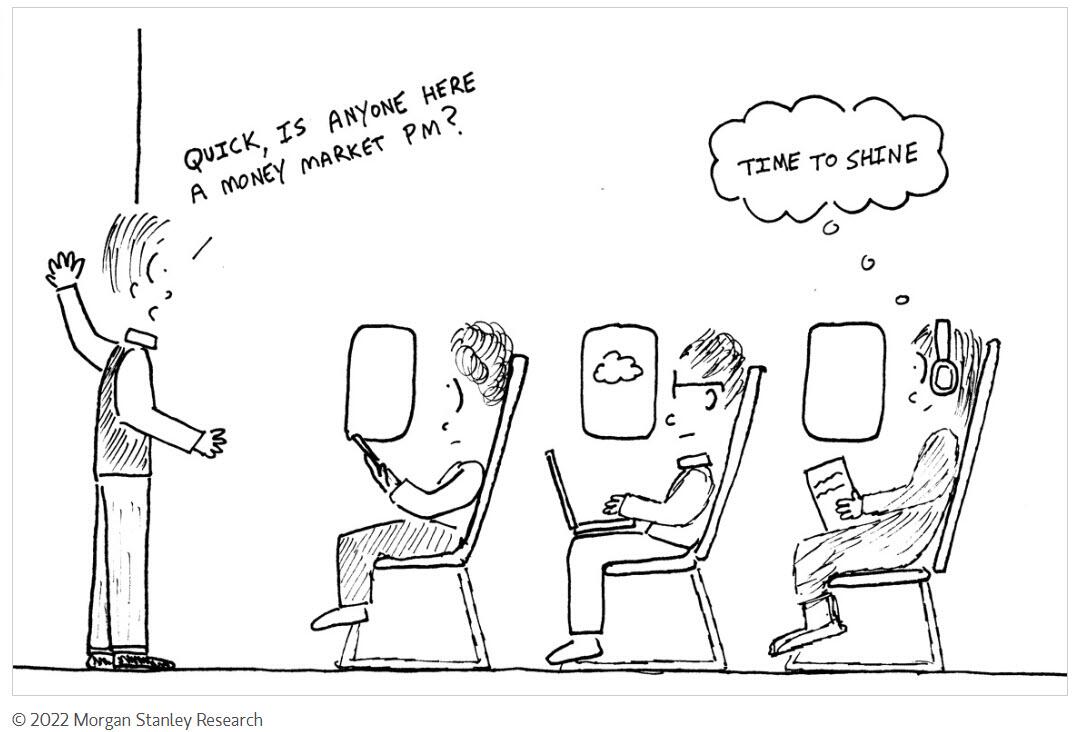
  • Third, and another factor that may be limiting outflows, is that not all 'cash' is created equal. While US 6-month T-bills yield ~3.1%, the yields on 6-month US bank CDs are just 0.9% (and the Bankrate.com average for a US bank savings account is just 0.13%). For gathering assets and adding yield, it seems like an unusually good time to add value with money market strategies. This also raises some interesting questions around bank net interest margins, and it seems appropriate to note that the price/book ratio of EU banks was 57% higher the last time German bill yields were positive.
For much of the last 12 years, cash yielded nothing, and allocating to it represented a deliberate choice to pay an often high price for insurance. But times change. Cash yields have risen sharply at a time when Morgan Stanley’s forecasts for global cross-asset returns are low, squeezed by tighter policy if economic data continue to hold up, and higher risk premiums if the data turn down. The market is giving investors the opportunity to earn ~3% on safe, liquid T-bills, or ~5% on safe (but less liquid) short-duration CLO AAAs, and somewhere in-between for other AAA securitized paper that has cheapened as banks have faced RWA constraints. These aren’t the most exciting investments, but sometimes it makes sense to take what the market gives you.

WSJ : Ford Faces $1.7 Billion in Damages Over Fatal Rollover of F-250 Pickup

Ford Faces $1.7 Billion in Damages Over Fatal Rollover of F-250 Pickup
Auto maker says decision reached by Georgia jury isn’t supported by evidence

Ford Motor Co. F -1.67% is facing a potential $1.7 billion in punitive damages after a Georgia jury reached a verdict Friday in a case involving a 2014 rollover of a Ford F-250 pickup truck that left two people dead.

The Gwinnett County jury determined that damages should be imposed on Ford for selling 5.2 million Super Duty trucks with what plaintiffs’ attorneys said were dangerously weak roofs that could crush passengers in a rollover accident, according to James Butler, a lawyer representing the plaintiffs in the case.

The case was brought by the family of a Georgia couple, Melvin and Voncile Hill, who were driving a 2002 Ford F-250 Super Duty truck from their farm when the right front tire blew out and the truck rolled over, Mr. Butler said. The Hills were crushed inside the truck, he added.

“While our sympathies go out to the Hill family, we don’t believe the verdict is supported by the evidence, and we plan to appeal,” a Ford spokesman said Saturday.

The $1.7 billion verdict is believed to be one of Georgia’s biggest in history and is unusually large for an accident-related lawsuit involving an auto manufacturer. Typically, damages in these types of cases run in the millions of dollars, and many are settled out of court. Often, high-dollar verdicts are later reduced by judges or the appeals courts.

“The Hill family is glad this part of the case is finally over,” Mr. Butler said. “They intend to persevere and make Ford pay.”

On Thursday, the Georgia jury awarded plaintiffs Kim and Adam Hill, the children of the couple who died in the crash, $24 million in compensatory damages, Mr. Butler said. The jury allocated 70% of fault in the case to Ford, Mr. Butler said.

Ford executives have for years worked to tackle costly quality and warranty problems with their vehicles, including making this effort a priority under the current chief executive, Jim Farley. The company has issued 49 recalls this year, the most of any auto maker, according to data from the National Highway Traffic Safety Administration.

“We continue to be hampered by recalls and customer-satisfaction actions,” Mr. Farley said on a July earnings call. “This affects our cost but more importantly, it falls short on our most fundamental commitment to our customers.”

It couldn’t be determined whether the quality issues the company is trying to address have anything to do with the Georgia accident.

Last year, Ford set aside more than $4 billion for warranty costs, up 76% from five years earlier. The car company’s total warranty expenses increased about 17% from 2016 to 2021.

Earlier this year, Mr. Farley brought on a new executive director of quality, Josh Halliburton. Before coming to Ford, Mr. Halliburton spent 17 years at J.D. Power, an independent research firm that specializes in assessing and studying vehicle quality.

“We are placing more time and emphasis on ensuring everything is done right upfront to prevent quality issues from manifesting later in the development process,” Mr. Halliburton said.

He added that he expects to see Ford’s warranty problems improve next year, but that it might take two to three years to see results with the most impact.