FT : UK inflation projected to hit 18.6% as gas prices surge

UK inflation projected to hit 18.6% as gas prices surge
Bank raises forecast as European gas price sets new record

Surging wholesale gas prices are putting the UK on a path to exceed 18 per cent inflation next year, the highest rate among larger western economies, according to a report from Citigroup.

The bank’s projection heaps more pressure on candidates for the Conservative leadership to address a worsening cost of living crisis and came as UK gas prices for next-day delivery surged as much as 33 per cent.

Rapidly increasing prices for natural gas have left economic projections out of date. At the start of the month, the Bank of England forecast that higher gas prices would push inflation above 13 per cent towards the end of this year.

Bank of America said last week that it expected UK consumer price inflation to peak at 14 per cent in January, while Goldman Sachs and EY projected it to hit 15 per cent.

But with Europe’s gas crisis escalating in August, Citi predicted on Monday that inflation would reach 18.6 per cent in January.

Continental European gas prices are more than 14 times their average of the past decade. The benchmark European gas price rallied almost 10 per cent on Monday to €278 per megawatt hour ($81 per million British thermal units), the highest closing price on record and taking the rise over August to 45 per cent.

Examining the wholesale figures, Citi predicted that the UK’s retail energy price cap — which limits how much households pay for heating and electricity — would be raised to £4,567 in January and then £5,816 in April, compared with the current level of £1,971 a year. It added that the shifts would lead to inflation “entering the stratosphere”.

The bank’s projected rate would be higher than the peak of inflation after the second Opec oil shock of 1979 when CPI reached 17.8 per cent, according to estimates from the Office for National Statistics.

The rate of inflation has exceeded expectations in most months of this year as price rises have spread through the economy. The ONS said it stood at 10.1 per cent in July, the highest level in more than 40 years and the highest among G7 countries.

The energy regulator Ofgem will announce on Friday the energy price cap for October—January, which most analysts expect to rise to more than £3,500 for a household with average usage of energy — an increase of 75 per cent on current levels.

Recommended
ExplainerUK inflation
What is the Bank of England’s mandate on inflation and why does it matter?

The imminent rise will put pressure on Tory leadership candidates Rishi Sunak and Liz Truss to be specific in the help they propose for households. The Labour party has called for bills to be frozen and for the state to absorb the cost.

The government has said that energy policy was a matter for the new prime minister, but Number 10 has sought to reassure the public that the UK will not run short of gas this winter.

A Downing Street spokesperson urged people not to panic over energy supplies despite concerns about potential blackouts in the coming months, and said households did not need to cut back their usage.

“Households, businesses and industry can be confident they will get the gas and electricity they need over the winter,” she said. “That’s because we have one of the most diverse and reliable energy systems in the world, unlike other countries in Europe we are not dependent on Russian supplies and have access to our own North Sea gas reserves.”

(ZH) Shares, Corporate Bonds Seen Decoupling After Rise

Shares, Corporate Bonds Seen Decoupling After Rise

By Sagarika Jaisinghani and Tasos Vossos, Bloomberg Markets Live commentators and reporters
Resilient earnings and bets of peaking inflation have helped stocks and corporate bonds rally alike over the past couple of months, but with recession fears still lurking, the two asset classes could soon start taking different paths.
European stocks have gained about 9% since a low in early July, while corporate bonds are up 4.4% since bottoming in mid-June.
With Federal Reserve officials indicating they’ll keep monetary policy tight until they’re sure that inflation won’t flare up again, even at the cost of some economic pain, debt from safer firms may benefit from a potential flight-to-safety. But for stocks, it’s a risk to earnings that many investors may be unwilling to bear.
“What we’ve seen at this juncture is a bear market rally and we don’t want to chase it,” says Wei Li, global chief investment strategist at BlackRock, speaking of the rebound in equities. “I don’t think we’re out of the woods with one month of inflation cooling. Bets of a dovish Fed pivot are premature and earnings don’t reflect the real risk of a US recession next year.”
The second-quarter earnings season did much to restore faith in the health of Europe Inc. as companies largely proved demand was robust enough for them to pass on higher costs to consumers. But economists forecast a slowdown in business activity from here on, while Citigroup strategist Beata Manthey says she expects regional earnings to fall 2% this year and 5% in 2023.
And while investors in Bank of America’s latest global fund manager survey have turned less pessimistic about global growth, sentiment is still bearish. European stock funds saw outflows of $2.2 billion in the week to Aug. 17 -- a 27th straight week of redemptions, according to a BofA note that cited EPFR Global data.
Strategists now expect the Stoxx 600 to end the year at 447 points -- about 2% above current levels, according to the average of 15 estimates in Bloomberg’s monthly survey. BofA’s European strategists remain negative on the region’s equities as well as cyclicals versus defensives.
In the bond world, the layers that make up a company’s borrowing costs look set to play into investors’ hands. Corporate yields comprise the rate paid on similar government debt and a premium to compensate for threats like a borrower going bust.
When the economy falters, these building blocks tend to move in opposite directions. While a recession will raise concerns about firms’ ability to repay their debt and widen the spread over safe bonds, the flight-to-quality in such a scenario will cushion the blow.
To be sure, the summer rebound has made entry points in corporate bonds somewhat less appealing. George Bory, head of fixed income strategy at Allspring Global Investments, has turned more cautious on bond valuations, but remains bullish on them overall. “The world was becoming more bond friendly place and that should continue in the second half of the year,” he says.

(ZH) Nasdaq Tanks As "Gamma Unclench" Arrives - Here Are The Levels To Sell (Or

Nasdaq Tanks As "Gamma Unclench" Arrives - Here Are The Levels To Sell (Or Buy)

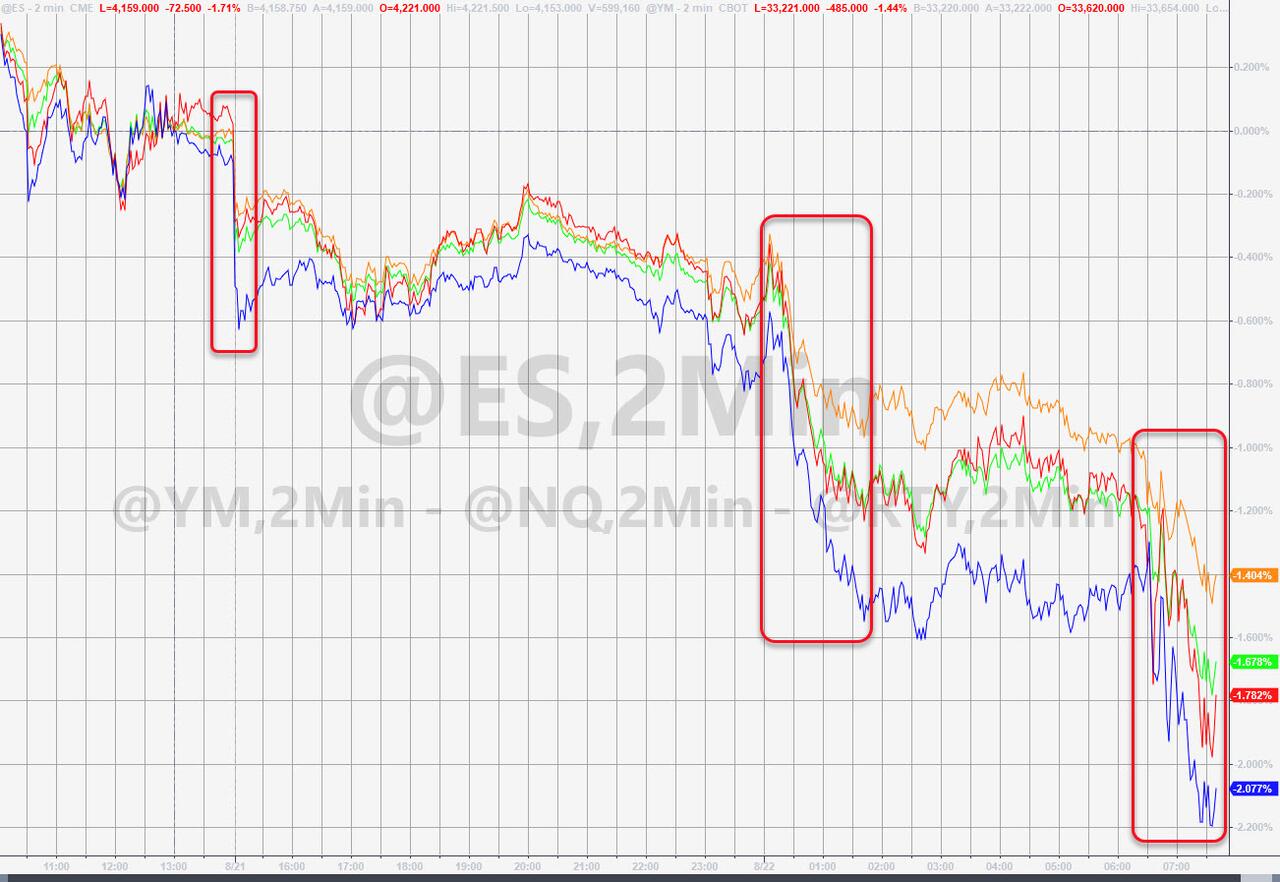
US equity markets are under pressure this morning with Nasdaq leading the charge lower (having been dumped at the Asia open, the European open, and the US open)...
The Dow, S&P, and Russell 2000 all reversed at their 200DMAs and look set to test the 100DMA (Nasdaq never made it back to its 200DMA)...
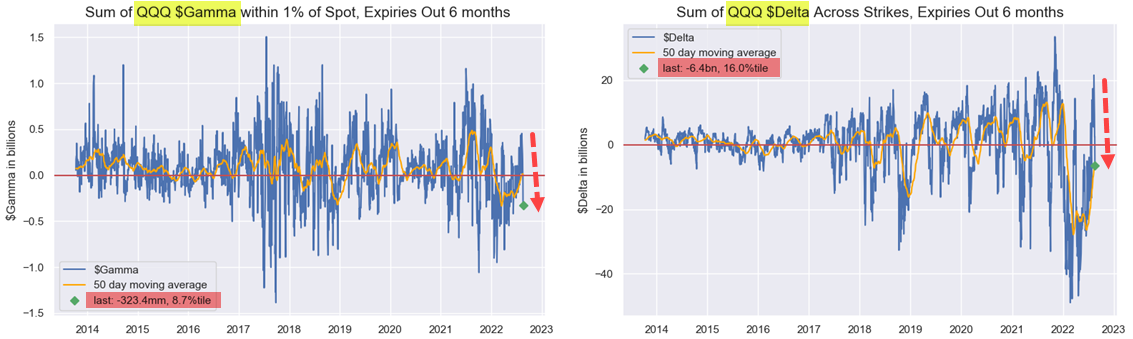
As Nomura's Charlie McElligott notes, one major reason for this sudden volatility is the anticipated post Op-Ex “Gamma Unchlench” arrives and is allowing US Equities a larger trading distribution, with several key technical levels in play(or broken):
  • Most critically after Friday’s heavy expiration activity, we now see Dealers in “Negative Gamma vs Spot” location below 4219 flip-line for SPX / SPY consolidated options (Note: QQQ, IWM and HYG all now in “Negative Gamma vs Spot” territory as well)
  • ES1 through the 4215 “50% high / low” retrace
  • Through 4202 sees a break below the bottom of the mid-July bull channel
Nasdaq stands out as the most obvious pivot back into "negative gamma" territory, with the ensuing 'delta purge'...
So what happens next?
As McElligott notes, from a “flows” perspective on the now two month Equities rally, we have focused on:
  • 1) Systematic strategy buying-to-cover from CTA Trend (+$78.6B of Global Equities buying off the June net exposure low / peak of aggregated “Short” positioning);
  • ...as well as 2) Vol Control re-allocation to add back exposure (+$35B off the May exposure lows), which only then accelerated the destruction of downside hedges AND forced grabbing into upside...
  • ...hence 3) massive Mechanical “Positive $Delta” flows from the Options space, which at one-point were > +$900B of implied $Delta off the June low
NOW, however, we see those Systematic and Mechanical “buy” flows either largely spent, or at risk of actually becoming supply a few weeks out, IF Vol was to reset higher here for a sustained period of time
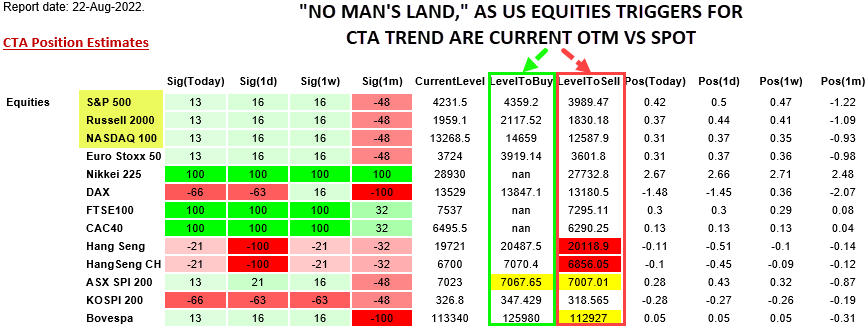
1. CTA Trend now sits in “no man’s land."
Well-below releveraging buy-triggers overhead in US Equities futures... but
Above de-leveraging / flip back “Short” sell-triggers...
For the S&P, 3989 is key for a big purge (with 4094 the next support to watch at 100DMA), but forthe Nasdaq 100 the 'level to sell' is close at 12,587.
2. Vol Control is the local tie-breaker, and it’s nuanced as-ever
Vol Control in the NEAR-TERM (next two weeks) would require sustained 2.0% daily chg type days in-order to see a pivot back towards de-allocation (2% daily chg = -$4.7B over the next two weeks)—or, as an alternative, larger 1d absolute Vol shocks (e.g. a 3.0% SPX change today would see -$2.3B of VC de-allocation selling)
3. From a Vol mkt perspective, Spot lower / Vol higher and resumption of downside hedging demand
(Skew actually performed on Friday) will see NEGATIVE $Delta flows picking back-up.
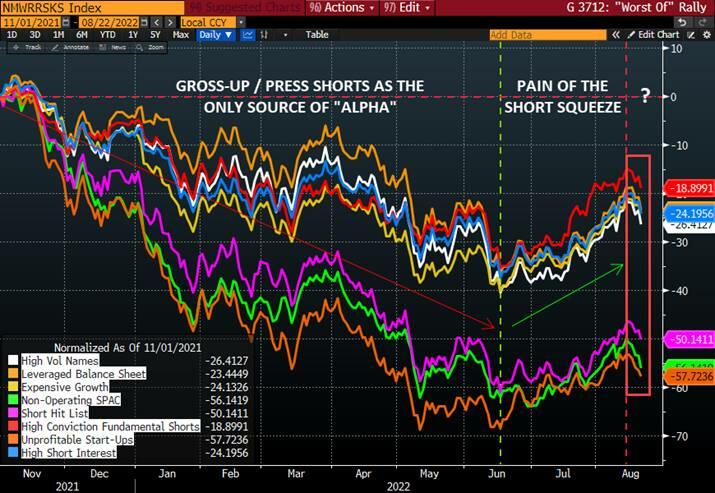
For the Nomura strategist, the key for this nascent selloff to hold is going to be the willingness then of ACTIVE / DISCRETIONARY traders to again “lean into” the market and resume “Shorting” HERE AND NOW while the post Op-Ex “window for Vol expansion” is open, and / or take down “Nets” again ahead of a rough seasonal for Equities, coming after what’s been a vicious two month covering explosion across previously “grossed-UP” Shorts in “worst of” themes...
...so there is some scar tissue to sort out.

>>> US Research Calls

Research Calls

  • Upgrades:
    • Bruker (BRKR) upgraded to Buy from Neutral at Citigroup; tgt raised to $80
    • Elevance Health (ELV) upgraded to Outperform from Mkt Perform at SVB Leerink; tgt raised to $580
    • Foot Locker (FL) upgraded to Equal-Weight from Underweight at Morgan Stanley; tgt raised to $36
    • Foot Locker (FL) upgraded to Equal Weight from Underweight at Barclays (Friday)
    • Salzgitter AG (SZGPY) upgraded to Neutral from Underperform at Credit Suisse
    • Schneider National (SNDR) upgraded to Outperform from In-line at Evercore ISI; tgt $28
    • Vipshop (VIPS) upgraded to Neutral from Sell at Citigroup; tgt raised to $10.90
    • Vipshop (VIPS) upgraded to Outperform from Neutral at Credit Suisse; tgt raised to $12
    • Youdao (DAO) upgraded to Outperform from Market Perform at CICC; tgt $7
  • Downgrades:
    • Canadian Nat'l Rail (CNI) downgraded to In-line from Outperform at Evercore ISI; tgt $129
    • Cochlear (CHEOY) downgraded to Neutral from Buy at Citigroup
    • Coupa Software (COUP) downgraded to Underperform from Sector Perform at RBC Capital Mkts; tgt lowered to $55
    • DocuSign (DOCU) downgraded to Sector Perform from Outperform at RBC Capital Mkts; tgt lowered to $65
    • Gritstone bio (GRTS) downgraded to Sell from Neutral at Goldman; tgt $2
    • Intra-Cellular Therapies (ITCI) downgraded to Neutral from Buy at Goldman; tgt lowered to $49
    • NeoGenomics (NEO) downgraded to Hold from Buy at Needham
    • Saia (SAIA) downgraded to In-line from Outperform at Evercore ISI; tgt $243
    • UPS (UPS) downgraded to In-line from Outperform at Evercore ISI; tgt $214
    • V.F. Corp (VFC) downgraded to Market Perform from Outperform at Cowen; tgt lowered to $50
  • Others:
    • AmerisourceBergen (ABC) assumed with an Equal-Weight at Morgan Stanley
    • Cardinal Health (CAH) assumed with an Overweight at Morgan Stanley; tgt raised to $76
    • C.H. Robinson (CHRW) added to Tactical Outperform List at Evercore ISI
    • CinCor Pharma (CINC) initiated with an Overweight at Piper Sandler; tgt $73
    • FedEx (FDX) added to Tactical Outperform List at Evercore ISI
    • Illumina (ILMN) added to 90-day Positive Catalyst Watch at Citigroup
    • Laboratory Corp (LH) assumed with an Overweight at Morgan Stanley; tgt $300
    • McKesson (MCK) assumed with an Overweight at Morgan Stanley
    • Millicom International Cellular (TIGO) resumed with a Reduce at HSBC Securities; tgt $14
    • Quest Diagnostics (DGX) assumed with an Equal-Weight at Morgan Stanley; tgt $142
    • Waldencast plc (WALD) initiated with an Outperform at Raymond James; tgt $11

>>> US Gapping up

Gapping up

News:

  • MSPR +25.6% (reports growth to 34 million unique healthcare member lives)
  • GTH +3.4% (receives Non-Binding Proposal to be acquired for $1.36 per ADS)
  • VXX +1.8% (trading higher with US futures under pressure)
  • PODD +0.5% (receives FDA clearance for Omnipod 5 for children aged two years and older with type 1 diabetes)

Analyst comments:

  • VIPS +0.9% (upgraded to Neutral from Sell at Citigroup; upgraded to Outperform from Neutral at Credit Suisse)

>>> US Gapping down

Gapping down

Select index ETFs showing early weakness:

  • QQQ -1.5%, SPY -1.1%, IWM -1.1%, DIA -0.9%, .

Other news:

  • AMC -31% (APE shares to begin trading today - CEO tweeted: Remember, with the APE seeing its first trade on the NYSE at some time tomorrow morning, the value of your AMC investment will be the combination of your AMC shares and your new APE units. An AMC share plus a new APE unit added together — compared to just an AMC share previously)
  • ADES -28.2% (to merge with Arq Limited)
  • BBBY -10.8% (report some suppliers are restricting or halting shipments as BBBY fell behind on payments, according to Bloomberg)
  • MREO -5% (Sends Letter to Rubric Capital Management)
  • RVLP -4.4% (files for 15,451,612 share common stock offering by selling shareholders)
  • TSLA -2.2% (Elon Musk tweets "After wide release of FSD Beta 10.69.2, price of FSD will rise to $15k in North America on September 5th. Current price will be honored for orders made before Sept 5th, but delivered later")
  • CS -1.3% (appoints Dixit Joshi as CFO)
  • OXY -1.3% (Warren Buffett (BRK.B) is not expected to bid for control of Occidental)
  • INST -1.2% (files for $800 mln mixed securities shelf offering; also files for 122,065,804 share common stock offering by selling shareholders)
  • VOD -1.2% (agrees non-binding terms in relation to the sale of Vodafone Hungary for €1.8 billion to 4iG and Corvinus)
  • WEN -0.9% (CDC confirms E. coli outbreak with unknown food source; WEN says "we are taking the precaution of discarding and replacing the sandwich lettuce at some restaurants in that region")
  • VIAV -0.8% (files mixed securities shelf offering)
  • GILD -0.7% (receives EC Marketing Authorization for Sunlenca)

Analyst comments:

  • GRTS -12.2% (downgraded to Sell from Neutral at Goldman)
  • COUP -4.1% (downgraded to Underperform from Sector Perform at RBC Capital Mkts)
  • DOCU -4.1% (downgraded to Sector Perform from Outperform at RBC Capital Mkts)
  • ITCI -2.8% (downgraded to Neutral from Buy at Goldman)
  • VFC -2.7% (downgraded to Market Perform from Outperform at Cowen)
  • NEO -2.5% (downgraded to Hold from Buy at Needham)
  • UPS -2.1% (downgraded to In-line from Outperform at Evercore ISI)
  • CNI -1.6% (downgraded to In-line from Outperform at Evercore ISI)

>>> US Early premarket gappers

Early premarket gappers

  • Gapping up:
    • MSPR +40.9%, GTH +6.8%, VXX +1.6%, DSX +1.5%, PODD +0.6%, SKYT +0.5%
  • Gapping down:
    • ADES -20.4%, BBBY -8.6%, RVLP -4.4%, TSLA -2.3%, QQQ -1.3%, VOD -1.3%, OXY -1.3%, INST -1.2%, SPY -1.1%, GILD -1.1%, CS -1.1%, IWM -1%, WEN -0.9%, VIAV -0.8%, DIA -0.8%, MREO -0.8%