German teens went crazy for this ‘compliments’ app, and now VCs are backing its next phase

Image Credits: Slay team
The teenage market for apps is a tough nut to crack and stay relevant in. Just ask Snapchat. Equally, teens are going through a stage in life where almost every social interaction seems to carry portent of some kind of other. This would explain in part why apps like SendIt, NGL, and Nocapp (some are Snapchat connected tools) took off as ways for teens to anonymously comment on each other. And AskFM would probably like us all to forget the various suicides that occurred when it was released in its initial form, back in the day. (And you thought Instagram is bad for mental health…).
Meanwhile, somehow (somehow!?) a new startup has appeared with the idea that yet another app is going to help this dumpster fire of social interactions, but let’s hear them out before jumping to conclusions.
“Slay” bills itself as a “positive social media network for teenagers”. The reason we are talking about it today is that it’s grown like a weed after launching last year in Germany, where it reached Number 1 on the German iOS App Store four days after launch. It’s now claiming to have over 250,000 registered users and claims its gaining traction in other countries including the UK, where it recently launched.
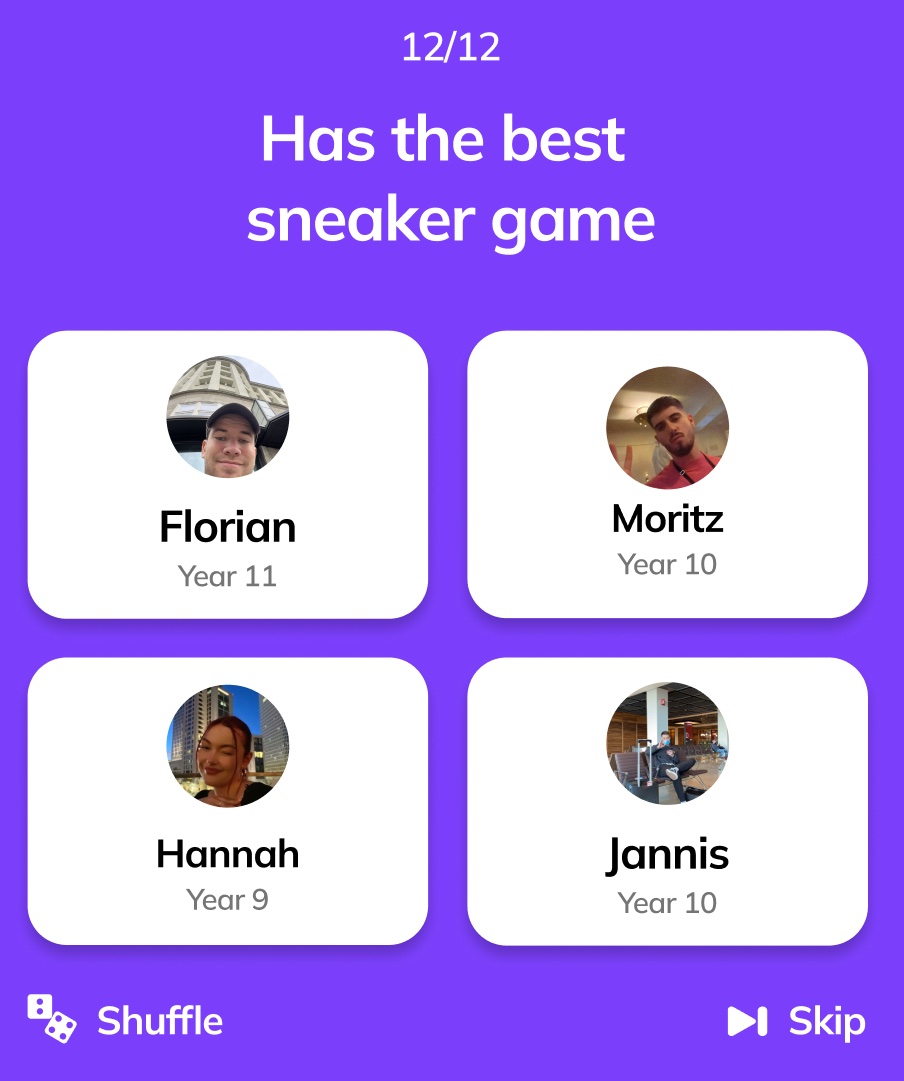
So what’s the attraction here? When users open the app it shows users 12 questions which the user can only answer by choosing another user (from their school, class or peer group) to pay an anonymous compliment to (or “slay”). For example, the app may ask a user “Who inspires me to do my best?”. They can then choose from four other users from their school to pay this ‘slay’ to. They can then view compliments from other kids, provided they answer the 12 questions when logging on. The identity of those who sent the compliment remains hidden.
This reminds me of BeReal’s mechanic, where you can only see other people’s BeReal photos by uploading your own.
And Slay is also not dissimilar to Gas, the messaging platform popular among teens for its positive spin on social media, acquired by Discord yesterday. On Gas, anonymous polling is intended to boost users’ confidence.
The other reason Slay has popped onto the TC radar, is that its growth has attracted the interest of VCs.
It’s now raised a $2.63m (€2.5m) pre-seed funding round led by Accel. Also participating was 20VC. Additional investors including Supercell Co-Founder and CEO Ilkka Paananen, Behance founder Scott Belsky, football star Mario Götze, Kevin Weil (Scribble Ventures) and musician Alex Pall (The Chainsmokers).
Slay says it is aiming to reset the teen relationship with social apps by re-balancing things away from the negative sentiments on social platforms, by normalising the giving of compliments. It also says it’s been designed with safety, content moderation and teenage mental wellbeing built in. We shall see…
Digging into the app, one can see that it’s been built very simply as a ‘compliment app’. Whether that is going to be enough to keep users coming back is hard to say. Teenager behaviour is hard to second guess. Getting zero can also send a ‘signal’, for instance.
Suffice it to say, Slay claims it will “never sell or share personal data with third parties.” Given the history of social apps, let’s see how long this lasts.
There is also no direct messaging facility, although users will be able to add links to social media profiles, so clearly they will be able message each other eventually, off-app.
Adults are supposedly not allowed to ‘join’ schools, and approximate location is asked for to suggest nearby schools. Any questions and interactions are asked by the app, not by users themselves.
SLAY was founded in 2022 by a team of three 23-year old, Berlin-based co-founders: Fabian Kamberi, Jannis Ringwald and Stefan Quernhorst. The idea was Kamberi’s, who had been building consumer apps since he was a teenager, and says he was inspired by the experiences of his siblings struggled with the negativity of social media apps during the COVID-19 pandemic.
CEO and Co-founder Kamberi, told me via email: “We see Slay in the future not only as an anonymous polling app [referring to the aforementioned Gas], but as the go-to spot for teens to rediscover social interactions in various play modes.”
“Our app is similar to Gas, and their acquisition shows a great proof of what we have built and what is in store for the future in our space. However, apps that rely solely on anonymous Q&A, for example, carry a high cyberbullying risk, which – by contrast – we prevent through our rigorous content moderation as well as specially designed gamemodes,” he added.
But the question is, why does he think a social app can improve mental health when so many social apps have not?
“We have received thousands of feedback messages from users thanking us for making them feel valued in times of fast moving, negative social media interactions,” he told me.

He said the startup could well ship new features which might create more engagement but at the same time it might bring a risk for negativity: “So we focus very much on the individual experience that each user has, aiming to make it as positive as possible.” He said the startup’s job is “content safety.”
So what’s Slay’s business model? How will it make money? Kamberi says it will likely be premium features, services or tools which users pay for: “We are currently building several exclusive, paid play modes as well as add ons, which we will release through feedback cycles with users and supported by data.”
SLAY is available in Germany, Austria, Switzerland and the United Kingdom.
Julien Bek, Principal at Accel, added via a statement: “We’re extremely impressed by the SLAY app, both in its immediate popularity among teenagers and the team’s positive goal of improving teenage mental health in the digital world. Already, the SLAY team has seen almost half its active users use it every school day.”
What American Retailers Can Learn From European Department Stores
Creative experiences and a less-standardised approach to operations and design have helped iconic stores like Selfridges, Liberty and Le Bon Marché resist multi-brand retail’s decline.
KEY INSIGHTS
- Consumers, retail industry veterans and brands are taking cues from the consummate shopping experience at iconic European department stores like Liberty and La Samaritaine.
- These stores have key advantages over their American competitors, such as cash-rich backers, being located in tourist hubs and operating on a concessions model.
- Still, their success is also rooted in better store design, stronger visual merchandising and incorporating higher creativity in the shopping experience.
Neri Karra walked into a Macy’s in Washington, DC, last month and was surprised at just how different it was from the department stores in her native Paris.
“Things were on top of one another — everything all at once and no curation,” said Karra, a brand consultant and professor of entrepreneurship strategy at Oxford University.
She had been visiting family in the American capital and wanted to shop for the holidays. The single-brand Georgetown boutiques were great, she said. But the big-box retailers? Not so much.
Karra isn’t alone in her conviction that American department stores lack the je ne sais quoi of their European counterparts. Consumers, industry veterans and even brands agree that the shopping experience in stores like Selfridges in London or LVMH’s Le Bon Marché and La Samaritaine in Paris are unmatched.
To be sure, the department store format has been losing ground everywhere. The rise of e-commerce eroded the convenience factor of department stores, while the pandemic was another catastrophic blow. In the US, the market size of department stores as defined by retail value has shrunk by more than 40 percent between 2016 and 2021, according to Euromonitor. In Europe, that decline is more tempered. Over the same period, department stores’ sales diminished by 27 percent in Western Europe and 12.5 percent in Eastern Europe.
As the world reopened from the pandemic, nonetheless, physical stores enjoyed a renaissance. While opening single-brand boutiques has been the focus for many players, consumer appetite for multi-brand spaces that can serve customers with novelty, discovery and immersive experiences is also growing.
“Competition in the fashion landscape is getting more intense…So the physical [experience] is a point of differentiation, both a challenge and an opportunity,” said Peter Baldaszti, founder and chief executive of Vanguards Group, the Budapest-based portfolio company that owns contemporary brands Nanushka, Aeron and Sunnei.
For American department stores, the push to better compete with single-brand retail and e-commerce often involves taking cues from their European counterparts, seen as leading the pack in everything from assortment and restaurant concepts down to displays and lighting. Many have already made major improvements in recent years: Saks Fifth Avenue spent millions renovating its New York City flagship and Neiman Marcus said it’s currently making significant investments for store concepts.
It’s not a completely fair comparison: European multi-brand chains are often anchored in tourist capitals, where visitors from Asia, the Middle East and increasingly the US stock up on tax-free luxury merchandise. They also have a stronger heritage in the space — Le Bon Marché was the world’s very first department store when it opened in 1852 — as well as consumers who are less discount-driven than in the US.
The rise of the travelling luxury shopper created a virtuous cycle of higher investment in Europe’s iconic emporiums — at the same time that a vicious cycle of rampant discounting and lack of cash flow sped American multi-brand players’ decline.
European department stores are also mostly privately owned, with ultra-wealthy owners who have been able to keep up investment during downturns in a way publicly traded US players could not.
“It becomes difficult to improve when things are so revenue-driven,” said retail consultant Robert Burke, a former executive at Bergdorf Goodman. “The tendency in the US is to be transactional, which doesn’t give a lot of freedom of opportunity.”
Differentiating Through Design
A fundamental difference between American department stores and those in Europe is store design, from the layout of the space to the materials used for floors and displays to finishing touches like light fixtures and the pictures on the walls.
Given the bottom line-focused mentality of American big-box chains, their approach toward how stores look and feel tends to be very “systematic,” said George Yabu, who founded design firm Yabu Pushelberg alongside partner Glenn Pushelberg.
Whereas American corporations would insist on meeting specific criteria, like racks with multiple hanging capabilities, “you never get criteria in store planning at La Samaritaine, for example,” Yabu said. “[Just] make an exalted temple of desire, responsibly.”
As a result, the European stores exude a more creative and inviting atmosphere for consumers. Rather than vast, open layouts, they are partitioned into rooms or shop-in-shops with varying styles, contrasting open spaces and high ceilings with little corridors where shoppers can stumble upon things and explore. Variation is key: differences in lighting, openness of space, store furniture and the art that adorn the walls.
Inside the memorable Tudor-style Liberty in London, for instance, three large atriums are flanked by numerous smaller rooms, and each room is designed to be distinct with details like vintage furniture instead of standardised decor. Liberty also merchandises each room not by category or brand but by different tones of style.
“We’ve turned the clock tower into an intimate brow bar, we’ve built a gallery-esque accessories department in the centre of the store to give centre stage to our architecture and have peppered interesting pop-ups throughout the store,” Liberty’s managing director of retail, Sarah Coonan, told BoF in an emailed statement. “One of the ways we operate differently is starting from the creative idea rather than the commercial objectives.”
Transforming lacklustre interiors into something a bit more special isn’t always a heavy lift. Even small changes can go a long way, such as reducing the number of garments on each clothing rack or varying the lighting, said Glenn Pushelberg. Lights at different heights in different temperatures, for instance, can inspire different emotions in the shopper. Product displays and tables can be recycled materials or even found objects. And retailers can’t forget about fitting rooms and bathrooms, which can make or break the overall experience, Pushelberg added.
Upgrading little details adds to the air of luxury and therefore can augment the value of the products they display, too.
“We used to joke that with good lighting and good mirrors, you can sell anything,” said Burke.
The Shift to Concessions
American department stores are increasingly invoking the European model where they can. Luxury brands like Chanel, for instance, have pushed their American wholesale partners to embrace the concessions model, the common way of operating multi-brand retail in Europe.
Under a concessions model, trusted brands manage their own products and in-store experience within department stores, which take a cut of each sale rather than buying the inventory wholesale.
For the likes of Neiman Marcus, mixing wholesale and concessions means giving up some control over selection and service. But housing retail locations for anchor names like Louis Vuitton (which snubs wholesale completely) or Nike is a powerful draw for foot traffic, and often more profitable than holding inventory and operating the space themselves.
For customers, the brand-operated shop-in-shop is often a more engaging experience, with brand-employed sales associates who are experts on the products.
“Concessions actually makes a huge difference,” said Karra. “It means it’s the brand’s own people serving the customers in the department stores, representing the brand the way they want to.”
Commitment to the Experience
“Experiential” may be the ultimate buzzword in retail, but a truly immersive, delightful shopping experience is still somewhat of a rarity.
In recent years, certain American department stores have seriously invested in amping up their experiential components. Shortly after renovating its beauty floor, Saks Fifth Avenue in Manhattan opened the only American outpost of popular Parisian bistro L’Avenue in 2019. In 2018, Bloomingdale’s launched a rotating pop-up series in four of its stores; every two months the space is repurposed based on a new theme.
Those moves recall London’s Selfridges strategy of reserving some of its most coveted, visible corner spaces for brand takeovers and art installations rather than merchandise or a blue-chip shop-in-shop tenant.
Some of these efforts have been effective. But by and large, they don’t compare to the frequent and large-scale activations put on by the likes of Le Bon Marché, Selfridges, Harrods and others in Europe. The Selfridges on Oxford Street alone offers more than 20 food and beverage options, some of which are sprinkled throughout the sales floor. Last fall, to celebrate its 170th-year anniversary, Le Bon Marché put on a two-hour play inspired by New York’s Sleep No More production inside its store every Friday and Saturday — a run that will pick up again this spring.
The goal, Le Bon Marché told BoF, is to provide customer experiences that evoke an emotional response. By always offering new and unpredictable activations and pop-ups, European department stores ensure that local customers will keep coming back.
It’s not that special events and installations are absent from American department stores: Nordstrom has hosted numerous “pop-ins” and collaborations under its creative projects division headed by Opening Ceremony alum Olivia Kim.
The missing piece of the puzzle is the cumulative effect of a multitude of products, experiences and services that helps reach different customers and create the consummate shopping experience. Initiatives often work best when executed with the aim of surprising and delighting the customer — creating a connection or exceeding their expectations — rather than simply making a sale.
“Fashion at the end of the day is about fantasy, about selling you a dream,” said Karra.
With Rising K-pop Influence, South Korea Is Luxury’s Next Big Opportunity
Dior has become the biggest winner in the market, with sales growing by eight times over the last few years, according to a recent Morgan Stanley report.
If 2022 has been the year that kicked off a K-pop frenzy, 2023 might just get even crazier.
Outside Fondazione Prada, the show venue for Prada men’s fall 2023 fashion show, crowds erupted as members of the seven-member boy band Enhypen stepped to greet fans. The group, which consists of Heeseung, Jay, Jake, Sunghoon, Sunoo, Jungwon and Ni-ki, made its debut last November and has more than 11.5 million fans on Instagram.
In recent years, the influence of K-pop, especially K-pop girl groups, has become more visible in the global luxury market.
Over the last few years, nearly all popular South Korean idols have been anointed ambassadors at one or several luxury brands. Lisa, Jennie, Rosé and Jisoo of Blackpink, members of the world’s most popular all-girl group, has secured partnerships with top luxury brands such as Celine, Chanel, Dior and Saint Laurent.
Competition is heating up to secure the next South Korean idol as the face of luxury brands. In recent months, NewJeans, a five-member girl band often billed as the next Blackpink, has seen its members Hyein, Hanni and Danielle named ambassadors at Louis Vuitton, Gucci and Burberry, respectively.
According to industry insiders, the remaining members of NewJeans, Minji and Haerin, will likely secure ambassadorships with Chanel and Dior separately.
Within the last week alone, Dior has signed BTS member Jimin as a global ambassador; Valentino also named BTS member Suga as a brand ambassador, and Givenchy unveiled Taeyang, a member of Big Bang and a solo artist, as its newest brand ambassador.
Top entertainment studios, such as YG Entertainment, SM Entertainment and JYP Entertainment, often spend years recruiting and grooming talent through an intense elimination process.
After a seven-year hiatus, Blackpink’s agency, YG Entertainment, dropped teasers for a seven-member girls’ band called Babymonster on Jan. 1. The new group’s reveal video quickly amassed more than 28 million views on Youtube.
According to Kim Seiwan, an economics professor at Ewha Womans University’s estimate, the K-pop phenomenon generates about $10 billion annually for the country.
“K-culture has now become a powerful marketing method targeting APAC consumers, and this trend is expected to continue and be stronger during post-pandemic in 2023,” said Sunny Moon, research manager at Euromonitor International Korea.
All eyes are on the Korean market, with luxury brands planning to stage more destination shows this year.
In May, Gucci will stage its cruise show in South Korea to mark the brand’s 25 years in the country after canceling the original event planned for last November due to a tragic stampede in Seoul killing more than 150 people. According to local public relations agencies, Saint Laurent is also considering putting on a fashion show in South Korea this year.
“South Korea has been the leader across Asia in recent years. If you have South Korea, you have the northeastern Asian market,” Jacob Cooke, chief executive officer of WPIC, a Beijing-based e-commerce consulting firm, told WWD recently.
After the pandemic, the local luxury market has registered upbeat growth results. According to Euromonitor, luxury retail value sales in South Korea, which excludes duty-free shopping and the resale market, is projected to grow 8 percent year-on-year to 19.4 trillion South Korean won, or $15 billion, in 2022.
According to a Morgan Stanley report published this month, with a vibrant middle-class and upper-middle-class demographic, South Korean nationals are now the world’s biggest spenders per capita on personal luxury goods. At $325 per capita, it is higher than $280 in the U.S., $210 in Japan and $55 in China.
Morgan Stanley estimates that South Korean nationals now account for “10 percent or more” of the brand’s total retail sales for Prada, Bottega Veneta, Burberry and Moncler.
“At an estimated 5 percent, Vuitton was likely below the industry average, a function of the broad geographical reach of the brand,” the report added.
Increased investment in the market, including fashion shows, pop-up stores and hospitality offerings, helped elevate the appeal of leading luxury brands and reach their growth targets.
Louis Vuitton launched a pop-up café at its Seoul flagship in Gangnam last March, followed by a pop-up vegetarian restaurant at the brand’s Seoul maison last September. Also in March, Gucci opened its fourth Gucci Osteria outpost on the top floor of its Gucci Gaok flagship.
For Dior, with the opening of the expansive Seongsu-dong pop-up store, signing on Blackpink’s Jisoo as brand ambassador and holding its first fashion show in Seoul, the LVMH crowned jewel has become the “fastest-growing player in the market,” according to the Morgan Stanley report.
“We believe the brand’s [Dior’s] sales have potentially multiplied by eight times over the past five years,” wrote the report.
The rise of Generation MZ, a group term for Gen Z and Millennials, became a crucial driver for the market. “Brand awareness has increased not only as brands have efficiently utilized social media platforms as a marketing tool, but also as young customers post their shopping items on social media platforms,” wrote the Morgan Stanley report.
According to Shinsegae, a major fashion department store franchise, sales from Generation MZ reached nearly 40 percent of total luxury sales in 2021, up from less than 30 percent of the sales mix five years ago.
Riding the “Hallyu” (or Korean culture) wave and after more than a decade’s healthy organic growth in the market, Our Legacy, the cult Swedish label, took the leap and opened three shops-in-shop in Seoul last year.
The three retail locations, located within Hyundai Department Store Apgujeong Main Branch, Hyundai Department Store Pangyo and Galleria Luxury Hall East, aim to create a sense of serenity and intimacy “in a chaotic world,” according to the brand’s press release.
Richardos Klarén, CEO of Our Legacy, revealed that the brand had seen double-digit growth since the locations opened.
Working with Handsome Corp., the fashion division of Hyundais Department Store, which is the largest fashion group in South Korea and the brand’s longtime wholesale partner, Our Legacy has plans to open a flagship store in downtown Seoul, featuring Our Legacy’s main line and the Our Legacy Work Shop collection.
“Our brand and product sit well with the market. We’ve also been inspired a lot by Asia, which is what drew us to the South Korean market in the first place,” Klarén said. “When it comes to music, films, beauty, food, South Korea really stands out in terms of the level and pace of development.
“Maybe it’s a word used too much, but I think a minimalistic approach to fashion is a good foundation to have in the market, but we try to push it quite a lot fashion-wise as well,” Klarén added.
Partnering with Handsome Corp., American designer brand Gabriela Hearst has picked South Korea as its first stop in the Asia market.
The retail residence, located within Hyundai Department Store Apgujeong Main Branch and launched last December, recorded sales “seven times” that of other stores on its opening day, Hearst told WWD in a recent interview. “This is without any marketing campaign,” she said.
According to local media reports, the Nordic fashion brand Totême and the New York-based contemporary label Veronica Beard has also inked deals with Handsome Corp. to roll out shops in Seoul.
Under inflation pressure, housing market headwinds and in the face of a global economic downturn, Morgan Stanley expects local consumption to be under pressure in 2023. Euromonitor’s Moon also expects more local consumers to opt for affordable luxury goods, including in the handbag and luggage categories.
But the Korean luxury market could still benefit from pent-up demand from Chinese tourists after borders reopened on Jan. 8.
“Even though China fully opened its borders, there will be a limitation on the speed and scale of Chinese tourists rebounding in the short run,” said Moon, citing tightened rules toward Chinese travelers to control new inbound COVID-19 cases.
Moon predicts the duty-free shopping segment will most likely bounce back in the second quarter and “significantly affect the luxury market, particularly fashion and beauty industries.”
Luxury’s Play in a Challenging World Economy
At the National Retail Federation's Big Show, leaders from LVMH, Neiman Marcus Group and Harrods discussed what's ahead for their brands.
Luxury players may be more resistant to recession, but they are feeling the impact of rapidly shifting shopping patterns, and the need to intensify efforts to win over consumers, convince existing shoppers to shop more and innovate.
Those themes rang out at this week’s National Retail Federation “Big Show” convention and expo at Manhattan’s Jacob K. Javits Center, which attracted close to 40,000 attendees, scores of heads of leading retailers and brands, including many in the luxury sector.
“There’s no such thing as being immune from a recession,” said Anish Melwani, chairman and chief executive of LVMH North America, during a season at the Big Show. “Remember, our product portfolio isn’t exclusively at the ultra high-end. We have Sephora; we have many brands that certainly are more democratic in their pricing. I don’t think that any company is immune.
“Thanks to our leadership in Paris, we’re a very conservatively financed company, and so we have the financial wherewithal to withstand economic shocks,” Melwani added.
He suggested that based on what he’s been hearing in the media and elsewhere, if a recession occurs, the impact won’t be as bad as the COVID-19 pandemic or the Great Recession of 2008. “Time will tell what this next period brings,” he said. “To the extent that there is a softening in the economy, the main preparation we have is our financial strength.”
There have been reports that aside from a few luxury brands, such as Hermès and Chanel, the luxury sector is slowing after several seasons of incredible growth, partly because consumers are shifting their dollars to experiences and away from buying stuff, and Chinese tourism has dried up due to a weakened economy and COVID-19 crisis.
But Melwani characterized luxury as “sticky” for two fundamental reasons. “Like all things related to fashion, it’s very connected to identity. And so once you adopt luxury, once you start wearing luxury, it’s part of your identity. Most people don’t want to go backward.”
Luxury’s stickiness also has to do with its “genuine scarcity” and incorporation of “only the best materials and the best techniques, he said. “Once you experience that, again, it’s difficult to go back.”
He said the LVMH luxury business “continues to see strength” and LVMH “thrived” during the COVID-19 period.
Melwani characterized 2022 as the year of travel. “Call it revenge travel, call it a new normal, and we’re still waiting to see how all that plays. There’s no question that we saw demand rise dramatically from a travel perspective.” He said LVMH’s hotels, Belmond and Cheval Blanc, saw a spike in business after having a difficulty earlier in the pandemic.
“If anyone’s taken any holiday recently, you know that the inflation in airfares and hotels is not the 6, 7, 8 percent that you’ve seen in the CPI. It’s 60, 70, 80 percent.
“The other big factor is how many Americans have been shopping in Europe,” Melwani said. “On some weeks last summer, for example, at a boutique in Paris, 30 percent of the businesses came from American tourists. So that’s a phenomenon that we certainly hadn’t seen before.” Currency exchanges favoring the dollar helped that trend.
In terms of innovation, he said LVMH takes Web3 “very seriously,” and has hired several people to work in the metaverse. “But like with any innovation, we are looking at in a way of how it actually reinforces the characteristic DNA of LVMH brands.”
In 2021, LVMH became one of the founding members of the Aura Blockchain Consortium, along with Prada Group, Mercedes-Benz, OTB and Richemont. The consortium promotes the use of a single global blockchain solution for luxury brands to provide consumers with additional transparency and traceability. “If you’re purchasing a product, you actually have a certificate that the item has been tracked from the time it was mined, all the way to where it was cut, polished and sent. And you can be completely confident that it hasn’t been tainted along the way by any illicit practices,” Melwani said. “We believe that, going forward, especially younger consumers will care more about the raw materials that go into the things they invest in. And we believe this consortium will provide an industry standard that across luxury brands can be used to give consumers that confidence.”
In another session, Geoffroy van Raemdonck, CEO of the Neiman Marcus Group, discussed the luxury retailer’s approach in a challenging economy. “What’s next is really to continue to grow the relationship and to reach more people,” he said. “It’s great that we have 2 percent of our customers who [generate] 40 percent of our revenue. The big focus we have is how do we recruit more people who have that potential? And then even more pressing is when we look at the customers we have today, how do we migrate them to become their destination of choice and more of their share of wallet. So today, as much as we are happy with the results we had last year…in fiscal year 2023, I’m asking the team to really focus on how we operate in a volatile environment to strengthen the relationships [with customers] because we can invest in the business.”
There are reports that Louis Vuitton and other brands have been pulling away from their distribution in department stores in favor of their own stores and websites. But Van Raemdonck said, “The question is always are they going to go direct. Are we going to be dis-intermediated. And right now what we’re seeing is just the opposite.”
Top luxury brands have increased their distribution with Neiman Marcus stores as a means to access their customers, he added.
Aside from striving to increase, rather than lose, points of distribution with luxury brands, NMG is planning to take bergdorfgoodman.com internationally through its partnership with Farfetch, which invested $200 million in NMG last year.
Van Raemdonck said bergdorfgoodman.com “could be and should be global. And so it’s going on the Farfetch platform,” which will help with currency conversions, translations, call center and other operations. “And that allows us to scale to as many countries as we want, up to 200.”
For NMG, online- and store-generated revenues, “I actually don’t believe that it will be 50-50. Today it’s less than 20 percent” online. Ultimately, “it might be 25 percent to a third online.…What we’re clearly seeing is when we migrate someone from online to the store, the average order value increases.” He said people are “social creatures,” meaning they want human interactions from stores, and want to touch and feel products. “There are some products that you don’t buy online,” he added.
In another NRF session, Michael Ward, managing director of Harrods, said his company opted to work with the technology arm of Farfetch, called Farfetch Platform Solutions, rather than spend “an obscene amount of money” to independently revamp its website. He likened the situation to a chimpanzee battling a gorilla and decided it made more sense to work with the gorilla than fight it.
He looked into his crystal ball and said he believes traditional wholesaling in the luxury arena will “gradually disappear” and be replaced by an e-concession model where brands have more control over their future.
But Harrods is not about to give up without a fight, so it too turned instead to Farfetch to help it navigate this evolving situation.
“The future of online luxury commerce is about a connected retail experience,” said Kelly Kowal, chief platform officer of Farfetch Platform Solutions. As the pandemic eased around the world, physical stores regained their footing, so the trick is to find a way to “holistically” blend online and offline.
For Harrods, this translates into not only offering shoppers an extraordinary in-store experience but also work to recreate that same feeling online as much as possible.
“Crusty old Harrods has to be more flexible,” Ward said.
Having a strong technological base can also help retailers better service their customers in each channel. Harrods invested heavily in algorithms that provide data, which allows it to personalize the customer experience. Ward said the store will quadruple the size of its private shopping area this year and will use the data it captures from these algorithms to better predict what customers will be attracted to when they arrive in the store.
But he cautioned that technology is not the be-all-and-end-all. Buyers still need to have the flexibility to purchase items that are new and intriguing and may open up a whole new stream of sales.
Changes at Farfetch’s Executive Team, Elizabeth von der Goltz Takes New Role
Chief brand officer Holli Rogers and chief growth officer Martin Avetisyan will be leaving the company.
LONDON — Elizabeth von der Goltz has joined the executive team at Farfetch.
The appointment is part of a raft of changes to the leadership team announced Wednesday.
Von der Goltz will become chief fashion and merchandising officer at Farfetch, and chief executive officer at Browns, the London retailer.
Von der Goltz left her role as chief commercial officer at Matchesfashion in September 2022, a position she had held from early 2021. She joined Matches from Net-a-porter, where she held the role of global buying director.
The changes at Farfetch are wide-ranging. Sindhura Sarikonda is joining the company this month as president for the Americas. Stephanie Simon is also joining the business as vice president for community and Web3 at the group.
Holli Rogers, chief brand officer at Farfetch, and Martin Avetisyan, chief growth officer, will be leaving the company to pursue other opportunities, according to a statement from the business.
“I am delighted to welcome Elizabeth, Sindhura and Stephanie to Farfetch,” said José Neves, founder, chairman and CEO of Farfetch.
“Our 2023 plan is very much focused on continuing to advance our platform vision whilst delivering growth, profitability and free cash flow. These hires will help us achieve that. Elizabeth will play an integral role in curating and securing incredible merchandise to ensure Farfetch customers continue to have access to unrivaled supply.”
Neves added that “Sindhura’s leadership will position us to provide a differentiated shopping experience to luxury customers in the Americas, including our largest market, the United States. Finally, Stephanie brings her incredible experience on how fashion can engage in Web3 and all the opportunities still to explore in this space,” he added.
Neves thanked Rogers and Avetisyan in his statement for their contributions over the years.
Sarikonda was previously global head of in-store at Klarna, and Simon was head of brand evangelism and development at the social audio app, Clubhouse.
In 2021, Rogers became chair of Browns, while maintaining her role at Farfetch. She had previously served as CEO.
She took the helm of Browns in 2015, just after Farfetch purchased the London retailer. During her tenure as CEO, she oversaw the rebranding of Browns in 2016; the launch of Browns East a year later, and the retailer’s 50th anniversary in October 2020.
Research Calls
- Upgrades:
- Chegg (CHGG) upgraded to Overweight from Sector Weight at KeyBanc Capital Markets; tgt $29
- Coeur Mining (CDE) upgraded to Hold from Sell at Canaccord Genuity; tgt $4
- CureVac (CVAC) upgraded to Buy from Neutral at UBS; tgt raised to $18
- Heineken (HEINY) upgraded to Sector Perform from Underperform at RBC Capital Mkts
- IBM (IBM) upgraded to Market Perform from Underperform at MoffettNathanson; tgt $140
- iQIYI (IQ) upgraded to Equal-Weight from Underweight at Morgan Stanley; tgt raised to $5.10
- Klépierre SA (KKLPEF) upgraded to Buy from Hold at Deutsche Bank
- Lawson (LWSOF) upgraded to Neutral from Underperform at Credit Suisse
- Philip Morris International (PM) upgraded to Buy from Hold at Jefferies; tgt raised to $118
- Symrise (SYIEY) upgraded to Buy from Hold at Berenberg
- Universal Display (OLED) upgraded to Neutral from Negative at Susquehanna; tgt raised to $135
- Downgrades:
- Alamos (AGI) downgraded to Hold from Buy at Canaccord Genuity
- Charles Schwab (SCHW) downgraded to Underperform from Buy at BofA Securities; tgt lowered to $75
- Coca-Cola FEMSA (KOF) downgraded to Neutral from Buy at UBS; tgt raised to $80
- Cognizant Tech (CTSH) downgraded to Underperform from Market Perform at MoffettNathanson; tgt lowered to $60
- DXC Technology (DXC) downgraded to Underperform from Market Perform at MoffettNathanson; tgt lowered to $28
- Eni S.p.A. (E) downgraded to Neutral from Overweight at JP Morgan
- Equinor (EQNR) downgraded to Underweight from Neutral at JP Morgan
- Fresnillo (FNLPF) downgraded to Sell from Neutral at UBS
- HireRight Holdings (HRT) downgraded to Hold from Buy at Stifel; tgt $12
- Inotiv (NOTV) downgraded to Hold from Buy at Jefferies; tgt lowered to $8
- Intellia Therapeutics (NTLA) downgraded to Mkt Perform from Mkt Outperform at JMP Securities
- Kuehne & Nagel International (KHNGY) downgraded to Neutral from Outperform at Exane BNP Paribas
- Newmont Goldcorp (NEM) downgraded to Hold from Buy at Canaccord Genuity; tgt raised to $56
- OMV Aktiengesellschaft (OMVKY) downgraded to Underweight from Neutral at JP Morgan
- Renault (RNSDF) downgraded to Hold from Buy at HSBC Securities
- Roblox (RBLX) downgraded to Underweight from Equal-Weight at Morgan Stanley; tgt lowered to $24
- TE Connectivity (TEL) downgraded to In-line from Outperform at Evercore ISI; tgt $130
- Tencent Music (TME) downgraded to Hold from Buy at 86 Research
- Teva Pharma (TEVA) downgraded to Hold from Buy at Jefferies; tgt raised to $12
- Ubisoft (UBSFY) downgraded to Hold from Buy at HSBC Securities
- United Comm Banks (UCBI) downgraded to Neutral from Buy at Janney
- V.F. Corp (VFC) downgraded to Sell from Hold at Williams Trading; tgt $25
- Others:
- Alpine Immune Sciences (ALPN) initiated with an Overweight at Morgan Stanley; tgt $17
- American Axle (AXL) named Catalyst Call Sell at Deutsche Bank
- ams AG (AUKUF) initiated with a Mkt Perform at Bernstein
- ASML (ASML) initiated with an Outperform at Bernstein
- Baker Hughes (BKR) initiated with a Buy at The Benchmark Company; tgt $36
- Cactus (WHD) initiated with a Buy at The Benchmark Company; tgt $70
- CF Industries (CF) initiated with an Overweight at Wells Fargo; tgt $110
- Corteva (CTVA) initiated with an Overweight at Wells Fargo; tgt $78
- D.R. Horton (DHI) initiated with a Perform at Oppenheimer
- Eni S.p.A. (E) initiated with an Outperform at Credit Suisse
- FMC Corp (FMC) assumed with an Overweight at Wells Fargo; tgt $148
- GE HealthCare (GEHC) initiated with a Buy at Redburn
- Goodyear Tire (GT) named Catalyst Call Sell at Deutsche Bank
- Graphic Packaging (GPK) named Catalyst Call Buy at Deutsche Bank
- Halliburton (HAL) initiated with a Buy at The Benchmark Company; tgt $50
- HCI Group (HCI) initiated with a Buy at Compass Point; tgt $56
- Helmerich & Payne (HP) initiated with a Hold at The Benchmark Company
- Hugo Boss AG (BOSSY) assumed with an Overweight at Morgan Stanley
- Infineon (IFNNY) initiated with an Outperform at Bernstein
- Inflection Point Acquisition Corp. (IPAX) initiated with a Buy at The Benchmark Company; tgt $14
- Karyopharm Therapeutics (KPTI) initiated with an Overweight at Piper Sandler; tgt $8
- Mosaic (MOS) initiated with an Equal Weight at Wells Fargo; tgt $47
- Nabors Industries (NBR) initiated with a Hold at The Benchmark Company
- Noble Corporation (NE) initiated with a Buy at The Benchmark Company; tgt $50
- NOV Inc. (NOV) initiated with a Buy at The Benchmark Company; tgt $28
- Nutrien (NTR) initiated with an Equal Weight at Wells Fargo; tgt $80
- Oceaneering Intl (OII) initiated with a Buy at The Benchmark Company; tgt $25
- Palantir Technologies (PLTR) initiated with a Neutral at Mizuho; tgt $7
- Patterson-UTI (PTEN) initiated with a Hold at The Benchmark Company
- ProPetro (PUMP) initiated with a Hold at The Benchmark Company
- PulteGroup (PHM) initiated with a Perform at Oppenheimer; tgt $64
- SLB (SLB) initiated with a Buy at The Benchmark Company; tgt $65
- STMicroelectronics (STM) initiated with an Outperform at Bernstein
- TechnipFMC (FTI) initiated with a Buy at The Benchmark Company; tgt $15
- The Shyft Group (SHYF) initiated with a Buy at BTIG Research; tgt $40
- Toll Brothers (TOL) initiated with an Outperform at Oppenheimer; tgt $71
- Transocean (RIG) initiated with a Buy at The Benchmark Company; tgt $7.50
- TRI Pointe Homes (TPH) initiated with a Perform at Oppenheimer
- Valaris (VAL) initiated with a Buy at The Benchmark Company; tgt $95
- Visteon (VC) named Catalyst Call Buy Idea at Deutsch Bank
- Volaris Aviation (VLRS) placed on Positive Catalyst Watch at Citigroup
Gapping down
In reaction to earnings/guidance:
- DFS -7.3%, AA -5.9%, ALL -5.6% (prelim Q4 numbers), KEY -2.2%, TAL -2.1%, PG -2.1%, FUL -2%, CBSH -2%, MATX -1.9% (DecQ guidance), NTRS -1.6%, FAST -1%, BKU -0.8%, SNV -0.7%
Other news:
- AKTS -14.1% (proposed public offering; receives first high-volume 5G filter order)
- OLK -13.5% (prices offering of 5831028 mln ADSs at $20.00 per ADS)
- IIPR -13% (reports Q4 operating metrics)
- SRDX -12.2% (provides regulatory update related to its FDA premarket approval application for the SurVeil drug-coated balloon)
- VRE -7.9% (Kushner Companies not interested in transaction)
- DCPH -6.9% ($125 mln public offering)
- VNO -3.8% (reduces quarterly dividend)
- APPH -2.9% (starts commercial shipments of tomatoes at new farm)
- WBX -1.7% (announced measures to reduce costs to better align with its 2023 full year guidance; will impact ~15% of the workforce)
- BTG -1% (reports record total gold production for Q4)
Analyst comments:
- CTSH -3.2% (downgraded to Underperform from Market Perform at MoffettNathanson)
- DXC -2.2% (downgraded to Underperform from Market Perform at MoffettNathanson)

Gapping upIn reaction to earnings/guidance:
- TCBI +3.9%, EGBN +1.6%, SMCI +1.4% (DecQ guidance), THC +1% (guidance), WNS +0.7%
Other news:
- VMEO +4.2% (reports December 2022 statistics)
- BLUE +3.6% (prices offering of 20 mln shares of common stock at $6.00 per share)
- CHK +2.4% (to sell Brazos Valley region)
- TCMD +1.4% (files $150 mln mixed shelf)
- EDIT +1.4% (Editas Medicine and Shoreline Biosciences enter into definitive agreement for Shoreline to Acquire Editas' iNK cell franchise and related gene editing technologies)
- BSM +1.2% (CFO departing)
- PSNL +1.2% (approved a reduction in the Company's workforce by up to approximately 30% to reduce operating costs and improve operating efficiency)
- PGTI +1% (collaborating with GLW)
Analyst comments:
- CVAC +9.7% (upgraded to Buy from Neutral at UBS)
Early premarket gappers
- Gapping up:
- TCBI +4.9%, VMEO +4.2%, SMCI +3.7%, BTG +2.7%, BLUE +2.4%, ADV +2.1%, EGBN +1.6%, TCMD +1.4%, TAL +1.4%, NCNO +1.2%, BSM +1.1%, PGTI +1%, APPH +0.7%, KMI +0.7%
- Gapping down:
- OLK -12.1%, AKTS -10.1%, WTFC -8.2%, VRE -7.9%, IIPR -7.1%, DCPH -6.8%, DFS -6.6%, AA -6.5%, FUL -3.6%, ALL -3.4%, TFC -2.3%, CBSH -2%, MATX -1.9%, TPIC -1.8%, AAPL -1.1%, VNO -0.8%, SNV -0.7%