"Who Wants To Hold Volatile Risk Assets When You Can Hold Cash?"
Reinforcing our thoughts in the last week that 'TINA has left the building', Morgan Stanley's Andrew Sheets wrote over the weekend that for much of the last 12 years, it was common to hear some variation of 'TINA' (There Is No Alternative), the idea that one needed to be long stocks and bonds because cash offered so little. Low yields were not the primary reason why stocks rallied over that time; global equities and global equity earnings simply rose by the same amount (~100%). But was TINA a helpful mental crutch for markets, especially in times of stress? Absolutely.
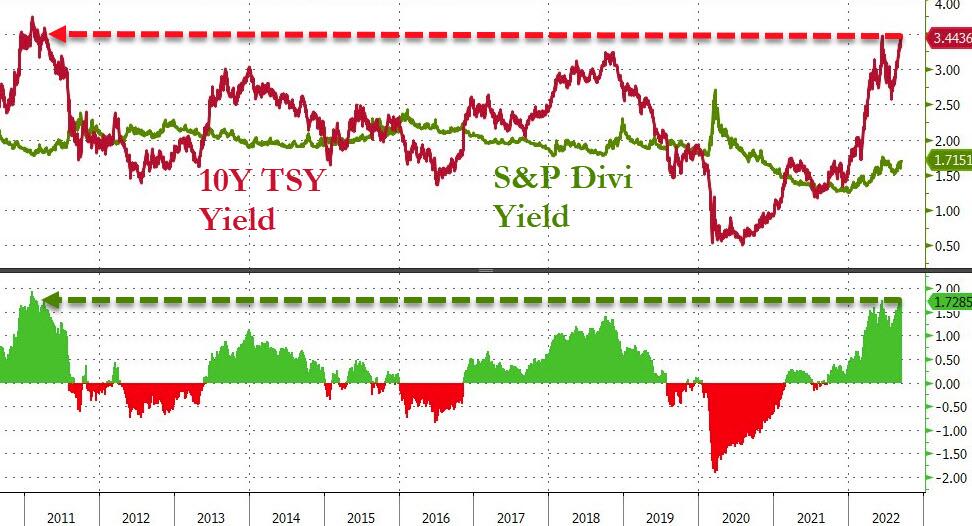
These tighter policy rates are now scrambling that mindset. Six-month US T-bills yield about ~3.75% and, as we discussed last month, cash and short-term fixed income increasingly offer lower volatility and high yield within a cross-asset portfolio. US 1- to 5-year credit yields ~4.9% against an S&P 500 earnings yield of ~5.9%. But over the last 30 days, the S&P 500 has been 5.7 times more volatile.
In short, investors now have a number of higher-yielding, lower-volatility alternatives if they want to step back from the market.
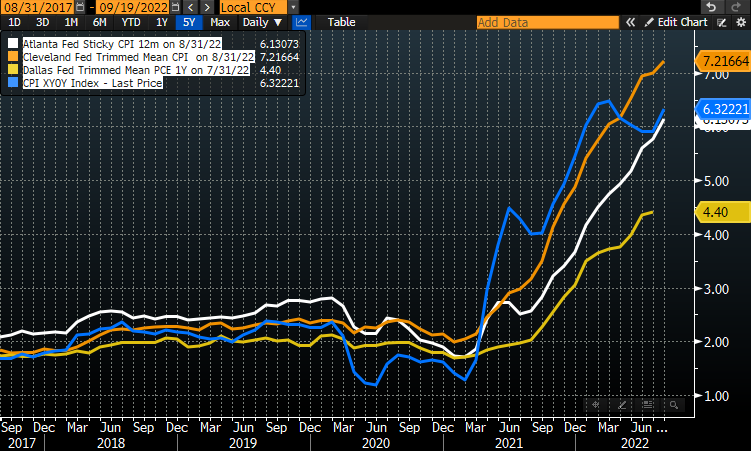
The fear among investors is further fomented by the realization, as Nomura's Charlie McElligott writes, that the "broadening-out" inflation (both Core Services and a surprise reacceleration in Core Goods) and increasing evidence of “Wage-Price Spiral” >>> unanchoring of Inflation Expectations - but versus still “too hot” Labor- and Wage Growth- data...
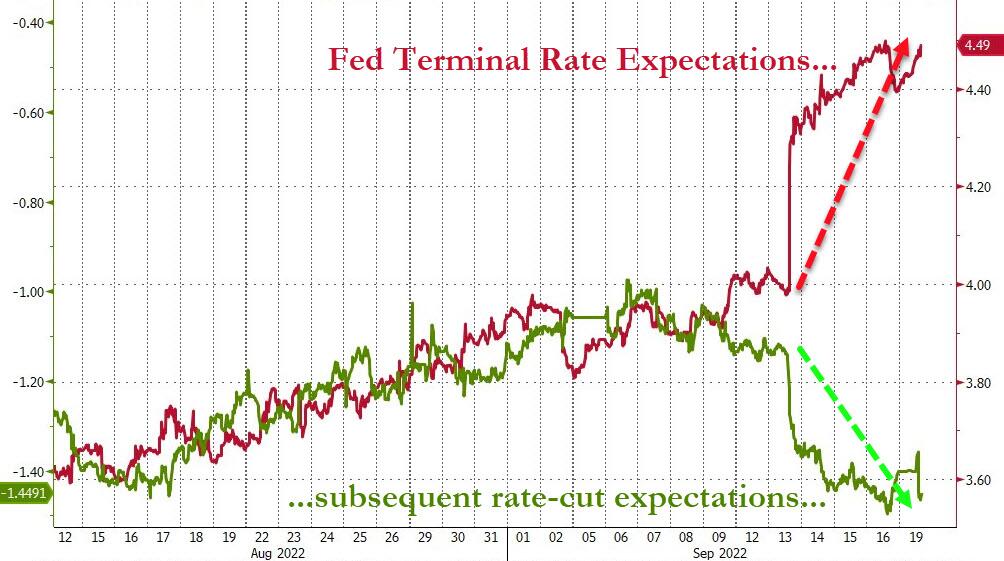
...continue the fuel market repricing of higher Fed “Terminal Rate” in this week’s Fed meeting and beyond, with Mar23 FFOIS now comfortably parked ~ 4.50 (4.482 last)...
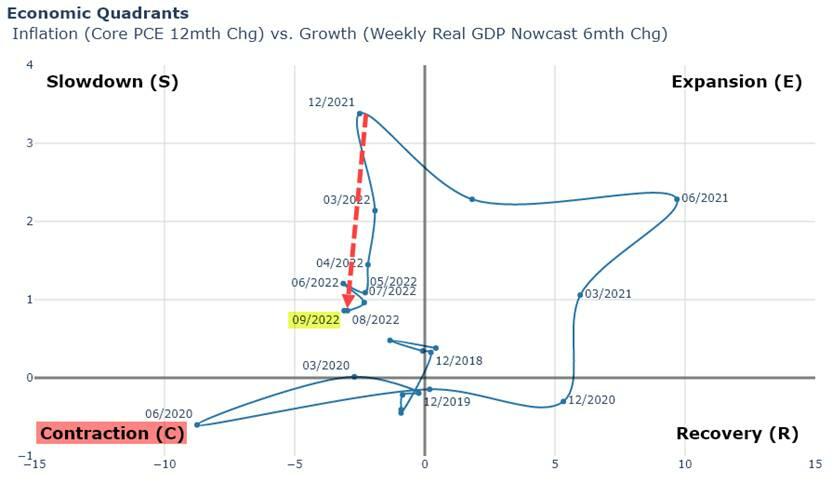
...which is part of the “FCI tightening impulse” driving US Dollar and Real Yields to multi-year highs which is causing so much strain for Risk-Assets, as “hard landing” is viewed as the only realistic US Economic outcome in ’23 with the Fed "slamming the breaks."
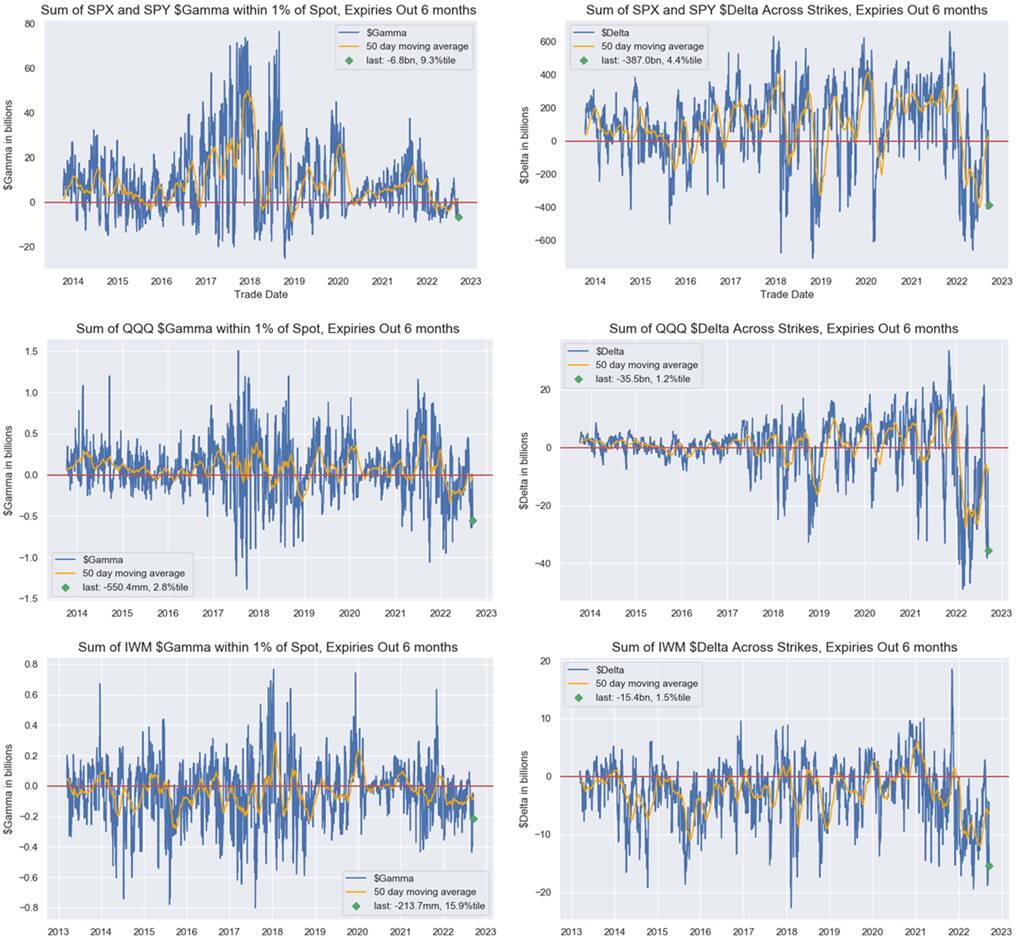
Shifting from the fundamental to the technical, McElligott notes that Options Dealer Positioning is in “Negative Gamma vs Spot” regime (where again we currently find ourselves, and have been for majority of the year 2022), making markets prone to outsized moves due to intraday hedging flows which counterproductively “press” underlying market moves, acting as an “momentum accelerant” which mechanically “has to” sell into lows and / or buy into highs, acting as a net “liquidity TAKER” which further exacerbates the magnitude of ranges and iVol.
So within both this particular:
1) Equities Vol “market structure” context, in addition to2) the larger Macro theme of Equities currently being punished under the global Central Bank regime of “Tight FCIs until demand-side Inflation is killed”
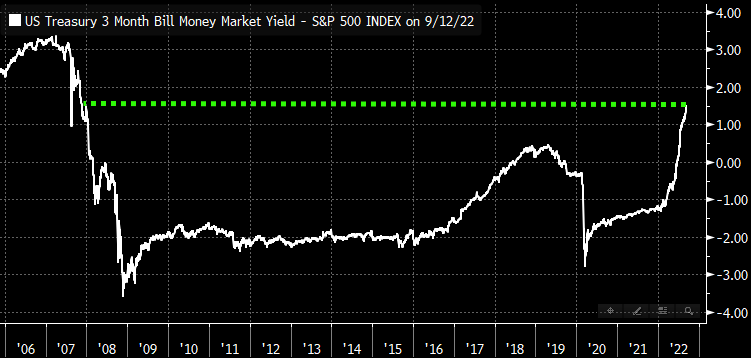
...a topic that is part of almost every conversation we are currently having with clients is “Who wants to hold volatile Risk-Assets when you can hold CASH?”, as global Central Banks are telling you that we have months left of the “financial conditions tightening shocks” left until we see Terminal Rates at a level where the “demand-side” of Inflation is broken…versus say owning and rolling 3m US T-Bills yielding 3.10% in “risk-free heaven,” now a net 1.5% over SPX 12m Div Yield
The Nomura strategist also notes that further to this “End of TINA” -era of “Equities over everything,” Asset Allocation –type Clients are voicing “cautiously constructive” long-term views on US Credit > Equities as well, where we currently see decade-high type pick-up with A’s yielding a very “real” 4.91%, Baa @ 5.45%, Ba @ 7.10% and B @9.04%, but particularly where 1m rVol on US Investment Grade is 5.9, and for High Yield is 7.9…versus US Equities benchmark S&P 500 as a 26 Vol asset!
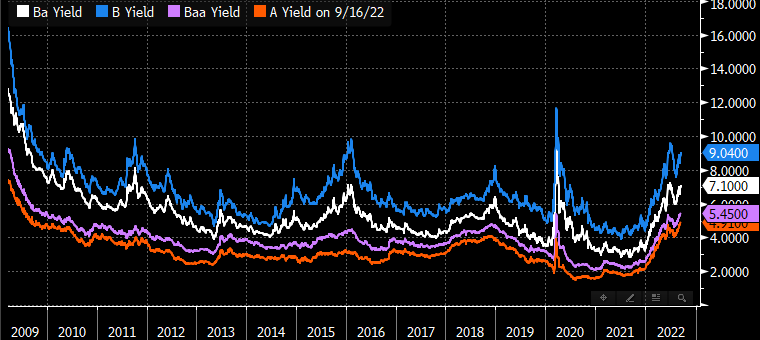
This idea that there now IS actual competition again for Equities as the de facto “bulk weighting” for US Investors is going to be critical as we move forward, particularly when thinking about “Who is the Incremental Seller of Equities From Here?”, especially IF there there is to be another “leg down,” as the Fed is forced to “crash-land the plane”
The punchline to all this is that McElligott believe a “next leg” shock-down in Equities in coming-months would probably require the “401k Investor Class” to sees years-worth of positive Equities performance wiped-out first (back to pre-COVID levels), which then in conjunction with the “Return of Cash” as a viable Asset Class, would drive a larger “Asset Allocation” regime shift out of Equities and back towards Fixed-Income now yielding at levels which allow it to act as AAA - “An Actual Alternative” to Equities, but at a much lower Vol -in a future-state where the Inflation monster has been slayed, but likely via a hard “Recessionary” outcome.
Finally, as we discussed over the weekend, the chart below shows the SPX returns for the weeks into OPEX (top chart) and after OPEX (bottom), illustrating the stark contrast of negative returns into OPEX, and positive returns out of OPEX.

BUT, for those hoping to BTFD and play this swing again; as SpotGamma explains, it's different this time because the huge event risk surrounding this week's FOMC meeting is holding implied volatility up. You can see this reflected in the term structure between 9/20 (pre-FOMC) & 9/22 (post-FOMC).
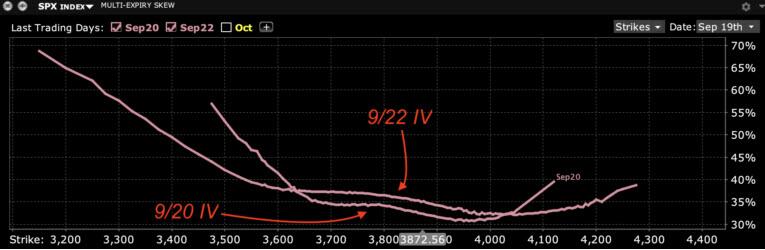
SpotGamma's view remains that FOMC is going to trigger a large directional move which should last into month end. Ultimately a move back above the 4000 Vol Trigger signals a full risk-on for markets with a move up into 4200 by 9/30. If Powell triggers bearish sentiment, we target recent lows of 3650 by 9/30.
Spac implosion: Palihapitiya’s retreat marks the end of an era
Investor says companies to return $1.5bn to backers
Silicon Valley mainstay Chamath Palihapitiya was the embodiment of the blank cheque craze between 2019 and 2021. He may now be the face of the subsequent bust. On Tuesday, Palihapitiya announced that two of his outstanding special purpose acquisition companies (Spacs) would return $1.5bn to backers. They are unable to meet a coming deadline to find private companies with which to merge.
Palihapitiya coined the term “IPO 2.0” to describe his strategy of taking hot upstarts to public markets via mergers with Spacs. The trend appeared to muffle complaints from ordinary investors previously deprived of the chance to profit from high growth start-ups.
Yet five of the half-dozen companies that Palihapitiya has taken public are at least 40 per cent below their $10 per share listing price. They include such fallen stars as Opendoor, SoFi and Virgin Galactic.
Palihapitiya himself seems to have done just fine. In a recent interview, he claimed that his $750mn of Spac profits represented double his outlay. Therein lies the rub of blank cheque deals. Sponsors are typically granted 20 per cent of the shares simply for arranging the mergers. Such incentives can result in questionable companies being brought to market. The sponsor tends to profit no matter how poorly a business performs in the public sphere.
It is not just Spac companies that are floundering at the moment. The traditional tech IPO market has effectively shut down, as has the market for risky corporate debt. Palihapitiya said underlying market conditions prevented him from being comfortable signing any new deals.
In theory, this should be the perfect time for sages, real and imagined, to scoop up assets on the cheap. Palihapitiya was one of several serial Spac issuers who claimed a unique ability to identify good companies at good prices across industries. In reality, this cohort looks like bull market opportunists who found a clever way to score a windfall for themselves.
Inside the $7 Billion Dior Phenomenon
A Path To Reviving Heritage Sports Brands
Brands like Kappa, K-Way and Superga are dwarfed by sportswear giants, but owner BasicNet is betting on iconic products and collaborations to fuel growth.
In the thriving sportswear market, a handful of sleepy heritage brands are finding relevance again.
Kappa, Superga and K-Way — decades-old European sport and lifestyle brands whose products have iconic status, but which never rose to the status of global leaders — have mounted a turnaround after their Italian parent company, BasicNet SpA, struggled to get sales back above pre-pandemic levels last year.
By maintaining a laser-focus on marketing their most recognisable products, leaning into wholesale as sportswear giants pulled back, and by forging partnerships with sports teams and luxury fashion labels, BasicNet’s brands appear to be enjoying a renaissance: The company, which also owns American boat shoe brand Sebago, posted first-half revenues up 26 percent year-on-year, reflecting an 18 percent increase over 2019′s pre-coronavirus levels. Aggregate sales of BasicNet products (including through licensees who distribute its brands) climbed 28 percent to €568 million ($569 million) while net profits more than doubled, the company said in July.
“We don’t have to reinvent the brands every year. We don’t have to invent anything, really, so much as we have to tell the brands’ story,” said vice president Lorenzo Boglione, whose family owns a controlling stake in the group.
“For our sports brand [ Kappa], we’re competing against humongous giants but there is always space for challengers,” he added. “Everyone knows about their strategies — where they are going in and out of markets — that leaves room for smaller players if you are fast and reactive.”
Nike and Adidas have limited their exposure to wholesale, creating a key opportunity for smaller brands to fill the gaps in their wake. In addition to BasicNet, Puma and running brand On are among other sports companies to have seized the chance to stock smaller wholesale boutiques where the giants have cut doors and reduced orders.
BasicNet has also fuelled momentum with a full slate of partnerships and collaborations: A tie-up between Sebago and Kering’s Saint Laurent was released Monday, on the heels of recent collaborations including Superga x Alaïa, K-Way x Fendi and K-Way x Comme des Garçons Play. The latter is an ongoing partnership, which BasicNet hopes could be similar to Play’s longstanding tie-up with Converse, whose heart-emblazoned high-tops are a pillar of its business.
While BasicNet’s portfolio seems to have turned a corner, economic uncertainty is on the rise. Rapid inflation, accelerated by soaring energy costs following Russia’s invasion of Ukraine, risks sparking a downturn, particularly in BasicNet’s home European market.
In the case of slowing consumer spending, the company is hoping that some aspirational luxury consumers may be inclined to trade down from luxury prices to its more accessible propositions like €100 K-Way windbreakers and €160 Sebago boat shoes.
“We try as much as we can to be fair on prices,” Boglione said. “If we do our job properly we can do well no matter the economic background.”
Meanwhile, Kappa is branching out of its historic focus on football with new sports sponsorships with the US snowboarding and ski team that will run through the next two Winter Olympic Games, in 2026 and 2030. It’s also producing a line of jerseys as a partner of the Formula 1 team for French carmaker Alpine.
BasicNet has also sought to solidify its business by operating more of its activities directly, reducing its dependence on licensees by acquiring key distributors including the operating company for K-Way France earlier this year. “It’s the fastest-growing brand of the business, and a big part of that growth is now coming from our own retail stores,” Boglione said.
The Turin-based group is also set to open a new campus in Milan, which will include not just showrooms and offices, but also a restaurant and 10 apartments. The aim is to increase BasicNet’s attractiveness as an employer, as well as its convenience for wholesale buyers and licensees. “In Italy, the talent for our industry is in Milan—it’s hard to take them outside that ecosystem. And when you want to attract talent from [outside Italy], it’s easier to bring them to Milan,” Boglione said.
BasicNet is set to inaugurate the new campus Wednesday during Milan Fashion Week.
Ralph Lauren Accelerates, Sets Strategic Plan to Build on ‘Fortress Foundation’
Ralph Lauren rang the opening bell at the New York Stock Exchange on Monday, celebrating 25 years as a public company and a new strategic plan.
When Ralph Lauren rang the opening bell at the New York Stock Exchange on Monday, he was celebrating 25 years as a public company — and also ringing in the firm’s next phase.
Lauren, who leads Ralph Lauren Corp. as executive chairman and chief creative officer, followed up the stock market milestone with an investor day that highlighted the company’s new strategic plan, complete with financial targets for the next three years.
But clearly, the founder was also taking stock of the empire he started 55 years ago.
“I am the largest shareholder and I’m very proud of it — and I’m very proud of it because the team here is amazing,” Lauren told investors, speaking off the cuff. (Lauren owns 100 percent of the company’s Class B shares and about 350,000 of its Class A shares, giving him control over 84.9 percent of companies’ voting rights).
“Names don’t matter, it doesn’t matter who cooked up the stew,” said Lauren, one of the most famous names in fashion. “If you don’t have a great team, you’re never going to have a great company. I’m proud of the team we have here and you all look so cool.”
Lauren said the professionalism of the company’s executive team was “infectious” and specifically thanked chief executive officer Patrice Louvet.
“You’ve done an amazing job and you’ve put this company in the right place,” he said.
Lauren also took a dig at his former boss from way back when, who didn’t want to get into the tie business with the young designer.
“He said, ‘The world is not ready for Ralph Lauren,” Lauren recalled. “I feel sorry for the company I left, because I turned out to be pretty great.”
Joking aside, Lauren said: “I don’t get paid for this, but I must say that I hope you understand what it is to feel what I feel. When you get up to go to work in the morning and you’re happy. This company has a heart, it has soul, it has power. I thank you very much for being here. I love you. I love that you’re here.”
And that is a healthy dose of the Ralph Lauren dream — optimistic and classic with a feeling of family.
Wall Street seemed to buy into the dream to an extent, driving up the company’s shares by 3 percent to $96.27 on Monday, giving it a market capitalization of $6.5 billion. Still, shares of Ralph Lauren — like much of retail and fashion — have fallen sharply this year, down 29.2 percent from their 52-week high.
Louvet’s job in the years ahead is to make sure that Ralph’s dream not only reaches more people, but that the brand becomes an important part of their lives.
During the investor meeting, Louvet laid out the company’s new strategic plan — dubbed “Next Great Chapter: Accelerate” — which builds on and extends on the strategy he laid out in 2018.
The CEO started the meeting with a personal acknowledgement of the founder.
“Ralph, you provide us with a clear ambition, set of values and purpose that guides everything we do to inspire the dream of a better life through authenticity and timeless style,” Louvet said. “That grounds us, always has and always must.”
He described Lauren as “so much more than a fashion designer” and “is actually closer to a movie director.”
“Ralph creates worlds and then invites people into these worlds,” he said, describing it as an approach to luxury that is not about wealth or status, but love and family connection.”
And that, he said, is a powerful business proposition.
In an interview with WWD before the meeting, Louvet was also in a mood to both take stock of how the company built what he described as a “fortress foundation” and how it speeds on to its new goal, coming on top of $6.2 billion in revenues logged last year.
Over the next three years Ralph Lauren is planning revenue to show a compounded annual growth rate in the mid- to high-single digits with operating profit growth exceeding the top-line expansion in constant currency by 2025. Ralph Lauren also plans to send $2 billion back to investors in the form of dividends and share repurchases.
“Our overall ambition is to be the leading luxury lifestyle company in the world,” Louvet said. “When we look at the data, it’s very clear that our brand is bigger than our business by far — we have significant runway for our business to catch up with the size of the brand.”
While that message is clear, it’s coming to the market at a time of incredible turmoil.
Ultra-high inflation, war in Ukraine, the threat of a recession, general consumer wariness, supply chain backups and whatever the next shock to the system might be all have the potential to swamp the message of any company on a given day — as Louvet is very well aware.
But the CEO is laying out a vision for the future of the brand that looks beyond the current turmoil and is based on four years of work to build up the company.
Louvet pointed to progress from the last strategic plan:
A brand that’s been strengthened with more younger consumers buying in, and paying more, with average unit retail prices up 64 percent over the past four years. The price increases have been driven by more expensive product such as outerwear, fewer promotions, faster growth in China and higher prices on like-for-like items.
An emphasis on building the core of the brand to 70 percent of the offering, highlighting looks like the cable knit sweater, the double-breasted blazer and the polo shirt while growing in outerwear, wear to work looks and so on.
Transforming the company’s go-to market strategy, driving 64 percent of sales from the direct-to-consumer business and growing digital to 26 percent of the overall business.
Louvet sees the last strategic plan as a case of “promises made, promises kept” and now he’s playing on that to get investors to follow along with him on this next phase.
The new strategic plan rhymes with the last one, coming in three parts and hitting on the same broad areas, but with the emphasis placed on the elements now needed to drive the business forward.
The push to elevate the Ralph Lauren brand and bring in fresh faces continues, but now the company is zeroing in on retention to boost consumer lifetime value.
So, nudging the customer who comes into the Ralph Lauren family by purchasing, say, a polo, to go deeper and buy a sweater, a suit or more.
Louvet said the brand’s product depth “uniquely positions us” to keep customers shopping once they connect with the brand.
Ralph Lauren, which employs 250 data scientists, has also been sharpening its data and analytical skills to help it not just know who bought that polo, but what their next step in the brand might be and how to lay that path out with a little marketing.
The company’s effort to build the core has transformed into a plan to drive that business forward and “expand for more.”
That means doubling down on women’s, continuing to build outerwear and going big in home.
Louvet said that while 56 percent of the brand’s shoppers are women, only 30 percent of the business comes from women’s products.
“They buy for their husbands, their boyfriend, their children or gifting and not as much for themselves,” said the CEO, who’s looking to develop women’s to be 50 percent of the business.
Home is also getting a spotlight, where Louvet said there is an opportunity to sell more couches and other furnishings.
“Right now the headlines are about people pulling back to some extent in home investment, but our lens is absolutely beyond the next few months,” he said. “When I think of Ralph Lauren, I think of him as so much more than a fashion designer. He creates worlds.”
Louvet described the home category as having “very long-term potential.”
And, finally, where Ralph Lauren was reworking its go-to market strategy, it is now looking to use the breadth of its distribution and touch points — from stores to coffee shops — to win in its 30 top cities around the world, 14 of which are in the U.S.
“Our ability to create these ecosystems where we have different Ralph Lauren store formats coupled with quality wholesale combined with surround sound digital is the most effective way to engage with our customers,” Louvet said.
The CEO described the overall strategy as “enabled” by five key attributes of Ralph Lauren, including its people and culture; its data analytics capabilities; operational savvy; a strong balance sheet, and its standing in the area of citizenship and sustainability.
At the meeting, Louvet also stressed the importance of having the right people and culture to put the strategy into action.
“Culture eats strategy for breakfast, lunch and dinner and our company’s culture is a competitive advantage,” he said.
The CEO is looking to press that competitive advantage.
“We’re not just planning for the next three years, we’re planning for the next decade and beyond,” he said, inviting investors to dream a little bit about the future.
“Imagine if every consumer who purchases one of our iconic polo shirts — and we sell over 10 million every year — also bought a pair of our denim, a pair of Polo sneakers or one of the new Polo ID bags,” he said. “Imagine we were able to replicate our success in men’s in the women’s segment. There’s an amazing runway of possibility for this company. It is the strength of our assets and our fortress foundation that gives us the confidence to continue to dream, to imagine.”
Ralph Lauren, after all, started with a dream.
Nordstrom Adopts Poison Pill After Mexican Retailer Buys Stake
Operator of Liverpool department stores in Mexico takes 9.9% stake in U.S. chain
Nordstrom Inc. JWN -1.88% adopted a so-called poison pill to prevent outsiders from boosting their stake in the business after a Mexican company acquired a 9.9% stake in the upscale U.S. retailer.
A roughly $300 million investment made El Puerto de Liverpool SAB—which operates high-end department stores in Mexico—the second largest shareholder after the founding Nordstrom family, which owns about 30% of the Seattle company.
Poison pills, also called shareholder rights plans, are legal maneuvers that make it hard for shareholders to build their stakes beyond a set point by triggering an option for others to buy more shares at a discount.
In the case of Nordstrom, the company adopted a shareholder rights plan that will issue new shares if Liverpool or anyone else acquires a stake of 10% or more in a transaction not approved by Nordstrom’s board. Existing holders of more than 10% of the company’s stock, including the Nordstrom family, will be grandfathered in.
Liverpool said in a statement on Sept. 15 that it had spent 5.9 billion pesos, or about $295 million at current exchange rates, to purchase Nordstrom stock as a means to diversify geographically. The company’s securities filing indicated it was a passive investment.
“We wouldn’t rule out the possibility that [Liverpool] might increase its stake and take on a more active role over the long-term,” wrote Citi analyst Sergio Matsumoto in a note to clients. “Meanwhile, the two entities may forge a closer relationship.”
In 2016, Liverpool acquired the Suburbia clothing chain from Walmart de Mexico SAB for about 19 billion pesos. The company operated 122 department stores, 164 Suburbia stores as well as 28 shopping malls, according to its most recent annual report.
Liverpool has a market capitalization of around $6.5 billion, compared with a roughly $3 billion valuation for Nordstrom.
The Nordstrom family offered to take the company private in 2017 for about $50 a share, but abandoned the transaction after it had difficulty securing financing. The company’s shares were recently trading around $19.50.
Thor, which goes into production in 2025, is notable not just because it’s a step up from Nvidia’s Drive Orin chip. It’s also taking Drive Atlan’s spot in the lineup.
Nvidia is scrapping the Drive Atlan system on chip ahead of schedule for Thor, founder and CEO Jensen Huang said Tuesday at the company’s GTC event. Ever in a race to develop bigger and badder chips, Nvidia is opting for Thor, which, at 2,000 teraflops of performance, will deliver twice the compute and throughput, according to the company.
“If we look at a car today, advanced driver assistance systems, parking, driver monitoring, camera mirrors, digital instrument cluster and infotainment are all different computers distributed throughout the vehicle,” said Nvidia’s vice president of automotive, Danny Shapiro, at a press briefing Monday. “In 2025, these functions will no longer be separate computers. Rather, Drive Thor will enable manufactures to efficiently consolidate these functions into a single system, reducing overall system cost.”
One chip to rule them all. One chip to help automakers build software-defined autonomous vehicles. One chip to continuously upgrade over-the-air.
Nvidia already has several automotive customers that are building software-defined fleets using Drive chips. For example, Volvo announced in January at the annual CES tech conference that its new automated driving features would be powered by Drive Orin. The automaker also said it would power its infotainment system with Qualcomm’s Snapdragon chip. It’s precisely this space-sharing with competitors that likely drove Nvidia to create a more robust chip.
Zeekr is the first to raise its hand for Thor. The Chinese luxury EV startup owned by Geely said it will use the advanced chip for its next-generation of vehicles starting in 2025, according to Shapiro.
Xpeng is already using Drive Orin, the latest generation chip, for its G9 SUV, which will be able to support highly advanced driver assistance functions, “such as parking and driving on main and secondary streets, highways and private roads, and safely handling, entering and exiting highways, city byways and toll collection routes,” said Shapiro. No doubt Xpeng, which has recently launched its City Navigated Guided Pilot ADAS in its P5 sedan and is planning to roll it out in the G9, will sign on for the upgraded chip.
Shapiro also noted that autonomous solutions provider QCraft will begin robotaxi operations in China powered by Orin.
Other automakers that have previously announced use of Nvidia’s Drive Orin include Baidu’s EV company JiDU Auto, NIO, Li Auto, R Auto, IM Motors and Polestar. It’s notable that a fair number of Nvidia’s automotive customers are based in China. While the chip-maker is based in California, its chips are produced, along with pretty much everybody else’s, in Taiwan.
Can Nvidia deliver Thor to Chinese customers?
Earlier this month, the U.S. government imposed export restrictions on advanced AI chips to China, including Hong Kong, and Russia. Nvidia doesn’t sell to Russia, but the sanctions on China could cost the company as much as $400 million in potential sales in the third quarter. The U.S. said the move would address the risk of chips being used in or diverted to a “military end use” or “military end user” in China and Russia, but it’s also a move by the Biden administration to keep China from becoming a more dominant player in the essential and lucrative chip production industry.
The government has restricted access specifically to Nvidia’s A100 and H100 graphic processing units. Fortunately for Nvidia, the company can keep manufacturing the H100 in China, though purchases by Chinese customers will be restricted.
Shapiro said automotive customers won’t be affected by the restrictions posed to Nvidia’s high-end data center products, and that the company is working with Chinese customers and the U.S. government to “come up with different alternatives that are not subject to the same license requirements.”
At the GTC event, Nvidia also announced that its end-to-end simulation platform, Drive SIM, is getting a new suite of AI tools that it’s calling the “neural reconstruction engine” in order to assist the testing and development of self-driving vehicles.
“Using a neural engine made up by multiple [deep neural networks], real world rides can be recreated and replayed precisely in simulation with the ability to change sensor configurations and location, create new scenarios, and modify or add new aspects of behavior of other road users,” said Shapiro.
The way it works is the AI can deconstruct a 3D scene from recorded sensor data, and then that scene can then be augmented in Drive SIM with either human-created content or AI-generated content.
Nvidia said these upgrades will also allow car designers, software engineers and electronics engineers to collaborate in Drive SIM in order to simulate the software inside the car.
The company also announced the second generation of Nvidia OVX, which will deliver immersive digital twins of cities that can be operated in Nvidia’s Omniverse.
BMW Group and Jaguar Land Rover are some of the first customers to use OVX, said Shapiro, noting that marketing group WPP is using the Omniverse cloud to create a suite of services for automotive customers, like personalized programmatic ads that feature “perfectly photo real content via virtual sets, which will save the automotive companies orders of magnitude in costs” for expensive photo and video shoots that are usually done in scenic locations around the world.
Revolut confirms cyberattack exposed personal data of tens of thousands of users
Fintech startup Revolut has confirmed it was hit by a highly targeted cyberattack that allowed hackers to access the personal details of tens of thousands of customers.
Revolut spokesperson Michael Bodansky told TechCrunch that an “unauthorized third party obtained access to the details of a small percentage (0.16%) of our customers for a short period of time.” Revolut discovered the malicious access late on September 10 and isolated the attack by the following morning.
“We immediately identified and isolated the attack to effectively limit its impact and have contacted those customers affected,” Bodansky said. “Customers who have not received an email have not been impacted.”
Revolut, which has a banking license in Lithuania, wouldn’t say exactly how many customers were affected. Its website says the company has approximately 20 million customers; 0.16% would translate to about 32,000 customers. However, according to Revolut’s breach disclosure to the authorities in Lithuania, first spotted by Bleeping Computer, the company says 50,150 customers are impacted by the breach, including 20,687 customers in the European Economic Area and 379 Lithuanian citizens.
Revolut also declined to say what types of data were accessed but told TechCrunch that no funds were accessed or stolen in the incident. In a message sent to affected customers posted to Reddit, the company said that “no card details, PINs or passwords were accessed.” However, the breach disclosure states that hackers likely accessed partial card payment data, along with customers’ names, addresses, email addresses, and phone numbers.
The disclosure states that the threat actor used social engineering methods to gain access to the Revolut database, which typically involves persuading an employee to hand over sensitive information such as their password. This has become a popular tactic in recent attacks against a number of well-known companies, including Twilio, Mailchimp and Okta.
But Revolut warned that the breach appears to have triggered a phishing campaign, and urged customers to be careful when receiving any communication regarding the breach. The startup advised customers that it will not call or send SMS messages asking for login data or access codes.
As a precaution, Revolut has also formed a dedicated team tasked with monitoring customer accounts to make sure that both money and data are safe.
“We take incidents such as these incredibly seriously, and we would like to sincerely apologize to any customers who have been affected by this incident as the safety of our customers and their data is our top priority at Revolut,” Bodansky added.
Last year Revolut raised $800 million in fresh capital, valuing the startup at more than $33 billion.