Are Retail Investors Done? Biggest Liquidation Since 2020 As Retail Is Now 'Selling The Rally'
When it comes to the stock purchasing (and selling) habits of institutional and retail investors, even as the former had aggressively unwound their exposure throughout 2022 with both gross and net leverage at multi-year lows, retail investors showed remarkable stoicism, patience and resiliency. But all that changed in recent weeks, and according to JPMorgan's Peng Cheng, retail traders have now capitulated, not only selling stocks for the second week in a row, but in a stark reversal from their momentum-chasing ways, retail investors sold both the Monday and Tuesday rallies.
- Specifically, in the past week they net sold - $1.1B (1.9-SD below 12M average), and more notably they sold the rally on both Monday (SPX +2.59%) and Tuesday (+3.06%). Curiously, they remain buyers in ETFs (+$1.4B) and net bought S&P 500 (+0.7z leverage adjusted) but sold Russell 2000 ETFs (- 2.0z).
- Retail traders net sold -$2.4B of single stocks. Large cap tech names including AAPL (-$470MM), META (-$134MM), and GOOG (-$128MM), in particular, suffered from heavy selling.
As both retail and gross flows and social media posts show, we are well beyond peak retail enthusiasm and we can now conclude that the distribution phase where institutions sell to retail - which defined markets for much of the past two years - is truly over.
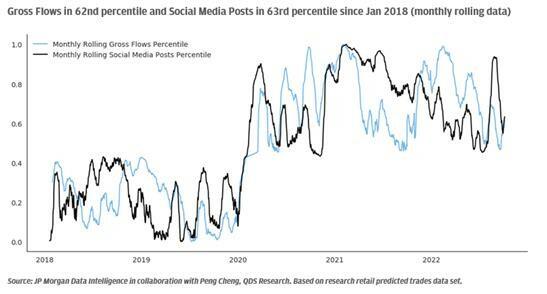
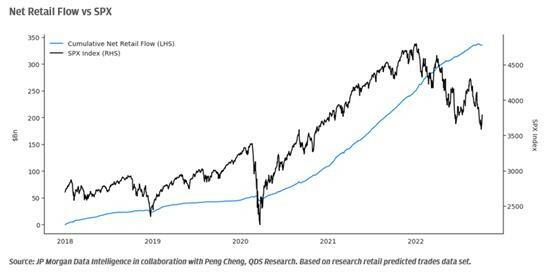
Even more notable is that as the chart below shows, the last two weeks represented the worst selling in single stocks since March 2020 (on the other hand, inflows into ETFs, although showing signs of slowdown, remained positive).
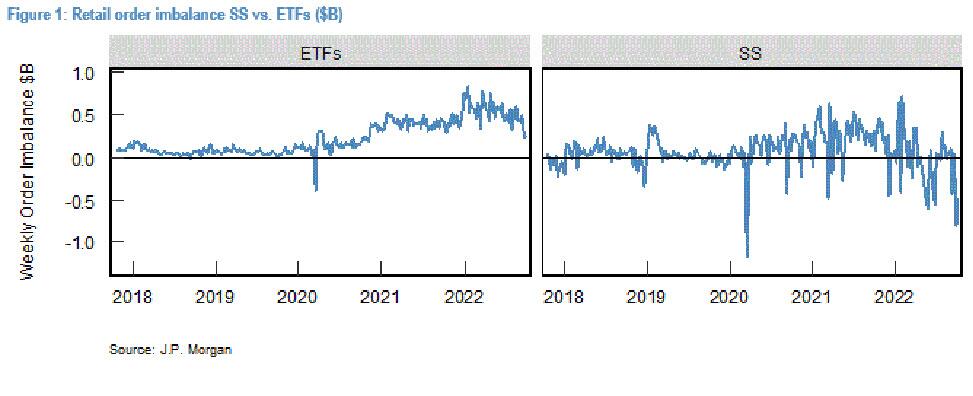
Some more details broken down by industry group and thematic:
- Large-cap: At the industry group level, volumes were slightly higher, driven by Autos and Consumer Services, partially offset by Tech Hardware. Looking at Large-cap single-stock, retail pared down exposure again this past week (-$2.0B) across most industry groups. We again observed some of the strongest retail selling across Technology, especially Tech Hardware (e.g. AAPL, CSCO). This was partially offset by buying within Autos (e.g. TSLA, RIVN, QS).
- Thematic: Retail investors again shed exposure this past week across themes, though Green / EV Infrastructure (JPAMIGRN) and Long Rising Oil Beneficiaries (JPAMNRGY) were marginal bright spots. We observed heavier selling across Domestic (JPAMDOME) and Covid-19 Domestic Recovery (JPAMCRDB). On the wage side, we also saw Retail cut exposure to US Wage Growth Sensitive Basket (JPAMWAGG)
Bearish sentiment was also evident in the options market. According to JPM, retail traders sold -$1.0B of delta and bought $520MM of gamma this past week. They supplied -$1.3B of delta on SPX/SPY, QQQ, and IWM, mostly via put option buying.
Finally, just to make things "interesting", here is the latest confirmation that anyone trying to make even a little sense of the market is destined for catastrophic failure: as noted above, JPM said that "retail investors sold the rally on both Monday and Tuesday."
Well, one look at VandaTrack's latest weekly research shows that "retail investors have been chasing the last two days rebound by buying US$ 860 mn worth of US securities on Monday and US$ 960 mn on Tuesday. A considerable amount given that they are usually contrarian and reduce their purchases during rallies. We expect this trend to continue and foresee a slowdown in inflows if the rebound will fade; however, we could see a ramp up in purchases if the rally gains traction."
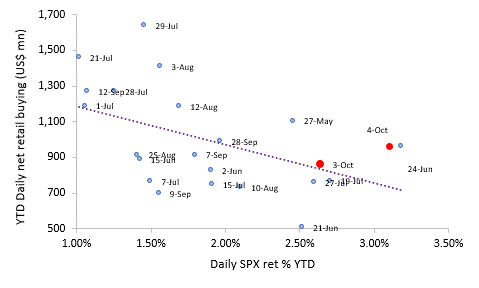
And while retail investors may have bought... or sold... stock in during the latest meltup, depending on whose "research" one reads, one thing is clear: the recent sell-off in retail favorites such as AAPL and TSLA has had a large impact on retail portfolios’ performance and as of yesterday, the average retail portfolio’s relative drawdown is again close to -32% and has started to underperform the S&P 500 again.
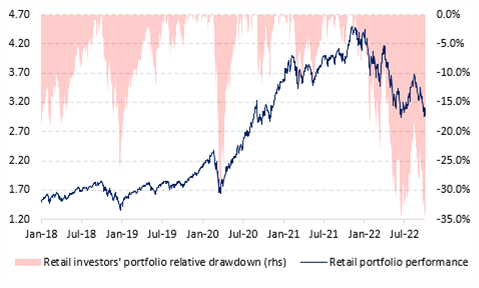
As Vanda notes, "additional losses will be both financially and psychologically hard to handle for the average retail trader", and the greater the eventual drawdown, the less likely retail will be to rush into the next dip and buy it.
Porsche overtakes VW as Europe’s most valuable carmaker
Sports car maker takes crown from parent company a week after initial public offering
Porsche has become Europe’s most valuable carmaker, taking the crown from parent company Volkswagen just a week after going public in one of the region’s largest-ever flotations.
Shares in the sports car group climbed 3.5 per cent to €91 on Thursday, giving Porsche a market capitalisation of €82.9bn and eclipsing Volkswagen, which was valued at €78.3bn.
VW braved a grim economic backdrop and the downturn in global stock markets to sell 12.5 per cent of Porsche, its most profitable brand, as the group tries to fund a major push into electric vehicles.
While VW has lost its title, Porsche’s rapid ousting of its parent company as Europe’s most valuable car group provides vindication for the initial public offering. VW executives had hoped that investors would attach a higher valuation to Porsche, a luxury brand that produces far fewer cars than its parent.
The shift in valuations between the two groups echoes what happened with Italian sports car maker Ferrari, whose valuation eclipsed that of its parent Fiat following its 2015 IPO.
After being sold for €82.5 each, shares in Porsche climbed on their debut and have outperformed Germany’s benchmark Dax index since. However, the share price has been supported by the banks that advised on the IPO, which purchased the stock between September 29 and October 4.
Shares in Porsche, which sells roughly 300,000 cars a year versus the 10m that VW does, had dipped below their IPO price earlier this week.
VW said measures to support the stock in the early days of trading were necessary because “September inflation data, renewed concern about energy supplies in Europe . . . and a worsening of the situation in Ukraine”, had made the market backdrop tougher.
VW plans to return some of the €9.4bn it raised through the Porsche IPO to its shareholders via a special dividend, as well as ploughing money into electric vehicles.
UK to sign deal with EU energy partnership amid thawing relations
Truss agrees 2023 summit with Macron as meeting of European nations leads to first post-Brexit tie-up
The UK is poised to sign a deal with an EU energy partnership it left after Brexit, in the first concrete result of warming ties between Brussels and London.
The voluntary North Seas Energy Cooperation (NSEC), which focuses on supporting the construction of wind farms and distribution networks in the region, is made up of the European Commission, eight member states and Norway.
Since leaving the EU in 2020, the UK has shown little enthusiasm for formal collaboration with Brussels. However, the need to find alternatives to Russian gas because of the war in Ukraine has led to a change of heart.
The UK is preparing to sign a memorandum of understanding with the NSEC, in effect rejoining. It cannot be a formal member, however, unless it signs up to internal market rules.
Liz Truss, the British prime minister, spoke to leaders of neighbouring countries about energy security at the inaugural meeting in Prague of a new grouping of European states, the European Political Community.
She had lunch with host Petr Fiala, the prime minister of the Czech Republic, holder of the rotating EU presidency.
Fiala said: “Our presidency aims to complete the process enabling the UK to join the North Seas Energy Cooperation as soon as possible. This step will strengthen European energy co-operation and security in the face of Russian aggression and energy price manipulation.”
Truss also had bilateral meetings with French president Emmanuel Macron and Dutch premier Mark Rutte on the margins of the summit. Both France and the Netherlands are NSEC members.
Rutte later told reporters that he supported closer energy ties with the UK. The Netherlands and Belgium supply electricity through interconnectors to the UK in the winter, when there is generally a shortfall.
“We discussed exactly . . . how to work together as North Sea countries on issues like hydrogen, issues like wind energy, but also on gas and the connections between countries like the Netherlands, Britain, but also Germany, Belgium, France. So this was an excellent discussion.”
The nine NSEC countries have agreed to increase the capacity of offshore wind energy to at least 260 gigawatts by 2050.
Belgian prime minister Alexander de Croo joked to reporters that his country had “kept the lights on in London three months ago” when there had been an electricity shortage. He said he supported more joint infrastructure in the region and more interconnectors.
Truss had spoken to the leaders of 44 countries attending the meeting and urged them to keep supplying power to the UK through their interconnectors. The UK has been chosen to host the planned fourth meeting of the EPC group in 2024.
The UK prime minister released a joint statement with Macron saying that they would hold a Franco-British summit in 2023, the first since Brexit, “to take forward a renewed bilateral agenda”.
They further agreed to deepen co-operation on illegal migration within the bounds of international law, to tackle criminal groups trafficking people across Europe ending in dangerous journeys across the Channel. Interior ministers are due to conclude a package of measures on the issue this autumn.
Asked about an earlier comment when she questioned whether Macron was a “friend or foe”, she told reporters: “He is a friend.”
“We’re both very clear: the foe is Vladimir Putin.”
Macron said he hoped the move on NSEC marked a “new phase of our common relations”. “Having the UK being engaged in a lot of common initiatives makes sense, because we share the same continent. We have a lot of challenges in common,” he said.
“Our willingness is clearly to work together for the unity of our continent.”
Talks over how to resolve the post-Brexit trading relationship — that had soured relations and led the EU to exclude the UK from its Horizon research programme — have resumed, raising hopes of a deal.
Tiger Global slows pace of investment with scaled-down fund
Prominent technology investor seeks $6bn for new private equity vehicle less than half the size of predecessor
Tiger Global is raising a private equity fund that will target $6bn in investment, less than half the amount raised for a prior fund, as the prominent technology investor slows its once breakneck pace.
The fundraising began on Thursday, according to a letter sent to limited partners and obtained by the Financial Times. Chase Coleman, Tiger’s billionaire founder, has been seeking investors willing to buy into the technology downturn that has battered his group’s portfolio.
Tiger’s preceding private equity fund of $12.3bn closed in February. The $6bn private fund is below early targets of about $8bn, according to a person familiar with the situation.
People close to Tiger believe the new fund’s smaller scale of investments will match lower valuations after the market rout this year.
The group has promised it will invest less than half the fund in its first year, a more measured pace than the prior fund, which is already mostly invested. The size of Tiger’s typical investment has also been nearly halved to about $30mn.
The letter said Tiger would attempt to take advantage of opportunities such as secondary sales of private technology companies whose values have fallen in the financial market downturn.
The diminished fundraising and defensive approach comes as the $63bn in assets Tiger confronts upheaval. Its flagship fund fell about 50 per cent this year to July, according to documents sent to limited partners, while it has marked down its more than $45bn portfolio of private technology investments each month this year, it recently told investors.
The fund group has also experienced turnover among investment staff. On Monday, Tiger announced that former partner John Curtius, who headed the firm’s software and business services private equity investments, would be leaving.
Curtius had been expected to temporarily stay on following the announcement to ensure an orderly handoff of his portfolio to others inside Tiger. “John will work closely with other investment team members over the coming months to transition his responsibilities,” Tiger said on Monday.
However, as of Thursday he was no longer an employee, said three people familiar with the situation. Curtius is planning to launch an investment firm called Cedar Investment Management, people with knowledge of the matter said.
Curtius had been one of Tiger’s most prolific investors, leading over 100 venture capital investments, according to PitchBook data, including investments made as recently as September 27.
This week, Tiger Global fielded questions at meetings with limited partners who sought to get a better understanding of Curtius’s sudden departure, said two people directly involved with the matter.
Coleman and Scott Shleifer, head of Tiger’s private investment business, decided this summer that Curtius would leave the firm amid concerns over the autonomy he was seeking in managing an increasingly large portfolio, people close to Tiger said.
Internally and in discussions with limited partners, Tiger has described itself as a collaborative firm, where investors overseeing public and private investments from the US to Brazil, India and China work closely together to identify investments.
People close to Curtius painted a different picture. In recent months, he had been looking for the opportunity to start his own firm to capitalise on a dramatic reset in valuations across the industry, they said.
Tiger Global and Curtius declined to comment.
Closing Stock Market SummaryThe stock market had a rough showing today while it continued to deal with concerns that it got carried away with expectations of a Fed policy pivot soon and amid some hesitancy in front of the September Employment Report on Friday.
The major averages were influenced by the behavior of the Treasury market today. The 2-yr note yield, which saw 4.14% earlier, traded above Friday's close and settled at 4.23%, up ten basis points for the day. The 10-yr note yield, stood at 3.74% overnight, but also traded above Friday's close and settled at 3.83%, up seven basis points for the day.
As Treasury yields moved higher, the major indices moved lower and struggled to mount a comeback effort today. They ultimately finished near their worst levels of the session.
The US Dollar Index jumped 1.0% to 112.18, acting as an additional headwind for the equity market.
There was also some hawkish Fed speak for participants to digest. Atlanta Fed President Bostic (2024 FOMC voter) said the inflation fight is still in the early days and Minneapolis Fed President Kashkari (2023 FOMC voter) said he is not comfortable pausing until there is evidence of inflation cooling.
In addition, there was heightened geopolitical uncertainty after OPEC+ agreed to cut production by 2 million barrels per day starting in November, a move that drew sharp criticism from the White House. WTI crude oil futures rose 1.0% today to $88.51/bbl.
Today's stock market losses were broad based but somewhat modest in scope relative to recent gains. The major indices fell between 0.6% and 1.1%.
The rising price of oil boosted the S&P 500 energy sector (+1.8%), which was the only sector to close with a gain. Meanwhile, utilities (-3.3%) and real estate (-3.2%) fell to the bottom of the pack.
Market breadth showed decliners outpacing advancers by a greater than 2-to-1 margin at the NYSE and a 3-to-2 margin at the Nasdaq.
Looking ahead to Friday, market participants will receive the following economic data:
- 8:30 ET: September Nonfarm Payrolls (consensus 250,000; prior 315,000), Nonfarm Private Payrolls (consensus 275,000; prior 308,000), Average Hourly Earnings ( consensus 0.3%; prior 0.3%), Unemployment Rate (consensus 3.7%; prior 3.7%), and Average Workweek (consensus 34.5; prior 34.5)
- 10:00 ET: August Wholesale Inventories (prior 0.6%)
- 15:00 ET: August Consumer Credit (prior $23.30 bln)
Reviewing today's economic data:
- Initial jobless claims for the week ending October 1 increased by 29,000 to 219,000 ( consensus 203,000) while continuing jobless claims for the week ending September 24 increased by 15,000 to 1.361 million.
- The key takeaway from the report is that initial claims -- a leading indicator -- have a lot more scope for deterioration before the Fed can be convinced that its rate hikes have induced a sufficient softening in the labor market to ease wage-based inflation pressures.
- Weekly EIA natural gas inventories showed a build of 129 bcf versus a build of 103 bcf last week
Dow Jones Industrial Average: -17.6% YTD
S&P Midcap 400: -18.1% YTD
S&P 500: -21.4% YTD
Russell 2000: -22.0% YTD
Nasdaq Composite: -29.2% YTD
Research Calls
- Upgrades:
- Credit Suisse (CS) upgraded to Neutral from Underweight at JP Morgan
- Group 1 Auto (GPI) upgraded to Overweight from Neutral at JP Morgan; tgt $210
- Pinterest (PINS) upgraded to Buy from Neutral at Goldman; tgt raised to $31
- RPM Inc (RPM) upgraded to Overweight from Neutral at JP Morgan; tgt raised to $100
- Sonic Automotive (SAH) upgraded to Overweight from Neutral at JP Morgan; tgt $60
- Steel Dynamics (STLD) upgraded to Buy from Neutral at Goldman; tgt lowered to $88
- Take-Two (TTWO) upgraded to Buy from Neutral at Goldman; tgt raised to $165
- TechnipFMC (FTI) upgraded to Overweight from Equal Weight at Barclays; tgt raised to $14
- Transocean (RIG) upgraded to Overweight from Underweight at Barclays; tgt raised to $5
- Verizon (VZ) upgraded to Outperform from Perform at Oppenheimer; tgt $50
- Westlake Corporation (WLK) upgraded to Neutral from Sell at UBS; tgt raised to $95
- Downgrades:
- ArcelorMittal (MT) downgraded to Neutral from Buy at UBS
- AutoNation (AN) downgraded to Neutral from Overweight at JP Morgan; tgt $125
- BTRS Holdings (BTRS) downgraded to Sector Weight from Overweight at KeyBanc Capital Markets
- Equity Residential (EQR) downgraded to Market Perform from Outperform at BMO Capital Markets; tgt lowered to $74
- Fair Isaac (FICO) downgraded to Neutral from Outperform at Robert W. Baird; tgt lowered to $475
- First Quantum Minerals (FQVLF) downgraded to Neutral from Outperform at Exane BNP Paribas
- Freeport-McMoRan (FCX) downgraded to Neutral from Outperform at Exane BNP Paribas; tgt $29
- Global Medical REIT (GMRE) downgraded to Market Perform from Outperform at BMO Capital Markets; tgt lowered to $9
- Reliance Steel (RS) downgraded to Neutral from Buy at Goldman; tgt lowered to $201
- Silvergate Capital (SI) downgraded to Underweight from Overweight at Wells Fargo; tgt lowered to $70
- Venator Materials (VNTR) downgraded to Sell from Neutral at UBS; tgt lowered to $0.65
- Others:
- Aclaris Therapeutics (ACRS) initiated with a Buy at BTIG Research; tgt $32
- Akoya Biosciences (AKYA) initiated with an Overweight at Stephens; tgt $16
- Bally's Corporation (BALY) initiated with a Hold at Deutsche Bank; tgt $23
- Bread Financial (BFH) initiated with a Neutral at Credit Suisse; tgt $38
- CrowdStrike (CRWD) initiated with an Outperform at Evercore ISI; tgt $250
- DraftKings (DKNG) initiated with an Underperform at Exane BNP Pariba
- Element Solutions (ESI) initiated with an Underperform at Credit Suisse; tgt $15
- Entegris (ENTG) initiated with an Outperform at Credit Suisse; tgt $108
- Guardant Health (GH) initiated with an Overweight at Stephens; tgt $99
- Myriad Genetics (MYGN) initiated with an Equal-Weight at Stephens; tgt $22
- Okta (OKTA) initiated with an Underperform at Evercore ISI; tgt $45
- Palo Alto Networks (PANW) assumed with an Outperform at Evercore ISI; tgt $207
- ENN Entertainment (PENN) initiated with a Buy at Canaccord Genuity; tgt $50
- Verve Therapeutics (VERV) initiated with a Neutral at Credit Suisse; tgt $48
- Viavi (VIAV) initiated with a Buy at Rosenblatt; tgt $18
- Western Alliance Bancorp (WAL) initiated with a Neutral at JP Morgan; tgt $85
- Zscaler (ZS) initiated with an Outperform at Evercore ISI; tgt $235