9to5 : Here’s how to test iPhone 14 Emergency SOS via satellite before you actua


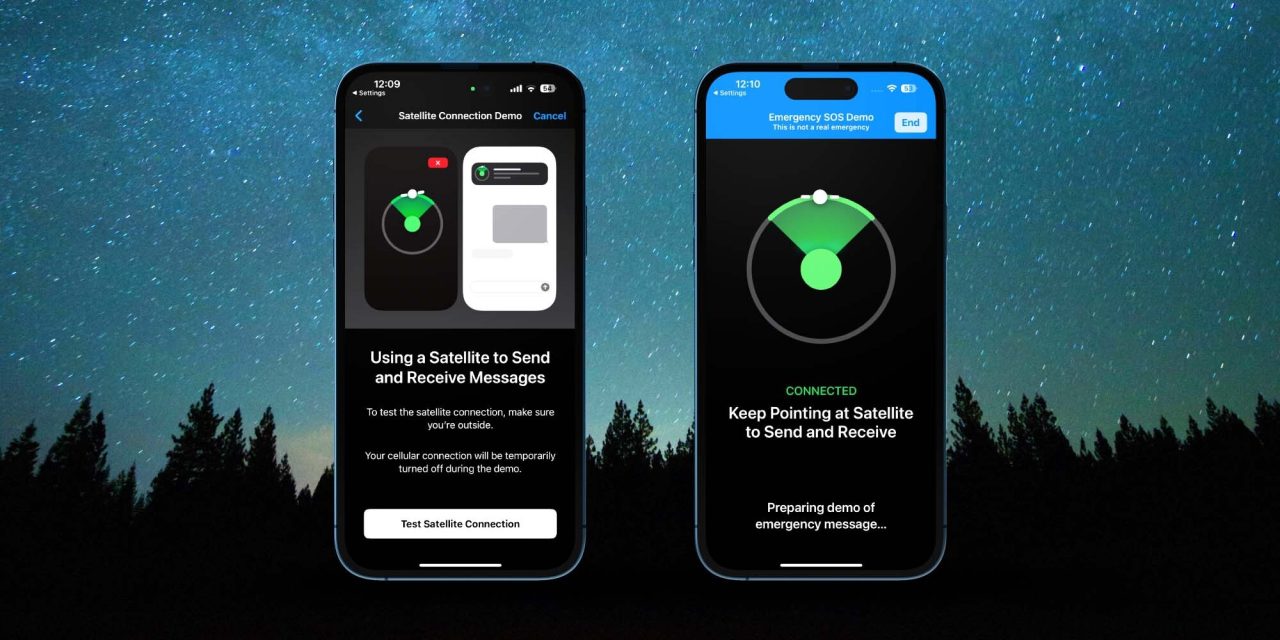
Apple’s new Emergency SOS iPhone via satellite feature is now live in the US and Canada with support for more countries coming soon. Read on for how to test iPhone Emergency SOS messages via satellite so you know how to use it in case you ever need to rely on it.


Apple launched the new safety feature for iPhone 14 users today. Here’s how the company describes it:
“Available on all iPhone 14 models, the innovative technology enables users to message with emergency services while outside of cellular and Wi-Fi coverage. Additionally, if users want to reassure friends and family of their whereabouts while traveling off the grid, they can now open the Find My app and share their location via satellite. Emergency SOS via satellite is available in the US and Canada starting today, November 15.”
It’s an impressive feature to include with the iPhone 14 lineup as standalone satellite messaging devices or phones can cost as much as $1,000.
How to test and use iPhone Emergency SOS via satellite
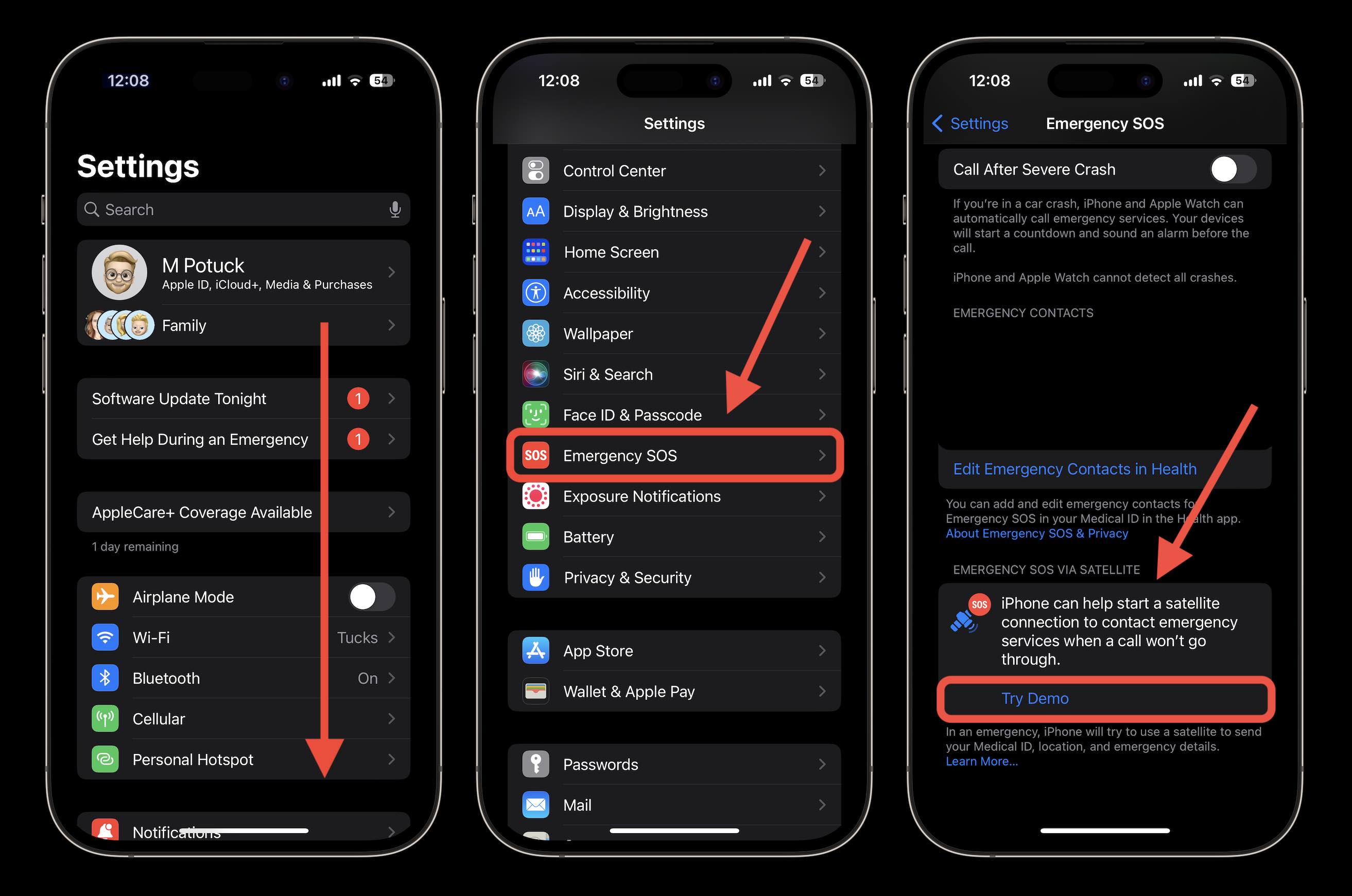
  1. Open the Settings app on your iPhone 14
  2. Swipe down and choose Emergency SOS
  3. Swipe to the bottom, under Emergency SOS via Satellite, tap Try Demo
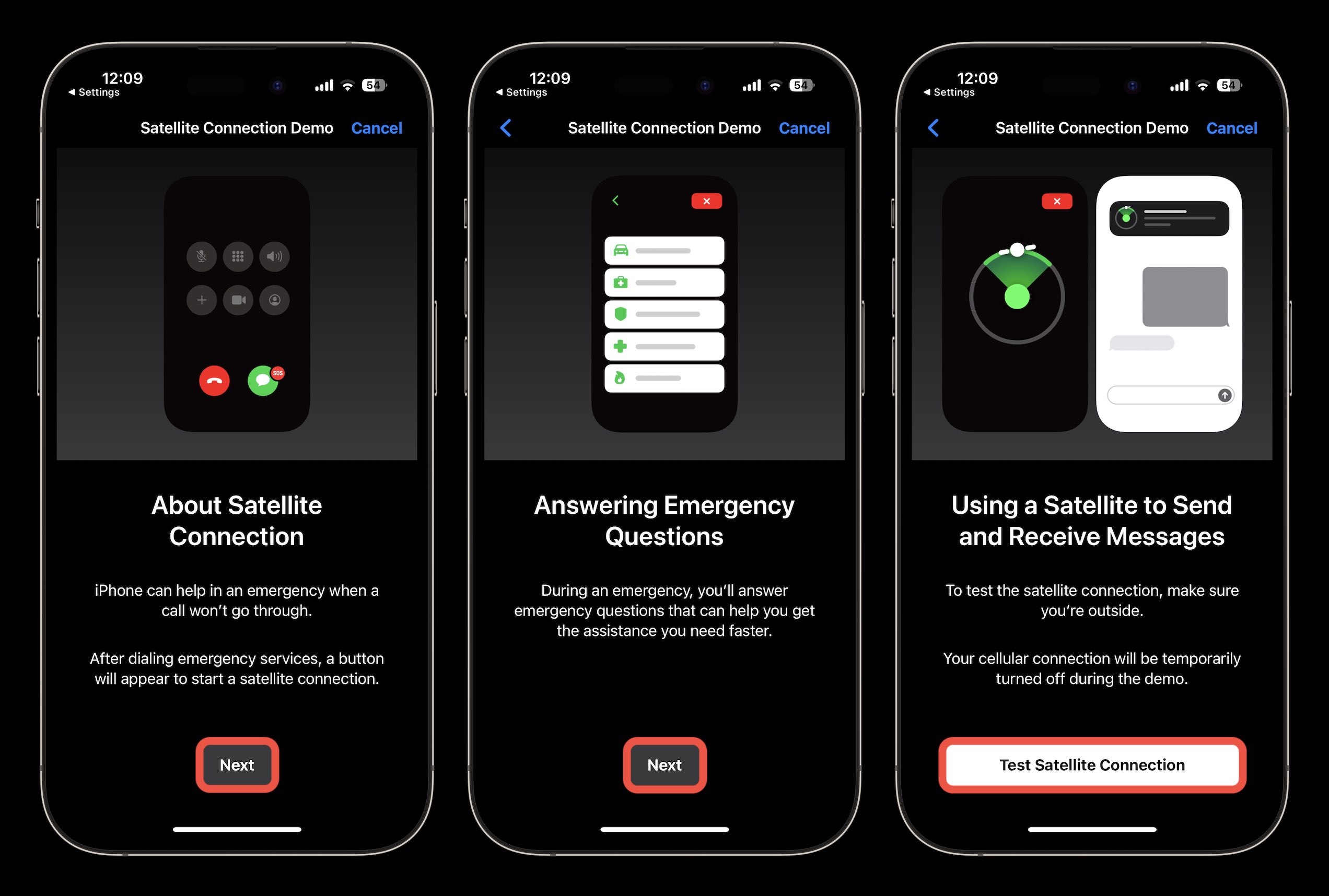
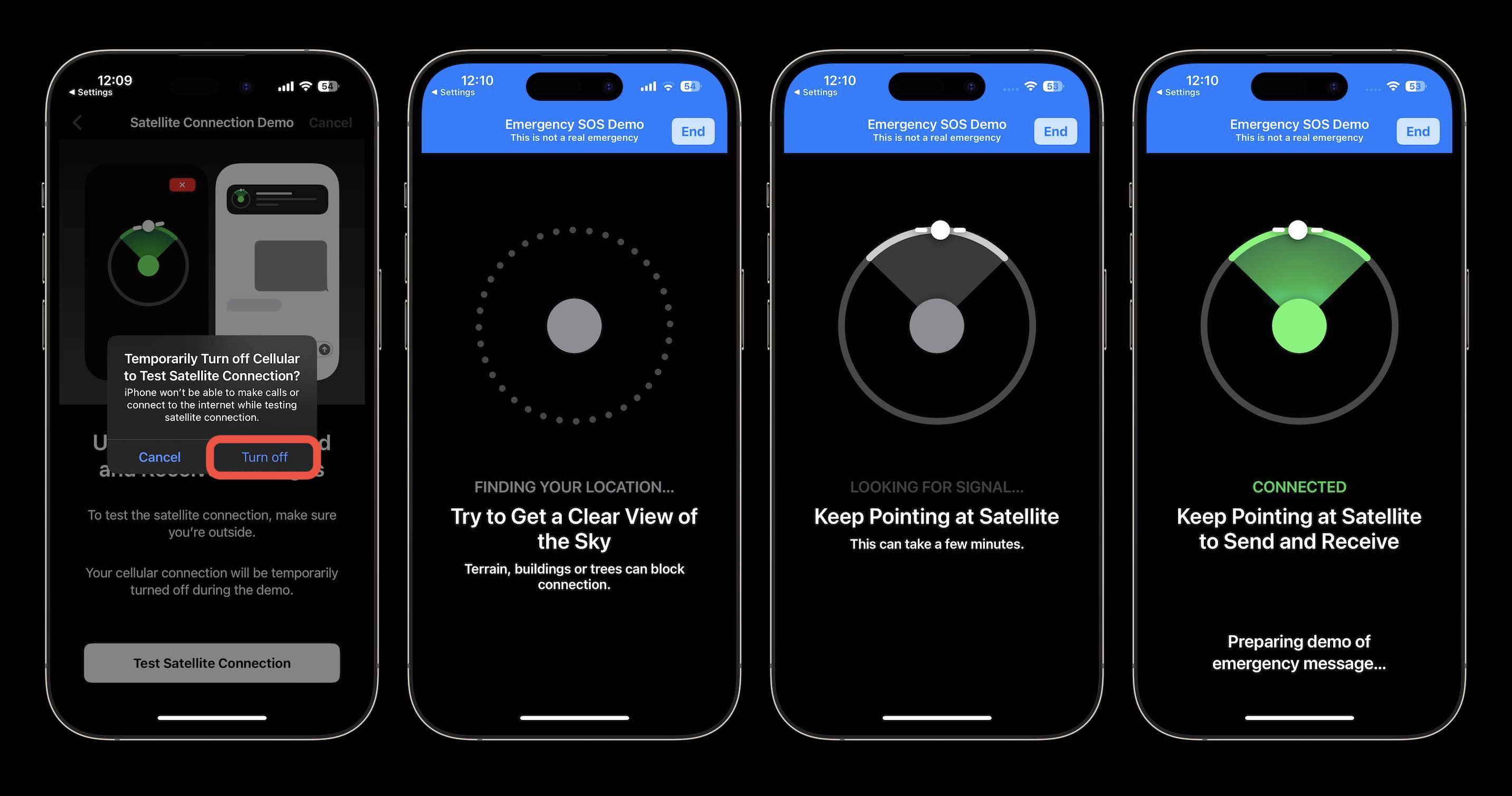
  4. Follow the prompts
You may see a new “Get Help During an Emergency” button at the top of your Settings app screen. This walks you through updating and familiarizing yourself with all of iPhone’s emergency features.
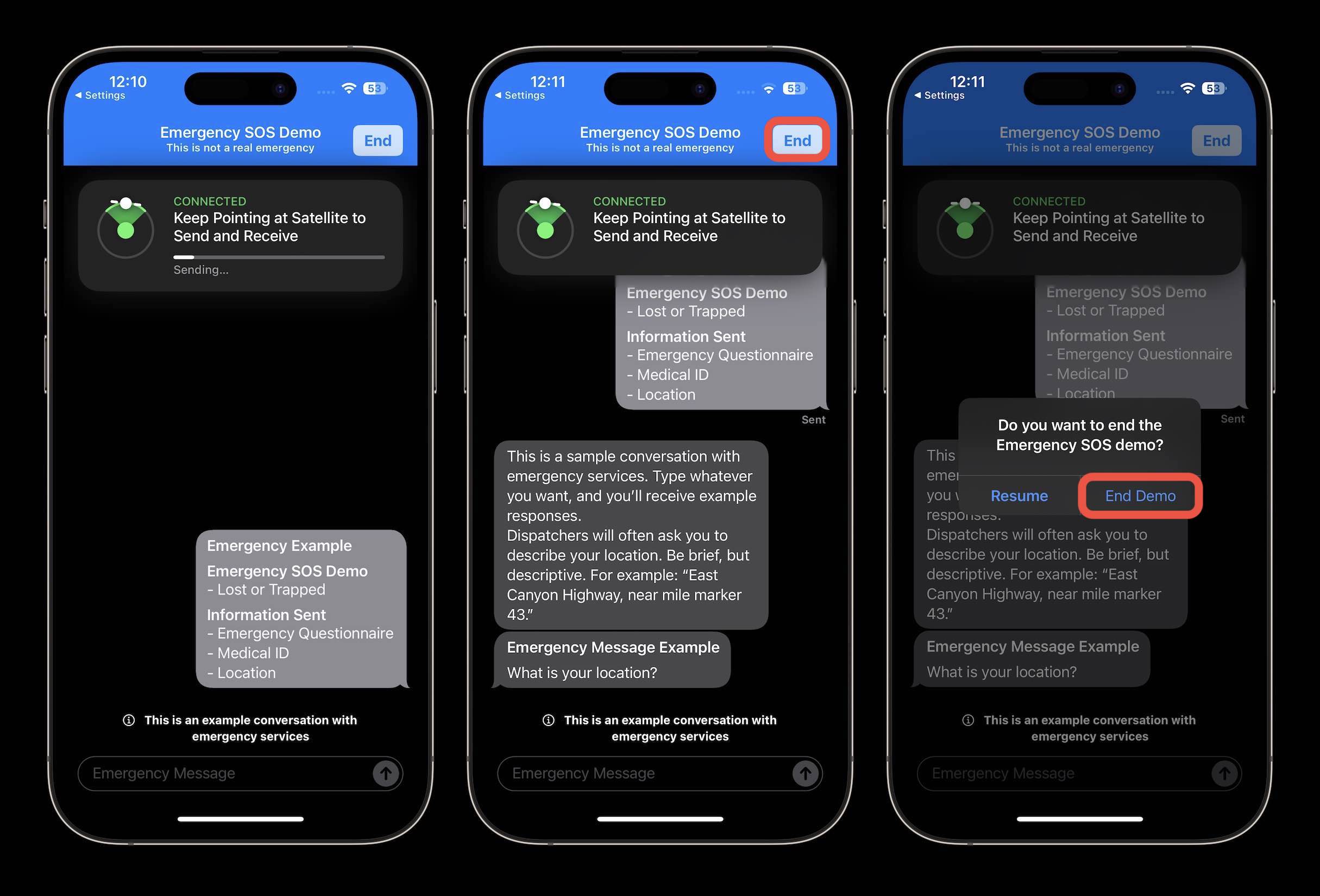
Here’s how the process looks:
After you’ve successfully connected with a satellite, you can practice responding to the demo’s emergency messages if you’d like.
When finished, tap End in the top right corner, then End Demo in the middle of your screen.
How to use the feature in a real emergency (US and Canada for now)
  • As noted in the demo, in a real emergency, try calling 911 (or your local emergency number)
  • If the call doesn’t go through – your iPhone 14 will offer to start a satellite connection, proceed as you did in the test
Check out more details on iPhone Emergency SOS in real-world use and our other resources on Apple’s emergency features:

9to5 : Emergency SOS via satellite available today; UK, France, Germany, Ireland

When Apple announced the iPhone 14 line-up, it said that the Emergency SOS via satellite service would be launching in November. It last week reiterated that, providing a little more information. Today, the service is live in the US and Canada.
Additionally, Apple has also revealed that the feature will go live in four more countries sometime next month …


Emergency SOS via satellite
The iPhone 14’s Emergency SOS via Satellite feature was one of the headline announcements made during the launch event, and the reason for the Far Out name and space visuals.
The service operates via Globalstar satellites specifically designed to provide services to smartphones. It allows access to 911 services when you are in isolated areas without cellular coverage.
The service will eventually be subscription-based, but Apple says it will be free for all iPhone 14 owners in compatible countries for the first two years. We don’t yet know what the subscription will cost at the end of the free period.
Live in the US and Canada
Apple made the announcement today.
Apple today announced its groundbreaking safety service Emergency SOS via satellite is now available to customers in the US and Canada. Available on all iPhone 14 models, the innovative technology enables users to message with emergency services while outside of cellular and Wi-Fi coverage. Additionally, if users want to reassure friends and family of their whereabouts while traveling off the grid, they can now open the Find My app and share their location via satellite. Emergency SOS via satellite is available in the US and Canada starting today, November 15.
“Some of the most popular places to travel are off the beaten path and simply lack cellular coverage. With Emergency SOS via satellite, the iPhone 14 lineup provides an indispensable tool that can get users the help they need while they are off the grid,” said Greg Joswiak, Apple’s senior vice president of Worldwide Marketing. “Our teams worked tirelessly to tackle a new set of technical challenges to bring this service to life, in addition to building a reliable on-the-ground infrastructure. Emergency SOS via satellite is a breakthrough service available only on the iPhone 14 lineup, and a new innovation that we hope will provide our customers some peace of mind.”
The company went on to announce availability plans for four more countries.
[It] will come to France, Germany, Ireland, and the UK in December.
Available for all iPhone 14 models
The feature is available on any iPhone 14 model.
Every model in the iPhone 14 lineup — iPhone 14, iPhone 14 Plus, iPhone 14 Pro, and iPhone 14 Pro Max — can connect directly to a satellite through a combination of custom-designed components and deeply integrated software.
Emergency SOS via satellite builds on existing features vital to iPhone users, including Emergency SOS, Medical ID, emergency contacts, and Find My location sharing, offering the ability to connect to a satellite for a more 360-degree approach to sharing critical information with emergency services, family, and friends.
This game-changing service allows Public Safety Answering Points (PSAPs) — or emergency services call centers — to connect to even more users in emergency situations, and requires no additional software or protocols to enable communications. Users will be connected directly to emergency services that are equipped to receive text messages, or to relay centers with Apple-trained emergency specialists who are ready to contact PSAPs that cannot receive text messages on the user’s behalf.
How it works
Apple walked us through the service during the keynote, and has summarized how the service works.
iPhone can quickly and easily call emergency services if a user is in need of help, even if they are unable to dial 911. With Emergency SOS via satellite — introduced with the iPhone 14 lineup — if a user is not able to reach emergency services because no cellular or Wi-Fi coverage is available, an easy-to-use interface appears on iPhone to get the user help utilizing a satellite connection. A short questionnaire appears to help the user answer vital questions with a few simple taps, which is transmitted to dispatchers in the initial message, to ensure they are able to quickly understand a user’s situation and location. Apple worked closely with experts to review standard questions and protocols to identify the most common reasons for calling emergency services.
Following the questionnaire, the intuitive interface guides the user where to point their iPhone to connect and sends the initial message. This message includes the user’s questionnaire responses; location, including altitude; iPhone battery level; and Medical ID, if enabled. The questionnaire and follow-up messages are relayed directly via satellite to dispatchers that accept text messages, or to relay centers staffed by Apple‑trained specialists who can call for help on the user’s behalf. The transcript can also be shared with the user’s emergency contacts to keep them informed.
A key benefit is that 911 centers need no extra equipment to receive these messages.
“We dedicate our lives to helping people in need, but there are inevitably people who are not able to contact a dispatcher. Emergency SOS via satellite will allow us to help iPhone users in more remote areas who might not otherwise be able to reach us,” said Jennifer Kirkland, ENP, the Grand Junction Regional Communication Center’s 911 center manager. “Because this service requires no additional technology for PSAPs [Public Safety Answering Points], and because Apple has implemented a relay center model that 911 operators are familiar with, we can expect a seamless rollout, both for the PSAPs that accept text messages, and for those that are still voice-only.”
The feature includes a demo mode, so you can familiarize yourself with how it works, so you’ll be ready in a real emergency.
Using the built-in Emergency SOS via satellite demo, users can test satellite connectivity on their iPhone by connecting to a real satellite in range without calling emergency services, allowing them to experience the process and familiarize themselves with the service.
The system also expands the availability of the Find My feature.
For users who go off the grid but don’t experience an emergency, this advanced technology also enables them to share their location via satellite with Find My. In the Find My app, users can open the Me tab, swipe up to see My Location via Satellite, and tap Send My Location. The satellite connection on the iPhone 14 lineup also works with other safety features available on iPhone and Apple Watch, including Crash Detection and Fall Detection.
Apple has provided a support document for the service.

WWD : French Department Store Galeries Lafayette Expands to India

French Department Store Galeries Lafayette Expands to India
The company will partner with Aditya Birla on two outposts in Mumbai and New Delhi.

PARIS – Famed French department store Galeries Lafayette is setting up shop in India.

The retailer will open its doors in Mumbai and New Delhi through an exclusive partnership agreement with local fashion group Aditya Birla Fashion and Retail Limited, and will launch a dedicated website for the country.

The 86,000-square-foot space in the southern city of Mumbai is scheduled to open in 2024. London-based architectural firm Virgile & Partners will helm the project, which will be housed inside two century-old buildings in the historic Fort district. Virgile has previously helmed the revamp of the Harrods luxury accessories space, as well as the design of the Andaz hotel in New Delhi.

The store will carry more than 200 local and international brands, with personalized shopping, digital check-in and omnichannel connections to cater to the “millennial luxury” customer.

The second location in India’s capital will open in the upscale DLF Emporio shopping center in a 60,000- square-foot space there.

“We are proud to expand our international footprint in such a prestigious and refined market as India, where we believe our brand can benefit from a strong potential,” Galeries Lafayette and BHV Marais chief executive officer Nicolas Houzé said in a statement.

“This is a coming-of-age moment for Indian luxury. India is now home to a generation of young, and affluent consumers, with global exposure, who are willing to spend on the finer things in life. This is visible in the boom and dynamism of the luxury market. The partnership with Galeries Lafayette is a ringing endorsement of India’s significance as a global luxury market and a future engine of growth for luxury brands,” said Aditya Birla managing director Ashish Dixit.

“The Aditya Birla Group’s deep and nuanced understanding of the luxury landscape on the back of our portfolio of designer brands, combined with Galeries Lafayette’s global experience, will enable us to create a world-class destination for Indian consumers and global luxury brands,” he added.

Aditya Birla operates 3,500 stores across India, with a mix of international and local brands in single and multi-brand retailers, as well as being the distributor of American Eagle, Fred Perry, Hackett London, Ralph Lauren, Reebok and Ted Baker in the country.

The India outposts are part of Galeries Lafayette’s plan to open 20 stores outside of France by 2025, with a focus on China, Asia and the Middle East.

The group opened stores in Doha, Qatar; Luxembourg, Luxembourg, and Shanghai, China, in 2019. Its outposts in Beijing and Shanghai are run with partner I.T Limited, and Galeries Lafayette has announced further projects in Macau and Chongqing. A Shenzhen store is planned for early 2023, and the group aims to have 10 stores in China by 2025.

WSJ : FTX’s New Chief Says ‘Complete Failure’ of Oversight Contributed to Firm’s

FTX’s New Chief Says ‘Complete Failure’ of Oversight Contributed to Firm’s Downfall
The crypto exchange’s new CEO in a court filing said he has no confidence in FTX financial statements because many weren’t audited

FTX’s new chief executive said lax controls over the company’s billions of cash and cryptocurrency assets under the leadership of Sam Bankman-Fried has left current management scrambling to establish just how much money the bankrupt crypto platform has today.

The declaration made in a Delaware bankruptcy court on Thursday marks the first attempt by FTX’s new chief executive, appointed shortly before the company filed for bankruptcy, to explain what went wrong at the company. John J. Ray, who acted as Enron’s chairman in the years after the company collapsed, took over as CEO last week and his first official act was to authorize the company’s bankruptcy filing, he said.

“Never in my career have I seen such a complete failure of corporate controls and such a complete absence of trustworthy financial information as occurred here,” Mr. Ray said in the court filing. “From compromised systems integrity and faulty regulatory oversight abroad, to the concentration of control in the hands of a very small group of inexperienced, unsophisticated and potentially compromised individuals, this situation is unprecedented.”

Mr. Ray said that while many of FTX’s balance sheets show the company holding substantial assets that exceed their liabilities, he has no confidence in those financial statements because many weren’t audited and said the court shouldn’t rely on them to be accurate.

For example, Alameda Research LLC, which acted as a “crypto hedge fund” inside of FTX, reported assets of over $13 billion and liabilities of over $5 billion, Mr. Ray noted.

The lack of audited financial statements is one among a list of such “unacceptable management failures” Mr. Ray lays out. Other failings include no record of board meetings and inadequate internal controls over cash management. Mr. Ray noted that FTX didn’t have an accurate list of bank accounts holding its cash.

He added that FTX used the lack of oversight to help “conceal the misuse of customer funds” and keep little record over internal decision making. To date, FTX has only secured roughly $740 million in cryptocurrency that belongs to FTX entities including Alameda Research, which is only “a fraction” of FTX’s digital assets that the company hopes to recover.

Mr. Ray’s and the board’s immediate goals are to protect and recover assets, “a substantial portion of which may be missing or stolen,” and investigate claims against the company’s founders and third parties. Moreover, they plan to implement oversight and audit controls over the company’s business, Mr. Ray said.

Mr. Ray said he has been working around the clock alongside advisers including Alvarez & Marsal, Sullivan & Cromwell LLP, Nardello & Co., and others to answer questions from regulators including the Securities and Exchange Commission, the Commodity Futures Trading Commission and the U.S. attorney’s office in the Southern District of New York.

>>> US Research Calls

Research Calls

  • Upgrades:
    • Agios Pharma (AGIO) upgraded to Neutral from Sell at Goldman; tgt raised to $32
    • Allete (ALE) upgraded to Neutral from Underweight at JP Morgan; tgt $65
    • Ardelyx (ARDX) upgraded to Overweight from Neutral at Piper Sandler; tgt raised to $8
    • Banco Bradesco (BBD) upgraded to Overweight from Neutral at JP Morgan
    • Intercontinental Exchange (ICE) upgraded to Buy from Neutral at BofA Securities; tgt raised to $132
    • NVIDIA (NVDA) upgraded to Buy from Hold at Summit Insights
    • Pinnacle West (PNW) upgraded to Peer Perform from Underperform at Wolfe Research
    • Target (TGT) upgraded to Overweight from Neutral at Piper Sandler; tgt raised to $200
  • Downgrades:
    • Advance Auto (AAP) downgraded to Hold from Buy at Truist; tgt lowered to $147
    • Advance Auto (AAP) downgraded to Neutral from Buy at Citigroup; tgt lowered to $161
    • Advance Auto (AAP) downgraded to Neutral from Buy at Guggenheim
    • AppLovin (APP) downgraded to Neutral from Overweight at JP Morgan; tgt lowered to $18
    • Aveanna (AVAH) downgraded to Neutral from Outperform at Credit Suisse; tgt lowered to $2
    • GrainCorp Ltd (GRCLF) downgraded to Underperform from Sector Perform at RBC Capital Mkts
    • IQVIA (IQV) downgraded to Neutral from Buy at Citigroup; tgt lowered to $245
    • Kinnate BioPharma (KNTE) downgraded to Hold from Buy at Stifel; tgt lowered to $11
    • LPL Financial (LPLA) downgraded to Neutral from Buy at UBS
    • Membership Collective Group (MCG) downgraded to Neutral from Overweight at JP Morgan; tgt lowered to $7
    • Norwegian Cruise Line (NCLH) downgraded to Underperform from Outperform at Credit Suisse; tgt lowered to $14
    • Principal Fincl (PFG) downgraded to Underperform from In-line at Evercore ISI; tgt raised to $81
    • Principal Fincl (PFG) downgraded to Underweight from Equal-Weight at Morgan Stanley; tgt raised to $79
    • Public Service (PEG) downgraded to Peer Perform from Outperform at Wolfe Research
    • Quest Diagnostics (DGX) downgraded to Sell from Neutral at Citigroup; tgt lowered to $125
    • REE Automotive (REE) downgraded to Neutral from Buy at BTIG Research
    • Science Applications (SAIC) downgraded to Hold from Buy at Jefferies; tgt $110
    • Target (TGT) downgraded to Hold from Buy at Deutsche Bank; tgt lowered to $144
    • Target (TGT) downgraded to Market Perform from Outperform at BMO Capital Markets; tgt lowered to $165
    • Two Harbors Investment (TWO) downgraded to Sector Perform from Outperform at RBC Capital Mkts; tgt lowered to $16
  • Others:
    • Citizens & Northern Corp. (CZNC) resumed with a Neutral at Piper Sandler; tgt $26
    • Dragonfly Energy (DFLI) initiated with a Buy at Stifel; tgt $12
    • Edgewell Personal Care (EPC) initiated with a Buy at Canaccord Genuity; tgt $48
    • e.l.f. Beauty (ELF) initiated with a Buy at Canaccord Genuity; tgt $63
    • Energizer (ENR) initiated with a Hold at Canaccord Genuity; tgt $34
    • Energy Recovery (ERII) initiated with a Buy at B. Riley Securities; tgt $28
    • Estee Lauder (EL) initiated with a Hold at Canaccord Genuity; tgt $228
    • Grove Collaborative Holdings (GROV) initiated with a Buy at Canaccord Genuity; tgt $2
    • Helen of Troy (HELE) initiated with a Buy at Canaccord Genuity; tgt $120
    • Hippo (HIPO) initiated with an Outperform at Keefe Bruyette; tgt $24
    • KemPharm (KMPH) initiated with an Overweight at Cantor Fitzgerald; tgt $20
    • LSB Industries (LXU) initiated with an Outperform at RBC Capital Mkts; tgt $20
    • Middleby (MIDD) initiated with a Buy at Canaccord Genuity; tgt $171
    • OceanFirst Finl (OCFC) assumed with a Mkt Perform at Raymond James
    • Orrstown Financial Services (ORRF) resumed with a Neutral at Piper Sandler; tgt $28
    • Olaplex (OLPX) initiated with a Buy at Canaccord Genuity; tgt $8
    • Prestige Consumer (PBH) initiated with a Buy at Canaccord Genuity; tgt $71
    • Solo Brands (DTC) initiated with a Buy at Canaccord Genuity; tgt $7
    • Theratechnologies (THTX) initiated with an Overweight at Cantor Fitzgerald; tgt $9
    • Thorne HealthTech (THRN) initiated with a Buy at Canaccord Genuity; tgt $5.50
    • Traeger (COOK) initiated with a Buy at Canaccord Genuity; tgt $6
    • Vaxcyte (PCVX) initiated with a Buy at BTIG Research; tgt $69
    • Whirlpool (WHR) resumed with a Neutral at Goldman; tgt $160
    • YETI Holdings (YETI) initiated with a Buy at Canaccord Genuity; tgt $58

>>> US Gapping down

Gapping down
In reaction to earnings/guidance
:

  • GLBE -10.4%, KLIC -10.1% (also increases dividend), PLCE -8.7%, BOWL -5.7%, WB -4.2%, KSS -3.8%, SBLK -2%, CPRT -1.6%, BABA -1.3%

Other news:

  • TNYA -18.8% (prices public offering consisting of common stock and warrants)
  • BNOX -15.9% (prices offering of 641026 ADSs at $7.80 per ADS)
  • DZSI -13.4% (prices offering of 3377315 shares of common stock at $11.50 per share)
  • ORA -8.7% (prices offering of 3.75 mln shares of common stock at $90.00 per share)
  • EDIT -8.6% (clinical data from the Phase 1/2 BRILLIANCE trial of EDIT-101)
  • SI -5.2% (provides mid-quarter update)
  • CAAP -4.8% (reports October traffic)
  • MKL -4.6% (Thomas Gayner to be become sole CEO upon retirement of Richard Whitt on Jan 1)
  • PBR -2.1% (cutting liquefied petroleum gas sales prices for distributors)
  • UBER -1.3% (NYC pitching a minimum wage of $23.82/hr by 2025 for app-based delivery workers according to Bloomberg)
  • TSLA -1.1% (James Murdoch says Musk has identified a potential successor as CEO according to Reuters)
  • FANG -1.1% (to acquire all leasehold assets and related assets of Lario Permian)
  • ATVI -1.1% (Blizzard Entertainment and NetEase (NTES) suspending game services in China)

Analyst comments:

  • DGX -3.5% (downgraded to Sell from Neutral at Citigroup)
  • TWO -1.3% (downgraded to Sector Perform from Outperform at RBC Capital Mkts)
  • SAIC -1.1% (downgraded to Hold from Buy at Jefferies)
  • IQV -1% (downgraded to Neutral from Buy at Citigroup)

>>> US Gapping up

Gapping up
In reaction to earnings/guidance
:

  • BBWI +21.5%, BV +9.7%, M +8.1%, CSCO +4.1%, DOLE +3.7%, CPA +3%, BJ +3%, SONO +2.6% (also authorizes new repurchase program of up to $100 mln; names new CFO), CLBT +2%, SQM +1.9%

Other news:

  • ARDX +68% (reports FDA Advisory Committee votes that the benefits of XPHOZAH (tenapanor) outweigh its risks for the control of serum phosphorus in adult patients with chronic kidney disease on dialysis)
  • MRNS +4.6% (has entered into a collaboration and supply agreement with Tenacia Biotechnology)
  • IXHL +3.7% (provided development update for IHL-42X for obstructive sleep apnoea)
  • UROY +3% (acquires U.S. Uranium Royalty Portfolio from Anfield Energy)
  • CTRM +2.4% (to effect a spin-off of its tanker fleet)
  • DLO +2% (responds to short seller report; says report contains "numerous inaccurate statements groundless claims and speculation")
  • ARNC +1.1% (authorizes new $200 mln share repurchase program)
  • ESPR +1% (names new CFO)

Analyst comments:

  • THTX +8% (initiated with an Overweight at Cantor Fitzgerald; tgt $9)

>>> US Early premarket gappers


Early premarket gappers

  • Gapping up:
    • ARDX +77%, BBWI +21.1%, CTRM +7.2%, CPA +6.2%, SONO +3.9%, CSCO +3.5%, SQM +3.3%, KKR +3.1%, DOLE +2.7%, ARNC +1.9%, NVDA +1.6%, HOOD +1.4%, ESPR +1%, PBR +0.9%
  • Gapping down:
    • TNYA -20.1%, DZSI -14.9%, BNOX -13.2%, GLBE -11.3%, ORA -9%, SI -7.5%, MKL -4.6%, NTES -4.3%, BOWL -3.8%, WB -3.4%, SBLK -3.3%, CPRT -3.3%, KLIC -2.4%, HP -1.2%, ATVI -1.1%, UBER -1%, UEC -0.8%, DASH -0.8%, FSLR -0.7%

(ZH) Germany Preparing For Emergency Cash Deliveries, Bank Runs And "Aggressive

Germany Preparing For Emergency Cash Deliveries, Bank Runs And "Aggressive Discontent" Ahead Of Winter Power Cuts

While Europe has been keeping a generally optimistic facade ahead of the coming cold winter, signaling that it has more than enough gas in storage to make up for loss of Russian supply even in a "coldest-case" scenario, behind the scenes Europe's largest economy is quietly preparing for a worst case scenario which include angry mobs and bankruns should blackouts prevent the population from accessing cash.
As Reuters reports citing four sources, German authorities have stepped up preparations for emergency cash deliveries in case of a blackout (or rather blackouts) to keep the economy running, as the nation braces for possible power cuts arising from the war in Ukraine. The plans include the Bundesbank hoarding extra billions to cope with a surge in demand, as well as "possible limits on withdrawals", one of the people said. And if you think crypto investors are angry when they can't access their digital tokens in a bankrupt exchange, just wait until you see a German whose cash has just been locked out.
Officials and banks are looking not only at origination (i.e., money-printing) but also at distribution, discussing for example priority fuel access for cash transporters, according to other sources commenting on preparations that accelerated in recent weeks after Russia throttled gas supplies.
The planning discussions involve the central bank, its financial market regulator BaFin, and multiple financial industry associations, said the Reuters sources most of whom spoke on condition of anonymity about plans that are private and in flux.
Although German authorities have publicly played down the likelihood of a blackout and bank runs - for obvious reasons - the discussions show both how seriously they take the threat and how they struggle to prepare for potential crippling power outages caused by soaring energy costs or even sabotage. They also underscore the widening ramifications of the Ukraine war for Germany, which has for decades relied on affordable Russian energy and now faces double-digit inflation and a threat of disruption from fuel and energy shortages.
As everyone familiar with the recent history of the Wimar Republic Germany knows, access to cash is of special concern for Germans, who value the security and anonymity it offers, and who tend to use it more than other Europeans, with some still hoarding Deutschmarks replaced by euros more than two decades ago.
According to a recent Bundesbank study, roughly 60% of everyday German purchases are paid in cash, and Germans, on average, withdrew more than 6,600 euros annually chiefly from cash machines.
And here is the punchline: a parliamentary report a decade ago warned of "discontent" and "aggressive altercations" in case citizens were unable to get their hands on cash in a blackout. Translation: in case of cash withdrawal halts, German society may very well tear itself apart.
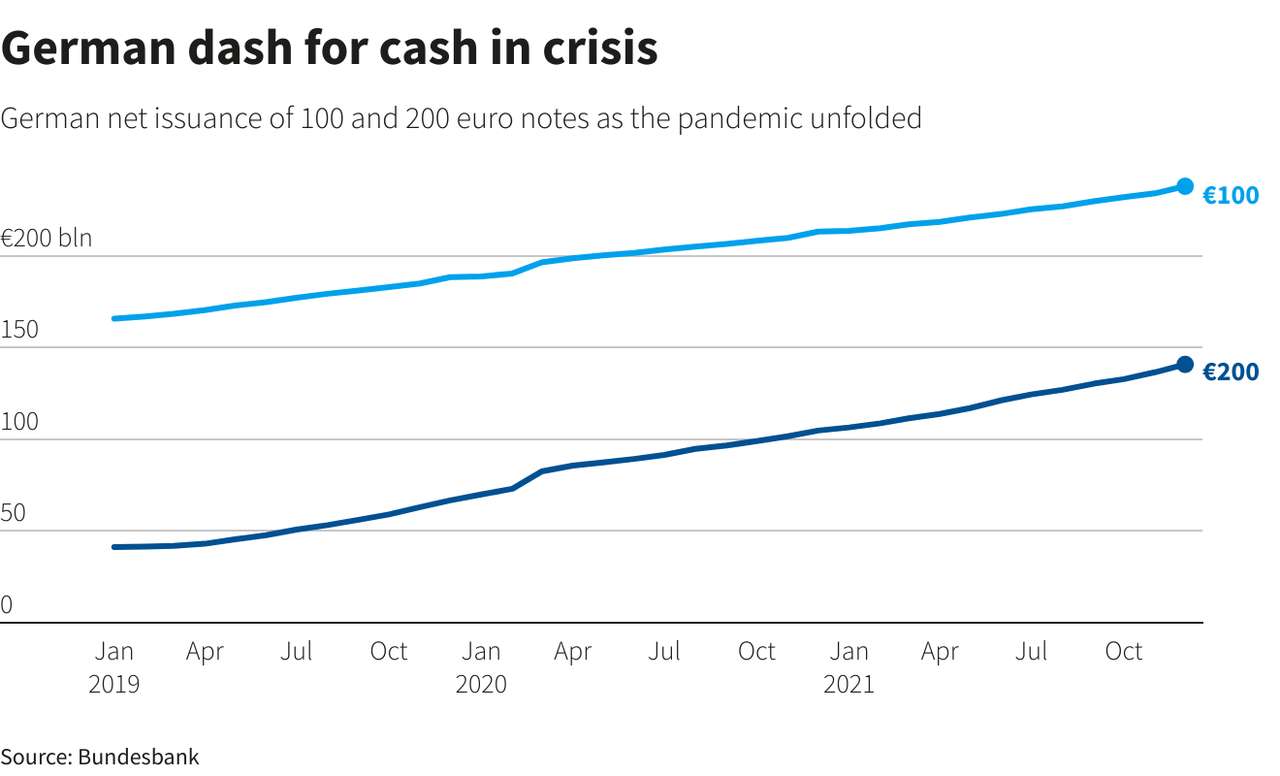
Indeed, there was a rush for cash at the beginning of the pandemic in March 2020, when Germans withdrew 20 billion more euros than they deposited. That was a record, and it worked generally without a hitch. But a potential blackout raises new questions about possible scenarios, and officials are intensively revisiting the issue as the energy crisis in Europe's largest economy deepens and winter nears.
If a blackout struck, one option for policymakers could be to limit the amount of cash individuals withdraw, said one of the people. Needless to say, that would be a very bad option for Germany, and for fiat in general (after all, if the FTX bankruptcy is a black eye for crypto, what can one say about fiat if one of the world's most advanced economies limits access to cash). The Bundesbank processes cash moving through Germany's shops and economy, removing fakes and keeping circulation orderly. Its massive stocks make it ready for any spike in demand, that person said.
One weakness that planning exposed involves security firms that transport money from the central bank to ATMs and banks. The industry, which includes Brinks and Loomis is not fully covered by law guiding priority access to fuel and telecommunications during a blackout, according to the industry organization BDGW.
"There are big loopholes," said Andreas Paulick, BDGW director. Armoured vehicles would have to line up at petrol stations like everyone else, he said. The organization hosted a meeting last week with central bank officials and lawmakers to press its case.
"We must preventively tackle the realistic scenario of a blackout," Paulick said. "It would be totally naive to not talk about this at a time like now."
How bad could it get? Well, more than 40% of Germans fear a blackout in the next six months, according to a survey last week published by Funke Mediengruppe. And since at least one blackout is virtually assured in the coming months, that means a stampede for the nearest ATM, something the local financial infrastructure will unlikely be able to handle.
As a result, Germany's disaster office said it recommended people keep cash at home for such emergencies (surely this will inspire confidence).
Meanwhile, another Reuters source notes that German financial regulators worry that banks are not fully prepared for major power outages and view it as a new, previously unforeseen risk. Banks consider a full-scale blackout "improbable", according to Deutsche Kreditwirtschaft, the financial sector's umbrella organization. But banks nevertheless are "in contact with the relevant ministries and authorities" to plan for such a scenario, especially since anything banks say is "improbable" tends to happen rather regularly. It said finance should be considered as critical infrastructure if energy is rationed.
At times politics can get in the way of blackout planning. In Frankfurt, Germany's banking capital, one city council member proposed requiring it to present a blackout plan by Nov. 17. The politician, Markus Fuchs of the right-wing AfD party, told the council it would be irresponsible not to plan for one. But the other parties rejected the proposal, accusing Fuchs and his party of inciting panic.
Fuchs later said in a phone interview: "If we found a solution for world peace, it would be rejected." The issue also underscores the dependence of commerce on technology, with transactions increasingly electronic, and where most cash machines have no emergency power source.
Cash would be the only official payment method that would still work, said Thomas Leitert, chief of KomRe, a company that advises cities on planning for blackouts and other catastrophes.
"How else will the ravioli cans and candles be paid for?" Leitert said. Well, there is that whole crypto thing, but the 2nd biggest Democratic donor did a bang up job there...