FT : European fighter jet project moves into next phase

European fighter jet project moves into next phase
Europe’s biggest weapons programme had been mired by delays and Franco-German recriminations

Europe’s largest weapons programme took a big leap forward on Friday when Germany, France and Spain struck a deal on the next phase of their much-delayed project for a new combat aircraft.

The three nations have reached an industrial agreement to take the Future Combat Air System project forward after intense negotiations, Germany’s defence ministry announced on Friday.

It had also been agreed at the highest government level that a “co-operative approach on an equal footing” would be pursued in the project, the ministry added, noting that it was “under overall French responsibility”. 

“The political agreement on FCAS is a great step and — especially in these times — an important sign of the excellent Franco-German-Spanish co-operation,” Germany’s defence minister Christine Lambrecht said.

“It strengthens Europe’s military capabilities and secures important knowhow not only for our, but also for the European industry.”

The Elysée palace confirmed the German announcement, which it said followed “intense negotiations” that involved high-level political officials. The French presidency added: “It has been demonstrated once again that we can meet considerable challenges together.”

The agreement breaks the log jam that has held up the programme amid what had been protracted industrial wrangling over workshare and technology sharing between Airbus and Dassault Aviation, the two main industrial partners involved.

Recent tensions between Berlin and Paris over energy policy in the wake of the war in Ukraine had further complicated the situation.

The agreement paves the way for the start of the development of the demonstrator jet, which is estimated to cost about €3.8bn.

Launched by Berlin and Paris in 2017 — Spain joined in 2019 — the programme is seen as a critical building block for the region’s defence and security ambitions. Along with the FCAS programme, which France was supposed to lead, the countries also agreed to collaborate on a future tank project, dubbed the Main Ground Combat System, which Germany would lead.

Although industrial agreements were reached on six of the FCAS project’s seven pillars — spanning manned and unmanned aircraft, space communications and stealth technologies — divisions remained on the seventh pillar — the next-generation fighter jet itself.

Dassault has always stressed that it had to be the clear leader in the development of the aircraft. A deal on this phase was supposed to have been reached last year.

Airbus said the agreement “represents a big step forward for this European flagship defence programme”. 

It cautioned, however, that a “number of formal steps” still had to be taken in the respective countries “in order to allow a speedy contract signature which we will have to adhere to”. The company said it would provide further updates on the programme once the contract between industry and the three nations was ready for final signature.

Dassault declined to comment.
WSJ : FTX’s Sam Bankman-Fried Cashed Out $300 Million During Funding Spree

FTX’s Sam Bankman-Fried Cashed Out $300 Million During Funding Spree
Cryptocurrency-exchange founder told investors last year that the share sale was partial reimbursement of money he’d spent to buy out

When FTX raised $420 million from an array of big-name investors in October 2021, the cryptocurrency exchange said the money would help expand the business, improve user experience and allow it to engage more with regulators.

Left unmentioned was that nearly three-quarters of the money, $300 million, went instead to FTX founder Sam Bankman-Fried, who sold some of his personal stake in the company, according to FTX financial records reviewed by The Wall Street Journal and people familiar with the transaction.

Mr. Bankman-Fried’s cashout was large by startup world standards, where such sales historically were taboo, because they allow founders to reap profits before investors. Mr. Bankman-Fried told investors at the time it was a partial reimbursement of money he’d spent to buy out rival Binance’s stake in FTX a few months earlier, according to some of the people familiar with the transaction.

The deal offers a glimpse at the swirl of money between Mr. Bankman-Fried and multiple entities he controlled while his crypto business flourished, a funding stream that helped finance a burst of political donations, philanthropic commitments and a large purchase of Robinhood Markets Inc. stock in the past year.

That swirl is now under scrutiny in the sprawling bankruptcy of FTX and Alameda Research LLC, Mr. Bankman-Fried’s crypto hedge fund. FTX, which lent customer funds to Alameda, faces a funding gap of roughly $8 billion, Alameda and FTX executives have said.

John Ray, FTX’s new chief executive installed to oversee the bankruptcy, said in a court filing Thursday the process would involve the “comprehensive, transparent and deliberate investigation into claims against Mr. Samuel Bankman-Fried” and other co-founders of the entities.

The filing highlighted numerous failings, including “the concentration of control in the hands of a very small group of inexperienced, unsophisticated and potentially compromised individuals.”

Mr. Bankman-Fried’s sale of stock in October 2021 came in the midst of a six-month fundraising blitz that ultimately brought in roughly $2 billion from investors including Sequoia Capital, funds managed by BlackRock Inc. and the Singapore sovereign-wealth fund Temasek.

The October 2021 fundraising valued the company at $25 billion. In a press release, Mr. Bankman-Fried said he was happy “to partner with investors that prioritize positioning FTX as the world’s most transparent and compliant cryptocurrency exchange.”

The amount raised contained numerical references to marijuana and oral sex: $420.69 million raised from 69 investors. An article published by one of FTX’s investors, Sequoia, called that fundraising a “meme round,” referring to the embedded jokes.

Three months earlier, in July 2021, Mr. Bankman-Fried bought out the roughly 15% stake owned by Binance, FTX’s first outside investor. Binance CEO Changpeng Zhao tweeted this month that the amount totaled $2.1 billion, paid in a combination of FTT, FTX’s in-house cryptocurrency, and BUSD, Binance’s stablecoin, whose value is pegged to the U.S. dollar.

It couldn’t be learned where Mr. Bankman-Fried came up with the money for the Binance stake. At the time, crypto was booming and Alameda was highly profitable, Mr. Bankman-Fried has said. Those finances came under question this week from Mr. Ray, who said prior numbers were unreliable and Alameda lacked audited financials.

After that sale, the FTX shares Binance previously owned ended up in Paper Bird Inc., according to FTX documents. Paper Bird is an entity 100% owned by Mr. Bankman-Fried, according to documents on FTX filed with Miami-Dade County.

Soon after Mr. Bankman-Fried bought out Binance’s stake, he spoke publicly about differences in the way he and Mr. Zhao ran their businesses and their approaches to regulators.

It couldn’t be determined what Mr. Bankman-Fried did with the $300 million and whether the money was plowed back into FTX or kept separate. FTX’s 2021 audited financial statements, viewed by the Journal, said the money was retained by the company for “operational expediency” on behalf of a “related party.”

FTX came back to investors for more money in January 2022, when it raised an additional $400 million.

Generally, venture investors frown on large sales of stock by founders before a company goes public, in part because they dislike the idea of a founder who put little or no money into a business getting rich before investors can cash out.

But during the frenzied years of startup investing of the past decade, the practice became more common, venture capital investors say, as investors lowered their standards to push their way into deals.

“It just isn’t a great sign,” said Charles Elson, a professor at the University of Delaware who studies corporate governance. It shows the company’s founder thinks there’s a better place to invest. “Anytime you see a founder selling shares in a secondary offering, you have to really ask them pretty tough questions,” he said.

Startups at which founders sold significant slugs of private stock before rocky public market debuts include WeWork Inc., Groupon Inc. and Zynga Inc.

Such sales are typically approved by a board of directors, where venture-capital investors generally have one or more seats. FTX’s board, though, had only three directors as of earlier this year: Mr. Bankman-Fried, an FTX employee and an Antigua lawyer who specializes in gaming.

(ZH) US Existing Home Sales Are Crashing At Their Fastest Pace 'Since Lehman'

US Existing Home Sales Are Crashing At Their Fastest Pace 'Since Lehman'

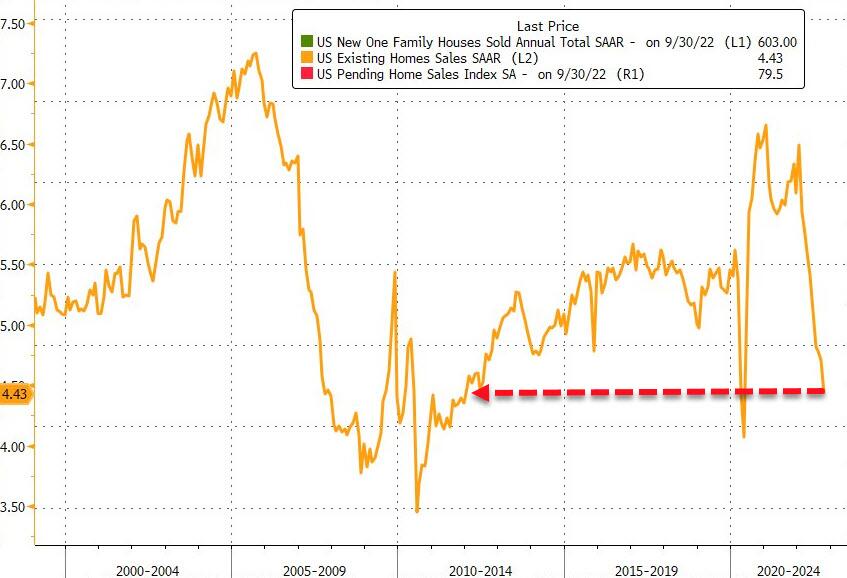
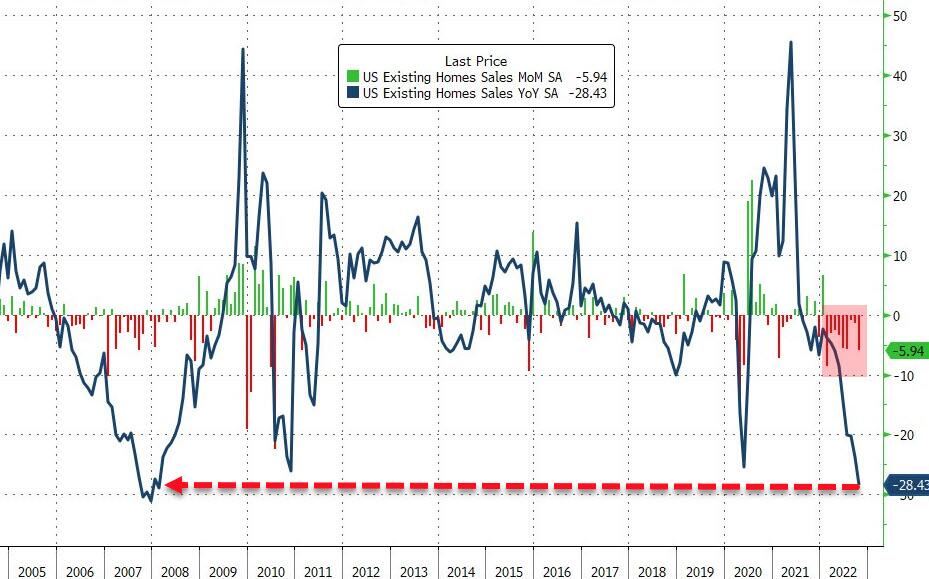
The first glimpse of October's housing market (after September's slump) is not a pretty one as US existing home sales in October collapsed 5.9% MoM (slightly better than the 6.6% expected). That is the 9th straight monthly decline in sales.
This monthly decline pushed the year-over-year drop in existing home sales to -28.4% - its worst level since 2008!
Source: Bloomberg
Absent the nadir of the COVID lockdowns, this is the lowest existing home sales SAAR since Dec 2011...
"More potential homebuyers were squeezed out from qualifying for a mortgage in October as mortgage rates climbed higher," said NAR Chief Economist Lawrence Yun.
"The impact is greater in expensive areas of the country and in markets that witnessed significant home price gains in recent years."
Total housing inventory registered at the end of October was 1.22 million units, which was down 0.8% from both September and one year ago (1.23 million). Unsold inventory sits at a 3.3-month supply at the current sales pace, up from 3.1 months in September and 2.4 months in October 2021.
"Inventory levels are still tight, which is why some homes for sale are still receiving multiple offers," Yun added.
"In October, 24% of homes received over the asking price. Conversely, homes sitting on the market for more than 120 days saw prices reduced by an average of 15.8%."
The median existing-home price for all housing types in October was $379,100, a gain of 6.6% from October 2021 ($355,700), as prices rose in all regions.
This marks 128 consecutive months of year-over-year increases, the longest-running streak on record.
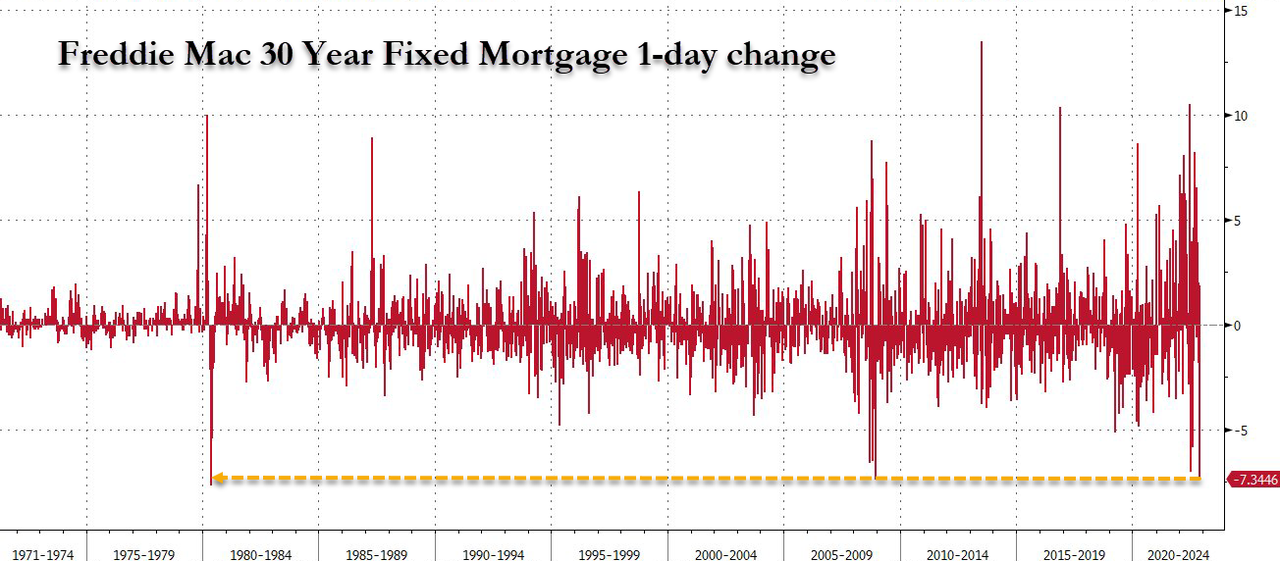
Finally, we note a potential silver lining for November data as mortgage rates plunged by nearly a half-percent this week, marking the largest week-over-week decline since November 1981. The rate on the average 30-year fixed mortgage fell to 6.61% from 7.08% the week prior, according to Freddie Mac, which this week changed its methodology calculating rates.
The drop follows a sharp decline in the yield on the 10-year Treasury last week after a government showed inflation cooled last month.
All-cash sales accounted for 26% of transactions in October, up from 22% in September and 24% in October 2021.

WWD : Meet 100mL, the Start-up Making Travel-size Beauty Convenient

Meet 100mL, the Start-up Making Travel-size Beauty Convenient
The fledgling company has partnered with brands like Aesop, Ursa Major and Maude to provide a one-stop online shopping destination for travel-size beauty and wellness products.
100mL, a start-up founded by Kate Cervini, is looking to capitalize on the return to travel.

The company has teamed with brands including Maude, Aesop, Fortuna Skin and more to build a curated online shopping destination that allows consumers to purchase travel-friendly sizes of skin, body, oral and hair care products.

“We want to help people create a relaxing experience in getting high-quality products for when they’re on the road,” said Cervini, adding that it was her own experience with last-minute, frenzied pre-travel shopping runs that spurred the idea for 100mL.

The company has signed 10 brand partners to date, a number Cervini says is slated to double by May, which is when 100mL will hard launch (although the company is up and running now at shop100ml.com).

Next spring, Cervini aims to host a handful of pop-ups in key cities around the globe, inaugurate a subscription offering in which shoppers can opt-in to receive customized, TSA-friendly pouches periodically and launch an app in 2024.

“My ultimate goal is to partner with an airline, or have airport locations and vending machines in certain airports” said Cervini, adding that she also envisions 100mL airport lounges, wherein consumers can receive hair, nail and skin services as they wait for their flight.

“We’re using this period as a great testing and research phase for us,” Cervini said. “It’s important for us to test the market and see what people are buying, at what price point; how many products people are buying, and then going from there.”

On the 100mL site, consumers can shop travel-size products by category, with the option to build their own pouch or choose from three curated pouches — En Route, Carry On or Nomad — each containing four products and costing between $70 to $140.

La Lettre A : LVMH trouve enfin son directeur de la sûreté et de la sécurité

LVMH trouve enfin son directeur de la sûreté et de la sécurité

Après une petite année d'atermoiements, le groupe de Bernard Arnault a trouvé son nouveau Monsieur sécurité en changeant le périmètre du poste précédemment occupé par Laurent Marcadier, mis en cause dans l'affaire d'espionnage du journal Fakir. Le nouveau venu est passé par Casino, un must en matière d'exigence de sûreté des lieux.

Des mois que ça durait. Sans doute un peu sonnée par le départ imposé en janvier de son ancien directeur de la protection des actifs et des personnes, Laurent Marcadier, après sa mise en cause dans l'affaire d'espionnage du journal Fakir, la direction de LVMH hésitait sur le périmètre exact du poste de son prochain directeur de la sécurité. Selon nos informations, le PDG Bernard Arnault vient finalement de trouver son homme en la personne de Jean-Robert Lefèvre.

Cet ancien militaire de carrière ne remplace pas Laurent Marcadier poste pour poste, puisque son titre serait "directeur des services généraux, de la sûreté et de la sécurité des sièges du groupe". Mais, comme Laurent Marcadier, il reportera à Jérôme Sibille, le directeur de l'administration générale et des affaires juridiques, qui lui-même reporte à Bernard Arnault. Il aura donc la responsabilité des différents sièges de l'avenue Montaigne et alentours, où est hébergée la majorité des petites maisons du leader mondial du luxe.

La garantie Naouri
Jusqu'ici directeur du bâtiment et de la sécurité du Centre Pompidou à Paris, cet officier de réserve de la gendarmerie a surtout été choisi pour avoir fait ses classes, de 2009 à 2020, comme directeur des services généraux du groupe Casino. Il y avait notamment été chargé de la sûreté des quatre sièges (la direction générale rue de l'Université à Paris, le paquebot de Saint-Etienne, Franprix à Vitry-sur-Seine et Monoprix à Clichy) et des événements, comme les assemblées générales. Vu le niveau d'exigence en matière de sécurité du PDG de Casino, Jean-Charles Naouri, les locaux du géant du luxe devraient être bien gardés.

C'est donc la fin d'une longue recherche pour LVMH, qui avait reçu de nombreuses candidatures et poussé les entretiens avec Alexis Marsan, numéro 2 de la Direction de l'ordre public et de la circulation (DOPC) à la préfecture de police (LLA du 13/09/22). Ou encore avec Nicolas Duquesnel, l'ancien chef d'état-major de la Direction de la sécurité de proximité de l'agglomération parisienne (DSPAP), débauché il y a un mois par Veolia d'après les informations de Glitz.paris (lire notre publication sœur du 13/10/22). L'actuel directeur des services généraux de LVMH, Grégory Rouca, devrait trouver un nouveau poste au sein du groupe.

Reuters - France, Germany, Spain agree on moving on with FCAS warplane developme

France, Germany, Spain agree on moving on with FCAS warplane development - sources - Reuters
18-Nov-2022 14:52:39
Adds German government

By Sabine Siebold and Michel Rose

BERLIN/PARIS, Nov 18 (Reuters) - France, Germany and Spain have reached agreement over starting the next phase of the development of a new fighter jet dubbed FCAS, Europe's largest defence project at an estimated cost of more than 100 billion euros, two sources told Reuters on Friday.

The three countries and their respective industries had struck a deal, said a defence source who spoke on condition of anonymity and did not give details.

A French official also confirmed that the industries, seen as the main stumbling blocks on the way to an agreement recently, had found a deal to move to the next phase of the warplane project.

The German government said that talks over the next phase were progressing.

"We have nothing new to report but we are on the right path," a defence ministry spokesperson told reporters in Berlin.

"... As soon as there is agreement, we will communicate it," he added.

Asked whether there will be an announcement at a meeting between German Chancellor Olaf Scholz and French Prime Minister Elisabeth Borne next Friday, Scholz's spokesman said: "We are very confident that we will be able to answer your question on Friday."

Previously, sources had said that the next development phase for the Future Combat Air System (FCAS) is expected to cost some 3.5 billion euros ($3.63 billion), to be shared equally by the three countries.

France's Dassault AM.PA, Airbus AIR.PA and Indra IDR.MC - the latter two representing Germany and Spain, respectively - are involved in the scheme to start replacing French Rafale and German and Spanish Eurofighters from 2040.

French President Emmanuel Macron and then German Chancellor Angela Merkel first announced plans in July 2017 for FCAS, which will include a fighter jet and a range of associated weapons, including drones.

Lately, the project - originally meant to unify Europeans after the migration crisis and Britain's decision to leave the European Union - has been a source of tension between the two countries.

Last month, Macron cancelled a joint Franco-German ministerial meeting over disagreements with Berlin on a wide range of issues including defence and energy projects.

Both sides had been struggling for more than a year to agree the next stage of FCAS's development, although the French and German government broadly agreed on the project.

Some sources saw the blame lying with Dassault, as the company had refused to budge in a long-running row over intellectual property rights.

Other sources blamed Airbus for pushing for a bigger workshare of the Dassault-led project, insisting it should be given "equal footing" with the French company.

FT : Cryptofinance: On the trail of Sam Bankman-Fried in The Bahamas

Cryptofinance: On the trail of Sam Bankman-Fried in The Bahamas
Crypto winter in the sunshine

Welcome to this week’s FT Cryptofinance newsletter, which comes to you from The Bahamas where I have been talking to people about FTX.

FTX was the big fish that The Bahamas reeled in as it sought to become a leading digital assets market in the heart of the Caribbean.

The plan was epitomised by FTX’s blowout conference in April, featuring appearances from Bahamas prime minister Philip Davis, Tony Blair, Bill Clinton, Katy Perry and NFL star Tom Brady and supermodel Gisele Bündchen (then still together).

Now that Sam Bankman-Fried’s crypto empire has exploded, a muffling fog of silence has descended on the island, as I have discovered during my stay here this week.

For the prime minister, FTX’s collapse is a serious challenge because he viewed its presence on the island as part of the country’s recovery from Hurricane Dorian in 2019 and the Covid-19 pandemic. As for Bankman-Fried, some say he kept himself to himself. “He’s just a young kid that’s hiding in Albany,” one cab driver told me.

Albany is a luxury resort community, jointly owned by Tiger Woods, Ernie Els, Justin Timberlake and Joe Lewis, the British entrepreneur.

One local told me Albany is an “island within an island”, a place where members can live out their entire lives, almost never having to leave. There is even a high school for kids. A 600-acre community, the mystery lies well beyond what the eye can see, even if — like me — you’re curious enough to show up unannounced at the security gates.

“I’m sorry you came all the way from London, but I can’t give you any information,” the guard said.

“FTX went to Albany because they wanted privacy, and they knew that’s what Albany offered,” one local told me. “Dubai is where people go to show off their money. Albany is where people go to keep it a secret.”

That’s secret in a non-ostentatious sense rather than a nefarious one. Still, it works like a charm when a storm hits. Repeated efforts to get behind Albany’s doors have come to nothing. Non-member passes were once on sale but one Albany employee told me none are available now. A car driver leaving the estate wouldn’t give comments to the press; in his haste to leave he nearly drove over my foot. Another employee told me curtly that: “Albany functions on confidentiality.”

Stefen Deleveaux, chief executive of the Caribbean Blockchain Alliance, said over lunch that people “just don’t really think about Albany”. “We’re not going to have the money to live there, I never really thought about it until this week.”

It’s not just Bankman-Fried’s gated community that is trying to avoid the spotlight. Over at Baha Mar, the luxury resort for that era-defining conference, the vast majority of staff told me they were not at liberty to discuss FTX or its disgraced former chief executive.

But one worker — who I found at the conference centre FTX used — told me “everyone was excited” when the crypto kings came to town.

The jazz club, I’m told, was a favourite among the FTX crew. But when push came to shove, Baha Mar also pulled the drawbridge.

“Nobody is going to tell you anything about anything,” one front-desk staff member told me. I pushed for an interview with the manager, they said: “You want an honest answer? My manager told me to tell you to Google it.”

The fact is, The Bahamas is a small place, and most people are simply unwilling to stick their neck out on “delicate” issues like this one. Not even the government: I have asked repeatedly for an interview with the prime minister but my requests have been turned down. “People don’t want to expose themselves to unwanted public scrutiny,” one Bahamian told me.

While some scurry to avoid awkward questions, in the palm trees and clear water beaches that surround the island it is ordinary people that lose out. A cab driver told me Bahamians are disappointed about FTX’s collapse because its arrival promised “good things” — like jobs for the economy.

As our video shows, FTX’s collapse could never be better symbolised than by the desolate and overgrown site that was meant to house the exchange’s future marquee office on the island.

Yet despite the wall of silence, I’d be remiss not to mention the scene at Nassau’s airport, which was still inexplicably running ads for FTX when I arrived. As one dismayed couple at passport control noted: “The first thing they tell you to do is to trust FTX!”