>>> What to look at today - 21st of December 2022

European and US stock futures advanced after the S&P 500 closed higher for the first time in four sessions, providing a moment of respite in one of the worst years for stocks and bonds in more than a decade. The picture in Asia was mixed with Japanese stocks falling, Australian shares rallying and Chinese benchmarks oscillating between gains and losses. The yen trimmed a fraction of its gains after the biggest one-day jump since 1998 on Tuesday, when it climbed almost 4% against the dollar on a surprise policy adjustment from the Bank of Japan. The impact of the BOJ’s surprise decision to let yields on 10-year government bonds trade up to 0.5%, from a previous ceiling of 0.25%, continues to reverberate. Ten-year Treasury yields rose slightly in Asia after jumping 10 basis points for the second consecutive session on Tuesday. The BOJ announced a bond buying operation Wednesday as the yield on 10-year debt approached the new upper limit, while the nation’s two-year yields rose above zero for the first time since 2015. 
Traders are on guard for the prospect of Japanese institutions repatriating money held in overseas stocks and bonds. Japanese investors have more than $3 trillion in foreign equities and debt with roughly half in the US, according to data compiled by Bloomberg.  Meanwhile, fresh data indicating a cool down in the US housing market in a year that’s been marked by quickly rising interest rates that have weighed on stocks and bonds. Global equities have fallen by a fifth in 2022, on pace for their worst year since 2008. A Bloomberg index of global bonds has tumbled by 16%, by far the largest decline on an annual basis since the benchmark began in 1990. Meanwhile, fresh data indicating a cool down in the US housing market in a year that’s been marked by quickly rising interest rates that have weighed on stocks and bonds. Global equities have fallen by a fifth in 2022, on pace for their worst year since 2008. A Bloomberg index of global bonds has tumbled by 16%, by far the largest decline on an annual basis since the benchmark began in 1990.

Nikkei -0.68% Hang Seng +0.21% CSI +0.04% Shanghai -0.17% Shenzen -0.47%

Eur$ 1.0628 CNH 6.9720 CNY 6096775 JPY 132.06 GBP 1.2175 CHF 0.9268 RUB 70.4455 TRY 18.6631 WTI$ 76.07 -0.21% Gold 1,815 -0.15% BTC 16,835 -0.28% ETH 1,210 -0.35%

S&P +0.50% Nasdaq +0.52% EuroStoxx +0.68% FTSE +0.33% Dax +0.77% SMI +0.33%

Macro :
- FTX Claims Lure Some Big Players in Distressed Market
- Wall Street Strategists Say 2023 Equity Recovery Won’t Be Easy

Keep an eye on :
- ADS GY : Watch Adidas, Puma as Nike Soars After Reporting Robust Sales
- AAL LN : De Beers Sells $410m of Rough Diamonds at Tenth Sale of 2022
- ARGEO NO : Argeo Offering of 30.3m Shares Prices at NOK1.65/Share
- NDA GY : Aurubis Suspends Dividend Policy; to Set New Ratio Every Year
- BKT SM : Sonae, Bankinter to Create Consumer Credit Operator in Portugal
- CCL LN : Carnival’s Fiscal 2023 Outlook Is Focus of Report: Preview
- CYAD BB : Celyad Oncology to Discontinue Development of CYAD-211
- DCACS NA : Disruptive Capital to Announce Share Buyback This Week: Sky
- IDR SM : Indra to Buy Back as Many as 281,000 Shares, or 0.16% of Capital
- ITP FP : Lacoste, Interparfums Sign Global 15-Year Fragrance License Deal
- LHA GY :Lufthansa Considers Taking Minority Stake in ITA Airways: Ansa
- OLG FP : Milwaukee Bucks Co-Owner Backs Takeover of Lyon
- OMV AV : Adnoc Accelerates Chemicals Push by Buying Mubadala’s OMV Stake
- OX2 SS : OX2 Wins Poland Auctions for Solar Farm and Energy Storage
- PHIA NA : Philips Says Visible Foam Degradation in Returned Devices is Low
- PRS SM : Prisa to Offer Convertible Notes in Near Future to Reduce Debt
- PURP LN : Purplebricks to Cut More Than 10% of Workforce: Times
- SAN FP : Sanofi’s VidPrevtyn Beta Covid-19 Vaccine Gets UK Authorization
- SCAB SS : SCA Acquires Wind Farm in Markbygden for About SEK800m
- SON PL : Sonae, Bankinter to Create Consumer Credit Operator in Portugal
- TEF SM : *TELEFONICA TO INVEST €300M IN RURAL FIBER OPTICS: EXPANSION
- TRMR LN : Tremor International Explores Sale: Sky
- UHR SW : Swatch Plans to Stay Out of Second-Hand Market, Hayek Says
- UN01 GY : EU Approves €34.5 Billion Rescue Package of Uniper
- VOW GY : Germany Falls Short On Workplace Diversity, VW Labor Leader Says
- XXL NO : XXL Gets Waiver Pact With Banks, to Raise NOK500m in New Equity

>>> Europe : Brokers Upgrades & Downgrades - 21st of December 2022

>>> Up
* ABN AMRO GDRs Raised to Add at AlphaValue/Baader

>>> Down
* Billerud Cut to Hold at DNB Markets; PT 150 kronor
* Boliden Cut to Hold at Pareto Securities; PT 401 kronor
* Genmab Cut to Neutral at Citi; PT 3,055 kroner
* Terna Cut to Hold at Intesa Sanpaolo; PT 7.10 euros
* Vidrala Cut to Neutral at JB Capital Markets; PT 84.90 euros

>>> Initiation
* Hoegh Autoliners Rated New Buy at Nordea; PT 94 kroner
* Sampo New Hold at Jefferies, Structural Moves Already in Shares
* SOITEC Rated New Buy at Stifel; PT 205 euros

>>> Call
* Brunello Cucinelli PT Hiked at Jefferies on Strong Momentum
* Genmab Cut to Neutral at Citi on Balanced Risk/Reward Outlook
* Jefferies Has Positive View on Restaurants; McDonald’s Top Pick

>>> Stoxx 600 Pre-Market Indications

  • Puma (PUM TH) +3.6%
    • Watch Adidas, Puma as Nike Soars After Reporting Robust Sales
  • Adidas (ADS TH) +3.1%
  • Nel (D7G TH) +1.9%
  • SOITEC (SOH TH) +1.8%
    • SOITEC Rated New Buy at Stifel; PT 205 euros
  • Brenntag (BNR TH) +1.8%
  • Zalando (ZAL TH) +1.7%
  • LVMH (MOH TH) +1.5%
  • Rio Tinto (RIO1 TH) +1.4%
  • Evonik (EVK TH) +1.3%
  • Philips (PHI1 TH) +1.2%
  • UMG (0VD TH) -0.7%
  • Enel (ENL TH) -0.7%
  • Aurubis (NDA TH) -2.3%
    • Aurubis Sees 2023 Pretax Operating Profit EU400M to EU500M

>>> TradeGate Pre-Market Indications

DAX:
  • Adidas (ADS TH) +3.4%
    • Watch Adidas, Puma as Nike Soars After Reporting Robust Sales
  • Zalando (ZAL TH) +1.8%
  • Brenntag (BNR TH) +1.7%
  • Deutsche Post (DPW TH) +1.4%
    • Watch Mail-Delivery Stocks After FedEx Profit Tops Estimates
  • Siemens Energy (ENR TH) +1.4%
MDAX:
  • Puma (PUM TH) +3.3%
    • Watch Adidas, Puma as Nike Soars After Reporting Robust Sales
  • Telefonica Deutschland (O2D TH) +1.5%
  • Evonik (EVK TH) +1.3%
  • Aroundtown (AT1 TH) +1%
SDAX:
  • Uniper (UN01 TH) +6.7%
    • EU Approves Huge Uniper Rescue With Long List of Conditions (2)
  • Grenke (GLJ TH) +1.6%
  • Deutsche Wohnen (DWNI TH) +1.5%
  • Varta (VAR1 TH) +1.2%
  • Salzgitter (SZG TH) +1.1%
  • MorphoSys (MOR TH) -1.2%
    • MorphoSys CFO Sung Lee to Leave Company in March

>>> US After Hours Summary: NKE +11.7% on earnings; CVGW -14.4% on earnings, WDAY -2.2% after appointing a co-CEO

After Hours Summary: NKE +11.7% on earnings; CVGW -14.4% on earnings, WDAY -2.2% after appointing a co-CEO

After Hours Gainers:

Companies trading higher in after hours in reaction to earnings/guidance: NKE +11.7%, CAMP +7.3%

Companies trading higher in after hours in reaction to news: BOC +4% (appoints new CFO), INBK +3% (authorizes $25 mln repurchase program), UAA +3% (in sympathy with NKE), ATRA +2.6% (enters into royalty interest financing agreement), SKX +2.6% (in sympathy with NKE), STRO +2.1% (option grant agreement with Vaxcyte), LULU +1.8% (in sympathy with NKE), ONTF +1.5% (Indaba Capital discloses 8.8% stake), UPS +1.2% (awarded part of U.S. Transportation Command contract), LMT +0.5% (awarded $677 mln U.S. Navy contract), BA +0.2% (awarded $2.02 bln U.S. Navy contract),

After Hours Losers:

Companies trading lower in after hours in reaction to earnings/guidance: CVGW -14.4%, WOR -5.3%, PEB -1.9% (guidance), AIR -1.4%, BB -0.6%

Companies trading lower in after hours in reaction to news: ICCM -15.3% (proposes public offering), WDAY -2.2% (appoints a co-CEO), AEL -1.2% (rejects acquisition offer of $45/share), OKE -0.2% (files Presidential Permit application with the FERC), SITC -0.1% (authorizes $100 mln repurchase program), GVA -0.1% (selected for $174 mln Los Angeles contract), UVE -0.1% (authorizes up to $8.0 for repurchases)

>>> US Close Dow +0,28% S&P +0,10% Nasdaq +0,01% Russell +0,54%


Closing Stock Market Summary

Shortly after the opening bell, today's trade had the looks of another downtrend day for the stock market. The main indices bounced off their early lows, however, after buyers stepped in when the S&P 500 breached the 3,800 level.

The upside bias was supported by some speculative buying interest due to the market being oversold on a short-term basis. At their lows this morning, the Nasdaq Composite and S&P 500 were down 9.7% and 7.5%, respectively, from their highs a week ago. When taking into account the scope of recent losses, though, today's gains still had a tenuous feel and were decidedly modest in size.

Most of the outsized price action today was seen in the bond and currency markets. The 2-yr Treasury note yield settled at 4.27% after hitting 4.30% overnight. The 10-yr note yield rose ten basis points to 3.68% after hitting 3.71% overnight. The U.S. Dollar Index fell 0.7% to 103.97 with USD/JPY -3.8% to 131.69. 

These moves followed a surprise announcement from the Bank of Japan (BOJ) that it will allow the 10-yr JGB yield to move +/- 50 basis points from 0.00% versus its prior band of +/- 25 basis points as part of an effort "to improve market functioning." Separately, the BOJ maintained its benchmark rate at -0.1%, as expected.

Market participants also had to digest some disappointing economic data released this morning. The focal point was an 11.2% month-over-month decline in November building permits (a leading indicator) to a seasonally adjusted annual rate of 1.342 million (Briefing.com consensus 1.480 million). Single-unit permits were flat to down in every region. 

Still, buyers were not scared away entirely today and market breadth skewed somewhat positive. Advancers led decliners by a roughly 11-to-10 margin at both the NYSE and the Nasdaq.

The majority of the 11 S&P 500 sectors closed the session with a gain, although only one -- energy (+1.5%) -- ended more than 1.0% higher. That sector drew some added support from rising oil prices ($76.02/bbl, +0.55, +0.7%). Meanwhile, the consumer discretionary sector (-1.1%) suffered the steepest loss by a wide margin due to ongoing weakness in Tesla (TSLA 137.80, -12.07, -8.1%). 

Many mega cap stocks had a volatile session and played an influential role in driving the meandering price action for the three main indices. The Vanguard Mega Cap Growth (MGK) closed flat versus a 0.1% gain in both the S&P 500 and Invesco S&P 500 Equal Weight ETF (RSP). 

Notably, small and mid cap stocks performed better than their larger peers today. The Russell 2000 (+0.5%) and S&P Mid Cap 400 (+0.5%) were among the "biggest" winners for the main indices, albeit still registering modest gains. 

  • Dow Jones Industrial Average: -9.6% YTD
  • S&P Midcap 400: -15.5% YTD
  • S&P 500: -19.8% YTD
  • Russell 2000: -22.2% YTD
  • Nasdaq Composite: -32.6% YTD

Reviewing today's economic data:

  • Total housing starts declined 0.5% month-over-month to a seasonally adjusted annual rate of 1.427 million units (consensus 1.395 million), yet single-unit starts fell by 4.1% to 828,000. Total building permits declined 11.2% month-over-month to a seasonally adjusted annual rate of 1.342 million (consensus 1.480 million), with permits for single-unit dwellings dropping by 7.1%.
    • The key takeaway from the report is the weakness in building permits, which are a leading indicator. There wasn't growth in any region of the country for single units. That speaks to the waning confidence among homebuilders who recognize the affordability constraints for prospective buyers due to building cost inflation and much higher mortgage rates.

Looking ahead to Wednesday, market participants will receive the following economic data:

  • 7:00 a.m. ET: Weekly MBA Mortgage Applications Index (prior +3.2%)
  • 8:30 a.m. ET: Q3 Current Account Balance (consensus -$224.0B; prior -$251.1B)
  • 10:00 a.m. ET: December Consumer Confidence  consensus 101.0; prior 100.2)
  • 10:00 a.m. ET: November Existing Home Sales ( consensus 4.20M; prior 4.43M)
  • 10:30 a.m. ET: Weekly EIA Crude Oil Inventories (prior +10.23M)

(ZH) Potential Pre-Christmas Bomb Cyclone Could Wreak Havoc Across US

Potential Pre-Christmas Bomb Cyclone Could Wreak Havoc Across US
BY TYLER DURDEN
TUESDAY, DEC 20, 2022 - 08:45 PM
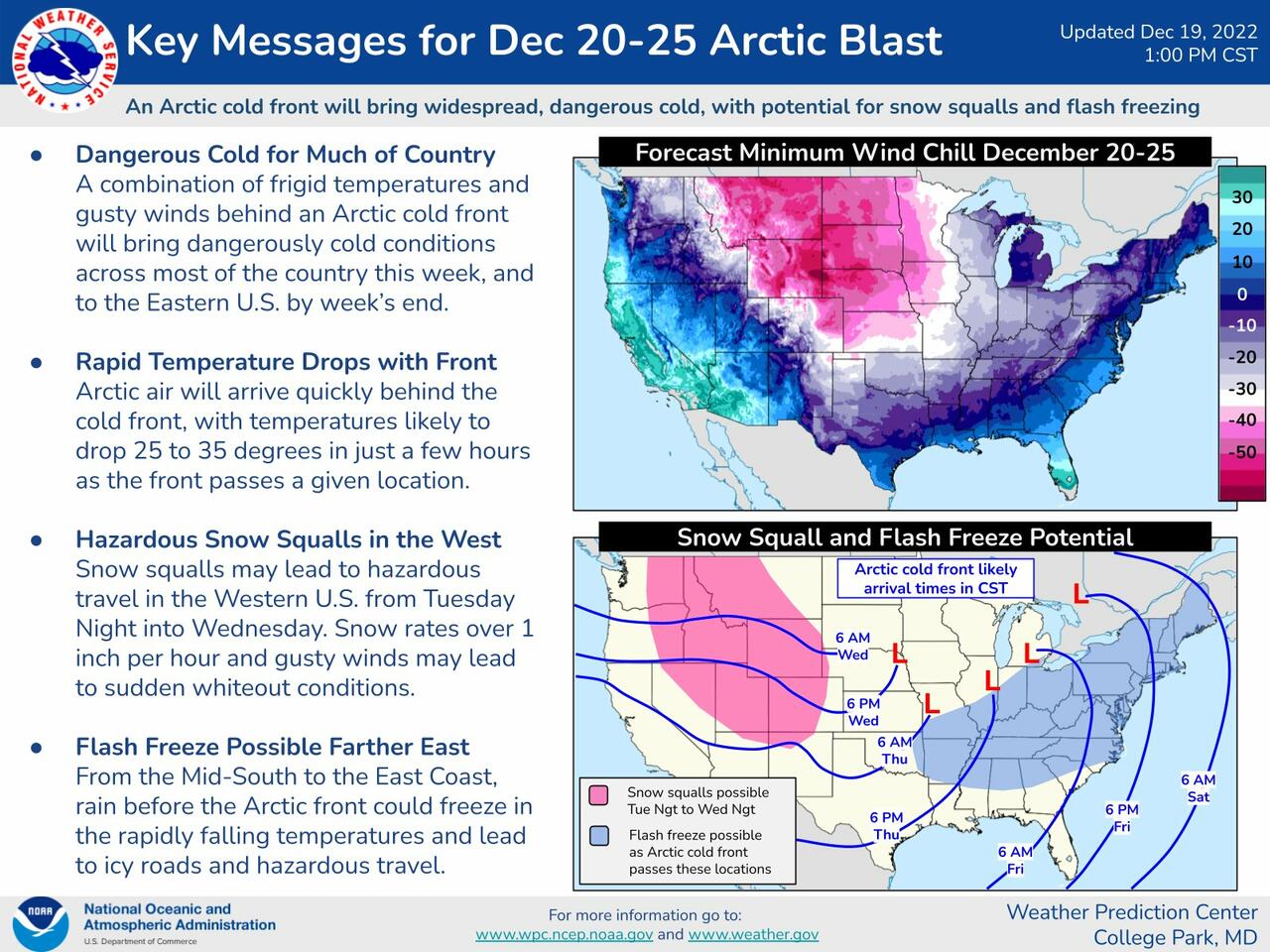
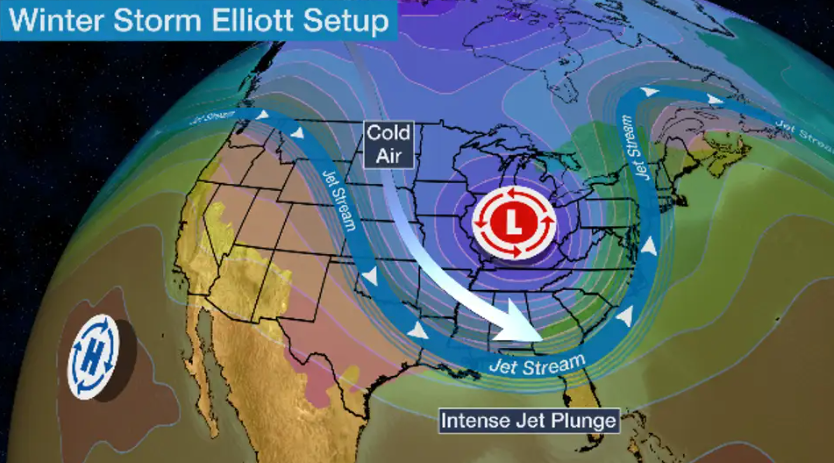
Millions of Americans could be caught in a travel nightmare before Christmas as a major winter storm could become a bomb cycle at the end of the week, dumping heavy snow across the Midwest and Great Lakes and mixed precipitation in the Northeast, according to The Weather Channel.
The storm will usher in below-freezing air across much of the country as far south as Texas, the Gulf Coast, and Florida.
On top of the cold blast, a "bomb" cyclone (a strengthening low that surface pressure drops at least 24 millibars in 24 hours) is expected to unleash high winds, heavy snow, and potential blizzard conditions in parts of the Great Lakes from Wisconsin and Illinois to parts of Michigan, Indiana, and Ohio, starting Friday.
Widespread blizzard conditions could impact transportation networks over portions of the Midwest and Great Lakes during one of the year's busiest travel weekends.
The Weather Channel said airlines had issued travel waivers ahead of the winter storm. JetBlue, American Airlines, Delta, Southwest, and Alaska Airlines offer waivers that allow passengers to change flights free of charge.
A paralyzing blizzard is increasingly likely across a large swath of the US. According to CNN meteorologists, Christmas Day could be the coldest in four decades nationwide, which takes us back to the climate alarmist this past summer who insisted the world was melting and the imminent demise of the human race. So much for their bold prediction -- now Americans will be freezing.

WSJ : What to Know About This Flu Season and the Symptoms

What to Know About This Flu Season and the Symptoms
Find out symptoms to watch for, the latest case rates and what to do when you’re contagious

After an early start to this year’s flu season, cases remain high across much of the U.S.

A widespread reduction in Covid-19 precautions likely contributed to what is proving to be a tougher flu season this year compared with the past two, which were relatively mild.

As of Dec. 16, less than half of American adults reported they had received the flu vaccine, according to Centers for Disease Control and Prevention estimates.

People from some racial and ethnic groups are more likely to be hospitalized with the flu, as well as less likely to be vaccinated against the flu, according to the CDC. U.S. health officials are urging all eligible people to get vaccinated against the respiratory illness.

Here is what we know about this flu season, according to infectious-disease specialists.

How bad is this flu season?
As of mid-December, there had been at least 15 million cases, 150,000 hospitalizations and 9,300 deaths from flu, so far this season, according to CDC estimates. The CDC noted that, while flu activity remains high, it appears to be declining in some areas.

There were between eight million and 13 million cases of influenza in the U.S. in the 2021-2022 flu season, compared with an estimated 35 million cases in the 2019-2020 flu season, according to the CDC.

About 6.9% of visits to the doctor the week ending Dec. 10 were for an influenza-like illness, down from 7.5% two weeks prior, CDC data show. Influenza-like illness can include other cases of respiratory illnesses, such as Covid-19 and RSV.

Doctors say they are glad to see numbers peaking but caution we are not out of the woods yet. Case numbers are still higher than previous flu seasons at their peaks, and there is always the possibility that another flu strain bypasses the vaccine response, says Scott Roberts, an infectious-disease specialist at the Yale School of Medicine.

“Usually with flu, we don’t see a single wave; we see multiple waves as different flu strains become predominant,” says Dr. Roberts. “The trend is promising, but certainly I’m not at the level where I would say, ‘Oh, we’re fine.’ ”

Doctors had said they expected to see more influenza cases than in the past two years, and possibly as many cases or more as there were in prepandemic flu seasons.

Australia reported more than 224,000 cases of influenza this flu season, which is tracked between April and October each year, after they fell sharply earlier in the pandemic. This year’s reported number is almost double the prepandemic five-year average of about 114,000 cases, according to Australia’s Department of Health and Aged Care.

“Not only did flu come back with a vengeance in terms of high numbers of cases, but it also came back earlier in the flu season,” says Andrew Pekosz, co-director of the Johns Hopkins Center of Excellence in Influenza Research and Surveillance.

What flu symptoms should I look for?
The flu, like Covid, is a respiratory virus that can cause symptoms such as fever, cough, fatigue, sore throat, runny nose, body aches, shortness of breath, headache and gastrointestinal distress.

Most people who get the flu and don’t experience complications recover in a few days, whereas Covid symptoms, while variable, can last for up to two weeks or more. The symptoms of flu and Covid-19 can look similar, so doctors say it is important to get tested for both viruses if you feel sick.

Why is it worse this year?
Covid-19 precautions have largely waned as Americans are spending more time in-person at their offices, gyms and social gatherings. Those precautions helped prevent the spread of influenza as well as Covid-19.

The low levels of influenza over the past two years have also led to lower levels of natural immunity, doctors say. So if you haven’t had the flu in a few years, your immune system might not be as prepared to fend it off.

Doctors are also concerned that pandemic or vaccine fatigue might make people forget about or avoid the flu shot altogether.

Last season, approximately half of people ages 6 months and older in the U.S. received the flu vaccine, the CDC estimates. Uptake was even lower among certain high-risk groups, including pregnant women.

This year, nearly a third of American adults report they probably or definitely will not receive a flu vaccine, according to the CDC.

When is flu season?
Flu season usually begins in October in the U.S. This season was off to an early start, with hospitalization rates in late October at the highest for this time of year in more than a decade.

In a typical year, flu season peaks between December and February. The 2021-2022 flu season was mild but lasted longer than average with steady case numbers reported through May.

What precautions should I take to protect myself from influenza?
Get yourself and your family vaccinated against the flu. This will help prevent severe infection, reduce the risk of hospitalization and death, and might also help prevent transmission, health experts say.

Take precautions such as frequent handwashing, covering your coughs and sneezes, and staying home when you feel sick. Covid-19 precautions such as wearing a mask in public indoor spaces also help protect against the flu.

As cases of respiratory syncytial virus, or RSV, and Covid-19 remain high, it is smart to take precautions, doctors say.

If you do get sick, ask your doctor about prescription antiviral drugs that can treat the flu, such as Tamiflu, Relenza and Rapivab. They come in various forms, including pill, liquid and inhaled powder. They work most effectively when started two days after getting sick, according to the CDC.

Who should get vaccinated against the flu?
Children 6 months and up and all adults should get their annual flu shot, according to the CDC, with rare exceptions.

Vaccination could help prevent the flu and potentially serious complications, especially for people who are at higher risk of developing a severe case.

Lower vaccination rates contribute to the more severe outcomes among Black, Hispanic and American Indian people, the CDC said. From 2009 to 2022, flu hospitalization rates were some 80% higher among Black adults, 30% higher among American Indian adults and 20% higher among Hispanic adults, compared with white adults, according to a report published by CDC.

When is the best time to get a flu shot, and which vaccine should I get?
For people under the age of 65, doctors advise getting the first flu shot available. Shots are available now at health offices and drugstores.

“Your flu vaccine is like timing the stock market: You don’t want to overthink it too much,” says Dr. Pekosz.

The vaccine takes about two weeks to reach peak efficacy. It is especially important for people at high risk of severe disease to get the flu shot as soon as possible, doctors say.

This year, the CDC issued a recommendation for people over the age of 65 to receive one of three specific flu vaccines: Fluzone high-dose quadrivalent, Flublok quadrivalent or Fluad quadrivalent. People in that group should talk to their doctors and pharmacists about receiving those vaccines, says Dr. Alicia Fry, chief of CDC influenza division’s epidemiology and prevention branch.

The first two contain higher doses than standard shots and the third contains an adjuvant, an ingredient that sparks a stronger immune response.

Can I get the flu vaccine at the same time as my Covid-19 booster?
Yes, you can get both shots at the same time, so long as you are eligible for the booster, which means you have received at least a primary series of the vaccine, don’t actively have Covid-19 and have waited at least two months since your last Covid-19 shot.

Doctors say there is no harm in getting the shots together, though you should expect to feel a little achier than you normally would.

How much does the flu shot cost?
The vaccines are fully covered by most forms of health insurance.

People without health insurance might face an out-of-pocket cost between $20 and $75, according to GoodRx, a healthcare company that tracks drug prices. Some health centers provide free shots, and some pharmacies accept coupons from partner organizations to reduce or cover out-of-pocket costs.

Who is most vulnerable for a severe case?
Most people who get the flu will recover on their own in a few days to two weeks, according to the CDC. But some people are more at-risk for severe illness, including those with underlying health conditions, the elderly and pregnant women. Children under the age of five, and particularly those under the age of two, are also at higher risk.

WSJ : EU to Probe Broadcom’s $61 Billion Planned Takeover of VMware

EU to Probe Broadcom’s $61 Billion Planned Takeover of VMware
European regulator says it is concerned that the deal could limit competition for some hardware

BRUSSELS—The European Union’s antitrust watchdog said on Tuesday that it would open an investigation into chip maker Broadcom Inc.’s AVGO -0.87% planned $61 billion acquisition of VMware Inc. VMW -0.14%

The European Commission, which leads the EU’s antitrust enforcement, said it is concerned the deal would allow Broadcom to restrict competition in the market for certain hardware components.

The deal has also attracted attention from other regulators. The U.K.’s Competition and Markets Authority has said it is looking into the planned acquisition. The U.S. Federal Trade Commission has been seeking information about the deal from the companies, citing a previous regulatory filing.

Broadcom said it looked forward to continuing to work with European regulators as part of their review process.

“The combination of Broadcom and VMware is about enabling enterprises to accelerate innovation and expand choice,” a Broadcom spokesman said. “We are confident that regulators will see this when they conclude their review.”

The EU said in a statement on Tuesday that its preliminary examination of the deal prompted concerns about hardware components such as network interface cards and storage adapters.

For example, Broadcom could make it harder for VMware’s software to interoperate with competitors’ hardware, the commission said. It said the company could also shut out competitors by preventing them from using VMware’s software or making it harder for them to access it.

“This, in turn, could lead to higher prices, lower quality and less innovation for business customers, and ultimately consumers,” the commission said.

The commission said it would also look into whether Broadcom could hinder the development of smart network interface cards by other providers or start bundling its software with VMware’s software in a way that limits customer choice.

The European Commission will have until May to make a decision on the merger.

The deal to buy VMware would further Broadcom’s push into software, nearly tripling the size of the company’s software division.

Broadcom Chief Executive Hock Tan said in a recent call with analysts that the company is expecting an extended period of reviews of the planned VMware acquisition in multiple jurisdictions. He said he expects the reviews to finish in the company’s 2023 fiscal year, which runs through October.