Business Of Fashion : Why Even Luxury Brands Can’t Quit Discounting

Why Even Luxury Brands Can’t Quit Discounting
After avoiding markdowns for much of the last two years, many brands may be tempted to return to their old ways this holiday season. Are discounts a necessary evil?

During the pandemic, many luxury brands pledged to rein in – or even end – discounting, which had become a year-round habit in many corners of the industry. Sticking to that promise has proven harder than expected. To understand why, it would be helpful to look back at how the industry has navigated the last few years:

Starting in the 2010s, the luxury calendar morphed from two seasons to numerous drops throughout the year. Online, brands and retailers competed for attention by sending out email blasts and updating their landing pages to hype new products. These tactics have proven a great way to drive sales, but they have made planning a challenge: how much to buy, and in which colourways, is more complicated when there are more and more products hitting the market at any given time. The likelihood of over-ordering a particular item is multiplied by this approach, hence the need for discounting to convert that excess inventory into cash. In other words, as a direct result of the world of luxury chasing its tail in the name of innovation, in-season markdowns have become more commonplace.

The pandemic, which forced immediate and drastic discounting to get rid of excess inventory, felt like a tipping point in this race to the bottom. A group of fashion designers, retailers and executives led by Dries Van Noten penned a heartfelt open letter to the fashion industry advocating for a realignment of seasonal deliveries and sale periods, the production of fewer goods as well as less travel for fashion weeks and buying appointments. Dries pointedly described in-season markdowns as “a knife in my heart”.

Big brands for the most part weren’t signatories to that letter, but around the same time they were undertaking their own efforts to take back control of pricing, including exiting wholesaling or switching to concession formats. Prada had in fact announced in early 2019 that the group would stop doing markdowns and re-focus on full price sales. From the first half of 2019 to the first half of 2022, the group’s wholesale sales have indeed decreased by 39 percent whilst its direct-to-consumer sales have gone up by 38 percent. The group was praised in the aftermath of its 2021 results for its shift towards full-priced sales contributing to a 41 percent turnover growth.

These moves have come at the expense of multi-brand online retailers such as Yoox Net-a-Porter, Matches and Farfetch (the latter of which is nevertheless running an up to 60 percent off sale at the time of this publication, which happens to feature 38 Prada items).

A Necessary Evil

This holiday season, discounting appears poised to make a comeback. There is no global supply chain crisis keeping products off shelves, as there was in 2021. In its place there is a growing fear that 2023 will be a challenging year, with fears of a global recession perhaps prompting companies to fill their coffers even at the sacrifice of margin. Looking further ahead, McKinsey also estimates that off-price sales are likely to grow five times faster than full-price from 2025 to 2030.

There are however a few tricks brands can play to minimise the impact of discounting on brand perception and ultimately company valuation.

The first is to contain off-price sales to outlet destinations such as Bicester Village. These have the advantage of being a destination format so customers have to choose between shopping at full price stores in luxury shopping districts or travel to an outlet in the hope for a bargain. The latter choice frequently means that the customer is already primed to spend money.

Another strategy is to have more targeted discounting initiatives such as rewarding higher spending customers with early or exclusive access to certain discounted items. Dior Beauty, for example, has a loyalty programme whose four tiers provide exclusive benefits that reward members’ interactions with the brand.

A common practise within beauty is to offer bundles or kits coupled with a price incentive as a means to increase average customer spend or to offer gift with purchase incentives, again to increase average customer spend. This is a great way to attract custom while preserving brand cachet in what is becoming an increasingly competitive brand landscape.

Finally, there is a strong sustainability message associated with discounting rather than destroying, which could be targeted at the up-and-coming, more socially conscious consumer. Just as in the case of second-hand luxury, this could be managed in a way that there is little overlap between a brand’s core full-priced consumer and a consumer that doesn’t yet have the means to buy the brand but aspires to in the future.

The Savigny Luxury Index (“SLI”) gained 15.5 percent in November as China eased Covid 19 restrictions and the sector looked forward to a strong holiday sales season, outperforming the MSCI by 9 percentage points.


Going up

  • Richemont’s shares rallied in the aftermath of the jewellery group’s first half earnings beat. The stock ended November up 27 percent.
  • US stocks Capri and Ralph Lauren’s share prices increased by 26 percent and 22 percent respectively on the back of positive economic data in the US as well as strong third-quarter financial performances.

Going down

  • All stocks in the SLI posted gains this month.

What to watch

While luxury brands are still counting the cash in their tills from the holiday sales season in the Western Hemisphere, there is still Lunar New Year and, to a lesser extent, Valentine’s Day to come. Lunar New Year may not be the discounting bonanza that is Singles Day, but it is nevertheless an additional sales period that luxury brands can bank on.

(ZH) The Science Of Nuclear Fusion Explained

The Science Of Nuclear Fusion Explained

U.S. scientists at the National Ignition Facility, part of the Lawrence Livermore National Laboratory (LLNL), announced a major breakthrough in nuclear fusion this week.
For the first time ever, scientists successfully produced more energy from a nuclear fusion experiment than the laser energy used to power it.
In the infographic below, Visual Capitalist's Mark Belan and Bruno Venditti describe nuclear fusion and illustrate how this discovery may pave the future for a new form of clean and sustainable energy.
What is Nuclear Fusion?
Nuclear fusion powers the Sun and the stars, where immense forces compress and heat hydrogen plasma to about 100 million degrees Celsius. At this temperature, the lighter particles fuse into helium, releasing enormous amounts of energy.
Nuclear fusion is a fairly clean energy source as it does not produce harmful atmospheric emissions and only produces a small amount of short-lived radioactive waste.
Scientists have been trying to replicate it on Earth for almost 70 years, using isotopes of hydrogen—deuterium and tritium—to power fusion plants.
Since deuterium is found in seawater and tritium is attained through irradiating lithium (a common element used in batteries), the accessibility of these isotopes means that fusion could become a major source of energy in the future.
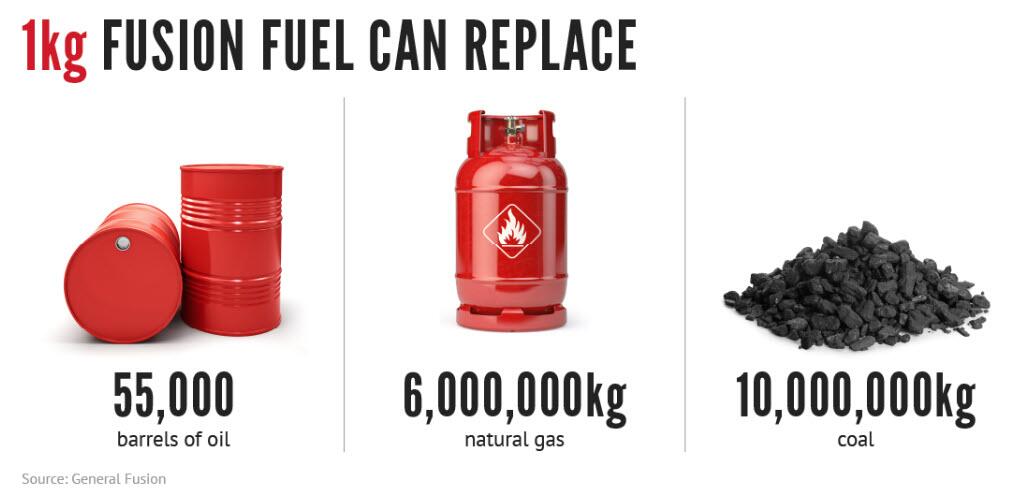
The amount of deuterium present in one liter of water, for example, could produce as much fusion energy as the combustion of 300 liters of oil.
However, the real challenge is ensuring fusion power plants generate more energy than they consume.
The Challenge of Fusion Ignition
Fusion ignition is the term for a fusion reaction that becomes self-sustaining, in which the reaction creates more energy than it uses up. Up until now, scientists were only able to break even.
The National Ignition Facility used a special setup called inertial confinement fusion that involves bombarding a tiny pellet of hydrogen plasma with lasers to achieve fusion ignition.
LLNL’s experiment surpassed the fusion threshold by delivering 2.05 megajoules (MJ) of energy to the target, resulting in 3.15 MJ of fusion energy output, according to the U.S. Department of Energy.
Can Nuclear Fusion Energy Be Commercialized Soon?
In recent years, fusion technology has been attracting the attention of governments as well as private companies such as Chevron and Google. Bloomberg Intelligence estimates that the fusion market will eventually be worth $40 trillion.
Besides energy generation, fusion is expected to be used in other markets like space propulsion, marine propulsion, and medical and industrial heat.
However, according to the director of the Lawrence Livermore National Laboratory, Kim Budil, it will take “probably decades” before nuclear fusion energy is commercialized.
During the breakthrough announcement, she noted that it was necessary to produce “many many fusion ignition events per minute” as well as have a “robust system of drivers” before fusion can be commercialized successfully.

(ZH) Caroline Ellison Throws SBF Under The Bus: Pleads Guilty To Fraud, Agrees T

Caroline Ellison Throws SBF Under The Bus: Pleads Guilty To Fraud, Agrees To Cooperate With The DOJ

Two weeks ago, when amid reports that the former CEO of Alameda Capital (which as a reminder was ground zero of the FTX implosion after it blew up $8 billion in FTX client funds on trades gone horribly wrong), Caroline Ellison, was spotted in New York just after retaining Clinton superlawyer, Jamie Gorelick of Wilmer Hale, which as readers may recall was the former No. 2 ranking member in the Clinton Justice Department, and in a recent interview, she referred to current AG Merrick Garland as her "wingman", we asked if Caroline had rolled on Sam Bankman-Fried, who was also her former lover.
Fast forward to today when we just got confirmation that Caroline Ellison has fncked Bankman-Fried one final time by indeed rolling on him, and "turning states" in the criminal prosecution of the corpulent "Hairy Plotter", who commingled and stole the client money in his FTX exchange to fund a series of terrible crypto bets at his personal hedge fund Alameda, fund tens of millions in donations to democrats and buy up prestigious real estate for himself and his "altruistic" progressive lawyer parents.
According to a Manhattan Federal prosecutor, two of FTX founder Sam Bankman-Fried’s closest associates have pleaded guilty to fraud and agreed to co-operate with US authorities investigating the collapse of the bankrupt cryptocurrency exchange. In other words, they took a plea deal to avoid even more prison time in exchange for serving SBF on a silver platter to the Feds.
Damian Williams, the US attorney for the Southern District of New York, announced the guilty pleas and criminal charges against Caroline Ellison and Zixiao “Gary” Wang, the low profile co-founder of FTX, in a short video statement. His office had brought eight charges against Bankman-Fried last week.
Ellison pleaded guilty to seven counts, including wire and securities fraud and conspiracy to commit money laundering, which carry a maximum sentence of 110 years in prison, while Wang pleaded guilty to four counts of fraud, with a maximum 50-year sentence.
The documents said prosecutors would not oppose bail requests from both defendants under certain conditions, including posting a bond and handing in their travel documents, as they awaited formal sentencing.
Concurrently, the Securities and Exchange Commission and the Commodity Futures Trading Commission also filed civil lawsuits against the 28-year-old Ellison and 29-year-old Wang, accusing them of fraud.
“As part of their deception, we allege that Caroline Ellison and Sam Bankman-Fried schemed to manipulate the price of FTT, an exchange crypto security token that was integral to FTX, to prop up the value of their house of cards,” said SEC chair Gary Gensler. Furthermore, as CEO of the FTX trading affiliate, Ellison “used FTX’s customer assets to pay Alameda’s debts” and diverted billions of dollars of depositors’ money to the company to fill a hole caused by a crypto market crash in May, the SEC’s complaint alleges.
The CFTC said Wang had a hand in creating some of the algorithms that underpinned FTX, which allowed Alameda “to maintain an essentially unlimited line of credit” on the exchange, giving it an “unfair advantage” over regular depositors. “These critical code features and structural exceptions allowed Alameda to secretly and recklessly siphon FTX customer assets from the FTX platform."
Both defendants are co-operating with the SEC, the agency said. The CFTC said they were not contesting their liability. Which means that SBF is looking at a lot of prison time, unless he too can throw someone even more important and powerful under the bus...
... although if that is the case, he probably will be Epsteined within hours of arriving at MDC Brooklyn, singe MCC New York where Epstein "killed himself", has been closed since August 2021 due to deteriorating conditions.
While Ellison's superlawyers have yet to make a statement, a lawyer for Wang, Ilan Graff, said: “Gary has accepted responsibility for his actions and takes seriously his obligations as a co-operating witness.”
Last week, the DOJ filed charges against Bankman-Fried and accused him of orchestrating “one of the biggest financial frauds in American history” by misappropriating customer assets from FTX to Alameda Research. He was arrested in the Bahamas, where he lives. He is also facing parallel civil cases from the SEC and CFTC.
Williams reiterated his call for others who worked with Bankman-Fried to come forward. “If you participated in misconduct at FTX or Alameda, now is the time to get ahead of it,” he said. “We are moving quickly and our patience is not eternal.” One of them is former Alameda CEO Sam Trabucco, best known for quietly bailing on Sam just as everyone was about to blow up and fleeing on his multi-million dollar new yacht.
The announcement from Williams comes just after a plane carrying Bankman-Fried took off from the Bahamas, where he waived his right to challenge extradition to the US. He is due to appear in a Manhattan court as soon as Thursday, where his bail request will be considered, although in light of Caroline's plea, it is safe to say it won't be granted.

WSJ : U.S. Life Expectancy Fell to Lowest Level Since 1996

U.S. Life Expectancy Fell to Lowest Level Since 1996
Covid-19 and opioid overdoses contributed to a 5% rise in death rate last year

Life expectancy in the U.S. fell again last year to the lowest level since 1996, federal data showed, after Covid-19 and opioid overdoses drove up the number of deaths.

Covid-19 was the third-leading cause of death for a second consecutive year in 2021, the Centers for Disease Control and Prevention said Thursday, and a rising number of drug-overdose deaths also dragged down life expectancy. Overdose deaths have risen fivefold over the past two decades.

The death rate for the U.S. population increased by 5%, cutting life expectancy at birth to 76.4 years in 2021 from 77 years in 2020. The CDC in August released preliminary estimates demonstrating a similar decline. Before the pandemic, in 2019, life expectancy at birth in the U.S. was 78.8 years. The decline in 2020 was the largest since World War II.

Heart disease remained the leading cause of death in the U.S., followed by cancer. The CDC in its final count said there were 416,893 deaths last year where Covid-19 was the underlying cause, up nearly 19% from the 350,831 deaths counted during the pandemic’s first year. Though excluded here, throughout the pandemic the CDC has also included instances where Covid-19 is listed as a contributing cause of death while tracking the impact of the disease.

Though Covid-19 deaths have declined as protection against severe disease has grown, due to vaccines and prior infections, it is once again poised to be a significant cause of death in 2022. The CDC’s preliminary count for this year from death certificates, including deaths where Covid-19 was the underlying and contributing cause, topped 233,000 by mid-December.

The country during the pandemic has recorded more than 1.2 million excess deaths, which is a measure of all deaths beyond prior-year averages and can represent both undercounted Covid-19 deaths and collateral damage from other causes, including more overdoses. The CDC put the final count for 2021 overdose deaths at about 106,700, a record that is 16% higher than the prior year. The final count differs from a preliminary count for last year that topped 108,000 because the CDC in its final counts doesn’t include overdose deaths that occurred among non-U. S. residents.

The replacement of heroin in many markets with illicit versions of the powerful opioid fentanyl, which is cheaper and easier for Mexican cartels to manufacture, has fueled the surge in overdose deaths.

The rate of drug fatalities involving synthetic opioids other than methadone, a category that largely includes fentanyl, increased 22% year-over-year. The synthetic opioid is also increasingly showing up in the death certificates among people who died with cocaine and methamphetamine in their system. Cocaine deaths climbed 22% while deaths from a drug category mostly including meth rose by 33%.

The rate of heroin overdose deaths dropped 32% in 2021 as fentanyl overtook the market.

The CDC hasn’t broken down life-expectancy data by race and ethnicity. Preliminary data earlier this year showed Native Americans had the biggest drop in life expectancy in 2021 at 1.9 years, bringing their life expectancy to 65.2 years, down 6.6 years since 2019.

The decline among Native Americans was driven by higher Covid-19 death rates than in 2020, unintentional injuries including overdoses and chronic liver disease and cirrhosis.

Life expectancy declined less among Black people than white people in 2021, the preliminary data showed, reflecting in part the higher burden of deaths among some minority groups in the early phases of the pandemic. Black people in the U.S. had a life expectancy of 70.8 years last year, according to the CDC, compared with 76.4 years for white people.

Black and Hispanic Americans have been hard hit by an overdose crisis driven primarily by the spread of fentanyl produced in makeshift Mexican labs.

WWD : Liu Jo, Blumarine Owner Still Pondering Group IPO

Liu Jo, Blumarine Owner Still Pondering Group IPO
A listing of EIH Eccellenze Italiane is still in the cards, albeit with no set date, as the group's fashion division keeps growing.

MILAN — An IPO is still in the cards for the owner of Liu Jo and Blumarine, EIH Eccellenze Italiane, as the group, which also owns a minority stake in retailer Coin, keeps evaluating market conditions.

In an interview with WWD, founder and president of the board Marco Marchi pointed to robust growth for the conglomerate, spurred by customer loyalty to the Liu Jo contemporary brand and the successful creative shift at Blumarine.

Hiring Moncler SpA alum Paola Durante as general manager for Liu Jo last June suggested a renewed interest to go public for Marchi, who had originally planned a listing of Liu Jo in 2018, a project that the entrepreneur has said was postponed because of unfavorable market conditions.

The executive now says the listing of the entire group is on the table, characterizing the potential move as an opportunity rather than a necessity.

“Since 2018, the company has been organized to be ready whenever an opportunity pops up. Paola’s arrival is a strong plus, for the skills she developed throughout her career, and because she chose a company that has the right features to become a successful case story. The fact that [she decided to] share a journey geared at an extraordinary operation [listing] is a reason of pride as it means we had headed in the right direction [before],” Marchi told WWD.

A date has not been set for the time being as Eccellenze Italiane needs “to seize the best moment to make it work successfully,” Marchi said.

“We see a complex and turmoiled environment in the market, so we don’t see [listing] as an opportunity in the short term. However, we’re committed to keep growing in a healthy and responsible manner… we will do it whenever all conditions align, otherwise we will keep doing what we do in a virtuous way,” he said.

“My ambition is to ensure that Italian companies can survive the entrepreneur who founded them,” Marchi explained. “This is a must and a priority high on my agenda every day. I think that an IPO today is a great and important opportunity not only for the group per se but also for the brands joining it to guarantee a solid and virtuous future for them.”

The entrepreneur dodged questions about making additional acquisitions, but said ongoing conversations are happening with several parties. “I value the idea of synergies and [shared] know-how in supporting growth with respect to the identities of each brand. We’re always having conversations with entrepreneurs who are triggered and curious about Eccellenze Italiane as the house for brands in the premium segment,” he said.

Marchi established the conglomerate on the heels of the acquisition in November 2019 of the Gruppo Blufin and its brands Blumarine, Blugirl, Anna Molinari and Be Blumarine, a week after announcing he had bought a 15 percent stake in Coin SpA.

The executive declined to disclose the group’s total revenues for 2022 beyond saying they jumped double digits compared to the previous year, but detailed performances for the fashion brands in its portfolio.

The flagship Liu Jo brand navigated 2022, a year he described as “unprecedented” and impacted by the war in Europe and rising inflation that dented consumer confidence and spending power in Europe, by leveraging its global brand awareness.

“Remaining top of mind for our clientele despite the current climate has helped us achieve great results,” Marchi said, adding that new markets including the Middle East and Latin America, especially Mexico, proved dynamic and drawn to Made in Italy.

To this end, Liu Jo, which in 2021 posted revenues of 411 million euros, introduced a new eco-minded store concept at Abu Dhabi’s The Galleria Al Maryah Island in October, and at the Dubai Mall of Emirates in August. It also strengthened its presence in Mexico, unveiling six corners at the El Palácio De Hierro department store.

Europe, Germany, France and Spain are growing exponentially for the brand, Marchi said. In Spain, Liu Jo opened two stores this month for a total of 32, and plans five more units by 2025.

The retail push does not necessarily suggest Liu Jo is done with wholesale, which currently accounts for 60 percent of the business.

During COVID-19, the wholesale system was challenged by the industry, but Marchi opined that “in this unprecedented moment, the customer service provided by wholesale accounts has a pivotal role in securing customers’ loyalty,” adding that the company has benefited from its omnichannel business model.

The entrepreneur took pride in the successful turnaround of the Blumarine brand, for which he expects revenues to hit the 50 million euros threshold in a few years.

Despite the headwinds caused by the pandemic and consequent need to adjust the strategy, Marchi pointed to a new phase for the brand through the introduction of new product categories, including handbags, which are viewed as pivotal in expanding its scope and to fuel the Y2K aesthetic that creative director Nicola Brognano has imprinted on Blumarine since his appointment in 2019.

“The path has been marked by obstacles due to the extraordinary market conditions,” said Marchi, explaining that its “aesthetics needed to be fixed and tweaked.”

The radical change in perception has reverberated across business units and influenced the distribution strategy.

“In Italy, storied retailers that were drawn to the brand’s previous look saw [the change] as a friction and at the same time, 70 percent of our turnover is now generated abroad, where this new daring aesthetic is reaping its rewards,” Marchi said.

Blumarine’s best-performing markets are the U.S., the U.K. and South Korea and its presence on the digital shelves of premium e-tailers and genuine interest among celebrities and social media personalities is proof the strategy is working, Marchi contended.

Blumarine currently operates two stores in Rome and Forte dei Marmi, Italy. The Rome store will undergo a revamp and reopen next summer with a new concept in line with Brognano’s vision.

Marchi said he was cautious about expanding a retail footprint for the brand, given its “radical aesthetic change.”

The executive characterized his investment in Coin as not only equity ownership but also as an asset for the other brands Eccellenze Italiane controls.

The Italian retailer is at the center of M&A activities, and last June OVS announced it had submitted a letter of intent to all shareholders to take over Coin. An exclusive due diligence kicked off soon thereafter, and its outcome is expected in January 2023, Marchi said.

He sees opportunities for Coin even if the acquisition falls through. “I don’t see independence as necessarily a negative scenario,” Marchi opined.

After the store closures caused by the lockdowns over the past two years, the retailer is now gaining ground again and will open a new door in Milan’s Piazza Cordusio in 2023. Also, it has recently unveiled a new Florence outpost inside central Loggia del Grano.

Separately this week, Coin said it has sold the building in Rome’s San Giovanni neighborhood housing one of its banners in town to the Fondo Torre IV fund, strengthening its financial position.

WWD : Gucci Opens First Stand-alone Luggage Store in Paris

Gucci Opens First Stand-alone Luggage Store in Paris
The 2,900-square-foot shop on Saint-Honoré offers the full Gucci Valigeria range, from one-of-a-kind trunks to aluminum and regenerated nylon suitcases.

Gucci is setting down its suitcases on tony Rue Saint-Honoré for its first permanent boutique dedicated to its Gucci Valigeria travel line.

Sitting opposite Moynat and a few doors away from Goyard in a space formerly occupied by Off-White, the 2,900-square-foot unit located at 229 Rue Saint-Honoré opened Tuesday.

“The opening of our first Gucci Valigeria boutique on Rue Saint-Honoré represents the next stage in our ongoing strategy to reinforce our leadership in the travel category,” the Italian house’s president and chief executive officer Marco Bizzarri told WWD in an email.

The house’s travel range holds a particular place in the house, as trunks, suitcases and hatboxes were the first items that founder Guccio Gucci offered after opening his store in Florence in 1921.

Bizzari explained that the concept for the travel line’s permanent locations had been inspired at once by the original Florentine store and a three-month pop-up in London coinciding with the launch of the Savoy luggage line that started in October.

The three-month residency in London, which concludes at the end of the year, nodded to its origins story by taking over the tea shop at The Savoy in London, where Guccio Gucci had been a luggage porter at the turn of the 20th century. His observations of guests coming in and out with their exquisite luggage inspired him to start an artisanal luggage atelier.

“Gucci Valigeria is a powerful reminder of our Florentine roots and our timeless craft,” said Bizzarri, calling the line a “symbol of [the Gucci] legacy, reinterpreted through the ages for the travelers and modern-day explorers of every era.”

The Saint-Honoré store, in particular, was created to be “a portal into our ever-expanding world of travel and discovery,” the executive continued.

Its 2,000-square-foot retail space is spread over two floors, inspired by the heyday of rail travel during the Belle-Epoque, vintage light fixtures and all. Window displays take cues from luggage carts, while the interior’s neutral-hued canvas surfaces and dark walnut furniture and finishes go for an impression of well-traveled opulence.

The ground floor evokes a tony train station, with the cash register masquerading as a welcome desk and piles of luggage as decor. Travel essentials such as pajamas, eye masks, beauty products and pet accessories will be offered here. Exotic-skin versions of its weekender duffel and one-of-a-kind trunks also take pride of place.

On the first floor, brass shelving nods to the racks found in old-fashioned trains, while the ceiling is modeled after the arched roof of carriages. A loom-woven carpet in a tartan motif and plush banquette seating give a cozy vibe.

The Paris store offers the full range of Gucci’s travel line from totes and backpacks to garment bags, hat cases and suitcases. Among the styles showcased are the Gucci Savoy line, which plays with the brand’s monogram, its distinctive stripe and the double G hardware, as well as the top-handle Gucci Bauletto handbag model.

Trunks will also be available as well as its newly launched and “Off the Grid” version in regenerated Econyl nylon. It will also be the first retail debut of the freshly launched aluminum trolley suitcase, created in collaboration with Italian luxury luggage specialist FPM Milano.

Sold in Gucci’s physical retail network and online, the travel category has seen a “very positive momentum,” following the early November launch of the Valigeria campaign featuring Ryan Gosling and shot by photographer Glen Luchford. This was particularly visible in the “U.S., Europe and South Asia, where travel and tourist flows have restarted strongly following the relaxation of COVID-19-related restrictions,” Bizzarri continued.

Meanwhile, vintage luggage pieces included in Gucci’s Vault Vintage drops had also generated “great excitement,” he said, attributing this to the “timelessness that is naturally associated with travel.”

Bizzarri said the brand would continue to enhance its offer, both with vintage pieces and innovations in terms of functions and materials such as the recently launched aluminum trolleys.

Further Gucci Valigeria stores in “other iconic city destinations” around the world are in the works, but Bizzarri did not further detail a timeline or locations.

Travel itself is also a longstanding source of inspiration in the Gucci-verse that saw former creative director Alessandro Michele, who exited the brand in November, say that “travel had never been something purely physical” for the brand at the launch of the Gosling-fronted campaign.

“A Gucci suitcase is a magical suitcase,” Michele continued at the time, describing the creatives who had chosen items from the brand as people who “realize the importance of creativity in service of the construction of imaginary places.”

FT : UK economy contracts by more than expected in third quarter

UK economy contracts by more than expected in third quarter
Output remains below pre-pandemic levels while other economies have pulled ahead

The UK economy contracted by more than previously estimated in the third quarter, while households’ disposable income continued to fall, according to data published on Thursday by the Office for National Statistics.

Output fell 0.3 per cent between the second and third quarter, a larger contraction than initial estimates of 0.2 per cent. The figures show the UK lagging further behind other advanced economies.

“Our revised figures show the economy performed slightly less well over the last year than we previously estimated, with manufacturing and electricity generation notably weaker,” said Darren Morgan, ONS director of economic statistics.

In the third quarter, the UK economy was 0.8 per cent below the level in the final quarter of 2019, before the pandemic. By contrast, output in the US, Canada and the eurozone was ahead of pre-pandemic levels in the same period.


The ONS also showed that real households’ disposable income, which is what households have available to spend after taking inflation into account, fell 0.5 per cent between the second and third quarter. It was the fourth consecutive fall as wages have not kept up with inflation.

“Household incomes continued to fall in real terms, albeit at a slower rate than in the previous two quarters, while — taking account of inflation — household spending fell for the first time since the final Covid-19 lockdown in the spring of 2021,” said Morgan.

>>> Stoxx 600 Pre-Market Indications

  • Rheinmetall (RHM TH) +0.7%
    • Rheinmetall, KMW Aim to Repair Puma Vehicles in 2-3 Weeks
  • Commerzbank (CBK TH) -0.4%
  • ASMI (AVS TH) -0.4%
    • Watch European Chip Stocks as Micron Gives Weak Sales Forecast
  • Fresenius SE (FRE TH) -0.4%
  • Thyssenkrupp (TKA TH) -0.4%
  • Puma (PUM TH) -0.5%
  • Airbus (AIR TH) -0.6%
    • Business News: Airbus Satellites Lost After Rocket Failure
  • BE Semiconductor (BSI TH) -0.7%
    • Watch European Chip Stocks as Micron Gives Weak Sales Forecast
  • Rational (RAA TH) -0.8%
  • STMicroelectronics (SGM TH) -1%
    • Watch European Chip Stocks as Micron Gives Weak Sales Forecast
  • Delivery Hero (DHER TH) -1.1%

>>> TradeGate Pre-Market Indications

DAX:
  • Porsche SE (PAH3 TH) +0.9%
MDAX:
  • Rheinmetall (RHM TH) +0.9%
    • Rheinmetall, KMW Aim to Repair Puma Vehicles in 2-3 Weeks
  • Aroundtown (AT1 TH) +0.8%
  • TAG Immobilien (TEG TH) +0.8%
  • Delivery Hero (DHER TH) -0.7%
SDAX:
  • Adesso SE (ADN1 TH) +2.3%
  • Uniper (UN01 TH) +1.7%
    • SFC Energy to Replace Uniper SE in SDAX Index
  • Ceconomy (CEC TH) -1.5%
  • Hamborner REIT (HABA TH) -1.9%