FT : Brazil faces economic headwinds as Lula prepares to take office

Brazil faces economic headwinds as Lula prepares to take office
High interest rates and fiscal uncertainty challenge leftwing leader’s pledge that ‘good times’ will return

Luiz Inácio Lula da Silva won the Brazilian presidency by promising voters that the good times of “steak and beer” would return to Latin America’s largest country.

But as the leftwing leader prepares to take office on January 1, he faces a darkening economic outlook. Growth forecasts for 2023 have been revised down over concerns on the impact of high interest rates, fiscal uncertainty and the broader global slowdown.

“When you put all these elements together, external and domestic, we see a strong deceleration of the Brazilian economy next year,” said Alessandra Ribeiro, an economist at consultancy Tendências.

Lula presided over a period of strong growth during his first stint in office from 2003 to 2010, as a boom in commodities exports powered expansions in output of 4 to 5 per cent a year. Wages rose, the middle class expanded and millions of Brazilians were lifted out of poverty.

But the incoming president now faces an entirely different environment. While the agribusiness sector remains strong and unemployment has fallen to about 9 per cent — the lowest level in seven years — the economy is having to digest a series of interest rate rises aimed at taming inflation. The rate rises to the current level of 13.75 per cent weigh on growth by limiting consumer consumption and business investment.

“There are clear signs that credit is becoming scarcer and more expensive,” said Marcelo Fonseca, chief economist at asset manager Opportunity. “With very high interest rates we can expect consumption to slow down very quickly.”

The economy also remains hamstrung by deep structural inefficiencies, low wages and a long-term trend towards deindustrialisation.

The government last month revised down its official 2023 growth forecast from 2.5 per cent to 2.1 per cent. Independent economists, however, are even more pessimistic, with a consensus survey pointing to growth of just 0.8 per cent.

“There is the context of the global slowdown, which affects us. But we also have the more pronounced effects of high interest rates and the exhaustion of the post-pandemic services recovery which helped the economy a lot this year,” said Ribeiro.

She predicted unemployment would fall over the next 12 months, but at a slower pace than this year, probably ending 2023 at 8.2 per cent.

A key concern for Fonseca and other economists is how the Lula administration approaches fiscal policy. On the campaign trail, the former trade unionist pledged to increase spending on social assistance programmes, telling voters “the wheel of the economy will turn with the poor being part of the budget”.

Brazil’s Congress this month passed a constitutional amendment that allows the incoming administration to maintain the flagship Bolsa Família cash handout, the main social welfare programme, at R$600 (US$116) per month by circumventing the country’s spending cap rule.

The move has sparked concerns that the incoming administration could abandon its professed commitment to fiscal responsibility.

Economists fear that investors will be moved to quit Brazil if the country’s debt-to-GDP ratio — now at almost 80 per cent — begins to soar next year, further weakening the exchange rate and stoking inflation. This, in turn, would force the central bank to keep rates higher for longer, further curbing growth.

“The outlook next year is very mediocre,” said Fonseca. “And with a loose fiscal policy, I don’t see a stronger rebound in the years to come.”

Gabriel Leal de Barros, partner at Ryo Asset Management, said a loose fiscal policy resulting in rising government expenditure would create multiple knock-on effects and could potentially jeopardise a long overdue and much-needed tax reform.

“We would have to raise some taxes or find some money to pay for expenditures. We won’t have space or time to focus on the efficiency and structural problems of taxation in Brazil,” he said.

“Even the green agenda, which is one of the best opportunities we have, depends on the guidelines for fiscal solvency and debt-to-GDP trajectory.”

Yet economists also say there are reasons for optimism, despite the challenges facing Lula. Agribusiness, which accounts for almost 30 per cent of GDP, is expected to remain solid next year.

There is also demand among foreign investors for infrastructure concessions, such as roads and airports, which had boomed during Jair Bolsonaro’s administration. “[This] could hold up investments for a little bit,” according to Fonseca.

Ribeiro from Tendências said she believed Brazil could also get a boost if Lula succeeded in boosting diplomatic relations with key trading partners and finally approved the long-delayed EU-Mercosur trade deal.

“Improving our international relations, with the possibility of rescuing the EU-Mercosur deal, would greatly improve expectations, not only in the short term but in the medium term because of the expectation of more investments.”

FT : NFT creators diversify into real-world assets to generate new revenues

NFT creators diversify into real-world assets to generate new revenues
Entrepreneurs behind digital art collections expand into retail and entertainment amid crypto downturn

Creators of best-selling internet collectibles have responded to a crash in the value of crypto and digital assets by seeking new revenues, such as using cartoons to sell real-world products and create entertainment franchises.

Digital items known as non-fungible tokens burst into mainstream culture last year as people snapped up animal collections, including Bored Ape Yacht Club, Cool Cats and Pudgy Penguins.

Celebrity endorsements and social media hype helped encourage people to spend billions of dollars to acquire NFTs from marketplaces such as OpenSea.

But the market has plummeted since April after being hit by a sell-off in the broader cryptocurrency market, which has been rocked by a series of high-profile scandals such as the collapse of crypto exchange FTX and the TerraUSD stablecoin in May.

Between January and March 2022, more than $19bn was spent on NFTs — representing the majority of this year’s $36bn worth of sales, according to Chainalysis. Since then, monthly spending has tumbled more than 87 per cent to just over $442mn in November.

The number of active NFT buyers and sellers is now down to just over a third of its peak in January 2022. NFTs are also being “minted” much less, with the number of new NFTs on the ethereum blockchain down by nearly 60 per cent, according to research group Nansen.


This has left makers of popular NFT collections looking at ways to expand their brands into real-world investments, such as selling products that are not linked to so-called blockchain technology, where records of transactions are stored on a decentralised digital ledger.

“If sales are not predictable, consistent [and] recurring revenue, [then] you have to figure out how are you going to diversify your revenue streams and expand,” said Drew Austin, co-founder of Knights of Degen, a sports-themed NFT project and one of the investors behind crypto group WAGMI United, which bought English football club Crawley Town this year.

Some analysts are sceptical that NFT makers will create successful businesses beyond selling digital art. “The fundamental model of NFTs didn’t work,” said Claire Enders of Enders Analysis. “It was a bubble that has burst and is not going to happen again.”

Doodles, a leading NFT project, recently hired musician and producer Pharrell Williams as its chief brand officer, who has used his music to produce live animations of the Doodles characters. The group is working on a video series and an album.

“We’re going into . . . a little bit of a slower economic environment in the next couple of years, and the thing that really wins out in those times is entertainment,” said Julian Holguin, chief executive at Doodles.

“Although entertainment is extremely saturated and consumers’ attention is very fragmented, we [can] build really great stories that connect with people and just put smiles on people’s faces.”

The former Billboard executive has been using his contacts in the music industry to partner with high-profile talent, working to diversify the Doodles intellectual property into live events, music streaming and physical merchandise.

Pudgy Penguins is another project that has been making deals to produce cuddly toys and children’s books based on its NFTs, returning some of the profits to holders of the tokens. It is one of the few collections that has seen the average price of its NFTs more than triple to around $5,700 in December.

“Every generation has had its great penguin IP from Pingu to Club Penguin to Happy Feet . . . there’s a huge opportunity for the next great penguins to invade not only the metaverse but the real world,” said Luca Schnetzler, chief executive of Pudgy Penguins.

Knights of Degen has taken a more scattershot approach to its investments, which include a minor league American football team, celebrity meet-and-greets, IPA beer and an upcoming line of vodka-based sauces.

The group said it had been inspired by Disney’s business model. “Disney started with creating Mickey Mouse, and from there, you have the amusement park, the shows, the movies, the merch, the toys and all these different things. We kind of want to take that similar trajectory,” said Austin.

Yuga Labs, the parent company of some of the most popular NFT collections such as Bored Ape Yacht Club, CryptoPunks and Meebits, has a host of products launching using content from its brands.

Yuga gives away IP rights with its tokens, which means the owners of the NFTs can use the images associated with the tokens however they like, without the company’s knowledge or permission. This has led to a flood of businesses developing associated Yuga products: everything from a burger restaurant to custom-made Tiffany’s pendants.

“From day one, the community has been empowered and encouraged to commercialise their Ape IP, and almost immediately, we started seeing Apes show up on hot sauces, food trucks, in music videos and more. Decentralisation of IP is a powerful tool for community building,” said Yuga Labs.


Yuga Labs has been one of the biggest beneficiaries of last year’s surge of interest in NFTs.

The group raised $450mn in a funding round led by Andreessen Horowitz, which valued it at $4bn at the beginning of this year. Meanwhile, in April, it generated $300mn by selling NFT “deeds” for up to 55,000 plots of virtual land in the “Otherside”, its upcoming metaverse game.

The Otherside land collection remains one of the most traded on the NFT marketplace OpenSea, but the average price for a deed in the Otherside has almost halved to around $3,300.

Associated projects bearing Yuga images have allowed the brand to spread, as well as several celebrities, including Snoop Dogg, Justin Bieber and Madonna, posting their cartoon apes on social media.

Yuga is facing a class-action lawsuit accusing the start-up of partnering with celebrities to “artificially inflate and distort prices” of the NFTs. Yuga Labs has denied any wrongdoing.

However, with trust for crypto faltering and NFT values plummeting, some analysts are sceptical that the brands will be able to catch on in the real world.

“Once there has been a disconnect between the valuation and the product, they can never become a Disney-type brand,” said Claire Enders.

(ZH) Swiss Government Rejects Third-Gender Option On Official Records

Swiss Government Rejects Third-Gender Option On Official Records

Years from now, historians will look back at the Swiss government's decision to reject the introduction of a third gender option on official records as some sanity has returned to Europe. But the prevailing trend across the bloc is neighboring countries have added ways for residents to identify as nonbinary.
AP News reported the governing Federal Council said, "the binary gender model is still strongly anchored in Swiss society." The council rejected two proposals from parliament on Wednesday to introduce a third-gender option or no-gender option for official records.
"The social preconditions for the introduction of a third gender or for a general waiver of the gender entry in the civil registry currently are not there," the council continued.
According to the government, such options would require too many changes to the country's constitution and laws at national and cantonal levels. They added now wasn't the right time to overhaul the system, citing a 2020 report via the national ethics commission.
Meanwhile, third-gender options on official documents are allowed in several European countries, including Denmark, Sweden, Ireland, Norway, and Belgium. An increasing number of western countries are passing laws allowing a third-gender option.
What's absurd is that western governments are normalizing third-gender options where biology or, let's say, "science" only says there are two: man and woman -- that's it.
Woke gender ideology is disinformation because science says people generally either have XY (male) or XX (female) chromosomes.
When historians and archaeologists dig up graves from those in the western world hundreds of years from now, there will be no way to decipher which of the 72 genders those remains are. Instead will be either male or female.

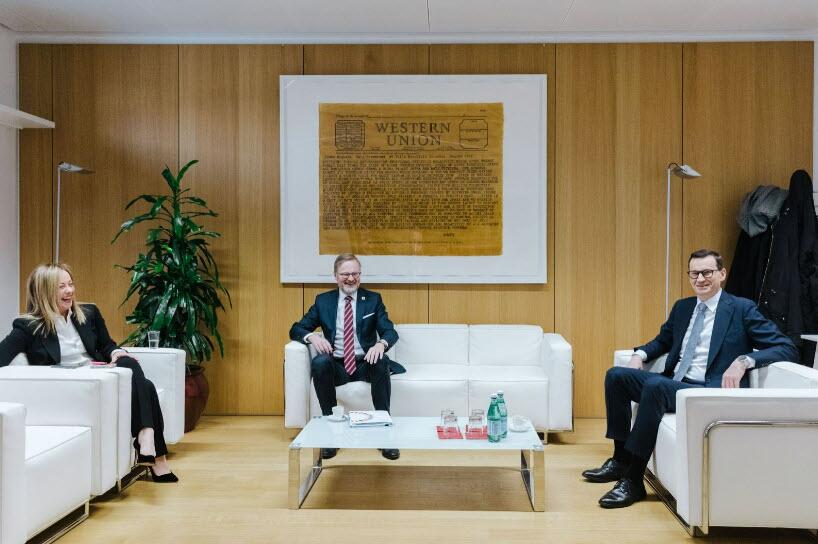
(ZH) "We Will Change Europe" - Polish PM Tells Italian Media He & Meloni Will Re

"We Will Change Europe" - Polish PM Tells Italian Media He & Meloni Will Return Europe To A Union Of Homelands

Polish Prime Minister Mateusz Morawiecki said that “he and Italy’s Prime Minister Giorgia Meloni will change Europe.”
In an interview for the Italian newspaper La Stampa, Morawiecki explained that Europe and power should return to stronger nation states.
“We do not believe in a superstate of 27 EU member states. We want a return of a union of homelands,” underlined the Polish prime minister.
Morawiecki pointed out that Europe has to choose between an authentic solidarity of equal states, or a model of a single superstate in which “decisions will be made in a couple of the largest capitals, disregarding other countries.”
Referring to Russian aggression in Ukraine, Morawiecki pointed out that the Ukraine war will end only with the defeat of Vladimir Putin.
“We have warned that Russia’s colonial ambitions are a threat to eastern European countries and the entire EU,” said Morawiecki, adding that Europe must do everything to aid Ukraine, as the fall of Kyiv would open the way for Russia to conquer Europe.
“Together with [Italian] Prime Minister Meloni, we stand to defend Ukraine. We realistically assess the threat posed by the Russian Federation,” the Polish leader added.
According to Morawiecki, some European nations are more acutely aware of the Russian threat due to their past experiences.
“That is why we all think about armaments and protecting against the threat from the East,” he explained
Meloni often refers to policies pursued by Poland’s Law and Justice (PiS) government, using them as a model and an example. She often mentions that European conservative parties need to cooperate, previously saying: “We will transform ideas into a government policy, just as our friends from the Czech and Polish republics have done.”

FT : Saudi Arabia celebrates step change in Christmas festivities

Saudi Arabia celebrates step change in Christmas festivities
Conservative kingdom opens up to the Christian holiday as it pushes through a series of modernising reforms

Christmas trees for sale in Riyadh, Saudi Arabia. The taboo on Christmas has been gradually easing in the Muslim kingdom over the past few years © Tasneem Alsultan/Bloomberg

Saudi Arabia wishes you a Merry Christmas! Rulers of the conservative Muslim kingdom have not traditionally tolerated formal celebrations to mark the most important day of the Christian calendar.

But this year, residents of the capital Riyadh could enjoy seasonal displays in shopping malls and were able to buy Christmas trees, while one official Saudi newspaper published a special festive edition for the first time in its history.

“Saudis feel Xmas spirit like never before,” read the front page of the official English-language Arab News, advising readers on the best place to secure a turkey for Christmas dinner. “Better late than never,” editor Faisal Abbas wrote in a column.

This is not the first time that Christmas paraphernalia has been on sale in Saudi Arabia; restrictions on the celebration have been gradually easing for a few years. But 2022 marks a step change for a country where almost all Christians are expatriates, and where traditionally any form of worship other than Islam has been prohibited. Shoppers in one Riyadh shopping centre were this month treated to festive lights, Christmas trees and a toy polar bear holding a stringless cello.

The newfound Christmas cheer comes as Crown Prince Mohammed bin Salman, the kingdom’s day-to-day ruler, pushes through a significant series of reforms. These include revamping the economy to make it less oil reliant and easing religious restrictions on life that, until a few years ago, meant women were unable to drive.

Offering good wishes to those celebrating non-Muslim religious holidays remains a controversial topic for Saudi Arabian hardliners. This year, however, Mohammed Al-Issa, a senior Muslim cleric, told television viewers that “there’s nothing in scripture that bans congratulating”.

The change of tone has been welcomed by some Saudis, including those who have studied abroad. One Saudi professional said that several of his friends enjoyed Christmas.

“Young couples, western educated Saudis with kids,” he said of those he knew who marked the occasion. “It’s usually for the kids, the presents and the celebratory atmosphere,” he added.

The conservatism of previous times was waning, he continued, while also requesting anonymity so he could speak candidly. “They were [in previous years] closing down flower shops over Valentine’s Day, now they’re allowing people to celebrate Christmas. It’s a step forward for liberalism.”

The move by the Arab News appeared to be aimed at showing that Saudi Arabia was becoming a more tolerant country. The kingdom is attempting to attract western talent and businesses in the face of increasing competition from the likes of the United Arab Emirates, which offers freedom of religion to most faiths as well as a more liberal lifestyle.

Prince Mohammed has won support for his reforms from many young Saudis, but the kingdom has been heavily criticised by western governments and advocacy groups for continued human rights abuses.

Saudi Arabia has put dozens of sentenced prisoners to death this year, while a PhD student and mother of two was jailed for almost 40 years for tweeting criticism.

Prince Mohammed’s supporters insist he has to take a firm stance if he wants his reforms to succeed, although some of his critics also want social reforms.

His drive has angered conservatives in the country that identifies as the custodian of Islam’s holiest sites. Although there are no accurate public opinion polls on the topic, a Halloween display in Riyadh in October prompted a flood of criticism on social media from conservatives in Saudi Arabia and across the region.

>>> What to look at today - 26th of December 2022

Stocks made small gains while currencies were mixed in Asia on Monday amid cautious trading and reduced liquidity with many markets closed for holidays. Benchmark equity indexes for mainland China, Japan, India and South Korea climbed less than 1%. Other markets including Hong Kong, Singapore and Australia were shut. Appetite for risk taking was damped by concerns over China’s ability to cope after abandoning its Covid Zero policy. This was most evident in a drop in the Australian dollar, which is particularly sensitive to the outlook for demand in China. Amid a new wave of infections, China’s National Health Commission said it would stop publishing daily case numbers for the coronavirus, complicating the task for investors trying to assess the economic impact. The yen advanced versus the dollar as traders considered the possibility of the Bank of Japan raising interest rates next year after last week’s surprise adjustment to its 10-year yield target. The euro was little changed. Figures on Friday showed Japan’s key inflation gauge further accelerated to the fastest pace since 1981, which may support more bets for a shift from the BOJ. Meanwhile, shares on Wall Street ended Friday’s session with gains as investors digested data showing that US inflation is continuing to ease and the Federal Reserve’s rate hikes are serving their purpose.  That provided a degree of support for Asian markets, though the S&P 500 and the tech-heavy Nasdaq 100 still suffered their third week of losses. Looking across all the year for global equities, 2022 has been the worst annual performance in more than a decade. There will be no cash trading on Monday of Treasuries, which ended a holiday-shortened session lower on Friday. The benchmark 10-year yield climbed the most last week since early April, ending Friday around 3.75%. Bitcoin was little changed below $17,000 on Monday as the crypto world continued to reel from the collapse of FTX. In commodities, everything from oil to gold and copper rose on Friday. Oil posted a substantial weekly gain as Russia said it may cut crude production in response to the price cap imposed by the Group of Seven on its exports, highlighting risks to global supplies in the new year.

Nikkei +0.61% Hang Seng -0.44% CSI +0.59% Shanghai +0.69% Shenzen +1.20%

Eur$ 1.0628 CNH 6.9887 CNY 6.9771 JPY 132.58 GBP 1.2071 CHF 0.9333 RUB 69.1033 TRY 18.6593 WTI$ 79.56 Gold 1,798.20 BTC 1,686.60 ETH 1,221 +0.20%

S&P +0.53% Nasdaq +0.19% EuroStoxx -0.05% FTSE +0.07% Dax +0.34% SMI

Macro :
- China Aims to Rebuild US Ties in Diplomatic Push for 2023
- ECB’s Klaas Knot Sees ‘Quite a Decent Pace of Tightening’ : FT

Keep an eye on :
- AIR FP : Boeing Wins $497.1 Million U.S. Army Contract
- CPAI NA : IMC to Become Publicly Listed After Merger With Crystal Peak
- EDP PL : EDP Completes Sale of 50% of Hydro Global to China Three Gorges
- ENEL IM : Enel Signs EU12b Revolving Credit Line Backed by State Guarantee
- LDO IM : Leonardo: US DOD Exercises Option for 26 TH-73a Helicopters
- RLF SW : Relief Thera Sees US IPO of 4.17m Units at $5.50-$6.50/Unit
- VIV FP : Vivendi CEO Sees Room for Additional Investments in Italy

WSJ : Chinese IPOs Set to Return Outside the Mainland, One Step at a Time

Chinese IPOs Set to Return Outside the Mainland, One Step at a Time
Easing of Covid-19 restrictions and U.S. audit progress likely to boost new listings

Will initial public offerings from Chinese companies make a comeback in Hong Kong and New York next year? Deal makers hope so—but they might have to start small.

Chinese companies have raised just $536 million from U.S. listings this year through Dec. 23, down around 96% from the total they raised throughout 2021. The proceeds of their Hong Kong listings are less than a third of last year’s haul. But after progress on resolving a long-running audit dispute between China and the U.S. and guarded hopes for a recovery in share prices, these companies may now be preparing to return to overseas exchanges in greater numbers.

Auto maker Zhejiang Geely Holding Group Co. is among the Chinese companies expected to boost IPO supply next year. The company filed a draft registration statement in December to spin off its Zeekr electric-vehicle brand through a U.S. IPO. A raft of smaller Chinese companies have filed documentation for listings in Hong Kong and the U.S., despite a clampdown this year on small-cap listings on American exchanges.

Deal makers expect the recovery in international IPOs from China to be gradual. The pickup could start as early as the second quarter, but the bulk of activity may not come until the second half of the year, they said.

“If these are the good-quality, big-value IPOs, I don’t think they would rush into that first glimpse of rebound,” said Bosco Yiu, a lawyer whose practice includes Hong Kong IPOs at Paul, Weiss, Rifkind, Wharton & Garrison LLP. “They would rather price it better than rush into a first-quarter listing.”

Growatt Technology Co., a maker of inverters for solar panels that had previously been aiming to raise as much as $1 billion, has delayed its IPO due to the volatile market, according to people familiar with the matter. The company, which in November filed updated paperwork after passing its listing hearing in Hong Kong, will consider launching the deal next year, some of the people familiar with the matter said. A spokeswoman for Growatt declined to comment.

Bankers expect secondary share sales and block trades—sales of large blocks of stock that can be executed as quickly as overnight—to recover more quickly than new listings.

“IPOs are always the last product to come back,” said Kenneth Chow, co-head of Asia-Pacific equity capital markets at Citigroup Inc.

The Chinese government made sweeping changes to its Covid-19 policies earlier this month, including dropping most testing requirements and reducing the power of local officials to impose widespread lockdowns. Attention has already shifted to the costs of reopening—but some bankers say the easing will help boost demand for IPOs from Chinese companies.

“With China reopening, we are seeing the sentiment starting to come back and that will definitely help some IPOs,” said Cathy Zhang, co-head of Asia-Pacific equity capital markets at Morgan Stanley. “We are seeing investors getting more active on China—they want to know what’s going on and what deals are coming next year. We haven’t seen this kind of investor engagement for a long time,” Ms. Zhang added.

Electric-vehicle manufacturers and their suppliers will be an important source of listing volumes from China next year, as will solar-panel makers and power companies, said Ivy Hu, a Hong Kong-based managing director for equity capital markets at UBS Group AG.

That builds on this year’s trend. CALB, a battery maker, and Zhejiang Leapmotor Technology Co., a car manufacturer, are among the companies in the EV sector that listed in Hong Kong this year—although Leapmotor’s shares plummeted on their debut.

The U.S. audit regulator recently secured complete access to inspect China-based audit firms, marking progress in a long-running dispute between the two countries. That resets a three-year potential delisting clock for Chinese companies already trading on New York exchanges—and means Chinese companies will continue to turn to U.S. investors to raise capital.

“If you think that you want to be considered a global company, you want to be able to attract global talents, it definitely still feels as though the U.S. is the first port of call,” said Matthew Culley, an emerging-markets portfolio manager at Janus Henderson Investors. He added that some Chinese companies he had talked to are considering ADR listings in the U.S. ahead of a possible secondary listing in Hong Kong.

There is a caveat: Chinese companies that want to list in the U.S. will need to survive tough scrutiny by regulators in both countries. That rules out a lot of tech IPOs—cutting out some of the biggest deals bankers could bring to market. ByteDance Ltd., the Beijing-based owner of social-media platform TikTok, had previously considered listing in either Hong Kong or the U.S. The company scrapped the plan last year, after Chinese regulators expressed concerns about data security.

“The data-sensitive ones are going to either be challenged or prohibited from listing in the U.S.,” said Robert McCooey, a Nasdaq Inc. vice chairman overseeing business development for new listings in Asia Pacific and Latin America. “That’s just the reality.”

Hong Kong’s stock exchange has been trying to expand the kinds of companies that are able to list, most recently through a proposal to lower revenue requirements for companies in categories including semiconductors and artificial intelligence. That could also boost supply from China. A government push to develop the semiconductor sector has led to a rise in domestic listings by Chinese companies—creating one of the few bright spots amid a sharp slowdown in global IPOs this year.

WSJ : Not So Fast on Electric Cars

Not So Fast on Electric Cars
Toyota’s CEO delivers a timely warning, and many states echo it.

Toyota CEO Akio Toyoda recently caused the climate lobby to blow a fuse by speaking a truth about battery electric vehicles that his fellow auto executives dare not. “Just like the fully autonomous cars that we were all supposed to be driving by now,” Mr. Toyoda said in Thailand, “I think BEVs are just going to take longer to become mainstream than the media would like us to believe.” He added that a “silent majority” in the auto industry share his view, “but they think it’s the trend, so they can’t speak out loudly.”

The Biden administration seems to believe that millions of Americans will rush out to buy electric vehicles if only the government throws enough subsidies at them. Last year’s infrastructure bill included $7.5 billion in grants for states to expand their charging networks. But it’s a problem when even the states are warning the administration that electric vehicles aren’t ready to go mainstream.

Maine notes in a plan submitted to the Federal Highway Administration this summer that “cold temperatures will remain a top challenge” for adoption, since “cold weather reduces EV range and increases charging times.” When temperatures drop to 5 degrees Fahrenheit, the cars achieve only 54% of their quoted range. A vehicle that’s supposed to be able to go 250 miles between charges will make it only 135 miles on average. At 32 degrees—a typical winter day in much of the country—a Tesla Model 3 that in ideal conditions can go 282 miles between charges will make it only 173 miles.

Imagine if the 100 million Americans who took to the road over the holidays were driving electric cars. How many would have been stranded as temperatures plunged? There wouldn’t be enough tow trucks—or emergency medics—for people freezing in their cars.

The Transportation Department is requiring states to build charging stations every 50 miles along interstate highways and within a mile of off-ramps to reduce the likelihood of these scenarios. But most state electrical grids aren’t built to handle this many charging stations and will thus require expensive upgrades. Illinois, for one, warns of “challenges related to sufficient electric grid capacity, particularly in rural areas of the state.”

Charging stations in rural areas with little traffic are also unlikely to be profitable and could become “stranded assets,” as many states warn. Wyoming says out-of-state traffic from non-Tesla electric vehicles would have to increase 100-fold to cover charger costs under the administration’s rules. Tesla has already scoped out premier charging locations for its proprietary network. Good luck to competitors.

New Mexico warns that “poor station maintenance can lead to stations being perpetually broken and unusable, particularly in rural or hard to access locations. If an EV charging station is built in an area without electrical capacity and infrastructure to support its use, it will be unusable until the appropriate upgrades are installed.”

Arizona says “private businesses may build and operate a station if a grant pays for the first five years of operations and maintenance” but might abandon the project if it later proves unprofitable. Many other states echo this concern, noting that federal funds could result in stranded assets.

The administration aims to build 500,000 stations, but states will likely have to spend their own money to keep them running. Like other federal inducements, these grants may entice states to assume what could become huge financial liabilities.

Federal funds also come with many rules, including “buy America” procurement requirements, which demand that chargers consist of mostly U.S.-made components. New Jersey says these could “delay implementation by several years” since only a few manufacturers can currently meet them. New York also says it will be challenging to comply with the web of federal rules, including the National Environmental Policy Act, the Americans with Disabilities Act, the Uniform Relocation Assistance and Real Property Acquisition Policies Act of 1970, and a 1960 federal law that bars charging stations in rest areas.

Oh, and labor rules. The administration requires that electrical workers who install and maintain the stations be certified by the union-backed Electric Vehicle Infrastructure Training Program. New Mexico says much of the state lacks contractors that meet this mandate, which will reduce competition and increase costs.

Technical problems abound too. Virginia says fast-charging hardware “has a short track record” and is “prone to malfunctions.” Equipment “previously installed privately in Virginia has had a high failure rate shown in user comments and reports on social media,” and “even compatibility with credit card readers has been unexpectedly complicated.”

A study this spring led by University of California researchers found that more than a quarter of public direct-current fast-charging stations in the San Francisco Bay Area were unusable. Drivers will be playing roulette every time they head to a station. If all this weren’t disconcerting enough, Arizona warns cyber vulnerabilities could compromise customer financial transactions, charging infrastructure, electric vehicles and the grid.

Politicians and auto makers racing to eliminate the internal-combustion engine are bound to crash into technological, logistic and financial realities, as Mr. Toyoda warned. The casualties will be taxpayers, but the administration doesn’t seem to care.