FT : Macro hedge funds toast blowout year that peers are keen to forget

Macro hedge funds toast blowout year that peers are keen to forget
Funds focused on bonds and currencies have profited from powerful trends that have hit equity specialists

Hedge funds trading bonds and currencies are on track for their best year since the global financial crisis, boosted by the steep interest rate rises that have inflicted heavy losses on equity specialists and mainstream investors.

So-called macro hedge funds, made famous by the likes of George Soros and Louis Bacon, endured a barren period when markets were becalmed by trillions of dollars of central bank bond buying after 2008. But this year they have thrived thanks to seismic moves in global bond markets and a bull run in the dollar as the US Federal Reserve and other central banks battle soaring inflation.

Among the winners have been billionaire trader Chris Rokos, who recovered from losses last year to gain 45.5 per cent in 2022, helped by bets on rising interest rates, including during the UK’s market turmoil in the autumn. It leaves the Brevan Howard co-founder on track for his best year since launching his own fund, now one of the world’s biggest macro funds with about $15.5bn in assets, in 2015.

Caxton Associates chief executive Andrew Law gained 30.2 per cent to mid-December in his $4.3bn Macro fund, which is shut to new money, according to an investor. Said Haidar’s New York-based Haidar Capital has gained 194 per cent in its Jupiter fund, helped by bets on bonds and commodities, having at one stage this year been up more than 270 per cent.

“It reminds me of the early part of my career when macro funds were the dominant style of investing,” said Kenneth Tropin, chair of $19bn-in-assets Graham Capital, which he founded in 1994, referring to strong periods for macro traders in the 1980s, 1990s and early 2000s.

“They were truly hedge funds that intentionally were not correlated to people’s underlying exposure in stocks and bonds,” added Tropin.

Global stocks have dropped 20 per cent this year, while bonds have delivered their biggest declines in decades, making 2022 a year to forget for most asset managers. But hedge funds that can bet against bonds or treat currencies as an asset class have leapt ahead. Macro funds on average gained 8.2 per cent in the first 11 months of this year, according to data group HFR. That puts them on track for their best year since 2007, during the onset of the global financial crisis.

Traders profited from bets on rising yields, such as in US two-year debt, whose yield has soared from 0.7 per cent to 4.3 per cent, and the 10-year gilt, which has risen from 1 per cent to 3.6 per cent. A surprise change by the Bank of Japan to its yield curve control policy, which sent Japanese government bond yields soaring, delivered a further boost to returns.

“They have given every macro trader a lovely Christmas — even the office security guards are short Japanese government bonds I think,” quipped one macro hedge fund manager.

With the “artificial suppression of volatility” from ultra-loose monetary policy now gone, macro traders were likely to continue to profit from their economic research, said Darren Wolf, global head of investments, alternatives at Abrdn.

Computer-driven hedge funds have also benefited, with many of the market moves providing long-lasting trends. These so-called managed futures funds are up 12.6 per cent, their best year of returns since 2008.

London-based Aspect Capital, which manages about $10bn in assets, gained 39.7 per cent in its flagship Diversified fund. It profited in markets including bonds, energy and commodities, with its biggest single win coming from bets against UK gilts. Leda Braga’s Systematica gained 27 per cent in its BlueTrend fund.

“We’re in a new era where the unexpected keeps happening with alarming regularity,” said Andrew Beer, managing member at US investment firm Dynamic Beta. Jumping yields and fast-moving currencies presented opportunities for trend-following funds, he added.

The gains stand in sharp contrast to the performance of equity hedge funds, many of which have endured a miserable year as the high-growth but unprofitable technology stocks that climbed in the bull market were sent plummeting by rising interest rates.

Chase Coleman’s Tiger Global, one of the biggest winners from soaring tech stocks at the height of the coronavirus pandemic, lost 54 per cent this year. Andreas Halvorsen’s Viking, which moved out of stocks trading on very high multiples early this year, lost 3.3 per cent up to mid-December.

Meanwhile, Boston-based Whale Rock, a tech-focused fund, lost 42.7 per cent. And Skye Global, set up by former Third Point analyst Jamie Sterne, lost 40.9 per cent, hit by losses on stocks such as Amazon, Microsoft and Alphabet. Sterne wrote in an investor letter seen by the Financial Times that he had been wrong about the “severity of the macro risks”.

Equity funds overall are down 9.7 per cent, putting them on track for their worst year of returns since the financial crisis of 2008, according to HFR.

“Our largest disappointment came from those managers, even well-known ones with long track records, who failed to anticipate the impact of rising rates on growth stocks,” said Cédric Vuignier, head of liquid alternative managed funds and research at SYZ Capital. “They didn’t recognise the paradigm shift and buried their heads in the sand.”

With the exception of 2020, this year has marked the biggest gap between the top and bottom deciles of hedge fund performance since the aftermath of the financial crisis in 2009, according to HFR.

“Over the last 10 years, people were rewarded for investing in hedge fund strategies correlated with [market returns],” said Graham Capital’s Tropin. “However, 2022 was the year to remind you that a hedge fund should ideally give you diversity as well.”
FT : China launches military drills around Taiwan after US passes defence act

China launches military drills around Taiwan after US passes defence act
PLA jets violate airspace in biggest show of force since Nancy Pelosi’s visit to Taipei in August

China staged its largest military manoeuvres near Taiwan over the weekend since the Taiwan Strait crisis in August, days after the US passed an annual defence spending bill that authorised up to $10bn in security assistance to the country for the first time.

In the 24 hours to Monday morning, 47 People’s Liberation Army aircraft entered the country’s air defence identification zone, with at least 41 flying across the Taiwan Strait median line, Taiwan’s defence ministry said.

This marks China’s third-largest number of single-day violations of Taiwan’s ADIZ, a self-declared buffer zone, and the most since August 5, during week-long exercises that Beijing staged to retaliate against US House Speaker Nancy Pelosi’s visit to Taipei.

China has been steadily increasing the scope and scale of its air and naval operations near Taiwan in recent years, including an elevated level of activity since the August stand-off. But the exercises on Sunday were the first officially announced by the PLA since August.

The military had organised “joint combat readiness patrols and joint firepower strike drills”, the PLA’s Eastern Theater Command said in a statement. “This is the resolute response to the US and Taiwan’s current escalation of their collusion and provocation,” it added.

The drills come after Beijing sharply increased its military posturing as the US Congress deliberated and then adopted unprecedented military assistance for Taiwan in its annual defence spending bill, which US president Joe Biden signed into law on Friday. The National Defense Authorization Act includes provisions for up to $10bn in security assistance over five years and fast-tracking of arms sales for Taiwan.

China on Saturday said it was “strongly dissatisfied and resolutely opposed” to the law, which it claimed damaged peace and stability in the Taiwan Strait. “The case ignores the facts to exaggerate a ‘China threat’, wantonly interferes in China’s internal affairs and attacks and smears the Chinese Communist party, which are serious political provocations,” the foreign ministry said.

According to Taiwan’s data, 42 of the 47 PLA planes that flew into the ADIZ were fighter aircraft, with early warning and reconnaissance planes, including one drone, accounting for the rest. More than two dozen fighters crossed the median line, including at its centre where the strait is narrowest — a highly risky manoeuvre the PLA uses infrequently, generally when Beijing is seeking to respond to moves such as visits to Taipei by senior US officials.

Following the NDAA’s emergence, the PLA stepped up relatively unusual operations, including an aerial refuelling exercise with fighters and bombers around southern Taiwan last Thursday, an ADIZ incursion by a record 18 bombers on December 13 and fighters crossing the centre of the median line on December 8.

Senior Taiwanese officials said the PLA had used these operations to practice elements of a potential Taiwan Strait war, including a simulated attack on warships and preparation for invasion with amphibious vessels positioned on the northern and southern ends of the strait.

China’s largest single-day incursion into Taiwan’s ADIZ was 59 aircraft in October last year, according to Taiwan defence ministry data. The ministry said a total of 71 PLA aircraft operated in the area surrounding Taiwan over the past 24 hours, but the significance of that number remains unclear because Taipei only selectively discloses Chinese military planes’ flight paths.

(ZH) Putin "Ready" To Negotiate End To Ukraine War, But West Wants To "Tear Apar

Putin "Ready" To Negotiate End To Ukraine War, But West Wants To "Tear Apart" Russia

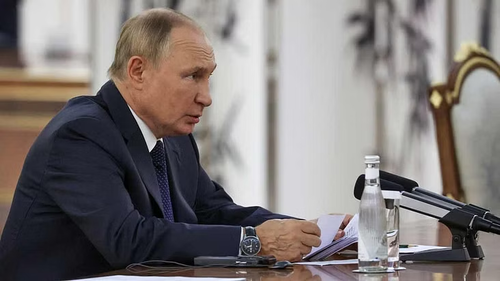
In a Sunday interview with Rossiya 1 state television, Russian President Vladimir Putin said his country is now ready to negotiate an end to the conflict in Ukraine. However, he once again pointed the finger at the West for making any dialogue toward an acceptable end to the fighting all but impossible.
"We are ready to negotiate with everyone involved about acceptable solutions, but that is up to them – we are not the ones refusing to negotiate, they are," Putin said.
Kremlin pool via Reuters
"I believe that we are acting in the right direction, we are defending our national interests, the interests of our citizens, our people. And we have no other choice but to protect our citizens," he added.
From Moscow's point of view, a signal of Ukraine's 'seriousness' about talks would likely hinge on Kiev's willingness to compromise on territorial concessions, especially regarding the Donbas in the east. Additionally the Ukrainians would likely have to acknowledge Russian control over the Crimea.
However, President Zelensky on Wednesday in his speech before Congress pledged "absolute victory" and has of late been vehement in rejecting any talk of letting go of territory as a non-starter, especially as the months-long Ukrainian counteroffensive has met with some significant successes.
Also in the interview Putin continued his theme of the US and NATO waging a proxy war using Ukraine as a pawn. He said in the Sunday comments that the West isattempting to "tear apart" Russia .
"At the core of it all is the policy of our geopolitical opponents, aiming to tear apart Russia, the historical Russia," Putin said. "They have always tried to ‘divide and conquer’… Our goal is something else – to unite the Russian people."
On Friday the US State Department said that Putin is belatedly "acknowledging reality" given that the day prior he for the first time ever used the word "war" to describe Russian actions in Ukraine. Putin had said in the Thursday televised news conference: "Our goal is not to spin this flywheel of a military conflict, but, on the contrary, to end this war," adding that "This is what we are striving for."
A State Department spokesperson reacted to Putin's unprecedented word choice by saying: "Since Feb. 24, the United States and rest of the world knew that Putin's 'special military operation' was an unprovoked and unjustified war against Ukraine. Finally, after 300 days, Putin called the war what it is."
At this point, and despite Putin's fresh remarks, all parties involved appear no closer to the negotiating table; instead, they seem further from this scenario than ever - given also US Patriot missiles are about to be transferred to Ukraine and could be a 'game-changer', while at the same time Putin is vowing his forces will destroy them.

WSJ : U.S. Steps Up Raids Against Islamic State Militants in Syria

U.S. Steps Up Raids Against Islamic State Militants in Syria
Operations result in capture, death of operatives but increase risks for American forces

WASHINGTON—The Pentagon said it has stepped up raids against Islamic State in Syria, conducting nearly a dozen risky helicopter and ground operations to kill or capture top militant operatives.

In December, the military said it had conducted at least 10 operations and raids, according to officials at U.S. Central Command, responsible for U.S. military operations in most of the Middle East. That included three operations Tuesday with the Syrian Democratic Forces, the U.S.’s ally in Syria, that led to the detention of six Islamic State operatives, a spokesman for the command said.

Those raids netted what the military said was an Islamic State provincial senior official named al-Zubaydi. Eight other raids, including seven earlier this month and another one in early October, killed or nabbed other Islamic State operatives, military officials said.

U.S. officials acknowledged that Central Command has carried out additional raids in Syria, but command officials declined to provide details on any of the other raids.

Ground raids and other operations keep Islamic State on its heels, officials said. But it isn’t without risk. In one recent raid, for example, U.S. forces were on the ground for about three hours as they engaged in extensive gunfire and ultimately detained individuals and collected intelligence at the site. Each operation is planned carefully and takes into account the perils of such raids after making assessments on “reams and reams” of intelligence, Col. Joe Buccino, a spokesman for Central Command, said.

In all, the raids are removing from the battlefield regional or local leaders who military officials believe play roles in planning and conducting attacks, mostly in rural areas against local security forces in the region, the military said. But the raids alone cannot stop the terror group’s expansion in Syria, particularly during an acute economic crisis and a stalled political settlement to resolve the nearly 12-year war, experts and former U.S. officials warned.

The U.S. is “doing more strikes because they have to,” said Andrew Tabler, a senior fellow at the Washington Institute for Near East Policy, a former White House and State Department official who oversaw Syria policy in the Trump administration. “The reason why the threat is growing is the economic problems and the lack of the settlement. [The U.S.] is ignoring the first part, and relying instead on strikes as a sort of drone therapy.”

The group grew inside Iraq and Syria following the withdrawal of American troops from Iraq in 2011. Islamic State, which lost most of its territory by 2017, has maintained the ability to conduct terrorism operations in Syria and Iraq with as many as 1,800 fighters in Syria and more than 8,000 in Iraq, according to unclassified assessments and military officials. The sophistication of the group’s attacks has diminished over time, and since 2019 the group is using fewer improvised explosive devices, military officials said.

But the problems posed by Islamic State remain acute. Syria is home to nearly 30 detention facilities housing thousands of imprisoned fighters. Nearby camps hold about 56,000 people, mostly women and children associated with the imprisoned fighters, who remain vulnerable to infiltration by Islamic State for radicalization, officials have said.

And the terror group still is capable of carrying out attacks on U.S. forces and allies, as well as mobilizing fighters.

“While ISIS is significantly degraded in Iraq and Syria, the group does maintain the capability to conduct operations in the region,” Army Gen. Erik Kurilla, who heads Central Command, based in Tampa., Fla., told reporters Thursday. “And we know the group has the desire to strike outside the region.”

Despite the growing regional threat, the terror group doesn’t pose an imminent threat to the U.S., officials said. But, they noted, the last time ISIS emerged as a major threat, in 2014, it happened very quickly, over a matter of weeks.

“When the instability in the Middle East begins to seep out and impact our interests and other areas, that’s when we are at a different point,” said Ret. Gen. Joe Votel, who led Central Command from 2016 to 2019.

The U.S. maintains about 1,000 U.S. service members at different locations inside Syria. Rocket attacks and other attacks are a regular reminder of the dangers posed by the group, officials have said.

Other raids, which are typically at night using special-operations forces in helicopters, included six operations Dec. 8, which led to the detention of five Islamic State operatives, military officials said. One more raid on Dec. 11 resulted in the deaths of two ISIS officials, they said.

Yet another raid, on Oct. 6, near the village of Qamishli, in northeast Syria, targeted and killed an Islamic State official deemed to be a smuggler of weapons and fighters known as Rakkan Wahid al-Shammri. On Nov. 30, Central Command announced the death of Abu al-Hassan al-Hashimi al-Qurayshi, identified as an Islamic State leader in what officials said was “another blow to ISIS.”

The raids do reflect an increased tempo of operations, but they are not the result of a more aggressive strategy to go after Islamic State, said Col. Buccino. “There are also several factors that allow us to conduct these raids without significant risk of civilian casualties or damage to infrastructure,” Col. Buccino said. “All these elements must come together for us to be able to launch these raids.”

Such raids have long been considered risky, putting U.S. special operations forces in situations in which they could be ambushed or otherwise attacked. The death of a U.S. service member in Syria would raise questions from Congress and inside the government about the value of targeting Islamic State operatives who typically are quickly replaced with other individuals.

No U.S. forces have been killed or injured in any of the raids, nor were any civilians killed or wounded, the U.S. military said.

Gen. Kurilla maintains the authority to conduct these kinds of raids against Islamic State in Syria, according to U.S. military officials. Following the strike in Kabul, Afghanistan, last summer that mistakenly killed 10 civilians, seven of them children, the White House took back the authority for such strikes, which had been held by commanders on the ground in Afghanistan.

At the time, however, Central Command got a “carve out” that allowed Central Command to retain the authority to strike as part of Operation Inherent Resolve, the name for the mission against Islamic State, officials said.

However, some operations, such as an Aug. 23 strike on bunkers in Deir Ezzor, Syria, required President Biden’s sign-off, in this case because it was targeting infrastructure used by groups associated with Iran’s Islamic Revolutionary Guard Corps, or IRGC, officials said.

The strikes come as Syria confronts both economic instability and a political stalemate.

The country is suffering the worst fuel crisis it has faced since the start of the war in 2011, leaving much of the country frustrated and at a standstill. That, coupled with a stalled political settlement between President Bashar al-Assad and opposition groups to end the war, has created enough instability for ISIS to grow, said Mr. Tabler.

There is enough volatility for ISIS “to survive as a terrorist organization to regenerate into something else,” he said.

Fortune : Mackenzie Scott isn’t the only one giving away her fortune. These are

Mackenzie Scott isn’t the only one giving away her fortune. These are the billionaires who made ground-breaking donations in 2022

If the first year of the COVID-19 pandemic minted a record number of new billionaires, then 2022 was the year of the giant billionaire philanthropic donation.
All year, there has been a steady trickle of announcements from billionaires pledging to give away the inordinate pile of cash they have amassed to groups (often their own foundations) set up to fight the huge challenges the world is facing, from combatting climate change to eradicating poverty.
“Giving a billion in a year puts you in pretty rare company,” Elizabeth Dale, an associate professor of nonprofit leadership at Seattle University, told Fortune, adding, “Anytime someone’s making an announcement of giving more than a billion dollars in a year, we know that they’re going to be one of the largest donors in a typical year.”
Here are the largest donations the world’s richest have made this year. This list is not exhaustive and only includes those who have donated north of $1 billion. It is notably missing Bernard Arnault and Elon Musk, who are the first and second richest people in the world at the time of publication.

Warren Buffett
At his annual summer party in June, Warren Buffett announced he had given away another $4 billion donation worth of shares in his conglomerate Berkshire Hathaway — the 17th time Buffett had made this annual gift. At the time of the announcement, the donation pushed Buffett’s total lifetime commitment to charity to $48 billion.
Buffett made a pledge in 2006 to donate 99% of his entire fortune to philanthropic foundations, making donations each year to the same five foundations: the Susan Thompson Buffett Foundation, the Sherwood Foundation, the Howard G. Buffett Foundation, the NoVo Foundation, and the Bill and Melinda Gates foundation.
Beyond the Bill and Melinda Gates Foundation ­— which Buffet once chaired and usually donates the largest sum to — the other four charities are run by his three children.
But his philanthropic donation didn’t end there for the year. In November, Buffett made another surprise $750 million donation in Berkshire Hathaway stock on Thanksgiving eve — the first time the 92-year-old has made a second major gift within the same year.
But unlike his usual annual donation, the Bill and Melinda Gates Foundation was noticeably missing from the roster of recipients. Buffett said the timing and the recipients of the second donation were no coincidence and it was his way of giving thanks to his children for their charitable work.
“I’ve got a personal pride in how my kids turned out,” Buffett told CNBC’s Becky Quick. “I feel good about the fact that they know I feel good about them. This is the ultimate endorsement in my kids, and it’s the ultimate statement that my kids don’t want to be dynastically wealthy.”

Bill and Melinda Gates
Microsoft co-founder Bill Gates joined Buffett this year in planning to give away his entire fortune.
“As I look to the future, I plan to give virtually all of my wealth to the foundation,” Gates wrote in a tweet in July, when he announced he was donating another $20 billion to the Bill & Melinda Gates Foundation.
“I have an obligation to return my resources to society in ways that have the greatest impact for reducing suffering and improving lives. And I hope others in positions of great wealth and privilege will step up in this moment too,” Gates wrote in a tweet.
Gates and his ex-wife Melinda French Gates have already pledged more than $50 billion to the foundation since 1994. For Bill to achieve his lofty goal of giving away his entire fortune, it would mean another $116 billion going towards his charity, which fights disease and poverty around the world
In a blog post published in July, Gates wrote that the Gates Foundation, which he founded with his wife in 2000, plans to boost its annual spending by 50% — to $9 billion by 2026, up from its current $6 billion.
“It is now clear that the need in all the areas where we work is greater than ever. The great crises of our time require all of us to do more,” Gates wrote, adding that the huge global setbacks ranging from the COVID-19 pandemic to Russia’s invasion of Ukraine, shouldn’t discourage people from trying to make the world better. “Focusing on being part of the solution is better than giving up in despair,” he wrote.
But no goods deed goes unpunished. Gates and his foundation became a prominent target for coronavirus conspiracy theories, including false claims that link him to the coronavirus’ origins or suggest he planned to use the COVID vaccines to implant monitoring microchips in billions of people. “You almost have to laugh because it’s so crazy,” Gates said in a BBC Interview in May.

Jeff Bezos
Another person to join the roster of the world’s richest people giving away their entire fortune was Amazon founder Jeff Bezos.
Bezos announced in November that he plans to give away the majority of his $122 billion fortune ­­­— after years of criticism for his relative lack of philanthropy when compared with his billionaire peers. Bezos is noticeably missing from the list of signatories to the Giving Pledge, a campaign founded by Buffett and Gates which encourages the world’s wealthiest to give half their net worth to charity.
The world’s fourth richest person made his pledge after giving $100 million to the country singer Dolly Parton to give to charities of her choice as part of Bezos’s annual Courage and Civility award.
When making the announcement with his girlfriend Lauren Sanchez, Bezos said: “The hard part is figuring out how to do it in a levered way — it is not easy.
“Building Amazon was not easy. It took a lot of hard work and a bunch of very smart teammates. Philanthropy is very similar. It is really hard and there are a bunch of ways you can do ineffective things, too.”
Bezos did not specify how he plans to divvy out his fortune nor did he provide any details of exactly which causes are likely to be his biggest focus.
“There’s still a lot we don’t know,” Benjamin Soskis, a senior research associate at the Urban Institute’s Center on Nonprofits and Philanthropy, told CNBC’s Make It program, adding: “If he is going to make good on his pledge, he is almost definitely going to be one of the major philanthropists of the first half of the 21st century.”
But part of the move to commit the huge sum may be in part of the growing public pressure to do so after the very public and prolific philanthropic efforts of his ex-wife MacKenzie Scott following her divorce from the 58-year-old billionaire.

MacKenzie Scott
Since taking control of her post-divorce fortune, Scott gave away more than $12 billion of her now $27 billion net worth in only two years.
In the first Medium blog post she published, in what would become a biannual series of essays announcing her donations, Scott wrote: “Last year I pledged to give the majority of my wealth back to the society that helped generate it, to do it thoughtfully, to get started soon, and to keep at it until the safe is empty.”
As the story of her huge donations first broke, Scott revealed in late March that she’d given away another $3.9 billion ­since June 2021. In the Medium post, the world’s 22nd-richest person listed her latest recipients, which were mostly underrepresented people who live in the regions they support and have personal knowledge of the issues they hope to address.
After the shock of her huge donation subsided, she did it again, announcing in a November Medium post that she had given another $2 billion to more than 300 organizations in the last seven months.
In an explosive Bloomberg article exposing the use of donor-advised funds, or charitable investment accounts, that are used by the ultra-wealthy to park their money to reap the tax benefits of donating to charity without actually having to give the money away to the needy, Scott was named as one of the few philanthropists who used the fund correctly.
“Part of why MacKenzie Scott has really made the headlines is kind of in the way she’s done it,” says Dale, noting that Scott stands out from her peers because of the speed in which she has managed to get her money to the people who need it. “When she made her first announcement like ‘I’ve given $1.6 billion’ that was out the door. You had a list of organizations that were receiving that money,” Dale says.

Gautam Adani
The world’s third richest man Gautam Adani made a pledge in June to donate 600 billion rupees ($7.7 billion) to a range of social causes to mark his 60th birthday and pay tribute to the birth centenary year of his father, Shantilal Adani.
India’s wealthiest people have been criticized in the past for not donating more to philanthropic causes. The India Philanthropy Report 2021 by global consultancy firm Bain and Co. found that on average, the country’s ultra-rich with a net worth of more than 500 billion rupees, had donated 0.5% of their wealth.
The donation instantly propelled Adani into the echelons of Western philanthropists who have given away significant portions of their wealth.
The funds, which will be managed by the Adani Foundation, will go to healthcare, education, and skills development, with a particular focus on India’s rural regions.
“Our experience in large project planning and execution and the learnings from the work done by the Adani Foundation will help us uniquely accelerate these programs,” Adani said in a statement in December.

WSJ : SPAC Boom Ends in Frenzy of Liquidation

SPAC Boom Ends in Frenzy of Liquidation
Surprise tax bill, deal drought cause a rush to unwind before year-end

During the boom in blank-check companies, their creators couldn’t launch them fast enough. Now they are rushing to liquidate their creations before the end of the year, marking an ugly conclusion to the SPAC frenzy.

With few prospects for deals soon and a surprise tax bill looming next year, special-purpose acquisition companies are closing at a rate of about four a day this month, nearly the same pace they were being launched when the sector peaked early last year.

Roughly 70 special-purpose acquisition companies have liquidated and returned money to investors since the start of December. That is more than the total number of SPAC liquidations in the market’s history, according to data provider SPAC Research. SPAC creators have lost more than $600 million on liquidations this month and more than $1.1 billion this year, the data show.

Many more SPACs have said they would wind down in the coming weeks. The trend is hurting prolific backers such as venture capitalist Chamath Palihapitiya and private-equity billionaire Alec Gores, wealthy former business executives like Gary Cohn and big Wall Street firms such as KKR & Co. and TPG Inc.

For many of the big SPAC creators, the losses have barely dented the fortunes they made during the mania. Mr. Palihapitiya, who said he would shutter two SPACs in September, told The Wall Street Journal that his investment firm made about $750 million across several deals. The firm, Social Capital Holdings Inc., took public companies like space-tourism firm Virgin Galactic Holdings Inc. and personal-finance app SoFi Technologies Inc.

Those SPACs that came late to the game are often struggling to find deals. Falling stock prices and rising interest rates have essentially frozen the market for new public listings, making it difficult for executives to meet their two-year deadline to find a deal. Many of those deadlines are coming up in the first half of next year.

A 1% federal tax on share repurchases that is part of new climate, health and spending legislation has accelerated liquidations. Winding down a SPAC and returning cash to the investors could be considered a repurchase of the company’s existing shares, which would face the buyback tax beginning next year. Some analysts project SPAC liquidation losses will top $2 billion in the coming months.

“Something people thought was going to be a fantastic vehicle for creating wealth is looking increasingly like a poisoned chalice,” said John Chachas, co-managing principal at Methuselah Advisors, a boutique investment bank that has advised companies fielding an increasing number of calls from SPACs desperate to find deals.
Also called a blank-check company, a SPAC is a shell firm that raises money from investors and lists publicly with the sole purpose of merging with a private company to take it public. After regulators review the deal and it is completed, the company going public replaces the SPAC in the stock market.

Such mergers burst onto the scene as popular alternatives to traditional initial public offerings in 2020 and 2021. The boom turned into a bust during this year’s market reversal.

An exchange-traded fund tracking companies that went public this way is down more than 70% this year, dragged down by losses in startups such as sports-betting firm DraftKings Inc. and electric car maker Lucid Group Inc. Companies that went public via SPACs have performed worse than other newly public companies this year.

One characteristic of SPACs is that investors can get their cash back if they don’t want to participate in a deal. When the market was hot, investors often held shares in the newly public startups, expecting big returns or selling immediately if shares had already gone up. Now they are pulling out before the deals close, dramatically reducing the amount of cash companies can raise.

SPACs are now paying less for companies than they did during the sector’s peak. The average valuation of startups announcing SPAC mergers has fallen to about $400 million this quarter from more than $2 billion for most of last year, Dealogic data show. Roughly 300 companies have gone public through SPACs in the last two years.

There are still nearly 400 SPACs together holding about $100 billion that have yet to find deals, according to SPAC Research. If roughly 200 of the SPACs liquidated, the losses for creators would be well above $2 billion, said New York University Law School professor Michael Ohlrogge, who studies SPACs. SPAC creators have lost about $9 million on average through liquidations this year, money they paid to banks and law firms to set up the shell companies.

There are another roughly 150 SPACs holding about $25 billion that have reached merger agreements but haven’t closed them, including a blank-check firm that is trying to take public Donald Trump’s social-media company, according to SPAC Research. Some of those will likely get called off, meaning liquidation losses could end up being even greater than expected.

To some observers, this year’s losses show why SPACs are inefficient for companies seeking to raise money or go public.

“It just emphasizes the needlessly wasteful aspects of the SPAC structure,” said Mr. Ohlrogge, who has proposed companies could get the benefits of a blank-check merger while doing a variation of a traditional IPO or direct listing.

WSJ : Rising Power Prices in Europe Are Making EV Ownership More Expensive

Rising Power Prices in Europe Are Making EV Ownership More Expensive
In some cases, filling a tank with gas has become cheaper than charging an electric vehicle

BERLIN—Rocketing electricity prices are increasing the cost of driving electric vehicles in Europe, in some cases making them more expensive to run than gas-powered models—a change that could threaten the continent’s electric transition.

Electricity prices have soared in the wake of Russia’s invasion of Ukraine, in some cases eliminating the cost advantage at the pump that EVs have enjoyed. In some cases, the cost difference between driving both types of cars 100 miles has become negligible. In others, EVs have become more expensive to fuel than equivalent gasoline-powered cars.

The price rises for power, which economists expect to last for years, remove a powerful incentive for consumers who were contemplating a switch to EVs, which used to be much cheaper to run than combustion engines.

Coming just as some governments are removing subsidies for EV buyers, this change could slow down EV sales, threaten the region’s greenhouse-gas emission targets, and make it hard for European car makers to recoup the high costs of their electric transition.

In Germany, Tesla has raised prices at its fast-charging stations several times this year, reaching a peak of 0.71 euros, equivalent to 75 cents, in September before falling somewhat, according to reports from Tesla owners on industry forums. There is no public source to track the prices on Tesla superchargers.

At the pricing peak, drivers of Tesla’s Model 3, the most efficient all-electric vehicle in the Environment Protection Agency’s fuel guide in the midsize-vehicle category, would pay €18.46 at a Tesla supercharger station in Europe for a charge sufficient to drive 100 miles.

By comparison, drivers in Germany would pay €18.31 for gasoline to drive the same distance in a Honda Civic 4-door, the equivalent combustion-engine model in the EPA’s ranking.

Tesla didn’t immediately respond to requests for comment.

The change has been particularly notable in Germany, Europe’s largest car market, where household electricity cost €0.43 per kWh on average in December. This puts it well ahead of France, where consumers paid €0.21 per kWh in the first half of the year, but behind Denmark, where a kWh cost €0.46, according to the German statistics office.

The cost of electricity isn’t the only factor that can make an EV cheaper or more expensive to run than a gas-powered car. The price of the car, including potential subsidies, the cost of insurance and the price of maintenance all play a role in the cost equation over a car’s lifetime.

Maria Bengtsson, a partner at Ernst & Young responsible for the company’s EV business in the U.K., said studies of the total cost of owning an EV now show that with much higher electricity prices, it will take longer for EVs to become more affordable than conventional vehicles.

“When we looked at this before the energy crisis, we were looking at a tipping point of around 2023 to 2024. But if you assume you have a tariff going forward of $0.55, the tipping point then moves to 2026.”

If costs for operating EVs rise again, the tipping point would be pushed even further into the future, she said.

So far, there is no sign that the higher costs to charge electric cars has affected EV sales. Sales of all-electric cars totaled 259,449 vehicles in the three months to the end of September, up 11% from the previous quarter and 22% from the year earlier, according to the European Automobile Manufacturers’ Association. In the third quarter, all-electric cars accounted for 11.9% of total new vehicle sales in the EU.

There is no relief in sight for EV users. In Germany, power prices have risen by a third from €0.33 per kWh in the first half of this year, according to Germany’s federal statistics office, and some power companies have announced prices will increase to more than €0.50 per kWh in January.

The German government’s independent panel of economic experts forecast that in the medium term these prices are likely to decline but won’t return to precrisis levels, meaning that higher costs for EV owners are here to stay.

Rheinenergie, a municipal utility in Cologne, said in November that it would raise its prices to €0.55 per kWh in January. In October, EnBW, a Stuttgart-based regional power company, raised its prices for a kWh of electricity to €0.37, up 37% from the previous month.

The most expensive way to charge an EV in Europe is on one of the fast-charging networks. Operators such as Tesla, Allego and Ionity have built roadside charging stations along major highways, where EV owners can drive up, plug in, and charge their batteries in as little as 15 minutes.

Fuel-economy estimates calculated by the EPA and current charging and gas prices in Europe show that some conventional vehicles are now cheaper to fuel with gasoline than equivalent electric models using fast-charging stations.

In the subcompact segment of the EPA’s 2023 Fuel Economy Guide, the Mini Cooper Hardtop was the most efficient model among EVs and gasoline-powered cars.

A 100-mile ride cost the Mini EV owner €26.35 at the Allego fast-charging network, which charges €0.85 per kWh. The conventional Mini cost €20.35 to pump enough fuel to accomplish the same journey.

Mini and its owner, Bayerische Motoren Werke AG , didn’t immediately respond to a request for comment.

In the small two-door SUV category, the gasoline-powered Nissan Rogue handily beats the Hyundai Kona Electric, at a cost difference of €19.97 to €22.95. The Subaru Ascent standard SUV with four-wheel drive costs less to drive 100 miles than the Tesla Model X.

If an EV owner only charges their vehicle at home, they are generally still paying less for driving than conventional car users, although this gap has narrowed considerably.

Analysts say about 80% of EV charging takes place at home or at work, so if an electric vehicle is only used close to home it generally remains the least expensive option. But once the vehicle is used for longer road trips, drivers are more likely to use fast-charging stations because other options would take too long to charge the battery.

Charging a Tesla on 120V AC power—the power that comes from a standard European wall socket—would take days. Standard 240V AC chargers installed on street corners, at supermarkets, places of work and in home garages can charge a powered down Tesla battery overnight.

The supercharger networks run on DC power, requiring at least 480 volts of power, and can charge up to around 200 miles of range within 15 minutes.