WSJ : Bullpen Capital Raises Fund for ‘Unloved Gems’

Bullpen Capital Raises Fund for ‘Unloved Gems’
A new $145 million fund will target startups that are turned away by other investors, a general partner says

Bullpen Capital said it raised a new $145 million venture-capital fund, which will support overlooked startups across all sectors with the potential for long-term growth.

The fund, the firm’s sixth and largest to date, signals continued confidence from Bullpen’s backers in its ability to identify “unloved gems” among startups that were passed over by other investors—especially during the past year’s turbulent markets, said Paul Martino, Bullpen co-founder and general partner.

“VCs can fall into looking for patterns and if you don’t match the pattern, you don’t get the money,” Mr. Martino said. “That’s a big mistake.”

Based in San Francisco, Bullpen typically provides early-stage startups with several million dollars of what it calls post-seed funding. Mr. Martino said post-seed startups are new businesses that have tapped their first funding round but aren’t quite ready for a formal Series A round. The firm spends up to a year coaching startup founders and teams that have identified clear market opportunities but need help fine-tuning their products or services, he said.

In the initial phase of business development, he said, “we’re the sixth and seventh inning pitchers,” Mr. Martino said.

Though Bullpen invests across the startup ecosystem, both its name and Mr. Martino’s sports analogies reflect some of the firm’s most successful investments. That includes early funding for fantasy-sports betting company FanDuel.

More recently, Bullpen in November took part in a $33 million Series B funding round for OneRail, an Orlando, Fla.-based last-mile delivery software startup, which has grown revenue by more than 300% and expanded services to over 330 U.S. cities since a previous fundraising round in 2021, OneRail said.

Bullpen’s latest fund adds to the venture-capital market’s record-high levels of dry powder—the estimated amount of capital available for VC firms to invest. Venture-capital firms in the U.S. raised a combined $151 billion in the first three quarters of 2022, exceeding any prior full-year totals, according to market-research firm PitchBook Data Inc. It estimates that, going into the new year, VC firms are sitting on nearly $300 billion in dry powder.

Yet market observers are divided over whether the level of pent-up venture capital bodes well for startups in the year ahead, or reflects investors’ reluctance to make risky bets in the face of mounting economic uncertainties. Both the number and size of funding deals slowed sharply in the second half of year, PitchBook said. It expects the pace of venture-investor fundraising for new funds to ease in the months ahead as rising interest rates offer lower-risk opportunities for limited partners, among other issues.

Mr. Martino said Bullpen’s investing strategy—which involves avoiding hot startups that draw a “pile on” of investors, he said—helped shield the firm from deep losses incurred by other VCs from overheated funding markets in 2021 and early 2022, especially in areas like crypto.

“You’ve just gotta move slowly and even more methodically than you did before,” Mr. Martino said about navigating uncertain conditions in the year ahead. “Being different is the key,” he said.

>>> US Gapping down

Gapping down

Other news:

  • LJAQ -21.1% (and Moolec Science announce that their previously announced business combination was approved at a special meeting of stockholders of LightJump on December 27, 2022)
  • QMCO -1.9% (stock offering)
  • ISEE -1.7% (to sell its preclinical stage gene therapies IC-100 and IC-200 to Opus Genetics)
  • LUV -0.8% (memos showed concern about winter storm)

>>> US Gapping up

Gapping up
Other news:

  • KULR +5.2% (to Introduce All-New Modular Energy Platform)
  • TSLA +3.2% (ARK Innovation ETF (ARKK) purchased 25K shares)
  • CLNE +2% (announces sustainability-linked financing with riverstone credit partners to fund RNG growth)

Analyst comments:

  • GNRC +0.9% (initiated with a Buy at Janney)

WSJ : Negative-Yielding Bonds Could Be Approaching Their Final Days

Negative-Yielding Bonds Could Be Approaching Their Final Days
Japan is the last major economy to have a target interest rate below zero

Negative yields on government bonds look like they are about to ride off into the sunset.

The worldwide sum of negative-yielding debt has almost completely evaporated, another effect of central bankers’ efforts to fight inflation around the world. It now stands at $271 billion, down from more than $18.4 trillion two years ago, according to Bloomberg index data accessed via FactSet.

This unusual debt piled up in recent years as central banks in Europe and Japan held their target interest rates below zero to try to stimulate economic growth.

This year, however, surging inflation has prompted Europe’s major central banks to raise interest rates, pulling yields there back into positive territory. That has left Japan as home to nearly all the sub-zero-yielding debt that remains.

But last week, the Bank of Japan eased its efforts to keep the yield on 10-year Japanese government bonds below 0.25%. In the days since, the Japanese 10-year yield has risen to just shy of 0.5%, and yields on shorter-term notes of less than 10 years have turned positive. Now, only the yields on Japanese government bills that mature in a year or less remain negative.

Some investors believe that move has opened the door for the Bank of Japan to raise its target interest rate above zero next year, from minus 0.1% today. If it does, yields on more Japanese short-term bills would likely turn positive.

The European Central Bank, along with the central banks of Sweden, Denmark and Switzerland, all held their target interest rates below zero in the late 2010s, bringing a flood of negative government-bond yields to the continent. But each has now brought interest rates positive again. The ECB’s rate has climbed from minus 0.5% in January to positive 2% to finish 2022.

As negative yields fade, investors focused on overseas bonds are seeing the playing field of attractive fixed-income investments open up.

“Negative yields in Japan and Europe certainly made global fixed income very challenging to invest in,” said Lynda Schweitzer, co-head of global fixed income at Loomis Sayles.

In recent years, Loomis Sayles’s global-bonds team turned to buying somewhat riskier European and Japanese debt like corporate bonds and bonds backed by mortgages or car loans to secure positive fixed-income yields denominated in euros or Japanese yen, she said. As those currencies’ government yields have flipped above zero again, she and other bond buyers can lock in positive returns overseas with less risk again.

Bonds with negative yields make for a counterintuitive investment, because they effectively require the bondholder to pay for the privilege of lending the government money.

They can also send investors hunting for alternatives that offer more solid returns. Low and sometimes negative yields on many government bonds throughout the world helped set the backdrop for a yearslong rally in riskier investments like stocks through the end of 2021.

Still, many investors found reasons to buy bonds at negative yields in recent years. Some needed a safe place to park large sums of euros or yen and had little choice but to swallow the negative yields. Others bought negative-yielding bonds hoping to sell them for a profit before maturity if yields fell farther. Bond prices rise when yields fall.

Other investors based outside Japan have profited from low-yielding government bonds there by pairing their investments with a currency hedge. Ella Hoxha, a senior investment manager at Pictet Asset Management, said that some of the firm’s fixed-income funds have been earning yields of more than 4% by trading dollars for yen in short-term swaps and investing the yen in short-term Japanese government debt. Most of the yield in that trade comes from the currency hedge, because foreigners are willing to pay more to borrow dollars at a time of relatively high interest rates in the U.S.

The Bank of Japan has held its benchmark interest rate below zero since 2016 in an attempt to stimulate lackluster economic growth, but rising prices are testing the bank’s commitment to that strategy.

The central bank described its recent change in yield-curve policy as a technical adjustment. But the move still ignited a debate over whether officials may bring their target rate higher next year.

Goldman Sachs Group Inc. economists took the Bank of Japan’s decision as “a sign that policy rates could be adjusted further in coming months,” they wrote in a note to clients last week.

Brent Donnelly, a currency trader and macro analyst who leads Spectra Markets, said that the bank’s path will depend on who is chosen to succeed Haruhiko Kuroda, the Bank of Japan’s governor, whose term ends next year.

“They could be selecting either a dove or a hawk, and that signal is probably all you will need to know,” Mr. Donnelly said.

WSJ : China Approves Foreign Videogames in Latest Breather for Tech Giants

China Approves Foreign Videogames in Latest Breather for Tech Giants
Beijing regulators approve ‘Pokémon’ and ‘Game of Thrones’ titles, ending a suspension on foreign videogames dating to June 2021

SINGAPORE—China has resumed granting publishing approvals for foreign videogames, ending a halt stretching back to June 2021 and removing a source of uncertainty for the country’s once-flourishing videogame industry.

China’s main videogame regulator, the National Press and Publication Administration, said Wednesday that it had approved 45 imported titles, including “Pokémon Unite,” a multiplayer battle arena game co-developed by China’s Tencent Holdings Ltd. TCEHY 3.90% and Japan’s The Pokémon Co., and Riot Games Inc.’s first-person shooter game “Valorant.”

One of the games on the list, “Game of Thrones: Winter is Coming,” a strategy game developed by Shanghai-headquartered Yoozoo Games Co. and licensed by Warner Bros. Interactive Entertainment, was approved in September, while the rest were licensed earlier this month, the regulator said in a statement.

The resumption of approvals for imported titles paves the way for game developers and publishers to cash in on some popular global titles in the world’s biggest mobile game market. In China, companies must seek government approval to charge players for a new game. Imported games have been an important source of income for large Chinese game companies.

In a separate statement on Wednesday, the industry regulator said it also granted licenses this month to 84 domestic games, including Tencent’s third-person shooter “Synced: Off-Planet.”

Including the games approved on Wednesday, Beijing has approved more than 500 videogames this year since it resumed the licensing process in April. The rate is lower than in previous years, when some 1,000 titles were greenlighted each year. Chinese regulators froze game licensing in July 2021 and unveiled strict new measures to limit players under age 18 to only one hour of videogames each Friday, Saturday and Sunday, plus public holidays.

Chinese videogame makers, including Tencent and smaller rival NetEase Inc., have shifted their focus to making fewer games with higher potential, given the limited number of government licenses available in China, as well as developing games for international markets.

(ZH) These Are The 100 Biggest Public Companies In The World

These Are The 100 Biggest Public Companies In The World

This year has been shaped by uncomfortable macroeconomic headwinds.
Trillions of dollars were erased in public company market capitalizations, investor confidence waned, and cost pressures squeezed consumer pocketbooks.
Taken together, many of the world’s largest companies experienced sharp declines in market share. Still, a few companies in key sectors had positive growth over the year.
As 2022 comes to a close, Visual Capitalist's Dorothy Neufeld shows the infographic below, the biggest companies in the world, using data from Companiesmarketcap.com.

The World’s Largest Public Companies in 2022
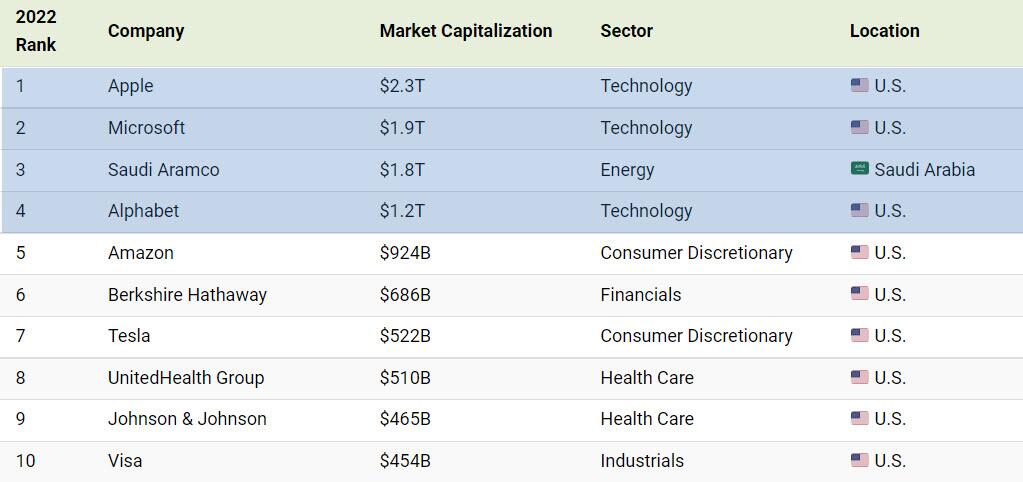
Today, Apple stands as the world’s most valuable company, towering at a $2.3 trillion valuation.
Despite the tech downturn of 2022—driven by rising interest rates and slower sales—Apple maintained its top spot. This was largely thanks to record revenues and healthy consumer demand for iPhones, which drive about half of its total revenue.
Following Apple is Microsoft. Unlike Apple, Microsoft has faced slower earnings over the year due to lower demand for personal computers and the weighing impact of a strong U.S. dollar. Overall, about 50% of the company’s sales take place overseas.
As we show below, there are now only four companies left in the trillion dollar market cap club.
Oil giant Saudi Aramco is the third largest publicly-traded company globally, at $1.8 trillion. It’s also the only non-U.S. company in the top 10.
In May, the state-run company briefly became the most valuable company on the planet as soaring energy prices boosted earnings. Saudia Arabia is the largest exporter of oil in the world, and the country’s economy is forecast to grow 7.6% in 2022—one of the fastest globally.
Overall, 62 companies of the 100 largest are headquartered in the U.S., 11 are based in China, and five are located in France.

Top 10 Performance in 2022
For many of the world’s largest companies, 2022 was a brutal year for performance.
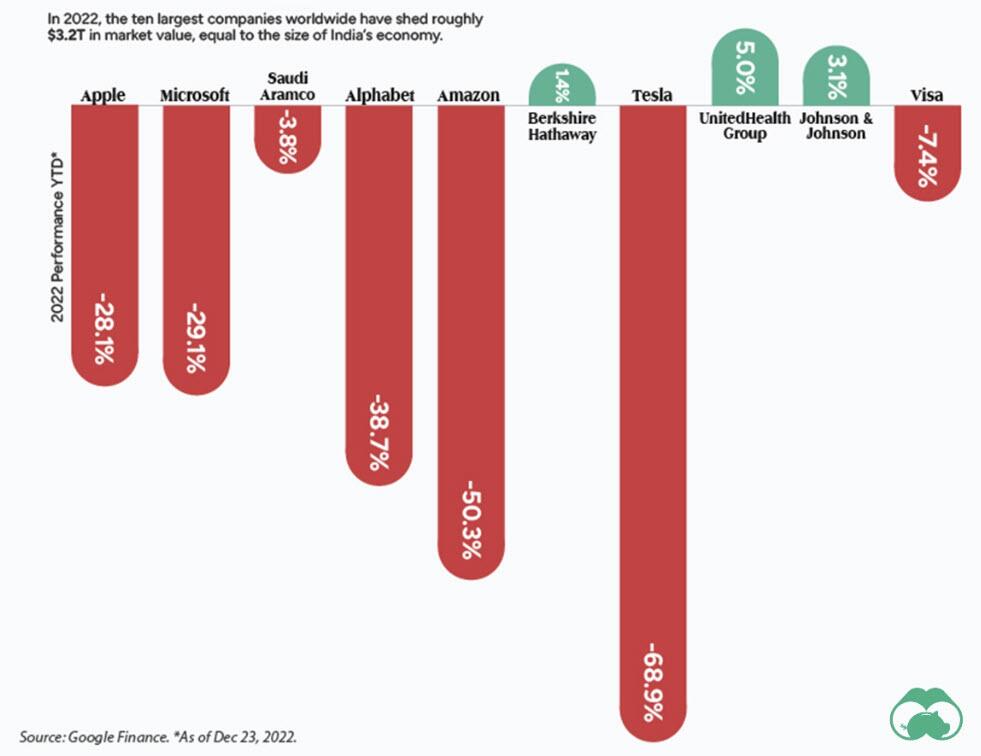
As the above graphic shows, the vast majority of the world’s titans saw their market values decline. Half of these companies saw double-digit drops.
Tesla has witnessed nearly 70% of its market cap being erased this year. Two main factors are behind this drop: falling demand, especially in China, and CEO Elon Musk’s volatile and risky acquisition of Twitter.
On the other hand, UnitedHealth Group has seen the strongest performance among the top 10.
The company, which rakes in a large share of its earnings from employer-backed insurance plans, said that recessionary impacts had not yet begun materializing in 2022.

Biggest Companies in the World, by Sector
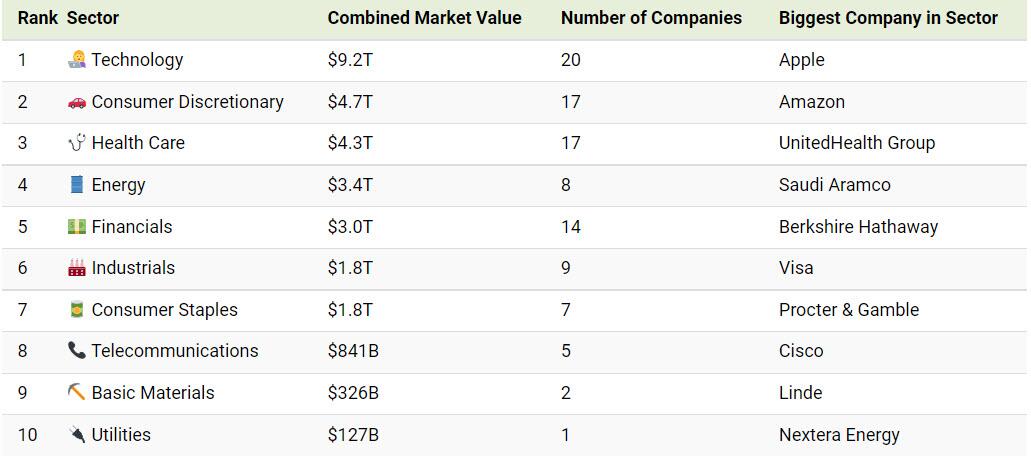
Even with sinking market values across the sector in 2022, tech remains dominant.
Among the world’s biggest companies, 20 are in tech, spanning a combined market value of $9.2 trillion. For perspective, that’s about 31% of the market value of the 100 largest companies.

Companies are classified according to the FTSE Russell Industry Classification Benchmark. *As of Dec 12, 2022.

Consumer discretionary and health care sectors fall next in line, with big players such as Amazon and Johnson & Johnson among their ranks.
At the other end of the spectrum is utilities, the smallest sector overall at least pertaining to the largest companies list. NextEra Energy, the sole utilities company among the rankings is one of the world’s largest developers of wind and solar energy. Over the next three years, it plans to invest up to $95 billion in greening its power operations.

Change of Fortune
It comes as no surprise that many of the biggest companies in the world are long-established players in global markets.
Yet within the rankings, some of the notable risers compared to 2021 are UnitedHealth Group, which launched from #19 in 2021 to #8 this year and NVIDIA which has climbed to become the 11th largest company globally, up from #24 last year.
By contrast, some of the biggest losers are Meta (Facebook’s parent company) and Alibaba. Meta has fallen across the rankings to #26 in 2022 from #6 in 2021. Meanwhile, Alibaba was once the ninth largest globally but has tumbled to #36. Both companies have seen considerable value wiped from their market caps—roughly 66% and 28%, respectively​​—amid lagging earnings.
With the year coming to a close, it remains to be seen whether the world’s biggest companies stage a comeback in 2023, or face more challenging conditions ahead.

(ZH) Billionaire Developer Li Zhang Arrested in London for Bribery in San Franci

Billionaire Developer Li Zhang Arrested in London for Bribery in San Francisco, Facing Extradition

Li Zhang, a Chinese billionaire who is cofounder and CEO of Guangzhou R&F Properties, was arrested in London on Nov. 30 under a provisional warrant issued by the U.S. Attorney’s Office of Northern California District.
Zhang was accused of “participating in a scheme to bribe public officials” between 2015 and 2020, according to Reuters.
Zhang, 69, is worth $2.3 billion, according to Forbes magazine. He was granted bail under 15 million pounds (approximately $18.4 million) ahead of a legal battle against extradition to the United States. He did not show up at a Dec. 12 hearing.
As part of his bail conditions, Zhang will be confined to an apartment 24 hours a day and subject to CCTV and security monitoring by a London investigation and security risk firm. He will be handcuffed to a representative of the security firm when he leaves the apartment to attend court hearings, according to South China Morning Post.
Guangzhou R&F Properties issued an announcement in its official WeChat channel, stating: “Li Zhang was accused of bribery for hosting a banquet in China and providing hotel accommodation for the former San Francisco Public Works Director.”
This was the first time R&F Properties responded on the alleged bribery accusation against Zhang. The announcement confirms that the person called “DEVELOPER 1” in the corruption case of Mohammed Nuru, the former San Francisco Public Works Director, is Zhang.
In December 2021, Nuru pleaded guilty to the charge of honest services wire fraud, including a string of briberies and corruption during his years in office, and was sentenced to seven years by U.S. District Judge William H. Orrick in August 2022.
According to a press release from the U.S. Attorney’s Office Northern District of California, Nuru admitted in the plea agreement that he “received free travel, gifts, and benefits, for working with Walter Wong to use Nuru’s official position to benefit a billionaire developer from China.”
Zhang (referred to as “DEVELOPER 1”) first surfaced in the FBI investigation into the Nuru case in the fall of 2018, when Nuru was talking on his cell phone about his then-upcoming trip to China, according to the affidavit of FBI agent James A. Folger.
On a phone call with his girlfriend, official Sandra Zuniga, in November 2018, Nuru described how he was flattered by a luxury hotel: “We get there, they take us to our rooms and everything, and everybody’s in their room, and then as soon as I come out, they’re like still outside our room. I’m like, ‘Oh man, what’s going on?’”
Nuru also said in the phone call that he did not realize how rich Zhang is before this trip to China.
He said in the call: “I’m helping him with a project here, San Francisco. So whenever he comes, I always go to see him. I didn’t know … he has this plane; I didn’t know that, how big he was, until I got to China.”
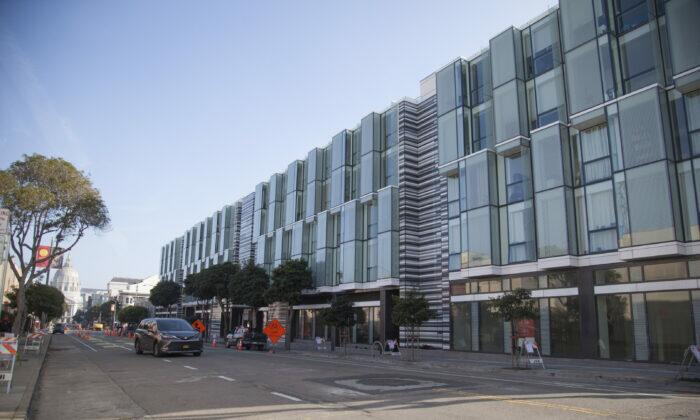
The project Nuru mentioned is 555 Fulton Street in San Francisco, developed by R&F’s U.S. affiliate Z&L Properties Inc., which was referred to in the complaints against Nuru as “Multimillion-Dollar Mixed-Use Development.” Wong was working as a consultant of that project.
The building project 555 Fulton Street in San Francisco on Dec. 20, 2022. (Lear Zhou/The Epoch Times)
On the same phone call with Zuniga, Nuru said, “He [Zhang] had a whole list of things that we need to get done.”
Nuru also mentioned that the project couldn’t get a certificate due to a possible defect in the glass windows made in Mexico.
He added, “Yup, and he’s very upset about [it] because he’s, you know, he thinks he’s lost, he’s spent so much money and … can’t see the end of the tunnel.”
The glass issue was mentioned by one of Nuru’s employees when Nuru was in China in 2018. In a phone call, Nuru directed one of his managers to solve the problem and expedite the process.
According to a report by the San Francisco Chronicle in 2019, 555 Fulton St. was in the “finalizing construction” stage after a massive delay. More than one year of the delay was caused by the developer redesigning the building’s exterior without city permission. The builder was forced to go back to the approved yet more expensive design, which had a glass exterior.
Tom Hui, former director of the Department of Building Inspection (DBI), who went to dinner with Zhang and Wong in February 2019, stepped down in March 2020 following internal investigations by then City Attorney Dennis Herrera.
It was not clear whether Hui helped with the 555 Fulton Street project’s permit. In early 2020, after Nuru was arrested and indicted, the FBI raided the DBI’s server room, according to Mission Local. Hui was not charged with any federal crimes.
The Epoch Times reached out to the U.S. Attorney’s Office of Northern California District for comment but did not receive a response.

FT : Inside London’s rental crisis

Inside London’s rental crisis
The mass return to cities post-lockdown swamped the rental market with demand

When my friend and I started hunting for a rental flat in the south-east London district of Peckham over summer, we didn’t expect the search to be quick. But six months, 50 viewings and a dozen or so rejected offers later, we’re still looking.

After boomeranging back to our family homes not long before the pandemic started, the two of us had unknowingly decided to re-enter the rental market during its most chaotic period in a generation.

In the autumn, rapidly rising mortgage rates slammed the brakes on the capital’s runaway sales market — but for renters like us, the crisis rages on.

We’ve queued around the corner to view properties, offered to lock in for 24-month contracts and even bid on apartments before seeing them — all in an attempt to beat the competition. But to no avail.

Compared with 2019, demand for two-bedroom properties in London is up 59 per cent, while the number of places available to rent is down 35 per cent, according to Rightmove, the UK’s largest online property portal.

“It’s like everyone who left London or went back to Mum and Dad’s during the pandemic was in the same WhatsApp group and decided the very same week: ‘Should we all move back?’” says Kristjan Byfield, co-founder of the London-based letting agency Base Property Specialists.

What really happened was the mass return to cities post-lockdown, combined with ballooning student populations — and would-be buyers getting priced out by high mortgage rates — swamped the rental market with demand.

Meanwhile, Britain’s rental stock of 5.5mn homes has been more or less flat for the past seven years, according to Zoopla, as home building falls below targets and landlords sell up because of higher taxes and tighter regulation.

It’s now common to get up to 70 inquiries per flat and to close listings within a few hours, says Byfield. And more unscrupulous landlords and letting agents are using the imbalance in supply and demand as “an excuse to take advantage” of prospective tenants, he adds.

As one agent confided in me during a viewing, she saw it as “part of [her] job” to incite a bidding war. In an extreme case, a friend lost out on a two-bedroom flat on the market for £2,000 a month to a young couple with a baby who bid 50 per cent above the asking price out of fear they would be left homeless with their newborn.

As a result, the average rental price for a two-bedroom flat in London currently stands at nearly £2,200, 18 per cent higher than last year. But it’s not just price that landlords are dictating in a seller’s market.

In August, my friend and I had a bid accepted on a two-bed flat in East Dulwich, which neighbours Peckham, but only after a 45-minute interview with the landlady and her property manager in which they pried into our personal lives.

In order to finalise the offer, they wanted to see three months’ worth of bank statements to check whether we spent excessively on credit cards or gambling. We initially hesitated before sending them the documents, and our reluctance made us appear “untrustworthy” and they voided the offer.

Along with more exacting checks on tenants, landlords are also choosing renters with higher income ratio than before to “recession proof” their rental agreement — just in case one of the tenants loses their job, Byfield tells me.

At least some of the heat has been let out of the rental market in recent months — though much of this is down to the usual seasonality of the market. In November, the average member branch of UK estate agent body Propertymark registered 77 new rental applicants, down from an all-time high of 147 new applicants in September but still above the pre-pandemic average of 61 new applicants for November.

Lucy Morton, head of UK residential agency JLL, says the market is unlikely to calm down anytime soon. “I’ve never seen the market as frenetic as it is and next year I think it’s going to be frenetic again,” she says.

In October, my friend and I had a second offer accepted by a couple in the process of buying a bigger property in the suburbs to accommodate their growing family, while planning to rent out their old place in Peckham. But as mortgage rates soared in the aftermath of Liz Truss’s “mini-Budget”, the chain on their new property purchase collapsed, nixing our rental agreement along with it.

For a lot of tenants, the rental market amounts to “shouting into a cave and getting nothing back”, Byfield says. As for my friend and me, we’ve resolved not to get our hopes up if and when our next offer is accepted. Still, roll on 2023 — fingers crossed it will be third time lucky.

TechCrunch : Y Combinator-backed Poly uses AI to generate art assets

Y Combinator-backed Poly uses AI to generate art assets
Image Credits: v_alex / Getty Images
As generative AI like ChatGPT and DALL-E 2 attract investor attention, startup entrepreneurs are looking to cash in with new business models built around them. One of the more interesting ventures to emerge from the space recently is Poly, which lets designers create video game and other virtual assets, including textures for 3D models, using only text prompts.
Poly is essentially a stock asset library along the lines of Adobe Stock and Shutterstock but populated exclusively by AI generations. While platforms like Getty Images have banned AI-generated content for fear of potential legal blowback, Poly is barreling full steam ahead.
“Almost everyone knows the all-too-common pain of searching for that perfect icon, illustration, font or sound effect online, only to give up and settle for something imperfect. Poly is trying to drastically improve this with a suite of generative tools focused on creators,” CEO Abhay Agarwal told TechCrunch in an email interview.

Before co-founding Poly with Sam Young, Agarwal was a research fellow at Microsoft, where he published papers in the field of AI for social impact. Agarwal then started Polytopal, a “human-centered AI” consulting company that worked with brands like Spotify, Meta and Nestlé to develop various intelligent systems. Among other projects, Polytopal co-created a dance choreography algorithm for the game BeatSaber and launched a virtual baking assistant for Toll House that helps design a cookie recipe to suit users’ dietary needs.
“Young and I started Poly in early 2022 from a shared passion to ‘increase the creative capacity of the world,’ and joined Y Combinator’s S22 batch,” Agarwal said.

Image Credits: Poly

Poly’s first tool in its planned web-based suite generates 3D textures with physically-based rendering maps. In modeling, “physically-based rendering” refers to a technique that aims to render images in a way that mimics the flow of light in the real world.

With Poly, designers can describe a texture (e.g. “Tree bark with moss”) and optionally provide a reference image to get generated textures for crafting 3D models. The models come in customizable resolutions and with normal and invert maps — maps often used in game development to add volume, depth and details to 3D objects’ surfaces.

“Poly trains its generative AI models with several proprietary methods, such as extracting texture information from normal images to augment its model’s learning capabilities,” Agarwal said.
When asked about how Poly treats more sensitive content that developers might request, like violent and overtly sexual generated imagery, Agarwal provided few details but said that Poly “carefully and responsibly” audits its products. “We’ve had no instances of harm reported to us yet,” he added.
Poly sees itself competing both with traditional asset marketplaces and developers’ manual design processes. Besides portals such as GameDev Market and OpenGameArt, major game engine vendors like Unity host and sell assets through their own platforms.
Poly’s also not the first to apply AI to generating game assets. Direct competitors include Hotpot and Pixela.ai, which use similar algorithms to create custom backgrounds, sprites and other art content.

Agarwal asserts that Poly’s generative AI is superior to most in terms of the quality of assets it produces. The jury’s out on that. But Poly aims to further differentiate itself by expanding its generative AI service across asset types such as illustrations, sprites, sound effects and more. It plans to make money through enterprise partnerships, premium integrations for design tools and by charging a subscription fee for royalty-free access to assets, including commercial and resale rights.
Agarwal claims that “thousands” of developers are currently using Poly’s free service, which generates an unlimited number of assets for noncommercial use, while “hundreds” are paying for Poly’s pro plan. To date, the platform has generated more than two million textures.
That momentum drew in investors, including Felicis, Bloomberg Beta, NextView Ventures, Y Combinator, Figma Ventures and the AI Grant, which together contributed $3.9 million in venture capital toward Poly at Y Combinator’s demo day in September.
“Poly’s customers range from professionals at Fortune 500 companies to individual freelancers in game design, AR/VR, interior design, architecture and 3D rendering for ecommerce and marketing,” Agarwal said. “Poly has a multi-year runway and can focus on building the best possible technology since a higher-quality product is required to stand out and win in this emerging and highly active space.”

Image Credits: Poly

Assuming Poly broadly catches on, it and its generative AI rivals run the risk of upsetting the artist community — not only because they might threaten livelihoods but because generative AI systems have been shown to regurgitate the data on which they were trained (e.g. existing art assets). On the art community portal ArtStation, which earlier this year began allowing AI-generated art on its platform for the first time, members began widely protesting by placing “No AI Art” images in their portfolios.

The alluded-to legal questions around the technology remain unresolved, as well. One class action lawsuit alleges that GitHub’s code-generating system, Copilot, regurgitates sections of licensed code without providing credit, which could have implications for art-generating AI systems as well as those that use art created by them. In an unrelated case, the U.S. Copyright Office recently ended copyright protection for a comic book created with generative AI after initially granting it, saying that only works created by humans are entitled to protection.
Agarwal isn’t concerned, though — or if he is, he isn’t showing it.
“Generative AI is facing a lot of criticism from creators and is being viewed as ‘anti-creator’ as many companies in this space want to replace creators with automated systems. However, Poly’s focus has always been to empower creators with easier access to design assets,” Agarwal said. “Building on its current momentum, Poly plans to continue its relentless focus on its proprietary generative AI innovation, model training and product development to support more types of design assets and be embedded into designers’ daily workflows.”
Poly has three employees at present, and plans to double its team in the next six-12 months.