Kishida says Japan on 'brink' of social dysfunction as births fall
Prime minister pledges 'unprecedented countermeasures' for child-rearing support
TOKYO -- The low birthrate puts Japan "on the brink of being unable to maintain social functions," Prime Minister Fumio Kishida warned Monday.
"In thinking of the sustainability and inclusiveness of our nation's economy and society, we place child-rearing support as our most important policy," Kishida said.
Kishida, who is contending with low approval ratings, was making a major policy speech on the opening day of a 150-day ordinary Diet session. He spoke about issues such as increased defense spending, diplomatic commitments to emerging countries and nurturing startups.
His remarks on child-rearing support, one of the core elements in his 45-minute speech, came amid news that the country's new births last year fell below 800,000 for the first time on record. Japan's total population as of Jan. 1 was estimated at 124.77 million, down 0.43% from a year earlier -- 29% of them were 65 years old or over, while 11.6% were aged 0-14.
Like in other Asian nations such as South Korea, fewer births means that Japan's labor force is likely to continue shrinking, putting pressure on a social security system that has to support a graying population.
But the prime minister was short on specifics. Having earlier proposed three key platforms -- economic support, childcare services and working style reform -- Kishida said he would present an outline by June for a future doubling of the childcare budget.
"I would like to implement unprecedented countermeasures to [halt] the falling birthrate to allow everyone to participate in child-rearing regardless of age or gender," he said, adding that he would "thoroughly" listen to the voices of parents, young people and childcare service providers.
Another focus of this parliamentary session will be how Japan pays for a planned increase in defense spending.
Kishida said that Japan will need an additional 4 trillion yen (about $30 billion) per year from fiscal 2027 for its military budget, and the government will seek to secure about three-fourths of that from fiscal reforms.
Kishida pledged that Japan will lead responses to global issues such as the Russia-Ukraine war and climate change as it assumes the presidency of the Group of Seven this year.
"To cooperate as the entire international society in addressing the multiple issues the world faces, the G-7 will unite and strengthen engagement with the so-called Global South," he said, using the term describing emerging countries.
With respect to China, Kishida said Japan will forge "a constructive and stable relationship" with the country through the efforts of both sides.
Kishida also stressed that Japan would support startups to catalyze innovation, such as the introduction of a new credit system that enables entrepreneurs to raise funds more easily, and an immigration program to lure global talent.
"We will arrange an environment where foreign talent can participate actively, such as by creating a system for accepting highly-skilled workers," he said.
Kishida's approval ratings remain low, with surveys showing public discontent with his defense policies, rising prices and politicians' links to the problematic Unification Church.
A Nikkei-TV Tokyo poll in December showed 35% support for his cabinet, the lowest level since he took office in 2021.
"Widespread Weakness" Across US Leading Economic Indicators "Signal Recession In The Near-Term"
The Conference Board's Leading Economic Indicators (LEI) suffered a significantly worse than expected drop in December, tumbling 1.0% MoM (vs -0.7% exp), and the 1.0% decline in November was revised down to a 1.1% drop.
- The biggest positive contributor to the leading index was orders for non-defense capital goods ex aircraft at 0.02
- The biggest negative contributor was ISM new orders at -0.23
This is the 10th straight monthly decline in the LEI (and 11th month of 12) - the longest streak of declines since 'Lehman' (22 straight months of declines from June 2007 to April 2008)

“The US LEI fell sharply again in December - continuing to signal recession for the US economy in the near term,” said Ataman Ozyildirim, Senior Director, Economics, at The Conference Board.
“There was widespread weakness among leading indicators in December, indicating deteriorating conditions for labor markets, manufacturing, housing construction, and financial markets in the months ahead. Meanwhile, the coincident economic index (CEI) has not weakened in the same fashion as the LEI because labor market related indicators (employment and personal income) remain robust. Nonetheless, industrial production— also a component of the CEI—fell for the third straight month. Overall economic activity is likely to turn negative in the coming quarters before picking up again in the final quarter of 2023.”
Despite 'soft landing' hype, the LEI is showing no signs at all of 'recovering'...

And on a year-over-year basis, the LEI is down 6.04% - its biggest YoY drop since 2008 (Lehman) outside of the COVID lockdown-enforced collapse...
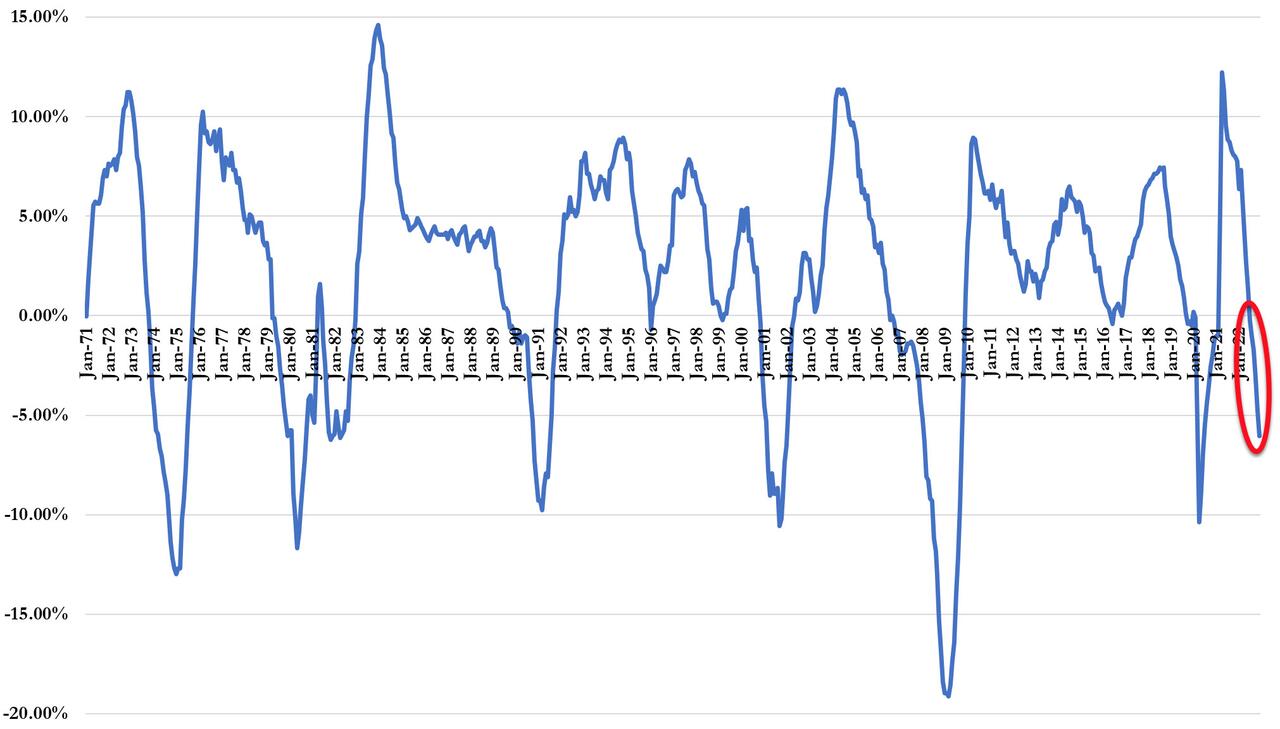
Judging by this, the tightening policies of The Fed are having a 'lagged' effect.
Microsoft Confirms third phase of long term partnership with OpenAI; Azure to power all OpenAI workloads across research, projects and API services
This multi-year, multi-billion dollar investment from Microsoft follows their previous investments in 2019 and 2021, and will allow us to continue our independent research and develop AI that is increasingly safe, useful, and powerful.
In pursuit of our mission to ensure advanced AI benefits all of humanity, OpenAI remains a capped-profit company and is governed by the OpenAI non-profit. This structure allows us to raise the capital we need to fulfill our mission without sacrificing our core beliefs about broadly sharing benefits and the need to prioritize safety.
Microsoft shares this vision and our values, and our partnership is instrumental to our progress.
- We’ve worked together to build multiple supercomputing systems powered by Azure, which we use to train all of our models. Azure’s unique architecture design has been crucial in delivering best-in-class performance and scale for our AI training and inference workloads. Microsoft will increase their investment in these systems to accelerate our independent research and Azure will remain the exclusive cloud provider for all OpenAI workloads across our research, API and products.
- Learning from real-world use – and incorporating those lessons – is a critical part of developing powerful AI systems that are safe and useful. Scaling that use also ensures AI’s benefits can be distributed broadly. So, we’ve partnered with Microsoft to deploy our technology through our API and the Azure OpenAI Service — enabling enterprise and developers to build on top of GPT, DALL·E, and Codex. We’ve also worked together to build OpenAI’s technology into apps like GitHub Copilot and Microsoft Designer.
In an effort to build and deploy safe AI systems, our teams regularly collaborate to review and synthesize shared lessons – and use them to inform iterative updates to our systems, future research, and best practices for use of these powerful AI systems across the industry. - Source TradeTheNews.com
Millions in Pakistan in nationwide blackout as power grid fails
- Pakistan faced a major nationwide power breakdown because of ‘reduced frequency’ in the national grid, the energy ministry said in a Twitter message
- It may take up to 12 hours to fully restore the power, the federal energy ministry Khurram Dastgir Khan told a local TV station
Pakistan suffered nationwide power outages on Monday morning due to a “major breakdown” of the national grid, the power ministry said, with factories, hospitals and schools impacted in all its major cities.
Millions were plunged into a blackout prompted by the failure, dealing another blow to the nation already reeling from surging energy costs.
Outages were reported in locations including Karachi, Lahore and capital Islamabad, according to local media reports, and it could take as long as 12 hours to fully restore electricity, Geo TV said, citing Power Minister Khurram Dastgir Khan.
“Electricity blackout in the country due to sudden drop in the frequency of power transmission system resulting in a widespread breakdown,” the Energy Ministry said in a tweet early on Monday.
“System maintenance work is progressing rapidly,” it added, and a limited number of grids in Islamabad and Peshawar have been restored, the ministry said.
Khan told local media that the power generation system is currently closed down at night since there is less demand nationwide in winter.
“However, when the systems were turned on in the morning today, frequency variation and voltage fluctuation was observed in the south of the country,” he said.
The hashtag #poweroutage was trending on social media with some people holding the coalition government led by Prime Minister Shehbaz Sharif responsible for the failure.
Karachi-based K-Electric Ltd. confirmed its network had been impacted and said teams were working to resume supply.
In Peshawar, a city of more than 2.3 million people, some residents said they were unable to get drinking water because the pumps were powered by electricity.
Mohammad Asim, a spokesman for the city’s Lady Reading Hospital, the largest in Khyber Pakhtunkhwa province, said back up generators were used to provide uninterrupted electricity for the emergency ward, intensive care units, and laboratories.
“My kids and I could not take a shower this morning because there was no water due to the power crisis,” said bank employee Hassan Imran in Karachi. “They went to school, and I came to the office, without a shower.”
The power ministry issued a statement saying that work was ongoing to revive the system, and the minister said that electricity had been restored in some parts of the country.
Pakistan has struggled with power outages for years, including a major incident in January 2021 when a power plant fault collapsed the national grid, prompting calls for an overhaul of ageing electricity transmission infrastructure.
The nation was also hit hard by last year’s global energy crisis as sky-high prices forced Pakistan to drastically curb liquefied natural gas imports, prompting rolling blackouts, fuel rationing and hikes to power costs.
Government plans seek to reduce electricity consumption by half, and have involved requests for some markets and malls to close early and public sector employees to work from home.
Pakistan is facing a default risk due to fast shrinking foreign exchange reserves, last year’s devastating floods and the global economic slowdown.
Juventus shares tumble after 15 point penalty for transfer dealings
The deduction could prevent Italian club from taking part in lucrative European competitions
Juventus shares fell as much as 13 per cent on Monday after Italy’s football authorities hit the club with a 15 point penalty following alleged false accounting practices.
The decision, taken by the country’s football federation late on Friday, is the latest development in an ongoing investigation into how the club, backed by the billionaire Agnelli family, accounted for players’ salaries and their transfers.
The points deduction is expected to push Juventus, which has won more titles than any other Italian club, to ninth position in the Serie A league table. It is also unlikely that the club will be able climb back to the top of the ranking in time to take part in lucrative European competitions such as the Uefa Champions League.
“It’ll be a real battle to qualify for the Champions League this season,” said Kieran Maguire, a lecturer in football finance at the University of Liverpool. “The Champions League gives you a platform that’s very appealing to commercial partners.”
Turin prosecutors are seeking indictments for a dozen Juventus executives, including former president Andrea Agnelli, for charges including market manipulation and false accounting.
Agnelli played a leading role in trying to establish the European Super League, a breakaway project that collapsed in April 2021 despite support from the likes of Spain’s Real Madrid and FC Barcelona. Critics said the ESL was trying to concentrate power and revenues in the hands of a few elite teams.
Juventus, which has denied wrongdoing, said it would appeal against the decision by the Italian football federation.
The punishment triggered strong reactions among Juventus’s fan base and sparked fresh concerns over the club’s future following the board’s resignation two months ago and the recent reshuffle at the top.
Newly appointed chief executive Maurizio Scanavino said on Sunday the club’s position “is clear and solid”, calling the sports authorities’ decision “completely unfair”.
Scanavino, who also holds the top job at GEDI, the publisher of Italian daily newspaper La Repubblica, said the football federation’s “justice system can behave in an unfair way [and] this is worrying because what happened to Juventus now could happen to another club in the future”.
The authorities also handed Scanavino’s predecessor, Maurizio Arrivabene, and Agnelli a two-year ban from football activities.
Nine other Juventus staff and former board members were also banned from engaging in football activities in Italy for periods ranging from eight months to two years and a half.
Fabio Paratici, the club’s former sports director and current Tottenham Hotspur managing director for football, was handed the longest suspension.
Italian sports authorities also requested that “the ban be extended to Uefa and Fifa activities”.
Last week the club appointed Gianluca Ferrero, an accounting expert who has previously worked for other Agnelli-controlled companies, as its new president.
Juventus recorded losses of more than €550mn in the last three seasons. In a letter to shareholders in October, Agnelli said the annual loss of €254mn in the 2021/22 campaign was “certainly the gloomiest moment” from an “economic-financial point of view”.
Also last week, Agnelli announced that he was stepping down from all of his positions within the family businesses, including carmaker Stellantis, which controls Fiat, as well as the holding company Exor.
A preliminary hearing into the case is scheduled for March 27.
The Russia corporate divestment that never happened
Less than 9% of rich-world companies have sold up and left the country despite Ukraine war
No one’s Russian for the exits
A thought-provoking and disturbing paper has emerged from the formidable duo of Simon Evenett and Niccolò Pisani, respectively of the St Gallen university and the IMD business school in Switzerland. You might remember a great flurry of activity (or at least of announcement) in the weeks after the invasion of Ukraine last year that image-conscious rich-world multinationals were leaving Russia in a May Day Parade-style display of moral righteousness.
If only by observing their willingness to continue trading in other countries with unpleasant regimes, I was sceptical at the time that this was actually being done on principle. Volkswagen and McDonald’s, the latter of particular significance given its symbolic opening in Moscow after the fall of communism, both announced they were pulling out of Russia. But both continue to operate in Xinjiang, the province where China is holding more than a million Uyghurs in camps. Divestment would happen when it was compelled by sanctions, I thought, not by corporate ethics or consumer pressure. Since then, of course, we’ve had the Qatar World Cup: lots of talk about brand reputation being at risk but still a commercial success.
Looks like that scepticism was justified. Evenett and Pisani found that fewer than 9 per cent of EU and G7 companies had divested from Russia, above the average from all countries (4.8 per cent) but still not exactly a stampeding exodus. Among the rich nations, US companies were more likely to have left than others, though still below 18 per cent.
What do we conclude from this? Probably that we should rely on determined governments rather than corporate voluntarism to isolate repellent regimes. It can be done. Western Europe and particularly Germany’s sharp reduction in usage of Russian gas, for example, is a truly impressive feat, Leopards or no Leopards. It’s also worth about 100,000 pious business executives’ statements about social responsibility.
Research Calls
- Upgrades:
- Advanced Micro (AMD) upgraded to Overweight from Equal Weight at Barclays; tgt raised to $85
- Associated British Foods (ASBFY) upgraded to Buy from Hold at Deutsche Bank
- Coca-Cola FEMSA (KOF) upgraded to Buy from Neutral at BofA Securities; tgt raised to $157
- Confluent (CFLT) upgraded to Buy from Hold at Deutsche Bank; tgt lowered to $28
- Galapagos NV (GLPG) upgraded to Hold from Underperform at Jefferies; tgt lowered to $47.20
- Murphy USA (MUSA) upgraded to Overweight from Equal Weight at Wells Fargo; tgt raised to $350
- PTC (PTC) upgraded to Overweight from Sector Weight at KeyBanc Capital Markets; tgt $155
- Qualcomm (QCOM) upgraded to Overweight from Equal Weight at Barclays; tgt raised to $150
- Ribbon Communications (RBBN) upgraded to Buy from Hold at WestPark Capital; tgt $6
- Seagate Tech (STX) upgraded to Overweight from Equal Weight at Barclays; tgt raised to $70
- Shopify (SHOP) upgraded to Buy from Hold at Deutsche Bank; tgt raised to $50
- Skechers USA (SKX) upgraded to Outperform from Market Perform at Cowen; tgt raised to $65
- Skyworks (SWKS) upgraded to Overweight from Equal Weight at Barclays; tgt raised to $125
- Sotera Health (SHC) upgraded to Neutral from Underweight at JP Morgan; tgt raised to $18
- Ternium S.A. (TX) upgraded to Buy from Neutral at BofA Securities; tgt raised to $42
- Unibail-Rodamco-Westfield (UNBLF) upgraded to Outperform from Neutral at Exane BNP Paribas
- Wayfair (W) upgraded to Buy from Underperform at BofA Securities; tgt raised to $65
- Wayfair (W) upgraded to Outperform from Neutral at Wedbush; tgt $38
- Wayfair (W) upgraded to Overweight from Underweight at JP Morgan; tgt raised to $63
- Western Digital (WDC) upgraded to Neutral from Underperform at Exane BNP Paribas; tgt $42
- Downgrades:
- Altice USA (ATUS) downgraded to Hold from Buy at TD Securities; tgt $6
- American Tower (AMT) downgraded to Sector Weight from Overweight at KeyBanc Capital Markets
- Applied Materials (AMAT) downgraded to Underweight from Equal Weight at Barclays; tgt raised to $90
- BCE Inc (BCE) downgraded to Hold from Buy at TD Securities
- Cellnex Telecom SA (CLNXF) downgraded to Sector Perform from Outperform at RBC Capital Mkts
- Check Point Software (CHKP) downgraded to Hold from Buy at Deutsche Bank; tgt lowered to $150
- CrowdStrike (CRWD) downgraded to Hold from Buy at Deutsche Bank; tgt lowered to $115
- Crown Castle (CCI) downgraded to Sector Weight from Overweight at KeyBanc Capital Markets
- Euronet (EEFT) downgraded to Neutral from Buy at Citigroup; tgt $117
- FirstEnergy (FE) downgraded to Underperform from Neutral at BofA Securities; tgt lowered to $38
- Gildan Activewear (GIL) downgraded to Hold from Buy at TD Securities
- Ingredion (INGR) downgraded to Equal Weight from Overweight at Barclays; tgt raised to $110
- KLA Corporation (KLAC) downgraded to Underweight from Equal Weight at Barclays; tgt raised to $325
- Levi Strauss (LEVI) downgraded to Neutral from Overweight at JP Morgan; tgt lowered to $17
- Matterport (MTTR) downgraded to Hold from Buy at Deutsche Bank; tgt lowered to $3
- Motorola Solutions (MSI) downgraded to Hold from Buy at Edward Jones
- Range Resources (RRC) downgraded to Hold from Buy at The Benchmark Company
- RingCentral (RNG) downgraded to Neutral from Buy at MKM Partners; tgt $40
- SentinelOne (S) downgraded to Hold from Buy at Deutsche Bank; tgt lowered to $15
- Southwestern Energy (SWN) downgraded to Hold from Buy at The Benchmark Company
- Tapestry (TPR) downgraded to Equal Weight from Overweight at Barclays; tgt $43
- Veeco Instruments (VECO) downgraded to Equal Weight from Overweight at Barclays; tgt raised to $20
- Warner Music Group (WMG) downgraded to Equal Weight from Overweight at Barclays; tgt $35
- Workday (WDAY) downgraded to Hold from Buy at Deutsche Bank; tgt lowered to $195
- Zoom Video (ZM) downgraded to Neutral from Buy at MKM Partners; tgt lowered to $75
- Others:
- Flywire (FLYW) initiated with an Equal-Weight at Morgan Stanley; tgt $26
- GitLab (GTLB) initiated with an Outperform at FBN Securities; tgt $60
- Guidewire Software (GWRE) initiated with a Buy at Goldman; tgt $88
- Lucid Group (LCID) resumed with a Buy at Citigroup; tgt $12
- Planet Labs (PL) initiated with an Equal-Weight at Morgan Stanley; tgt $6
- Quest Diagnostics (DGX) initiated with an In-line at Evercore ISI; tgt $159
- Rain Oncology (RAIN) initiated with a Buy at Mizuho; tgt $18
- Sapiens Int'l (SPNS) initiated with a Buy at Goldman; tgt $28
Gapping down
In reaction to earnings/guidance:
- BKR -0.9%
Other news:
- XYL -8.3% (AQUA to be acquired by Xylem in $7.5 bln all-stock transaction)
- BCRX -3.7% (enters collaboration with Swixx BioPharma AG to commercialize ORLADEYO (berotralstat) in Central and Eastern Europe)
- ABT -2.9% (being investigated by federal authorities over baby formula issues)
- VRAY -2.1% (reached an agreement with Hudson Executive Capital LP ") to appoint Sai Nanduri Senior Investment Analyst and representative of HEC as an observer of the ViewRay Board of Directors)
- MORF -1.8% (disclosed that Janssen has elected to terminate the Research Collaboration)
- EYPT -1.4% (enters lease agreement for manufacturing facility)
Analyst comments:
- VECO -2.3% (downgraded to Equal Weight from Overweight at Barclays)
- TPR -1.9% (downgraded to Equal Weight from Overweight at Barclays)
- WMG -1.9% (downgraded to Equal Weight from Overweight at Barclays)
- KLAC -1.6% (downgraded to Underweight from Equal Weight at Barclays)
- AMAT -1.4% (downgraded to Underweight from Equal Weight at Barclays)
- WDAY -1.3% (downgraded to Hold from Buy at Deutsche Bank)
- INGR -1.2% (downgraded to Equal Weight from Overweight at Barclays)
- S -1.1% (downgraded to Hold from Buy at Deutsche Bank)
Gapping up
In reaction to earnings/guidance:
- NE +4% (guidance), SYF +2.5%
Other news:
- PLRX +74.8% (reports positive data from the INTEGRIS-IPF Phase 2a trial demonstrating Bexotegrast 320 mg was well tolerated and achieved statistically significant FVC increase)
- AQUA +16.5% (to be acquired by Xylem in $7.5 bln all-stock transaction)
- HCM +8.5% (Takeda (TAK) to acquire exclusive worldwide (ex-China) license of HUTCHMED's Fruquintinib)
- CLLS +8.5% (amends $20 mln convertible note under collaboration agreement with its partner Cytovia Therapeutics)
- IDCC +7.4% (commenced a modified "Dutch auction" tender offer to purchase for cash up to $200 million of its common stock at $60.00-69.00)
- SPOT +4.5% (announced a reduction in the Company's employee base by about 6%)
- WDC +4.1% (merger discussions with Kioxia Holdings are progressing according to Bloomberg)
- SGML +3.2% (announces initiation of commissioning of Dense Medium Separation processing plant and go forward leadership as it evolves to lithium producer)
- SMR +2.5% (positive Barron's article)
- ASML +2.1% (positive Barron's article) TV +1.6% (positive Barron's article)
- SI +1.3% (reports that exposure to Genesis was limited with deposit relationship under $2.5 mln)
- HMC +1% (signed a memorandum of understanding with GS Yuasa International for collaboration in a high-capacity and high-output Lithium-ion Battery)
Analyst comments:
- SHOP +4.7% (upgraded to Buy from Hold at Deutsche Bank)
- SWKS +2.8% (upgraded to Overweight from Equal Weight at Barclays)
- AMD +2.5% (upgraded to Overweight from Equal Weight at Barclays)
- QCOM +2.1% (upgraded to Overweight from Equal Weight at Barclays)
- STX +1.9% (upgraded to Overweight from Equal Weight at Barclays)
- SHC +1.1% (upgraded to Neutral from Underweight at JP Morgan)