TechCrunch : Arm launches new chips for faster smartphone performance during Com

Arm launches new chips for faster smartphone performance during Computex

Just ahead of CEO Rene Haas’ keynote at Computex in Taipei today, Arm launched two new products designed to increase smartphone performance. The first is the Arm Cortex-X4, its fourth-generation Cortex-X core. Arm said the Cortex-X4 is the fastest CPU it is made so far and will bring 15% more performance than its predecessor, the Cortex X-3, with a focus on enabling artificial intelligence and machine learning-based apps.

The second new product is the Arm Immortalis-G720, which is based on its fifth-generation GPU architecture. Its predecessor, the Immortalis-G715 GPU, is currently inside flagship devices from OPPO and vivo through a partnership with MediaTek. Arm’s fifth-generation GPU architecture was created with high geometry games and real-time 3D apps in mind, in order to replicate the feel of console gameplay on mobile devices.

Arm said the Cortex-X4’s microarchitecture consumes 40% less power than Cortex-X3 on the same process, increasing responsiveness and app launch time.

Arm also announced a new platform called for mobile computing called Arm Total Compute Solutions 2023 (TCS23), which will include IP like the Immortalis GPU, Armv9 CPUs and software enhancements. With their packages of IP, the company’s Total Complete Solutions series were created for System on Chip (SoC) designers who are building their own compute subsystems. TCS23 is meant for premium smartphone models and build on Arm’s new Armv9.2 architecture. Its GPUs are based on fifth-generation architecture, including the newly-launched Immortalis-G720, Mali-G720 and Mali-G620. The Armv9.2 compute cluster includes the new Cortex-4, Cortex-A720 and Cortex-A520 CPUs, and the DSU-120, Arm’s latest DynamiQ shared unit.

In his keynote today, Haas said Arm has traditionally been an IP supplier, but then started to see how long it was taking for IP to integrate with other IP. So to help SoC designers, it started to build CPU, memory systems and compute blocks before integrating, configuring and validating them to deliver a full system.

Arm is continuing its partnership with TSMC by “taping out the Cortex-X4 on the TSMC N3E process,” which it calls an industry first.

Owned by the SoftBank Group Corp, Arm announced last month that it had filed in the U.S. what will be this year’s largest initial public offering. It plans to raise between $8 billion to $10 billion in its IPO on Nasdaq.

Arm’s decision to make its stock debut comes as U.S. IPOs, excluding SPACs, are down about 22% to just $2.35 billion year-to-date, reports CNN.

FT : China developers: the main quake is over but the aftershocks are not

China developers: the main quake is over but the aftershocks are not
Surge in court-ordered liquidations and developer defaults should give investors pause for thought

A year ago the demolition of China’s property sector was well under way. Developers struggled to borrow, home buyers were on strike.

This year, sagging financial foundations have been underpinned. The central bank has made about $29bn in loans. Local banks have extended deadlines for borrowers.

A bounce in April’s new home prices was a sign of hope. But a surge in new court-ordered liquidations and developer defaults should give investors pause for thought.

Another Chinese developer, KWG Group, faced a court-ordered liquidation in Hong Kong earlier this month. It is the latest to default and faces repayment demands on $4.5bn worth of debt in coming months. Developers missing their interest payments have increased in numbers in recent weeks.

These events challenge the narrative that the worst of the property crisis has passed. KWG’s default comes as a surprise. It had not defaulted on a single coupon for its dollar bonds last year, even when most of its peers had.

Other signs of weakness have appeared among the big-name property groups. China Vanke, the second-largest local developer, missed its earnings estimates. Its share price, down a fifth this year, is again approaching five-year lows.

True, regulators have provided plentiful financial support for developers and slashed mortgage rates, boosting new home prices. Yet analysts still expect the top-25 listed developers to report April’s sales down about a fifth compared with March. Guangzhou R&F Properties should record a sales plunge of nearly half.

That may not stymie optimists seeking value when Beijing is injecting liquidity into the system. Shares of Country Garden, the largest developer, and Vanke consistently trade below their book values. The latter had never done so before last year. Elsewhere, investors should step more gingerly. Shares of KWG are down 60 per cent this year. Its dollar bonds fell to as low as 20 cents on the dollar.

To survive an earthquake, you need to avoid the aftershocks as well as the main event. China’s property market has yet to fully settle.

>>> What to look at today - 29th of May 2023

US and European equity futures delivered small advances while a gauge of Asian shares climbed about 0.5% as global markets greeted the US debt-ceiling deal between President Joe Biden and House Speaker Kevin McCarthy with cautious optimism. Investors had already become increasingly confident on Friday that an agreement would be struck in Washington, reducing the strength of moves Monday. Assuming the deal passes Congress, which can’t be taken for granted, traders still have much to contend with — from the prospect of another interest-rate hike from the Federal Reserve to a likely deluge of bond issuance from the US Treasury Department. Contracts for the S&P 500 steadied about 0.3% higher around lunchtime in key Asia markets while those for the Nasdaq 100 were up 0.4%. While gains of around 1% were seen in Japanese and Australian stocks benchmarks, Chinese shares traded in Hong Kong erased an initial burst higher. They’re inching toward a bear market as the economic recovery wobbles, geopolitical tensions worsen and a weaker yuan keeps investors away. Gold was flat on waning demand for havens as oil and Bitcoin climbed, reflecting a modestly buoyant tone. Credit spreads for higher-rated Asian debt also narrowed Monday, extending a rally that was seen in the previous three weeks. An index of dollar strength was little changed, having reached a two-month high earlier last week. The greenback traded in tight ranges of less than 0.2% versus most of its major counterparts.  Treasury futures fell slightly, in the absence of cash trading with US markets closed Monday for a holiday, along with the UK and some parts of Europe. Traders were demanding less of a premium to hold US Treasury bills on Friday that were seen most at risk of nonpayment if a deal isn’t reached in time. The agreement struck by Biden and McCarthy is running against the clock given that June 5 is the date when Treasury Secretary Janet Yellen has said cash will run out. There is plenty in the deal that Democrats and Republicans won’t like. In stocks Friday, the S&P 500 rose 1.3% and the tech-heavy Nasdaq 100 added 2.6% as Marvell Technology Inc. said 2024 revenues would “at least double” from a year ago on a surge in demand from AI, echoing sentiments from rival chipmaker Nvidia Corp. earlier in the week. Elsewhere, there will be heightened interest in emerging markets after Turkish President Recep Tayyip Erdogan sealed an election victory, raising the prospect of more friction with Western governments and more uncertainty for investors.

Nikkei +1.18% Hang Seng -0.92% CSI -0.68% Shanghai +0.15% Shenzen -0.69%

Eur$ 1.0734 CNH 7.0711 CNY 7.0671 JPY 140.44 +0.12% GBP 1.2355 +0.09% CHF 0.9050 RUB 79.3744 TRY 20.0152 WTI$ 73.27 +0.83% Gold 1,946 -- BTC 27,944 +1.38% ETH 1,900 +2.46%

S&P +0.30% Nasdaq +0.49% EuroStoxx +0.16% FTSE Close Dax +0.16% SMI Close

Macro :
- Debt Talks Inch Forward as June 5 Becomes New Default Deadline
- Autos the Next Asset Bubble? US Real Yield: Most-Read Research
- IMF Urges US to Raise or Suspend Debt Cap, Sees Higher Fed Rates
- The AI Stock Frenzy Stands to Boost the Dollar, Barclays Says
- Watch Spanish Stocks After Socalists Lose Control of Key Regions

Keep an eye on :
- AIR FP : Boeing Works to Win Another Saudi Deal, This Time for 737 Max
- ALICA FP : ICAPE Group Buys the Assets of the German PCB Distributor HLT
- BP/ LN : Starmer Plans to Block New North Sea Oil, Gas Projects: Times
- DBK GY : Deutsche Bank Used Big Trades to Raise Cash in March: Reuters
- ENEL IM : Former Enel CEO Starace to Join PE Firm EQT in June: FT
- EQT SS : Baring EQT set to buy HDFC's education loan arm Credila for up to $1.5 billion
- GLEN LN : Bunge-Viterra Deal Could Hurt Canadian Farmers, Wheat Group Says
- MC FP : Beverly Hills voters reject LVMH luxury hotel on Rodeo Drive - FT
- MANU US : Ratcliffe Still Lead Bidder for Manchester United, Sky News Says
- MITRA BB : Mithra Names Christian Homsy as Chairman
- NVDA US : Nvidia Unveils More AI Products to Further Capitalize on Frenzy
- NVDA US : Cathie Wood Defends Bailing on Nvidia, Citing Risk of Chip Cycle
- Ottoboc : Näder to Sell 10% of Stake in Prothesis Maker Ottobock: FAS
- 1913 HK : +2.1% in HK
- PSY IM : Prysmian Board Designates Massimo Battaini Next CEO Candidate
- RR/ LN : Rolls-Royce Could Cut 3,000 Jobs in Turnaround Plan, Times Says
- SBBB SS : SBB Cut to Junk by Fitch on High Leverage, Refinancing Risk
- SBBB SS : Sweden’s SBB Weighs Sale of Company as Part of Strategic Review
- SCR FP : Scor Sponsors New Catastrophe Bond
- 9984 JP : SoftBank, Nvidia: New Data Centers Can Operate at Peak Capacity With Low Latency, at Lower Energy Costs
- SOW GY : Software AG Supports Acceptance of Tender Offer by Silver Lake
- STAN LN : Trust Bank Deposits Reach Over S$1b, Aims to Break Even by 2025
- STJ LN : St James’s Place Starts Search for New CEO, Sky News Reports
- SUSE GY : SUSE Surges on Report Buyout Firms Remain Interested in Bid
- TLX GY : Liberty Sells Latin America Business to HDI for $1.48 Billion
- TARO US : Taro Pharma Says Sun Pharma Made Buyout Offer at $38/Share
- TEP FP : Teleperformance, Blackstone Plan Separate Bids for Everise: Mint
- TTE FP : Conoco to Buy Rest of Surmont From TotalEnergies Up to $3.3b
- UBSG SW : UBS Winds Down a US Trading Unit in Mortgages, Retains Financing
- VLA FP : French Drugmaker Valneva Weighs Bids for Sale of Scottish Site
- RIN FP : Vilmorin Board Gives Positive Opinion on Limagrain Offer
- WPP LN : WPP teams up with Nvidia to use generative AI in advertising - FT
- WTB LN : Whitbread Considers Selling its Beefeater Chain: Telegraph

>>> Europe : Brokers Upgrades & Downgrades - 29th of May 2023

>>> Up
* Fifax Abp Raised to Reduce at Inderes; PT 20 euro cents
* Harvia Raised to Accumulate at Inderes; PT 24 euros
* Nurminen Logistics Raised to Buy at Inderes; PT 1.40 euros
* Puma Raised to Buy at Baader Helvea; PT 60 euros

>>> Down
* Nvidia Cut to Accumulate at Phillip Secs; PT $440

>>> Initiation
* Atlas Copco Rated New Hold at Nordea
* Ericsson Rated New Buy at Nordea; PT 75 kronor
* SCA Rated New Hold at Nordea
* SEB Rated New Hold at Nordea
* Tele2 Rated New Hold at Nordea
* Volvo Rated New Buy at Nordea; PT 290 kronor

>>> Call

(ZH) Race To 100 Million Users. Who Did It The Fastest? And What Does This Mean

Race To 100 Million Users. Who Did It The Fastest? And What Does This Mean For Productivity?

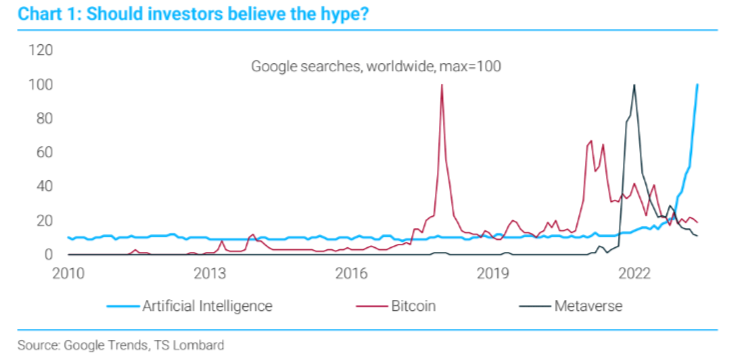
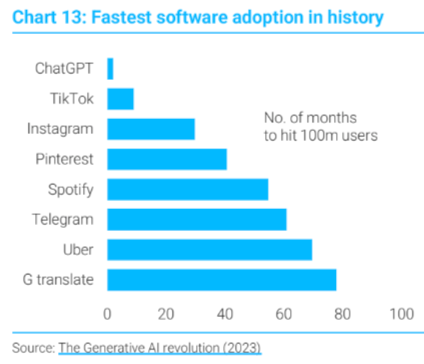
OpenAI's viral ChatGPT chatbot reached 100 million monthly active users in just two months in January after launching in November, making it the fastest-growing consumer application in history. For some context, it took TikTok nine months after its launch to reach 100 million users and Instagram 2.5 years.
TS Lombard's Dario Perkins told clients Thursday there are "large effects, and their macroeconomic impact could show up faster than economists anticipate – especially given the pace of technological adoption we are currently seeing."
Perkins, who heads the global macro desk at TD, found that the widespread adoption of the viral chatbot might spark faster innovation:
ChatGPT gained 100 million users faster than any other application in history, and these fast adoption rates are not confined to individual users. Major corporations, such as Bain & Company, have entered into deals with OpenAI to use generative AI in their strategy consulting business, while companies like Expedia have integrated ChatGP T through plug-ins.
The more exciting impact on living standards, however, is likely to come from the second of our productivity channels – the pace of technological innovation. Generative AI can significantly expedite the R&D process by automating complex tasks, analysing vast datasets and predicting potential outcomes. It has already been useful in biological research: DeepMind's AlphaFold predicted the 3-D structure of almost every known protein – a task that had been predicted to take decades of human labour (according to the journal Science, the most important scientific breakthrough of 2021).
This, alongside other AI breakthroughs, has led Dr. David Baker from the Institute for Protein Design to estimate that the pace of innovation in his field is now 10 times higher than it was 18 months ago. If we see rapid increases in innovation across other areas, the impact on productivity could be transformative.
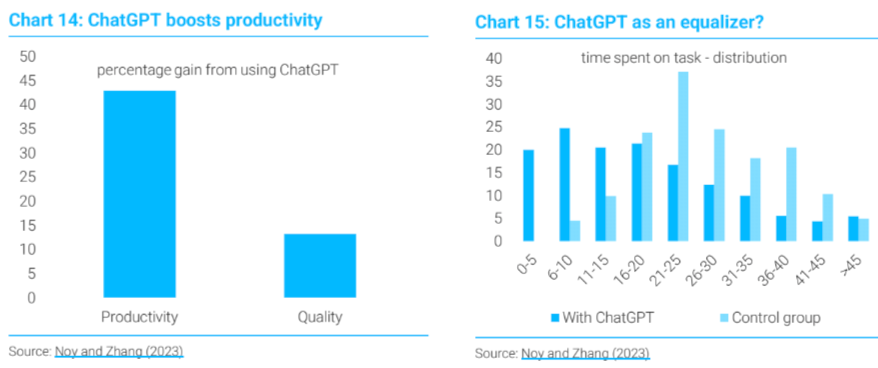
He stated AI "has huge potential to boost economy-wide productivity" and cited a recent MIT study that showed a massive improvement in productivity while using ChatGPT. Also, much of the productivity gains were seen between 21 to 40-year-olds.
Perkins mentioned "massive uncertainties about where AI is ultimately headed" from here. And he wasn't too concerned about layoffs, unlike Goldman, who has warned about 300 million jobs could be displaced by AI in the US and Europe.
And AI is here to stay, unlike Zuck's overhyped metaverse.
So the bottom line, as Perkins laid out, is that massive and rapid adoption of ChatGPT will "deliver significant productivity improvements" for society. He added, "This is a big deal for a global economy that has been stuck in a long secular productivity funk." However, he wasn't too concerned about jobs being displaced, unlike other macro desks.

(ZH) China Shadow Banking Defaults Surge

China Shadow Banking Defaults Surge

Three things we learned last week:
1. A town builder’s last-minute bond repayment reignited fears over a potential default by such issuers. Investors are watching out for the first missed payment by a local government financing vehicle, something regional authorities are trying hard to avoid. The possibility has recently increased, as a weakening fiscal situation means authorities are less able to provide support.
Research from GF Securities Co. shows there were 73 cases of shadow-banking defaults in the first four months, already a full-year record since data became available in 2018.
“Missing payments in shadow banking are a signal that debt risks in a certain region have become more prominent,” GF analysts led by Liu Yu wrote in a report.
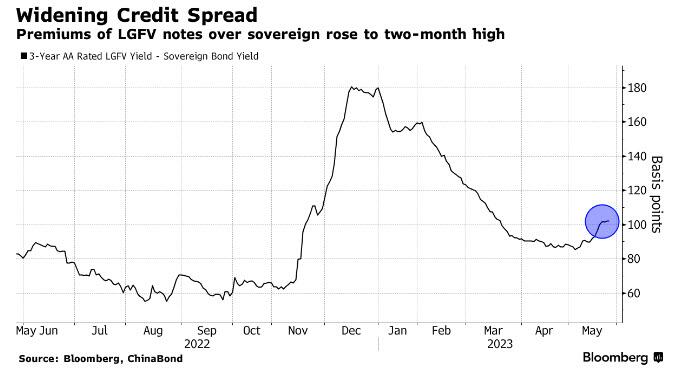
Yields on Kunming Dianchi Investment Co.’s note due in December surged to over 20% last week, as two holders said they didn’t receive payments until after business hours for a note due this month. Premiums of three-year AA rated LGFV bonds widened to the most since March, and investors cited local-debt worries as one of the reasons behind a decline in Chinese stocks.
China’s LGFVs had 13.5 trillion yuan ($1.9 trillion) of bonds in total outstanding as of end-2022, or almost half of the nation’s non-financial corporate notes, data from Moody’s Investors Service show.
Steps by authorities “to lower LGFV debt risks will not fully resolve long-term issues,” and their refinancing ability depends on investors’ confidence in government support, especially in weaker provinces, Moody’s analysts led by Ivan Chung wrote in a report.
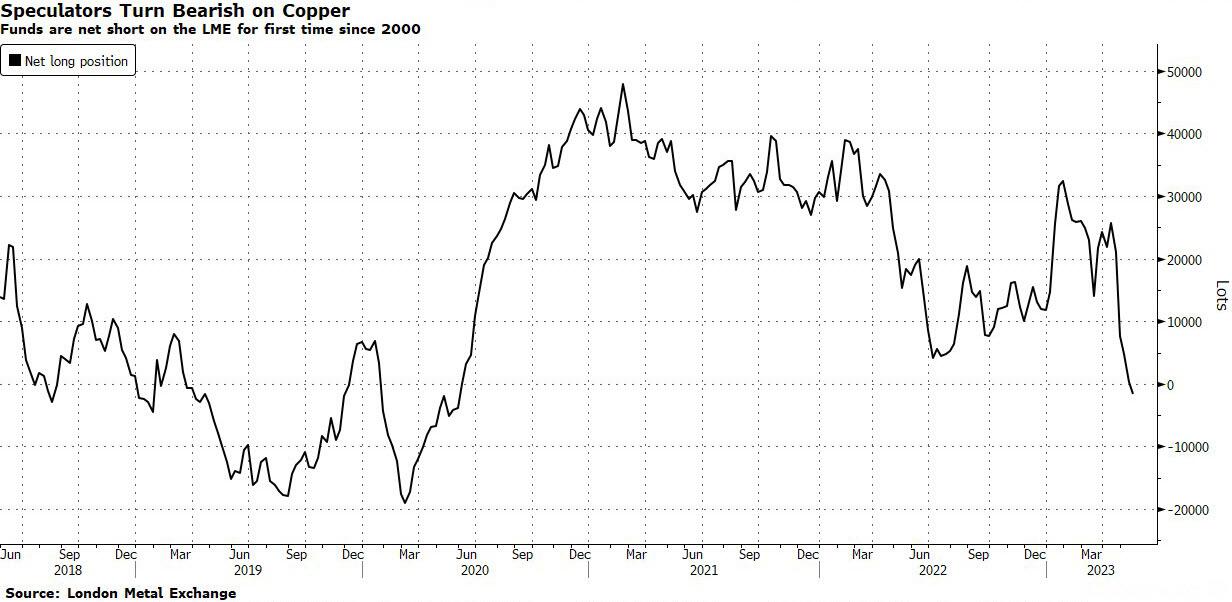
2. With the financial strength of both town builders and their sponsors deteriorating, investors became more pessimistic about China’s demand for raw materials. Copper dived below $8,000 a ton while iron ore breached $100, unwinding gains since Beijing ended its Covid Zero policies late last year.
At the London Metal Exchange’s annual Asian event in Hong Kong, participants reported lackluster activity and said that any market optimism from the National People’s Congress in March had evaporated.
The selloff in Chinese stocks also extended, with the benchmark CSI 300 Index erasing all of its gains for the year. Now, even bulls are rethinking their calls, with Citigroup Inc.’s global allocation team cutting its overweight rating on China to neutral.
3. Luckily, positive developments on China-US bilateral relations helped to alleviate some of the pessimism. Soon after President Joe Biden said he expected ties with China to improve “very shortly” after a spat over an alleged spy balloon earlier this year, top commerce officials from the two countries agreed to strengthen communications. The meeting served as a sign that Beijing and Washington are trying to prevent their relations from worsening further.
It remains to be seen though if China’s decision to bar Micron Technology Inc. from supplying critical infrastructure leads to another round of tension. Some analysts see this as an opening shot by Beijing to retaliate, while US lawmakers want to react with putting more Chinese firms on a blacklist.

WSJ : Luxury Brands Don’t Just Sell to the Superrich (26/05)

Luxury Brands Don’t Just Sell to the Superrich
European luxury stocks slipped this week because spending by aspirational shoppers is weakening in the U.S.

Hermès sells $50 packs of cardboard nail files and $105 hand cream. Luxury brands shift millions of these kinds of small treats each year to shoppers who may not be able to afford a $10,000 handbag.

It is this more affordable part of the luxury goods industry that is now shaping up to be a weak spot.

European luxury stocks lost billions of euros in value this week. Prada fell 11%, while Hermès and LVMH Moët Hennessy Louis Vuitton LVMUY 2.20%increase; green up pointing triangle, which are considered the two safest bets in the industry, dipped 5%. Investors seem to have been spooked by comments at an industry conference that demand for entry-priced designer goods like sneakers or wallets that target so-called aspirational shoppers is falling in the U.S.

The trend isn’t new, but it is gaining steam. Credit-card data shows U.S. luxury spending has been cooling for at least five months, especially among younger shoppers who have been squeezed by inflation. In April, Americans spent 18% less than they did in the same month of last year, according to Citi luxury analyst Thomas Chauvet, whose data tracks U.S. spending both at home and overseas. On Wednesday, Chanel, which is privately owned but reports annual sales, became the latest brand to say it has noticed a change in its American stores.

Expensive brands have a reputation for selling to the superrich, but they rely heavily on shoppers further down the income scale too. Luxury sales are driven by “millions of people buying small things and a handful of people spending gigantic amounts of money,” according to Luca Solca, luxury goods analyst at Bernstein.

The top 5% of wealthiest shoppers drive around 40% of global luxury sales, according to a report from Boston Consulting Group. The rest comes from affluent consumers who spend up to €2,000 a year on luxury goods, equivalent to $2,147 at current exchange rates.

The top end of the market is growing much faster—by 2025, the richest shoppers will be responsible for 60% of luxury sales, based on BCG’s forecasts. But the industry still needs aspirational spenders for a big chunk of business.

If these shoppers are tightening their belts, luxury stocks may not be as defensive as investors hoped. And as trends in Europe tend to lag the U.S. market by a few months, a slowdown may be on the way in that market too.

Companies like Burberry that have younger and more price-sensitive customers would be hit harder by a slowdown than higher-end competitors. Hermès made 11% of group sales from entry-level products like cosmetics, perfumes and silk scarves in the first quarter of 2023—a significant chunk of its business but probably lower than the industry average.

LVMH made almost one-third of its overall sales from divisions that sell goods like lipsticks, blushers and perfumes. These businesses are still performing very well, but the Paris-based company warned on its first-quarter results call that its Hennessy cognac brand is under pressure in the U.S., as inflation has forced some drinkers to cut back.

Even after this week’s falls, European luxury shares have gained around 16% on average since January, ahead of the 11% increase in the MSCI Europe Index. At the same time, some luxury shoppers have been forced to trim their spending.

Investors may soon find out how reliant some ritzy brands are on small-ticket buyers.

WSJ : Why Are Markets So Calm? It’s Revenge of the Quant Funds

Why Are Markets So Calm? It’s Revenge of the Quant Funds
Firms that use computers to determine buy and sell signals have been loading up while other investors sit back


The U.S. stock market is surprisingly calm right now, especially in the face of the debt-ceiling fight. A key reason: a growing divide between mainstream investors, who have largely been sitting out the 2023 stock rally, and the machines whose buying has been driving it.

Only days remain until the U.S. blows past its debt-ceiling deadline. On Saturday, President Biden and Republican House Speaker Kevin McCarthy reached a tentative agreement to prevent a destabilizing default. But passage of the plan, which is expected to face opposition from some House conservatives this week, isn’t yet assured.

Despite the political uncertainty, the rebounding stock market has barely gotten nicked, with the S&P 500 finishing 0.3% higher last week. Over recent months, stocks have handily overcome stress in the banking system, stubborn inflation and interest-rate hikes. Last year, those kinds of issues repeatedly torpedoed stocks. This year, markets have met such events with a shrug.

The market’s steady rise has puzzled analysts and portfolio managers as the S&P 500 has churned more than 9% higher this year (and the technology-focused Nasdaq Composite has risen 24%). One explanation: Quant funds, or those relying on computer models and automated trading, have been doubling down on equity markets as other investors have stepped back, citing high valuations and concerns about the likely course of the U.S. economy.

Quant-fund buying has pushed these funds’ net exposure to U.S. stocks to the highest level since December 2021, according to data from Deutsche Bank. Mainstream investors, in contrast, have been pulling cash from stock funds and pouring it into money markets.

The continuing demand from quants has provided a lifeline for the stock market. Combined with robust corporate buybacks, their buying has helped counteract selling pressure and led to placid moves. The S&P 500, for example, has moved less than 1% in either direction for 36 of the last 46 sessions, according to Dow Jones Market Data, the quietest 46-day stretch since December 2021.

“We have seen them sort of balance each other out for the last six or seven weeks now,” said Parag Thatte, a strategist at Deutsche Bank. He estimates that systematic and fundamental investors haven’t been this divergently positioned since 2019.

Driving the quant funds is a self-reinforcing dynamic. When market volatility drops, they pile in more. Big stock-market moves collapsed this spring after regulators rushed to stem the banking crisis, and the Federal Reserve signaled it might stop raising interest rates soon.

So-called vol-control and risk-parity funds, which tend to automatically load up on riskier assets during calmer periods, ramped up equity exposure, according to the Deutsche Bank data, available through May 18. Other quants, such as trend-following CTAs, or commodity trading advisers, have similarly piled in.

The dominance of quants has helped explain previous periods of calm trading, including long stretches in 2017 and 2018. Those periods were punctured by rapid selloffs, including the 2018 selloff dubbed “Volmageddon” when the dynamics exerting calm on the market suddenly went away. Some warn a repeat could be ahead.

“If you do have concentrated positioning, it does create the risk of unwinds in the case of a negative shock,” said Christian Mueller-Glissmann, head of asset allocation research at Goldman Sachs. “And the risk you face with them is not just that they might have bought some equities because volatility has gone down, they might have levered up.”

The market has started to see early signs of eroding tranquility. Last week, the Cboe Volatility Index—the VIX, or Wall Street’s fear gauge—on Wednesday briefly settled above 20 for the first time in about three weeks as simmering debt-ceiling anxieties surfaced. Typically, anything higher than 20 indicates fear is starting to rise.

Treasury Secretary Janet Yellen has said the U.S. could start missing payments on its obligations as early as June 5 if Congress doesn’t act. While investors have so far said they aren’t viewing the event as a key risk to stocks, other areas have been showing signs of worry. Investors have ditched short-term Treasury bills that could be at risk of missed payments, with yields on some bills maturing in early June topping 7% at one point last week.

Karl Rogers, chief investment officer at Elkstone, a Dublin-based investment firm, is among the non-quant investors who have been hesitant to jump back into the market. “We always thought 2023 was going to be quite volatile,” he said.

Rogers doesn’t believe inflation or interest rates will recede as quickly as investors expect, and thinks stocks will fall again as the economy worsens. Other investors are similarly worried about a possible recession, with a May survey from BofA Global Research showing that fund managers view it as the biggest tail risk for markets.

“The people who are really just looking at fundamentals, they are having a really hard time getting excited about this market,” said Patrick Ghali, co-founder of Sussex Partners, which advises institutional investors on hedge-fund investments.

Computer-driven trading isn’t new, and its influence has ebbed and flowed over recent years. A strong performance by quants last year has put them back on investors’ radar. At the end of March, quant-focused hedge funds held about $1.13 trillion in assets, according to research firm HFR, hovering just below last year’s record high. That represents about 29% of all hedge-fund assets.

Systematic investors’ foothold—combined with their tendency to move in lockstep—has often made them a target of ire. When markets unravel, investors are usually quick to blame the quants, whether justified or not.

“It’s rules-based trading,” said Charlie McElligott, a managing director at Nomura Securities International. “There’s no emotion involved.”

Data from McElligott shows quants tend to move together quickly when volatility strikes. Take, for example, the stock market selloff of May 2019, when the S&P 500 slid some 7% as investors panicked about U.S.-China trade tensions. McElligott estimates that CTAs unloaded $35 billion worth of equities over the course of a month.

Quants’ growing equity exposure could leave stocks similarly vulnerable going forward, McElligott said. However, he noted another possibility: Fundamental investors’ might instead increasingly chase a market that has gotten away from them. Already, there is evidence of increased buying from mainstream investors, according to flow data from major U.S. banks.
FT : Brussels proposes tough targets for live trading database operators

Brussels proposes tough targets for live trading database operators
Commission has suggested minimum turnover for companies running consolidated tape service

Brussels is proposing to dump the companies running its live share trading database if they fail to meet revenue targets for two years, a move that has raised concerns among some industry participants about the effectiveness of the ambitious project.

The European Commission has suggested setting minimum turnover targets for the companies running a database of live stock information, known as a consolidated tape, according to documents seen by the Financial Times. If the data provider fails to meet the target for two years, officials could withdraw its tender, according to a proposal circulated in Brussels.

The plans form the basis for a meeting between officials and industry on Thursday that will try to hammer out the fine details for running the tapes.

Brussels has pushed for the creation of the tapes, which would be similar to ones in the US, as a way to deepen and unify the EU’s fragmented financial markets.

The EU wants to bundle together basic trading information, such as price and trade size, from Europe’s patchwork network of exchanges and alternative marketplaces. Supporters say it will make European stock markets more transparent and attractive for international and retail investors.

Rainer Riess, director-general of the Federation of European Securities Exchanges, which represents 35 trading venues, said potentially ejecting the data provider after two years “defeats a little bit the purpose of the tape”.

“We want the tape in order to have a functional capital markets union . . . we can’t switch the provider every two years,” he added.

The proposal estimates that revenues would be generated by 10,500 fund managers paying for the additional information the tape offered. Pricing would be tiered, with the majority taking out the most basic subscription. The biggest groups are expected to take the most expensive option. “Revenue projections are highly dependent on user interest,” the paper said.

Anish Puaar, head of European equity market structure at market maker Optiver, said a tape alone would not be useful for the high volumes of trading it did every day.

“Many prop trading firms like us will still need to buy the faster products sold by the exchanges as the consolidated tape won’t be suitable for trade execution,” he added.

Brussels has already mandated that the tape will be operated by a private company, picked after a tender process. Euronext, Deutsche Börse and Nasdaq are among 14 exchanges that are bidding to collaborate on an equities tape.

European markets have suffered a dearth of listings and liquidity in recent years, compared with the US. 

Turnover in equities, an indicator of market liquidity, rose 40 per cent in the six years to 2022 in the US but remained flat over the same period in Europe, according to data compiled by AFME, a banking lobby group.

The proposed consolidated tape has deeply split market participants in Europe. Asset managers have largely been in favour because it means live stock and ETF prices from exchanges across Europe will be available in one place.

But European stock exchanges have fiercely opposed its introduction, saying that handing over data deprives trading venues of revenues and threatens the viability of some of the region’s smaller exchanges.

“This [proposal] is all about perceived loss of revenue for the exchanges,” said Susan Yavari, senior regulatory policy adviser at the European Fund and Asset Management Association, which is lobbying for a consolidated tape.

She said that by setting a revenue target the commission was “making the ability to generate the highest amount of revenue one of the key selection criteria”, rather than focusing on the “intrinsic value of a consolidated tape”.

The commission declined to comment.