FT : AI executives warn its threat to humanity rivals ‘pandemics and nuclear war

AI executives warn its threat to humanity rivals ‘pandemics and nuclear war’
Statement with more than 350 signatories says mitigating the risk of extinction should be a ‘global priority’

A group of chief executives and scientists from companies including OpenAI and Google DeepMind has warned the threat to humanity from the fast-developing technology rivals that of nuclear conflict and disease.

“Mitigating the risk of extinction from AI should be a global priority alongside other societal-scale risks, such as pandemics and nuclear war,” said a statement published by the Center for AI Safety, a San Francisco-based non-profit organisation.

More than 350 AI executives, researchers and engineers, including Sam Altman of OpenAI, Demis Hassabis of Google DeepMind and Dario Amodei of Anthropic, were signatories of the one-sentence statement.

Geoffrey Hinton and Yoshua Bengio, who won a Turing Award for their work on neural networks and are often described as “godfathers” of AI, also signed the document. Hinton left his position at Google at the beginning of the month to speak freely about the potential harms of the technology.

The statement follows calls for regulation across the sector after a number of AI launches from Big Tech companies have heightened awareness of its potential flaws, including spreading misinformation, perpetuating societal biases and replacing workers.

EU lawmakers are pushing ahead with Europe’s Artificial Intelligence Act, while the US is also exploring regulation.

Microsoft-backed OpenAI’s ChatGPT, launched in November, is seen as leading the way in the widespread adoption of artificial intelligence. Altman this month gave testimony for the first time in US Congress, calling for regulation in the form of licences.

In March, Elon Musk and more than 1,000 other researchers and tech executives called for a six-month pause on the development of advanced AI systems to halt what they called an “arms race”.

The letter was criticised for its approach, including by some researchers cited within its reasoning, while others disagreed with the recommended pause on the technology.

With the one-line statement, the Center for AI Safety told the New York Times that it hoped to avoid disagreement.

“We didn’t want to push for a very large menu of 30 potential interventions,” executive director Dan Hendrycks said. “When that happens, it dilutes the message.”

Kevin Scott, Microsoft’s chief technology officer, and Eric Horvitz, its chief scientific officer, also signed the statement on Tuesday, as did Mustafa Suleyman, former Deepmind co-founder who now runs start-up Inflection AI.
>>> US Research Calls

Research Calls

  • Upgrades:
    • Alliant Energy (LNT) upgraded to Outperform from Market Perform at BMO Capital Markets; tgt lowered to $56
    • Boston Beer Co (SAM) upgraded to Buy from Neutral at ROTH MKM; tgt raised to $386
    • ChargePoint (CHPT) upgraded to Buy from Neutral at BofA Securities; tgt lowered to $14
    • Coinbase Global (COIN) upgraded to Overweight from Neutral at Atlantic Equities; tgt $70
    • Constellation Brands (STZ) upgraded to Buy from Neutral at ROTH MKM; tgt raised to $270
    • * Elevation Oncology (ELEV) upgraded to Outperform from Market Perform at SVB Securities; tgt raised to $8
    • Equitrans Midstream (ETRN) upgraded to Outperform from Sector Perform at RBC Capital Mkts; tgt raised to $10
    • Ford Motor (F) upgraded to Buy from Hold at Jefferies; tgt raised to $16
    • HEICO (HEI) upgraded to Buy from Hold at Vertical Research; tgt $191
    • Medtronic (MDT) upgraded to Overweight from Equal-Weight at Morgan Stanley; tgt $104
    • Paramount Global (PARA) upgraded to Peer Perform from Underperform at Wolfe Research
    • Universal Health (UHS) upgraded to Outperform from Market Perform at SVB Securities; tgt raised to $170
  • Downgrades:
    • Abbott Labs (ABT) downgraded to Equal-Weight from Overweight at Morgan Stanley; tgt $112
    • Millicom International Cellular (TIGO) downgraded to Equal Weight from Overweight at Barclays
  • Others:
    • ACELYRIN (SLRN) initiated with a Buy at Jefferies; tgt $31
    • ACELYRIN (SLRN) initiated with an Overweight at Piper Sandler; tgt $68
    • ACELYRIN (SLRN) initiated with an Outperform at TD Cowen
    • Alcon (ALC) assumed with an Equal-Weight at Morgan Stanley; tgt $85
    • Bausch + Lomb (BLCO) assumed with an Equal-Weight at Morgan Stanley; tgt $20
    • Baxter (BAX) assumed with an Equal-Weight at Morgan Stanley; tgt $45
    • Becton Dickinson (BDX) assumed with an Overweight at Morgan Stanley; tgt $295
    • Boston Scientific (BSX) assumed with an Overweight at Morgan Stanley; tgt $58
    • Confluent (CFLT) initiated with a Buy at Needham; tgt $35
    • CRISPR Therapeutics (CRSP) initiated with an Outperform at William Blair; tgt $75
    • Cooper (COO) initiated with an Equal-Weight at Morgan Stanley; tgt $410
    • Dexcom (DXCM) assumed with an Equal-Weight at Morgan Stanley; tgt $131
    • Edwards Lifesciences (EW) assumed with an Overweight at Morgan Stanley; tgt $102
    • Insulet (PODD) assumed with an Equal-Weight at Morgan Stanley; tgt $343
    • Johnson & Johnson (JNJ) resumed with a Buy at Citigroup; tgt $185
    • Kenvue (KVUE) initiated with a Buy at BofA Securities; tgt $30
    • Kenvue (KVUE) initiated with a Hold at Deutsche Bank; tgt $27
    • Kenvue (KVUE) initiated with a Neutral at Citigroup; tgt $28
    • Kenvue (KVUE) initiated with a Neutral at Exane BNP Paribas; tgt $28
    • Kenvue (KVUE) initiated with a Neutral at Goldman; tgt $29
    • Kenvue (KVUE) initiated with an Outperform at RBC Capital Mkts; tgt $29
    • Kenvue (KVUE) initiated with an Overweight at JP Morgan; tgt $29
    • Paylocity (PCTY) initiated with an Equal Weight at Barclays; tgt $199
    • ShockWave Medical (SWAV) assumed with an Equal-Weight at Morgan Stanley; tgt $291
    • Steris (STE) initiated with an Equal-Weight at Morgan Stanley; tgt $206
    • Teleflex (TFX) assumed with an Equal-Weight at Morgan Stanley; tgt $261
    • Vertex Pharma (VRTX) initiated with an Outperform at William Blair; tgt $382
    • Viridian Therapeutics (VRDN) initiated with an Outperform at RBC Capital Mkts; tgt $44

>>> US Gapping down

Gapping down
In reaction to earnings/guidance
:

  • SKY -3.8%

Other news:

  • BGNE -11.2% (announces that BRUKINSA has been approved by Health Canada for the treatment of adult patients with chronic lymphocytic leukemia)
  • EFC -4.2% (acquires AAIC for $4.77 per share)
  • UL -1.6% (CFO informs Board of retirement in May 2024)
  • ELP -0.9% (started to structure a potential primary and/or secondary offering of common shares or units in connection with the process of dispersion of the share capital of the Company)
  • CPG -0.5% (provides update on Alberta wildfires; reaffirms FY23 guidance)

>>> US Gapping up

Gapping up
In reaction to earnings/guidance
:

  • GLNG +0.5%

Select airline stocks trading higher:

  • SAVE +1.1%, LUV +0.7%, JBLU +0.7%, UAL +0.6%, DAL +0.6%

Other news:

  • AAIC +51.3% (to be acquired by Ellington Financial (EFC) for $4.77 per share)
  • ETRN +26.4% (Mountain Valley natural gas pipeline approval in West Virginia)
  • LXRX +21.1% (announces FDA approval of INPEFA (sotagliflozin) for treatment of heart failure)
  • IOVA +19.7% (received FDA Acceptance of BLA for Lifileucel)
  • CCCC +12.3% (C4 Therapeutics and Betta Pharmaceuticals announced an exclusive licensing agreement for the development and commercialization of CFT8919 in Greater China)
  • AKBA +10.6% (FDA provides Akebia Therapeutics a path forward for Vadadustat)
  • COHR +9.4% (details May 2023 Restructuring Plan)
  • NFLX +4.8% (positive Barron's article)
  • NVDA +3.8% (announces DGX GH200 AI Supercomputer and several other product updates)
  • SMCI +3.8% (COMPUTEX keynote unveils company's Accelerate Everything Strategy for product innovation, manufacturing scale, and green technology)
  • MX +3.2% (announces plan to separate display and power businesses)
  • SONO +2.2% (wins $32.5 mln patent case against Google)
  • NWL +2% (announces restructuring and savings initiative that is intended to simplify and streamline its North American distribution network)
  • SHOP +1.8% (nominates former Salesforce co-CEO Bret Taylor to join its board of directors)
  • NNDM +1.7% (Stratasys Board of Directors unanimously rejects Nano Dimension's (NNDM) partial tender offer)
  • STNE +1.5% (promotes Mateus Scherer as new CFO)
  • MU +1.2% (Commerce Secretary Gina Raimondo says US "won't tolerate" Micron (MU) chip ban)
  • BTE +1.2% (brought back onstream the full 24,000 boe/d of production that was shut-in as a result of the Alberta wildfires)

Analyst comments:

  • CHPT +5.2% (upgraded to Buy from Neutral at BofA Securities)
  • COIN +4.2% (upgraded to Overweight from Neutral at Atlantic Equities)
  • F +3.2% (upgraded to Buy from Hold at Jefferies)
  • SAM +1.4% (upgraded to Buy from Neutral at ROTH MKM)
  • HEI +0.9% (upgraded to Buy from Hold at Vertical Research)
  • LNT +0.8% (upgraded to Outperform from Market Perform at BMO Capital Markets)
  • STZ +0.8% (upgraded to Buy from Neutral at ROTH MKM)

OilPrice.com : Scientists Report Breakthrough With Very Low Cost Calcium Battery

Scientists Report Breakthrough With Very Low Cost Calcium Battery

  • Tohoku University researchers have managed to develop a prototype calcium metal battery.
  • The battery is capacable of 500 cycles of repeated charge-discharge.
  • Calcium is widely available and inexpensive, and has higher energy density potential than lithium-ion batteries.

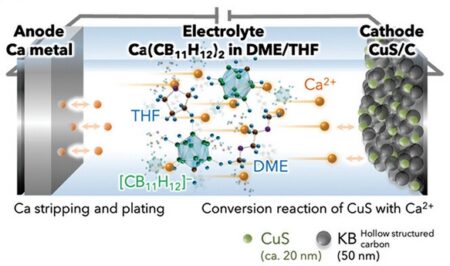
Tohoku University researchers have recently developed a prototype calcium metal rechargeable battery capable of 500 cycles of repeated charge-discharge. Five hundred cycles is the benchmark for practical battery use. The breakthrough was made thanks to the development of a copper sulfide nanoparticle/carbon composite cathode and a hydride-based electrolyte.
With the compulsive sales of electric vehicles and grid-scale energy storage systems on the rise, the need to explore alternatives to lithium-ion batteries has never been greater.
The advancement is focused on the element calcium and now a prototype is in testing. Calcium (Ca) is the fifth most abundant element in earth’s crust, calcium is widely available and inexpensive, and has higher energy density potential than lithium ion batteries (LIB). Its properties are also thought to help accelerate ion transport and diffusion in electrolytes and cathode materials, giving it an edge over other LIB-alternatives such as magnesium and zinc.

But many hurdles remain in the way of Ca metal batteries’ commercial viability. The lack of an efficient electrolyte and the absence of cathode materials with sufficient Ca2+ storage capabilities have proved to be the main stumbling blocks.
Schematic of a prototype Ca metal battery. The battery comprises a Ca2+-storing positive electrode containing the CuS/C composite and a Ca plating/stripping negative electrode with a hydride-based electrolyte, Ca(CB11H12)2 in DME/THF. Image Credit: Tohoku University. Click both the press release and the open access study report for more images and information.
In 2021, some members of the current research group provided a solution to the former problem when they realized a new fluorine-free calcium electrolyte based on a hydrogen (monocarborane) cluster. The electrolyte demonstrated markedly improved electrochemical performances such as high conductivity and high electrochemical stabilities.
Kazuaki Kisu, assistant professor at Tohoku University’s Institute for Materials Research said, “For our current research, we tested the long-term operation of a Ca metal battery with a copper sulfide (CuS) nanoparticle/carbon composite cathode and a hydride-based electrolyte.”
Also a natural mineral, CuS has favorable electrochemical properties. Its layered structure enables it to store a variety of cations, including lithium, sodium and magnesium. It has a large theoretical capacity of 560 mAh g-1 – two to three times higher than present cathode materials for lithium-ion batteries.
Through nanoparticulation and compositing with carbon materials, Kisu and his colleagues were able to create a cathode capable of storing large amounts of calcium ions. When employed with the hydride-type electrolyte, they produce a battery with a highly stable cycling performance. The prototype battery maintained 92% capacity retention over 500 cycles based on the capacity of the 10th cycle.
The group is confident that their breakthrough will help advance research into cathode materials for Ca-based batteries. “Our study confirms the feasibility of Ca metal anodes for long-term operations, and we are hopeful the results will expedite the development of Ca metal batteries,” said Kisu.
***
When one thinks about low cost materials, calcium and its naturally occurring forms comes to mind really quickly. The theoretical potential is outstanding. Getting it to work is now a strong possibility.

Calcium based batteries might make electric vehicles a practical reality. At the moment the practicality is factually a niche, and a not particularly big one at that. Weight has to be reduced dramatically, cost come down by a factor of 5 or more, charge time immensely cut and safety improved such that they can be parked in a garage without the insurance company going nuts.
That makes this important news. Yes it's a new born technology, but over time the potential is simply huge and the demand for electrical storage grows by the second.
By Brian Westenhaus via Newenergyandfuel.com

OilPrice.com : OPEC Would Welcome Iran’s Return To The International Oil Market

OPEC Would Welcome Iran’s Return To The International Oil Market

OPEC will welcome the return of Iran to the international oil market once the U.S. lifts sanctions from Tehran, the secretary general of the cartel said.

"We believe that Iran is a responsible player amongst its family members, the countries in the OPEC group. I’m sure there will be good work together, in synchronization, to ensure that the market will remain balanced as OPEC has continued to do over the past many years," Haitham Al Ghais said during a visit to Tehran, as quoted by local media.
The Trump administration reimposed U.S. sanctions on Iran in a bid to put an end to its nuclear program back in 2016. The sanctions have specifically targeted, among other things, Iran’s oil and gas industry.

As a result of the U.S. punitive action, Iranian exports of oil and gas have become troubled although they never stopped completely as some U.S. legislators hoped they would because of the sanctions.

Since the sanctions were reimposed, Iran’s biggest oil buyer has been China, as well as some ally countries in the Middle East such as Syria.

In the past couple of years, there have been tentative attempts to get the United States and Iran to resolve their differences and have the sanctions lifted but talks have broken down repeatedly signaling some potentially unresolvable differences.
The strongest impetus for a resolution presented itself last year as oil and gas prices soared in the wake of Russia’s invasion of Ukraine but even that wasn’t enough to get the U.S. and Iran to agree on a scenario that would see the sanctions lifted.

Meanwhile, Iran and Saudi Arabia have been working to restore their diplomatic relations with the help of mediation from China. The two earlier this year agreed to reopen their respective embassies and forge closer economic ties.

>>> US Early premarket gappers

Early premarket gappers

  • Gapping up:
    • LXRX +15.7%, IOVA +15%, COHR +8.3%, SMCI +4.4%, NVDA +3.4%, SHOP +2.1%, STNE +2%, JBLU +2%, NWL +1.6%, NFLX +1.5%, SONO +1.4%, BTE +1.2%, MU +1.1%, TDG +0.9%, UAL +0.8%, LUV +0.8%, SWTX +0.8%, GM +0.7%, AAL +0.7%, DAL +0.7%
  • Gapping down:
    • NNDM -1.3%, UL -1.3%, ELP -0.9%, CPG -0.5%

WSJ : China Launches Three Astronauts, Including First Civilian, Into Orbit

China Launches Three Astronauts, Including First Civilian, Into Orbit
Mission to relieve space-station crew shows nation’s growing capability and drive to rival U.S. beyond Earth

SINGAPORE—China sent its first civilian astronaut into orbit Tuesday as part of a new crew for its space station, showcasing the nation’s expanding capabilities in space at a time when mounting military and technological competition with the U.S. is stoking geopolitical tension.

The rocket carrying the Shenzhou-16 spacecraft and its three crew lifted off from a launch site in northern China’s Gobi Desert in the morning, beginning a trip of more than six hours to the Tiangong Space Station. The mission is the first since China finished building and fitting out the permanently manned orbital base, and as it prepares to venture deeper into space, sending astronauts to the moon and a probe to Mars.

Washington sees Beijing’s space program as another front in the deepening rivalry between the two, and has restricted exports of some technology and parts to prevent China from gaining an edge. The U.S. is gearing up for a potential conflict in space and has been strengthening its deterrence against China. In March, the White House proposed a $30 billion annual budget for its Space Force, almost $4 billion more than the previous year.

China accuses the U.S. of trying to contain its rise by denying access to the latest technologies. Chinese leader Xi Jinping has said that the “space dream is an important part of the dream to make China stronger,” while making a broad push for technological self-reliance. The country has invested heavily in its space program and has raced to build up a satellite-communications network. It has also developed ground-based missiles, lasers and more surveillance capabilities to deny adversaries access to space-based assets.

“Such demonstration of independent space capabilities adds to China’s great power status and as a rival alternative space power to the world,” said Namrata Goswami, an Alabama-based independent scholar on space policy.

Veteran astronaut Jing Haipeng, on his fourth mission, is accompanied by two first-timers, spaceflight engineer Zhu Yangzhu and payload specialist Gui Haichao, a professor at Beihang University in Beijing.

“We’re 20 years apart in age, which makes this a cross-generational team,” the 56-year-old Jing said Monday.

After a five-day handover, they will take over from the three crew members who have been aboard the Tiangong—which means “Heavenly Palace” in Chinese—since November. During their five-month mission, the newly arrived crew will conduct spacewalks, assist with the docking and departure of cargo and other spacecraft, and carry out scientific experiments.

The inclusion of a civilian dovetails with Beijing’s strategy of opening the space industry to the private sector, said Liu Bojian, a research assistant at the National University of Singapore who studies China’s activities in space. Previously, astronauts were all from the People’s Liberation Army’s Air Force.

“China is trying to make sure that in the next two decades it will have enough well-trained astronauts, both experienced and young, to prepare for even larger missions, such as landing on the moon, and even on Mars,” said Liu.

Lin Xiqiang, deputy director of the China Manned Space Agency, said on Monday that China aims to put astronauts on the moon before 2030, as the space race with the U.S. heats up. The U.S. plans its first return to the lunar surface in more than five decades as early as 2025.

The U.S. and Chinese space programs have developed independently of each other. Since 2011, China has been excluded by U.S. law from working with NASA, and its astronauts are barred from the International Space Station. But China’s Tiangong could be the only space station in operation if its older counterpart is decommissioned as planned in 2030.

“China’s space program is integrated into its civil-military fusion strategy…[and it] plans to challenge U.S. dominance on the moon within this framework,” said Goswami, who is the co-author of “Scramble for the Skies: The Great Power Competition to Control the Resources of Outer Space.” She points to China’s goal to bring back samples from the lunar South Pole and to set up a permanent research base on the moon.

In preparation for the mission, the Chinese space agency said it is developing a new carrier rocket, spacecraft and spacesuit, as well as a lunar lander.