After Hours Summary: KBH +0.7% ticks higher on earnings; CDMO -21% falls on earnings; AAOI +13.8% pops on MSFT supply deal; LOGI +2.1% higher on buyback authorizationAfter Hours Gainers:
Companies trading higher in after hours in reaction to earnings/guidance: EPAC +2.6%, SCS +1.1%, KBH +0.7%
Companies trading higher in after hours in reaction to news: AAOI +13.8% (enters into supply agreement with MSFT to provide design and assembly services), KURA +3% (Director bought 50000 shares), LOGI +2.1% (authorizes new $1 bln share repurchase program), MRNS +2% (patent granted by USPTO), MFIN +0.6% (files $100 mln mixed shelf securities offering), SPCE +0.4% (Board Chair Evan Lovell died unexpectedly), RIVN +0.2% (acquires mapping company Iternio), IPI +0.1% (completes Phase One and provides update on Phase Two of its HB Injection Pipeline Project), ATAT +0.1% (co-CFO resigns)
After Hours Losers:
Companies trading lower in after hours in reaction to earnings/guidance: CDMO -21%
Companies trading lower in after hours in reaction to news: ALVR -19.1% (commences $75 mln public offering), GPOR -9.3% (stock offering by selling shareholders), CRNC -3.4% ($190 mln convertible notes offering), IGMS -1.8% (announces $100 mln public offering and concurrent private placement), COLD -1.3% (CP and COLD announce collaboration to co-locate Americold warehouse facilities), RJF -1% (reports May operating data), CP -0.6% (CP and COLD announce collaboration to co-locate Americold warehouse facilities), RTX -0.6% (awarded $294 mln U.S. Navy contract modification), AAPL -0.1% (releases developer software tools for the Apple Vision Pro)
Asset or accessory? Luxury handbags spark growing interest
Booming prices make the accessories attractive to investors seeking protection against inflation and market volatility
Three years ago, a London-based finance co-ordinator who works for a corporate company bought her first Hermès handbag. She now owns four. Having spent a little under £100,000, she plans to keep the handbags for at least five years and expects between a 40 and 50 per cent return on investment once she sells them.
“Coming from a finance background you can on your own see how profitable the market is and the returns you can get,” she tells the Financial Times. “It wasn’t really something that I had in mind, it was something that I was introduced to and I got to know slowly. Eventually I studied the market and saw that it is actually a good way to invest.”
The term “investment piece” is commonly used in fashion to describe pieces that are worth splurging on because of their timelessness. For a growing number of wealthy individuals, the expression has taken a much more literal connotation when referring to handbags.
“This asset class is becoming more prevalent for our clients,” says Hari Hundle, managing partner at Mayfair’s boutique wealth advisory firm Hundle, which manages about $1bn of assets from London. “We are seeing a huge growth in special unique assets. Their value is de-correlated to the market, and the market has been quite volatile, so this is a useful investment class. It started as a point of passion and luxury, but it has evolved.”
It’s a trend that has also been picked up by luxury research group Agility, which compiles studies on the spending habits of the wealthy. “A lot of high net worth individuals have passion investments, which would consist of a couple of things, such as watches and jewellery,” says managing director and co-founder Amrita Banta. “The handbags category has definitely started playing a part in that.”
Hundle says it is women and younger clients who tend to have an interest in the luxury handbag category, but only about 10 to 20 per cent take that interest to an investment level. Those clients, however, typically still invest more in established categories such as art or classic cars.
“If you were to put all luxury acquisitions and investments in an asset class, art and cars would be 80 per cent of what they are buying,” Hundle says. “The art market and the car market are more liquid, there are more buyers and there is more variety of supply.
For us, the handbag market has three suppliers: Hermès, Chanel and Louis Vuitton.”
Interest in handbags as collectibles has grown hand in hand with prices in the primary market, which have skyrocketed. In the past 10 years, a medium Chanel classic flap bag has more than doubled in price to $10,200. HSBC research shows that prices of the hero products of the 21 luxury brands they track increased by an average of 3 per cent in the three months between October 2022 and January 2023. A 2022 report from Credit Suisse says Chanel handbags, as well as traditional Chinese works of art and wristwatches, offer the best inflation protection. Investors are drawn to the handbag category for these reasons, as well as the opportunity to invest in objects that they actually enjoy.
“Since 2012, we have continued to see an incredible growing interest in the category, as well as increasing sales,” Rachel Koffsky, international head of handbags and accessories at Christie’s, writes via email. “Today, most of our clients are balancing passion and love for the object with making sound financial decisions when it comes to making their acquisitions. Some clients make six-figure acquisitions in order to wear their bag every day, some to wear once a year, and some to display in a custom case as a wearable work of art.”
At the auction house, global sales of handbags totalled $32.8mn in 2022, the highest value ever achieved by the department since it launched standalone handbag sales in 2012.
Christie’s Asia-Pacific division is at present offering an in-person Collecting Handbags as an Alternative Asset course for HK$3,800 (£390).
The London-based finance co-ordinator who spoke to the FT was advised in her purchases by BagsbyAppointment, a company founded in 2019 by Farida Patel, who after working in private banking for more than 10 years started to source and trade luxury handbags for private clients. About 100 of its clients, or a fifth of the total, have built handbag portfolios so far, bringing to the service an average of £500,000 to £1mn, although some clients start with smaller sums. “We advise on what to buy, when to buy it and how long they should keep the items for,” says head of strategy and growth Serena Piazzolla. (Patel declined to speak to the FT, citing a wish to keep a low profile.)
Much like the art market, the collectible handbag market is dependent on experts’ advice on what to buy. Sebastian Duthy, director of Art Market Research, a London-based research company that focuses on investments in fine art and luxury collectibles, warns that not all handbags, even from the Hermès, Chanel and Louis Vuitton triad, increase in value over time.
“You got to do your homework and you got to be connected with the information circle,” says Duthy. “Something very rare, and as long as it is in pristine conditions, will go up in value.” To preserve conditions, companies such as BagsbyAppointment offer a storage service. “Keeping the bags in pristine conditions is the number one priority when you make an investment,” says Piazzolla. “Occasionally [clients] will wear them, maybe for one night, but always knowing that what they are wearing is a financial asset.” Limited editions are considered the safer bet. The Hermès Kelly Cut So Black with feathers, released in 2010 as part of then creative director Jean Paul Gaultier’s So Black collection, retailed for about £10,000. One was recently sold by Christie’s for €277,200.
“What we want to explain to wealth managers and family offices is that those collectibles can represent an important portion of the wealth of their clients and need to be managed properly,” says Adriano Picinati di Torcello, director at Deloitte Luxembourg, who also warns that “there is no guarantee” for capital gains.
“When we look at the component of ‘investment’ we need to be very careful about the fashion trends and taste, which as we know can evolve over time,” he says. “Condition is extremely important and also provenance. Let’s be very selective, very prudent about conditions and provenance and [authenticity] documentation.”
Pixar flop shows Walt Disney struggling to revive the magic
Marvel and Pixar films were pushed hard during the pandemic to feed the company’s streaming service
In 2019, Walt Disney released seven films that each grossed more than $1bn at the global box office — a remarkable feat built on Bob Iger’s string of studio acquisitions during his first 15-year tenure as chief executive.
Disney’s film studios were “on fire”, said Jessica Reif Ehrlich, an analyst at Bank of America. “Bob came up with a branded film strategy and for 10 years or longer, no other studio could compete with them.”
Now, however, Iger must deal with questions about whether the creative spark is starting to flicker at Disney’s studios, including the box office powerhouses Marvel, Pixar and Lucasfilm.
“The creative engines are just not working,” said Rich Greenfield of LightShed Partners, an investment research group. “And the challenge with the movie business is that there’s no quick fix.”
Last weekend’s disappointing box office performance by Pixar’s Elemental — a story about forbidden love between characters made of water and fire — crystallised the sense that Disney’s studios had fallen into a rut.
Elemental has had positive reaction from critics and audiences, but the film brought in under $30mn in the US box office on its opening weekend — a significant shortfall for a movie with an estimated $200mn budget. This poor showing has sounded alarms following the underwhelming performance of last year’s Lightyear, a Toy Story prequel that grossed only a quarter of the previous instalment of the franchise.
Ehrlich said: “It’s been a while since there’s been something like a Toy Story, something extraordinary that’s original and that really hits everybody.”
Iger was pulled out of retirement in November to help re-set the company’s course after his successor, Bob Chapek was forced out following a dispute with Florida governor Ron DeSantis and ballooning losses in its streaming business.
He has restructured the company to hand power back to creative executives, and last week Disney pushed out the release dates of a number of films — including those in the Avatar and Star Wars franchises.
But with less than 18 months left of his two-year contract, Greenfield asks if Iger will have time to revive the Disney magic.
“Everything at Disney flows from its creative excellence, whether that’s the theme parks, whether that’s consumer products, whether that’s Disney Plus,” he said. “More than any company, Disney is tied to its creative output, and that output just is not performing — and it’s not clear what’s wrong.”
Company executives acknowledged Elemental’s performance was disappointing but rejected the notion that Disney has hit a creative slump. They noted the strong US performance this spring of the live action version of The Little Mermaid and said they have high hopes for upcoming films including Indiana Jones and the Dial of Destiny, The Marvels and Wish. Marvel movies continued to draw large audiences, they added.
But the Elemental box office has drawn unfavourable comparisons with recent animated films released by Illumination studios, co-owned by Universal. Illumination’s The Super Mario Bros Movie, released April 5, has grossed $1.3bn worldwide, and its Minions: The Rise of Gru, has raked in $940mn since its release last year.
Pixar is under the leadership of Pete Docter, an Oscar-winning animator who started at the company in 1990.
He has said Pixar is at work on a number of sequels, including Toy Story 5 and a follow-up to Inside Out.
Inside and outside Disney there is a sense that key brands, particularly Marvel but also Star Wars and Pixar, were pushed too hard to feed the company’s streaming service Disney Plus.
During the pandemic, three Pixar features were released straight to Disney Plus, angering employees who say this conditioned audiences to think its films did not need to be seen in a cinema.
“The question is how much of this is overuse,” Greenfield said. “Is it trying to force everything on to Disney Plus with a series? Did they go too far with Marvel and Lucasfilm, diluting the power of the movie franchises by introducing all these [streaming] shows?”
After Disney bought Marvel in 2009, it spawned franchises that have produced dozens of movies and raked in tens of billions of dollars, making it the most successful hit engine in Hollywood.
Marvel’s Avengers: Endgame, released in 2019, made an astounding $2.8bn and is the second highest-grossing film in history.
But Marvel’s record has been mixed more recently.
There have been two hits — Guardians of the Galaxy Vol 3 and Black Panther: Wakanda Forever — along with a miss, Ant Man: QuantumMania.
Earlier this year, Iger said there was nothing “inherently off in terms of the Marvel brand” but suggested Disney needed to be more judicious about sequels.
“What we have to look at at Marvel is not necessarily the volume of Marvel storytelling, but how many times we go back to the well on certain characters,” he told a media conference in March.
“Sequels typically work well for us, but do you need a third or a fourth?”
The same goes for the Star Wars films, which are under the supervision of Lucasfilm chief Kathleen Kennedy.
Iger said: “We still are developing Star Wars films.
We’re going to make sure that when we make one, that it’s the right one, so we are being very careful there.”
For Greenfield, the question is whether audiences are ready for Disney to branch out in new directions, instead of relying on its, admittedly valuable, library of intellectual property.
“If you look back over the last decade and Iger’s entire first run, the improvement year by year and the franchise growth was incredible,” he said. “And I think the question now is, have they gone to that well too many times? Do they need to create new IP?”
Rocket Internet’s Oliver Samwer to earn €260mn dividend payout
German billionaire in line for massive payday after consolidating control over European tech investment group
The billionaire owner of the German technology investment firm Rocket Internet is poised to receive a €260mn annual dividend after consolidating control over one of Europe’s top venture capital groups.
Oliver Samwer’s Global Founders, the vehicle through which his family controls Berlin-based Rocket Internet, is set to receive the huge payout this year, according to Financial Times’ calculations based on company filings.
Shareholders at Rocket’s upcoming annual general meeting on Thursday are set to approve an issue of an overall €315mn dividend, a more than six-fold increase over the previous year.
As Samwer has increased his majority ownership over Rocket in recent times, his Global Founders vehicle is due to receive €260mn.
The hefty payment for Samwer is another signal of how he has shifted the business away from its roots as one of Europe’s most prolific start-up financiers, towards a more conservative investment house focused on generating profits.
Due to concern over the broader tech downturn, Rocket has recently slashed staff at its venture funds, closed a start-up fund and urged certain nascent companies to reduce spending.
Even while cutting back on tech investing, the company has secured steady profits from other dealmaking, such as providing debt financing to companies such as Revolut and amassing a large public stock portfolio in groups like Amazon and Alibaba.
“The general theme is to get as much liquidity out,” said one person familiar with the company. “It’s really driven by how much cash they thought they could distribute at this point.”
Rocket’s expanded dividend comes after Samwer increased his control when the company bought out the roughly 20 per cent stake held by activist investor Elliott Management in a deal that closed over the past year. The FT previously reported that he also bought out the holdings of his brother Alexander.
This has left Samwer’s vehicle Global Founders with about 83 per cent ownership of Rocket Internet.
Samwer did not respond to requests for comment.
Founded about 16 years ago by Samwer and his brothers Marc and Alexander, Rocket Internet became one of the most prolific investors in European technology companies.
The firm generated immense profits for its owners by providing early backing to start-ups such as HelloFresh and Delivery Hero, which eventually went on to hold initial public offerings at multibillion-euro valuations.
After its share price halved during six years as a public company, the firm made plans to delist in 2020. The take-private process was contentious, after Rocket offered to buy shares below their trading price and Elliott amassed a blocking stake.
Eventually, Rocket succeeded but had to pay almost double its initial offer and included a special deal for Elliott.
Rocket Internet posted revenues of €18mn and other operating income of about €468mn, according to a 2022 annual report seen by the FT.
In a sign of the difficult times for technology investors, Rocket Internet had to write down the value of its financial assets and marketable securities by more than €452mn, the report said. The company still had about €211mn of cash.
Samwer controls Rocket Internet through a network of companies. The Rocket Internet-owner Global Founders GmbH is owned by another company called Zerena, which is jointly owned by the Oliver Samwer Family Foundation and the Aramid Foundation, according to German filings. Zerena counts Marc Samwer as a member of its management, according to a 2021 filing.
Russia gas flows through Ukraine could stop next year, Kyiv says
Ukrainian energy minister said renewal of five-year transit contract to supply Europe was unlikely
One of the last arteries carrying Russian gas to Europe could be shut off by the end of next year when Ukraine’s supply contract with Gazprom expires, the Ukrainian energy minister has said.
In an interview with the Financial Times, German Galushchenko said that the chances of Kyiv and Moscow agreeing the renewal of the five-year transit contract first signed in 2019 were slim — even though the route through Ukraine accounts for almost 5 per cent of Europe’s total gas imports.
“I really can’t imagine how it could be bilaterally,” Galushchenko said when asked if Ukraine would be prepared to renegotiate the agreement with Moscow following last year’s invasion.
“I can tell you that we are preparing our system for a cut of supplies,” he added.
Moscow’s decision to slash gas supply to Europe last year triggered an energy crisis, stoking inflation and raising the cost of living across the continent.
But while several routes were shut off, the Ukrainian pipeline is one of just two that have continued to supply gas, albeit at reduced volumes.
According to data from energy consultancy ICIS, Austria relied on Russian gas passing through Ukraine for about half of its gas imports in May, while in Slovakia, the pipeline accounted for 95 per cent.
The energy minister said Europe would be relatively prepared for a further slowdown in supply, having had to adapt to similar cuts in the past by reducing demand and sourcing alternative imports such as liquefied natural gas.
But this is the first acknowledgment from Kyiv that the contract underpinning the remaining flows from Russia through Ukraine will probably be allowed to expire at the end of next year.
Without the Ukrainian transit route, the only pipeline from Russia still delivering gas into Europe would be TurkStream, which supplies countries in the south-east of the continent and accounted for just under 3 per cent of Europe’s gas imports in May.
While Galushchenko suggested that European politicians might wish to renegotiate the contract — as happened in 2019 when an EU delegation brokered trilateral talks with Russia and Ukraine — analysts say this is unlikely given the difficult optics of holding talks with Moscow.
The European Commission declined to comment on whether it would try to instigate talks with Russia on the contract renewal.
The loss of even a small percentage of supply has the potential to raise prices across the continent given the tightness of global gas markets, though supplies of LNG are expected to rise rapidly from 2025 with the launch of major projects in Qatar and the US.
Earlier this month, Russian deputy foreign minister Mikhail Galuzin said that a decision not to extend the gas transit agreement would “deal a blow” to the EU, while Ukraine would “shoot itself in the foot by losing the dividends from transit”.
European gas prices surged to more than 10 times their normal level in 2022, reaching the equivalent of almost $600 a barrel in oil terms, but have since fallen sharply.
The benchmark TTF contract is back to about €40 per megawatt hour — down almost 90 per cent from its peak last August.
The current gas transit contract was signed in December 2019, a last-minute deal that came just 24 hours before the previous agreement expired, securing Russian gas flows through Ukraine until 2024.
Under the deal, Russia’s state-owned energy company Gazprom agreed to send a minimum of 65bn cubic metres of gas in 2020, and 40 bcm/year between 2021 and 2024, through the Ukrainian pipeline, which would have secured the country $7bn in transit fees.
However Russia is currently only shipping volumes of about 12 bcm/year, and Kyiv claims Moscow has been underpaying it, despite contractual obligation to pay the full transit fee regardless of whether agreed volumes of gas are supplied.
OMV, one of Austria’s largest energy companies, said it would be “able to supply its customers even without Russian gas”, having made preparations since the invasion of Ukraine last year.
If the contract lapses, Gazprom could technically still send gas through Ukraine by booking capacity through auctions that its gas transmission system operator is obliged to hold, under European rules.
“It’s hard to see how you renew a contract that neither side believes the other has honoured, let alone in a middle of a war between the two parties,” said Laurent Ruseckas, an analyst at S&P Global Commodity Insights.
“But in theory the gas should continue to flow if European buyers still want it and Russia is prepared to send it,” he added.
Elliott Seeks Ouster of NRG Energy CEO
Activist is in talks with CEO, other executive replacement candidates
Elliott Investment Management is ratcheting up the pressure on NRG Energy NRG 1.07%increase; green up pointing triangle and is now seeking to oust its chief executive, according to people familiar with the matter.
The activist investor is in talks with potential candidates to replace Chief Executive Mauricio Gutierrez as well as other top executives, the people said.
Elliott disclosed in mid-May that it had taken a $1 billion stake in the power company, or about a 13% economic interest.
Elliott said in a public letter last month that it aimed to refresh NRG’s board, cut costs and implement a strategic review of the company’s home-services unit, Vivint. It called the acquisition of Vivint “the single worst deal in the power and utilities sector during the past decade.”
NRG shares closed Wednesday at $33.88, having risen about 6% so far this year, giving the company a market capitalization of roughly $7.8 billion.
A spokeswoman for NRG said in an emailed statement that the company “looks forward to discussing NRG’s strategic plan” with shareholders at an investor day scheduled for Thursday morning.
“The board fully supports NRG’s CEO Mauricio Gutierrez and management team and the strategy they are executing to drive substantial shareholder value,” the spokeswoman said.
In early May, NRG reported a net loss of $1.3 billion for the first quarter, compared with net income of $1.7 billion in the prior-year period. Revenue fell slightly to $7.7 billion from $7.9 billion.
The company said its losses were primarily related to large declines in natural-gas and power prices.
Elliott previously disclosed a large investment in NRG in 2017. It was successful then in helping appoint two new board members and helping push NRG to revise its business plans and to consider selling assets and slashing debt.
Since then, however, Elliott has said that NRG has become unfocused on its turnaround plans, including with the Vivint deal.
NRG’s $2.8 billion purchase of Vivint was completed in March, a bet that the company made in part to offer customers simpler options to service their homes.
NRG said earlier this month that Bruce Chung would succeed Alberto Fornaro as chief financial officer, effective June 1. Chung had served as head of strategy and M&A at NRG since 2016.
NRG also said earlier this month that Constellation Energy would buy out its 44% stake in the South Texas Project Electric Generating Station, in a deal valued at $1.75 billion. NRG said the move was part of its broader portfolio-optimization strategy.
Gutierrez became CEO of NRG in 2015, having previously held the role of chief operating officer. He joined the company in 2004.
In its May letter, Elliott said NRG “must restore the credibility of the management team” and the board, without specifying further.
Elliott is known for taking on tech companies and others and forcing changes that include sales and executive shake-ups. Its targets have included Salesforce, PayPal, Twitter, Duke Energy and U.S. utility Evergy.
Closing Stock Market SummaryThe stock market closed on a softer note today. The price action in the mega caps drove a lot of the index level moves, as well as a sense the market is still due for some consolidation. Notwithstanding the losses seen in the mega cap stocks, the major indices held up fairly well. The market-cap weighted S&P 500 fell 0.5%, but the Invesco S&P 500 Equal Weight ETF (RSP) fell by a modest 0.1%.
Market participants were also digesting Fed Chair Powell's semiannual monetary policy testimony before the House Financial Services Committee, but his comments didn't contain anything too surprising; therefore, they did not move the market much. Specifically, he reiterated that there is still a long way to go to get inflation back down to the 2.0% target and that nearly all Fed members anticipate the need for additional tightening before year end.
Following an early slide, there was a rebound effort in the afternoon trade as stocks pared their losses in response to falling Treasury yields, which reacted to a strong $12 billion 20-year bond reopening at 13:00 ET. The 2-yr note yield, which flirted with 4.76% earlier, fell to 4.67% before settling the session up one basis point at 4.71%. The 10-yr note yield, which hit 3.79% earlier, fell to 3.71% and settled down one basis point at 3.72%.
Selling in the stock market, however, picked up again in the final hour of trading on no news. Ultimately, the major indices all closed in negative territory.
The Vanguard Mega Cap Growth ETF (MGK), which had narrowed its loss to 0.6%, fell 1.1% today.
S&P 500 sector performance was mixed. The energy (+0.9%) and utilities (+0.8%) sectors held the top spots on the leaderboard at the close.
Meanwhile, lagging mega cap stocks pinned the communication services (-1.4%), information technology (-1.4%), and consumer discretionary (-1.2%) sectors at the bottom of the pack. Tesla (TSLA 259.46, -14.99, -5.5%), which has been on a tear, gaining 50% since May 24, was the main drag on the consumer discretionary sector after being downgraded by Barclays to Equal Weight from Overweight.
The information technology sector was also weighed down by its weak semiconductor components. The PHLX Semiconductor Index declined 2.7% with every component registering a loss. NVIDIA (NVDA 430.45, -7.63, -1.7%), up nearly 200% for the year, was among the more influential laggards from the space.
- Nasdaq Composite: +29.0% YTD
- S&P 500: +13.7% YTD
- Russell 2000: +5.8% YTD
- S&P Midcap 400: +5.3% YTD
- Dow Jones Industrial Average: +2.4% YTD
Reviewing today's economic data:
- The weekly MBA Mortgage Applications Index rose 0.5% with purchase applications rising 2.0% while refinancing applications fell 2.0%.
Looking ahead, market participants will receive the following economic data on Thursday:
- 8:30 ET: Weekly Initial Claims ( consensus 259,000; prior 262,000), Continuing Claims (prior 1.775 mln), and Q1 Current Account balance (prior -$206.80 bln)
- 10:00 ET: May Existing Home Sales (consensus 4.28 mln; prior 4.28 mln) and May Leading Indicators ( consensus -0.8%; prior -0.6%)
- 10:30 ET: Weekly natural gas inventories (prior +84 bcf)
- 11:00 ET: Weekly crude oil inventories (prior +7.92 mln)
Also, Fed Chair Powell will appear before the Senate Banking Committee at 10:00 a.m. ET.
Prices Of Middle Eastern Oil Skyrocket On Sudden Surge In Chinese Demand
At a time when global recession concerns have depressed global oil prices to pre-Ukraine war levels, prices of Middle Eastern oil have skyrocketed on soaring demand from Asian refiners in China to Japan as the market takes stock of heavy trading by the industry’s biggest names this month.
According to Bloomberg, spot differentials for August-loading Oman crude have jumped to more than $2 a barrel against the Dubai benchmark as of Wednesday, compared with 60-70 cents last week; premiums for Abu Dhabi’s Murban grade also rose - it’s rare for spot differentials to move more than 10-to-20 cents a barrel between days and deals.
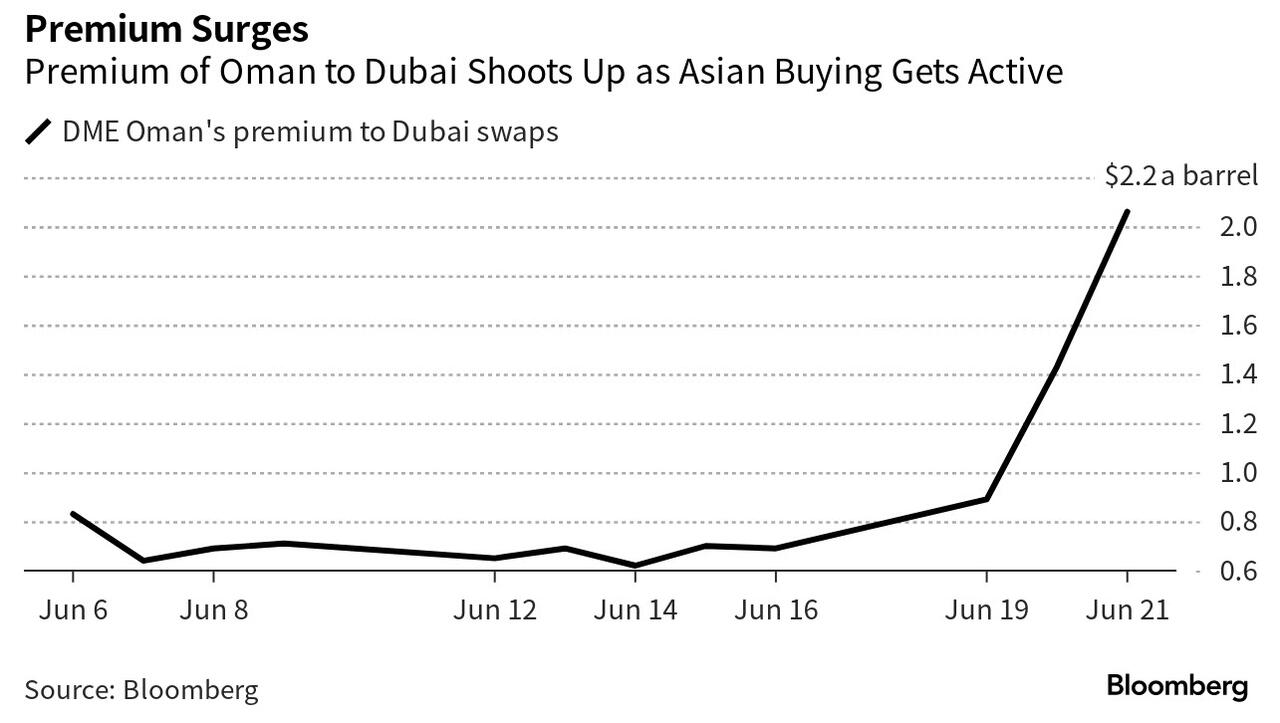
The soaring regional prices have been underpinned by Asian refiners snapping up barrels over the past couple of days, including China’s Rongsheng Petrochemical, Taiwan’s Formosa Petrochemical and processors in Japan and Thailand, according to traders. A surge in activity on a normally sedate Middle Eastern crude-trading window has also sparked the interest of market participants.
For those asking where is all that pent up oil demand out of a post-covid China, here is your answer: Unipec - a unit of China’s top refiner Sinopec - TotalEnergies SE and Shell Plc have been going head-to-head with aggressive bids and offers of Dubai crude partial contracts on the so-called Platts trading window this month, an activity that goes into pricing a benchmark of the same name.
As Bloomberg explains, cargoes of crude including Oman, Murban and other Middle Eastern grades can be delivered from seller to buyer following the transaction of a set number of Dubai partials. Shipments are typically 500,000 barrels and Oman is one of the easiest to handle due to its high export volume and large pool of buyers and sellers.
So far this month, almost 40 Oman cargoes and two Upper Zakum shipments from the United Arab Emirates have been delivered, according to data compiled by Bloomberg, which is the most activity seen on the Platts window in years.However, the number of Oman shipments equates to almost 70% of the grade’s exported volume in recent months. That’s led traders to consider whether sellers on the Platts window such as Unipec may curtail offers should physical cargoes become scarce. These concerns have contributed to a rise in prices, and may give room for more increases if sellers find it hard to get their hands on window-deliverable cargoes.
The sharp increase in sentiment (and price) is a dramatic turnaround from earlier in the month when traders were unsure about the market’s direction following contrasting trading on the window. Companies may also actively buy and sell on the window due to associated positions in Brent and Dubai paper markets.
The backwardation in prompt Dubai swaps also strengthened to the widest in six weeks Wednesday, while the premium of London’s Brent to the Middle Eastern benchmark — also known as Brent-Dubai EFS — was narrow at under $1 a barrel. Earlier this month, Saudi Arabia surprised the market with additional output cuts that were followed by a spike in official prices to all regions.
Bloomberg notes that last month cargoes of Oman, Upper Zakum and Murban crude for July loading were transacted for Europe and the US, shipments considered unusual, as Asian demand was soft at the time but that has since reversed notably. A US major sold Murban into the US west coast, traders said, while a trading company supplied Upper Zakum to Italy.
Western buyers considered spot Middle Eastern crude as affordable due to muted demand from Asia, where many refiners were undergoing seasonally planned maintenance work on plants, according to traders. It now appears that China is fully back in the market.
EU agrees measures to target Russian sanctions evaders
Eleventh package seeks to curb Moscow’s ‘ghost trade’ via other countries
The EU has agreed on an 11th package of economic sanctions aimed at punishing Russia for invading Ukraine, including unprecedented new powers to punish countries suspected of helping Moscow circumvent the existing restrictions.
The new measures come as G7 states seek to tighten loopholes faster than Moscow can find new ways to evade them and crack down on routes that are supplying the Kremlin with goods and technologies used to manufacture weapons for the war.
The EU, US and UK have in recent months stepped up pressure on countries such as Turkey, Armenia, the United Arab Emirates, Kazakhstan that have, since the war began in February 2022, increased imports of western technology that can also be used by the military while expanding exports to Russia.
The measures were agreed by member state ambassadors on Wednesday after weeks of debate over the targeting of Chinese companies accused of sanctions evasion. After multiple countries objected, fearing reprisals from Beijing, just three Hong Kong-listed companies were included, according to officials.
The sanctions, which are set to be formally adopted by the end of this week, include “exceptional, last-resort measures restricting the sale, supply, transfer or export” of sensitive technology that can be used for military purposes to countries “whose jurisdiction is demonstrated to be at a continuing and particularly high risk of being used for circumvention”, according to a document seen by the Financial Times.
The move takes the EU into new territory of targeting third countries and would require both proof that they are involved in sanctions evasion and that they have refused to comply with repeated warnings.
The new package also bans the “transit via the territory of Russia of goods and technology which might contribute to Russia’s military and technological enhancement”. FT research last month showed that more than $1bn of Moscow’s “ghost trade” with sanctioned EU goods never reached their stated destinations in Kazakhstan, Kyrgyzstan and Armenia.
In addition, 71 persons and 33 entities are also added to the EU’s sanctions list, hitting them with asset freezes and travel bans to the bloc, according to the document.
Some of those people and entities are in response to the illegal deportation of Ukrainian children to Russia.
The Swedish EU presidency on Wednesday said that ambassadors agreed the package, which “includes measures aimed at countering sanctions circumvention and individual listings”.