"Prepare Generators": Largest US Power Grid Declares Emergency Alert For Second Day
Update (Friday):
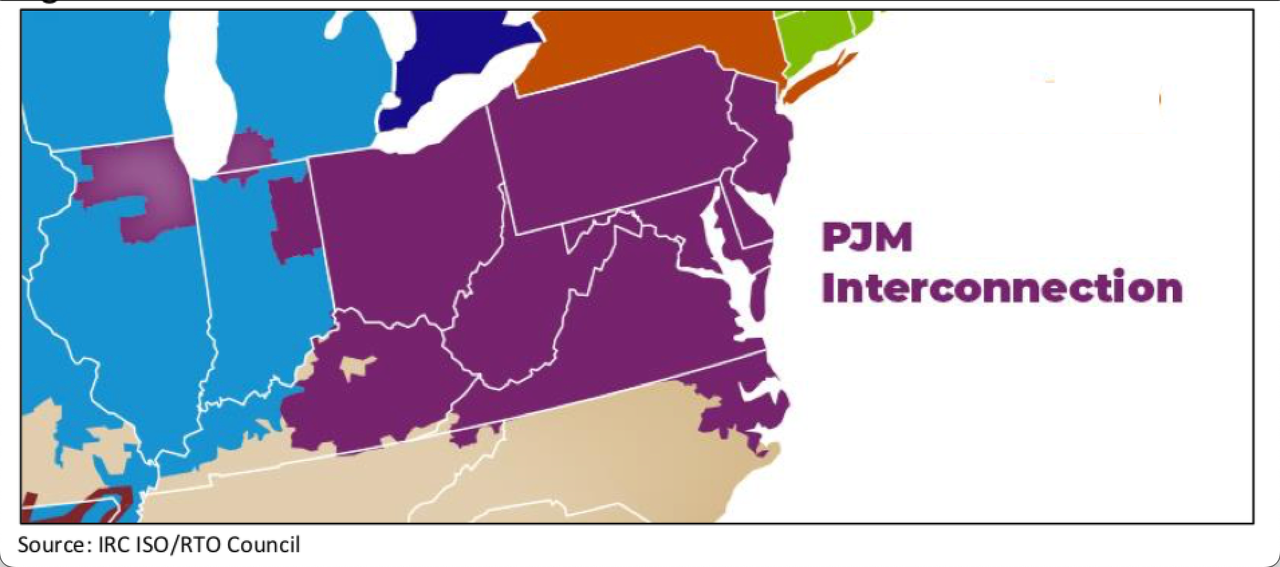
PJM Interconnection LLC declared another Energy Emergency Alert Level 1 through Friday. Excessive heat advisories and warnings cover much of PJM's grid across 13 states, from Illinois to New Jersey, with over 65 million customers.
Here's a map of the PJM grid:
The latest National Weather Service data shows that advisories and warnings for heat plague most of PJM's grid.
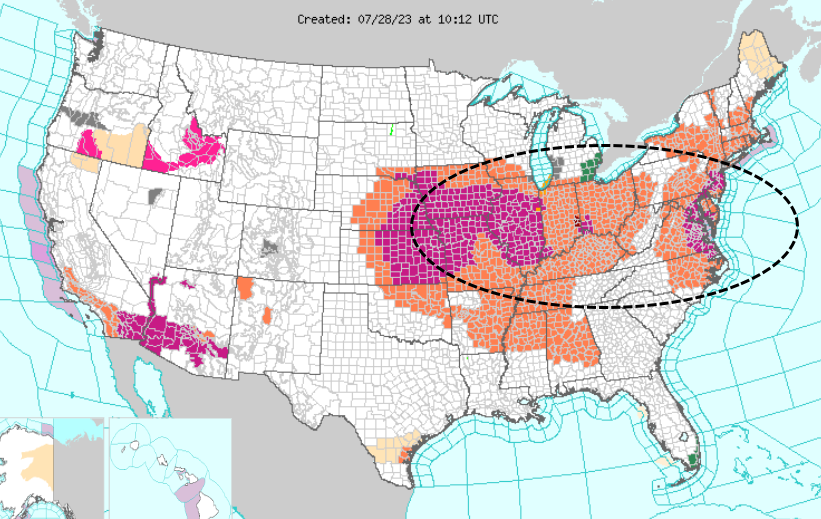
"PJM has issued these alerts to help prepare generators for the onset of intense heat," the grid operator said.
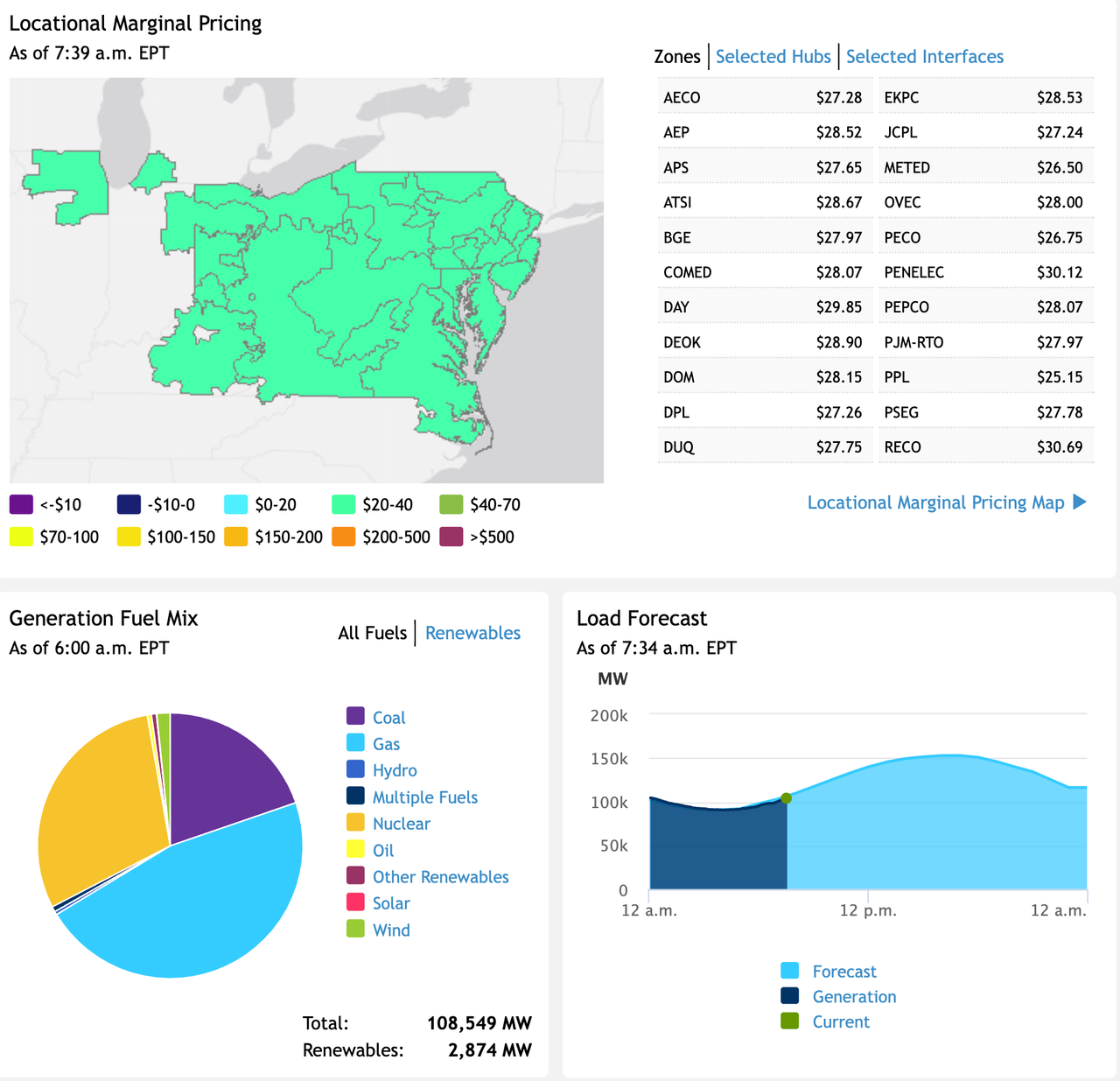
This is the second day the largest US grid operator declared a level one emergency. On Thursday, PJM's preliminary peak load was around 148,000 megawatts and is forecasted to peak at around 155,000 megawatts later on Friday.
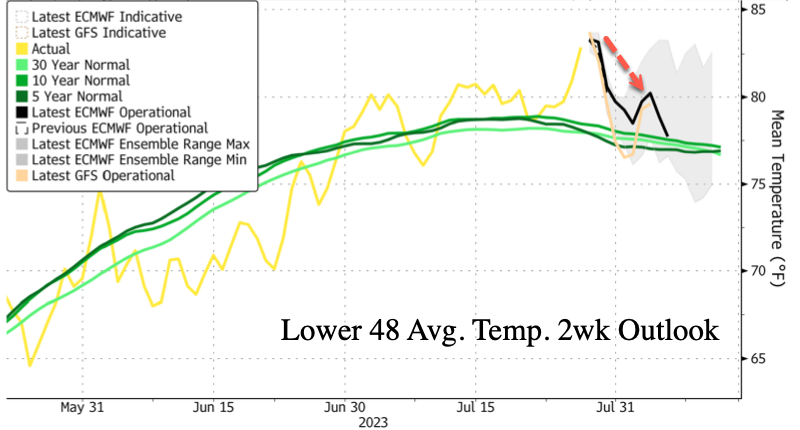
PJM expects hot weather to persist through Saturday. Bloomberg data shows average temperatures across the Lower 48 are expected to peak on Saturday and possibly revert to 5-10-30-year averages. Also, notice how the yearly temperature averages have plateaued for the Northern Hemisphere summer.
"A Hot Weather Alert helps to prepare transmission and generation personnel and facilities for extreme heat and/or humidity that may cause capacity problems on the grid. Temperatures are expected to be near or above 90 degrees in these regions, which drives up the demand for electricity," the grid operator said.
How did PJM become so unreliable all of a sudden? Well, PJM published a study earlier this year that showed the alarming trend of state and federal decarbonization policies across the grid that "present increasing reliability risks during the transition, due to a potential timing mismatch between resource retirements, load growth and the pace of new generation entry."
So before corporate media blames 'climate change' for power grid woes, remember decarbonization policies have sparked these instabilities.
* * *
A heat wave continues to blast the Midwest, Northeast, and South through the end of the work week, forcing the largest US grid operator to declare a level one emergency for Thursday as tens of millions of people crank up air conditioners to escape scorching temperatures as summer in the Northern Hemisphere peaks.
On Wednesday evening, PJM Interconnection LLC declared an Energy Emergency Alert Level 1 in 13 states that stretch from Illinois to New Jersey with over 65 million customers. PJM is concerned about maintaining adequate power reserves on Thursday as power demand is set to soar because of air conditioners. It expects demand to reach 153,286 megawatts as of 1700 ET and has about 186,000 megawatts of generating capacity.
The power mix of the grid shows natural gas, coal, and nuclear are doing most of the heavy lifting of 0600 ET. Power prices across the grid appear normal.
The surge in above-average temperatures for the Lower 48 is expected to peak on Friday and return to normal levels for this time of the year. According to Bloomberg data, 5-10-30-year average temperatures show the Northern Hemisphere summer has peaked.
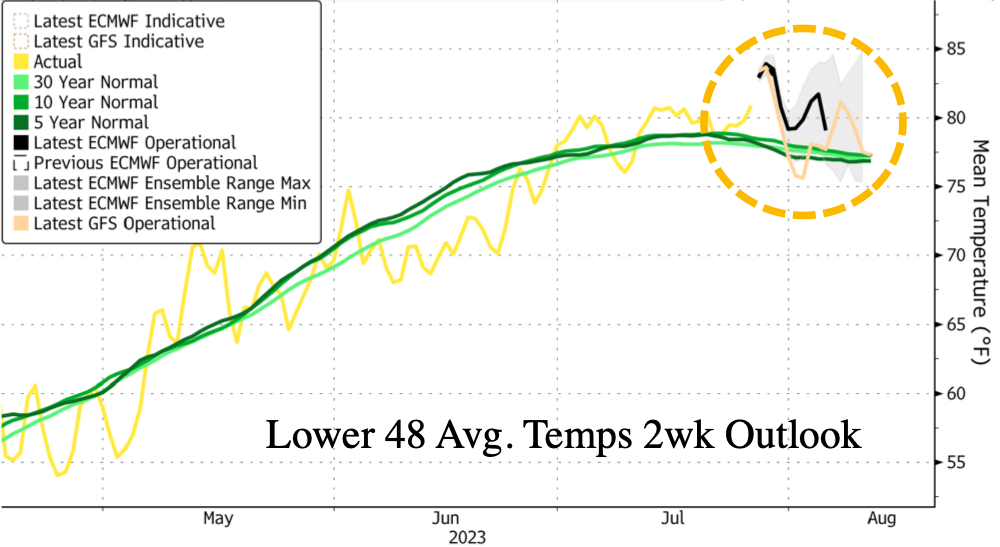
Before corporate media blames "human-induced climate change" on power grid woes, we must note PJM's reliability has worsened because of federal and state decarbonization policies.
The Week’s 10 Biggest Funding Rounds: Lvrch Capital Advisory, OneTrust And Kriya Raise Big
A trio of big rounds led the way this week, including a huge $400 million raise. The week didn’t provide any specific trends, but did see a unicorn raise a down round and investors writing big checks to two companies using AI in health care.
1. Lvrch Capital Advisory, $400M, financial services: This week’s top entry likely stayed under the radar for most people — after all it does not involve AI. Nevertheless, Woodland Hills, California-based investment firm Lvrch Capital Advisory locked up the top spot with a massive $400 million Series D. Investors in the round were not disclosed. The firm plans to use the cash infusion to introduce a new compounding system for investors to maximize their earnings through the power of compound interest. Founded in 2013, the firm has raised $600 million, per Crunchbase.
2. (tied) OneTrust, $150M, compliance: Down rounds have become a reality for many startups as the venture market has slowed, especially those that have been minted unicorns. Atlanta-based OneTrust became one of the latest startups to raise a down round, as it locked up a $150 million round led by new investor Generation Investment Management — a firm co-founded by former Vice President Al Gore — with participation from existing investor Sands Capital at a $4.5 billion valuation. The valuation represents about a 12% drop from the $5.1 billion valuation the privacy and security startup garnered after it raised a Series C in late 2020 and an extension in 2021. OneTrust helps companies manage privacy, security and governance requirements in the ever-changing regulatory environment. Other large private companies such as Klarna and Stripe also have raised down rounds as the venture market has continued to slow since its highs of 2021. Founded in 2016, OneTrust says it has now raised more than $1 billion.
2. (tied) Kriya Therapeutics, $150M, biotech: Even with the slowdown in venture, biopharmaceutical companies continue to see big raises. This week Palo Alto, California-based Kriya Therapeutics leads the way, announcing the addition of more than $150 million in capital committed as part of its Series C. That brings the total for the round to more than $430 million. Patient Square Capital led the Series C. The startup is developing gene therapies for a range of conditions including those involving ophthalmology and metabolic disease. Founded in 2019, the company says it has now raised more than $600 million.
4. AppHub, $95M, e-commerce: E-commerce is only growing as more people buy things digitally. New York-based AppHub helps merchants make those sales happen with its e-commerce enablement platform, and this week it raised $95 million from PSG to help even more. AppHub’s platform helps merchants across a variety of e-commerce sites, including Shopify and BigCommerce. The company also announced it acquired Boost, an AI-powered search tool. Founded in 2021, the company has raised $155 million, per Crunchbase.
5. RapidAI, $75M, health care: RapidAI became the latest startup sitting at the intersection of AI and health care to raise a significant amount of money. The San Mateo, California-based startup, whose platform uses AI to help diagnose neurovascular, cardiac and vascular diseases, closed a $75 million Series C led by Vista Credit Partners, a subsidiary of Vista Equity Partners. RapidAI’s Rapid NCCT Stroke platform gives hospitals imaging and decision support to address possible strokes — the second leading cause of death globally. The company also has developed modules for cerebral aneurysm management and the identification and notification of a suspected central pulmonary embolism. It hopes to eventually also address other diseases. Founded in 2011, the company has now raised $100 million, per Crunchbase data.
6. Nexo Therapeutics, $60M, biotech: Littleton, Colorado-based Nexo Therapeutics, a small molecule oncology company, came out of stealth this week and raised a $60 million Series A led by Versant Ventures.
7. Ossium Health, $52M, biotech: San Francisco-based Ossium Health, a bioengineering company developinga bank of on-demand bone marrow, closed a $52 million Series C led by CPMG. Founded in 2016, the company has raised nearly $129 million, per Crunchbase.
8. Impulse Space, $45M, space: Redondo Beach, California-based Impulse Space, a developer of in-space transportation services, secured a $45 million Series A led by RTX Ventures. Founded in 2021, the company has raised $75 million, per Crunchbase.
9. Proprio, $43M, health care: Seattle-based Proprio, a developer of an AI-driven surgical navigation platform that generates a real-time 3D visualization of the surgery, announced a $43 million Series B. No lead investor was disclosed. Founded in 2016, the company has raised $85 million, per Crunchbase.
10. Kincell Bio, $36M, biotech: Gainesville, Florida-based Kincell Bio, which focuses on cell therapies, emerged from stealth with a $36 million round led by Kineticos Ventures.
*EUROPEAN BANKS STRESS TEST CET1 EROSION 459 BPS VS 485 IN 2021
*BBVA STRESS TEST CET1 EROSION 295 BPS VS 303 IN 2021
*BNP PARIBAS STRESS TEST CET1 EROSION 392 BPS VS 440 IN 2021
*COMMERZBANK STRESS TEST CET1 EROSION 464 BPS VS 502 IN 2021
*CAIXABANK STRESS TEST CET1 EROSION 313 BPS
*CREDIT AGRICOLE STRESS TEST CET1 HIT 731 BPS VS 634 IN 2021
*DEUTSCHE BANK STRESS TEST CET1 EROSION 528 BPS VS 620 IN 2021
*HANDELSBANKEN STRESS TEST CET1 EROSION 371 BPS VS 410 IN 2021
*ING STRESS TEST CET1 EROSION 554 BPS VS 443 IN 2021
*INTESA STRESS TEST CET1 EROSION 268 BPS VS 466 IN 2021
*NORDEA STRESS TEST CET1 EROSION 330 BPS VS 369 IN 2021
*SABADELL STRESS TEST CET1 EROSION 374 BPS VS 548 IN 2021
*SANTANDER STRESS TEST CET1 EROSION 170 BPS VS 258 IN 2021
*SEB STRESS TEST CET1 EROSION 407 BPS VS 357 IN 2021
*SOCGEN STRESS TEST CET1 EROSION 513 BPS VS 562 IN 2021
*SWEDBANK STRESS TEST CET1 EROSION 163 BPS VS 217 IN 2021
*UNICREDIT STRESS TEST CET1 EROSION 349 BPS VS 592 IN 2021
Top Goldman Sachs executive to leave in blow to asset management ambitions
Exit comes as David Solomon tries to diversify away from trading and dealmaking
Goldman Sachs executive Julian Salisbury is leaving the bank to join Sixth Street Partners, a blow to chief executive David Solomon’s efforts to build up its asset and wealth management division.
Salisbury’s departure is the latest from Goldman’s asset management business, where he was chief investment officer, with other senior executives including Katie Koch and Luke Sarsfield having left within the past year. Goldman on Friday also confirmed that Takashi Murata, co-head of Asia Pacific private investing, is departing the bank.
Salisbury, who has been at Goldman for 25 years, was co-head of the Wall Street group’s asset management division until last year but his role changed to chief investment officer in a major reorganisation by Solomon.
“When you look at what’s happened over the past 12 months and how we’ve reformulated the business, it wasn’t surprising to the partners in the business that people have left,” Goldman’s head of asset and wealth management Marc Nachmann told the Financial Times.
Goldman does not plan to fill Salisbury’s role, which was created as part of the reorganisation last year.
“We feel pretty good about the set-up we have,” Nachmann said, adding that employee attrition in the business has been lower in 2023 than in recent years.
Salisbury said in a statement that leaving Goldman was a “difficult decision” and called his soon-to-be role of co-CIO at Sixth Street “a unique opportunity to reunite with a group of people for whom I have deep, longstanding respect”.
Salisbury is close friends with Sixth Street chief executive Alan Waxman, with the two having backed the takeover of Swiss communications company Cablecom while they worked together at Goldman in the early 2000s. The deal proved successful for Goldman and other investors including Apollo Global.
Sixth Street has become one of the most active private capital firms in lending to corporate buyouts and investing in the media rights of top football clubs including FC Barcelona and the stadium of Real Madrid.
Salisbury was expected to help lead the $65bn-in-assets, San Francisco-based investment group’s operations outside of the US, said a source familiar with the matter.
Goldman’s asset and wealth management businesses were combined in October and they form the cornerstone of Solomon’s efforts to diversify the firm’s business away from investment banking and trading.
The Wall Street bank has been active in asset and wealth management for decades and has $2.7tn in assets under supervision across equities, private equity, credit and fixed income.
But the division’s revenues are much smaller than its core investment banking and trading business, which investors view as unpredictable and attract a lower stock market valuation.
The asset management division for years made much of its profits from investments Goldman has made with its own capital. The bank is in the process of shrinking this business, which it blames on its volatility and treatment by regulators.
It is trying to earn more money from the outside funds it manages, raising more than $200bn in gross third-party funds since 2020, with a target of $225bn by 2024.
National Express owner plans to launch Eurostar rival
Mobico has been holding talks with Spanish Cosmen family about cross-Channel rail service
A group of companies including the UK coach and train service company Mobico has held detailed talks over launching a cross-Channel train service to rival Eurostar.
Other parties involved in the discussions include the Spanish Cosmen industrialist family, which is an investor in Mobico, formerly known as National Express, according to two people with knowledge of the plans.
The new rail service, to be named Evolyn, would start running between London and Paris through the Channel Tunnel as early as 2025, they said, although final details have yet to be finalised and could change. The proposed consortium had also held discussions with other investors over funding, the people added.
The initiative would represent the first challenge to Eurostar’s current monopoly of passenger rail traffic linking London to major cities in Europe including Brussels and Amsterdam as well as Paris.
There has long been talk of other companies taking on Eurostar, but no competitors have yet been able to overcome the logistical and financial challenges of operating services.
The group had held discussions to order trains from France-based manufacturer Alstom, and for permission to run services with the operators of both the Channel Tunnel and high-speed rail infrastructure in the UK, one of the people said.
Mobico, the Cosmen family and Alstom declined to comment. Eurostar has been contacted for comment.
The plan comes as Eurostar has struggled to increase capacity at its stations because of post-Brexit border checks.
The company has outlined plans to double passenger numbers from 15mn in 2022 to 30mn by 2030, but has pared back its route map to focus on its most profitable routes linking London with Paris, Amsterdam and Brussels.
Eurostar has stopped running trains to Disneyland Paris, as well as its former seasonal direct service to southern France. Within the UK, Eurostar has also abandoned stations at Ebbsfleet and Ashford in Kent.
A new entrant would face formidable hurdles, both in finding capacity at London’s St Pancras and Paris’s Gare du Nord stations, and obtaining trains that pass the Channel Tunnel’s rigorous safety requirements.
One industry executive said the group was just one of several holding “live” discussions about entering the market. Spanish rail operator Renfe indicated its interest in a service between London and Paris in 2021 but has yet to lay out any concrete plans.
Deutsche Bahn, the German national rail operator, abandoned high-profile plans to enter the market amid frustration about the difficulty of obtaining the required technical clearances.
Border delays would have to be fixed through new technology before it would be feasible to add an extra operator, the industry executive added.
The Cosmen family, which sold its Madrid bus company to National Express in 2005, is the biggest shareholder in Mobico.
The UK group operates in 11 countries, including bus and coach services in Spain, as well as rail services in Germany. It is best known for its National Express bus and coach services in the UK, but derives the majority of its revenue internationally.
Ben Bernanke to lead Bank of England review into forecasting
Appointment of former Fed chair follows criticism of UK’s central bank for failing to predict persistence of inflation
The Bank of England has asked former US Federal Reserve chair Ben Bernanke to review its economic forecasting after it came under heavy criticism for underestimating inflation.
The BoE’s governing body, the court of directors, announced Bernanke’s appointment on Friday, adding that the review would seek to strengthen support for the Monetary Policy Committee’s approach to “forecasting and monetary policymaking in times of uncertainty”.
Andrew Bailey, BoE governor, said the review would allow the bank “to take a step back and reflect on where our processes need to adapt”. It will begin this summer, with findings published in spring 2024.
Bailey conceded in May that there were “very big lessons to learn” after the central bank failed to forecast high and persistent inflation, which reached a peak of 11.1 per cent in October 2022, and the bank announced plans for the review last month.
Huw Pill, BoE chief economist, told MPs in May that it was “almost inevitable” that models based on the past 30 years would go wrong in the face of big new shocks to the economy.
But the heavyweight appointment of Bernanke, who led the Federal Reserve in its response to the 2008-09 global financial crisis, suggests the UK’s central bank wants the review to look broadly at all aspects of its communication, not just at technical improvements to its modelling.
Bernanke was chair of the Fed in 2012 when it began publishing its “dot plot” — the predictions for the path of interest rates made by each of the Federal Open Market Committee’s members based on their own research and forecasting. Most other central banks, including the BoE, prefer to publish a single forecast.
However, the BoE often struggles to explain its policy decisions at times of big moves in markets. Its central forecasts for growth and inflation are built on market expectations for the path of interest rates, and this can produce results apparently at odds with the policy stance.
“If we want people to understand what we, the MPC, think is the necessary path of interest rates to achieve the inflation target, why not just tell them?” Gertjan Vlieghe, a former external member of the committee, argued in a speech in 2019.
Tony Yates, a former senior BoE official, said the central bank needed to become more transparent about a forecasting process that was “a mystery to the outside world”.
He added that, although it published the code underlying its modelling, forecasts published by the BoE were adjusted according to the judgements of the MPC, and the process by which the committee did this was “an indecipherable black box”.
Bernanke said he was delighted to be leading the work, as it was “right to review the design and use of forecasts . . . in light of major economic shocks”.
Italy’s cheesemakers cool their cows to keep the milk flowing
Dairy farmers are increasingly using giant fans and sprinklers to help their cattle cope with extreme heat
While Italy sweltered under a heatwave last week, Roberto Gelfi’s herd of cows enjoyed the cool privileges of being milk suppliers for Parmigiano-Reggiano cheese.
From morning till night, giant fans whirred at top speed to cool the prize cattle, whose milk production can dip by 10 per cent under heat stress. Special machines, meanwhile, spritzed the cows with a fine mist.
Gelfi, 58, the second-generation owner of the Zecca del Carzeto dairy, first installed his cow coolers more than a decade ago, back then using them only in the hottest hours of the two warmest months. Now the cooling systems are typically running five months a year for as much as 16 hours a day, all at considerable expense.
“The cows usually suffer when it reaches more than 26C,” said Gelfi, who is president of the Parma chapter of Confagricoltura, Italy’s oldest association of farmers and agribusinesses.
How to keep cows cool and comfortable in a warming world is a considerable preoccupation for dairy farmers in Italy’s Emilia-Romagna region, where the world-renowned Parmigiano Reggiano is produced under a strict code that is almost 17 pages long.
As well as milk flow, cheesemakers warn that extreme weather — from floods to drought — is hitting local farming of alfalfa and other forage that cows are required to eat. Local farms are also having to invest in new wells and other irrigation equipment to cope with rising water demand and scarcer supply.
“Cheese is a function of milk and big heat stresses the animals that make milk, and it stresses fodder production,” said Luca Rovesti, president and chief executive of cheesemaker Montecoppe, which has around 500 cows on its estate. “Less milk means less cheese.”
Cows drink up to 140 litres of water a day in the summer heat compared with 80-90 litres in winter, and they also eat less, which reduces milk production. Milk volumes are affected even after the peak heat abates, while the cows recover from the gruelling summer.
Sleepless nights have become more common; hot cows find it tricky to lie down comfortably. “An incredible energy is consumed in the summer by the cows to manage this difficult situation of heat and humidity,” Rovesti said, adding that even the lowest night temperatures in the region were now typically 2C to 3C higher than 15 years ago.
During the recent heatwave, Montecoppe’s cooling fans and sprinkler systems ran 24/7 to try to keep the cows comfortable. The cheesemaker now plans to install additional mist machines in the feeding area in the hope that the cows will eat more next summer.
At Giansanti Di Muzio farm, a 30-hectare dairy farm and artisanal cheesemaker just outside Parma, summer milk volumes have fallen, reducing the production of 40kg cheese wheels from seven to six per day.
The farm’s master cheesemaker Vincenzo Fanari, 71, who has made Parmigiano-Reggiano since he was 16, said summer milk is thinner than winter milk, which means more is required to make each 40kg wheel. “You need extra milk in summer to make the same amount of cheese,” he added.
Yet the dairy farmers’ worries about encouraging cows to eat more have a flipside. Many are also concerned about the security of forage supplies to feed them, after last year’s severe drought and this spring’s massive floods in the Emilia-Romagna region.
Under the exacting rules for producing certified Parmigiano-Reggiano, cheesemakers can only use milk from cows that follow a strictly regimented diet, with at least half their total feed coming from forage — mainly alfalfa.
Under the rules, half the cows’ forage must come from the farm where they live, another 25 per cent can come from other farms within the designated Parmigiano-Reggiano production area, and just 25 per cent can come from beyond the district.
But extreme weather has local hit forage production hard, sending prices spiralling. “The price of fodder went up, but the price of Parmigiano didn’t,” said Marina Di Muzio, matriarch of the family that owns the Giansanti Di Muzio estate.
At Montecoppe, forage production was down 20 per cent last year after a second successive year of extreme drought in northern Italy. That forced the estate to buy in more at a significant cost as prices rose roughly 40 per cent. Rovesti warned the recent devastating floods threatened to push the cost even higher this winter.
Cheesemakers say that these complex challenges could leave some dairies and manufacturers struggling to fill this year’s quotas, which are allocated by a consortium that regulates Parmigiano-Reggiano production. According a Confagricoltura analysis of Parmigiano Consortium data, production of the cheese fell 2.2 per cent last year, while the region was stricken by drought.
Rovesti said many farmers were still uncertain whether recent extreme weather was a temporary phenomenon or a harbinger of things to come. “The big hope is that things will go back to normal,” he said. “If this is the new normal, the industry will have to cope.”
"Something Very Strange Has Happened": Albert Edwards Stunned By "The Maddest Macro Chart I Have Seen In Many Years"
Two weeks ago, we showed that as interest rates inexorably keep rising ever higher as the Fed's crusade to tame inflation (which the Fed unleashed three years ago) reaches a crescendo, arguably the most significant consequence of this relentless creep higher in rates is that the annual payment on US Federal debt is about to hit $1 trillion, surpassing how much the US pays every year on defense!
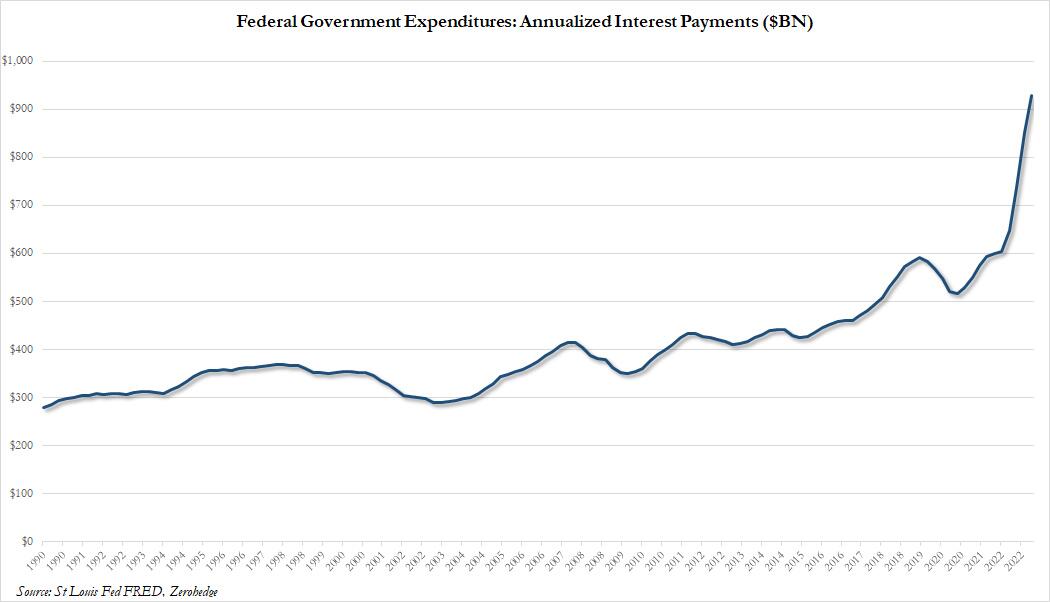
Yet while the motley composition of US federal debt - which ranges from a few days for T-Bills to 30 Years for Bonds - means that the impact of higher rates is relatively quick to pass through to actual interest payment cash outflows, other debt portfolios have far better insulation from the most aggressive Fed tightening cycle since Volcker, which while superficially beneficial to the issuer, could have profoundly adverse impacts for the broader economy as the Fed is forced to keep rates far higher for much longer, which crushes ordinary retail borrowers who, unlike most corporations, didn't have the ability to issue debt maturing many years from now back in 2020 and 2021 when rates hit record lows.
This brings us to what SocGen's Albert Edwards has dubbed the "maddest macro chart I have seen for many years."
In his latest Global Strategy Weekly note, the SocGen permabear turns "to the strangest chart I have seen for a very long time, or rather a series of charts." This is how he frames it.
We can see clearly from the Fed’s Z1 (table L103) that the US corporate sector is a massive net borrower. Normally when interest rates rise, so too do net debt payments, squeezing profit margins and slowing the economy. BUT NOT THIS TIME. Corporate net interest payments have instead collapsed (H/T my derivatives colleague, Jitesh Kumar). What on earth is going on?
And here is the maddest macro chart in question:
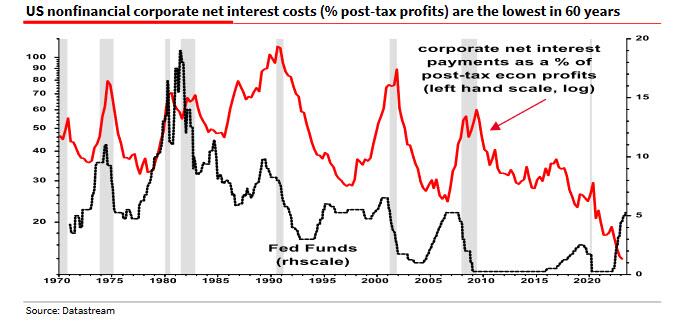
As Edwards elaborates, he was "so surprised when I saw Jitesh’s chart (above), I assumed it was a mistake and emailed the SG macro-network for help. No, the chart is correct. The data comes from the BEA GDP press release (table 11 line 9). Raw net interest payments in $bn are shown as the red line below."
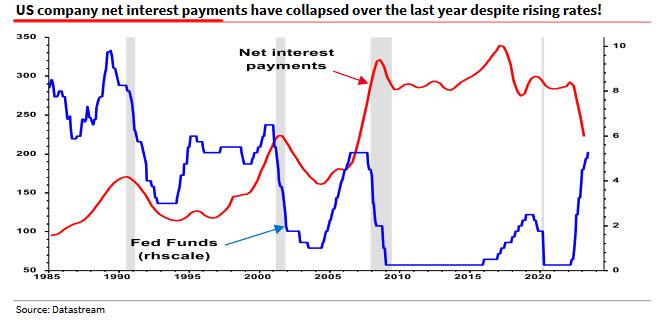
The next chart leads the SocGen skeptic to conclude that "something very strange has happened, and it helps explain the recession’s tardy."
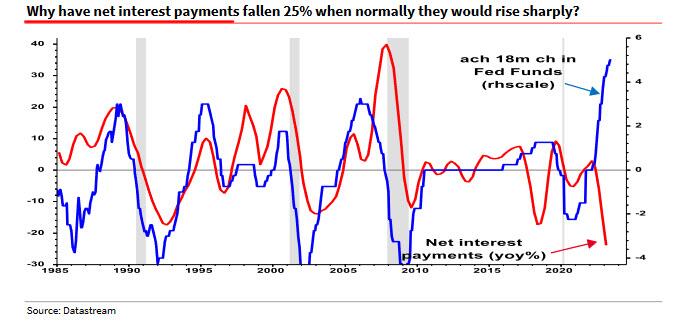
So what has happened? Well, as Edwards concludes, a sizeable proportion of the "huge, fixed rate borrowings during 2020/21 still survives on company balance sheets in variable rate deposits (see Z1 table L103)" meaning that corporations continue to benefit from locking in the ultra low rates of 2020 and 2021 even as their cash interest income are soaring. Indeed, as the SocGen strategist adds, "companies have effectively played the yield curve in reverse and become net beneficiaries of higher rates, adding 5% to profits over the last year instead of deducting 10%+ from profits as usual (chart below)."
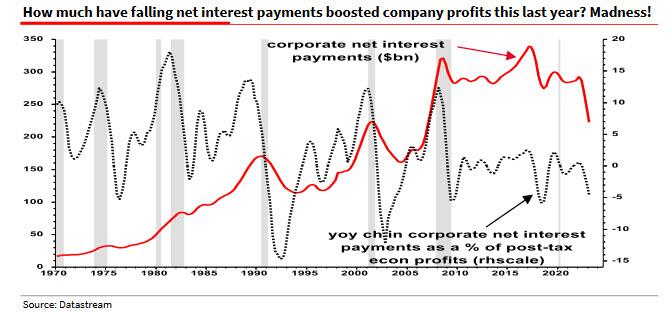
Putting it all together, Edwards says that "it’s not just ‘Greedflation’ that has boosted US profit margins and delayed the recession " - here Edwards is referring to a recently popular theory especially among socialists, that corporations are "greedy" and take advantage of naive, gullible consumers by spiking prices, which of course is what all capitalist corporations are supposed to do, and they will hike prices until demand finally drops. Needless to say, we disagree with this theory. We do however agree with his punchline: "Interest rates simply aren’t working as they once did. It is indeed a mad, mad world"
More in the full Edwards note available to professional subscribers in the usual place.