OilPrice.com : Gasoline: The Price Rally That Nobody Saw Coming

Gasoline: The Price Rally That Nobody Saw Coming

  • Gasoline prices have gained around 20% year-to-date.
  • This week, gasoline topped $2.90 per gallon and may yet reach $3.
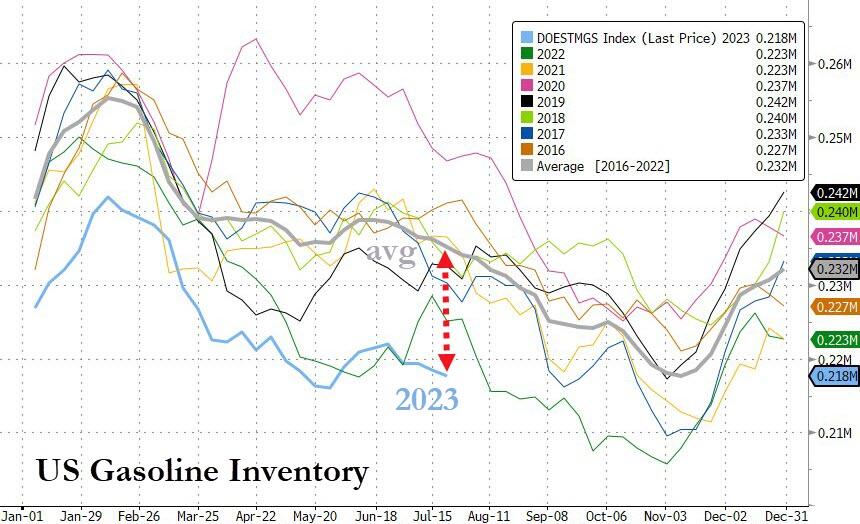
  • In the United States, gasoline inventories are lower than the five-year average both because of the gap between demand and production rates but also because of unplanned refinery outages.

The direction of oil prices is top news material. Everyone follows oil prices. Many also follow the prices of the most traded oil derivatives, and some may have noticed something rather alarming in the trend of one of these derivatives.
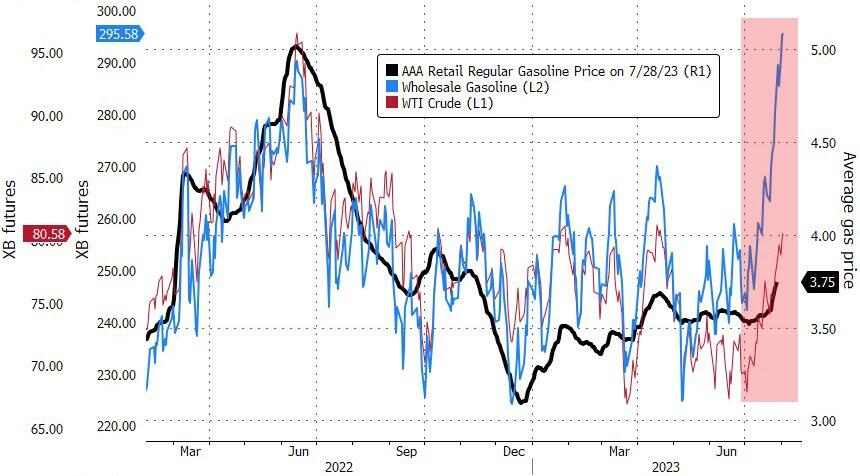
Gasoline, one of the six most traded petroleum contracts on the global futures market, has gained over 20% in the year to date, according to a recent Bloomberg report. This is more than what crude oil has gained—a lot more.

At the start of this year, Brent crude was trading around $78 per barrel. This week, the international benchmark, which now also includes a U.S. crude grade, touched $83 per barrel.

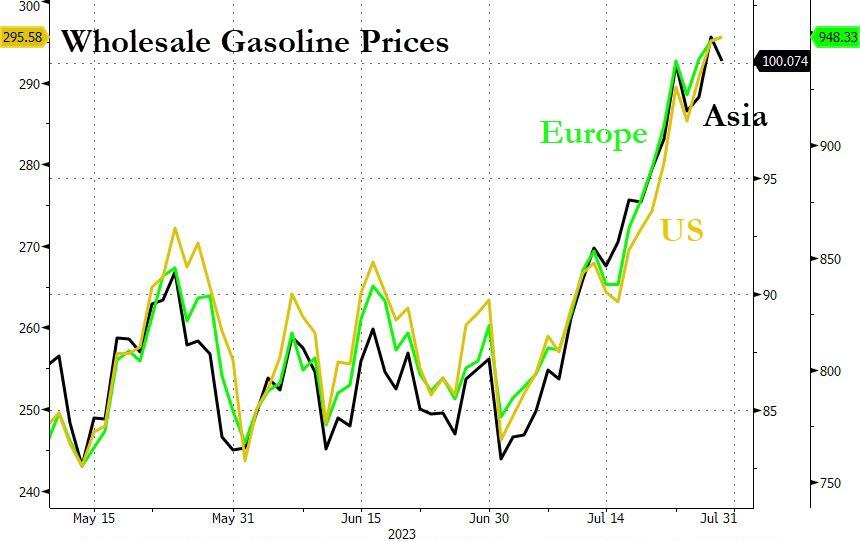
Gasoline, meanwhile, started the year at less than $2.50 per gallon. This week, gasoline topped $2.90 per gallon and may yet reach $3.
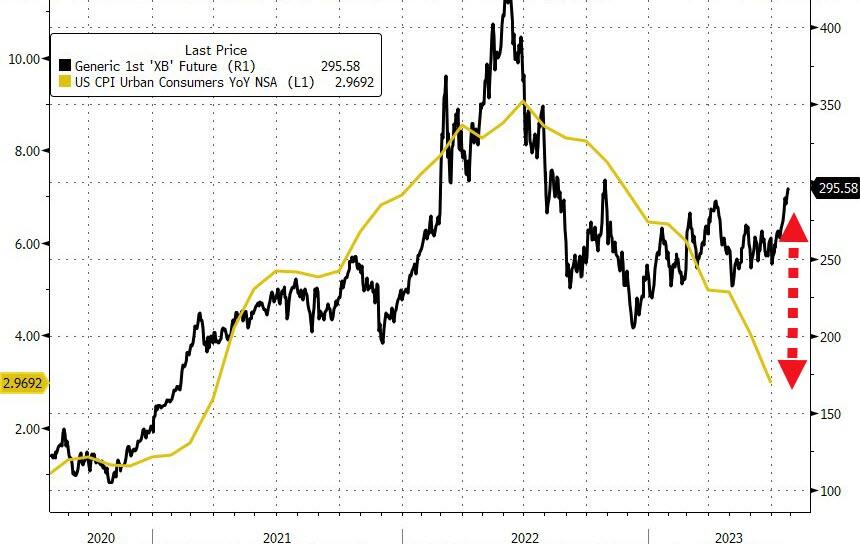
This is a cause for worry for governments around the world because gasoline, along with diesel, plays a lead role when it comes to inflation. When the price of fuels rises, the prices of everything else rises, too, because everything else is being moved from one place to another—from producer to consumer—on vehicles using either diesel or gasoline.
Yet while diesel is a lot more common for goods transportation, gasoline is a lot more popular among regular drivers. Gasoline demand is a closely watched economic indicator that analysts use to gain insight into the state of the economy, among many others.

Right now, the data suggests that gasoline demand is quite healthy, which could be cause for optimism about the global economy were it not for the fact that supply is falling short of expectations. This is fueling concern about more inflation pain despite the efforts of central banks in Europe and North America to tame it with a series of rate hikes.

In the United States, the Federal Reserve announced yet another hike of 25 percentage points for the benchmark interest rate this week. In the same week, gasoline prices moved higher, with the national average adding 4% in a single day. According to the EIA, gasoline stocks are some 7% below the five-year average for this time of the year.

And oil drillers are not drilling more. They are drilling less.

In Europe, governments had to step in last year and subsidize fuels amid the energy crunch and the following embargo on Russian crude and fuels. The move drew a lot of criticism from transition advocates who argued the EU is essentially selling out to the oil and gas industry by encouraging the use of its products.

Yet those governments that implemented the subsidies knew very well what they were doing: they were avoiding riots by millions of drivers whose living standard depends quite a lot on affordable fuels.

Meanwhile, the European Central Bank just hiked interest rates to the highest in more than two decades. And gasoline is not going down anytime soon. Because there is simply not enough supply, at least not everywhere.

In the United States, gasoline inventories are lower than the five-year average both because of the gap between demand and production rates but also because of unplanned refinery outages, Bloomberg noted in its report, such as the one at Exxon’s Baton Rouge facility from earlier this week. In fact, for this time of year, gasoline inventories are the lowest since 2015...
Media reported that a gasoline production unit was down at the Baton Rouge refinery earlier this week. The reports noted that the unit, a catalytic converter, could be down for several weeks. Needless to say, gasoline prices jumped lively at the news.

In Europe, refining and gasoline production has been disrupted by protests in France and then, last month, Shell’s Pernis refinery in the Netherlands shut down a unit due to a leak.

That and the shutdown of refineries in the past few years on both sides of the Atlantic have combined to create a tight supply picture even as governments consider bans for gasoline-powered cars.

While they consider these bans and even vote on them, consumption is on the increase. Bloomberg reports that gasoline consumption in France, Germany, Spain, and Italy is on the rise. At the same time, because of the embargo on Russian fuels, feedstocks needed to produce gasoline are in short supply on the continent.

Meanwhile, Chinese refiners are producing millions of barrels of gasoline and diesel. They are, in fact, producing so much that there were recently pressuring refining margins for the whole region. But most of the gasoline and diesel that Chinese refiners produce gets consumed locally. Because although it’s the world’s biggest EV market, China is also a giant non-EV market. And fuel demand is on the rise.
The picture that gasoline supply and demand trends paint is one of prolonged tight supply and high prices.

This, in turn, will likely keep inflation untamed despite the best efforts of central banks—efforts, which also unfortunately make life more expensive.

The silver lining: inflation leads to lower consumption of everything. The risk is slipping into a recession.

WSJ : Apple Admits to Bug in Screen Time Parental Controls

Apple Admits to Bug in Screen Time Parental Controls
Settings aren’t sticking; the company says it’s working ‘to improve the situation’

The company’s cloud-based Family Sharing system is designed in part for parents to remotely schedule off-limits time and restrict apps and adult content on their children’s iPhones, iPads and iPod Touch models. Trouble is, parents are finding that when they use their iPhones to set restrictions on their kids’ devices, the changes don’t stick.

“We are aware that some users may be experiencing an issue where Screen Time settings are unexpectedly reset,” an Apple spokeswoman said. “We take these reports very seriously and we have been, and will continue, making updates to improve the situation.”

Downtime, found in Settings under Screen Time, is the tool parents use to define the hours each day that a kid’s device is limited or completely unusable. But when they check the setting lately, they often see the times they scheduled have reverted to a previous setting, or they see no restrictions at all.

This can go unnoticed for days or weeks—and kids don’t always report back when they get extra time for games and social media.

Apple previously acknowledged the bug, calling it “an issue where Screen Time settings may reset or not sync across all devices.”
However, the company had reported the issue fixed with iOS 16.5, which came out in May.
In our testing the bug persists, even with the new public beta of iOS 17.

Broken controls, broken promise
When Apple introduced Screen Time in 2018, it held the promise of an easy fix for parents’ device-monitoring struggles—no third-party software needed to set limits, no futzing with your router to shut off the internet at night. The bug, however, is sending many parents in search of those clunky alternatives, or considering a switch to Android devices.

Tim Baker, a marketing executive in Nutley, N.J., discovered the problem late last year, after the release of iOS 16. He typically got requests from his two kids for extra time, and thought it was odd that he wasn’t hearing from them. He checked the kids’ Screen Time settings and saw the Downtime limits he had established were gone.

Baker didn’t really think his kids, ages 10 and 13, could have guessed the passcode but he changed it anyway just to be sure. The problem persisted. “Sometimes I could go for a couple of weeks and be fine and other times I had to reset things two or three times a week,” says Baker, a 25-year Apple devotee.

Baker echoes other parents, saying he relied on Apple’s Screen Time settings to keep his kids away from age-inappropriate content and put a check on time spent online.

“I want them to get their dopamine hits from other things, and I don’t want to be grabbing their phones all the time,” he says.

Enterprising kids have been known to find ways around parental controls. Baker and other parents I interviewed say their kids aren’t hacking the system.

In one Apple discussion page, more than 2,300 people indicated they were having the same problem as the person who posted about Screen Time limits not sticking. Dozens of parents have also complained about the problem on a popular private parenting and tech Facebook group. Many others have emailed me about it lately.

Despite Apple’s stated fix for iOS 16.5, lots of parents who are running the latest software say they’re still having problems. The Baker family’s devices are all running the latest update, pushed out on Monday. Baker has already had to redo his Screen Time settings.

My editor Wilson Rothman, who oversees the Journal’s personal tech coverage, has seen the problem firsthand. He checks Downtime repeatedly when adjusting hours for his kids, to make sure the change takes hold. Now running the public beta of iOS 17 on his iPhone, he says it took three tries to change one of his children’s Downtime hours.

Imperfect alternatives
Baker says he’s looking into third-party apps to manage screen time, but has privacy concerns with non-Apple software and doesn’t want to pay for something Apple provides free.

One workaround would be to set screen limits directly on the kids’ devices, which is what I do with my kids. But it can be annoying to set multiple devices for multiple kids.

Zhurang Zhao, an engineer in San Diego, has encountered similar problems getting the controls to stick for his 16-year-old daughter. He says he contacted Apple tech support by phone three times, starting late last year.

The first two representatives he spoke to didn’t offer a fix, he said. The third suggested he factory-reset his phone then restore the apps and data from a backup. That seemed to do the trick—for a few days, then the problem returned. He finally gave up and began using Qustodio, an app that offers subscription plans starting at $54.95 a year.

While he says it works well, he adds, “I am very disappointed that I had to spend money on a third-party solution.”

Mark Rowe, a father of four and chief executive of a healthcare company near Boston, had similar trouble. He has been checking the settings closely since his kids have been out of school for the summer. When he checked the Family Sharing settings for his 15-year-old daughter Monday morning he saw that the option to limit adult websites was unchecked.

“I would never have turned that off, and she doesn’t have my passcode,” he says.

The problems have made him wonder whether he should switch to Android devices. His kids have Chromebooks and he says he hasn’t noticed problems with Google’s Family Link parental controls.

“It’s frustrating that something that’s so simple and should work doesn’t,” Rowe says. “How much time can I spend on this every week?”

WSJ : Saudi Arabia to Host Ukraine Peace Talks as Part of Western Effort to Woo

Saudi Arabia to Host Ukraine Peace Talks as Part of Western Effort to Woo Global South
Washington and Europe are hoping the talks, which exclude Russia, can lead to international backing for peace terms favoring Ukraine

Saudi Arabia is set to host peace talks among Western countries, Ukraine and key developing countries, including India and Brazil, early next month, as Europe and Washington intensify efforts to consolidate international support for Ukraine’s peace demands.

According to diplomats involved in the discussion, the meeting would bring senior officials from up to 30 countries to Jeddah on Aug. 5 and 6. It comes amid a growing battle between the Kremlin and Ukraine’s Western backers to win support from major developing countries, many of which have been neutral over the Ukraine war.

Ukraine and Western officials hope the efforts could culminate in a peace summit later this year where global leaders would sign up to shared principles for resolving the war. They hope that those principles could frame future peace talks between Russia and Ukraine to Kyiv’s advantage.

A summit this year, however, wouldn’t include Russia, which has shunned any serious talk of peace and has held on to maximalist demands for any settlement, including annexation of territory its forces don’t currently control.

It comes as the war appears to have reached a stalemate, with neither side able to gain meaningful territory in recent months.

The meeting follows on from a gathering of senior officials in Copenhagen in late June, attended by Brazil, India, Turkey and South Africa.
U.S. national security adviser Jake Sullivan dialed into the meeting.
Ukraine and several major European countries also participated.

For the Jeddah meeting, Saudi Arabia and Ukraine have invited 30 countries, including Indonesia, Egypt, Mexico, Chile and Zambia. It isn’t yet clear how many will attend, although the countries who took part in the Copenhagen talks are expected to do so again.

The U.K., South Africa, Poland and the EU are among those who have confirmed attendance.

For now, Sullivan is expected to attend, according to a person familiar with the planning.

The White House declined to comment.

Saudi Arabia is trying to play a larger role in diplomacy on Ukraine, after the White House accused it last year of siding with Russia in keeping oil prices high—thus bolstering Moscow’s finances.
It has facilitated the exchange of prisoners of war and hosted Ukrainian President Volodymyr Zelensky at an Arab summit in May.

Western diplomats said that Saudi Arabia was picked to host the second round of talks partly in hopes of persuading China, which has maintained close ties to Moscow, to participate.

Riyadh and Beijing maintain close ties. Earlier this year, China helped negotiate a recent thaw between Saudi Arabia and its regional foe, Iran, months after the Saudis hosted Chinese President Xi Jinping at an Arab summit.

Despite claiming to be working on a peace plan for Ukraine, China sat out the Copenhagen meeting. People involved in the talks said Beijing isn’t expected to attend but that it hasn’t ruled it out.

The Saudi meeting comes at a critical moment in the fight between Russia and Ukraine’s Western backers for global support.

The U.S. and Europe have pushed for a global condemnation of Russia’s decision earlier this month to pull out of a United Nations-brokered deal aimed at easing the export of grain from Ukraine, a move that pushed grain prices up for poor countries.

At a meeting this month, top European and Latin American leaders expressed “deep concern on the continuing war against Ukraine.” Last month, the U.S. and India concluded defense deals aimed at weaning New Delhi off arms purchases from Russia.

Meanwhile, Russia President Vladimir Putin hosted African leaders in St. Petersburg this week, during which he pledged to provide free grain supplies for a half-dozen African nations.

European officials had hoped to narrow the differences between Ukraine and the developing countries on how to end the war quickly enough to hold a peace summit by the fall. But that timing appears ambitious.

At the Copenhagen meeting, there was a large gap in views between Ukraine and most of the attending developing countries, according to people involved.
Ukrainian officials pushed participants to back Zelensky’s existing 10-point peace plan, which calls for the return of all occupied territory and demands that Russian troops exit Ukraine before peace talks can start.

The developing-country group made it clear they were open to discussing shared principles but wouldn’t sign onto Ukraine’s plan.

While the U.S. and Europe are publicly backing Kyiv’s peace plan, Western officials say it is clear the global talks will only succeed if they are crafted around a set of widely shared international principles, such as the U.N. charter, which stands up for territorial sovereignty and political independence and condemns acts of aggression and the threat and use of force.

A senior European diplomat said Ukraine was still pushing for international backing on issues that developing countries won’t accept—for example, a broadening of sanctions on Moscow.

WSJ : Uber’s Grand Plan to Go All-Electric in London Ran Into Gridlock

Uber’s Grand Plan to Go All-Electric in London Ran Into Gridlock
The ride-share leader struggles with charging deserts and high prices

LONDON—On a sleepy residential street here, workers last month installed four electric-vehicle chargers, the first in the city to be funded by Uber Technologies UBER 3.28%increase; green up pointing triangle as part of its plan to wean its fleet off gasoline.

The chargers—four plugs on two parking-meter-size posts—represent a slow start. Uber had initially planned to have hundreds of chargers installed by now and has more than 600 left to go for its plan—designed to switch all of its approximately 45,000 drivers in London to electric vehicles by the end of 2025.

“It’s taken us almost three years to get to one going in the ground,” said Christopher Hook, Uber’s global head of sustainability. “It really does take a long time.”

Uber wants to lead the electric-vehicle transition in London, where tightening emissions restrictions are nudging drivers to go electric. But it has run into surprising obstacles and is behind on its road map. Its experience is a warning for companies with ambitious sustainability goals and for policy makers counting on a private-sector-powered surge in electric-vehicle use.

Charging EVs has gotten more expensive in many parts of the world and a lack of infrastructure makes charging time-consuming and stressful. New electric vehicles are still relatively expensive and there aren’t enough affordable ones available in the used-car market.

Uber has long touted London as the showcase for its green efforts. Chief Executive Dara Khosrowshahi wooed city officials with the all-electric pledge nearly five years ago. At a sustainability event here last month, he said the city is establishing a proof of concept for Uber’s plan to go all electric worldwide by 2040.

“Our experience in London has set the stage for us now to begin to scale electrification on a global basis,” Khosrowshahi said.

Uber doesn’t purchase its drivers’ vehicles, so it has to provide incentives. It has reduced the commission it takes from EV drivers on its Uber Green service, struck reduced-price deals with carmakers and rental companies and arranged discounts at charge points. In London, it charged passengers a clean-air fee on each ride, which it put aside for drivers to subsidize future EV rentals or purchases.

Still, the number of Uber drivers in electric vehicles in the city has risen more slowly than the company had expected, according to Uber employees, others familiar with the company’s plans, and a review of company announcements.

London drivers have claimed less than a third of the 145 million pounds, or about $186 million, in clean-air fees Uber collected. Even with thousands of dollars worth of handouts, EVs still don’t make sense for many drivers.

“What would make a difference is more charging, more range, lower-cost cars. All of those things haven’t happened as fast as we were promised,” said Vince Cunningham, an Uber electric-vehicle driver in London who works as what Uber calls an EV ambassador and hears similar complaints from other drivers. “More needs to be done.”

Electric-powered rides make up about 19% of miles driven on Uber trips in London, the company said. That is up 5 percentage points from around a year ago and a long way from the 2025 target of 100%.

“I came into it expecting it to be hard,” Hook said. “If we don’t make it to 100%, I’ll be disappointed.”

Uber is investing $800 million worldwide to subsidize the switch to EVs. It says it will be fully electric in U.S. and Canadian cities by 2030 and half electric, in aggregate miles driven, across seven of the largest European cities by 2025. It plans to go all-electric in cities everywhere else by 2040.

In the U.S., 5% of miles driven on Uber are currently on electric vehicles. In California, the number is more than 10%. State law requires it to reach 90% by 2030.

Other companies have suffered setbacks in EV plans. In California, trucking companies have been slow to go electric because of charging limitations.

This past week, a group of automakers including BMW, General Motors and Mercedes-Benz said they plan to collectively invest $1 billion in a joint-venture company to try to build 30,000 fast chargers in the U.S. over several years. The joint investment is modeled after a similar company in Europe, Ionity, that was formed in 2017.

Tougher laws helped launch Uber’s efforts in London. In 2017, the U.K. capital announced it would expand daily fees for older, more polluting cars to operate in the city center. The next year, it said that by 2021 it would only exempt fully electric vehicles from a separate daily congestion charge.

Uber, which was then working to mend its relationship with cities around the world, including London, said it would piggyback on London’s electrification efforts with its own program.

When Hook took over Uber’s clean-air plan in London in the summer of 2019, nearly a year had passed since the company’s pledge. It had 100 electric vehicles on the road.

“That was a surprise to me on Day 1,” Hook said. Uber says it would be further along in London if not for Covid-19, which stopped much of its rides business and snarled supply chains.

Hook set to work trying to solve the cost and charging problems. The upfront costs to purchase or rent EVs is generally much higher than for gasoline vehicles. And the opportunity cost of taking time off to charge at peak hours can sap 20% of a driver’s earnings, making at-home, overnight charging far more economical, Uber estimates.

Uber targeted neighborhoods known as charging deserts—with lots of Uber drivers but limited on-street charging. The company approached five London boroughs with matching funds for hundreds of on-street chargers. One borough rejected the money because it had better offers. Another rejected it over control issues.

“Uber’s funding—though welcome—would have given the firm a say in where charging points were installed,” said Lutfur Rahman, mayor of Tower Hamlets, which turned Uber down.

Three boroughs agreed, but the planning and tender process has been slow. The first four charging points were turned on in the east London borough of Newham in June, after years of back and forth.


An electric charger in Newham, a borough in eastern London. PHOTO: SAM SCHECHNER/THE WALL STREET JOURNAL
Uber’s strategy has shifted toward discount deals with rapid-charging hubs run by operators such as BP in such places as public parking lots, where deployment has been faster.

Last year, surges in electricity prices following Russia’s invasion of Ukraine raised the cost of operating electric cars. The end of U.K. subsidies for electric-car purchases and rising interest rates also hurt demand, said Gurinder Dhillon, CEO of Otto Car, which rents out electric cars and supplies drivers with around 3,000 of the 10,000 EVs Uber has in London.

Uber’s target of getting from 10,000 electric cars in London to 45,000 in the next 30 months is reminiscent of President John F. Kennedy’s moonshot goal in 1961, Dhillon said.

“It’s not impossible,” he said. “But it’s hard. It’s a hell of a goal.”

In some other European cities, where Uber will have more time to get fully electric, the shift is happening faster than expected, the company said.

In Madrid, one fleet partner is tackling the charging-time dilemma with a pilot program to buy cars with swappable batteries that can be changed in minutes, said Anabel Diaz, who leads Uber’s ride-hailing business in Europe, the Middle East and Africa.

At the sustainability event in London in June, Uber demonstrated technology that taps into Uber drivers’ battery data to suggest where and when they should charge to maximize earnings. Another feature allows drivers to filter out trip requests that would put them at risk of running out of battery power.

Khosrowshahi said at the event that Uber drivers are going electric faster than the general public and that they help showcase the technology for riders.

“It’s a challenge,” he added, “that’s bigger than Uber.”

FT : Bosch boss urges Europe to be more competitive and worry less about China

Bosch boss urges Europe to be more competitive and worry less about China
Stefan Hartung’s call comes after Germany warned its companies to reduce their dependence on Beijing

The head of Europe’s largest car parts supplier Bosch has urged European governments to spend more time improving the competitiveness of the EU instead of focusing on the risks companies face doing business in China.

The call from Stefan Hartung, who has led Bosch since last year, comes as European capitals grow increasingly concerned over the exposure of the region’s companies to China as the superpower’s relations with the west sour.

Earlier this month, Germany warned its companies to reduce their dependence on Beijing as it adopted its first China strategy, stressing that the government would not pick up the bill if they fell victim to mounting geopolitical risk.

Asked about “de-risking” from China, Hartung said: “What are we doing for the unified market of Europe? That has recently not been so much discussed.”

Governments should target improvements to the single market “if we, as Europeans, want to be competitive”, he said in an interview at the German group’s headquarters in Stuttgart.

Hartung pointed to the bureaucracy facing businesses within the 27-country bloc, such as the process of filling out A1 social insurance forms as an “issue”.

“In various areas, you find barriers between countries and import-export relations that [ . . .] are actually sometimes worse than [when doing business] outside of Europe,” he added.

Privately owned Bosch is among the EU’s largest employers and last year made roughly half its €88.2bn in sales outside Europe. Alongside its auto suppliers business, its biggest and the chief driver of profits, Bosch also makes products ranging from home appliances to power tools.

Hartung said that “de-risking is not really a great term, because it sounds so easy” and that “you can’t de-risk by isolating yourself”.

But he added that the focus on the issue at least meant politicians in Europe are examining the broader question of “what our [companies] interests actually are.”

Hartung’s call for governments and Brussels to address the bloc’s own failings comes as the number of enforcements against breaches of internal market rules — set up to ensure the free movement of goods, capital, services and people — tumbled between 2020 and 2022.

Failure to adhere to the rules can lead to member states adopting different standards that stymie cross-border business.

As the world shifts to electric vehicles, the European auto industry is trying to keep pace in a global race in which China is a major player.

Bosch last year that it would spend €2bn retraining some of its more than 400,000 staff to better equip them for the transition the electric vehicle era. Earlier this month, Bosch announced plans to invest €2.5bn in hydrogen technology.

Barrons : The Disney Magic Will Return. It’s Time to Buy the Stock.

The Disney Magic Will Return. It’s Time to Buy the Stock.
A renewed focus on lower costs and doing what it does best could help the media titan’s shares recover from a long slump.

alt Disney DIS 0.90%’s films and theme parks have captured the hearts of millions, but its stock performance has been less than enchanting. Once a favorite of growth investors, shares have tumbled nearly 60% from their peak in 2021. With CEO Robert Iger ready to make some tough choices as he works to return the House of Mouse to its former glory, a path higher for the beaten-down shares is coming into view.

Walt Disney DIS 0.90%’s films and theme parks have captured the hearts of millions, but its stock performance has been less than enchanting. Once a favorite of growth investors, shares have tumbled nearly 60% from their peak in 2021. With CEO Robert Iger ready to make some tough choices as he works to return the House of Mouse to its former glory, a path higher for the beaten-down shares is coming into view.
If this were a fairy tale, Disney (ticker: DIS) could be compared with the kingdom in Sleeping Beauty: dormant, overrun with vines, and waiting for a hero to restore it to life. Perhaps Florida Gov. Ron DeSantis, who has chosen to make an example of Disney for its opposition to a state law passed under his administration, would be cast as the wicked witch, and a recent box-office slump could be blamed on a nefarious spell that had fallen over the land.

But this is the real world, and in the real world, Disney has been plagued by its own missteps. It is spending big on streaming, where profits remain elusive, while cable revenue continues to deteriorate. Its recent films, like Elemental and Indiana Jones and the Dial of Destiny, fell short of the mark set by Barbie, Oppenheimer, and even The Super Mario Bros. Movie. To repair the damage, Iger, who had stepped down in 2020, returned as CEO, taking over from Robert Chapek.

Iger is no Prince Charming, but he has made clear that this is a whole new world for the media titan. With his contract extended for two years, until 2026, Iger has time to implement his vision for the company, one that centers on two pillars: streaming and theme parks. Everything else, including Disney’s cable channels, could be on the table for a possible sale. Disney is also taking steps to ensure that its earnings return to a more sustainable path. Costs have been cut, shows canceled, and a course forward—one that focuses on what Disney does well and profitably—charted. Even the dividend, paused in 2020, could return by the end of this year. With its shares appearing cheap relative to its earnings and the sum of its parts, now looks like the right time to bet on the magic returning—at least to Disney’s stock.

“Rome wasn’t built in a day, and Disney’s problems won’t be solved in a year,” explains Wells Fargo analyst Steven Cahall. “Bigger picture is, Disney seems to be taking increasingly bold actions.”

Not that it has much of a choice. For now, the brightest spot in Disney’s portfolio is its theme parks, cruises, and consumer products business. The division, which represented more than a third of revenue last fiscal year, at $28.7 billion, and two-thirds of operating profits, at $7.9 billion, has benefited from pent-up demand for travel and experiences by consumers in the U.S. and abroad, keeping attendance high and giving Disney pricing power at its attractions. Management says that per capita spending at Disney’s parks is more than 40% higher than in 2019, thanks to premium offerings like Genie+ and Lightning Lane. Recent reports suggesting a drop-off in waiting times don’t change that.

“The parks are a really powerful tollbooth on consumer discretionary spending,” says Wolfe Research analyst Peter Supino. “They attract consumers with higher purchasing power, whose spending tends to grow faster than nominal GDP. It’s a really nice structural position.”

The same can’t be said for Disney’s media business. Iger is faced with the thorny problem of balancing its growing, but expensive, streaming segment against its slowing cable business. Disney’s revenue from its linear networks, which include ABC, ESPN, Disney Channel, FX, and National Geographic, was down 4% in the past four reported quarters, to $27.4 billion, as advertising sales slumped and customers cut the cord. The past year’s operating income dropped 11%, to $7.3 billion. Simply put, linear TV is caught in a doom loop: Higher churn and fewer subscribers prompt price increases to make up for lost revenue, increasing the incentive to cancel. Disney declined to comment for this article.

Streaming has yet to take the baton. Disney’s direct-to-consumer segment lost $4.2 billion in the past four reported quarters on revenue of $20.8 billion, which was up 13%. But losses widened 77%, as content costs grew faster than subscription revenue. Disney’s fiscal third-quarter results, which correspond to the calendar second quarter, are due on Aug. 9.

Things should improve as Iger focuses on running the streaming business for profitability, not merely subscriber growth. The company expects to have between 135 million and 165 million Disney+ subscribers outside of India by the end of its fiscal 2024, or September of next year, up from 104.9 million at the beginning of April. (Disney+ Hotstar in India adds another 53 million subscribers, but at an average monthly revenue of only 59 cents, versus $6.47 for core Disney+.) Management expects the streaming segment to reach break-even by the end of that year, though Wall Street isn’t convinced—analysts expect a streaming loss of about $500 million in fiscal 2024.

Still, there’s no denying that Disney remains a must-have for children of all ages, with popular shows like The Mandalorian and movies like Frozen on repeat. Disney plans to raise prices for the advertising-free tier of Disney+, which costs $11 a month in the U.S., $3 more than the ad-supported version, and more hikes are in store abroad. It’s likely most subscribers will simply pay the higher bill.

“Pixar, Marvel, and Star Wars are taxes on parents,” says Christopher Rossbach, chief investment officer at J. Stern & Co. “You have no choice but to subscribe, and that gives Disney pricing power.”

Other big changes are coming that should help Disney meet its numbers. Disney has all but promised to purchase the one-third of Hulu, with its 48 million subscribers, that it doesn’t own from Comcast CMCSA -0.26% (CMCSA) by early next year, which could come with a price tag of nearly $10 billion. There are benefits of bringing ownership fully in house. Hulu features adult-oriented content that can appeal beyond the more family-friendly Disney+ franchises.

Disney said it plans to allow U.S. users to access Hulu via the Disney+ app if they subscribe to both services—encouraging bundling. And bundling is likely the way forward for Disney—a bundle of Disney+, Hulu, and ESPN+ has just 2% churn, according to MoffettNathanson, far lower than the services individually. The no-ads version of the bundle goes for $20 a month in the U.S.

“In short, one hard Disney bundle that includes content from Hulu, Disney+, and ESPN+ will deliver enough premium content to reduce churn, aggregate engagement, and generate substantial nonprogramming cost savings,” explains MoffettNathanson analyst Michael Nathanson.

In the meantime, the focus will be on controlling costs. Disney plans to decrease non-content-related expenses by $2.5 billion this year by reducing marketing spending, cutting some 7,000 jobs, and finding savings in technology, procurement, and other areas. The company will also reduce spending on content, which was on track to reach $30 billion in 2023, by $3 billion annually. It plans to start with the low-hanging fruit, namely sports rights and high-price shows that don’t drive enough subscribers to justify, such as the recent cancellation of series based on the Mighty Ducks and National Treasure franchises. Disney also walked away from a bidding war for Indian Premier League cricket streaming rights. “We’re getting much more surgical about what it is we make,” Iger said in May.

An unexpected contributor to cost-cutting may be the concurrent strikes by unions representing Hollywood actors and writers. They are pushing for a share of streaming revenue and protections against artificial-intelligence use of their work or likeness—demands that Iger called “not realistic” in an interview with CNBC on July 13. The immediate result is that content production has come to a standstill, though most viewers won’t be able to tell for a while. Long postproduction timelines mean that strikes won’t begin to affect scheduled streaming releases until the winter or early next year. Sports, game shows, and news broadcasts will go on as usual, and international productions can largely proceed uninterrupted.

Needham analyst Laura Martin doesn’t expect meaningful production work to resume before January, even if the strike is resolved before the holiday season. That means studios won’t spend much on new scripted content in the U.S. for the remainder of 2023. She estimates that could translate to an additional $3 billion to $5 billion in free cash flow for Disney, and savings should continue even after the strike ends, Martin argues.

“The primary impact of the writers and actors strike is it will structurally lower content costs at the streaming companies, which is what Wall Street has been demanding,” she says.

In the long term, Disney’s direct-to-consumer business should look more like Netflix’s (NFLX), which is about 50% larger in streaming today and boasts an operating profit margin of nearly 20%, compared with Disney’s negative 20% streaming operating margin. “It’s going to be a multiyear path [to Netflix-like margins], and investors are going to need to be patient,” says Jason Ware, chief investment officer at Albion Financial Group. “But the good news is we’re not talking about a long-duration equity that has no earnings, which was the Netflix story. Disney has established businesses with real profits and cash flows. It’s not a speculative company.”

In the shorter term, a slow but steady narrowing of streaming losses and cost cutting will help turn the tide for Disney’s bottom line. Analysts are expecting the company to return to year-over-year earnings-per-share growth in the fiscal fourth quarter, which ends in September, after four straight quarters of negative comparisons. Even the soon-to-be-reported quarter should see Disney notch a profit of $1.00 per share, down 8%—but better than a 14% year-over-year decline three months earlier—as it pushes toward a profit of $3.75 in fiscal 2023. The following year should be even better, with earnings hitting $5.04, up 34%.

Little of the possible good news appears to be reflected in Disney’s stock price. At $85.50, near levels first hit in 2014, shares are trading at 18 times 12-month forward earnings, well below their five-year average of 29 times and below the S&P 500’s 20 times. That’s a large discount to Netflix, which trades at 30.6 times, and only a slight premium to Paramount Global (PARA), at 15.6 times, despite better prospects. Warner Bros. Discovery WBD 4.07% (WBD) trades at 196 times. Even an increase to 22 times—three quarters the historical multiple—would put Disney stock at $105, up nearly 25%.

But the real opportunity is evident when looking at the sum of Disney’s parts. In the worst case, shares could be worth $76, using math from Atlantic Equities’ Hamilton Faber, who doesn’t expect streaming to break even until 2026 and applies a 1.5 times revenue multiple to that revenue. He values Disney’s remaining business at 12 times earnings.

That seems too pessimistic. The current price looks close to a floor, even when writing off the entire value of Disney’s linear networks.

Streaming leader Netflix’s enterprise value amounts to 6.2 times expected revenue over the coming year. Applying just half that multiple to Disney’s streaming business gives a value of $74 billion. The company’s theme parks and consumer products segment is probably worth $134 billion, after putting a modest 13.5 multiple on operating income of $9.9 billion.

Adding those together and subtracting Disney’s net debt and minority interests gets to an equity value of about $156 billion, or $86 per share. That’s Disney stock’s current price.

But that ascribes not a penny of value to the company’s linear networks, a shrinking business that will still comfortably earn between $6 billion and $7 billion over the next year. Putting a multiple of seven on that business would give it a market value of about $46 billion, lifting the stock price to $111.

Slightly more aggressive math points to even greater upside. Putting a multiple of 16 on Disney’s parks yields $158 billion, more than the entire market value of the company. That would take the stock to $124. The risk/reward favors buying here.

There’s another potential path for Disney that could deliver a payout for shareholders, while also solving the CEO succession question: Sell the farm and move on. Needham’s Martin thinks that Apple AAPL 1.35% (AAPL) should buy Disney to propel its virtual- and augmented-reality ambitions. It would mean exclusively owned content for the Apple Vision Pro headset, and creative possibilities using AR at the theme parks. Apple doesn’t need to make money from content, she notes, instead using it as a lure to sell more high-margin hardware. Disney is already an initial content partner for the Vision Pro, with Iger making an appearance at the unveiling event in June.

“If you believe we’re moving into a world where goggles or headsets are the next computing platform, as Apple and Meta Platforms [META] do, then Disney becomes a very interesting target,” Martin says. Disney’s $210 billion enterprise value is 7% of Apple’s market capitalization, or two years of free cash flow. Apple didn’t respond to a request for comment.

Absent a sale, there’s a simple way for Disney to demonstrate to investors a return to financial stability—by reinstating the dividend. Former chief financial officer Christine McCarthy said earlier this year that the company plans to restart its payout by the end of 2023, though it would initially be smaller than what it was when put on hold in spring 2020, when it paid 88 cents a share semiannually. The company certainly has the money to do it, with free cash flow expected to hit $3.6 billion this fiscal year, on its way to $9 billion in fiscal 2025.

“Paying a dividend is important because it shows a focus on free cash flow,” MoffettNathanson’s Nathanson says. “Disney needs to get back to that $8 billion to $10 billion range in a few years’ time for the stock to be supported by cash flow.”

A dividend announcement could happen at an investor summit planned for September, an event that gives management a chance to get the narrative back on track and to potentially offer new targets for future streaming profit margins after reaching break-even. Disney will still need to achieve its goals—but putting them out will help Wall Street see the path to get there. In short, there’s a solid lineup of positive catalysts in the back half of 2023 that could help reignite interest in Disney’s beleaguered stock.

And who knows? Maybe it turns out to be a fairy tale with a happy ending after all.

Barrons : India Bans Some Rice Exports. What That Means for Global Prices.

India Bans Some Rice Exports. What That Means for Global Prices.

Vladimir Putin catalyzed a storm in world grain markets by resuming Russia’s blockade of Ukraine’s corn and wheat exports. Indian Prime Minister Narendra Modi may make it a perfect one with a partial ban on India’s rice sales.

India has quietly undergone a second green revolution over the past decade, with rice yields climbing by 20%, according to the U.S. Department of Agriculture. The downside of this boom is that it has given India, with 1.4 billion of its own mouths to feed, a whopping 40% of world exports for this essential grain.

With domestic food price inflation edging back toward 5% annually, and a general election pending next spring, Modi decided that India needs more rice at home. A moratorium announced on July 20 could cut exports in half.

“Modi’s going into an election year, and food inflation is very central,” comments Kona Haque, head of research at commodities consultant ED&F Man. (Western foodies can take heart; basmati rice is exempted.)

The timing is unfortunate for Bangladesh, Indonesia, and other nations that depend on Indian rice. Rice prices already soared 30% in the past 10 months, due largely to flooding in No. 4 exporter Pakistan, says Joseph Glauber, senior research fellow at the International Food Policy Research Institute.

Global rice inventories are at a six-year low, notes Zanna Aleksahhina, an analyst at consultant Mintec Global. Production is maxed out in Thailand and Vietnam, the No. 2 and No. 3 exporters.

And 2023 is an El Niño year. This cyclical weather event, driven by warmer water in the Pacific Ocean, tends to make Asia hotter and drier—bad for rice, which thrives in wetness. But specifics across the vast continent are hard to predict.


That wild card, plus broader climate-change-related weather weirdness, is pushing Modi to protect domestic food reserves. The Indian leader has played grain politics before, to limited effect. A wheat export ban last year was riddled with loopholes, Glauber says, like exemptions for neighboring countries and “humanitarian” sales.

This time looks different, says Shahnawaj Khan, agricultural research manager at Hyderabad, India–based Mordor Intelligence. “Considering the current situation, it is highly unlikely for the government to enter any side deals,” he says.

If all goes well, with regular summer monsoon rains and a healthy autumn harvest, Modi will ease export restrictions in late November, Khan predicts.

That could mean a hungry spell ahead for India’s South Asian neighbors and a smattering of rice-intensive African countries.

Bangladesh’s 173 million people depend on rice for two-thirds of their calorie intake, according to IFPRI figures, and Indonesians and Sri Lankans, more than 40%.

Unlike corn, wheat, and soybeans, which are also used to feed animals, rice is a subsistence grain, eaten almost entirely by humans. That leaves less chance for high prices to reduce consumption.

Aggregate global food prices have tapered off from a spike following Russia’s 2022 invasion of Ukraine, but are still at their highest levels since the 1970s in real terms, according to the United Nations Food and Agriculture Organization. Paying for imports in a surging dollar is draining vulnerable treasuries, Haque points out.

Sales from a state reserve in Japan saved the day during the last rice crisis—when India, Thailand, and Vietnam all cut exports to cope with the 2008-09 global financial meltdown, Glauber says.

The market has gotten too big for Tokyo to bail out this time. Pray for a good monsoon.