>>> US Gapping up

Gapping up
In reaction to earnings/guidance
:
  • CAAP +5.2%, ROST +4.7%, MSGE +2.1%, AMAT +1.9%
Other news:
  • HE +20.6% (issues response to Maui wildfires and efforts to restore electricity; as of August 17 approximately 1900 customers in West Maui remained without electricity; co is supporting emergency response efforts; goal is not to restructure the company)
  • DLB +6.1% (to join S&P MidCap 400)
  • BARK +2.5% (authorizes new $7.5 mln share repurchase program)
  • BLFY +1.6% (authorizes new 5% share repurchase program)
  • STAA +1.6% (to move to S&P SmallCap 600 from S&P MidCap 400)
  • APPF +1.4% (to reduce its workforce by nearly 9%)
  • FIVE +0.9% (in sympathy with ROST earnings)
  • BURL +0.6% (in sympathy with ROST earnings)
Analyst comments:
  • STRA +2.2% (upgraded to Buy from Neutral at BofA Securities)

>>> US Gapping down

Gapping down
In reaction to earnings/guidance
:
  • FTCH -40.5%, KEYS -12.2%, VIPS -8.6%, XPEV -6.5%, EL -5.5%, BILL -5.4%, RRGB -3.7%, BKE -2.6%, DE -1%
Other news:
  • HIVE -7.3% (amended at-the-market equity program)
  • NKLA -3.7% (files voluntary recall)
  • TTEK -3% (prices offering of $500.0 mln of 2.25% Convertible Senior Notes due 2028)
  • GOSS -2.9% (stock offering by selling shareholders)
  • RVMD -2% (announces publication describing molecular basis of tri-complex inhibitors)
  • GRRR -1.7% (files $300 mln mixed shelf securities offering)
  • HGTY -1.6% (convertible stock offering by selling shareholders)
  • MLNK -1.4% (names new chair of board)
Analyst comments:
  • HSAI -6.4% (downgraded to Neutral from Buy at Goldman)
  • ACRE -1.5% (downgraded to Mkt Perform from Outperform at Raymond James)
  • XPO -1.5% (downgraded to Hold from Buy at Loop Capital)
  • BZH -1.4% (downgraded to Neutral from Outperform at Wedbush)

>>> U.S. Steel: Cleveland-Cliffs (CLF) receives exclusive assignment of right to

U.S. Steel: Cleveland-Cliffs (CLF) receives exclusive assignment of right to bid from United Steelworkers (30.71)
  • Cleveland-Cliffs Inc. (CLF) announced receipt of the assignment of the United Steelworkers' (USW) right to bid under their Basic Labor Agreement with United States Steel Corporation (X).
  • With this exclusive assignment, Cliffs is the only realistic buyer able to acquire the totality of U.S. Steel. Furthermore, Cliffs has agreed to assume, upon closing of a transaction, all of the agreements between U.S. Steel and the USW that are applicable to the U.S. Steel employees.
  • Under the terms of the USW's collective bargaining agreement with U.S. Steel, a potential sale of the whole company or USW-represented assets could not be consummated without the support of the USW. The assignment transfers to Cliffs the USW's right to bid on such potential transactions. The USW's transfer and assignment only applies to Cliffs.

>>> Deere beats by $1.98, reports revs in-line; raises FY23 net income guidance

Deere beats by $1.98, reports revs in-line; raises FY23 net income guidance (419.18)
  • Reports Q3 (Jul) earnings of $10.20 per share, $1.98 better than the FactSet Consensus of $8.22; revenues (equipment sales) rose 9.9% year/year to $14.28 bln vs the $14.14 bln FactSet Consensus.
  • Net income attributable to Deere & Company for fiscal 2023 is forecast to be in a range of $9.75 billion to $10.00 billion (prior $9.25-9.5 bln). Co sees FY23 Production & Precision Ag sales up 20%.
  • "Reflected by our strong third-quarter results, Deere continues to benefit from favorable market conditions and an operating environment showing further improvement," said John C. May, chairman and chief executive officer. "We are also being helped by stabilizing conditions in the supply chain, the sound execution of our business plans, and an improving ability to meet demand for our products and serve customers."

>>> Estee Lauder beats by $0.11, beats on revs; guides Q1 revs below consensus;

Estee Lauder beats by $0.11, beats on revs; guides Q1 revs below consensus; guides FY24 revs below consensus (162.06)
  • Reports Q4 (Jun) earnings of $0.07 per share, $0.11 better than the FactSet Consensus of ($0.04); revenues rose 1.3% year/year to $3.61 bln vs the $3.48 bln FactSet Consensus.
  • Co issues guidance for Q1, sees EPS of ($0.29)-($0.19), may not be comparable to $0.98 FactSet Consensus; sees Q1 revs of decline 10-12% yr/yr to ~$3.46-3.54 bln vs. $3.94 bln FactSet Consensus.
  • Co issues guidance for FY24, sees EPS of $3.50-3.75, may not be comparable to $4.86 FactSet Consensus; sees FY24 revs of +5-7% yr/yr to ~$16.71-17.02 bln vs. $17.2 bln FactSet Consensus.
  • As the Company disclosed on July 18, 2023, it identified a cybersecurity incident involving an unauthorized third party that gained access to some of the Company's systems. After becoming aware of the incident, the Company proactively took down some of its systems, initiated an investigation with leading third-party cybersecurity experts and began coordinating with law enforcement. The Company began bringing its systems back online within days, which limited the incident's impact on the Company's operations. Based on the information available to date, the Company believes the incident is contained. The cybersecurity incident is expected to have an immaterial impact to net sales and a dilutive impact to net earnings per common share of approximately $.07 for the fiscal 2024 first quarter and full year.

>>> Tilray announces the acquisition of the remaining 57.5% equity ownership of

Tilray announces the acquisition of the remaining 57.5% equity ownership of Truss Beverage Co from Molson Coors Canada (TAP) (2.66)
  • Beyond the cannabis industry, functional beverages represent significant growth. These beverages offer consumers the functional advantages of THC and the diverse range of minor cannabinoids. These elements provide many benefits and other opportunities that enhance the lives of adults.
  • Strategic and Financial Benefits:
    • Robust Cannabis Beverage Platform Positions Tilray at the Forefront of a Dynamic Market. As regulations ease, Tilray's expansion into the billion-dollar functional drinks category is a strategic step into a dynamic market. Tilray is positioned to capitalize on this trend. By embracing this evolving landscape, Tilray not only taps into a lucrative market but also aligns with the changing preferences of consumers seeking functional benefits. This move reflects Tilray's commitment to innovation and consumer needs, setting the stage for a new era of cannabis-infused beverage experiences.
    • Bolsters Tilray's Portfolio of Cannabis Beverage Brands and Strengthens #1 Market Share Position. With a combined pro-forma market share of approximately ~36% (+33.2%), Tilray substantially broadens its consumer base and leading market share position. Tilray's expanded cannabis portfolio now includes the fastest-growing beverage brands including; XMG, Mollo, House of Terpenes, and Little Victory.
    • Enhances Commercial Framework with Streamlined Sales & Distribution. As retailers navigate the evolving landscape of product offerings, Tilray's comprehensive range empowers them to efficiently address a substantial portion of their business needs in just one visit.

(ZH) China Launches War On Yuan Bears With 1000+ pip Fixing Gap Vs Estimates

China Launches War On Yuan Bears With 1000+ pip Fixing Gap Vs Estimates

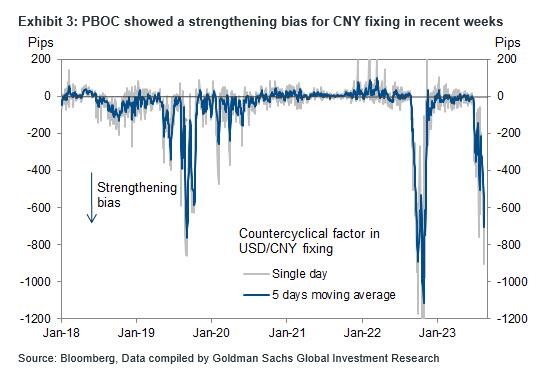
Earlier, when discussing China's recent surge in FX outflows, we said that while promoting growth remains a priority for Beijing, the PBOC is expected to follow up with more measures to slow the depreciation trend in the yuan, such as more significant countercyclical factors in the daily CNY fixing, cutting FX deposit reserve requirement ratio, and/or adding FX forward sales reserve requirement.

Of course, China can just keep doing what it has been doing now for several weeks, but never to the extent it just moments ago when the PBOC delivered its strongest ever pushback against a weaker yuan via its daily reference rate, as it sought to restore some confidence in a Chinese market that has seen an unprecedented collapse in confidence - not to mention prices - spooked by disappointing (and disappearing) data and heightened credit risks.

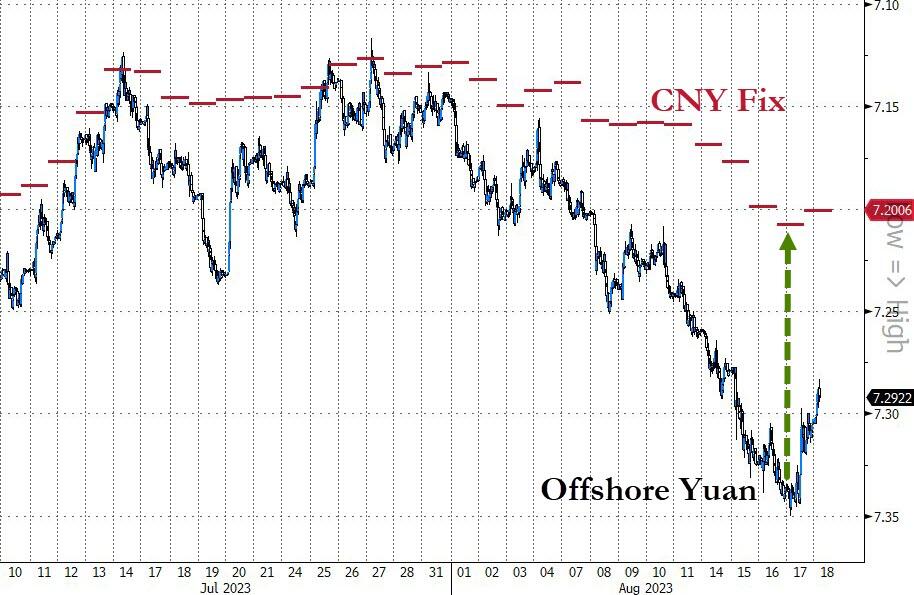
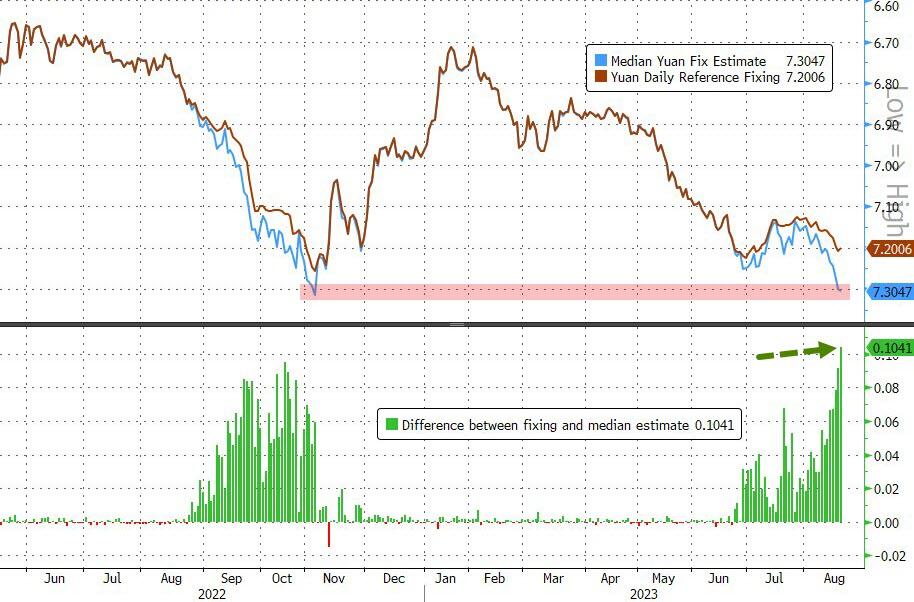
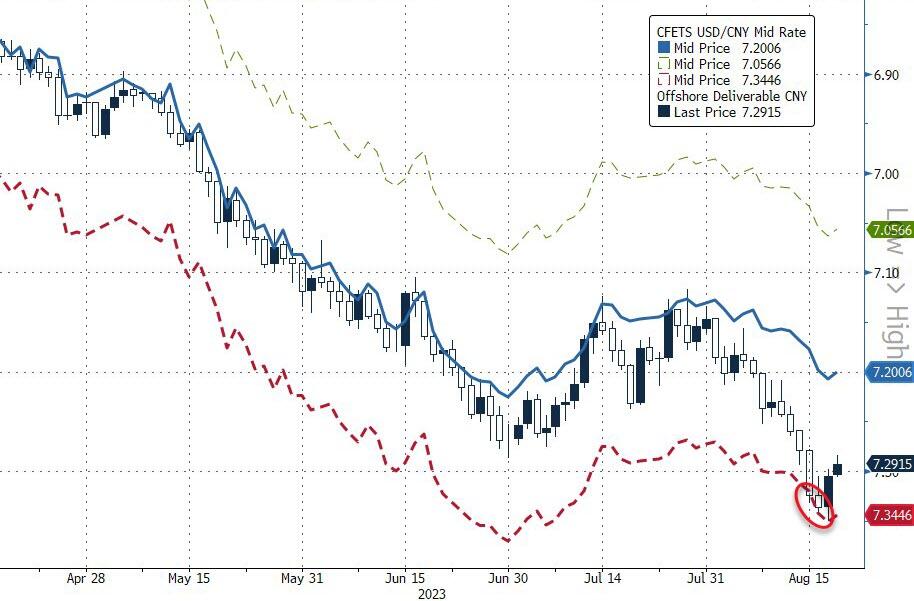
The Chinese central bank set its yuan fixing at 7.2006 per dollar compared to the average estimate of 7.3047. The gap - an unprecedented 1,041 pips - was the largest gap to estimates since the poll was initiated in 2018.
The offshore yuan extended gains to 0.2% after the fixing...
... which was also set at a stronger level to the previous day for the first time in six sessions...
“At this juncture, the PBOC might want to put a stop in the trend,” of a weaker yuan, said Kiyong Seong, lead Asia macro strategist for Societe Generale SA. “On a temporary basis, it’s possible the actions by policy makers can discourage more bearish betting.”

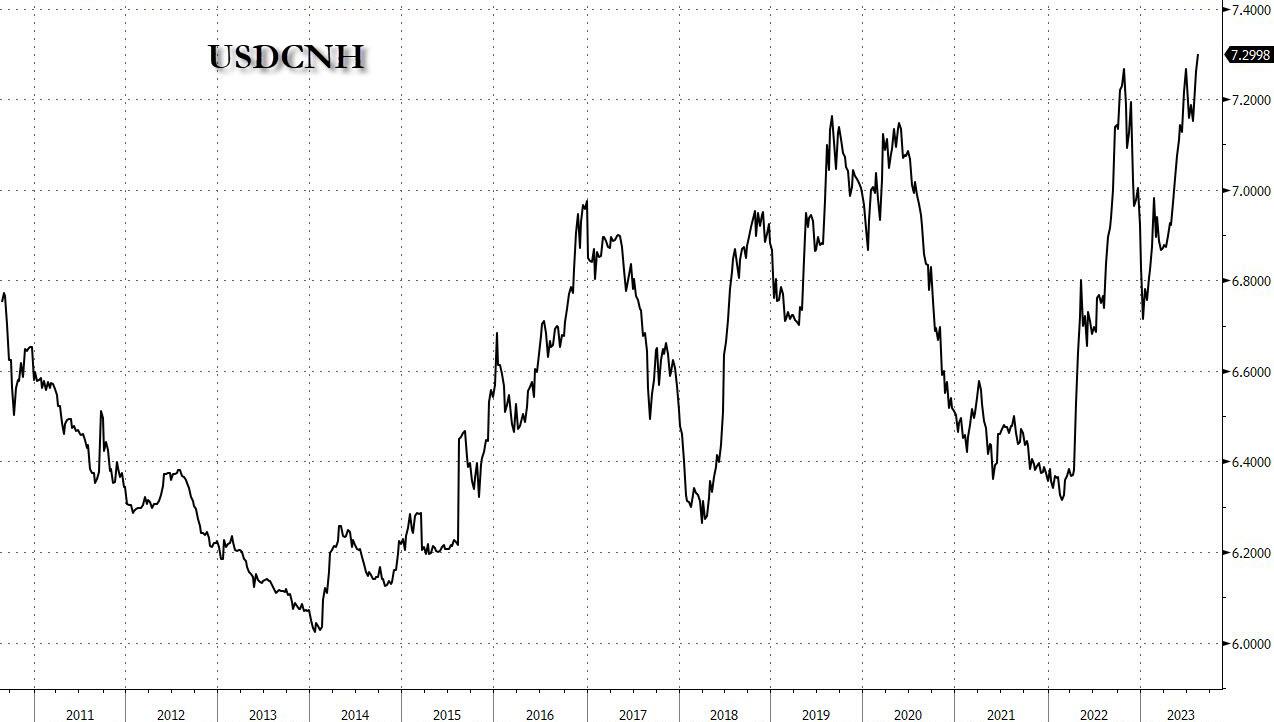
As discussed earlier today, as part of China's escalating support for the embattled yuan in recent days - which has so far failed to yield any notable results with the currency hitting an all time low yesterday...
... Beijing told state-owned banks to step up intervention, while the central bank said it will resolutely prevent excessive adjustment in the yuan.

That "request" came as the yuan touched on 7.35 per dollar, a level that Beijing has been paying close attention to as a line in the sand. The yuan traded around the 7.29 level offshore on Friday.

“Going ahead, further measures such as potential cut to the foreign-exchange reserve-requirement ratio following the PBOC’s pledge to prevent overshoooting may prompt yuan bears to trim their short position,” said Ken Cheung, FX strategist at Mizuho.

Still, as Bloomberg notes, the problem for China is that yuan bears had latched on to the fact that the fixing itself had been progressively weaker over the past weeks, regardless of its gap to estimates, and taken that as a sign the PBOC is ok with a slow depreciation in the currency. Of course, dismal economic data, plunging housing prices coupled with a spreading crisis in the property and shadow banking sector, and the biggest FX outflow in one year, have also hammered sentiment and led to further currency selling.

“The PBOC has persisted in setting the fixings much stronger than expected, with the largest counter-cyclical factor since late last year, but they have been allowing the yuan to adjust,” Australia & New Zealand Banking Group strategists including Mahjabeen Zaman wrote in a note Thursday. “This is a sign that the authorities are prioritizing the need to support growth at the expense of the currency.”

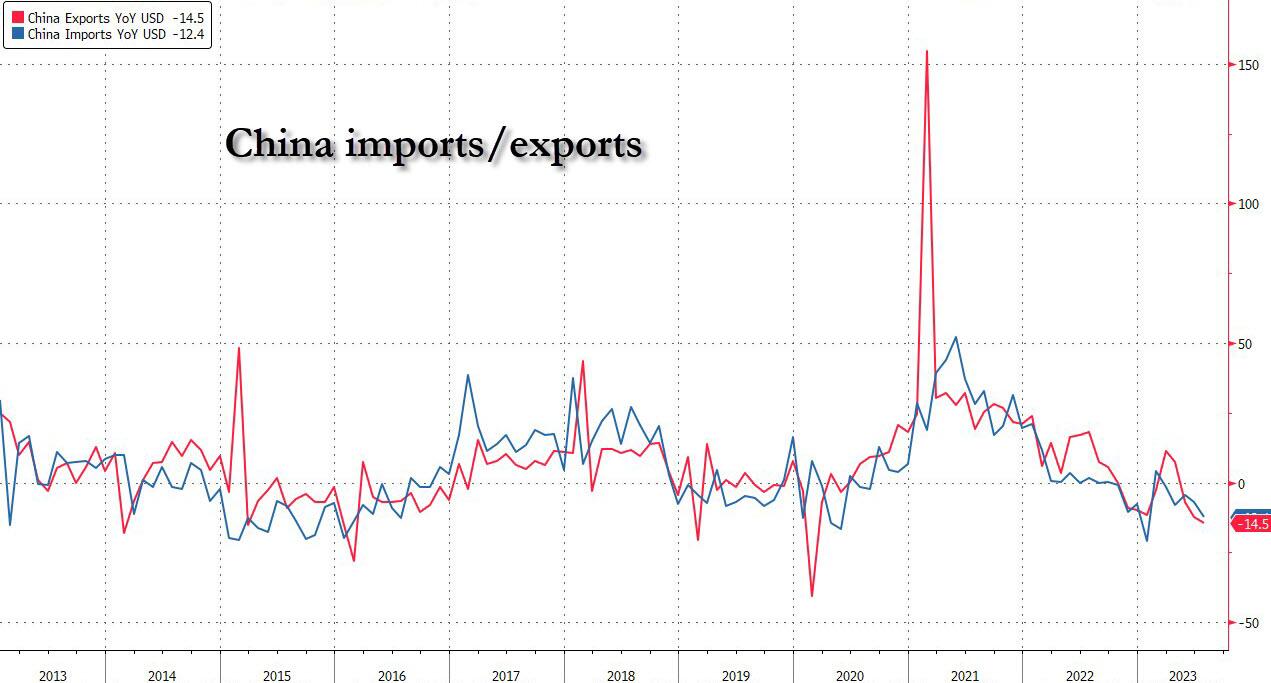
China's currency has tumbled over 5% against the dollar this year amid a disappointing economic recovery and broad dollar strength. Adding insult to injury, while traditionally an FX decline of this magnitude would boost exports, those have also languished and in July plunged the most since the covid crash.
Meanwhile, an unexpected PBOC rate cut earlier this week to re-ignite growth have just intensified the focus on the widening US-China yield gap and added more pressure to the yuan.

“The authorities are preparing to draw a line in the sand and defend the currency from further weakness,” said Khoon Goh, head of Asia research at Australian & New Zealand Banking Group in Singapore. “But for a more sustained rebound in the yuan, we really need to see US 10-year bond yields come down from current high levels.”
And that, as we explained yesterday, is unlikely to happen as long as the Biden admin keeps putting seasonally adjusted lipstick on the pig that is the US economy at least until the Nov 2024 election. So to all the EMs and DMs out there, condolences: your economies are about to get it because Biden has to get reelected.
(ZH) The Hits Just Keep On Coming: China Suffers Biggest FX Outflow Since July 2

The Hits Just Keep On Coming: China Suffers Biggest FX Outflow Since July 2022

And the hits just keep on coming for China.
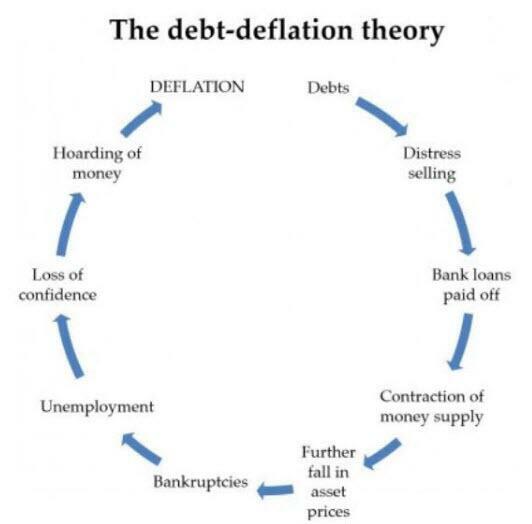
With its economy on the verge of a Japanification vicious loop, where record debts, lead to distressed selling, repayment of debt, contraction in the money supply, falling asset prices, a wave of bankruptcies, surging unemployment, a slowing economy, spiking unemployment and a crisis of confidence, which then leads to money hoarding and deflation...
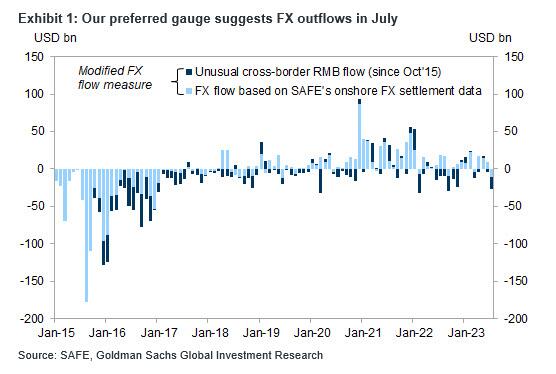
... China is now also facing a sudden surge in FX outflows: according to Goldman's preferred gauge of FX flows, China's net outflows were around $26bn in July, the fastest pace of outflows since September 2022, in contrast to US$6bn inflows in June. While there was net buying of equities in both Southbound and Northbound of the stock connect in July, and on net basis small inflows through the Stock Connect channel, the goods trade FX conversion ratio declined and related inflows slowed in July, while services trade deficit widened. In addition, cross-border RMB transfers showed net outflows in the month.
Here are the key points from the latest data:
1. In July, China experienced $25BN in net outflows via onshore outright spot transactions,and $14BN inflows via freshly entered and canceled forward transactions. Another SAFE dataset on "cross-border RMB flows" showed outflows of US$16bn in the month. Goldman's preferred FX flow measure therefore suggests a total US$26BN outflows in July, in comparison with US$6BN inflows in June. This was the biggest net outflow since Sept 22.
2. The current account showed broadly balanced flows as goods trade related inflows declined meanwhile services trade related outflows rose: There was a net inflow of $18BN related to goods trade in July, lower than the $36bn in June. Goods trade surplus conversion ratio declined to 22% in July vs 50% in June on the back of continued currency depreciation. The services trade deficit was $11BN, more negative than US$8bn in June as outbound tourism continued to recover. The income and transfers account showed outflows of $6BN in July, smaller than $8BN in June.
3. SAFE stated that foreigners continued to buy RMB assets on a net basis in July. Stock Connect flows showed net buying of $7BN of equities through northbound and $2BN net buying through southbound, which implies $5BN inflows through the Stock Connect channel, vs $3BN inflows in June. Foreigners' holding of RMB bonds data are not released yet though.
4. PBOC cut policy interest rates on August 15th, which added depreciation pressures on the currency. Promoting growth remains the priority, and the PBOC is expected to follow up with more measures to slow the depreciation trend in the next few weeks, such as more significant countercyclical factors in the daily CNY fixing, cutting FX deposit reserve requirement ratio, and/or adding FX forward sales reserve requirement.
With China's currency the weakest it has ever been, and with FX outflows accelerating sharply, one can't help but remember the panic observed after the August 2015 devaluation, which not only shocked global markets but woke bitcoin from its long slumber as billions in Chinese savings scrambled to the safety of offshore bank accounts via one of the few still open cracks in China's great monetary firewall. How long until we get a rerun?

>>> US Early premarket gappers

Early premarket gappers
  • Gapping up:
    • DLB +6.4%, CAAP +5.2%, ROST +5%, AMAT +3.2%, BARK +2.5%, BURL +1.8%, BLFY +1.6%, STAA +1.6%, MRNA +1.4%, APPF +1.4%, DE +1.4%, GOSS +1%, FIVE +0.9%, X +0.8%, LRCX +0.6%
  • Gapping down:
    • FTCH -39.7%, KEYS -10.7%, HIVE -7.9%, VIPS -6.9%, XPEV -6.1%, BILL -5.5%, NKLA -2.1%, RVMD -2%, RKLB -2%, HGTY -1.6%, MLNK -1.4%, BIG -1.1%, AGX -0.8%, GRRR -0.6%