FT : Private fund industry prepares for battle over sweeping US rules

Private fund industry prepares for battle over sweeping US rules
Private equity, real estate and hedge funds targeted by SEC proposal up for vote this week

The global private funds industry is bracing for one of the most sweeping regulatory reforms in its history as the US Securities and Exchange Commission prepares to impose tough rules on private equity, real estate and hedge funds.

The far-reaching rules, first proposed in February 2022, are aimed at protecting investors by requiring detailed quarterly reporting on performance, prohibiting secret side deals that give better terms to some investors and limiting what expenses private managers can pass on to their clients.

If the SEC adopts them unchanged at its open meeting on Wednesday, they would capture not just tens of thousands of US private funds but also overseas managers who take money from American investors.

The changes would be the most significant overhaul since at least the 2010 Dodd-Frank financial reform law for an industry with $25tn in assets, and “potentially ever”, said Christine Lombardo, an attorney at Morgan Lewis.

“For the first time, really, the SEC, especially in the institutional space, [would be] effectively dictating what terms you can and can’t give in the context of institutional arrangements between private fund managers and their investors,” she said.

Industry groups warn that because the rules do not exempt existing arrangements, tens of thousands of contracts with investors, some of them decades old, will have to be torn up and renegotiated within the next 12 months. Several are threatening to file a lawsuit, arguing that the SEC is improperly trying to control investment terms by limiting what funds and clients can agree to.

“If the rules come out as proposed, we feel the SEC would be exceeding its statutory authority,” said Jack Inglis, chief executive of the London-based Alternative Investment Management Association. “It really upends the whole concept of freedom of contract between buyer and seller.”

Jennifer Han, chief counsel of the US-based Managed Funds Association, said: “They have failed to identify a market failure and they haven’t done a proper cost-benefit analysis.”

The SEC declined to comment, but chair Gary Gensler defended the reach of the proposal earlier this year, saying: “Congress said we had a role to consider efficiency and competition in the capital markets . . . They didn’t leave out so-called sophisticated investors.”

Consumer groups have said the proposals improve accountability and transparency in a rapidly growing sector that receives trillions of dollars in public pension money and is increasingly seeking money from very wealthy individuals.

They particularly praised the SEC for requiring increased disclosure and proposing to ban side agreements that give some investors more favourable terms on crucial issues such as redemption limits.

“This industry is full of conflicts of interest and shady side agreements . . . The private fund advisers are making a killing in the shadows,” said Dennis Kelleher, chief executive of Better Markets, a financial reform group.

Fund managers are particularly exercised by a rule that makes managers financially liable for “negligence” rather than a harder-to-meet standard of “gross negligence”. They said it would curtail innovation and returns by making managers more reluctant to try novel strategies.

The overseas fund industry could be hit as well. Two-thirds of new private market investment came from North America last year, according to a McKinsey study.

“Many London-based fund managers who have US investors are going to be subject to these rigid US rules,” said Marc Elovitz, partner at Schulte Roth & Zabel. “It could cut US investors off from a lot of these funds.”

FT : China cuts loan rate less than expected as calls grow to stimulate economy

China cuts loan rate less than expected as calls grow to stimulate economy
Central bank leaves mortgage-linked 5-year rate unchanged despite property crisis

China has cut a benchmark lending rate but defied market expectations by leaving another unchanged as policymakers grapple with their response to slowing economic momentum, a property sector cash crunch and a weakening currency.

The one-year loan prime rate (LPR), a reference for bank lending in China, was lowered 10 basis points to 3.45 per cent, the People’s Bank of China announced on Monday. The equivalent five-year rate, which is closely watched because of its relationship to mortgage lending, was kept steady at 4.2 per cent.

Economists polled by Bloomberg had unanimously projected 15bp cuts to both the one-year and five-year rates. The outcome was “quite surprising and frankly it’s a bit puzzling,” said Hui Shan, chief China economist at Goldman Sachs.

The renminbi, which is approaching last October’s lows, lost ground following Monday’s announcement, dropping as much as 0.3 per cent to Rmb7.3051 per dollar.

The policy decision also weighed on Chinese equities, with the Hang Seng China Enterprises index falling as much as 1.7 per cent in morning trading despite a host of reforms announced on Friday intended to bolster investor confidence. China’s benchmark CSI 300 index of Shanghai- and Shenzhen-listed stocks fell as much as 0.5 per cent.

Beijing has come under pressure to reduce interest rates and spur demand following a series of disappointing economic data. Despite lifting pandemic restrictions this year, growth has been hampered by a property slowdown, declining exports and soaring youth unemployment, which the government last week announced it would stop publishing.

The Chinese economy expanded just 0.8 per cent in the second quarter of 2023, compared with the previous three months.

Monday’s rate announcement, which came days after Beijing unexpectedly cut its one-year medium-term lending facility 15bp to 2.5 per cent, was closely watched as a gauge of the government’s policy trajectory to stem the economic slowdown.

The PBoC had also stepped up efforts last week to counteract weakness in the renminbi amid outflows from stock and bond markets.

Julian Evans-Pritchard, chief China economist at Capital Economics, suggested the “underwhelming” move meant the PBoC was “unlikely to embrace the much larger rate cuts that would be required to revive credit demand”.

“Hopes for a stimulus-led turnaround in economic activity largely depend on the prospect of greater fiscal support,” he added.

The LPR is partly set by China’s biggest banks, which are set to release second-quarter results this month as their profits have come under pressure from declining rates.

“This looks like policymakers are putting a lot of weight on the banking system’s ability to run smoothly. They may want to protect banks’ net interest margins, which cutting the LPR can pull down,” said Shan at Goldman Sachs. “At the end of the day, you need a healthy banking system to help absorb economic shocks and continue to deleverage [the property sector].”

Shan added that if policymakers were focused on banking sector health, they would be constrained from making further cuts to either LPR unless they lowered deposit rates or the level of banks’ required reserves.

Beijing has dispatched teams of officials to assess ways of reducing local governments’ debts.

A two-year property crisis, which was triggered by the default of developer Evergrande in late 2021, has shown signs in recent weeks of derailing Country Garden, the country’s biggest privately owned homebuilder, as well as spilling over into wealth management products.

FT : Cargill boss calls for ship owners to invest in wind power

Cargill boss calls for ship owners to invest in wind power
US agricultural trader and freight operator is testing vessel fitted with 37.5 metre-high sails

Cargill’s head of ocean transport has called on the shipping industry to give wind power a chance in its efforts to decarbonise, as one of the world’s largest marine freight operators prepares to test the use of sails on a midsized vessel.

Jan Dieleman, president of the US agricultural trader’s shipping business, said some shipowners were too sceptical of proposals to propel large cargo vessels using wind, hundreds of years after sailors started using engines instead of sails to power ships.

He added that wind power was “underestimated”.

“We have an industry that has been focusing solely on the zero-carbon fuels for a long time,” he said. “Some people are sceptical [of sails] from a technical point of view and they feel very strongly that you shouldn’t alter their ship. [Other shipowners] don’t want to take all the risk [of investing without support from their customers].”

Cargill has had a previous foray into wind ship propulsion. In 2011, it announced an agreement to install a giant sail on the Aghia Marina cargo ship, in partnership with German company SkySails. In a 2015 update, Cargill said its project with SkySails had “encountered obstacles”.

Dieleman’s comments come amid a fractious debate between countries over how to decarbonise the international shipping industry, which carries up to 90 per cent of global trade but remains almost entirely dependent on fossil fuels. The industry faces growing pressure from regulators as well as customers such as Amazon, Unilever and Ikea, who have pledged to use only zero-emission ships by 2040.

Shipping groups investing in decarbonisation, however, are divided on the best solutions. Companies are betting on a range of fuels including methanol and ammonia, as well as giant kites that can use wind to propel ships, despite concerns over whether alternative fuels will be affordable or available at scale.

Dieleman spoke to the Financial Times as Cargill launched a ship, chartered by the agriculture group and owned by Japan’s Mitsubishi, which it said has been retrofitted with two 37.5 metre-high sails. Dieleman said the Pyxis Ocean bulk carrier, which can carry as much as 81,000 tonnes of cargo according to data provider MarineTraffic, is likely to transport corn from Brazil to Denmark on its first shipment.

But he admitted that Cargill, which itself has been criticised for driving deforestation and climate change, could not take on all the risk for the shipping industry. He added the trading house may struggle to profit from its initial investment in the wind-powered vessel.

Danish company Maersk, the world’s second-largest container shipping group, previously sold a vessel after analysis found that installing sails on the ship had only led to an 8 per cent drop in fuel consumption in a year.

“Are we going to get our money back on this one? I don’t think so . . . It’s a proof of concept,” Dieleman said, declining to reveal how much Cargill had invested. But he said that low-carbon alternatives such as green methanol or ammonia currently cost up to four times as much as fossil fuels, meaning wind power could be used alongside green fuels to save money if it proves successful.

Governments have also supported bringing back wind power. Last year, six countries including France and Spain submitted a paper to the UN’s International Maritime Organisation (IMO), stating wind propulsion systems were “ready, sufficiently mature and available” to help reduce emissions.

Climate experts also agree that wind could play a role in decarbonising shipping, but add that its role is limited in an era when shipowners use increasingly large vessels to serve customers who expect rapid and reliable shipments.

Tristan Smith, a shipping and energy researcher at University College London, said using sails was “generally viable” but less practical on container ships, which have less deck space, or on routes where wind is less favourable. Environmentalists have also said that stronger regulatory incentives are needed for shipping groups to invest in green technology.

In July, diplomats at the IMO agreed on a target for shipping to hit net zero emissions “by or around” 2050. The outcome, which followed lobbying against stronger goals by countries including China, was criticised for offering the industry too much leeway to delay decarbonisation.

Cargill has a target to reduce emissions in its supply chain by 30 per cent by 2030. Dieleman said wind power was just one piece of the puzzle to achieve that goal.

“There are factors you can control and factors you can’t,” he said. “We need things like biofuels to be deployed . . . If the industry’s not going to do anything different than today, we’re just not going to get there.”

FT : Russia files lawsuit against billionaire oligarch Andrey Melnichenko

Russia files lawsuit against billionaire oligarch Andrey Melnichenko
Move comes as Kremlin steps up campaign to force tycoons to bring their wealth and businesses back home

Russian authorities have filed a lawsuit against Andrey Melnichenko as they seek to seize and nationalise one of the companies in the billionaire oligarch’s metals and mining empire, claiming its purchase five years ago was a corrupt deal.

The state’s accusations come amid a campaign by the Kremlin to entice wealthy Russians to bring their wealth and businesses back home, stepping up pressure on magnates such as Melnichenko, who is now based mainly in the UAE, where he has moored a $300mn superyacht.

Since Russia’s full-scale invasion of Ukraine 18 months ago, the Kremlin has used both carrot and stick to try to compel oligarchs to prove their loyalty to their homeland.

Some businessmen who have voiced mild criticism of the invasion have found their assets subject to legal disputes, while loyalists have been rewarded. Some, for example, have been given the opportunity to purchase assets seized by the state from foreign companies.

According to the lawsuit against Melnichenko, who has described the invasion of Ukraine as “tragic”, state prosecutors aim to seize Sibeco, which runs several thermal power plants in western Siberia, generating electricity for the region. The suit was filed in the city of Krasnoyarsk this month.

Melnichenko bought the company in 2018 from Mikhail Abyzov, who was then a government minister. A few months later, in the spring of 2019, Abyzov was arrested, accused of embezzlement and of defrauding the shareholders of Sibeco and another company prior to the deal. The state took over his assets and Abyzov remains in jail in Russia.

In the current suit, state prosecutors claim to have uncovered “corrupt collusion” between Melnichenko and Abyzov in the 2018 Sibeco sale while continuing to investigate Abyzov himself.

A representative of Melnichenko acknowledged to the Financial Times that the lawsuit had been received, and said a team of lawyers was working on the case. However, he refused to comment on the allegations against his client until the litigation begins. A hearing has been scheduled for early September, according to a listing on the Krasnoyarsk court website.

Melnichenko was this year listed by Forbes as Russia’s wealthiest man, his net worth soaring to more than $25bn, thanks to rising prices for coal and fertilisers, the commodities sold by the two main companies he founded, EuroChem and Suek.

The oligarch removed himself as a beneficiary of the trust which owns the two companies after Russian president Vladimir Putin launched his full-scale invasion of Ukraine, when he along with many other top Russian industrialists was hit by US and EU sanctions. The primary beneficiary became his wife, who then also came under the sanctions. Forbes’ estimate of Melnichenko’s wealth is based on the corporate structure in place before the start of Russia’s invasion in February 2022.

Abyzov, a close ally of former president Dmitry Medvedev, faces four criminal charges, including of defrauding Siberian energy companies of Rbs4bn ($42.5mn) and moving the proceeds offshore. He is being held in the Lefortovo prison in Moscow. The state has already seized Rbs32.5bn from the former official and has sold some of his assets at auction, including apartments in the capital.

The Information : Biden Order Could Hit Chinese VC Firms Run by Americans

Biden Order Could Hit Chinese VC Firms Run by Americans

Some of China’s most prominent venture capitalists are U.S. citizens or green-card holders. That could soon become a problem for their firms.

THE TAKEAWAY
• Biden executive order limiting Chinese investment applies to U.S. citizens
• Some major Chinese VC firms are run by Chinese-born Americans
• Order restricts investments in areas like chips, AI and quantum computing

President Joe Biden’s executive order last week, limiting certain American investments in China, could also curtail the activities of Chinese investment firms whose leaders are U.S. citizens. The order prohibits U.S. citizens and permanent residents from investing in sensitive areas of technology—including semiconductors, quantum computing and artificial intelligence—that are critical to China’s military, intelligence and surveillance sectors.

The impact on Chinese venture capital firms shows that Biden’s order could have broader ramifications than was initially understood, potentially forcing a shake-up at top tiers of some firms.

The issue arises because some Chinese VC firms are run by “United States persons,” including people who were born in China but became U.S. citizens later. Those include David Zhang, one of the two founding partners of Matrix Partners China, which manages more than $8 billion. He is a U.S. citizen, according to a person with knowledge of the matter.

Another is James Mi, a founding partner of Lightspeed China Partners, a Chinese VC firm affiliated with—but separate from—Lightspeed Venture Partners of the U.S., and JP Gan, a founding partner of Shanghai-based INCE Capital. Both are U.S. citizens, according to their profiles in Forbes’ Midas List of the world’s top 100 venture capitalists. One of the two founding managing partners of Qiming Venture Partners, which manages $9.5 billion in assets, is Gary Rieschel, an American, according to a regulatory filing in China.

The executive order’s proposed regulations are still a work in progress, as there is an initial 45-day notice-and-comment period when the government will seek feedback from the public that could lead to adjustments.

Even so, the focus on “United States persons” could have profound consequences. Last year, the Biden administration’s semiconductor export restrictions, which included measures to limit U.S. citizens’ involvement in Chinese chip development activities, prompted Chinese chip firms to remove Americans from key positions.

If a U.S. person is among the general partners managing a fund investing in any of the three sensitive sectors in China, the executive order could have an impact, said Marcia Ellis, global co-chair of private equity practice at law firm Morrison Foerster.
The specific roles the U.S. person is currently playing by the U.S. person may be a key factor. Qiming’s Rieschel, for instance, told The Information via email that he was no longer involved in the firm’s day-to-day operations or investment decisions.

“The restriction would prohibit U.S. corporate officers and directors from ordering or approving investments by foreign branches or subsidiaries, or foreign funds, into Chinese entities involved in the covered technology sectors,” according to a notice to clients by law firm Sidley Austin.
Violations of the executive order could lead to civil penalties and criminal prosecutions.

One of the sectors the order covers, artificial intelligence, has been one of the few hot areas lately for China’s tech sector. Many local VC firms have invested in startups focusing on developing large-language models and applications. For example, Frontis, an AI startup founded by a professor of the prestigious Tsinghua University in Beijing, has received investments from Qiming and Matrix Partners China at a valuation of hundreds of millions of U.S. dollars, according to the startup’s website.
Lawyers say the Treasury Department’s advance notice of proposed rulemaking, released to accompany the president’s executive order, suggests that the regulations could apply even to investments by Chinese yuan funds operated by Chinese VC firms headed by U.S. persons. Major Chinese VC firms typically manage U.S.-dollar funds raised from global investors as well as Chinese yuan funds raised from domestic investors, including funds backed by state-owned enterprises and local governments. Chinese VC firms’ investments in the semiconductor sector—the most sensitive industry for both Beijing and Washington—are almost always from their Chinese yuan funds.

Questions about the order’s impact remain. On one hand, the scope of the order, which doesn’t include biotechnology or energy, appears relatively narrow. And it doesn’t mention any regulations on passive investments, in which U.S. institutions such as pensions and endowments invest in China-focused funds, which in turn invest in Chinese tech startups.

>>> Ford CEO Admits 'Reality Check' When He Took Electric F-150 Truck On Road Tr

Ford CEO Admits 'Reality Check' When He Took Electric F-150 Truck On Road Trip

Ford CEO Jim Farley admitted he underwent a "reality check" when he tried to make a cross-country road trip in the Ford electric F-150.

"Charging has been pretty challenging," Mr. Farley said in a video on X, formerly known as Twitter. "It was a really good reality check of the challenges of what our customers go through and the importance of fast charging and what we're going to have to do to improve the charging experience."
Ford CEO Jim Farley poses with the all-electric Ford F-150 Lightning pickup truck during the unveiling at the company's world headquarters in Dearborn, Mich., on May 19, 2021. (Rebecca Cook/Reuters)

In California, Mr. Farley said he encountered slow charging times. When using a low-speed charger, it took about 40 minutes for it to charge the electric F-150's battery to 40 percent.

According to Ford, the company has said it partnered with Telsa to allow Ford customers to use the more than 12,000 Tesla Superchargers next year. Other electric vehicles have also announced partnerships with Tesla.

Long hauling in an electric truck is an act of pioneerism, not because it’s hard or dangerous, but because it’s a new way to experience America,” Mr. Farley wrote in a LinkedIn post on Aug. 7. “Shifting from fueling stations to charging stations requires new behaviors and opens new possibilities.”

Another Charging Issue
It comes after a Canadian man told news outlets that he was forced to abandon his Ford electric truck after suffering charging failures during a road trip. Dalbir Bala of La Salle, Manitoba, said he left his Lightning in Minnesota last month after he couldn't charge its battery at two different stations.

He then continued his drive in a rented gas-powered vehicle instead, he said. His wife and three children joined him for the trip to Wisconsin and Chicago, setting out with three scheduled stops to recharge on the trip.

“It was really a nightmare frustration for us,” Mr. Bala told CBC News.
His first stop was in Fargo, North Dakota, roughly 350 kilometers south of Winnipeg. He paid $56 to charge his vehicle’s battery from 10 percent to 90 percent capacity.

The problems began at his next stop in Albertville, Minnesota, when he received a “faulty connection” message in his truck after he plugged in the charger. He dialed the number on the charger for assistance but received no response.

It was in [the] shop for 6 months. I can’t take it to my lake cabin. I cannot take it for off-grid camping. I cannot take for even a road trip,” he added. “I can only drive in city—biggest scam of modern times.”
The Ford F-150 Lightning pickup truck during a press event in New York on May 26, 2021. (Brendan McDermid/Reuters)

In response, Ford Motor Co. told news outlets that it is "looking into this individual customer’s case." No other details were given.

"This customer's experience highlights the urgent need to rapidly improve access to public charging across the U.S. and Canada," Ford's statement also said. "Ford's EV-certified dealers will install public-facing DC fast chargers at their dealerships by early 2024, providing alternative charging options to those available today. Ford was also the first in the industry to gain access to over 12,000 Tesla Superchargers for Ford drivers."

Other Issues
A report from the American Automobile Association (AAA), released in June, found that the vehicle's battery range drops significantly when it is hauling heavy cargo—possibly jeopardizing the vehicle's usage as a work truck. That includes hauling items like tools, toolboxes, equipment, and other items.

“In the case of battery electric pickups used as work vehicles, permanent loads (such as equipment racks, toolboxes, and equipment trays built into the vehicle) will reduce the range at all times, even without additional cargo,” the AAA said.

The AAA noted that potential buyers should note what type of driving they will be doing before making the purchase, adding that EVs are better suited for urban driving.

“Our testing revealed a significant range reduction, but it’s important to note that the Lightning was loaded to near its maximum capacity,” Greg Brannon, director of AAA’s automotive engineering unit, stated in a news release. “Most buyers will likely use their Lightning with a lighter load, resulting in a much smaller range reduction.”

Prices Slashed
Last month, meanwhile, Ford slashed prices on the F-150 Lightning, including a 17 percent cut for the base model, as it aims to boost its share of an EV market dominated by Tesla.

The Detroit-based automaker, which had raised Lightning prices earlier this year, said it was able to cut prices following improvements in scale and battery raw material costs.

The move comes amid a price war started by Tesla a few months ago, which has seen EVs of legacy automakers piling up at dealers as sales slow.

"The Ford Lightning is a good vehicle, just somewhat expensive, especially given the high interest rates these days for any kind of loan," Tesla CEO Elon Musk said in a post on X last month.

Angel Yuan and Reuters contributed to this report.

FT : Pursuit of a modern-day US steel industry leader will test Biden’s trustbus

Pursuit of a modern-day US steel industry leader will test Biden’s trustbusters
Capitalists’ tactics have changed since Andrew Carnegie’s day, but tensions over big business have not

America is fond of big things, the Financial Times of 1901 remarked as it marvelled at the creation of the new United States Steel Corporation. Like Niagara Falls, it said, the world’s first company to be capitalised at more than $1bn was of a scale that was hard for the ordinary man to grasp.

This “monster steel trust”, put together by power brokers including John Pierpont Morgan, Andrew Carnegie and Charles Schwab, would make two-thirds of the nation’s steel, giving it enormous pricing power. “It may easily give rise to trust legislation of a drastic character,” the FT wrote, prefiguring the long battle to break up United States Steel that ultimately failed in 1920.

The news last week of a brewing takeover battle for US Steel was greeted with less awe. The Pittsburgh-based company rejected a $7.3bn approach from rival Cleveland-Cliffs, and seemed to shrug when the privately held Esmark followed with a $10bn proposal. Both sums are drops in Niagara Falls against the trillion-dollar valuations the country’s leading tech companies command. 

Steel may no longer seize or symbolise the American imagination, but its most storied name can still tell us something about how today’s capitalists pursue bigness, and what the US wants from its critical industries now they cannot compete globally on scale alone. 

US Steel is still reviewing “strategic alternatives”, including several unsolicited approaches for all or parts of the company. It may yet stay independent, though last week’s stock price jump suggests investors are betting on a sale that could create a new industry leader domestically and put a US steelmaker back in the global big leagues.

Steel has long been a symbol of manufacturing’s drift to lower-cost countries. No US steelmaker ranked in the World Steel Association’s top 15 last year. China had nine companies on that list.


Even so, the industry’s enduring political salience has given America’s steelmakers cause for optimism of late. US Steel’s chief executive David Burritt welcomed Donald Trump’s 25 per cent tariffs on imported steel back in 2018 as a reprieve from 30 years of having “sand kicked in our faces” by other countries.

More recently, he has excitedly suggested that Joe Biden’s Inflation Reduction Act, with its incentives for investment in steel-hungry things such as electric vehicles, should be rebranded as the Manufacturing Renaissance Act. The $369bn stimulus showed that “the place we’ve called home for 120-plus years” was finally recognising that a strong manufacturing base was vital to its security in a deglobalising age, Burritt told analysts last month.

Similar flag-waving was on display from the very first line of Cleveland-Cliffs’ bid announcement, which promised to create an American steel company to rank among the world’s top 10. Its desired deal would secure investment in critical niche materials for the supply chain, it said, bolstering America’s economic security. 

Lourenco Goncalves, the Cleveland-Cliffs chief who once predicted that investors betting against his company would have to kill themselves, is not known for his silver tongue. But his pitch to buy US Steel is a masterclass in stakeholder capitalist smooth-talking, painting the enlarged group as an emissions-cutting ESG leader focused on creating union jobs, innovating for customers and benefiting its communities.

Cannily, Goncalves has co-opted one critical stakeholder by securing the support of the United Steel Workers union, which lauded Cleveland-Cliffs as “an outstanding employer”. The contrast with US Steel’s early years, with its strikes over 84-hour working weeks, could not be starker, but 21st-century industrialists must win over many more constituencies than their predecessors did to build their combines. 

Washington could prove the toughest of those stakeholders to persuade. The USW’s enthusiasm for Cleveland-Cliffs’ bid should carry some weight with Biden, a self-styled union booster who will need labour support for his re-election bid. The prospect of creating a globally significant US steelmaker also chimes with his administration’s embrace of industrial policy.

Yet, a deal with Cleveland-Cliffs or another suitor will test an administration whose antitrust agenda has been more aggressive than any Washington has seen for decades. 

If Goncalves wins his target over, he will need to convince Biden’s Federal Trade Commission that combining two of the country’s four large steelmakers will not harm competition. Together, they would control the country’s entire ore supply and about half of its output of sheet steel, on which other key industries such as automakers depend. 

FTC chair Lina Khan has drawn inspiration from Justice Louis Brandeis, who sat out the Supreme Court’s 1920 US Steel case having already given congressional testimony against the company but spent that era railing at the “curse of bigness” in industry. Capitalists’ tactics have changed radically since the days of Morgan, Carnegie and Schwab, but the tensions over big business have not. 

We will soon discover which impulse is stronger in the White House: the desire for national champions in critical industries, or the suspicion of companies that get too powerful. 

The market reaction suggests that investors believe America is still fond of big things. So too, it seems, does another heir to the whiskered robber barons who founded US Steel: Cleveland-Cliffs is advised by JPMorgan.

>>> What to Know About EG.5 (Eris)—the Latest Coronavirus Strain

What to Know About EG.5 (Eris)—the Latest Coronavirus Strain

A Yale Medicine expert explains whether EG.5 is more transmissible or severe than previous Omicron subvariants.

Viruses mutate, so it was only a matter of time before yet another new SARS-CoV-2 strain (the virus that causes COVID-19) emerged and started to spread. This summer, that strain is called EG.5, or, informally, Eris (nicknamed after the Greek goddess of strife and discord). A descendant of Omicron, Eris is already the dominant coronavirus subvariant in the country, infecting more people than any other single strain.

So far, EG.5 isn’t setting off any alarms as far as disease severity, although early reports show it may be more transmissible—it has surpassed XBB.1.16 (or Arcturus), another highly contagious Omicron subvariant that was in the news just a few months ago.

“I am not aware of data that suggests EG.5 leads to worse cases of COVID-19 compared to prior variants,” says Scott Roberts, MD, a Yale Medicine infectious diseases specialist. But early reports have shown EG.5 has been spreading faster than any other currently circulating strain.

Dr. Roberts answered questions about the summer uptick in COVID-19 cases and shared what we need to know about EG.5.

How prevalent is EG.5, the latest coronavirus subvariant?
According to Centers for Disease Control and Prevention (CDC) estimates, EG.5 was responsible for 20.6% of cases of COVID-19 in the United States at the end of the third week of August, which was more than any other single circulating SARS-CoV-2 strain. That same week, a strain called FL 1.5.1 (or Fornax), which is reported to be surging rapidly in the U.S. and accounted for 13.3% of cases, was second, followed by a mix of other XBB strains and descendants of Omicron.

How is EG.5 different from other recent coronavirus strains?
It’s not much different from other recent strains, explains Dr. Roberts. EG.5, first identified in February, is a descendent of the Omicron variant, which first appeared in November 2021 and has had many subvariants. (It may be worth noting that, except in rare cases, the original version of Omicron is no longer circulating—neither is the original strain of the SARS-CoV-2 virus and the early, more severe Alpha and Delta variants.)

However, EG.5 does have one new mutation in its spike protein (the part that facilitates virus entry into the host cell) that can potentially evade some of the immunity acquired after an infection or vaccination. “Similar to all variants that have arisen, there is some extra degree of immune evasiveness because of a slight difference in genotype,” says Dr. Roberts.

The World Health Organization (WHO) has classified EG.5 as a “variant of interest,” which means countries should monitor it more closely than other strains because of mutations that could make it more contagious or severe. (The CDC has not yet updated its variant classification page.)

Is EG.5 contributing to an uptick in COVID-19 hospitalizations?
Most likely. This year, in the first week of August, the CDC noted a 14.3% upward trend in COVID-related hospitalizations. However, this uptick in cases and hospitalizations is much lower than in previous summers.

“These summer COVID-19 spikes have occurred for the past three years, most likely because more people are traveling,” says Dr. Roberts. This recent uptick is also likely due to the new variant, which has a greater ability to bypass people’s immune defenses, and the waning effectiveness of last fall’s booster shots.

Does EG.5 cause symptoms that are different from other coronavirus subvariants?
Not so far. Like other Omicron strains, EG.5 tends to infect the upper respiratory tract, causing a runny nose, sore throat, and other cold-like symptoms, as opposed to lower respiratory tract symptoms, Dr. Roberts explains. But people 65 or older or who have a weak immune system are at higher risk of the virus traveling to the lower respiratory tract, causing severe illness.

Will the new booster shot expected this fall protect against EG.5?
The new booster won’t be an exact match for EG.5—Pfizer, Moderna, and Novavax are all developing versions aimed at Omicron offshoot XBB 1.5, a close relative. In August, Moderna announced that early clinical trials show that its booster shot will effectively target both the EG.5 and FL 1.5.1 subvariants.

“The two strains, EG.5 and XBB.1.5, are not identical, but they're pretty close,” Dr. Roberts says. “My strong suspicion is that, given the genetic similarities, there will still be a good degree of protection from the booster. We've seen throughout the pandemic that if there is a similar genetic code among Omicron subvariants—as opposed to a bigger shift like there was from the more severe Delta to Omicron—there is going to be much better cross-protection.”

That idea will likely be part of the groundwork for seasonal COVID-19 booster shots in the future. “The new booster this fall won’t be the last,” Dr. Roberts says. “COVID-19 will probably be similar to the flu, where the strain mutates slightly every year, and we develop a vaccine before we know exactly which variants will be circulating several months out. It’s always an educated guess based on what's around at the time.”

Antiviral medications, such as Paxlovid, should also work against EG.5, and at-home rapid tests should be able to detect it, Dr. Roberts adds.

How can people protect themselves against SARS-CoV-2 and other viruses this winter?
Anticipation of three viruses—SARS-CoV-2, influenza, and respiratory syncytial virus (RSV)—hitting at once in the fall and winter seasons has contributed to fears of a “tripledemic” for the last three years.

This year, there should be better protection from a new COVID-19 booster and new preventive tools for RSV, which can be fatal in vulnerable people (including infants and older adults). This summer, the Food and Drug Administration (FDA) approved and the CDC recommended two RSV vaccines for people over 60 and a preventive monoclonal antibody for infants and toddlers. All three are expected to be available in the fall.

While the new COVID-19 boosters have yet to be approved, Dr. Roberts says anyone who gets a newly formulated booster shot in the fall should expect to have ample protection early in the new year—the shots take about three months to reach peak effectiveness.

Following the pattern of previous years, Dr. Roberts expects to see the usual winter uptick in COVID-19 cases, but is hoping that with EG.5 being a mild strain, the availability of COVID-19 treatments such as Paxlovid, and the new booster shot, there will be a far less significant rise in COVID-19 hospitalizations than in previous winters.

However, taking precautions may still be important, especially if you are at higher risk for severe disease because you are 50 and older, are immunocompromised, or have underlying medical conditions, such as obesity or chronic obstructive pulmonary disorder (COPD).

Protective efforts, such as avoiding people who are sick and wearing masks when among people in confined spaces, can help, but "COVID-19 vaccination is the most effective tool for prevention,” Dr. Roberts says.

TechCrunch : Speed and tech dominated the lawns at Monterey Car Week

Speed and tech dominated the lawns at Monterey Car Week
Record-breaking, wallet-shredding electrified toys were plentiful
Image Credits: Matt Jelonek / Getty Images

The Pebble Beach Concours d’Elegance is just the cherry on top of a week of events highlighting, celebrating and sometimes even worshiping the automobile. While the lawn on Sunday mostly focuses on the past, other events like The Quail and the numerous private debuts scattered around Monterey, California have their sights very much set on the future of high-end motoring.

If there was a theme this year it was speed at any cost. Electrification was a huge story and indeed we saw a few EV debuts that are truly attainable in an everyday sense.

However, the true head-turners were more exotic, crafted of advanced composites or sculpted in additive manufacturing labs, riding on next-generation suspensions and battling it out for lap-time supremacy on some of the world’s greatest testing grounds.

Acura
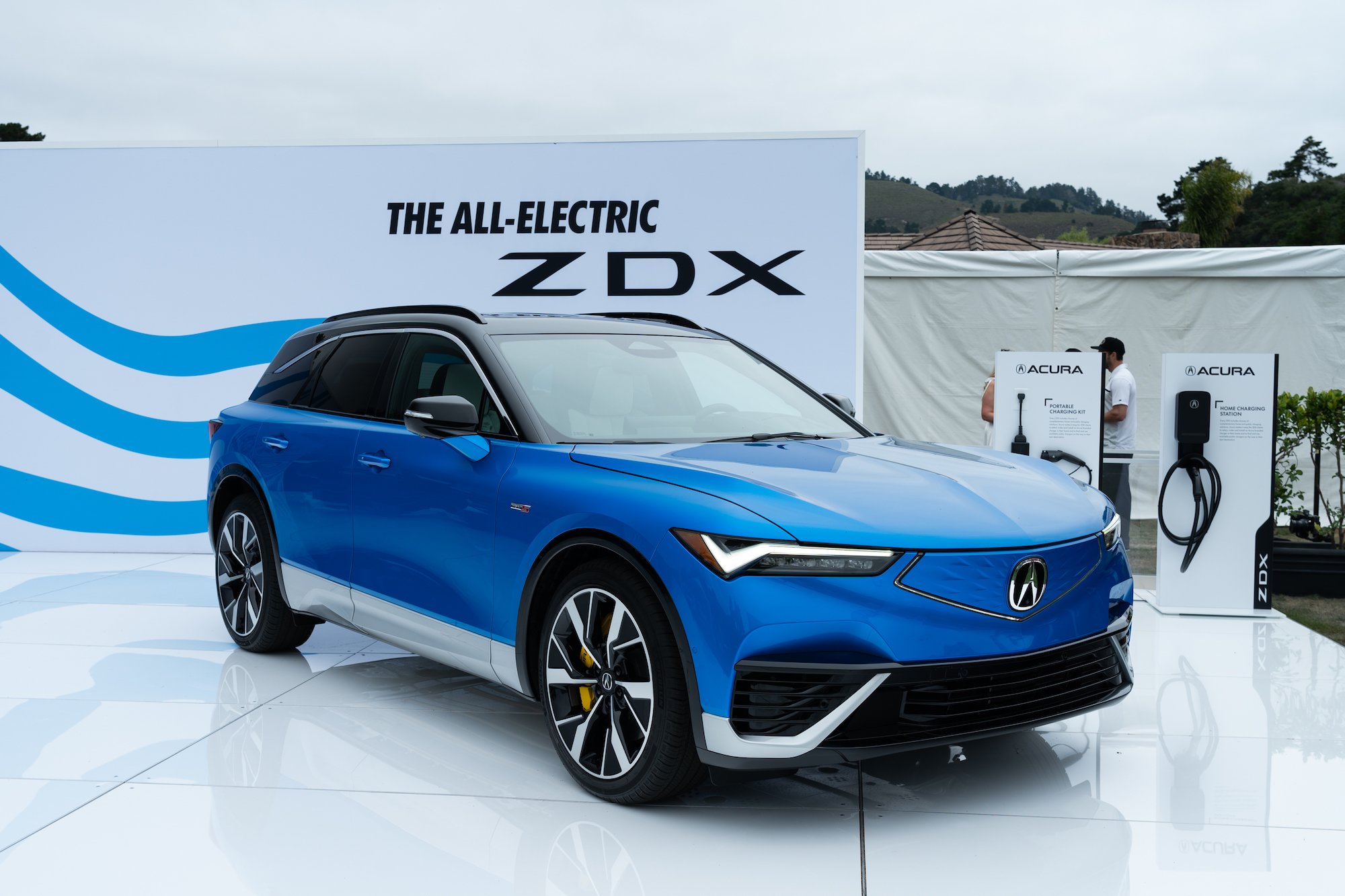
Image Credits: Tim Stevens

At last year’s Monterey Car Week festivities, Acura showed off a concept version of an all-electric rebirth for the ZDX. This year, Acura is back with the production model. Impressively, the final car looked little different than last year’s flight of fancy, but still it carried a bit of a surprise: It’s built on the General Motors Ultium platform.

Yes, Acura is teaming up with GM to create this battery-powered crossover, which will offer an EPA-estimated range of 325 miles and, if you go with the Type S flavor, will deliver 500 horsepower to all four wheels. Pricing for the 340 hp rear-drive version is said to start around $60,000 and, as a 2024 model year machine, should be hitting the road soon. If they don’t make it available in that blue, it’ll be a crime.

Bugatti

Image Credits: Tim Stevens


Though the all-conquering Chiron is nearing the end of its production, Bugatti is continuing to celebrate the car, this year unveiling a one-off called “Golden Era.” It features a custom designed mural celebrating the history of the marque.

More interesting, though, is what’s to come. Now that Bugatti has merged with Rimac, Achim Anscheidt, Bugatti’s head of design for a whopping 19 years, is taking on a more advisory role. He’ll be working directly with founder and CEO Mate Rimac to help define both the future of Rimac and Bugatti. “I have to say, the DNA of Bugatti is fairly straightforward and clear in evolution out of the last 15 to 20 years,” he told us. “The DNA Rimac still needs one more in-depth development of what that stands for.”

Anscheidt said he’s working on ways for Rimac to develop a “stronger identity” for its future products, in terms of style and character. He’s also helping to define what the next-generation Bugatti will look like, a car that will feature some degree of electrification and doubtlessly epic performance.
Czinger

Image Credits: Tim Stevens

The 3D-printed 21C supercar is finally becoming a reality and, while the first customer deliveries are still a few months away, the big fanfare this week was around a version called Blackbird Edition, honoring the iconic SR-71 Blackbird. With 1,350 horsepower, 100 more than the standard 21C, Blackbird will doubtlessly be quick, and like the regular version will ride on components crafted through generative design and additive manufacturing.

Czinger is making just four, priced in the $2 million ballpark, and all have been sold. “Within one day of revealing that car, they’re gone, which is a nice feeling,” Lukas Czinger, co-founder of Czinger, told TechCrunch. But, the company’s job isn’t done. On Sunday after the Concours, Czinger will be hosting a drive for 30 lucky 21C buyers. “I get nervous every time you put customers in the car, you hope they love it, but every time we have, they have.”
Ford
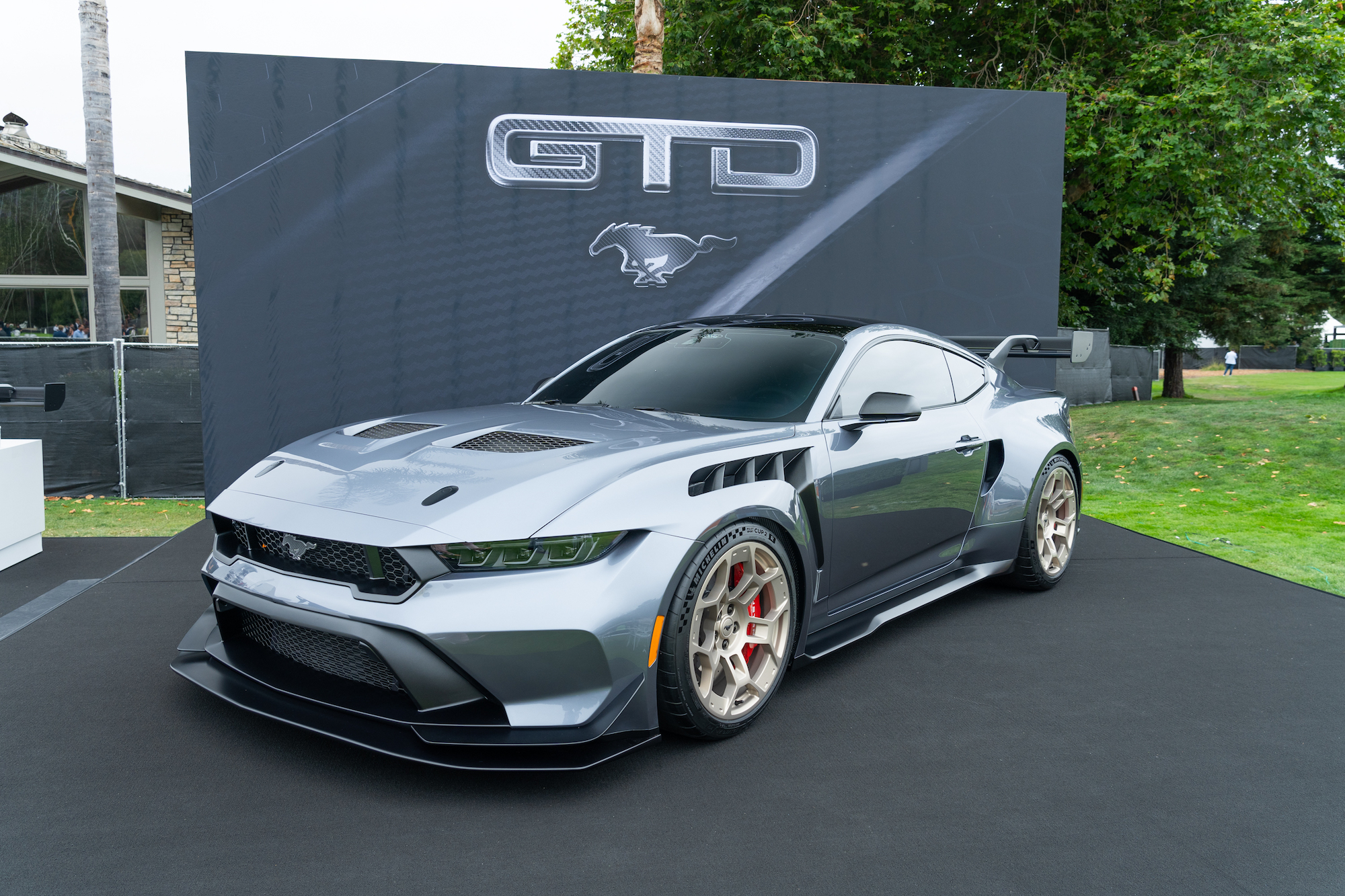
Image Credits: Tim Stevens

Yes, America’s Blue Oval was mixing it up with the multi-million-dollar hypercars at Quail this year, unveiling the Mustang GTD. This model, inspired by the track-only GT3, will bring outrageous performance and some novel technology, like an active aerodynamics system and suspension that can adjust both damper compression and spring rate for either road or track.

The ultimate target, though, is the track. “This vehicle is going to set a sub-seven-minute ‘Ring time,” Greg Goodall, Ford’s chief program engineer told TechCrunch after the GTD’s unveiling, targeting performance on Germany’s Nurburgring, an ever-present battleground for manufacturer bragging rights. “The technology is something we’ve never done on Mustang,” he said.
Lamborghini
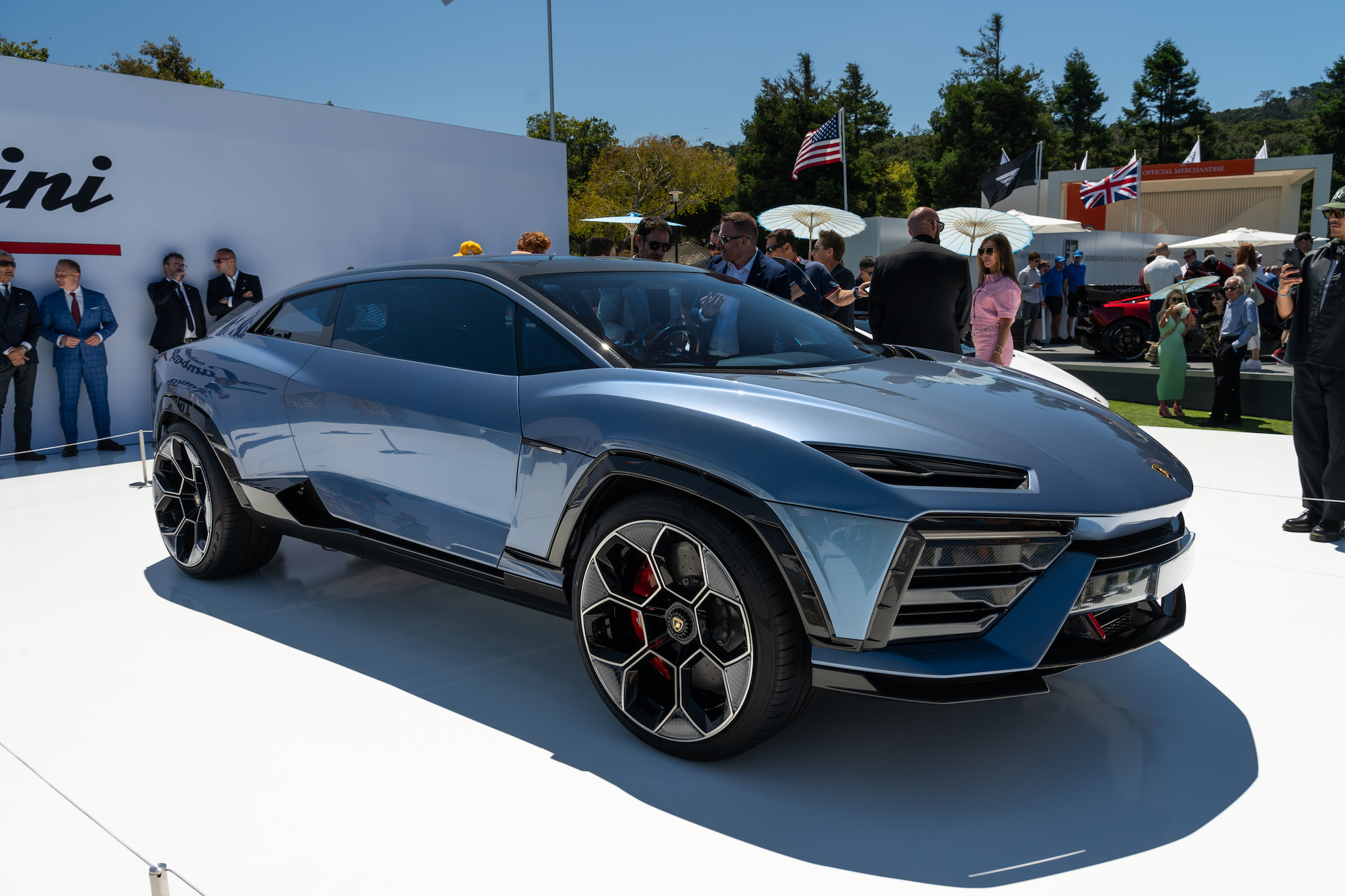
Image Credits: Tim Stevens

Lamborghini is dipping its toes into electrification with the upcoming plug-in hybrid Revuelto hypercar, and the Urus SUV is getting electrified as well. But, at this year’s Pebble Beach, the company showed off a preview of what will be its first full-bore EV: the Lanzador.

Though just a concept, Lamborghini says this is more or less what its first EV will look like when it goes into production in 2028. “A real teaser for what is going to happen,” Lamborghini CEO Stephan Winkelmann told us. When it does, this will become what Lamborghini is calling its “fourth model concept,” joining the Urus, Revuelto, and whatever replaces the Aventador.

Lanzador has an unusual shape, a tall coupe that looks to draw in the practicality and comfort of a crossover SUV while still delivering the driving dynamics of a sporty GT with 2+2 seating. “It’s the best of both worlds,” Winkelmann said. “We looked into every opportunity, until we found out that a higher seating position is mainly what everybody likes.”

No details on anticipated performance or range, only that Lanzador it will have all-wheel-drive from a pair of electric motors and will feature some aspect of active aerodynamics.
Maserati
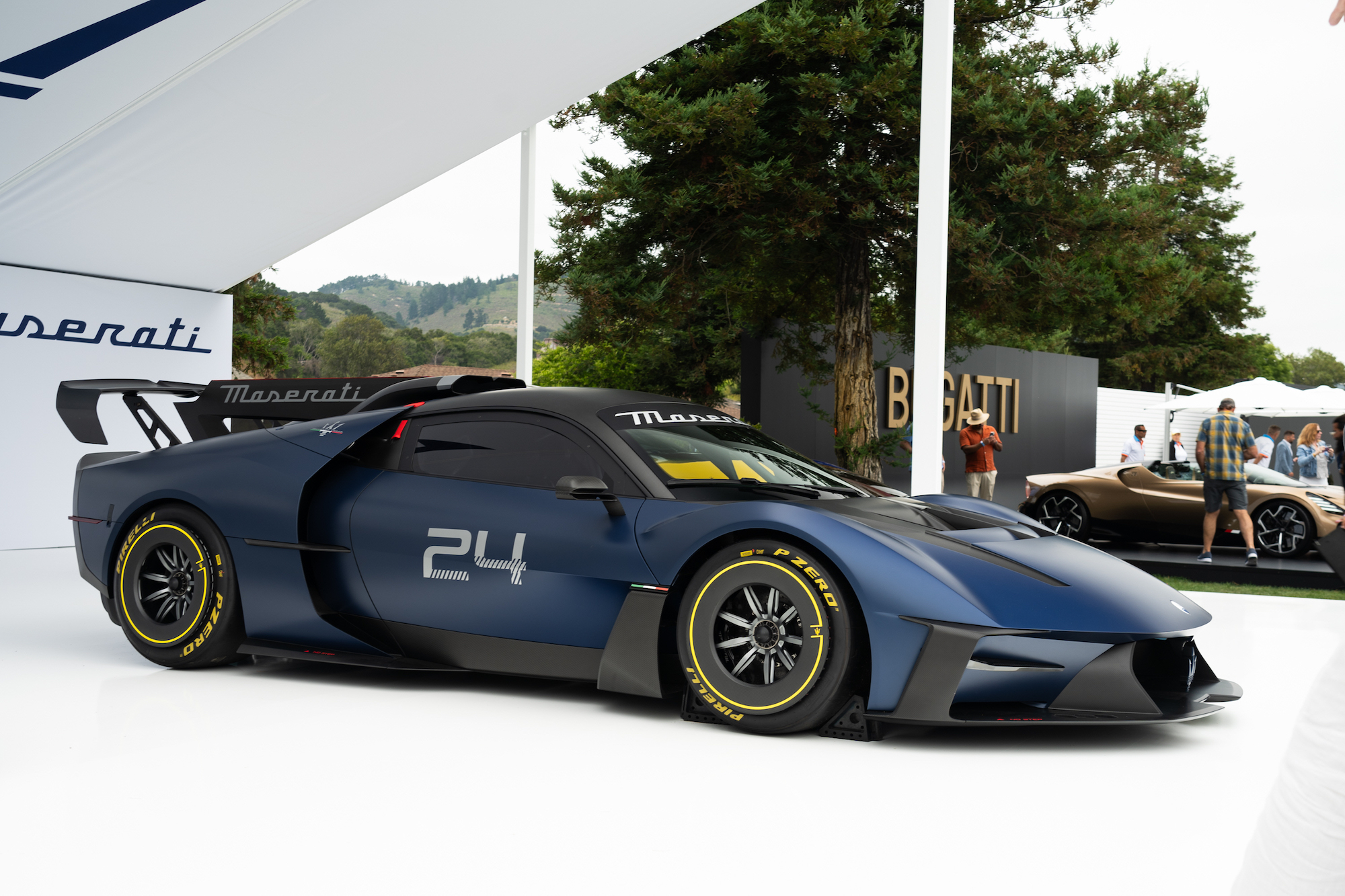
Image Credits: Tim Stevens

Maserati’s big debut at the show was MCXtrema (née Project24), a sort of limited-edition version of the company’s MC20. With 730 horsepower and some impressive aerodynamics, it looks a little too wild for the street. And that’s because it is. “It’s the most extreme version, thus the name extrema, of the MC20,” Bill Peffer, CEO of Maserati Americas, told TechCrunch. “This is a track-only weapon, if you will, not homologated for the street.”

The car does have an FIA-certified integrated roll cage, meaning it can run at maximum speed at many of the greatest tracks in the world. Only 62 will be made and, yes, they’re all spoken for.
Meyers Manx

Image Credits: Tim Stevens

Last year at The Quail, visitors fell in love with the Meyers Manx 2.0 — the rebirth of an iconic motoring toy from the 1960s. This year, many of those fans were surprised to learn what the first run of the machines will cost: $74,000. But, if you look at the car’s details, with its carbon fiber body and beautifully crafted switchgear, you can see where that money is going.

Thankfully, there’s a cheaper option coming. Meet the Resorter, a high-end entrant into the utilitarian Neighborhood Electric Vehicle, or NEV category, like the Eli ZERO or GEM e4.
“It’s a growing niche that allows vehicles to be on public roads, but limits the speed up to 25 miles per hour,” Freeman Thomas told TechCrunch. Thomas is CEO of the reconstituted Meyers Manx and well-known for his iconic designs like the original Audi TT and Volkswagen New Beetle.
The Resorter’s limited speed simplifies its construction and, more significantly, lowers the cost: $49,000. The 2.0, though, is also set to get cheaper with time. “As we ramp up, we’re gonna look at ways to bring pricing down,” Thomas said, saying that a non-carbon-body could become an option in the future. “But, right now, to get up and running, our costs are very high.”
Pininfarina
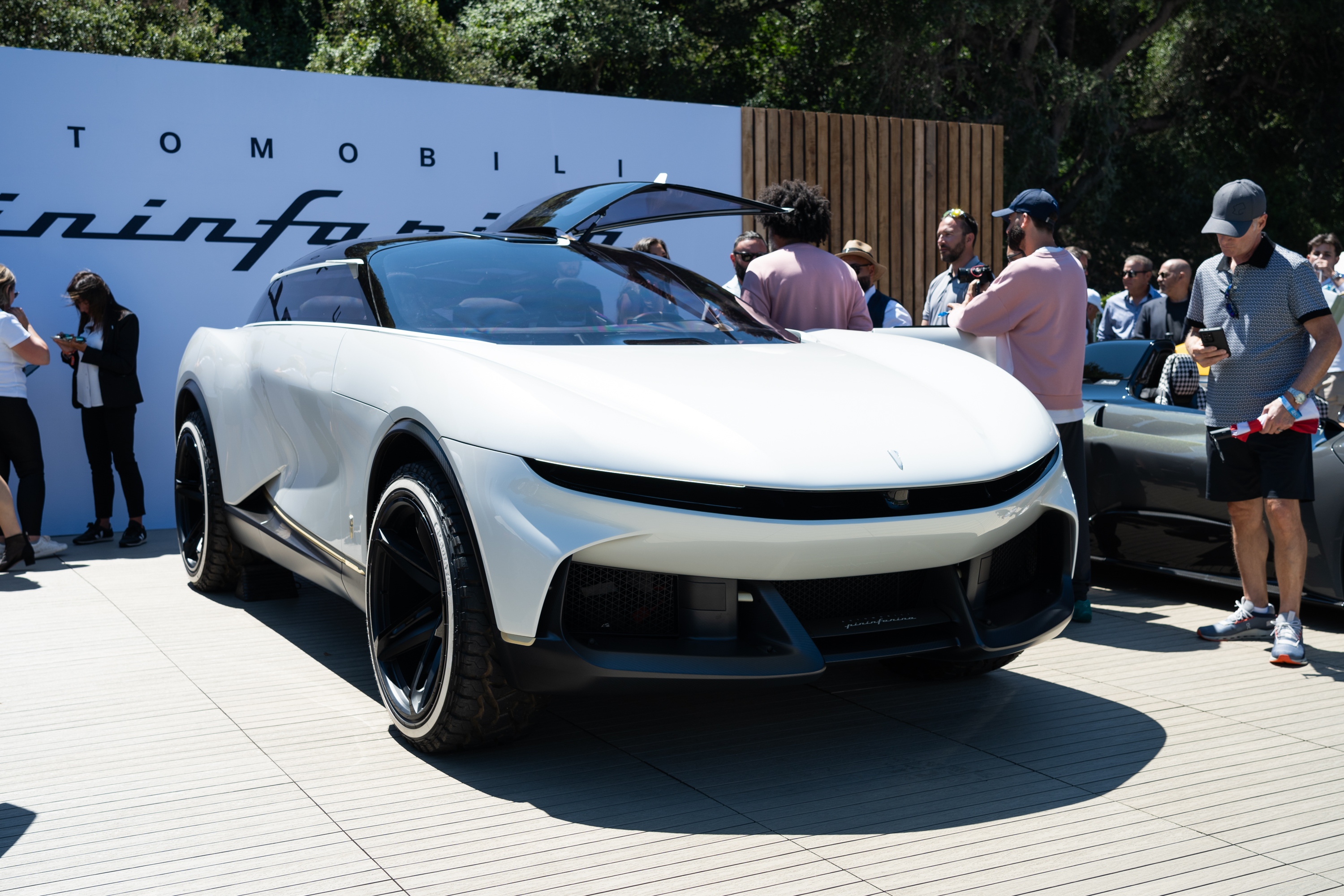
Image Credits: Tim Stevens

While Pininfarina had its own hypercars on display, showing off the new B95 roofless (and windshield-free) electric weapon, with 1,877 horsepower and a 0 – 60 time of 2.0 seconds. However, the company’s bigger story, quite literally, was the PURA Vision concept. Dubbed an electric luxury vehicle, or e-LUV, the thing is meant to represent a “new era of pure-electric luxury.”

Large and curvaceous, looking a bit like it had been stung by a bee next to the low, sleek Battista and B95, the PURA Vision is a radical departure for the storied designer of many iconic sports cars for other manufacturers. Many of those cars are referenced in the design, though, like doors honoring the 1957 Lancia Florida concept, while the interior is inspired by super yachts. No word on whether this will come to production, but the B95 will in extremely limited numbers. Pininfarina will build 10 cars, each priced at just south of $5 million.
Rimac

Image Credits: Tim Stevens

Rimac, the Croatian electric hypercar company that has taken the world by storm, took a curious approach by launching a car not based on what it could do, but based on what it did do. On the morning of its debut, Rimac announced that a limited edition of the Nevera, aptly dubbed “Time Attack,” had taken the electric production car record at the Nurburgring with a time of 7:05:298.
That’s just one performance record of 20 that the car has set this year. CEO Mate Rimac, though, wants more. “Am I happy? No,” he told us. “It still has a 7 in the front and I was hoping maybe a six. But it’s our first time, you know?” Rimac promised they’ll be back to the ‘Ring for more in the future. In the interim, it will build 12 of the Nevera Time Attack editions, each with a numbered plaque. All have already been sold.
Zenvo

Image Credits: Tim Stevens

While high-powered, mid-engined hypercars were everywhere at this year’s event, Danish Zenvo launched not one but two. The two vehicles are called Agil and Tur, the former optimized for high-downforce on-track performance, the latter for high-speed runs of up to 280 mph. They share quite a bit, including a brand new, quad-turbo V12 that can make up to 1,850 horsepower thanks in part to a hybrid system.

However, according to Zenvo chairman Jens Sverdrup, this really wasn’t about the specs. “We have big numbers in the car, they’re impressive, but they’ve never been the point. The point of the car is to turn everything up as far as it can until we get trade-offs,” he told us. “We can have 3,000 horsepower… it’s possible, but it doesn’t make the car better.”

What does make the car better? An obsession with analog detailing and tactility. The cockpit features a number of pods instead of a traditional gauge cluster. Everything looks analog, including the gear indicator, displayed via numbers on a disc like a date wheel on a fine watch. But, the technology is there. When needed, those pods flip over to reveal digital displays. No pricing was announced, but with only 50 of each being made, expect a price with seven digits.