>>> US Early premarket gappers

Early premarket gappers
  • Gapping up:
    • CRNX +65.9%, TWNK +18.7%, IMTX +10.3%, VRNA +9.3%, VIGL +6.5%, IBRX +3.1%, CPRX +2%, MBLY +1.5%, CRMD +1.4%, REKR +1.1%, NVS +0.9%, SJM +0.9%, GSK +0.8%, GSAT +0.7%, IDYA +0.7%, DINO +0.7%
  • Gapping down:
    • CBAY -4.6%, CMPS -3.7%, OVV -3.1%, MRTX -3%, BUR -1.8%, GROV -1.7%, URGN -1.4%

FT : Poor Things richly rewarded with Golden Lion at Venice Film Festival

Poor Things richly rewarded with Golden Lion at Venice Film Festival
Greek director Yorgos Lanthimos takes home top prize five years after coming second with ‘The Favourite’

It was never in much doubt. Yorgos Lanthimos’s audacious, sexy, troubling surrealist parable Poor Things has won the Golden Lion at the Venice Film Festival. The Greek director’s exuberant adaptation of Alasdair Gray’s 1992 novel established itself as a critical darling early on in this year’s event and clearly also dazzled the Venice jury, led this year by La La Land director Damien Chazelle. The victory means that Lanthimos goes one better than five years ago when The Favourite came second to Alfonso Cuarón’s Roma.

That year, Olivia Colman took home the Best Actress prize and repeated the feat at the Oscars six months later. Stone will be a strong contender to win her second Oscar (after La La Land) next year, though in Venice she was beaten to the Best Actress prize by Cailee Spaeny for her gently nuanced work as Elvis Presley’s woebegone wife in Sofia Coppola’s slightly underpowered Priscilla. Peter Sarsgaard was named Best Actor for his performance opposite Jessica Chastain in Michel Franco’s Memory, a New York-set story of trauma and recovery from Mexico’s master of grim intensity (Chronic, New Order).

Japan’s Ryusuke Hamaguchi (Drive My Car) picked up a rightful runner-up Grand Jury Prize for Evil Does Not Exist, his fascinating drama exploring the arrival of glamping and urban greed in a small rural town. A baffling Best Screenplay went to Guillermo Calderón and Pablo Larraín for the underwhelming El Conde, a vampiric satire directed at former Chilean dictator Augusto Pinochet.

Two films casting light on the global migrant crisis also fared well. The third-place Special Jury Prize went the way of Green Border, a well-reviewed drama by Poland’s Agnieszka Holland (Europa Europa), set in the border region between her country and Belarus. Meanwhile, the Silver Lion for direction was claimed by Matteo Garrone for Lo Capitano, which follows a Senegalese teenager desperately striving to reach Europe. He is played by Seydou Sarr, who also won the Best Young Actor award. It marks a change of pace for Garrone, better known for tough crime dramas such as Gomorrah and piquant fantasies such as Tale of Tales and Pinocchio.

In an 80th edition of the festival diminished at times by the ongoing American actors’ and writers’ strike, it was left to Sarsgaard to address the issue of contention, in particular Hollywood’s use of AI. “We all here agree that an actor is a person and a writer is a person, but it seems we can’t, and that’s terrifying because this work is about connection,” he said. “Without that . . . this holy experience of being human will be handed over to the machines and the eight billionaires who own them. So if we lose that battle in the strike, our industry will be the first of many to fall.”

FT : China gives strong warning against bets on renminbi depreciation

China gives strong warning against bets on renminbi depreciation
Currency rebounds from 16-year low as Beijing releases positive lending data earlier than usual

Beijing gave a strong warning against bets on renminbi depreciation and released a batch of positive lending data earlier than usual, spurring China’s currency to bounce back from a 16-year low touched last week.

The People’s Bank of China said in a statement on Monday that authorities “are capable of and feel confident in . . . keeping the renminbi exchange rate at a reasonably stable level”. The renminbi rose by as much as 1 per cent on Monday to an intraday high of Rmb7.2698 against the dollar.

“We will act when we act, resolutely correcting one-sided speculation,” the central bank added, referring to mounting bets against the currency’s dollar exchange rate driven by a string of underwhelming economic readings as China’s economy struggles to regain momentum.

Traders said the rhetoric from the central bank was much stronger than usual and that state-run banks, which have frequently supported the Chinese currency this year through purchases on the open market, were more actively buying up renminbi in exchange for dollars on Monday.

“The central bank showed its muscle this time and made a difference,” said a Shanghai-based currency trader. The gains for the renminbi outpaced those of other currencies against the dollar, as the dollar index measuring the US currency against a basket of peers fell 0.3 per cent in Asian trading on Monday.

Beijing also released better than expected lending figures to build on positive economic data released over the weekend showing that the country edged out of deflation in August. China’s statistics bureau released credit data shortly after the noon trading break on Monday in Shanghai, rather than after the closing bell.


Please use the sharing tools found via the share button at the top or side of articles. Copying articles to share with others is a breach of FT.com T&Cs and Copyright Policy. Email licensing@ft.com to buy additional rights. Subscribers may share up to 10 or 20 articles per month using the gift article service. More information can be found at https://www.ft.com/tour.

The figures showed Chinese banks extended Rmb1.36tn ($186bn) of new renminbi loans in August, rising sharply from just Rmb345.9bn in July and beating market expectations.

The larger-than-expected rise in new renminbi loans spurred a surge of buying in the afternoon trading session that drove the benchmark CSI 300 index as much as 1.3 per cent higher, later pulling back to close the session up 0.7 per cent.

Morgan Stanley analysts argued that the strong credit rebound was driven by a rise in local government special bonds issuance. They expected broad credit growth to edge up further by 10 to 20 basis points in September on continued strong government bond issuance and the easing of requirements for minimum mortgage interest rates nationwide.

However, they warned the sustainability of the credit growth improvement would hinge on policy efforts and said that stronger central government-led fiscal stimulus was “needed to help prevent the risk of a debt-deflation loop”.

These could include more funds for so-called urban village redevelopments as well as for social housing construction and green infrastructure, they said. It could also include local government debt resolution measures such as debt swaps from the central government.

“China credit data came in stronger than market expected, showing some initial signs of credit stabilisation on the back of PBoC’s stepped-up policy efforts with its surprise rate cuts, mortgage supports as well as an acceleration on government bond issuances in August,” said Zhi Xiaojia, chief China economist at Crédit Agricole.

“This is a good signal that at least growth is showing some early signs of stabilisation, even though uncertainty still looms.”

(ZH) As Moroccan Fatalities Soar, These Were The Deadliest Earthquakes Of The 21

As Moroccan Fatalities Soar, These Were The Deadliest Earthquakes Of The 21st Century

On September 8, 2023, a powerful earthquake rocked Morocco.

With its epicenter located in the Atlas Mountains and structural damage being done to the historical city center of Marrakesh, the 6.8-magnitude quake will likely have a death toll in the thousands.

Update: the disaster in Morocco is currently the 12th most deadly quake in the 21st century.
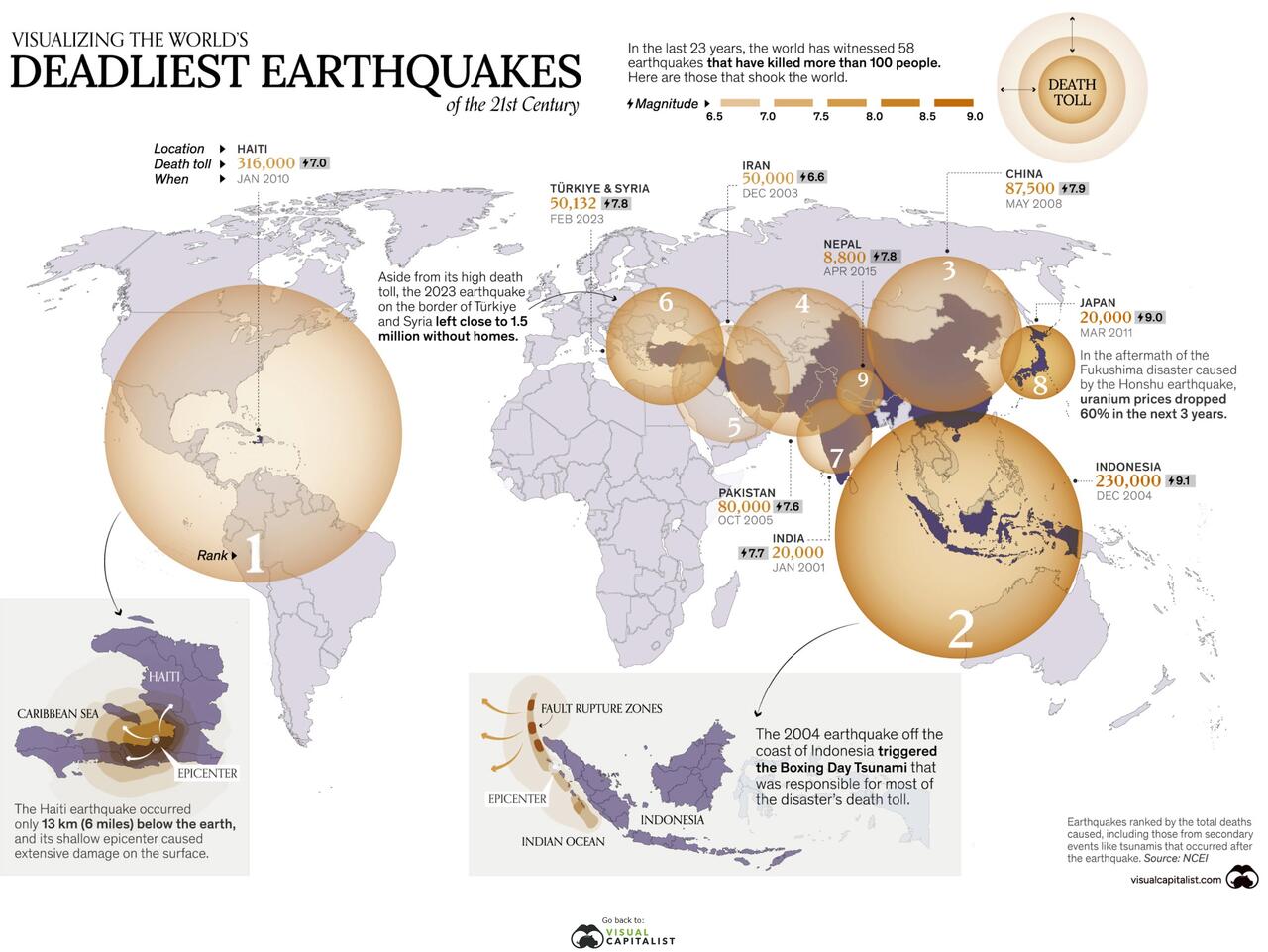
With these recent events in mind, Visual Capitalist's Pallavi Rao and Bhabna Banerjee use data from the National Centers for Environment Information (NCES) to map out the epicenters of the nine deadliest earthquakes in the 21st century so far, by their total death toll. This includes casualties from secondary events—like tsunamis—after each earthquake.

Earthquakes By Death Toll (2000–2023)
We delve into some of the deadliest earthquakes in recent history.
Haiti, 2010
On January 12th, 2010, a 7.0 magnitude earthquake hit the capital Port-au-Prince. The earthquake’s shallow epicenter—only six miles beneath the surface—caused most of the force to be directed close to where people lived. By the end of the month, after 52 aftershocks rocked the island, the disaster had claimed more than 300,000 lives—the deadliest earthquake in the 21st century thus far.
The extensive destruction led to global support, but slow recovery sparked criticism of government inaction. In 2017, the UN reported 2.5 million Haitians still required aid.

Indonesia, 2004
December 26th, 2004: A 9.1 earthquake occurred off the coast of Indonesia, deep under the ocean. It was the strongest earthquake in this century and the third-most powerful since 1900.
It triggered the worst tsunami recorded in history, causing 230,000 deaths mainly in Indonesia, Sri Lanka, Thailand, and India.
Here’s a list of the deadliest earthquakes, by death toll, in the 21st century.
Rank Date Location Total Deaths Magnitude
1 Jan, 2010 🇭🇹 Haiti 316,000 7.0
2 Dec, 2004 🇮🇩 Indonesia 227,899 9.1
3 May, 2008 🇨🇳 China 87,652 7.9
4 Oct, 2005 🇵🇰 Pakistan 76,213 7.6
5 Feb, 2023 🇹🇷 Türkiye 56,697 7.8
6 Dec, 2003 🇮🇷 Iran 31,000 6.6
7 Jan, 2001 🇮🇳 India 20,005 7.6
8 March, 2011 🇯🇵 Japan 18,428 9.1
9 April, 2015 🇳🇵 Nepal 8,957 7.8
10 May, 2006 🇮🇩 Indonesia 5,749 6.3
11 Sep, 2018 🇮🇩 Indonesia 4,340 7.5
12 May, 2003 🇩🇿 Algeria 2,287 6.8
13 Aug, 2021 🇭🇹 Haiti 2,248 7.2
14 April, 2010 🇨🇳 China 2,220 6.9
15 March, 2005 🇮🇩 Indonesia 1,313 8.6
16 Sep, 2009 🇮🇩 Indonesia 1,117 7.5
17 June, 2022 🇦🇫 Afghanistan 1,039 5.9
18 March, 2002 🇦🇫 Afghanistan 1,000 6.1
19 Jan, 2001 🇸🇻 El Salvador 844 7.7
20 Sep, 2013 🇵🇰 Pakistan 825 7.7
21 July, 2006 🇮🇩 Indonesia 802 7.7
22 April, 2016 🇪🇨 Ecuador 663 7.8
23 Nov, 2022 🇮🇩 Indonesia 635 5.6
24 Nov, 2017 🇮🇷 Iran 630 7.3
25 Feb, 2004 🇲🇦 Morocco 628 6.4
26 Aug, 2014 🇨🇳 China 615 6.2
27 Feb, 2005 🇮🇷 Iran 612 6.4
28 Oct, 2011 🇹🇷 Turkey 604 7.1
29 Aug, 2018 🇮🇩 Indonesia 560 6.9
30 Feb, 2010 🇨🇱 Chile 558 8.8
31 Aug, 2007 🇵🇪 Peru 514 8.0
32 Oct, 2010 🇮🇩 Indonesia 431 7.8
33 Oct, 2015 🇦🇫 Afghanistan 399 7.5
34 Sep, 2017 🇲🇽 Mexico 369 7.1
35 Feb, 2001 🇸🇻 El Salvador 315 6.6
36 April, 2009 🇮🇹 Italy 309 6.3
37 Aug, 2012 🇮🇷 Iran 306 6.5
38 Aug, 2016 🇮🇹 Italy 299 6.2
39 June, 2002 🇮🇷 Iran 261 6.5
40 Feb, 2003 🇨🇳 China 261 6.3
41 Oct, 2013 🇵🇭 Philippines 222 7.1
42 Oct, 2008 🇵🇰 Pakistan 215 6.4
43 April, 2013 🇨🇳 China 196 6.6
44 Sep, 2009 🇼🇸 Samoa Islands 192 8.1
45 Feb, 2011 🇳🇿 New Zealand 185 6.1
46 May, 2003 🇹🇷 Turkey 177 6.4
47 March, 2002 🇦🇫 Afghanistan 166 7.4
48 Feb, 2018 🇵🇬 Papua New Guinea 145 7.5
49 Oct, 2020 🇬🇷 Greece 118 7.0
50 Sep, 2022 🇨🇳 China 118 6.6
51 May, 2015 🇳🇵 Nepal 117 7.3
52 Feb, 2016 🇹🇼 Taiwan 117 6.4
53 Sep, 2011 🇮🇳 India 111 6.9
54 Jan, 2021 🇮🇩 Indonesia 105 6.2
55 March, 2011 🇲🇲 Myanmar 104 6.8
56 Dec, 2016 🇮🇩 Indonesia 104 6.5
57 June, 2000 🇮🇩 Indonesia 103 7.9
58 June, 2001 🇵🇪 Peru 103 8.4

Türkiye and Syria, 2023
February 6, 2023: Two earthquakes, also with shallow epicenters (5 miles deep), hit the border region between Türkiye and Syria, causing widespread damage in both countries and claiming more than 50,000 lives. Bad weather conditions—including snow, ice, and winter storms—inhibited search and rescue efforts.
In Syria, international sanctions prevented foreign charities and families from sending money to the country, which led to the U.S. suspending the sanctions for 180 days.

Japan, 2011
March 11, 2011: Another undersea earthquake—also 9.1 magnitude—occurred off the coast of Japan, triggering a deadly tsunami which flattened parts of the country 30 minutes later.
The high waves also damaged Fukushima’s Nuclear Plant’s emergency diesel generators leading to reactor meltdowns, and a release of radioactive waste. In total, 18,000 people lost their lives from the earthquake and tsunami.
How Does Earthquake Data Help With Disaster Preparedness?
Thanks to the study of plate tectonics, scientists know where earthquakes usually occur, even if they don’t know when precisely. For example countries along the “Ring of Fire”—a hotbed of earthquake and volcanic activity—witness hundreds of earthquakes a year, though most are not strong enough to cause any damage.
However, with deadly earthquakes, other factors, including epicenter depth, location near populous areas, and proximity to secondary events—tsunamis—can play a far bigger role in death tolls.
Disaster preparedness and swift government action can mitigate many secondary casualties as seen comparing the vastly different death tolls of the 2004 and 2011 tsunamis.

Miss Tweed : Management changes at Richemont: it’s just the beginning


From: Laurent Chekroun (MAKOR CAPITAL MARKET) At: 09/10/23 15:38:21 UTC+2:00
Subject: Miss Tweed : Management changes at Richemont: it’s just the beginning
Management changes at Richemont: it’s just the beginning

The Swiss luxury group Richemont announced several changes to its non-executive board this week and created two new positions: corporate affairs director and CEO of a newly created fragrance division. Both will join the group’s Senior Executive Committee. It is great news that Richemont is boosting its corporate governance and has made fragrance a new area of focus. The move mirrors similar efforts by the rival French group Kering which is investing heavily in this promising category.

Richemont will not stop there. More top management changes are on the cards, particularly at Richemont’s Specialist Watch Makers’ division and at jeweler Buccellati, Miss Tweed found out. Some bosses are on their way out while others are preparing to move to another brand within the group, several industry sources said.

BUCCELLATI
Catherine Rénier, CEO of Richemont’s Jaeger-LeCoultre since 2018, is expected to leave her position in the next six months to join Buccellati, the Italian jeweler favored by European royals and celebrities. “Rénier is a recurring name to takeover Buccellati,” one industry source told Miss Tweed. Since its purchase in 2019 for €230 million, Richemont has been investing vast amounts in the Italian jeweler. Buccellati’s revenue stood at €45 million when it was acquired by the group. Thanks to new boutiques, notably in Asia, and the expansion of its teams and marketing resources, it is now estimated to generate more than €180 million in revenue.

Last year, Buccellati “generated the highest growth rate across the group, albeit from a smaller base” than its much bigger sister brands Cartier and Van Cleef & Arpels (VCA), Richemont wrote in its 2023 annual report. Best-selling collections include Tulle, which is recognizable thanks to its honeycomb design made to look like lace, and Macri, whose surfaces are engraved with thin lines to resemble silk. Founded in 1919 by Mario Buccellati, the brand is regarded today as a classic expression of timeless elegance in jewelry. It is distinctly European and designed to adorn aristocrats. It has also been run in the same way for years. Very little has changed since it joined Richemont and came under the supervision of Nicolas Bos, CEO of VCA, an expert in preserving brand equity and spirit. Several Buccellatis are members of the founding family and work for the company: Andrea, honorary chairman and creative director, Maria Cristina, head of communication, and Luca, who looks after business development.

Bucellati has been led by Italian luxury veteran Gianluca Brozzetti for nearly a decade now. The seasoned executive will be 70 in March next year. He is well over Richemont’s official age limit for CEOs of 65 and is due to retire next year, several industry sources have said. It is expected that Rénier will first join Buccellati as Brozzetti’s deputy and take over after a transition period of several months. Her departure from Jaeger-LeCoultre has not been announced yet and it may be some time before it is, several sources said. The timing of her official appointment will also depend on how quickly Richemont finds a replacement. Many wonder whether Richemont will pick one of its senior managers or someone from outside the group or even the hard luxury sector. Earlier this year, Audemars Piguet surprised the industry by appointing as its new CEO Ilaria Resta, an executive at the Swiss fragrance group DSM-Firmenich.

Rénier worked for VCA and Bos for many years, mainly as head of the French jeweler in Asia Pacific. “Catherine is a woman under Nicolas’ protection. He’s the one who pushed for her to become CEO of Jaeger. He’s not going to let her down,” a source close to Richemont said. “However, taking over Buccellati will not be easy for Catherine as the brand is managed in a very patriarchal, top-down fashion.”

Several industry sources said Jaeger-LeCoultre’s sales growth has been lackluster in recent years. Watch retailers and connoisseurs said its best-selling Reverso model remained popular mainly in Western Europe and it was struggling to impose itself in Asia and elsewhere.

PANERAI
Another Richemont watch executive due to exit the group in the next few months is Benoit de Clerck, Chief Commercial Officer at the watchmaker Officine Panerai, industry sources said. That confirms media speculation over the summer. He is going to become CEO of LVMH’s Zenith, replacing Julien Tornare, who is leaving to become CEO of TAG Heuer. Frédéric Arnault, who was CEO of TAG Heuer, will take up a new role within the French group headed by his father Bernard, several industry sources said. Miss Tweed will publish more details regarding these musical chairs in a separate report.

These management changes come as the watch industry is suffering from a slowdown that started in January. After the post-pandemic boom of 2021 and 2022, demand is falling back to more normal levels. Also, sales in China have not picked up as much as hoped and U.S. consumers have been keeping their purse strings tight in an inflationary environment of rising interest rates. When business gets tough, shareholders start questioning management and its strategy. That’s also why so many leadership changes are planned at Richemont and at other groups such as LVMH.

However, replacing a leader who has been a brand’s father figure for many years is no easy task. Panerai, for example, has struggled to find a new voice after its charismatic leader Angelo Bonati left in 2018 after 17 years. Bonati led the brand’s storytelling and identity built around exploration and adventure. Under the current Richemont regime, there is less room for out-of-the box ideas and larger-than-life characters like Bonati. Panerai has become more subdued under Jean-Marc Pontroué, one of the many watch brand CEOs under the tight control of top Richemont executives – something Bonati avoided for years.

ROGER DUBUIS
Pontroué previously was CEO of Roger Dubuis, one of the smallest brands of the Specialist Watchmakers’ portfolio. It is estimated to make between €70 million and €100 million in annual revenue. The current Roger Dubuis CEO, Nicola Andreatta, is leaving Richemont at the end of November after five years, several industry sources have said. Founded in 1995, Roger Dubuis has been through several CEOs in the past decade. Its timepieces are known for their skeleton movements, avant-garde designs and prices between €65,000 and €130,000 -- a hefty sum for a brand that is not so well-known or popular among collectors. Some expensive Roger Dubuis models can be found at a discount to their official retail price on the second-hand market as many retailers are desperate to offload them to get cash into their coffers.

Richemont’s watch brands, which also include Piaget and IWC, have been through rough trading waters this year, several industry sources have said. An executive at a successful independent Swiss brand told Miss Tweed at the Geneva Watch Days that there were fewer problems securing watch parts thanks to IWC canceling orders in recent months. “The problem for some creates happiness for others,” the executive said with a smile. There are also question marks over the future of some members of the IWC’s leadership team, market sources have said.

Richemont watch brands have seen prices on the second-hand market collapse since last year. Big spenders have become reluctant to buy an expensive timepiece from a brand that some see as relatively dormant in terms of design and innovation. Also, the market’s polarization has gained pace. Leading brands have become even bigger and more desirable. In the current uncertain environment, buyers have been opting for safe names such as Rolex, Audemars Piguet, Patek Philippe, Richard Mille, Rolex’s Tudor and the independent Breitling. At Richemont, the only brands that continue to enjoy solid growth are A. Lange & Söhne and Vacheron Constantin. The latter has been helped by the reopening of China post-Covid, a country in which its rival Patek Philippe is poorly distributed. For its part, A. Lange & Söhne benefits from the fact that demand still outstrips supply for many of its models.

Also, many big brands — including Richemont ones — are having a hard time competing against smaller watchmakers. These independent brands can be more creative. They are also doing a better job building relationships with customers. People are tired of being told they cannot buy a Rolex, a Patek Philippe or another popular brand because there is officially no stock in the boutique. Best sellers are kept for privileged customers who have already bought many watches from them. Therefore, customers have been falling back on more niche and innovative brands.

CENTRALIZED DECISION-MAKING
Richemont’s watchmakers’ woes are not only due to tough market conditions and fierce competition from smaller brands, sources close to the group say. Centralized decision-making by top Richemont executives and the group’s Strategic Products and Communication Committee (SPCC) are also an issue. Together, they form a tight leash that controls Richemont’s watch brands and their bosses. Such governance leaves little room for creativity, innovation and zany ideas – qualities that feed brand desirability and awareness.

All power is in the hands of Richemont CEO Jérôme Lambert and Emmanuel Perrin, CEO of the Specialist Watch Makers division, distributors say. Watch CEOs have little freedom and room to maneuver. Lambert is the nephew of Alain-Dominique Perrin, the man who built Cartier into the world’s No. 1 jeweler. The industry legend, who celebrated his 80th birthday last year, still acts as a consultant for the group and has been advising the SPCC. Both Lambert and Emmanuel Perrin are said to be risk-averse. That’s why so many of the group’s watch brands are struggling to remain competitive and come up with original and smart initiatives that would help them stand out on the crowded luxury watch market, industry analysts say. “There are a lot of incredible brands at SWM that cannot express themselves properly because of the way the group is run,” one person close to Richemont said on condition of anonymity. The brands that are doing best are those whose CEOs have been able to hold their ground and resist Perrin’s intervention.

“The heads of Vacheron Constantin and Lange are the most resilient,” the source said. “They have a clear strategy and it’s working. So, there’s no reason to bother them. It’s when business isn’t doing so well that Perrin steps in,” the source said, referring to brands such as Jaeger-LeCoultre, Roger Dubuis, Panerai, IWC and Piaget.

Also affecting sales is the way Richemont has been treating third-party distributors. The group has been building its own network of boutiques and shutting down accounts with multi-brand retailers. Last week, Miss Tweed reported on how Richemont was expected to part ways with Bucherer after the Swiss retailer was acquired by Rolex.

Richemont watch bosses under centralized command from the top, have also been alienating distributors by showing them new releases at meetings and watch fairs and then telling them that they cannot order them because they will be sold exclusively at the brand’s own boutique. “Many distributors are tired of being badly treated by Richemont and that’s not helping sentiment towards the group and the performance of its brands,” one senior watch CEO told Miss Tweed at the Geneva Watch Days.

Miss Tweed reported in 2020and in 2021 that managers at the Specialist Watch Makers division enjoyed little freedom and felt hamstrung by Perrin and Lambert. In retaliation, the two executives blacklisted Miss Tweed from all Richemont events, press conferences and the annual Watches & Wonders trade fair, preventing this independent Paris-based news website from talking to non-Richemont brands participating in the show. On Friday, Richemont again did not answer Miss Tweed’s emails asking for comment or clarifications for this report.
>>> Europe : Brokers Upgrades & Downgrades - 11th of September 2023 V2(+)

>>> Up
* Accenture PT Raised to $390 from $340 at Barclays (+)
* Ageas Raised to Neutral at JPMorgan; PT 42 euros
* Deutsche Euroshop Raised to Add at Baader Helvea; PT 21.50 euros
* Electrolux Raised to Neutral at Citi; PT 120 kronor
* JCDecaux Raised to Outperform at Oddo BHF
* Prudential Raised to Neutral at BNPP Exane; PT 1,130 pence
* Solaria Energia Raised to Buy at JB Capital Markets (+)
* Vestas Raised to Hold at HSBC; PT 165 kroner

>>> Down
* Alfa Laval Cut to Neutral at Citi; PT 400 kronor
* F-Secure Cut to Reduce at Inderes; PT 2.10 euros
* Legrand Cut to Sell at Citi; PT 82 euros
* Melrose Industries Cut to Sector Perform at RBC; PT 540 pence
* Siemens Cut to Hold at HSBC; PT 145 euros

>>> Initiation
* Compass Group Rated New Hold at Goodbody; PT 2,120 pence (+)
* Elia Group Rated New Hold at Deutsche Bank; PT 106 euros (+)
* Metro Bank Holdings Rated New Hold at Peel Hunt; PT 100 pence
* Siemens Reinstated Underweight at Barclays; PT 122 euros
* Technoprobe Rated New Hold at Stifel; PT 7.60 euros

>>> Call
* Tesla Upgraded at Morgan Stanley on Autonomous Car ‘AI Mojo’
* Morgan Stanley’s Wilson Recommends Late-Cycle Defensive Exposure (+)
* Siemens Gets First Sell-Equivalent Rating From Barclays (+)

ArtNet : The Billionaire Founders of China’s Long Museum Plan to Sell Off an Est

The Billionaire Founders of China’s Long Museum Plan to Sell Off an Estimated $150 Million Worth of Art at Sotheby’s This Fall
It is not yet clear what has spurred the Long Museum's founder Liu Yiqian and his wife Wang Wei to sell off a part of their collection.

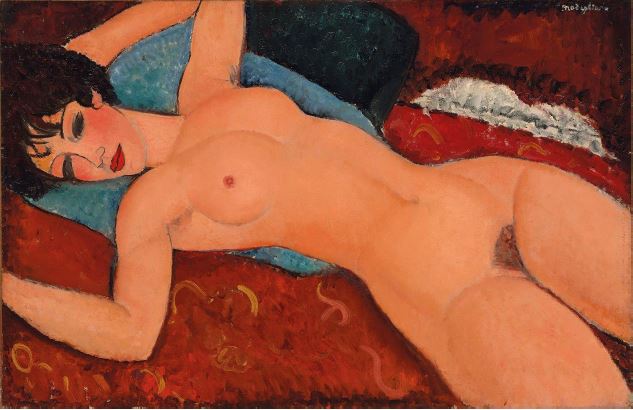
A decade ago, Liu Yiqian, a Chinese taxi driver-turned-billionaire, began turning heads in the art market by paying tens of millions of dollars for Chinese art with his credit card. As the Long Museum in Shanghai, which he co-founded with his wife Wang Wei, transformed into China’s leading private institution, the power couple became market makers at the highest level in Western art as well. In 2015, the two acquired Amedeo Modigliani’s Nu couché (Reclining Nude) for a record $170.4 million at a Christie’s sale in New York.

Now the couple is poised to send shock waves through the art market again—but this time as major sellers.
Liu and Wang asked Christie’s, Sotheby’s, and Phillips to pitch for a group of Western modern, postwar, and contemporary art valued at about $150 million (in excess of HK$1 billion), according to people familiar with their plans. Sotheby’s won the bid, the people said.

The consignment arrives just as the art market braces for a slowdown. Global auctions at Christie’s, Sotheby’s, and Phillips fell 22.7 percent in the first six months of 2023 compared to the same period last year, according to Artnet Price Database. Meanwhile, the Chinese economy is struggling to recover from the prolonged Covid lockdown, the country’s property market is in shambles, and its currency fell to the lowest against the U.S. dollar in 16 years.

Sotheby’s said it will offer around 50 works, including those by Modigliani, Zao Wou-ki, René Magritte, David Hockney, Matthew Wong, and Yayoi Kusama. The auction house didn’t specify what works will be included.

Many details remain unclear, including whether the sale will feature the couple’s impressive collection of Chinese painting and antiques. The museum is not closing its doors, sources told Artnet News.

“Sotheby’s is honored to be bringing to its Hong Kong sale rooms a truly outstanding group of works from the legendary collection of Liu Yiqian and Wang Wei—two of the greatest collectors of our time,” Sotheby’s said in a statement on Tuesday in response to Artnet News‘s request for comments. The house’s Hong Kong sales usually take place in October. The spokesperson added that “proceeds from the forthcoming sales [are] destined to further key initiatives at the Long Museum, while also funding future acquisitions and the continued fostering of cultural dialogues between different artists, geographies and generations.”

The Long Museum did not respond to Artnet News‘s request for comment by publication time.
Amedeo Modigliani, Nu couché, 1917–18. Courtesy of Christie’s New York.

Liu built his fortune investing in the stock market as China’s economy began to take off in the early 1990s. The chairman of Shanghai-based investment company Sunline Group, which has a portfolio ranging from pharmaceuticals, financial services, and properties, ventured into art collecting and bid at auction for the first time in 1994 in Beijing, acquiring a Chinese calligraphy work by Guo Moruo and a Chinese painting by Li Keran.

Together with his wife Wang, the couple became the best-known Chinese collectors in the West with high-profile purchases at auction that included the 500-year-old Ming dynasty Meiyintang “chicken cup” that fetched $36.6 million (including fees) at Sotheby’s Hong Kong in 2014, setting a new record. After the sale, Liu was photographed drinking from the cup while swiping his American Express card 24 times to pay for his winning bid.

At the time, his flamboyant behavior drew criticism, but he said in his defence that he needed to pull such stunts to generate publicity for his collection.

“I have a museum opening to the public. If I don’t tell people I have acquired these works, then no one would know, and no one will come to my museum to see them,” Liu said in an interview with the South China Morning Post in 2015. He also took pride in placing world class artworks in his museum in China.

Liu Yiqian drinks from his $36.3 million Meiyintang chicken cup. Photo: courtesy Sotheby’s.

In the Hurun China Rich List 2022, Liu and his family were ranked at 131st with an estimated accumulated wealth of 37 billion yuan ($5 billion), up 33 places from the previous year. His wealth has reportedly grown to 38 billion yuan ($5.2 billion) according to Hurun Global Rich List 2023, which ranked him at 513rd.

But the couple has been keeping a relatively low profile in recent years and their art purchases have slowed down, according to people familiar with their activity.

That coincides with China’s economic troubles. While major economies are tackling inflation by raising interest rates, China’s central bank, People’s Bank of China, announced on Monday that it has lowered its one-year loan prime rate, a key interest rate in the country, for the second time in three months, from 3.55 percent to 3.45 percent, according to the BBC.

China’s property market has also been hit with an unprecedented crisis. Embattled property giant Evergrande, which was revealed to be the world’s most indebted real estate developer (it accumulated more than $300 billion debts), filed for U.S. bankruptcy protection in New York last Thursday, August 17. Country Garden, once China’s largest property developer, is suffering from a cash crunch and is said to be removed from Hong Kong’s Hang Seng Index. Reuters reported property developers accounting for 40 percent of home sales in the country have defaulted since mid-2021 when the sector’s debt crisis began to deepen.

The artworks that Liu and Wang asked the three auction houses to evaluate included Plunge, a 1992 painting by Kerry James Marshall, which the collectors bought for $2.2 million at Christie’s in 2016. It was the auction record for the African American artist at the time.

Another work was Jenny Saville’s large-scale painting Shift (1996-1998), which sold for 6.8 million pounds (about $9 million at the time), also in 2016, and a record for the British painter at the time.

It doesn’t appear that Modigliani’s Nu couché is going to be part of the Long Museum batch headed for auction this fall. But another painting by the Italian modernist has been part of the pitch by auction houses: Paulette Jourdain (1919), which fetched $42.8 million as part of A. Alfred Taubman’s auction at Sotheby’s in 2015.

Some of these works have been featured in the Long Museum’s recent two-part exhibition celebrating its 10th anniversary.