>>> PVH beats by $0.16, misses on revs; guides Q4 EPS below consensus, revs belo

PVH beats by $0.16, misses on revs; guides Q4 EPS below consensus, revs below consensus; increases repurchase plan by $150 mln (91.50 +1.43)
  • Reports Q3 (Oct) earnings of $2.90 per share, excluding non-recurring items, $0.16 better than the FactSet Consensus of $2.74; revenues rose 3.6% year/year to $2.36 bln vs the $2.41 bln FactSet Consensus.
  • Co issues downside guidance for Q4 (Jan), sees EPS of $3.45, excluding non-recurring items, vs. $3.51 FactSet Consensus; sees Q4 revs to decline 3-4% yr/yr, implying $2.39-2.41 bln vs. $2.59 bln FactSet Consensus.
  • The Company completed its previously announced sale of its Heritage Brands intimate apparel business on November 27, 2023. The $160 million cash purchase price is subject to adjustment. There is a potential earn out of up to $10 million based on calendar year 2024 net sales of a portion of the sold business.
  • Planned share repurchases in 2023 to increase to approximately $550 million from up to $400 million previously.

>>> Snowflake beats by $0.09, beats on revs, product revenue up 34%, well above

Snowflake beats by $0.09, beats on revs, product revenue up 34%, well above its guidance, guides for Q4 product revenue growth of 29-30% (175.47 +3.92)
  • Reports Q3 (Oct) earnings of $0.25 per share, $0.09 better than the FactSet Consensus of $0.16; revenues rose 31.8% year/year to $734.2 mln vs the $713.75 mln FactSet Consensus.
  • Non-GAAP operating margin of 10%.
  • Product revenue of $698.5 mln, up 34%, and well above its guidance of $670-$675 mln.
  • Net revenue retention rate of 135%.
  • Guides for Q4 product revenue of $716-$721 mln, representing yr/yr growth of 29-30%. Guides for Q4 non-GAAP operating margin of 4%.

>>> Salesforce beats by $0.06, reports revs in-line; guides Q4 EPS above consens

Salesforce beats by $0.06, reports revs in-line; guides Q4 EPS above consensus, revs in-line (230.35 +5.43)
  • Reports Q3 (Oct) earnings of $2.11 per share, excluding non-recurring items, $0.06 better than the FactSet Consensus of $2.05; revenues rose 11.3% year/year to $8.72 bln vs the $8.71 bln FactSet Consensus.
    • Current Remaining Performance Obligation of $23.9 Billion, up 14% Y/Y, 13% CC.
    • Non-GAAP Operating Margin of 31.2%.
  • Co issues guidance for Q4, sees EPS of $2.25-2.26, excluding non-recurring items, vs. $2.18 FactSet Consensus; sees Q4 revs of $9.18-9.23 bln vs. $9.22 bln FactSet Consensus.

(ZH) Panama Canal Chaos Might Spread To Suez, Greek Shipping Exec Warns

Panama Canal Chaos Might Spread To Suez, Greek Shipping Exec Warns

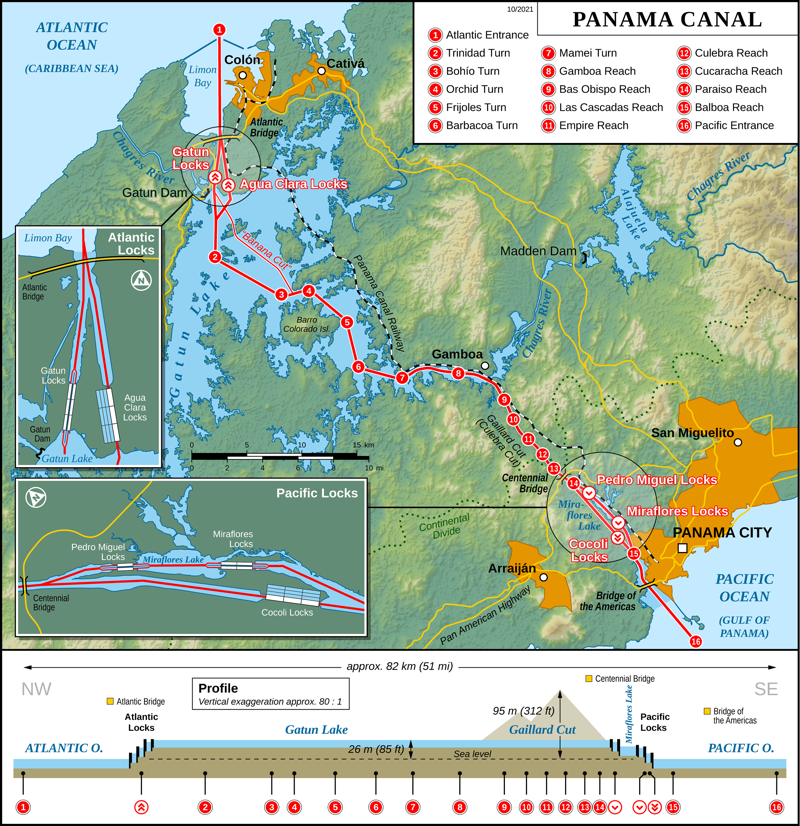
The giant bottleneck building at both entrances of the Panama Canal might spread to Egypt's Suez Canal. This is according to Bloomberg, which quoted a top executive at Greek shipping firm Angelicoussis Group during a conference in Athens.

Sveinung Støhle, the company's deputy chief executive officer, said, "Suez will need to take a lot more vessels" because the drought-stricken Panama Canal has sailing restrictions.

He noted that the Suez Canal, which serves as an alternative route for ships traversing between the US and Asia, has historically managed congestion issues "very well over the years," making it "less of an issue, but obviously, it's something you need to be aware of."

The bottleneck at the Panama Canal has only allowed companies with pre-booked slots to sail the canal, Støhle said. He said only four or five LNG vessels are sailing the canal each month, down from about 30 before restrictions were put in place earlier this year.

"If you can't go via the Panama Canal, you must add one more ship for the same volume," he said. "Where do you get the ships from? That's is going to be a challenge."
* * *
Panama Canal is one of the world's most important trade routes. In the second half of this year, we have detailed in-depth about a parking lot of commercial vessels building on either side of the canal amid worsening drought conditions across Central America. This has reduced the number of ships sailing through the waterway, as the bottleneck has forced one of the world's largest operators of chemical tankers to reroute its fleet.

Bloomberg reports that London-based Stolt-Nielsen has begun to charge customers for longer routes, avoiding the massive bottleneck at the Panama Canal.
The canal has been battered by a severe drought this year caused by the El Niño phenomenon (read: here & here). As a result, canal authorities have imposed sailing restrictions to 25 a day. And if conditions worsen, restrictions could end up with only 18 vessels transiting the waterway daily by February. For some context, the maximum number of sustainable bookings is between 38-40 per day.
Instead of the Panama Canal, Stolt-Nielsen's chemical tankers are being diverted around the Cape of Good Hope or through the Strait of Magellan off the tip of South America. The extra distance has forced customers to pay additional transiting costs. Those numbers weren't revealed in the report.

"Stolt Tankers has found that the service through the Panama Canal has become increasingly unreliable in recent months," the company said in an email response to Bloomberg.

The email continued, "Our customers need reassurance that their cargo will arrive on time to avoid negatively impacting their supply chains, therefore, we have been rerouting our ships via the Suez Canal."

Experts believe canal authorities will increase traffic once the rainy season begins mid-2024. Some vessels have waited nearly three weeks to pass through the waterway. According to Stolt-Nielsen, other shipping companies are notifying customers about similar strategies to manage the congestion at the canal.

FT : Farfetch shares plunge despite talk of founder taking it private

Farfetch shares plunge despite talk of founder taking it private
Online luxury retailer tells investors past forecasts ‘should no longer be relied upon’

Shares in Farfetch fell by as much as 50 per cent on Wednesday, despite reports that its founder could take the luxury online retailer private following a collapse in its market value.

Farfetch had been due to report quarterly results on Wednesday but postponed the announcement, saying it would “not be providing any forecasts or guidance at this time, and any prior forecasts or guidance should no longer be relied upon”.

Richemont, the Swiss luxury group that has been one of the ecommerce group’s main backers, also said it had no plans to invest any more money in Farfetch. 

José Neves, who launched the online retailer in the central London district of Clerkenwell in 2008, is exploring the option of taking it private with advisers at JPMorgan and Evercore, according to people with knowledge of the situation.

Farfetch, JPMorgan and Evercore declined to comment.

The company’s market value peaked at $23bn in early 2021 as pandemic luxury shopping boomed, but has since shrunk to below $400mn. The shares have lost more than 95 per cent of their value since it went public in New York in 2018. They rose by 22 per cent in US trading on Tuesday after the Daily Telegraph first reported the potential plan to take it private.

Neves owns 15 per cent of Farfetch but controls 77 per cent of the voting rights thanks to a dual-class share structure. Other large investors besides Richemont include Alibaba, the Chinese ecommerce group, and Artemis, the family holding company of the billionaire Pinault family.

Richemont, which owns jewellers Cartier and Van Cleef & Arpels, agreed to sell a stake in its lossmaking Yoox Net-a-Porter online fashion and accessories platform to Farfetch in 2020, but the deal has yet to close due to regulatory delays. It is unclear what a delisting would mean for the transaction.

Richemont on Wednesday said that it was “carefully monitoring the situation” but had no plans to put new funds into Neves’ company. 

“Richemont would like to remind its shareholders that it has no financial obligations towards Farfetch and notes that it does not envisage lending or investing into [the company],” the Swiss group said. 

Farfetch sells luxury goods to consumers online, obtaining inventory from independent boutiques and directly from some luxury brands. It also licences its technology to brands and department stores including Harrods, which operate their own websites.

However online shopping in luxury differs from ecommerce in other sectors because big brands like Hermes and Louis Vuitton tightly control distribution and see their high-end stores as key to wooing buyers. The top brands sell online via their own websites and are reluctant to relinquish control over their pricing and carefully curated images.

Even as its revenue has expanded and its staff swelled to over 6,000 at its peak in 2021, Farfetch has consistently reported operating losses over the past five years, which Neves has justified by saying the company was still in investment mode. Its business model is also burdened by a high cost base and thin margins. 

Farfetch’s deal with Richemont received the go-ahead from EU regulators last month. Under the terms, Farfetch would take a 47.5 per cent stake in Yoox Net-a-Porter and Richemont would receive Farfetch shares in exchange. A system of put and call options would also leave Farfetch with a chance to acquire the remainder of the company in the next five years, or allow Richemont to sell to other investors or list shares. 

Yoox Net-Porter has become an expensive problem for Richemont, which has lost market share to nimbler competitors, including Farfetch, and fumbled technology upgrades. Richemont has taken the ecommerce platform off its balance sheet and has had to write it down several times, to the tune of over €3bn. 

However, the value of Farfetch shares has declined drastically since the deal was struck, from around $10 each to around $1 currently. 

“Richemont would have to accept a significantly lower value for Yoox-Net-a-Porter or agree on new deal terms with Farfetch. Taking Farfetch private could facilitate a compromise on new terms,” said Rogerio Fujimori at Stifel. 

Given the collapse in Farfetch’s share price and Neves’s control over voting rights, “the market may see a buyout as the best solution for [the company] to resolve its problems without the pressure from external shareholders”, he added. 

FT : Falling German and Spanish inflation raises hopes of ECB rate cuts

Falling German and Spanish inflation raises hopes of ECB rate cuts
Price growth in large eurozone economies lower than expected

German inflation fell more than expected to 2.3 per cent in November, raising questions about whether the European Central Bank may soon need to consider cutting interest rates.

The figure — mirroring a similar undershoot by Spanish inflation relative to forecasts earlier on Wednesday — signals that eurozone inflation is also likely to fall below expectations when that data is released on Thursday.

Some economists responded by cutting their forecasts for eurozone annual price growth, which was already expected to drop from 2.9 per cent in October to a more than two-year low of 2.7 per cent in November. Goldman Sachs cut its forecast to 2.5 per cent.

“As disinflation is not only a German phenomenon but widely spread across the entire eurozone, the ECB runs the risk of underestimating the disinflationary momentum as much as it underestimated the inflationary momentum two years ago,” said Carsten Brzeski, global head of macro research at Dutch bank ING.

Germany’s federal statistical agency said annual consumer price growth had slowed in all categories, helping the EU harmonised rate of inflation in the eurozone’s largest economy to fall to a more than two-year low of 2.3 per cent.

That was down from 3 per cent a month earlier, and from a peak of 11.6 per cent a year ago. Economists polled by Reuters had forecast a much smaller drop to 2.7 per cent.


Analysts said the fall in German services inflation from 3.9 per cent in October to 3.4 per cent in November was an encouraging sign that underlying price pressures were abating, even if it reflected a post-summer fall in package holiday prices.

Tomasz Wieladek, economist at investor T Rowe Price, said: “If it turns out that the slowdown in German services inflation is broad-based, this would be a pretty good indicator that monetary policy is significantly too tight, given that a lot of the effect of the 2023 tightening is still to come through.”

German energy prices fell 4.5 per cent in November, while food prices rose at a slower pace of 5.5 per cent. Core inflation, excluding energy and food, was 3.8 per cent, down from 4.3 per cent a month earlier. The figures prompted investors to increase their bets on an early ECB rate cut, sending Germany’s two-year bond yield down to an almost six-month low of 2.84 per cent. The euro fell 0.26 per cent against the US dollar.

The figures prompted investors to increase their bets on an early ECB rate cut, sending Germany’s two-year bond yield down to an almost six-month low of 2.84 per cent. The euro fell 0.26 per cent against the US dollar.

However, ECB policymakers have warned that the “last mile” of bringing inflation down to their 2 per cent target could be bumpy.

German central bank boss Joachim Nagel has forecast that inflation in the country would rise again to more than 3 per cent as energy and food subsidies were removed. ECB president Christine Lagarde said this week it was “not the time to start declaring victory”.

The OECD on Wednesday forecast that the ECB would not start cutting rates until 2025 because of persistent price pressures, pointing out that more than half of the items in inflation baskets in the US, the eurozone and the UK still showed annual rates of more than 4 per cent. 

“Today’s data were a dovish surprise from a monetary policy perspective,” said Martin Wolburg, economist at Generali Investments. But he predicted the main disinflationary drivers of falling energy prices and slowing food inflation would “peter out” next year, keeping German inflation higher than 2 per cent throughout 2024.

Separate Spanish data published on Wednesday showed that inflation in the country declined for the first time since June, after lower fuel and tourism prices helped to bring down the headline rate, defying expectations for it to keep rising.

The harmonised index of consumer prices in Spain was up 3.2 per cent in November, falling from 3.5 per cent in the previous month and below the 3.7 per cent level forecast by economists in a Reuters poll. Core inflation, excluding energy and fresh food, dropped from 5.2 per cent to 4.5 per cent.