Business Of Fashion : Loro Piana Banks on ‘Not Quiet’ Luxury to Continue ‘Magnif

Loro Piana Banks on ‘Not Quiet’ Luxury to Continue ‘Magnificent Growth’
In an in-depth interview with BoF, chief executive Damien Bertrand breaks down the strategy shifts he’s put in place to unlock the uber-luxe label’s growth potential.

KEY INSIGHTS
  • Under CEO Damien Bertrand, ultra-luxe Loro Piana has subtly shifted its strategy in a bid to become more contemporary and appeal to a wider clientele.
  • Key to Bertrand’s strategy has been the launch of leather goods, the brand’s fastest growing category, as well as the introduction of seasonal themes and a “more modern” silhouette.
  • “Loro Piana existed before quiet luxury and will exist afterwards; there are a lot of things [about the brand] that are not quiet at all,” the CEO says.

Don’t call Loro Piana, the uber-luxe label owned and worn by LVMH owner Bernard Arnault, “quiet luxury.” Its chief executive Damien Bertrand who joined the brand two years ago from LVMH stablemate Dior is having none of it. Arnault last month described the northern Italian brand as having enjoyed “magnifique” growth over the past year.

But Bertrand takes issue with those who argue Loro Piana’s sales surge is down to a vogue for pared back luxury despite stellar results at logo-free labels.

“Sometimes, people ask me the question, ‘Is Loro Piana quiet luxury?’ I invariably answer ‘No.’ Loro Piana existed before quiet luxury and will exist afterwards; there are a lot of things [about the brand] that are not quiet at all,” he says.

As an example, Bertrand points to the launch of a prominent pop-up store in the middle of the elite ski resort Zermatt this winter. “It’s not so quiet, but people love it. They have hot wine and browse our collections. We’ve had a lot of new clients who have discovered us,” he says. “We were the first luxury brand in Zermatt, now all the brands want to be there,” he says. “In Dior we did a lot of disruption, in Loro Piana we are doing it too but in a Loro Piana way.” Next year, he plans to take the pop up somewhere else.

If that seems a different tack for the super-pricey, conservative northern Italian cashmere label LVMH acquired from the Loro Piana family a decade ago, that’s because it is. Arnault famously tells families he is not going to change anything when he buys their business. Loro Piana was no exception, according to members of its founding family. Yet the house has changed since its acquisition a decade ago, transformed from cottage industry to global luxury brand. The appointment of Bertrand, a native of Marseille, who spent 20 years at French FMCG behemoth L’Oréal and was made head of womenswear at Dior in 2016, is testament to that evolution.

Under Bertrand’s leadership, Loro Piana’s strategy has shifted subtly in a bid to make the brand more contemporary, and appeal to a wider clientele. Bertrand argues today that, far from being a label solely for the ultra-rich, the “potential of Loro Piana is infinite.” A key part of that new strategy has been the launch of leather goods, the brand’s fastest growing category, says Betrand, albeit from a low base. Last year, Loro Piana finally launched a long-awaited handbag range, the Bale, named after the pillow shaped wool bundle that’s the start of the supply chain. It’s a crucial step.

Arnault acquired Loro Piana a couple of years after failing to seize control of French family-owned ultra luxe maison Hermès. And it’s been clear from the outset that Arnault aims to turn Loro Piana into a credible Hermès rival. Loro Piana is dwarfed in size by Hermès. Analysts estimate annual revenues at the Italian label are around the billion euro mark. Hermès group sales hit 11.6 billion euros in 2022, the latest number available. Still, with last year’s launch of the Bale bag, Loro Piana has decisively entered the segment that drives the majority of Hermès’ growth.

The intention to rival Hermès seems to burn bright for Bertrand, even if it goes unstated. “My mandate is to make Loro Piana the pinnacle of luxury and the most desirable maison in the world,” he says. The Bale bag was just “the beginning of a category.” Interiors are another frontier Bertrand intends to grow.

It’s all part of an overhaul of Loro Piana’s image to make it more contemporary and appeal to a wider clientele. Bertrand says he took his first two years “to rework completely the silhouette,” and to make it “more modern and more harmonised between men and women.” He has also introduced seasonal themes in a (gentle) nod to runway rhythms. This Spring/Summer is an ode to artisanal manufacturing inspired by Italy and Japan. That’s helped drive the brand among younger consumers with shorter attention spans. Bertrand says the average age of its clientele has dropped to between 35 and 40 years old.

Still, Loro Piana’s central raison d’etre remains constant today: the creation of ultra luxe garments out of prized, and increasingly finite, raw materials with stellar price points to match. Access to rare fibres has been fundamental to the label since its founding by the Loro Piana brothers in 1924, but it’s taken on increased commercial significance as the Covid-19 lockdowns made clear the importance of supply chain resilience. Add in the impact of the climate crisis, both extreme heat events and water shortages, and deft management of Loro Piana’s supply chain has become increasingly key to its capacity for growth.

When LVMH bought 80 percent of Loro Piana for €2 billion in 2013, observers attributed its rich premium to its vertically integrated supply chain. Today, that sum is looking like money well spent as brands engage in an arms race for increasing scarce raw materials and manufacturing talent. It also means that Loro Piana’s growth potential is balanced on that finiteness: there is a limit to how much Loro Piana can produce, but perhaps not how much it can sell its goods for.

Loro Piana’s Record Bale competition is a case in point. The nub of the competition, begun by the Loro Piana family more than two decades ago, was to spur merino farmers in Australia and New Zealand to produce ever finer and higher quality wool. Italian academic Stefania Saviolo has argued a shortage of raw materials will mean the supply chain is going to become a branded luxury good itself, right down to the farmers who produced top quality wool. The winners of this year’s Record Bale competition “Pyrenees Park” fit that bill.

But all is not well in the supply chain. The wild vicuña which provide the rare fibres for Loro Piana’s top end ranges are increasingly moving higher into the Andes to avoid hotter weather putting them potentially out of reach of shearers who have rarely worked at such high altitude.

For Bertrand, Loro Piana’s growth model is also linked to a specific relationship with time. Bertrand makes a distinction between Dior, which has a six-month turnaround for collections, and Loro Piana. “It takes us up to 14 months [to create a new product]; the fashion brands do not have the luxury of this time,” he says. Of course, that concept of time without deadline is a pull for the restless global elite who wear Loro Piana themselves (Mark Zuckerberg and Jeff Bezos are clients) and apparently have little of it themselves.

Bertrand is also driving the stickiness of the brand by encouraging Loro Piana clients to see themselves as members of a tribe (the 0.1 percent given the $980 price tag on a pair of its popular Summer Walk Loafers). Customers tend to be “connoisseurs who can recognise each other,” he says. “You will never have big logos but there is a look and feel of our garments.”

The notion that Loro Piana is a badge of belonging to the elite is being fostered by the label’s new sponsorship of elite sports events: it backed the Ryder Cup for the first time last year, and this year will sponsor the Giraglia Regatta, a feature of the summer season on the French Riviera.

But is there a club Loro Piana would rather not be part of? Roy family characters in the hit television series “Succession” wore the brand, including Jeremy Strong’s odious Kendall Roy. Bertrand doesn’t miss a beat. True to the maxim that all publicity is good publicity, Bertrand says he’s “never had or heard a comment from anyone suggesting it was bad publicity.” The clothes were chosen by the actors and production and weren’t product placement, he adds.

Another key issue for Bertrand is manufacturing talent. Loro Piana has 1,200 artisans with the know-how to work its woollen garments, but it’s now doing talks to school children, especially in the regions famous for Italian luxury manufacturing clusters, such as Tuscany for leather goods, Piedmont for textiles and Marche for shoes, to encourage them to become artisans when they leave school. It’s also seeking architects and engineers out of universities.

Those engineers are necessary because today’s Loro Piana “is a mix between the hand and the machine,” says Bertrand. “I need people who can project themselves into the future but we are a gatekeeper of a tradition too,” he explains. He’s not talking about the use of robots but artificial intelligence. As of last year, Loro Piana engineers have been using AI to rapidly spot defects in colour or weave in a bale of wool. “We are implementing it in our factory as we speak,” he says.

It’s another sign this isn’t your mamma’s Loro Piana.
Le Monde : Pour la Cour des comptes, les stations de ski n’ont pas suffisamment

Pour la Cour des comptes, les stations de ski n’ont pas suffisamment pris la mesure du changement climatique
Dans un rapport, la Cour des comptes estime que seuls quelques sites en France peuvent espérer poursuivre une exploitation au-delà de 2050 et que cette évolution est sous-estimée par les maires et les collectivités territoriales.

Dans les trente prochaines années, le changement climatique va bouleverser les équilibres des stations de ski. Toutes ne vont pas mourir, mais toutes seront frappées. Seules « quelques stations » peuvent espérer poursuivre une exploitation au-delà de 2050, affirme la Cour des comptes, dans un rapport publié mardi 6 février. Or, nombre de ces communes ne semblent pas en prendre la mesure.

Ce document de 147 pages, réalisé après un audit de quarante-deux stations de tous les massifs, part d’un constat : le modèle du ski français « s’essouffle », étranglé à la fois par la baisse du nombre de skieurs, par un parc de logements de moins en moins adapté, et par les lourds investissements réalisés par des opérateurs de remontées mécaniques. A tout cela s’ajoute le changement climatique, qui a réduit la quantité de neige, raccourcit les saisons, et nécessite de plus en plus d’investissements dans la production de neige artificielle.

Aujourd’hui, les stations de ski bénéficient d’importantes aides publiques. Ainsi, 23 % du chiffre d’affaires des opérateurs de remontées mécaniques des petites ou moyennes stations est issu des subventions. Cela revient à faire payer le contribuable – et non l’usager – pour une activité touristique, ce qui « pose problème », selon la Cour, qui rappelle que hors de France « les remontées relèvent du secteur privé ».

Baisse de l’enneigement
Ces aides conduisent souvent à financer des modèles d’affaires à l’avenir incertain, et lourdement basés sur l’emprunt. Fragilisées par la baisse de l’enneigement et par un moindre nombre de skieurs, « de plus en plus de stations » ne sont plus en capacité d’atteindre l’équilibre d’exploitation, et sont « fortement déficitaires » (Chalmazel dans la Loire, Le Mont-Dore dans le Puy-de-Dôme, Auron dans les Alpes-Maritimes, Saint-Pierre-de-Chartreuse en Isère…).

« La tendance à la baisse de l’activité ski est insuffisamment prise en compte par les collectivités » dans leurs investissements, écrit la Cour. Elle cite l’exemple de Font-Romeu, dans les Pyrénées-Orientales, qui a adopté un plan de développement maintenant jusqu’en 2047 un nombre de skieurs « stable ». « Plus surprenant encore », Val Louron (Hautes-Pyrénées) indique, dans son plan d’affaires, vouloir presque doubler son nombre de clients, malgré son altitude moyenne, l’exposant de manière très élevée au manque structurel de neige.

Le rapport examine le cas de la neige artificielle, présentée par les acteurs de la montagne comme une solution face au changement climatique. Or, les canons à neige, très coûteux, posent de multiples problèmes, à commencer par leur impact sur la ressource en eau, souvent « sous-estimé ». De plus, si la température augmente trop, les canons ne peuvent pas être utilisés. En outre, les retenues collinaires, qui servent à stocker l’eau nécessaire, créent des conflits d’usage. Ainsi, dans certains cas, les politiques d’enneigement tournent à la « mal adaptation », estime la Cour, qui cite l’exemple de Super-Besse (Puy-de-Dôme), station d’altitude moyenne du Massif central, qui a énormément investi dans des appareils de production de neige, et envisage encore d’étendre cette couverture.

Les rapporteurs se montrent assez critiques sur le développement d’activités hors ski (luges, tyroliennes…), utilisables hiver comme été, pensées « sans stratégie », ce qui amène, par exemple, à des concurrences inutiles entre stations. Et lorsqu’il existe des bilans financiers de ces activités « ils font généralement apparaître un déséquilibre ».

Démantèlement des télésièges
Pour sortir de cette situation, la Cour des comptes appelle à une réforme de la gouvernance, afin que les décisions « ne relèvent plus seulement de l’échelon communal » – ce qui fait bondir, dans sa réponse, l’association qui représente les maires de ces stations. Le rapport propose de conditionner les aides publiques à la prise en compte du changement climatique, et de créer un fonds consacré à la transition de ces territoires, chargé notamment de l’épineuse question du démantèlement des télésièges abandonnés.

Enfin, le rapport établit un tableau comparatif de 163 stations de ski selon un indice de vulnérabilité, fonction du risque climatique et économique auxquels elles font face. Les stations les plus exposées au risque de faillite sont presque toutes situées dans les Alpes du Sud : Roubion-les-Buisses, Ceillac, Chaillol, Laye, Molines-Saint-Véran, Aiguilles, Arvieux… A l’inverse, les grandes stations des Alpes du Nord sont les moins menacées. Tignes, Val-Thorens, Val-d’Isère, Les Deux-Alpes, Valmeinier, Chamonix ou encore Les Ménuires disposent des meilleurs scores de viabilité.

(ZH) 'Markets Are Now Anchoring On Potential Trump Victory' - Ex-Soros CIO Says

'Markets Are Now Anchoring On Potential Trump Victory' - Ex-Soros CIO Says "All Pullbacks Should Be Bought"

“We are expecting an upward trajectory in the US equity markets,” wrote Scott Bessent, a former Soros Fund Management investing chief as he bets on a "Trump rally".
“Barring Biden pulling ahead in substantial fashion, all pullbacks should be bought.”
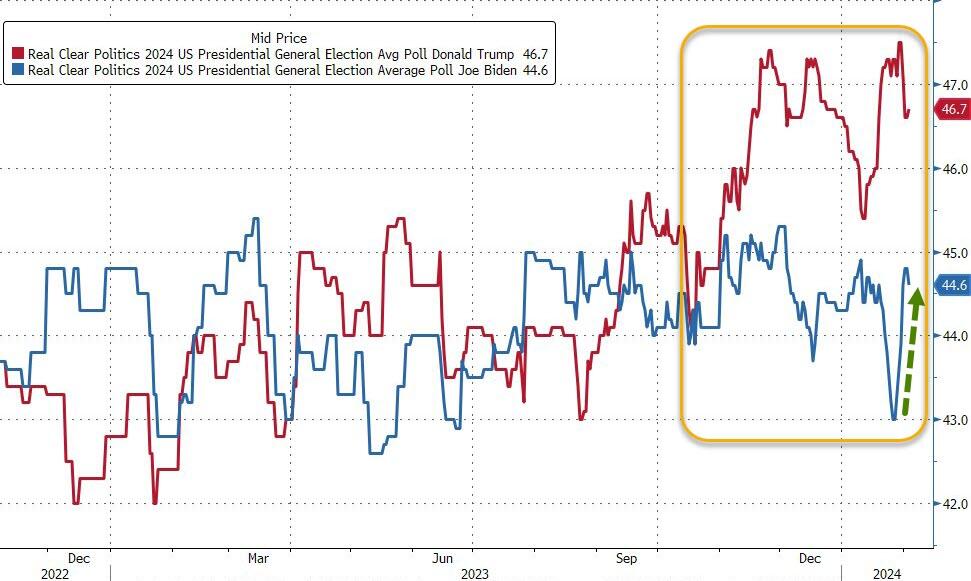
Bessent's bet appears well based as the polls (averaged by Real Clear Politics), Trump has a solid lead over Biden (although Biden - for some reason - saw a surge in the last few days?)...

Source: Bloomberg
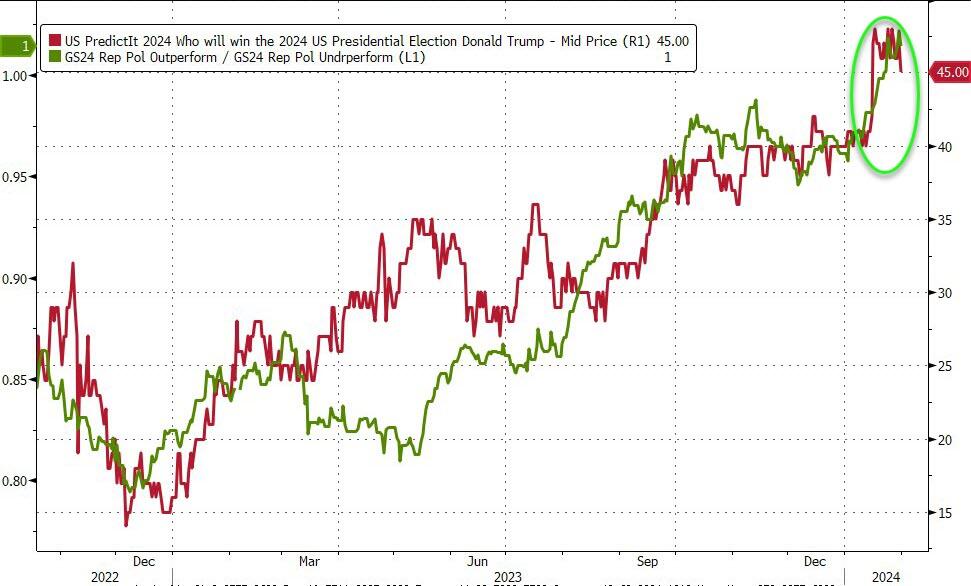
“Markets are now anchoring on the potential market-friendly policies of a Trump victory on Nov. 5,” Bessent wrote Wednesday to investors in his Key Square Capital Management macro fund.
And he is right, as we detailed previously, 2024 Republican Policy Pair basket (full details here) has tracked Trump’s victory odds since late 2022... notably tracking very tightly with the recent surge in Trump's odds...
Source: Bloomberg
Investors anticipating a Trump victory also expect “an extended market-friendly economic, tax and regulatory environment,” Bessent wrote.
So far the so-called improvement in economic conditions has only had a limited impact on voter sentiment about the economy.
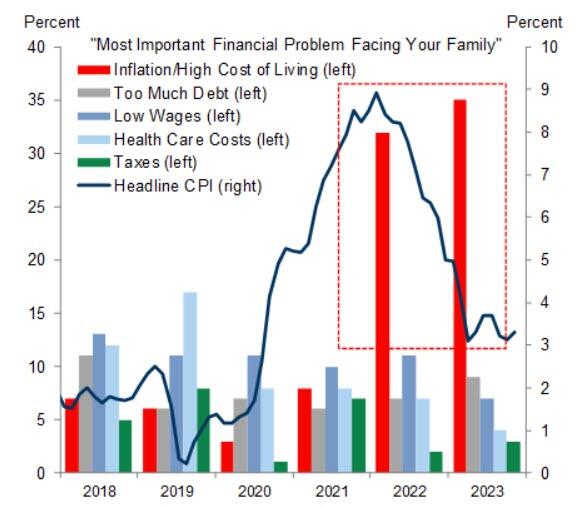
As Goldman shows in the chart below, voters still rated inflation as the most important financial problem for their family in 2023, despite its pace slowing...
Source: Goldman Sachs
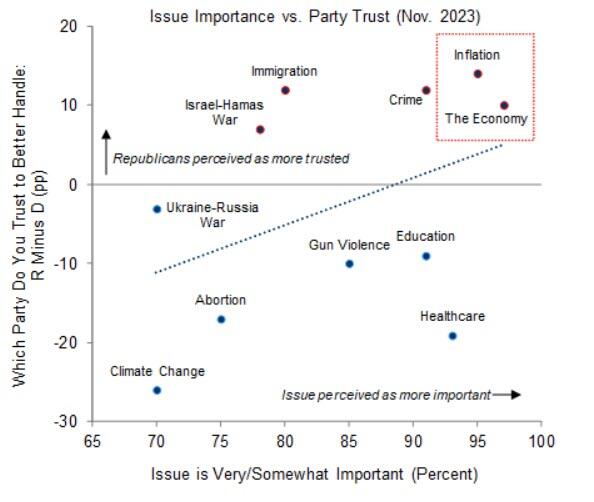
...and that is a positive for Trump as Goldman shows that Republicans score higher when voters are asked which party they trust more to handle inflation and the economy...
Source: Goldman Sachs
And, as Bessent wrote, don't expect a shift any time soon... “The Biden White House economic team has already thrown cold water on a renewal of most Trump-era tax cuts and called for higher taxes on corporates and upper-income Americans."
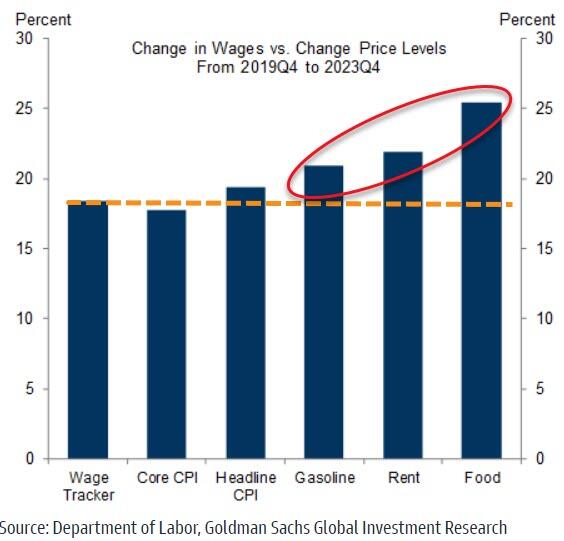
While the Biden White House keeps exclaiming that 'real incomes are rising... so STFU and say thank you America', the fact is that aggregate incomes have risen less than the cost of gasoline, food, and rent - so unless you're homeless and on full welfare,,, this explains the lack of 'belief' in Bidenomics...
Finally, Trump’s success in the polls is also influencing policymakers, according to Bessent. The Biden administration is inclined to “keep the economy buoyant, provide ample liquidity, contain interest rates” and avoid blowups such as the collapse of Silicon Valley Bank last year, he wrote.
Bessent also pointed to Fed Chair Jay Powell’s “dovish pivot” in December when he signaled rate cuts were ahead rather than more hikes.
“While we don’t think the Fed is an explicitly political institution, we think nearly all of Washington, DC is united in wanting to prevent the return of Donald Trump,” he wrote.
As Bloomberg reports, the hedge fund manager pushed back against the notion that another Trump administration would sow chaos, and that the former president would use his second term to seek revenge.
If re-elected, it’s likely that Trump “would seek rejuvenation/redemption,” Bessent wrote.

>>> US Gapping down

Gapping down
In reaction to earnings/guidance
:
  • SYM -18.1%, FN -14.1%, FMC -13.7%, CCK -12.8%, RMBS -10.5%, KE -10.2%, IT -8.5%, CHGG -7.5% (new CFO), JJSF -7%, LEA -5.9%, AMKR -5.5%, CRNC -5.1%, UBS -3.8%, SSD -3.7%, CHKP -3.6%, NVT -3.2%, ENR -2.3%, VVV -2%, ST -1%, WAT -0.7%
Other news:
  • UFPI -7% (increases dividend)
  • HESM -4.5% (prices secondary offerin 10.0 mln shares of Class A stock for gross proceeds of $331 mln)
  • FDMT -2.3% (commences $250 mln public offering; also files mixed shelf)
Analyst comments:
  • PLUG -6% (downgraded to Neutral from Buy at Seaport Research Partners)
  • TSLA -2.7% (downgraded to Neutral from Outperform at Daiwa Securities)
  • ITW -1.4% (downgraded to Underweight from Equal Weight at Wells Fargo)
  • MCD -0.6% (downgraded to Neutral from Buy at BTIG Research)

>>> US Gapping up

Gapping up
In reaction to earnings/guidance
:
  • PLTR +15.8%, COHR +11.7%, VRNS +7%, CHX +6.3%, PINC +6.3% (also completes strategic review process), SPOT +5.5%, BP +5.3%, AUDC +5.2%, LLY +4.8%, FI +3.7%, TM +3.5%, PNM +3.4%, NXPI +3%, GEHC +2.8%, ATHM +2.7%, BRBR +2.6%, CNC +2.3%, DCPH +2.3%, DD +2.1%, ARMK +2%, J +1.8%, ACM +1.6%, LIN +1.6%, CEIX +1.6%, VRTX +1.4% (announces positive results), SKY +1.3%, CBT +1.3%, CARR +1.3%, HIMX +1.1%, WTW +1.1%, AME +1.1%, GBDC +1%, UMC +1% (Jan revs), KKR +1%, SPG +0.9%
Other news:
  • VLRS +5% (January traffic)
  • ARVN +3.1% (Arvinas and Pfizer (PFE) announce that the U.S. FDA has granted Fast Track designation for the investigation of vepdegestrant for monotherapy in the treatment of adults with estrogen receptor positive/human growth epidermal growth factor 2 negative)
  • RPRX +2.6% (discloses MorphoSys (MOR) details following Novartis (NVS) acquisition news)
  • MOR +2% (to be acquired by Novartis AG)
  • INCY +0.8% (asset purchase agreement with MorphoSys)
  • OXY +0.7% (Berkshire Hathaway's (BRK.A) Warren Buffett bought another 4302324 shares worth approx. $245.9 mln)
Analyst comments:
  • LI +8.1% (upgraded to Buy from Hold at Deutsche Bank)
  • LPRO +3.7% (upgraded to Equal-Weight from Underweight at Morgan Stanley)
  • UPS +1.9% (upgraded to Buy from Neutral at UBS)
  • TSN +0.7% (upgraded to Neutral from Underperform at BofA Securities)

>>> Hertz Global misses by $0.31, beats on revs (8.21)

Hertz Global misses by $0.31, beats on revs (8.21)
  • Reports Q4 (Dec) loss of $1.36 per share, excluding non-recurring items, $0.31 worse than the FactSet Consensus of ($1.05); revenues rose 7.3% year/year to $2.18 bln vs the $2.15 bln FactSet Consensus.
    • Adjusted operating cash outflow of $366 million and adjusted free cash outflow of $128 million.
  • "Our business benefitted from solid demand and a stable rate environment in the fourth quarter," said Stephen Scherr, Hertz chair and chief executive officer. "Nevertheless, we continued to face headwinds related to our electric vehicle fleet and other costs throughout the quarter. We have taken steps to address those challenges and heading into 2024, we are confident that our planned reduction in EVs and cost base, along with the ongoing execution of our enhanced profitability plan, will enable us to regain our operational cadence and improve our financial performance with increasing effect into 2025."

>>> Spirit Aerosystems beats by $0.83, beats on revs; not providing guidance unt

Spirit Aerosystems beats by $0.83, beats on revs; not providing guidance until there is further clarity on the timing of Boeing (BA) 737 MAX production rate increases
  • Reports Q4 (Dec) earnings of $0.48 per share, excluding non-recurring items, $0.83 better than the FactSet Consensus of ($0.35); revenues rose 37.3% year/year to $1.81 bln vs the $1.74 bln FactSet Consensus.
  • As a result of the favorable pricing adjustments to the Boeing (BA) 787 program resulting from the Boeing MOA executed in October 2023, Spirit recorded forward loss reversals of $205.6 million and material right obligation liability reversal of $155.0 million related to the Boeing 787 program during the fourth quarter of 2023.
  • Spirit will not be providing guidance at this time until there is further clarity on the timing of 737 MAX production rate increases from our customer in relation to FAA approval and ongoing price negotiations with Airbus (EADSY).

FT : US Republicans prepare to torpedo bipartisan deal for Ukraine aid

US Republicans prepare to torpedo bipartisan deal for Ukraine aid
Donald Trump trashes Senate bill, as rift in the party threatens to kill last chance to boost funding for Kyiv

A bipartisan deal backed by President Joe Biden to deliver billions of dollars in US aid to Ukraine along with stricter immigration policies is facing a widening groundswell of resistance from Republicans in Congress, posing a major threat to its progress on Capitol Hill.

The legislation worth $118bn agreed on Sunday by Democratic and Republican negotiators in the Senate could be the last chance for the Biden administration to secure new military support for Ukraine in its defence against Russia’s invasion — alongside other national security goals including aid to Israel and Taiwan.

It also marks a rare compromise on efforts to curb immigration through the US border with Mexico, including restrictions on asylum, which has been a rallying cry for Republicans and a political liability for Democrats throughout Biden’s presidency.

But the bipartisan dealmaking has been trashed by Donald Trump in recent weeks — and the frontrunner for this year’s Republican White House nomination moved to torpedo the latest breakthrough again on Monday, just days ahead of a planned vote on the agreement in the Senate.

“This Bill is a great gift to the Democrats, and a Death Wish for The Republican Party,” the former president wrote on social media on Monday. “It takes the HORRIBLE JOB the Democrats have done on Immigration and the Border, absolves them, and puts it all squarely on the shoulders of Republicans. Don’t be STUPID!!!”

Trump, a foreign affairs isolationist, has treated the immigration crisis on the southern border as an opportunity to attack Biden as he steps up his push to win back the White House.

Within a few hours of Trump’s post, the leading Republicans in the House of Representatives — which also must approve the legislation for it to become law — issued a joint statement saying “any consideration of this Senate bill in its current form is a waste of time”.

“It is DEAD on arrival in the House,” they added.

The bill’s first legislative obstacle will be in the Senate, with a vote expected on Wednesday that would require the support of 60 of the chamber’s 100 senators.

At least 12 of the 49 Republican senators in total would have to back the bill for it to move forward as some Democrats are also expected to vote against it because they consider the border measures too draconian.

But the criticism from some Republican lawmakers has been brutal — and appears to doom its prospects.

Mike Lee, a Utah senator, called it “a betrayal of the American people” on X. Even some Republican senators close to the party leadership, which endorsed the deal, were wavering or expressing outright opposition.

“Now that I have seen the text, I have questions and serious concerns,” said John Cornyn, the Texas Republican senator who had previously encouraged the negotiations. Katie Britt, a Republican senator from Alabama, said the bill “would not stop President Biden from continuing his radical mass migration agenda”.

By late on Monday, at least 19 Republican Senators had declared they would vote against the bill, meaning it would fall at the first hurdle — another sign of the growing number and influence of isolationist hardliners on Capitol Hill as Trump extends his dominance over the party.

The expected failure of the bill also marks the latest blow to traditional Republican foreign policy hawks and political pragmatists who backed the bipartisan breakthrough, including Mitch McConnell, the party’s Senate leader. His future as leader could now be in jeopardy.

McConnell on Monday appealed for Republicans to come around and back a package that would help the US and its allies “regain the upper hand” over an “emerging axis of authoritarians” in Moscow, Beijing and Tehran.

“Make no mistake: the gauntlet has been thrown. And America needs to pick it up,” he said.

Democrats and the White House have also not given up hope the deal can at least pass the Senate.

“The $64,000 question now is whether or not senators can drown out the outside noise, drown out people like Donald Trump who want chaos, and do the right thing for America,” Chuck Schumer, the Democratic senate majority leader, said on Monday afternoon.

During a trip to Nevada on Monday, Biden was asked how the bill would pass the upper chamber. “With 60 votes, and you’re gonna watch,” the president responded.

>>> Royalty Pharma discloses MorphoSys (MOR) details following Novartis (NVS) ac

Royalty Pharma discloses MorphoSys (MOR) details following Novartis (NVS) acquisition news
  • As part of its July 2021 strategic funding partnership with MorphoSys, Royalty Pharma committed up to $2.025 billion in funding to MorphoSys to enable the acquisition of Constellation Pharmaceuticals in exchange for royalties, development funding bonds and equity.
  • Royalty Pharma is entitled to royalties on the following therapies: 3% royalty on future net sales of pelabresib, a bromodomain and extra-terminal (BET) inhibitor for myelofibrosis, in development by MorphoSys. A New Drug Application (NDA) for pelabresib is expected to be submitted in the United States and European Union in mid-2024 based on the results of the phase 3 MANIFEST-2 study. 3% royalty on future net sales of tulmimetostat, a second-generation enhancer of zeste homolog 2 (EZH2) inhibitor, which is in phase 2 development by MorphoSys for the treatment of hematological malignancies and solid tumors. Tiered, mid-single digit royalty on Tremfya, which is marketed by Johnson and Johnson for psoriasis and psoriatic arthritis, and generated sales of $3.1 billion in full-year 2023. Tiered 3.3% to 4.2% effective royalty on future net sales of trontinemab for Alzheimer's disease, in development by Roche.
  • Royalty Pharma provided MorphoSys $300 million in exchange for Development Funding Bonds. MorphoSys will make 36 consecutive payments to Royalty Pharma totaling approximately $660 million (2.2 times the funded amount) to repay the Development Funding Bonds, beginning in the fourth quarter of 2024.
  • Royalty Pharma also acquired 1,337,552 shares of MorphoSys which would be valued at approximately $100 million at Novartis' proposed acquisition price and current foreign exchange rates.