(ZH) Office Tower Vacancy Rate Hits Record High As Zombie Buildings Litter Skyli

Office Tower Vacancy Rate Hits Record High As Zombie Buildings Litter Skylines of Cities

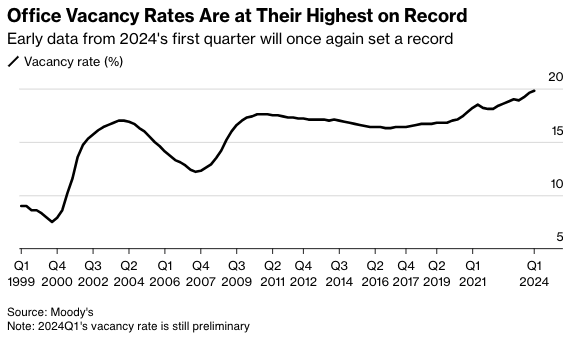
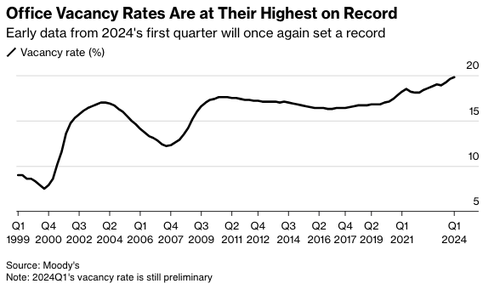
There are more dormant office towers in the United States than at any point since 1979, according to a new report from Moody's Analytics, which began tracking office leasing vacancies that year.

The rising supply of office space is due to a combination of surging remote and hybrid work that forces companies to reduce corporate footprints. Also, companies are exiting imploding progressive cities and high-taxed blue states for red ones while downsizing space.

In the report, office tower vacancies rose to a record 19.8%, up from 19.6% in the fourth quarter of 2023.

Source: Bloomberg

Even with the increase, there is an eerily calm across the commercial real estate sector. This comes as the Federal Reserve's interest rate hiking cycle is higher for longer, indicating that the pain train is nearing (perhaps after the presidential election).

"The office stress isn't quite done yet," Thomas LaSalvia, Moody's head of commercial real estate economics and one of the authors of the report, told Bloomberg in an interview. He noted recent positive economic indicators stave off a "perfect storm in the office sector."

"There are spots of light and there are spots of extreme darkness," LaSalvia said, adding, "This is part of a longer-term evolution where we are seeing obsolete buildings in obsolete neighborhoods."

The high office vacancy rate continues to be terrible news for landlords and developers eager to fill their buildings, and the Fed's hiking cycle has made refinancing very challenging.

Last month, Goldman's Vinay Viswanathan penned a note explaining how "office mortgages are living on borrowed time."
Viswanathan said there have been no major fireworks in CRE tower debt because the debt is being "extended and modified rather than refinanced," which "mitigates a default wave and a sharp pick-up in losses on CRE loan portfolios."

FT : Swiss private banker charged with stealing dirty money from own client

Swiss private banker charged with stealing dirty money from own client
Case is latest in a series of scandals exposing the enduring legacy of secrecy in Swiss banking

A Swiss private banker has been charged with multiple counts of theft, money laundering and fraud — and with using client funds to recapitalise illicitly the financially troubled lender he worked for.

The individual, whose anonymity is protected by Swiss criminal law, was accused by the Swiss public prosecutor on Wednesday of taking over SFr14mn ($15.4mn) in a multi-layered criminal conspiracy over seven years until 2015.

He was a board member of a small Geneva-based private bank, the name of which was also withheld in the indictment, filed in the southern Swiss city of Bellinzona.

The banker is alleged to have deposited large sums of money at his bank in his own name at the start of 2008, while in fact the money belonged to a third party, who wished to conceal its true ownership to shield his wealth from government authorities.

The banker then exploited the trust put in him by his client, the charges claimed, and stole the money outright, as well as making associates, family and friends large loans from it.

“The assets are believed to have been primarily used to finance the lifestyle enjoyed by the accused and his family,” said the prosecutor.

The fraud was uncovered after money-laundering authorities in Switzerland raised questions about large transfers made by the banker to businesses in the Dominican republic. Funds flowing back from those businesses to the banker were “of a criminal origin”, said the prosecutor.

The case is the latest in a series of scandals that have exposed the huge discretion Swiss bankers and wealth managers typically enjoy over their clients’ assets, and the potential for abuse that follows.

Despite sweeping changes to Swiss banking secrecy laws and compliance practices over the past decade and a half, the country, the world’s number one centre for offshore wealth, continues to be dogged by a steady drip of scandals.

In several recent instances, cases have come to court showing serious crimes going undetected for years thanks to a culture and system that still prizes secrecy and personal relationships.

The banker is also alleged to have routinely forged bank statements that he passed to his client, who, since he also sought to deceive the bank and money-laundering authorities, did not double check the true state of his account.

Prosecutors also claimed that the banker attempted to use at least SFr1mn of his client’s funds to try and keep his bank afloat. He invested SFr500,000 to help recapitalise the bank from the funds at one stage, and attempted to use a further SFr500,000 of the client’s money even after he had been notified that a criminal investigation against him was under way.

Instances of fraud and money laundering exposed by prosecutors raise questions over Swiss regulators’ ability to monitor and change corporate practices effectively across the country’s dozens of banks and more than 950 registered independent wealth managers.

In October, Swiss banker Benjamin G, a former employee of Julius Baer, was found guilty of stealing more than SFr22mn from the savings of an elderly Israeli-Ukrainian couple. He also routinely forged bank statements, and had been given full power of attorney over his client assets.

TechCrunch : Anthropic researchers wear down AI ethics with repeated questions

Anthropic researchers wear down AI ethics with repeated questions

How do you get an AI to answer a question it’s not supposed to? There are many such “jailbreak” techniques, and Anthropic researchers just found a new one, in which a large language model (LLM) can be convinced to tell you how to build a bomb if you prime it with a few dozen less-harmful questions first.

They call the approach “many-shot jailbreaking” and have both written a paper about it and also informed their peers in the AI community about it so it can be mitigated.

The vulnerability is a new one, resulting from the increased “context window” of the latest generation of LLMs. This is the amount of data they can hold in what you might call short-term memory, once only a few sentences but now thousands of words and even entire books.

What Anthropic’s researchers found was that these models with large context windows tend to perform better on many tasks if there are lots of examples of that task within the prompt. So if there are lots of trivia questions in the prompt (or priming document, like a big list of trivia that the model has in context), the answers actually get better over time. So a fact that it might have gotten wrong if it was the first question, it may get right if it’s the hundredth question.

But in an unexpected extension of this “in-context learning,” as it’s called, the models also get “better” at replying to inappropriate questions. So if you ask it to build a bomb right away, it will refuse. But if you ask it to answer 99 other questions of lesser harmfulness and then ask it to build a bomb … it’s a lot more likely to comply.

Why does this work? No one really understands what goes on in the tangled mess of weights that is an LLM, but clearly there is some mechanism that allows it to home in on what the user wants, as evidenced by the content in the context window. If the user wants trivia, it seems to gradually activate more latent trivia power as you ask dozens of questions. And for whatever reason, the same thing happens with users asking for dozens of inappropriate answers.

The team already informed its peers and indeed competitors about this attack, something it hopes will “foster a culture where exploits like this are openly shared among LLM providers and researchers.”

For their own mitigation, they found that although limiting the context window helps, it also has a negative effect on the model’s performance. Can’t have that — so they are working on classifying and contextualizing queries before they go to the model. Of course, that just makes it so you have a different model to fool … but at this stage, goalpost-moving in AI security is to be expected.

WSJ : Rio Tinto Faces Possible Norway Fund Divestment Over Alleged Deforestation

Rio Tinto Faces Possible Norway Fund Divestment Over Alleged Deforestation Links
The ethics adviser to the Norwegian sovereign-wealth fund has told the miner it is assessing it for alleged environmental damage in the Brazilian Amazon

The ethics adviser to Norway’s giant sovereign-wealth fund is examining whether to recommend the investor sell its multibillion-dollar stake in miner Rio Tinto because of environmental concerns, according to people familiar with the matter.

The Council on Ethics, as the adviser is called, has told Rio Tinto in recent months that it is assessing the mining company for environmental damage from its operations in the Brazilian Amazon, according to a letter viewed by The Wall Street Journal.

In the January letter, the council asked Rio Tinto for comment on its draft recommendation to exclude the company from Norway’s $1.6 trillion fund. Since then, Rio Tinto and the council have been in discussions but a final decision hasn’t been made, the people said.

The council, which is independent, plays an important role for the world’s largest sovereign-wealth fund. Its job is to scrutinize investments made by Norges Bank Investment Management, the fund’s operator, to ensure they comply with a strict set of ethical guidelines. It can then make recommendations to exclude companies from the fund or place them on an observation list.

Norges has followed every recommendation related to the environment since 2015, the council says.

Norges holds, on average, a 1.5% stake in the world’s listed companies. In recent years it has ramped up divestments related to environmental, social and corporate-governance factors. Its moves are closely watched by other sovereign-wealth funds and large pools of capital.

Getting blacklisted from the fund would be a blow for Rio Tinto, the world’s second-largest miner by market value. As of Dec. 31, Norges was one of the company’s largest shareholders, with a 2.24% stake worth some $2.7 billion.

A share sale by Norges could be a setback for Rio Tinto’s efforts to burnish its reputation after it blew up two ancient rock shelters in Australia in 2020. The company has apologized and taken steps to try to restore trust with the local indigenous community.

The council’s concerns about Rio Tinto have focused on deforestation, and its partial ownership of an operation in northern Brazil called Mineração Rio do Norte, or MRN.

MRN says it is Brazil’s largest producer of bauxite, which is used to make aluminum, with output of some 12 million tons a year.

Rio Tinto owns 22% of MRN. Its other shareholders are Glencore, with a 45% stake, and Australian miner South32, which has a 33% stake.

South32 is also in discussions with the Norwegian fund’s ethics adviser, according to people familiar with the matter. As of Dec. 31, Norges owned a 2.16% stake in South32 worth $223 million.

Norges divested from Glencore, alongside others, in 2020 because of concerns about thermal coal production.

Kjell Kristian Dørum, a chief adviser at the council, confirmed that Rio Tinto and South32 are under assessment but declined to comment further. Norges declined to comment.

A representative for South32 also declined to comment.

A spokesperson for Rio Tinto said it doesn’t manage MRN but that the latter is working to improve its environmental and social performance. Rio Tinto will continue to support those efforts, including by providing technical assistance, the spokesperson added.

MRN said mining activities in the area where it operates are subject to a rigorous environmental licensing framework, and that it operates in strict compliance with Brazilian laws and regulations. The company implements procedures to avoid and mitigate environmental impacts and has a program to restore mined areas as close as possible to their original condition, an MRN spokesperson added.

This isn’t the first time Rio Tinto has landed in the ethics adviser’s crosshairs. Norges sold its stake in the company in 2008, citing environmental damage caused by the Grasberg mine in Indonesia, in which Rio Tinto held a stake. Rio Tinto was allowed back into the fund in 2019 after the company sold its Grasberg stake for $3.5 billion.

Norway has its own history of involvement in the Amazon. Norsk Hydro, a Norwegian aluminum and renewable energy company backed by the Norwegian state, used to partially own MRN and continues to get bauxite from those operations. Spokespeople for Hydro and the Norwegian Ministry of Trade, Industry and Fisheries, which owns the stake in the company, declined to comment.

>>> US Gapping up/Gapping down

Gapping up/Gapping down

Gapping up
In reaction to earnings/guidance:

CALM +6.5% (also to pay $1/sh dividend), PLAY +6% (also increases share repurchase authorization by $100 mln), SIG +2% (raises FY25 EPS guidance following preferred shares repurchase transaction and amendment to the preferred shares agreement), LSPD +1% (announces cost reductions, share repurchase program, and reaffirms guidance)
Other news:

LENZ +32.6% (topline results from its Phase 3 CLARITY study of two investigational formulations of aceclidine, LNZ100 and LNZ101)
VNDA +26.3% (receives FDA approval for Fanapt for the acute treatment of bipolar i disorder)
ALVO +9.6% (hosts audio call for investors at 8:15 am EDT on April 3)
SGHT +7.4% (announces results of 3-yr prospective GEMINI trial and the cross-over phase of the SAHARA RCT)
FGEN +6% (topline results from Phase 1 Monotherapy Study of FG-3246)
TVGN +4.7% (to delay 10-K filing)
FEAM +4.6% (commences commercial production at 5E Boron Americas Complex)
OWL +4% (to acquire Kuvare Insurance Services LP (dba Kuvare Asset Management) for $750 mln; transactions are expected to be accretive to Blue Owl in 2024)
WISH +1.8% (announces post-closing board and mgmt team: Rishi Bajaj appointed CEO, Brett Just promoted to CFO)
DINO +1.3% (to repurchase 5 mln shares from selling shareholder at $59.22/sh)
RDNT +1.2% (announces a proposed refinancing of its term loan and revolving credit facility)
SILK +1.1% (announces launch of ENROUTE Transcarotid Neuroprotection System PLUS)
Analyst comments:

UPS +1% (upgraded to Buy from Neutral at Redburn Atlantic)
HOLX +0.7% (upgraded to Buy from Neutral at Citigroup)
Gapping down

News:

INTC -4.3% (outlines new reporting structure to reflect transition to foundry model; expects Intel Foundry operating losses to peak in 2024; provides historical financial metrics for new reporting segments)
MNMD -3.5% (stock offering by selling shareholders)
DJT -2.7% (amended 8-K to correct a scrivener's error contained in the audit opinion of Adeptus Partners; also amends 10-K)
RNA -2.3% (files for 24,255,624 shares of common stock)
ORGO -2.3% (announces favorable court ruling dismissing securities fraud case)
Analyst comments:

WOLF -2.3% (downgraded to Equal Weight from Overweight at Wells Fargo)
ALLY -1.8% (downgraded to Underweight from Neutral at JP Morgan)
DLTR -0.6% (downgraded to Hold from Buy at Gordon Haskett)
LOW -0.6% (downgraded to Hold from Accumulate at Gordon Haskett)

>>> US Early premarket gappers

Early premarket gappers

Gapping up:
VNDA +24.3%, FEAM +16%, SGHT +12.9%, PLAY +7.1%, CALM +6.9%, TVGN +4.7%, OWL +2.5%, WISH +1.8%, EVLV +1.7%, ADPT +1.3%, RDNT +1.2%, SILK +1.1%, DINO +0.9%, MNKD +0.9%
Gapping down:
INTC -5.3%, DJT -4.6%, FGEN -2.8%, MNMD -2.3%, RNA -2.2%, PVH -1.2%, GMAB -0.7%

FT : Abolishing AT1s would be a serious mistake

Abolishing AT1s would be a serious mistake
Dutch government has floated idea of ditching capital instrument that is indispensable for issuers and investors

The Dutch government has recently floated the idea of abolishing a capital instrument known as an AT1 in response to the turmoil created following the collapse of Credit Suisse one year ago. The argument is that investors still don’t fully understand the securities. 

Such a move would be a serious mistake. While AT1s — or Additional Tier 1 securities to give them their full name — remain a complex asset class, they perform a valuable function, absorbing losses when banks are stressed. They continue to be indispensable for issuers and investors.

In roughly 10-plus years of existence, approximately $250bn of AT1 capital has been raised for European banks. It is risible to think that the recapitalisation of the European financial system and the subsequent restructuring of balance sheets and business models could have taken place without this hybrid class of securities. 

Yet, in the sale of Credit Suisse to UBS, the stricken bank’s AT1s were written down to zero and subordinated to equity holders, who received a cash consideration for their shares. While the procedure may have been strictly legal per the fine print of the securities’ prospectuses, this inversion of the normal “waterfall” of cash flow through the capital structure of Credit Suisse was completely unprecedented. It led to an extreme sell-off of the AT1 market in the following weeks.

This abated only when investors learned that similar language did not exist outside Switzerland, thanks in large part to EU bank regulators, who swiftly distanced themselves from the Swiss. Similar sell-offs occurred in February 2016 over concerns about the ability of Deutsche Bank to pay AT1 coupons and in March 2020 at the start of the Covid-19 lockdowns. In both cases markets recovered as the panic settled — as they did again last year.

Indeed, regulators are mistaken in assuming that the market panic from Credit Suisse is in any way indicative of their lack of value to investors. For countless failing banks — including Credit Suisse — AT1s did the very job they were meant to do, namely provide an additional buffer to facilitate a smooth resolution. 

And even now, as market size reaches an equilibrium, the securities have an important role to play in the capital structure of financial institutions. As banks’ capital positions and profitability improve, risk premiums will continue to shrink and AT1s will become tools to allow flexible management of capital mix. This is especially the case if regulators allow an increase in the AT1 portion of loss-bearing capital. 

The appetite to hold more common stock of barely profitable institutions was non-existent in the early days of recovery from both the 2007-08 financial crisis and later eurozone sovereign debt troubles. AT1s have also benefited stronger banks, which have been able to avoid further dilutive equity raises, thereby bolstering their returns and leading to a normalisation of the sector. The conditions that have made the securities attractive are unlikely to change anytime soon, as low economic growth and high structural barriers to cost-cutting limit the scope for significant increases in profitability. 

This is not to say that AT1s cannot be improved. One of the dilemmas faced by stressed banks is that high coupons lead to valuable capital leakage out from the bank at the worst possible time. Skipping a coupon can quickly spiral into existential risk. This is not the same with skipped dividends, which remain as equity that might be paid out later if not needed. So why not do the same with AT1 coupons? 

Removing the cliff-edge would greatly reduce the stigma of coupon skips and aid in capital management in difficult moments. Further efforts should also continue to standardise terms. The “Swiss variation” should be eliminated to bring those issues in line with other jurisdictions. Increasing standardisation and transparency will catalyse a further maturation of the market.

Rather than making heavy-handed interventions in the market, regulators should carefully consider the function of AT1s, as time and time again, they have proved their own value. The AT1 market, while complex, has been a resounding success and it would be wrong to eliminate it. 

Perhaps, later down the line, issuers may find themselves in a position where they no longer want to have any AT1s outstanding because costs remain prohibitive against retained equity. Perhaps the instruments will one day outlive their usefulness. But that’s for the market to decide, and regulators should avoid trying to fix what isn’t broken.

FT : Venture capital reckons with the end of ‘megafund’ era

Venture capital reckons with the end of ‘megafund’ era
Data shows a ‘sustained slowdown’ has persisted in the first quarter of 2024 as a lack of exit options weighs on fundraising efforts

Venture capitalists are struggling to raise money, signalling the end of an era of “megafunds” and a slowdown in start-up dealmaking over the coming years.

Globally, venture firms raised $30.4bn from university endowments, foundations and other institutional investors in the first three months of this year, a marked slowdown from 2023 — which itself was the worst year for fundraising since 2016, according to private markets data provider PitchBook.

Investors in venture funds, known as limited partners, have reined in spending over the past two years, taking a more cautious approach as interest rates have risen, start-up exits including public listings and sales have slowed and returns from venture fund managers have cratered.

“Why has there been such a sustained slowdown? At the core of the issue is exits,” said Kaidi Gao, a venture capital analyst at PitchBook. A resurgence in initial public offerings or sales would allow LPs to recoup their invested capital and recycle it.

“Unless we see meaningful improvements from the exit market we’re expecting fundraising difficulties to linger and that will put downward pressure on dealmaking,” Gao added.

Fundraising activity has slowed sharply since 2021, when VCs hauled in $555bn. Last year, they raised a third of that total, and activity has continued to slow, putting venture investors on course for their worst fundraising year since 2015.

In the US, just $9.3bn in capital was raised in the first three months of this year, roughly a tenth of the total raised in 2023.

“We want to be there for our partners, but we don’t want to put ourselves in a hole,” said the chief investment officer at one big US foundation. He pointed out that he and other LPs had written ever-larger cheques as the market boomed but are yet to see a return because exit activity has stalled. “It’s tough maths for a lot of investors.”


The sluggish pace of fundraising is an ominous sign for start-ups, who rely on VC investment to grow in their earliest stages. It continues a sharp reversal in VC firms’ fortunes since 2021, when they spent a record $747.5bn in 2021, according to PitchBook. The splurge was made possible in large part by the advent of “megafunds” — vehicles of $5bn-$10bn that created a period of unprecedented abundance for start-ups.

That era is now over, according to PitchBook: Fundraising data for the first quarter “shows there may be no appetite for such vehicles in today’s market”.

Some of the biggest spenders in the boom years — including Tiger Global, Coatue, SoftBank and Insight Partners — have cut the size of their funds and slowed the pace of their investment.

Tiger closed its 16th fund last week, having received $2.2bn in investor commitments. The firm’s last fund was a $12.7bn vehicle raised in 2021. Insight, which raised $20bn in 2022, has also pared back ambitions for its latest fund.

The chief investment officer said: “I would be very surprised if in five years the industry hasn’t shrunk by half. The returns aren’t there . . . Usually the depth of the downturn is in proportion to the magnitude of the bubble, which would imply we’re in for a brutal time.”

VCs are now gambling that a boom in artificial intelligence will provide a generational opportunity and help “overcome the sins of 2020 to 2022”, said Venky Ganesan, partner at Silicon Valley firm Menlo Ventures. “Every venture firm is chasing the AI unicorn. Some are going to get it and will thrive, those who don’t will be sent to the dustbin of history,” he said.

VCs that raised large funds before the market turned still have billions of dollars of “dry powder”, but have been reluctant to invest in start-ups whose valuations have been rocked by higher rates.

Increasingly, they are focused on helping companies already in their portfolios towards exits which would then allow VCs to return capital to their own limited partners.

A smattering of successful public listings for venture-backed companies, including social media site Reddit and chip company Astera Labs last month, have raised hopes for a more widespread revival of the US IPO market. Rubrik, a data security start-up, filed for an IPO earlier this week.

But Gao cautioned it would take more than a handful of successful public debuts to kick-start the market.

“When [marketing automation software company] Klaviyo and [online grocery start-up] Instacart went public last September, there was a lot of excitement about this being the restart of IPOs, but there were lots of [share price] fluctuations,” she said. “It’s not just about the splashy IPO debut, we need to give it more time to see how performance has stabilised.”
>>> Europe : Brokers Upgrades & Downgrades - 3rd of April 2024 V2(+)

>>> Up
* Acciona Energia Raised to Neutral at Citi; PT 20 euros (+)
* Fortnox Raised to Buy at DNB Markets; PT 85 kronor (+)
* JOST Werke SE Raised to Buy at Quirin Privatbank AG; PT 53 euros
* Konecranes PT Raised to 64 euros from 57 euros at Nordea (+)
* Lindab PT Raised to 270 kronor from 240 kronor at Nordea (+)
* Rheinmetall PT Raised to 705 euros at Bankhaus Metzler
* Santander Raised to Buy at DZ Bank; PT 5.30 euros (+)
* Segro Raised to Overweight at Barclays; PT 1,000 pence
* UPS Raised to Buy at Redburn; PT $150
* WDP Raised to Overweight at Barclays; PT 29.50 euros

>>> Down
* Axfood Cut to Hold at Carnegie
* Civitanavi Systems Cut to Hold at Berenberg
* CTS Eventim Cut to Neutral at Redburn; PT 84 euros (+)
* Idorsia PT Cut to 1 Swiss franc at Morgan Stanley
* Intrum Cut to Sell at ABG; PT 20 kronor
* Iren Cut to Neutral at Mediobanca SpA; PT 2.70 euros
* Kitron Cut to Hold at Arctic Securities; PT 37 kroner (+)
* Nordic Semiconductor Cut to Sell at Arctic Securities
* Pattern Cut to Neutral at Corporate Family Office; PT 7 euros
* Rovi Cut to Neutral at Oddo BHF; PT 83 euros
* Scor Cut to Neutral at Mediobanca SpA; PT 35 euros (+)
* Sparebank 1 Oestlandet Cut to Hold at Carnegie (+)
* SSAB Cut to Hold at Handelsbanken (+)
* Tesla PT Cut to $160 from $180 at Cowen
* Topps Tiles Cut to Hold at Liberum; PT 40 pence (+)
* Verbund Cut to Sell at Stifel; PT 55 euros

>>> Initiation
* Eurogroup Laminations Rated New Buy at Equita; PT 5.30 euros (+)
* Eutelsat Reinstated Underperform at Oddo BHF; PT 3 euros
* First Solar Rated New Add at Huatai Research; PT $182
* Hemnet Rated New Outperform at BNPP Exane; PT 440 kronor
* Implenia Rated New Outperform at Oddo BHF; PT 41 Swiss francs (+)
* Ignitis Grupe AB Rated New Sponsored at Norne Securities (+)
* Interparfums Rated New Buy at Stifel; PT 62 euros
* Victrex Reinstated Buy at Investec; PT 1,538 pence

>>> Call
* Citi’s Montagu Says Equity Flows Indicate Room for Further Gains (+)
* Genmab’s ProfoundBio Deal Will Boost Pipeline, Kempen Says (+)
* Infineon Upgraded at Morgan Stanley With Bad News Priced In
* Morgan Stanley’s Shalett Says Stay Clear of ‘Overbought’ S&P 500
* Scandic Cut at Morgan Stanley, Positive on Accor and Whitbread
* Scandic Downgraded at Morgan Stanley: Europe Research Digest (+)
* Segro, De Pauw Upgraded at Barclays on Warehouse Outlook (+)
* Soitec Downgraded at Morgan Stanley on Inventory Correction