>>> Europe : Brokers Upgrades & Downgrades - 4th of April 2024

>>> Up
* Avis Budget Raised to Neutral at Goldman; PT $130
* CompuGroup Raised to Overweight at Morgan Stanley; PT 37 euros
* Elisa Raised to Buy at SEB Equities; PT 47 euros
* Lloyds Raised to Outperform at KBW; PT 60 pence
* Mitie PT Raised to 145 pence from 125 pence at Jefferies
* NatWest Raised to Market Perform at KBW; PT 275 pence
* Revenio Raised to Accumulate at Inderes; PT 28 euros

>>> Down
* Buzzi SpA Cut to Hold at Intesa Sanpaolo; PT 40.50 euros
* Byggfakta Group Nordic Holdco Cut to Hold at DNB Markets
* Celanese Cut to Underweight at JPMorgan; PT $160
* Epiroc Cut to Hold at Pareto Securities; PT 220 kronor
* Ferrari Cut to Equal-Weight at Barclays; PT $433.76
* Givaudan Cut to Reduce at Baader Helvea
* Hershey PT Cut to $170 from $183 at Morgan Stanley
* Hertz Cut to Sell at Goldman; PT $7
* NIBE Industrier Cut to Sell at ABG; PT 40 kronor
* Securitas Cut to Hold at Nordea

>>> Initiation
* 4imprint Re-Initiated Buy at Berenberg; PT 7,365 pence
* Unite Group Reinstated Outperform at BNPP Exane; PT 1,200 pence
* Xior Rated New Underperform at BNPP Exane; PT 24 euros

>>> Call
* Carlsberg Risks Skewed to Upside, Citi Opens Catalyst Watch
* CompuGroup Raised at Morgan Stanley, Downgrade Cycle Is Over
* Givaudan Cut at Baader Helvea, High Quality But High Valuation
* Stifel’s Bannister Says Bitcoin’s Top Is Bad Sign for US Stocks
* Swedish Bank PTs Cut at Morgan Stanley on Soft NII Momentum

>>> What to look at today - 4th of April 2024

Stocks in Asia gained ahead of key US jobs data due Friday, after Jerome Powell reaffirmed that the Federal Reserve will likely lower rates this year. Benchmarks rose from Australia to Japan and South Korea, with the Topix index up as much as 1.7% to head for its best day in about two weeks. Markets in Hong Kong, mainland China and Taiwan are closed for a holiday. 
US equity futures also increased in Asian trading after modest gains on Wall Street Wednesday. The dollar’s recent retreat has eased pressure on the region’s equities, which have been searching for a clear direction after delivering their best first quarter since 2019. A gauge for the greenback steadied after it saw its biggest drop in nearly four weeks on Wednesday as price pressures in the US services industry eased. Fed Chair Powell reiterated that the central bank will take a wait-and-see approach before reducing borrowing costs. However, his views that recent inflation figures did not “materially change” the overall picture offered support for risk assets. In recent days, traders had scaled back their rate-cut expectations amid signs of economic resilience and a more cautious tone from a drumbeat of Fed officials. That has led to skepticism on whether Powell and his colleagues would be able to deliver on the central bank’s projection of three rate reductions this year. Treasuries were steady after ending broadly higher Wednesday following a minor rally tilted toward the front end of the curve. In Japan, the breakeven inflation rate for the 10-year CPI-linked bonds rose one basis point to a record high. Elsewhere, gold held near a fresh record set Wednesday, when it topped $2,300 per ounce in a rally helped along by Powell’s support for potential rate cuts this year. West Texas Intermediate extended gains, poised for its fifth straight session of advances, leaving the US benchmark price at around $85 per barrel. Meanwhile, copper jumped to the highest since January 2023 amid fresh signs of demand. Investors were also assessing the impact of the strongest earthquake to hit Taiwan in a quarter of a century. The shock killed at least nine people and has disrupted semiconductor production. Taiwan Semiconductor Manufacturing Co., a major supplier of chips to Apple Inc. and Nvidia Corp, moved some staff out of its production centers but said there was “no damage to critical tools”.  Shares in Samsung Electronics and SK Hynix rose on expectations for higher chip prices due to production disruptions in Taiwan caused by the island’s latest earthquake. The yen was steady against the dollar Thursday. Former Bank of Japan board member Makoto Sakurai had said Wednesday that the central bank is likely to wait until around October before mulling another interest rate hike. Despite a “solid” outlook for a US soft landing, stock investors’ expectations have gotten stretched, according to a note from Morgan Stanley’s global investment committee. The dynamic provides an opportunity to seek opportunities outside the S&P 500, 
The US equity benchmark’s rally was driven by multiples expansion, with investors expecting improving profits despite cooling growth, Morgan Stanley Wealth Management Chief Investment Officer Lisa Shalett wrote this week. Investors appear to be showing “persistent” demand for US stocks, according to Citigroup Inc. strategists, suggesting there’s room for the rally to resume after the recent pullback. More than $16 billion in net long positions was added to S&P 500 futures last week, while exchange-traded funds showed net inflows, strategists led by Chris Montagu wrote this week. US After Hours SLP +7.3%, LEVI +7.2%, BB +5.5% higher on earnings; MGNX +10.2% higher on phase 2 data; RGP -4.5% lower on earnings.

Nikkei +0.91% Hang Seng -1.22% CSI -0.36% Shanghai -0.18% Shenzen -0.66%

Eur$ 1.0846 CNH 7.2487 CNY 7.2332 JPY 151.68 GBP 1.2658 CHF 0.9032 RUB 92.3148 TRY 31.9591 WTI$ 85.64 +0.25% Gold 2,298.50 -0.06% BTC 65,430 -0.47% ETH 3,287 -0.60%

S&P +0.21% Nasdaq +0.33% EuroStoxx -0.08% FTSE +0.09% Dax -0.11% SMI -0.12%

Macro :
- Italy Won’t Meet EU’s 3% Deficit Target Until at Least 2026
- Israel’s Gantz Ups Ante With Netanyahu by Calling for Early Vote

Keep an eye on :
- AV/ LN : UK’s Aviva Taps Australia Pension Funds for Private Market Deals
- BESI NA : Besi's Sales Could Be Boosted by SK Hynix's US Investment: React
- DNO NO : DNO Says Tawke License Output Restored After Kurdistan Flooding
- Euroleague : EuroLeague Taps LionTree as It Explores Sale of Minority Stake
- GLJ GY : Grenke 1Q Factoring New Business Volume EU212.9M
- HEIA NA : Heineken Nigeria to Raise 600b Naira of Capital to Curb Debt
- IMCD NA : IMCD Holder Offers Up to 2.1m Shares via JPMorgan: Terms
- IRBT US : IRobot Jumps on Report Apple Exploring Home-Robot Development
- OR FP : L’Oreal Is Said to Eye Stake in €3 Billion Perfume Brand Amouage
- MED SW : Medartis Offers ~CHF115M Senior Convertible Bonds of Due 2031
- RDC GY : Redcare Pharmacy NV Prelim 1Q Revenue EU560M
- RIO LN : Norway’s $1.5 Trillion Fund Raises Concerns With Rio Over Mine
- S30 FP : Solutions 30 FY Adjusted Ebitda Beats Estimates
- SAABB SS : Saab CFO Christian Luiga to Leave the Company
- SAN FP : Sanofi Agrees to Settle About 5,000 Zantac Cancer Suits in US
- SGO FP : Saint-Gobain to Buy Bailey Group Cos. for C$880M in Cash
- SRG IM : Snam to Boost Stake in Adriatic LNG to 30%
- SOLB BB : *SOLVAY ADRS JUMP ON MENTION AT SOHN, UP 19%
- TIT IM : Telecom Italia May Get €1 Billion From Italy After Ruling
- UBSG SW : Swiss Finma Seeks to Block Access to Credit Suisse AT1 Files: FT
- UCB BB : UCB Says FDA Accepts Supplemental Applications for Bimzelx
- US IM : UnipolSai: Board Unanimously Deems EU2.70/Shr Bid by Unipol Fair
- VOW GY : Chinese Electric Trucks Are Set to Take on Europe, CEO Says

FT : What next for Britain’s broken railways?

What next for Britain’s broken railways?
After years of quiet renationalisation, reform of the network is desperately needed

Successive Conservative administrations have quietly and reluctantly renationalised large parts of Britain’s railways in a process that was accelerated by the impact of the pandemic, reversing a 30-year legacy of privatisation.

But the industry is on the cusp of significant reform, with both politicians and industry bosses agreeing a wholesale rethink of the railway’s structure is needed, whichever party wins the election expected this year.

Almost 40 per cent of passenger mainline rail travel in Britain is now by trains directly controlled by the state, after ministers were forced to bail out privatised operators as they ran into trouble in recent years, according to an FT analysis of official data.

Emergency measures introduced in 2020 at the start of the pandemic have also ripped up the franchising model that lay at the heart of rail privatisation and was designed to encourage operators to maximise revenues in return for a slice of any profits.

It has left ministers and civil servants responsible for the financial and operational decisions of all rail operators, whether or not they have been renationalised. Train companies are reduced to contractors running services to a timetable determined in Whitehall.

“This can’t possibly be a sustainable way of managing the rail system going forward,” said Andrew Haines, boss of Network Rail, the state-owned infrastructure body, who also heads up the Great British Railways Transition Team (GBRTT), a new interim public organisation set up in 2021 to bring management of train and track back under one roof.

“It is a level of direct government control being perpetuated that is literally without precedent in my lifetime. Much more so than British Rail,” he added, referring to the former UK state-owned rail company pre-privatisation.


With the status of the railways in flux and suffering from long-running strikes, passengers have seen a sharp fall in service. Some 5 per cent of trains were cancelled in the last quarter of 2023, the worst performance since at least 2016.

“The system could work a lot better . . . the railways are in limbo,” said Chris Page, chair of Rail Future, a campaign group which represents rail users.

Should Labour win the election expected this year — it holds an average 20-point lead in the opinion polls — the industry would be formally nationalised, albeit only gradually as the majority of contracts come to an end during the next parliament.

The Conservatives have also pledged to bring in significant structural changes if they defy expectations and form the next government. These include formalising Great British Railways as a public body with a mandate to cut state subsidies by giving train companies greater commercial freedoms while also aiming to reprivatise nationalised operators.

Whichever party wins, the biggest challenge will be reversing the substantial fall in passenger revenues triggered by the pandemic and exacerbated by the subsequent collapse of high-margin commuter and business traffic.

According to the latest data available from industry regulator the Office of Rail and Road, fare income had recovered to 68 per cent of pre-pandemic levels by the end of March 2023. More recent traffic figures show that passenger numbers returned to 82 per cent by the end of last year.


Like other large national networks, Britain’s railway has long relied on some level of public funding, with much of it channelled through Network Rail to maintain and upgrade the existing infrastructure.

But when the pandemic hit in early 2020, ministers were forced to provide huge subsidies to keep passenger services running. The FT calculated that in the three years to April 2023, the government spent £23bn to plug the losses from ticket sales. This contrasts with a net £3.8bn returned by franchised rail operators to the taxpayer over the decade to March 2019.

Many regional operators, including ScotRail in Scotland and Northern, which mainly serves northern England, have long required government support.

But under the system brought in during the pandemic, the government pays all train operators a fee — typically between 1 to 2 per cent of their cost base — to run trains to tightly specified instructions.

Industry executives said this leaves them with no incentive to grow traffic or flexibility to respond to changing travel patterns. 

“What we have got is a stop-gap system no one thinks is working,” said Andy Bagnall, of Rail Partners, a lobby group for private train operators.


The system is further hamstrung by tight government control over the railway finances. The Department for Transport sets the budget for train operators a year in advance, which prevents them from reinvesting any revenues generated from ticket sales to respond dynamically to changes in demand.

The head of one rail operator said the arrangement meant he could not put extra trains on a popular route even when the data showed they would have generated a profit.

“The contracts were meant to be very flexible and uber dynamic, but because of the general financial challenge, and secondly the split of cost and revenue they have ended up not being at all flexible,” Haines said. 

Although transport secretary Mark Harper last year acknowledged the existing set-up was “nonsense” and “mad”, the government’s reform agenda has stalled. The glacial pace is epitomised by a three-year gap between the publication of a policy document on rail reform in 2021 and the draft legislation in February this year.

The draft bill has been welcomed by many in the industry. It would create Great British Railways and give it powers to put train services back on a commercial footing.

“We just need a clear path forward . . . I think we need to look at [the reform debate] as an opportunity to find the things that we need to do differently to move forward,” said David Brown, head of Arriva’s UK train business, which runs two national rail contracts, and the chair of RDG, the industry trade body.

“You need a body that is away from day-to-day political involvement, but can be business-like, and harness the value of the public and private sector,” he added.

The government said it had “set out a clear plan for the future of our railways”, which would “make the most of industry expertise while putting passengers and freight customers first.”

But Harper has acknowledged the reforms are not a government priority, which means the draft bill is unlikely to get any further before the election, leaving question marks over the future role of private operators. 

Labour leader Sir Keir Starmer has pledged to fully nationalise the rail industry. This has the support of the unions, which have long campaigned against privatisation and disrupted services for the last two years in a dispute over pay.

“We support the creation of an integrated, unified, publicly owned railway. This would unite track and trains in a single publicly owned company,” said Mick Lynch, general secretary of the RMT union, which settled its dispute late last year.

Labour has indicated it would set up a similar public body to Great British Railways but would not contract out the running of services to private companies. Louise Haigh, shadow transport secretary, insisted the party would enshrine rail nationalisation in its manifesto later this year.

“Under the Tories rail reform has stalled and we are on a train to nowhere,” she told the FT. “Labour will end this cycle of failure by bringing rail franchises back into public ownership as contracts expire.”

Many industry executives are frustrated by the lack of detail in Labour’s plans and have warned against completely excluding the private sector, particularly on long-distance routes where there is scope for competition between operators as well as airlines.

Bagnall said privatisation had worked, with passenger numbers doubling between the mid-1990s and 2019 and the number of train services up by a third.

“We would call on all decision makers to be pragmatic. It is not a binary choice of public versus private; if we get it right we can get the best of both worlds,” he said.

FT : Regulator fines broker-dealer for recommending leveraged ETPs

Regulator fines broker-dealer for recommending leveraged ETPs
Finra orders two Stifel divisions to pay $2.3mn after losses incurred by 381 customers who held the products too long

The US Financial Industry Regulatory Authority hit two Stifel broker-dealer divisions with $2.3mn in fines and restitution over unsuitable recommendations on leveraged exchange traded products.

The Stifel broker-dealers failed to implement policies that would limit recommendations of leveraged and inverse ETPs and ETFs to only be held briefly, according to a settlement published last week.

Instead, such products were held too long, costing 381 customers $1.3mn in total. The entities were also fined an additional $1mn in total.

Spokespersons for Stifel and Finra declined to comment.

In January 2014, Stifel Nicolaus and Stifel Independent Advisors, both St. Louis-based broker-dealer divisions of Stifel, settled with Finra for just over $1mn for failing to establish suitability policies for recommending non-traditional ETFs.

Between June 2014 and March 2018, the same two Stifel divisions implemented new policies, but they were not “reasonably designed to achieve compliance with their suitability obligations in connection with transactions” of leveraged and inverse ETPs and ETFs, the order stated.

Leveraged and inverse ETPs are designed to be held for just short periods of time, such as a single day or month, Finra warned in 2009.

“Stifel failed to take reasonable steps to detect and address hundreds of potentially unsuitable recommendations that customers buy and hold [non-traditional ETPs] for longer periods of time than they were designed to be held, resulting in realised losses for customers,” the order stated.

Stifel’s written supervisory procedures, required from the January 2014 settlement, did not require supervisors to align recommended exit or hold strategies aligned with a product such as a leveraged or inverse ETF or ETP.

Such written policies said supervisors “could consider” and discuss “the recommendation and the ‘intended exit strategy’ with the representative”, the order noted.

But they did not require these steps to be taken, “or any other steps”, and supervisors were not given any guidance on how to implement the steps, the order added.

Stifel also did not reasonably design ways to identify unsuitable recommendations of leveraged or inverse ETPs and ETFs, Finra found.

The firm implemented an alert that would notify when such products were held more than 30 days, but the firms “almost immediately deactivated this alert after it resulted in over 2,000 hits per day”.

Stifel reactivated the alert in March 2015, but the firm failed to provide supervisors “with any training on how to evaluate the red flags”, the order found, resulting in clearing of alerts without any suitability analyses.

In August 2016, Stifel brokers’ compliance departments discovered that the products were being recommended beyond their intended holding period, the order stated.

The compliance teams ordered a resulting “clean-up” effort that was insufficient, however, because supervisors were merely encouraged, not required, to speak with representatives and customers about the issue.

This led to 381 customer accounts’ receiving unsuitable recommendations to hold these products beyond their intended use, the order stated.

Affected customers included an 87-year-old who purchased a non-traditional ETP and held it for 454 days, resulting in $5,000 in losses, as well as a 77-year-old customer who purchased a “daily reset” non-traditional ETP and held it for more than a year, resulting in about $13,000 in losses.

Stifel Nicolaus was fined $920,000 and was ordered to return $1.2mn in assets to customers plus interest, while SIA was fined $80,000 and ordered to return $100,000 to customers plus interest. Finra set the interest rates at those set out in the tax code between March 2018 and March 2020.

Non-traditional ETFs, which have taken off since the Securities and Exchange Commission finalised its 2019 ETF rule, have been scrutinised and criticised by regulators.

Last May, the SEC ordered a small North Dakota-based adviser to pay out $1 million for investing client assets in leveraged ETFs. In July 2021, the SEC fined UBS Financial Services, now owned by Credit Suisse, $8mn for holding short-term, volatility-linked ETPs for customers longer than designed.

The SEC should require brokers to provide additional warnings and disclosures about certain non-traditional ETFs and ETPs at the point of sale, the SEC Investor Advisory Committee recommended last June. The advisory committee also recommended single-stock ETFs, which have exposure to only one security that is often leveraged or inverse, be renamed because they do not have the diversified qualities of other ETFs or ETPs.

The SEC should not impose additional disclosure burdens, much less ban any leveraged ETPs or ETFs, Dalia Blass, former director of the SEC’s Division of Investment Management, told Ignites.

Industry participants seeking to launch non-traditional ETPs and ETFs, including single-stock ETFs, should scrutinise their disclosures in their filings, Ryan Charles, a principal at Kelley Hunt & Charles, told Ignites last June.

>>> US After Hours Summary: SLP +7.3%, LEVI +7.2%, BB +5.5% higher on earnings;

After Hours Summary: SLP +7.3%, LEVI +7.2%, BB +5.5% higher on earnings; MGNX +10.2% higher on phase 2 data; RGP -4.5% lower on earnings

After Hours Gainers:

Companies trading higher in after hours in reaction to earnings/guidance: SLP +7.3%, LEVI +7.2%, BB +5.5%, SPWH +2.9%

Companies trading higher in after hours in reaction to news: MGNX +10.2% (provides Phase 2 TAMARACK study data), LUNR +4.2% (selected by NASA to advance capabilities for a lunar terrain vehicle), LAB +3% (enters into agreement with BMY for use of the SomaScan Platform), LNN +2.6% (acquires a 49.9% minority interest in Austria-based Pessl Instruments), PSN +1.8% (awarded a position on multiple award NASA task order contract), OPRA +1.7% (its current Google search commercial agreement has been extended), SNY +1.4% (to settle about 5,000 Zantac cancer lawsuits in US, according to Bloomberg), SMMT +1.3% (CFO steps down, COO assumes addiitonal role of CFO), KTB +1.1% (in sympathy with strong LEVI earnings), OLN +0.9% (among US epoxy resin producers filing trade cases), SD +0.9% (names new COO), RLGT +0.5% (acquires the operations of Viking Worldwide), CHTR +0.2% (Diamond Sports Group reaches multi-year renewal), RBLX +0.1% (judge allows illegal gambling lawsuit to proceed, according to The Verge), WLK +0.1% (among US epoxy resin producers filing trade cases)

After Hours Losers:

Companies trading lower in after hours in reaction to earnings/guidance: RGP -4.5% (also names new COO)

Companies trading lower in after hours in reaction to news: REPX -15.5% (commences 2.1 mln share offering), IMNM -2.1% (stock offering by selling shareholder), IRMD -1.8% (files $75 mln common stock offering), OCN -1.4% (to rebrand as Onity Group), AQST -0.9% (files $250 mln mixed shelf securities offering), GOOG -0.6% (considering charging for AI-powered search, according to FT.com), KBR -0.5% (names new CFO), CBOE -0.2% (reports March trading volumes)

Business Of Fashion : Is Chanel’s ‘Absolute Luxury’ Push Working?

Is Chanel’s ‘Absolute Luxury’ Push Working?
With the quality and price of its iconic handbags under scrutiny, the French couture giant is trying to reclaim the narrative. ‘We’re not perfect,’ fashion president Bruno Pavlovsky said.

KEY INSIGHTS
Chanel's handbags rank among the industry’s most-coveted styles, but have come under scrutiny amid rising prices and reports of declining quality.
A new campaign featuring Brad Pitt and Penelope Cruz celebrates the brand’s Classic flap bag, which "is often criticised for its price but is still the bag that embodies our brand most completely," fashion president Bruno Pavlovsky told BoF.
The executive tackled reports of declining quality head-on: "We're not perfect," Pavlovsky said. "We're aware that our positioning obligates us to always do better."
PARIS — Chanel has enlisted Hollywood A-listers Brad Pitt and Penelope Cruz as it tries to take back the narrative surrounding its iconic quilted handbags as rising prices and reports of declining quality tarnish the brand online.

In a handbag campaign first teased at Chanel’s March runway show, Pitt and Cruz re-enact scenes from Claude Lelouch’s 1966 film “A Man and a Woman,” including an iconic sequence where the film’s lovers dine with a Chanel bag sitting between them.

The multimillion-dollar campaign — the French giant’s first major accessories push in two years — has since been rolled out worldwide, and is complete with eye-catching affirmations of the brand’s most iconic codes: quilted handbags, double-C motifs, a black-and-white colour palette, Frenchness, cinema and enduring style.

For Chanel, the campaign couldn’t have come soon enough.

ADVERTISEMENT


In recent months, the house’s handbags have come under scrutiny on social media amid reports of diminished quality and a series of aggressive price hikes, the latest of which pushed the cost of a medium Classic Flap bag from Chanel above €10,000 ($10,820) for the first time, higher than the price of many sought-after Mini Kelly or Birkin styles from rival Hermès.

Brands across the luxury space have refocused their attention on top-end clients as demand from middle-class shoppers waned amid slowing economic growth and the return of spending on travel and experiences during the past year. The shift has been a boon to blue-chip luxury names like Chanel as well as Hermès, Loro Piana and Brunello Cucinelli, which also got a boost from the “quiet luxury” trend.

Still, it’s unclear how far even the wealthier Chanel customers will stretch their fashion budgets after years of price hikes intermittently explained by currency shifts, inflation or investments in supply chain and sustainability.

“We felt we needed to reaffirm this bag, which is often criticised for its price, for its positioning, but is still the bag that embodies our brand most completely,” Chanel’s president of fashion Bruno Pavlovsky said. “It’s a couturier’s bag made using couture techniques… This bag is positioned as one of the most expensive on the market. It’s a choice the brand has made; and it’s also a reality due to its fabrication. After that, there’s a whole range of smaller bags and other items which remain perfectly accessible.”

The latest rounds of price increases at Chanel have been particularly poorly received amid regular reports of declining quality at the brand, which tend to resonate on social networks like TikTok. In recent months, Chanel-obsessed content creators have complained of everything from crooked stitches to torn calfskin straps to loose or rapidly tarnishing hardware, leading some shoppers to question if one of the world’s most expensive brands is still worth it.

A $17 Billion Brand
Clearly plenty of consumers still think so. Chanel’s business has been on a tear: the privately-held fashion and beauty giant’s sales rose 17 percent in 2022 to $17 billion. While numbers for 2023 aren’t expected before May, Pavlovsky said financial performance in the fashion division has been “absolutely exceptional.”

In France, Chanel bags continued to account for three of the top 5 models in a February ranking of the most recognisable, exclusive and desirable luxury handbags, according to an analysis by Bernstein and Promise Consulting.

But Pavlovsky acknowledged the quality concerns. “We speak about creativity, about ultimate luxury. But quality is always at the heart of our preoccupations,” he said. “We’re not perfect, that’s clear. But we’re really working on all of these subjects, which are truly fundamental… We’re aware that our positioning obligates us to always do better, and we’re always trying.”

To help boost production in response to growing demand while trying to maintain standards, the brand has, in recent years, acquired a number of strategic suppliers, including five tanneries in order to help it secure the best leathers for its bags. “Between what we were making 10 years ago and today there’s a very large evolution. We’ve had to train, invest in, and engage with a great deal of people to get to where we are today,” Pavlovsky said.

Still, Pavlovsky took aim at critical videos making apples-to-oranges comparisons, such as clips showing the lustrous yellow of gold-plated archival bags shown next to more recent models whose hardware has been galvanised using far more durable (if less golden) finishes. Other items appearing in such videos could even be fakes, he suggested. “There’s 20 or 30 million bags out there in the wild; I can’t sign for all of them.”

‘Absolute Luxury’
Chanel has long promoted its brand by mixing its ultra-classic codes with fashion fabulousness on epic proportions: shows under late creative director Karl Lagerfeld included Chanel-branded rocket ships boosting off in Paris’ Grand Palais or models wearing Daft Punk-inspired helmets and tweed suits reworked to look like computer chips.

In recent years, his successor Virginie Viard has brought the brand closer to earth, ushering in a more relatable, wearable chapter for Chanel. While the brand’s double-C clad collections hardly constitute “quiet” luxury, a reinforced focus on timeless codes — as well as reinforced prices — suggest a desire to compete with Hermès, better known for purveying a 360-degree luxury lifestyle than driving the fashion agenda.

“We are positioning ourselves as a house of absolute luxury,” Pavlovsky said. “We’ve always valued creativity, but it’s not creativity for its own sake. It’s creativity as a way of looking at luxury, and always with a high attention to quality.”

Still, justifying an “absolute luxury” positioning may require more than a star-studded campaign and the supply chain upgrades the company has made thus far.

Last week, the fashion conversation on social media was focused less on Chanel’s Pitt and Cruz ads than on the eye-popping price tags on this season’s merch: could a $975 pair of Chanel logo-ed flip-flops possibly be worth it?

>>> Exxon Mobil details items that will impact Q1 results; changes in gas prices

Exxon Mobil details items that will impact Q1 results; changes in gas prices negatively impacting Q1 upstream earnings by $0.2-0.6 bln
  • Co provided estimated effects of market factors impacting 4Q23 adjusted upstream earnings compared to the $6.3 bln registered in 4Q23:
    • Change in liquids prices: $(0.4)-$0.0 bln.
    • Change in gas prices: $(0.6)-(0.2) bln.
    • Change in timing effects primarily related to unsettled derivatives (mark-to-market) and other earnings impacts: $(0.2)-0.2 bln.
    • Change in scheduled maintenance: $(0.1)-0.1 bln.
    • Absence of year-end inventory effects: $0.3 bln.

TechCrunch ; These AI startups stood out the most in Y Combinator’s Winter 2024

These AI startups stood out the most in Y Combinator’s Winter 2024 batch
Despite an overall decline in startup investing, funding for AI surged in the past year. Capital toward generative AI ventures alone nearly octupled from 2022 to 2023, reaching $25.2 billion toward the tail end of December.
So it’s not exactly surprising that AI startups dominated at Y Combinator’s Winter 2024 Demo Day.

The Y Combinator Winter 2024 cohort has 86 AI startups, according to YC’s official startup directory — nearly double the number from the Winter 2023 batch and close to triple the number from Winter 2021. Call it a bubble or overhyped, but clearly, AI is the tech of the moment.

As we did last year, we went through the newest Y Combinator cohort — the cohort presenting during this week’s Demo Day — and picked out some of the more interesting AI startups. Each made the cut for different reasons. But at a baseline, they stood out among the rest, whether for their technology, addressable market or founders’ backgrounds.


Hazel
August Chen (ex-Palantir) and Elton Lossner (ex-Boston Consulting Group) assert that the government contracting process is hopelessly broken.

Contracts are posted to thousands of different websites and can include hundreds of pages of overlapping regulations. (The U.S. federal government alone signs an estimated over 11 million contracts a year.) Responding to these bids can take the equivalent of whole business divisions, supported by outside consultants and law firms.

Chen’s and Lossner’s solution is AI to automate the government contracting discovery, drafting and compliance process. The pair — who met in college — call it Hazel.


Image Credits: Hazel

Using Hazel, users can get matched to a potential contract, generate a draft response based on the RFP and their company’s info, create a checklist of to-dos and automatically run compliance checks.

Given AI’s tendency to hallucinate, I’m a bit skeptical that Hazel’s generated responses and checks will be consistently accurate. But, if they’re even close, they could save an enormous amount of time and effort, enabling smaller firms a shot at the hundreds of billions of dollars’ worth of government contracts issued each year.

Andy AI
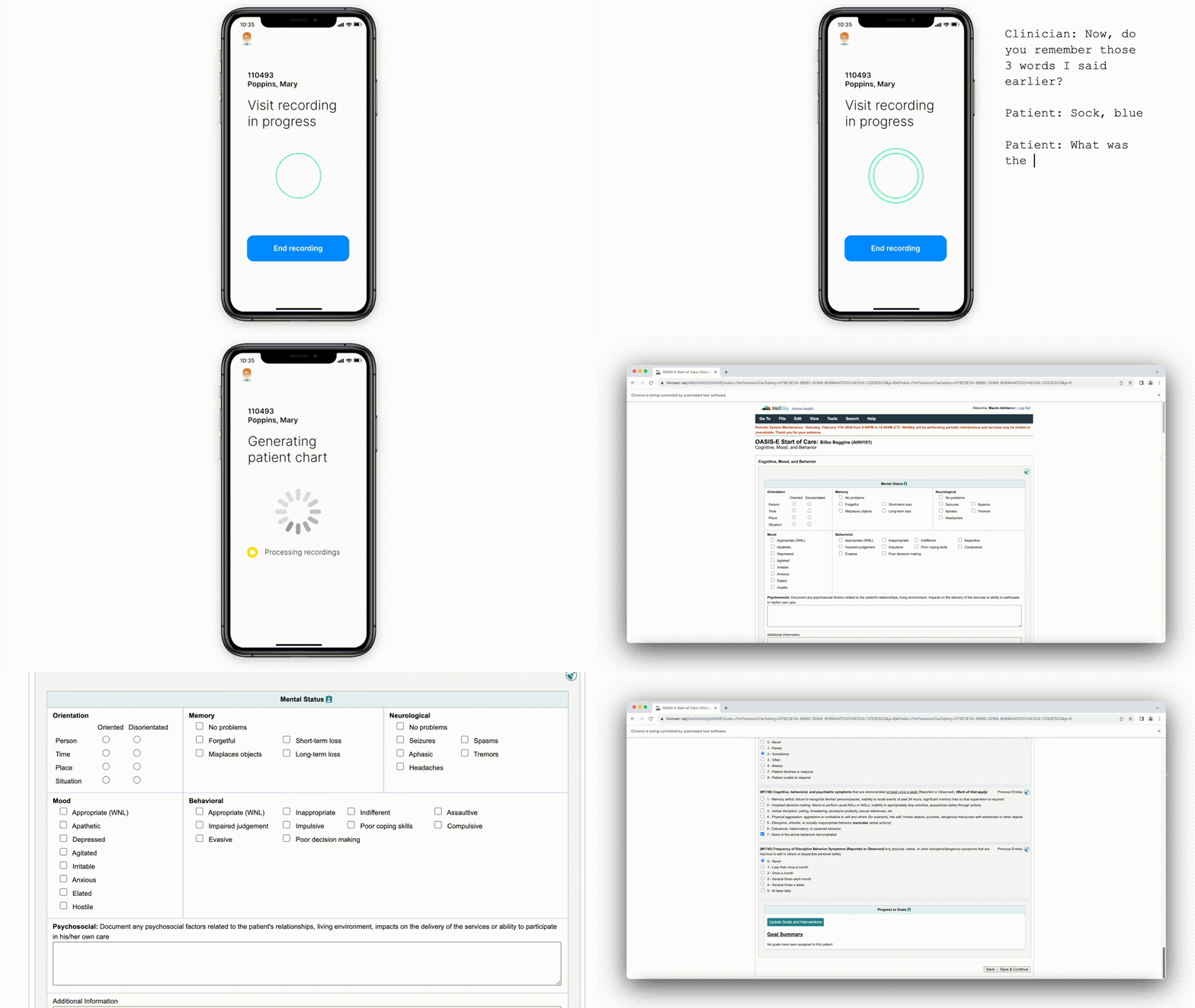
Home nurses deal with a lot of paperwork. Tiantian Zha knows this well — she previously worked at Verily, Google parent company Alphabet‘s life sciences division, where she was involved in moonshots ranging from personalized medicine to reducing mosquito-borne diseases.

In the course of her work, Zha found that documentation was a major time sink for at-home nurses. It’s a widespread issue — according to one study, nurses spend over a third of their time on documentation, cutting into time spent on patient care and contributing to burnout.

To help ease the documentation burden for nurses, Zha co-founded Andy AI with Max Akhterov, a former Apple staff engineer. Andy is essentially an AI-powered scribe, capturing and transcribing the spoken details of a patient visit and generating electronic health records.

Image Credits: Andy AI

As with any AI-powered transcription tool, there’s risk of bias — i.e. the tool not working well for some nurses and patients depending on their accents and words choices And, from a competitive standpoint, Andy isn’t exactly the first of its kind to market — rivals include DeepScribe, Heidi Health, Nabla and Amazon’s AWS HealthScribe.

But as healthcare increasingly shifts to home, the demand for apps like Andy AI seems poised to increase.

Precip
If your experience with weather apps is anything like this reporter’s, you’ve been caught in a rainstorm after blindly believing predictions of clear blue skies.
But it doesn’t have to be this way.

At least, that’s the premise of Precip, an AI-powered weather forecasting platform. Jesse Vollmar had the idea after founding FarmLogs, a startup that sold crop management software. He teamed up with Sam Pierce Lolla and Michael Asher, previously FarmLogs’ lead data scientist, to make Precip a reality.

Image Credits: Precip

Precip delivers analytics on precipitation, for example estimating the amount of rainfall in a given geographic area over the past several hours to days. Vollmar makes the claim that Precip can generate “high-precision” metrics for any location in the U.S. down to the kilometer (or two), forecasting conditions up to seven days ahead.

So what’s the value of precipitations metrics and alerts? Well, Vollmar says that farmers can use them to track crop growth, construction crews can reference them to schedule crews and utilities can tap them to anticipate service disruptions. One transportation customer checks Precip daily to avoid bad driving conditions, Vollmar claims.

Of course, there’s no shortage of weather prediction apps. But AI like Precip’s promises to make forecasts more accurate — if the AI is worth its salt, indeed.

Maia
Claire Wiley launched a couples coaching programming while studying for her MBA at Wharton. The experience led her to investigate a more tech-forward approach to relationships and therapy, which culminated in Maia.
Maia — which Wiley co-founded with Ralph Ma, a former Google Research scientist — aims to empower couples to build stronger relationships through AI-powered guidance. In Maia’s apps for Android and iOS, couples message each other in a group chat and answer daily questions like what they view as challenges to overcome, past pain points and lists of things that they’re thankful for.

Image Credits: Maia

Maia plans to make money by charging for premium features such as programs crafted by therapists and unlimited messaging. (Maia normally caps texts between partners — a frustratingly arbitrary limitation if you ask me, but so it goes.)
Wiley and Ma, both of whom come from divorced households, say that they worked with a relationship expert to craft the Maia experience. The questions in my mind, though, are (1) how sound Maia’s relationship science and (2) can it stand out in the exceptionally crowded field of couples’ apps? We’ll have to wait to see.

Datacurve
The AI models at the heart of generative AI apps like ChatGPT are trained on enormous data sets, mixes of public and proprietary data from around the web including ebooks, social media posts and personal blogs. But some of this data is legally and ethically problematic — not to mention flawed in other ways.
The distinct lack of data curation is the problem, if you ask Serena Ge and Charley Lee.

Ge and Lee co-founded Datacurve, which provides “expert-quality” data for training generative AI models.

It’s specifically code data, which Ge and Lee say is especially hard to obtain thanks to the expertise necessary to label it for AI training and restrictive usage licenses.

Image Credits: Datacurve

Datacurve hosts a gamified annotation platform that pays engineers to solve coding challenges, which contributes to Datacurve’s for-sale training data sets. Those data sets, speaking of, can be used to train models for code optimization, code generation, debugging, UI design and more, Ge and Lee say.

It’s an interesting idea to be sure. But Datacurve’s success will depend on just how well-curated its data sets are — and whether it’s able to incentivize enough devs to continue building on and improving them.