WWD : Tod’s, Diego Della Valle Give Back to Milan

Tod’s, Diego Della Valle Give Back to Milan
The restoration of Milan's city hall, sponsored by the Italian luxury group, officially kicked off on Friday.

MILAN — With one swift pull, Tod’s Group chairman and chief executive officer Diego Della Valle on Friday rolled down the curtain that hid the scaffolding covering part of the facade of Milan’s city hall, flanked by Mayor Giuseppe Sala. The event, which drew plenty of onlookers in the square where the building stands opposite the La Scala theater, signaled the beginning of the restoration works sponsored by the luxury group to the tune of 2.5 million euros. These are expected to span 16 months.

“This is the home of the Milanese, a building they love and respect and since our ambition is to complete the works by September 2025, Diego Della Valle suggested we celebrate with the city with a party and risotto with ossobuco [typical rice with a veal stew],” Sala said to a round of chuckles.

The building, Palazzo Marino, dates back to the 16th century, has housed the city hall and local administration operations since 1861 and attracts around 5,000 visitors a year. The last time it was restored was at the end of the ‘80s.

Della Valle admitted that seeing the “Tod’s for Milan” plaque appear on “one of the most representative buildings in the city” did not leave him unmoved. He has over the years invested in supporting several restoration projects — that of the Colosseum in Rome perhaps his most internationally famous — and, as he has in the past, he reiterated that he is driven by “a strong social attitude” of giving back, and not for financial gain.

He stressed that the Tod’s sign is “discreet” on the city hall in Milan as he does “not share the need to set in motion a communication invasion, taking buildings hostage, driven by commercial goals [with huge advertisements]. Of course, companies must make a profit, but we should not forget that we also have moral responsibilities,” he said.

He did not shy away from controversial issues and while conceding Milan’s stance as an international metropolis, he admitted that the ”social division is very strong” at the moment, and citizens — especially young people — are weighed down by high rents and the cost of living.

The message he wanted to deliver, he said, was not that the works are beginning but that “Milan and the country need our support and we must respond by providing it.”

The works on each of the four facades will take about four months, over a total of 54,000 square feet. The walls overlooking the courtyard, covering more than 21,600 square feet, will also be restored. The scaffolding covering the building during the work features illustrations on the history of the palazzo until today.

Architect Paolo Pecorelli, whose studio has restored the facade of the storied luxury Galleria Vittorio Emanuele II in the city, among other projects, said that “the decay of the materials employed on Palazzo Marino is not always visible, but it is dangerous, and could lead to the detachment of portions of the walls.”

In 2011, Della Valle offered to finance the work needed to restore the Colosseum in Rome through a sponsorship of 25 million euros, with a commitment that has extended for more than a decade.

Other initiatives of the group through the years include the support of Milan’s contemporary art museum PAC as well as its contribution to FAI, The National Trust for Italy, in its restoration of the hill that inspired the poem “The Infinite” by Giacomo Leopardi in the early 1800s. In addition, it implemented several social initiatives, including the education of children in need in the Barra district in Naples; support of Save the Children in its “Punti Luce” project, and a collaboration with the Patrignano community. The group also built a shoe manufacturing plant in Italy’s Arquata del Tronto in 2017, a town hit by a deadly earthquake a year earlier.

Miss Tweed : Fashion Merry-Go-Round Series: 3-Celine in talks with Alaïa’s Piete

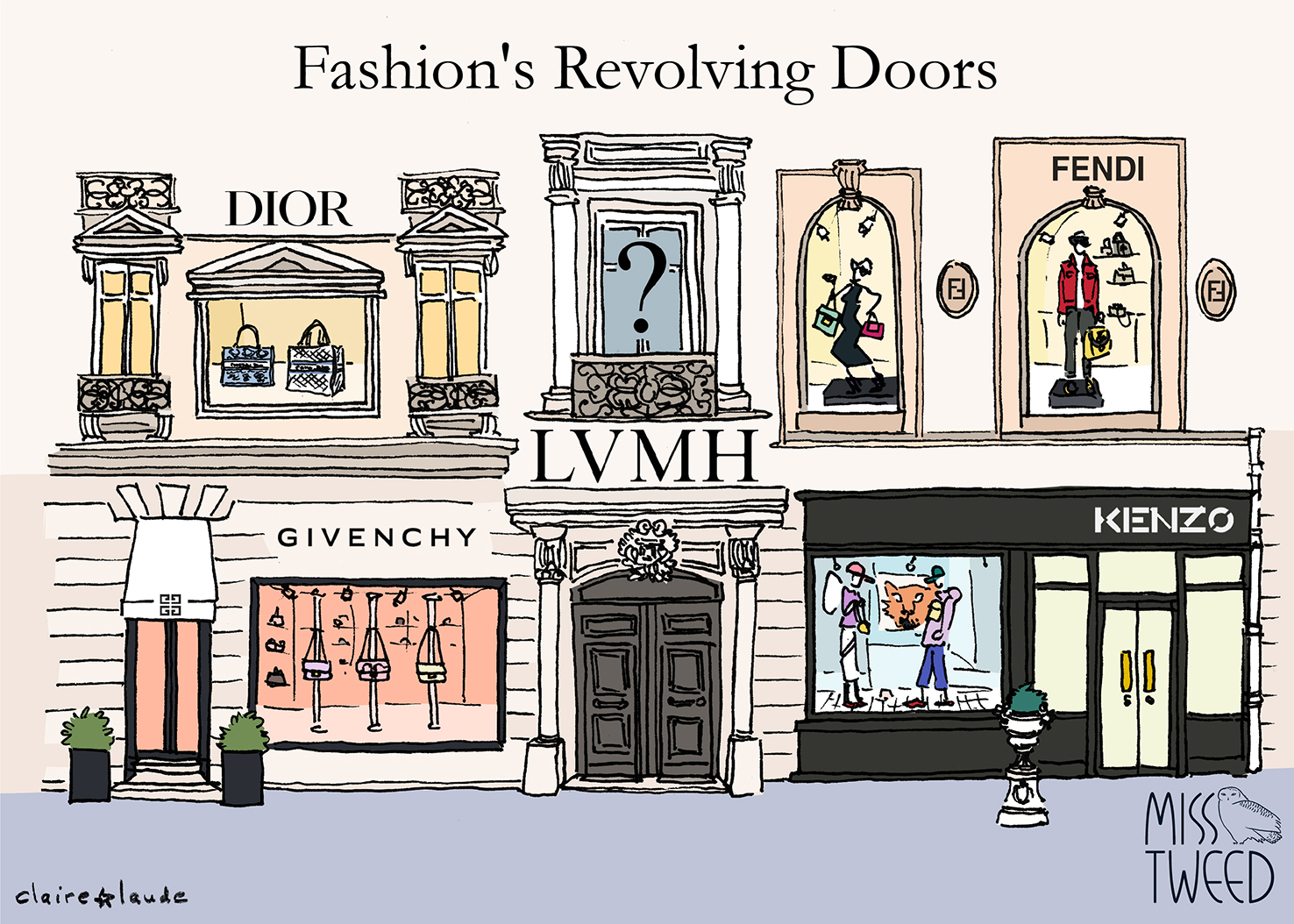
Fashion Merry-Go-Round Series: 3-Celine in talks with Alaïa’s Pieter Mulier

The departure of designer Hedi Slimane at Celine has yet to be announced but owner LVMH is not wasting any time looking for a replacement. The French group is in talks with several candidates. One of them is Alaïa’s popular creative director Pieter Mulier. If the Belgian designer gets the job, it would be great for Celine but disastrous for Richemont’s Alaïa, industry sources have said.

Celine is one of several LVMH fashion brands looking for a new creative director. Others include Fendi and Givenchy, industry sources say. Fendi’s womenswear creative director Kim Jones is on his way out and Givenchy has yet to find a replacement for Matthew Williams who left at the beginning of the year. There are question marks around Kenzo as designer Nigo has not created as much buzz and enthusiasm as expected and sales have yet to take off.

After Tunisia-born Azzedine Alaïa died in 2017, the French brand’s creative director remained in the hands of the historic design team, supervised by Carla Sozzani, chairman of the Alaïa Foundation and founder of the Milan multi-brand fashion store 10 Corso Como. Pieter Mulier took Alaïa’s creative reins in February 2021 and has successfully infused new life into the brand since.

Alaïa’s revenues, which remained modest for many years, are understood to have risen strongly thanks to Mulier’s cool designs. They are now close to €90-100 million, industry sources say, when they stood at around €65-70 million in 2022. The brand’s best-sellers include $1,290 crystal-embellished leather ballet flats which are regularly sold out on its website and at most multi-brand retailers. There are also the $990 heart-shaped crossbody handbags that made it to the top-10 hottest products of the Lyst index last year.

CONCERN
“People at Alaïa are worried about the possibility of seeing Mulier leave,” a senior industry source said. “It would be a shame for the brand as he’s done a fantastic job,” the source added. Mulier’s shows have been applauded by fashion critics and his designs have strengthened the brand’s appeal and widened its customer base. Mulier is a seasoned designer who worked for many years alongside fellow Belgian designer Raf Simons, now making wonders at Prada together with Miuccia Prada.

Mulier helped Simons launch his eponymous brand in 1995. He was his right hand at Jil Sanders, then at Christian Dior and finally at Calvin Klein. “At Dior, Pieter Mulier was very appreciated as he draws a lot. He is very talented and hard-working,” an industry source said. Hence, LVMH knows Mulier well and would be happy to hire him again. He would also be much easier to manage than Hedi Slimane, whose extravagant demands earned him the ire of LVMH CEO and controlling shareholder Bernard Arnault, as Miss Tweedreported last week.

Other designers are also being considered if Celine does not succeed in snatching Mulier away from Alaïa, industry sources have said.

Alaïa is one of Richemont’s smaller fashion brands. It has traditionally been run without much intervention from the Cartier owner. At Richemont, Alaïa sits alongside Chloé, Peter Millar and Delvaux. Last year, the Swiss group acquired the luxury shoemaker Gianvito Rossi, beating out competition from Renzo Rosso’s OTB, Miss Tweed was first to report. Fashion is not Richemont’s core business. The Swiss group’s strength is in watches and jewelry. Fashion features in the “other” category in its results together with real estate and other activities. Some analysts say this is designed to mask the poor performance of some of its fashion brands.

BIGGER BRAND
If Pieter Mulier joined LVMH, it would be a major step up. He would go from a small brand that is not its shareholder’s main focus to a label 20 times bigger owned by the industry’s No. 1 group in fashion. Celine now makes more than €2 billion in annual revenues.

It’s not clear what arguments Richemont Chairman Johann Rupert could find to retain Mulier. Rupert is not known to be passionate about fashion. The Richemont boss has never been spotted sitting in the front row of a fashion show. He did not even attend the 2020 extravaganza show for which 46 of the greatest designers produced a dress in honor of Alber Elbaz who passed away in April of that year. Nevertheless, if Alaïa lost Mulier, it would be a serious blow to the South African billionaire.

If Mulier were to leave Alaïa, it’s possible the designer may not be allowed to work for a rival brand for some time. Richemont most likely put a non-compete clause in his contract. Therefore, Slimane’s departure and Mulier’s arrival – if both were agreed – may not be announced for a while, industry sources predict.

FENDI
Change is also on the cards at Fendi. Kim Jones is expected to leave Fendi soon, as Miss Tweed reported in October. The brand’s sales have been stagnating in the past two to three years, industry sources have said.

Last year, LVMH held talks with former Gucci designer Alessandro Michele to replace Kim Jones, several sources close to the French group said. The Italian designer asked for huge amounts of money and wanted the brand to part ways with Fendi family members including Silvia Venturini Fendi and her daughter.

The Fendi matriarch is in charge of Fendi’s menswear and accessories and worked alongside the brand’s former star designer Karl Lagerfeld for five decades. Her daughter Delfina Delettrez Fendi has looked after the brand’s jewelry since 2020 and presented her first high jewelry collection in July last year. The two women are respectively the third and fourth generation of the Fendi family. This month, Michele started as Valentino’s creative director, replacing Pierpaolo Piccioli who left abruptly after 25 years.

“It would be sad for the fashion world if Pierpaolo decided to enjoy life,” one industry insider said. That’s unlikely to happen. Arnault is said to admire Piccioli’s talent and is keen to recruit him, most likely for Fendi, several industry sources have said.

If Piccioli became Fendi’s new creative director, he would give it a much more Italian and Roman identity. Fendi needs to reconnect with its Roman roots, fashion critics argue. As opposed to Kim Jones, who is British, Piccioli grew up and lives near Rome. He would understand what being Roman means in terms of attitude and fashion. Tapping into his vast knowledge of the city’s art and history, Piccioli could help Fendi build a strong Roman identity and celebrate in style its 100th anniversary next year.

However, Piccioli is great with haute couture and evening wear but not so strong in day ready-to-wear. Also, his latest bag collections for Valentino were not a huge success. That could be a concern when considering hiring him for Fendi, fashion head-hunters say.

Fendi was founded in 1925 by Adele and Edoardo Fendi as a specialized bag and fur workshop. LVMH acquired Fendi in 2000, when it had only a handful of boutiques.

In 2020, Kim Jones stepped into the big shoes of Lagerfeld a year after he passed away. Many fashion critics argue the British designer did not get Fendi. What he does is very elegant, luxurious and timeless, but it does not give you much emotion. Jones is also the creative director of Dior’s menswear, a big job for which he is getting more praise than for his work at Fendi.

When you walk into a Fendi boutique, everything shines. It’s clinically clean, like many of Jones’s designs. There are lots of sparkly products to choose from, but the atmosphere lacks the warmth and personality that a big luxury brand such as Fendi could have. Emotions – not sparkles – are what makes consumers pull out their credit card. This is particularly the case now that the industry is going through a slowdown and competition is as fierce as ever.

Fendi is first and foremost a provider of handbags and fur coats. Those are the areas on which its legitimacy as a luxury brand is based. But on the fur front, Fendi is playing it quiet in response to the industry’s anti-fur movement. On its website, there is no longer a fur section and it’s impossible to find any of the brand’s latest fur models online. These are only sold in boutiques.

There are also musical chairs at the management level at LVMH fashion houses. Charles Delapalme, currently head of retail at Dior, is expected to replace Serge Brunschwig as Fendi’s CEO. Dior has just hired Nicolas Baretzki as its new head of retail. Baretzki, ex-CEO of Richemont’s Montblanc, became the latest executive to migrate from the Swiss group to LVMH. Last year, the French group hired Benoit de Clerck, Chief Commercial Officer at Richemont’s Panerai, to lead LVMH watch brand Zenith.

GIVENCHY
Another LVMH brand looking for a new creative director is Givenchy. The French fashion brand founded by Hubert de Givenchy in 1952 has interviewed many people to replace Matthew Williams. But up until now, no one seems to fit the bill. Also, LVMH needs to decide what kind of Givenchy it wants: a couture or a more rock-chic brand.

Givenchy is a bit of a poisoned chalice, fashion experts say. Post-Hubert de Givenchy, who sold the brand to LVMH in 1988, it’s been through many designers, none of whom have been really true to the brand’s heritage. It went either extreme rock chic under Riccardo Tisci or an unconvincing mix between haute couture and studs under Clare Waight Keller. The latter was urged to keep the Riccardo vibe present, but it was not her. The couture side of the brand was applauded but the ready-to-wear ended up being slightly designed by committee, fashion critics said at the time. When Williams joined Givenchy in 2020, his mission was to bring back that cool streetwear sensibility that Tisci had introduced. But his work turned out to be just a lighter, more subdued version of Tisci.

One difficulty with Givenchy is that its heritage is not that easy to exploit and turn into silhouettes relevant for today’s world, industry specialists say. It is not like Yves Saint Laurent, where you have clear references such as the tuxedo, the Sahara jacket and other classics. Hubert de Givenchy is remembered as the designer whose little black dresses, advertised by his muse Audrey Hepburn, sold like hot cakes. But there is not that much else.

LVMH has already interviewed several candidates for Givenchy. These include the seasoned Haider Ackermann, who designed for the group’s luxury shoe brand Berluti. It has also considered the young Albanian-born, London-based Nensi Dojaka, who won the LVMH Prize in 2021 and is known for her “naked dressing,” industry sources have said. Sarah Burton, who left Alexander McQueen in September last year, is also said to have been interviewed but her style was considered to be too McQueen for Givenchy, fashion insiders said.

There is also Courrèges’s Nicolas di Felice, who has successfully resuscitated the brand owned by the Pinault family investment company Artémis. But di Felice is said to want to say at Courrèges for now and continue building the brand. Same for Julien Dossena, Paco Rabanne’s designer. Like di Felice, Dossena prefers to stay put. Another name in the hat is Martina Tiefenthaler, who was the right hand of Balenciaga’s Demna Gvasalia from the early days of his career and abruptly left the Kering brand earlier this year. “Martina is very highly regarded and could be a good fit for Givenchy,” one fashion head-hunter said.

And then there’s Kenzo. Japanese designer Nigo, who has been with Kenzo since September 2021, has won some applause, but his designs have not been a commercial success. He too will have to go at some point. The fashion merry-go-round never ends.

Business Of Fashion : Why Salone del Mobile Is Irresistible for Luxury Brands

Why Salone del Mobile Is Irresistible for Luxury Brands
This week, designers, collectors and major fashion brands will flock to Milan’s design fair. Also, LVMH reports first-quarter sales.

Milan’s Salone del Mobile design fair has taken on new proportions in recent years. In addition to luxury furniture makers courting decorators and their wealthy clients, it now attracts scores of fashion brands looking to make a splash among top-spenders. Proposing an 360-degree luxury lifestyle to their wealthiest customers is an bigger focus than ever this year as aspirational customers continue to spend less.

Salone doesn’t officially start until next Tuesday, but this year the fashion action will mostly be over by then: brands are trying to squeeze in their moments before tastemakers and top clients decamp for the Venice Biennale, where previews begin Wednesday. Armani/Casa’s opening dinner will be Saturday, followed by a flurry of fashion events Sunday and Monday.

A handful of luxury fashion brands have actually built substantial businesses in home design: Loro Piana’s home universe has seen real success in recent years, anchored by its expertise in top-end fabrics for upholstery. Hermès produces a full range of furniture in addition to its best-selling H-logo pillows and leather tchotchkes. Armani/Casa, Versace and Fendi have also established furniture and homeware extensions.

But even as sales of luxury homeware show promise, the focus for many brands during Salone isn’t on conversions, but being part of the conversation. Prada, for example, recently launched a new homeware range, but that collection won’t be the focus during the fair: rather the brand will stage the third edition of its “Frames” symposium, a series of talks which “delves into the complex relationship between the natural environment and design.”

Brands also just understand the power of hosting influential people, particularly during Salone when the Italian spring creates a potent backdrop for gatherings. It’s a big moment for cross-industry networking, as the event tends to draw a broader range of people from culture- and design-adjacent fields (architecture, fashion, design, art, media and advertising) than more insular events like fashion week or Cannes Lions.

One activation to watch will be Gucci: the decor for new designer Sabato De Sarno’s first flagship store in Milan hinted at a passion for Italian post-modern design. Exploring that avenue could add texture to the brand’s reboot after a year of palette cleansing.

WWD : The Downsides of Europe’s Spring Holidays

The Downsides of Europe’s Spring Holidays
The Easter holidays and skiing in Gstaad both happen in late spring — but perhaps they shouldn't.

As we are now well into spring, two things dominate my calendar — the Easter holidays, when the house fills again with family and an alarming number of children, and late season skiing. However, the older I get (no, dear reader, I will not say how old since age, like one’s wealth, is something that shouldn’t be discussed) the less enthusiasm I can muster for these annual events.

Let’s start with Easter. Now, don’t get me wrong, as devout members of the Holy Roman Empire, the Esterhazy clan take it all very seriously, even though it can be pretty hard stirring up any real excitement for the holiday. But at least in Europe we get a day or two off, while in the USA it doesn’t even warrant a public holiday (apart from, oddly, craven Wall Street, which each year is closed on Good Friday).

Christmas has all those lusty carols and seasonal “hits.” One can’t fail to notice that no one ever, in the entire history of popular music, has produced an Easter one beyond hymns or requiems. The Christmas canon is endless and still growing — ask an employee of any retail outlet, from Saks Fifth Avenue to Starbucks, and they will attest to that since these days they now hear it from early October through the New Year. The idea of a singer launching an Easter special would be considered completely weird.

And let’s discuss holiday decor and, of course, fashion too. While every home in Christendom has boxes and boxes of stored seasonal Christmas decorations and, as the song goes, we “deck the halls,” many of us would scratch our heads to identify any Easter specific decorative item that we own apart from perhaps a pastel-colored bunny or chick and, naturally, eggs in colors so increasingly vibrant they now look a danger to the environment. The Generalquartiermeister (aka, the German wife) does insist on creating the traditional Osterbaum, however (look it up).

As to Yuletide fashion — I will admit that no couture house has ever sent a model down the runway in Christmas-themed garb, but it does get an oblique look in. Think of those fabulous sweaters from “Love Actually.” Easter fashion…nada, unless you count the Easter bonnet, which pretty much went out with the girdle and spats. Although, having said that, watching “Easter Parade” in the Esterhazy manse over the holiday weekend we all marveled at the epic wardrobes of Ann Miller and Judy Garland. The scene with Fred Astaire selecting an Easter outfit for Ms. Miller in a New York couture house alone should be required viewing for all those in the fashion business.


And who came up with the series of unrelated and hare-brained Easter themes — the peculiar egg obsession mentioned above that really only candy-makers fully appreciate and, of course, the Easter basket brimming over with chocolate? So much chocolate that even the greediest Augustus Gloop of a child eventually succumbs and says, “Please, no more.”

The subject of chocolate takes me to my next springtime disappointment: skiing. In the Swiss ski resort of Gstaad there is a famous town center café named Charly’s that serves the thickest, richest and costliest hot chocolate drink on earth. I think the cost is based on the calorific content and it requires a second mortgage and, afterward, a two-hour workout with one’s personal trainer to lose the huge number of calories one has consumed by sipping a mere mouthful.

But the hot chocolate at Charly’s is not, by far, the only rich thing that can be found there. Remember, Gstaad, much like its competition for top swanky Swiss stakes Saint Moritz, is not really that great a ski destination. It’s low and often alarmingly brown. Since the new year, it has barely seen a snow flake.

But those who gather at the insanely expensive Palace Hotel and the fearsomely exclusive Eagle Club know that only too well. So they head to Charly’s, where much of the day is like a middle-aged fashion show from the ’60s with lots of women decked head to toe in mink or designer outfits more suited to the streets of Paris.

Of course, the ladies there would rather be dead than seen actually donning a pair of skis, but that doesn’t stop many of them from proudly kitting-up in a Fusalp or Perfect Moment athletic outfit that might imply, “I’ve just come off the piste” or “I am about to hit the slopes.” Mainly, though, it shouts, “Look at my gorgeously expensive and very flattering ski outfit.” And let me pose this fashion question: why do so many people freely elect to wear ski outfits of color combinations (such as orange and brown) that would lead to the fashion police making an arrest on Madison Avenue or Rodeo Drive? It seems the thin mountain air leads to fashion sensory deprivation.

Gstaad has the same number of permanent residents as the U.S.’ ski destination of choice for the 0.01 percent, Aspen. That number is 7,000 people. But at least in Aspen most people do occasionally venture out onto the snow, even if it is to be nannied by their $1,000-a-day ski instructor. To put that into context, however, Aspen has more than 100 billionaire property owners. Houses frequently sell for more than $70 million and the median price of an Aspen home last year was more than $9 million.

After the mild shock of those numbers, I’ll give you something to wryly smile about. The motorcar du jour in Gstaad, driven by many a young blond woman delivering her progeny to their personal ski guide, is the old farming workhorse, the classic Land Rover Defender. These chunky, military-grade, hard-to-drive vehicles are omnipresent in Gstaad today. They shout toughness and no-nonsense practicality and, “I can go anywhere I want in these mountains because I am rugged and I am real.”

However, I can guarantee that not one has been used in earnest off-road all season. And to completely undermine the myth, at night they all get parked in spotless sub-basement chalet garages (you can’t park in front of your house in Gstaad, god forbid), with underfloor heating, some even with piped muzak and artwork on the walls. I kid you not.

If they could, I bet these families would happily eat a chocolate egg too — but only if it’s from Fortnam & Mason or Jean-Paul Hevin.

TechCrunch : How Neural Concept’s aerodynamic AI is shaping Formula 1

How Neural Concept’s aerodynamic AI is shaping Formula 1

It’s a long way from pedal bikes to Formula 1. But that’s precisely the quantum leap that AI-based startup Neural Concept and its co-founder and CEO, Pierre Baqué, made in just six years.

In 2018, the company’s fledgling software helped develop the world’s most aerodynamic bicycle. Today, four out of 10 Formula 1 teams use an evolution of that same technology.

Along the way, Baqué’s company picked up contracts with aerospace suppliers like Airbus and Safran, earning a $9.1 million Series A raise in 2022. Now at 50 employees, Switzerland-based Neural Concept is working toward a Series B round while its software helps historic F1 teams like Williams Racing find their way back to the top of the world’s premiere form of motorsport.

However, where Formula 1 cars rely on 1,000-horsepower hybrid V6 engines, Baqué’s first practical application of the technology was human-powered.

Pedal power
In 2018, Baqué was studying at the École Polytechnique Fédérale de Lausanne’s Computer Vision Laboratory, working on applying machine learning techniques to three-dimensional problems.

“I was put in contact with this guy who was leading this team, designing the sixth or seventh generation of bike, and their goal was to break a world record of bicycle speed,” Baqué said. That guy was Guillaume DeFrance, and the team was IUT Annecy from the Université Savoie Mont Blanc. The cycling team had already gone through a half-dozen iterations of bike designs.

“Two days later, I came back to him with a shape that was almost looking like the current world record holder,” Baqué said. Impressed, the team asked for more iterations. The result was, per Baqué, “the most aerodynamic bike in the world at the moment.”

That’s a strong statement, but it’s backed up by multiple world records earned in 2019. We’re not talking about aerofoil-shaped downtubes or dimpled rims to reduce drag. This bike is fully shrouded, with the cyclist sweating away in a composite cocoon, completely sheltered from the wind.

The core technology is a product called Neural Concept Shape, or NCS. It’s a machine-learning-based system that makes aerodynamic suggestions and recommendations. It fits into the broad field of computational fluid dynamics (CFD), where highly trained engineers use advanced software suites to run three-dimensional aerodynamic simulations.

CFD is much faster than carving physical models and throwing them into wind tunnels. Still, it’s also hugely system-intensive and largely reliant on human beings making good decisions.

At its core, NCS helps engineers avoid potential aerodynamic pitfalls while pushing them into directions they might not have considered. In “co-pilot mode,” an engineer can upload an existing 3D shape, providing a starting point, for example.

NCS will then dig into its neural network to suggest improvements or modifications, possible paths in a 3D game of choose-your-own-adventure. The human engineer then picks the most promising suggestions and runs them through further testing and refinement, iterating their way to aerodynamic glory.

Not just “cheating the wind”
NCS is useful not just for racing but also in the automotive and aerospace industries. “The path to wide adoption in these kinds of companies is slow,” Baqué said of working within the somewhat conservative aerospace industry. “That’s how we started working more with the automotive industry, where the needs are a bit more burning, and they’ll be quick to change.”

Neural Concept secured contracts with several global suppliers, including Bosch and Mahle. Aerodynamics is increasingly key in the automotive world, with manufacturers searching for ever-more aerodynamic cars that deliver the greatest possible range from a given-sized battery pack.

But it’s not all about cheating the wind. NCS is also used in developing things like battery-cooling plates that, if made more efficient, can keep the battery at its optimal temperature without sapping too much energy in the process. “There are massive gains that can be made,” Baqué said, meaning yet more range.

While the ultimate proving ground for these technologies is always the road, the ultimate laboratory is Formula 1. A global motorsports phenomenon since 1950, F1 is currently experiencing an unprecedented wave of popularity.

The power of Netflix
The Netflix series “Formula 1: Drive to Survive” has brought the excitement of F1 to a whole new audience. While that series focuses on inter-team politics and drama, success on the track has much more to do with aerodynamics. That’s where Neural Concepts comes in.

Baqué started watching Formula 1 before Netflix was even a twinkle in Reed Hastings’ eye. “I always watched, since the time of David Coulthard and Michael Schumacher.”

Today, parts developed with assistance from his company’s software are running in this pinnacle of global motorsport. “It’s a great, great sense of accomplishment,” Baqué said. “When I started the company, I was seeing this as a landmark. Not only Formula 1, but just to have parts that were designed with the software on the road. And, yeah, every time that this happens, it’s a great, great feeling.”

Formula 1 is also an extremely secretive sport. Of the four teams that Neural Concept works with, only one was willing to be identified as a client, and even it was pretty tight-lipped about the whole process.

Williams Racing is one of the most storied teams in Formula 1. Founded back in 1977 by racing legend Frank Williams, his team was so dominant in the 1990s that it won five constructors’ world championships, including three in a row from 1992 to 1994.

But like in most sports, success is cyclical for Formula 1 teams, and right now, Williams is very much in a rebuilding phase. The team finished dead last in the 2022 season, rising only to seventh last year.

NCS is one of the tools helping Williams regain its competitive edge. “We use this technology in various ways, some of which improve our simulation, and other methods that we are working on will help deliver better results first-time in CFD,” said Williams Head of Aerodynamic Technology Hari Roberts.

Again, CFD simulations are time-intensive and costly, a situation compounded by Formula 1 regulations that limit a team’s ability to test. Physical time in the wind tunnel is heavily restricted, while each team also has a limited budget for computing time they can use to develop their cars.

Any tool that can help a team get its aerodynamic designs in shape quickly is a potential advantage, and NCS is very quick indeed. Baqué estimated that a full CFD simulation that typically takes an hour would take as little as 20 seconds through NCS.

And, since NCS isn’t running actual physics-based calculations but making AI-driven guesses based on its network of aerodynamic learnings, it’s largely exempt from F1’s draconian restrictions. “Anything we can do that allows us to extract more knowledge and therefore more performance from each CFD and wind tunnel run gives us a competitive advantage,” Roberts said.

But the teams still have to pay for it. Baqué said that NCS costs vary depending on the size of the team and type of access, but typically, it’s in the range of €100,000 to €1 million per year. Considering F1 teams also operate under a $135 million annual cost cap, that’s a substantial commitment.

Williams’ Roberts wasn’t willing to point to any specific parts or lap time improvements thanks to NCS software but said it has affected their car’s performance: “This technology is used as part of our toolset for developing the car aerodynamically. We, therefore, can’t attribute lap time directly to it, but we know that it helps our correlation and the speed at which we can investigate new aerodynamic conditions.”

Beyond aerodynamics
The ceaseless march of AI won’t stop there. There is talk of artificial agents on the pit wall calling the shots for race strategy and even car setups.

“It’s a fascinating time as the growth in the AI/ML industry is exponential,” Roberts said. “However, it’s also a real challenge that faces anyone involved in technology today. Which new tools do we devote time to exploring, developing, and adopting?”

That’s not the kind of intrigue that will captivate your average “Drive to Survive” viewer, but for many F1 fans, the race behind the race is the ultimate source of drama.

As for Neural Concept, the company is continuing to push deeper into the non-motorsport side of the automotive industry, working to develop more efficient electric motors, optimizing cabin heating and cooling, and even getting into crash testing.

Baqué said that the company’s software can help engineers optimize a car’s crashworthiness while stripping away unnecessary weight. But, for now, the company can only do crash simulations on individual components, not whole cars. “That is one of the few applications where we have been hitting the limits of performance,” he said.

Perhaps another application for the EU’s burgeoning AI supercomputing platforms?
FT : How Israel’s defences repelled Iranian missile and drone attack

How Israel’s defences repelled Iranian missile and drone attack
‘Multi-layered’ array deployed included early warnings and Arrow system that intercepts long-range projectiles

The barrage of more than 300 armed drones and long-range missiles that Iran fired at Israel late on Saturday was met with an unparalleled defensive response.

Ninety-nine per cent of the projectiles were intercepted, according to the Israeli military, with only a handful of ballistic missiles landing in Israeli territory. These caused minimal damage to an air base in the south of the country, although a child was seriously injured, likely from falling shrapnel.

“The Iranian attack, as it was planned, was thwarted,” Daniel Hagari, the Israel Defense Forces’ chief spokesperson, said in the early hours of Sunday.

Iran launched its attack in retaliation for a suspected Israeli strike in Damascus earlier this month that killed several Iranian commanders, the first time that it had targeted the Jewish state directly.

That Israel was able to intercept the attack and prevent any loss of life is a testament to its “multi-layered” system of missile defences that includes the much-vaunted Israeli Aerial Defense Array. The Arrow element of the array that is intended to physically intercept long-range projectiles was successfully deployed during the Iranian attack, according to Israeli military officials.

Israel was also aided by international partners including the US, UK and France, as well as Middle East allies that have not yet been named publicly. Two US aircraft and two destroyers were involved in intercepting the barrage, while jets from the Royal Air Force were also scrambled.

British Prime Minister Rishi Sunak on Sunday confirmed that RAF pilots shot down a number of Iranian attack drones and helped save lives “not just in Israel, but in neighbouring countries such as Jordan as well”. He said that had the attack been successful, “the fallout for regional stability would be hard to overstate”.

In Kyiv, President Volodymyr Zelenskyy highlighted the devastating impact of Iranian drones, such as Shaheds, which Russia is using in its war in Ukraine. 

“The sound of ‘Shahed’ drones, a tool of terror, is the same in the skies over the Middle East and Europe. This sound must serve as a wake-up call to the free world,” he said.

Hagari called the response to the Iranian attack “one of the most unique air defence battles” in the history of military warfare, alluding to the sheer number of fighter jets and missile interceptors deployed to stop an attack that unfolded over several hours.


The defensive effort began with early radar warning from forward bases near Iran operated by the US military’s Central Command. These detected the initial swarm of outgoing unmanned aerial vehicles and then later ballistic and cruise missiles fired from Iran, Iraq and Yemen.

Israel officially joined the US-led regional military command in 2021, in the wake of the Abraham Accords treaties signed with several Arab states. Since then the IDF has taken part in yearly war games, with an emphasis on aerial defence, as part of a burgeoning network dubbed the Middle East Air Defense Alliance.

After receiving the warnings, western fighter jets and air defences were deployed to intercept the wave of Iranian missiles and drones heading towards Israel over several Middle Eastern countries. Israeli F-35 stealth fighters already in the air strayed beyond the borders of the Jewish state to interdict the bulk of the incoming projectiles.

None of the 170 armed drones launched by Iran penetrated Israeli airspace, according to Israeli military data. The IDF also said that 25 out of the 30 cruise missiles heading its way were shot down by Israeli jets outside the country’s borders.

Those missiles and drones that did get through the initial interception stage had to contend with the widespread and deliberate jamming of the GPS signal, not just over Israel but neighbouring states.

As well as Arrow, the Israeli Aerial Defense Array also includes the Iron Dome and David’s Sling systems that are intended to physically intercept short- and medium-range projectiles respectively. But it was the Arrow that almost certainly dealt with most of the 120 ballistic missiles fired by Tehran.

The Arrow’s interceptors are meant to match and then intercept the high-altitude trajectory of ballistic missiles, striking them near space flight. This probably accounted for the widespread alerts that went off across southern, northern and central Israel, including Jerusalem, as well as the illumination of the night sky with countless streaking lights of Arrow interceptor missiles.

Of the “small number” of heavy projectiles that penetrated Israeli airspace, some struck the Nevatim air base in the southern Negev desert which remained fully operational.

But for Israeli officials, it was proof that, as one put it, a “strong defence coalition showed it can stand up to and create deterrence against Iran”.

Hagari noted that such a large number of ballistic missiles fired in short order was unprecedented in the annals of warfare, with Israel viewing it as “an escalatory factor” in the long history of conflict between the two countries.

Israeli officials, including Prime Minister Benjamin Netanyahu, had vowed to strike back at Iran directly if it attacked. Most Israeli analysts now deem such a response only a matter of time.

Yaakov Lappin, an Israel-based defence analyst, said the attack was a “resounding strategic failure for Iran,” and a “collapse of a central tenet of its [its] power projection — its conventional missile and UAV arsenals”.

“Iran must now await Israel’s retaliation, but unlike Israel, Iranian air defences are by comparison limited . . . . a response against Iranian soil looks like a certainty.”

>>> Barron’s Weekend Summary

Barron’s Weekend Summary: Plastic has never been so abundant

Cover:
-Plastic has never been so abundant: Oil companies are shifting their production towards chemical plants for plastic, as gasoline's days are numbered. Saudi Aramco plans to send about a third of its oil to chemical plants by 2030, mainly for plastics. The $100B project could transform Saudi Arabia from a midsize player in chemicals to a powerhouse capable of supplying enough plastic for all cars and planes built each year. Meanwhile, Chevron is constructing two major chemical plants through a joint venture with Phillips 66 and QatarEnergy. However, too many companies are ramping up chemical production simultaneously, leading to a glut that looks like it will last for years. Chemical companies could face diminished earnings and take some of the shine off their stocks. Prices for the most abundant chemicals used in plastics production have fallen more than 50% in the US since 2021. Despite the plunge, most companies are planning more new factories, with plants capable of producing millions of tons of unneeded plastics set to swamp the market before the end of the decade.

Interview:
-RK Invest CEO Cathie Wood is a renowned Tesla investor who recently bought shares after the stock fell 31% this year. She believes in Tesla's long-term prospects due to its dominance in autonomous driving and robotics initiatives. However, she is less keen on Nvidia, which has tripled in the past year after Wood's flagship fund, ARK Innovation, sold it early in 2023. Wood recently warned that Nvidia had gotten ahead of itself and compared the chip maker to Cisco Systems, which soared during the dot-com era before plummeting when rivals entered the market. ARK Innovation rebounded last year, gaining 72% against the Nasdaq Composite's 45%. Wood, who co-founded ARK in 2014, shares the firm's trades online daily and has launched the ARK 21Shares Bitcoin exchange-traded fund, which holds the cryptocurrency as its underlying asset. She believes Tesla is conducting the world's biggest AI project through autonomous driving and is expected to generate revenue of $8T-10T by 2030, with platform providers like Tesla receiving half of that.

Tech Trader:
-Earnings season is centered around AI, with the generative AI revolution nearly 17 months into its development. The focus is shifting to software companies, who are writing new code and revamping to join the AI wave. Investors are bidding up software shares, anticipating an eventual AI profit afterburner. Wedbush analyst Dan Ives believes that the AI revolution has begun to hit its next gear of growth, passing the baton to software from semiconductors. He believes first-quarter results will be a major catalyst for tech shares, with a potential 15% rally by the end of 2024. AI-related outlays will be 8% to 10% of 2024 IT budgets, up from under 1% in 2023.

Netflix will raise the curtain on big tech earnings on Thursday, focusing on progress signing up subscribers to its ad-supported subscription tier and the ongoing password sharing crackdown. The key metric is subscriber growth, with consensus calling for 4.5M net new subs. Microsoft's AI Copilot software, priced at $30 per user a month, and is expected to grow 28%. Azure Cloud business is also expected to grow 28%, with Morgan Stanley predicting AI could help Microsoft's per share profits double by fiscal 2029.

The Trader:
-FOMO, or the fear of missing out, is causing some investors to be "OK missing out" on this year's stock market rally due to concerns about earnings and high prices. Julie Biel, chief market strategist at Kayne Anderson Rudnick, believes investors should be cautious due to the narrow rally and stretched valuations. The S&P 500 index dropped about 1% and the Dow Jones Industrial Average fell nearly 2% following a consumer inflation report. Biel warns that growth needs to surprise investors to avoid compression and potential exits.
-The initial public offering market is showing signs of life again, with optimism following strong debuts for Reddit and Astera Labs. A closed-end fund, Destiny Tech100, which invests in Elon Musk's SpaceX, Epic Games, OpenAI, Stripe, and Chime, has experienced a significant increase since its inception in late March. The fund closed at $9 on its first day of trading on the New York Stock Exchange, nearly double its reference price and net asset value of $4.84. Investors are banking on the euphoria for new listings and hoping to invest in Silicon Valley's top start-ups at pre-IPO prices. DXYZ currently lists 23 companies as holdings, with SpaceX making up 34.6% of the portfolio. Musk has long maintained that an IPO of SpaceX isn't likely, but there is growing speculation that SpaceX could spin off its satellite internet unit Starlink through an IPO.

Features:
-Arista Networks, a company that sells high-speed connectivity switches and Ethernet networking technology used in data centers, has been downgraded by Rosenblatt Securities analyst Mike Genovese due to the company's overly optimistic outlook on AI. Genovese lowered his rating to Sell from Buy and reduced the target price to $210 from $330. The analyst also noted that Arista might be losing an edge in Ethernet technology to Nvidia, which has access to the largest and highest volume of Ethernet switching fabrics compared to competitors like Broadcom, Marvell Technology, and Cisco Systems. Arista is currently in a quiet period and unable to comment ahead of its first quarter earnings release on May 7.
-Boeing's stock closed down 2.2% at $169.55 on Friday, marking a new 52-week low. The S&P 500 fell 1.5% and the Nasdaq Composite dropped 1.6%. The stock has been under pressure all year, following an emergency door plug blowout on a 737 MAX 9 jet operated by Alaska Air Group on January 5. This incident has led to increased Federal Aviation Administration oversight and slower production of MAX jets, causing several airlines to grow capacity. The recent weakness is likely tied to CEO Dave Calhoun's massive 2023 pay package, which amounted to almost $33M, the highest annual pay for any Boeing CEO this century. The Wall Street Journal reported that Calhoun took private trips on corporate jets, with Boeing noting $514,285 for Calhoun's plane use as part of "all other compensation" in the proxy. Investors need guidance on when things will bottom out.

Europe:
-The European Central Bank (ECB) may begin lowering borrowing costs at its next meeting in June due to a faster-than-expected drop in headline inflation and anemic growth. Inflation in the euro area slipped to 2.4% in March from 2.6% the previous month, within a whisker of the 2% target. The comparable U.S. inflation rate jumped more than expected to 3.5% last month. The ECB held its key deposit rate at 4%. Until this week, economists had expected both the ECB and the Fed to start cutting rates in June. However, markets now see a strong chance that the Fed waits longer, with the odds of a June cut dropping to around 20% from 60% last week.

Emerging Markets:
-South Korea is attempting to emulate Japan by implementing corporate governance reform, but faces a tougher challenge due to the recent legislative elections. The opposition Democratic Party won, signaling political deadlock for President Yoon Suk Yeol's remaining three years in office. South Korea's capitalist paradox is evident in companies like Samsung Electronics, SK Hynix, and Hyundai Motor with poor stock prices. This is largely due to chaebol ownership, family-controlled businesses that account for the majority of listed Korean companies. Korean law provides incentives for chaebol clans to keep share prices low, with inheritance taxes peaking at 60%.

Commodities:
-Oil prices rose on Friday due to worsening Middle East tensions. Crude, the international benchmark, was up 2.2% to $91.73 per barrel, reaching its highest level since October. Oil-market executives believe stronger-than-anticipated demand, OPEC cuts, and renewed geopolitical uncertainty will keep prices elevated, with some suggestions of triple digits back on the table. J.P. Morgan strategists predicted that prices could touch $100 a barrel, while gasoline could increase to $4 per gallon in May. Oil stocks have also been jumping, with the SPDR S&P Oil & Gas Exploration & Production index up 0.8% and Exxon Mobil up 1.4%. The escalation of the Israel-Hamas war could threaten a larger portion of global oil supplies and transport routes.

Streetwise:
-(Note: This is a column from Apr 5, there was no Streetwise for this week) Wall Street experienced a significant drop in shares of Calvin Klein owner PVH, with shares dropping 22%. The issue was primarily due to Europe's slow economic growth, which has led to a shift in consumer preferences for undergarments and apparel. V.F. Corp., Tapestry, and Ralph Lauren all fell by mid-single digit percentages. PVH was hit harder due to its large exposure to Europe and its proactive measures, such as cutting 30% of its online platforms and eliminating online third-party sellers. The company's financial guidance suggested sales could drop by 6% to 7% this year, compared to Wall Street's 2% prediction. PVH also faced criticism for its recent success, which involved hiring Stefan Larsson, a former executive at Ralph Lauren, Gap, and H&M, to drive a turnaround effort.

FT : The Swedish kingmakers behind a European private equity giant

The Swedish kingmakers behind a European private equity giant
How the Wallenberg family helped turn EQT Partners into a colossus of the buyout industry

In 1989, one of Europe’s great industrial families, the Wallenbergs, sent a young Swedish executive called Conni Jonsson to the US to see how Wall Street worked.

His arrival coincided with the apex of the first leveraged buyout boom, when a small group of corporate raiders made fortunes buying well-known public companies in massive, debt-funded deals.

“The big thing that happened then was RJR Nabisco,” Jonsson said in an interview with the Financial Times, referring to the era-defining takeover by US private equity giant KKR immortalised in the book Barbarians at the Gate. “That caught my attention.”

Jonsson took the idea of launching a European version back to his billionaire employers, the Wallenbergs.

They were sceptical. With a fortune originally made in banking in the mid-19th century, the aggressive, buccaneering approach of the early buyout groups was anathema to their way of doing business: one focused on good corporate governance and an aversion to risk-taking.

“When we were able to convince Peter Wallenberg to do this, he was a bit nervous,” Jonsson said.

Now EQT Partners, the group he co-founded with the Wallenbergs’ backing, has minted at least half a dozen billionaires, manages more than €230bn in assets, and in February raised €22bn for its latest flagship private equity fund, one of the largest buyout funds of all time.

“Nobody could have seen exactly how big this would become,” said Marcus Wallenberg, who together with other family members is the public face of the Swedish dynasty.

EQT’s expansion from a niche player focused on buying small Swedish businesses to an investment empire spanning three continents tracks the growing influence private equity firms have come to exert over the global economy.

The group’s rapid growth since going public also provides a blueprint for European peers including CVC Capital Partners, whose senior executives have looked on with envy at their rival’s expansion turbocharged by the capital markets. CVC is expected to go public as soon as next week.

But the industry is facing an existential moment: groups including EQT are sitting on more than $3tn of unsold assets, deals done in a different economic climate. Calls are also growing for private equity to share its spoils with workers, as well as increasing regulatory scrutiny of the $13tn asset class.

The early role the Wallenbergs played at EQT — short for equity — was fundamental. They delivered access to a host of US power-players spanning politics and finance thanks to a relationship with US private equity firm AEA. 

“[The Wallenbergs] allowed us to travel the world with their business card as long as we behaved ourselves,” Jonsson said.

The downside was EQT had to “follow their way of doing business, which in the early days was very different from how private equity did business,” Jonsson said. “For a while we thought it was a handicap.”

Over time, the Wallenbergs’ conservative ownership style, as well as their network of contacts, became a key part of EQT’s pitch to companies it wanted to buy. “There wasn’t an obsession with leverage like there was in the US,” said Mark Florman, chair of Time Partners, which advises investors in EQT.

But despite the links to some of Sweden’s most influential industrialists, EQT drew flak from politicians and tax authorities.

EQT’s former CEO said in an interview with an academic that the prime minister of Sweden accused it of “selling children on the stock market” because of its ownership of a business that ran schools across northern Europe. Meanwhile, a challenge over the tax due on historic deals drove EQT to move its operations back onshore under a single umbrella company based in Sweden.

By the time Jonsson stepped down as managing partner in 2014, the group had accumulated about €13bn in fee-earning assets under management and expanded into new areas such as infrastructure. But despite EQT’s growth, in the post-financial crisis private equity boom era, others were doing better.

“We saw some of our competitors outgrowing us and outmanoeuvring us because they had access to capital,” said Christian Sinding, a longtime EQT employee who has served as chief executive for the past five years. “It was the US players.”

Starting in 2008, US heavyweights such as Blackstone, KKR and Apollo Global Management had all gone public, giving them balance sheets to seed new strategies and to buy competitors in fast-growing areas such as life sciences and insurance.

The decision to follow suit in 2019 caused tension within EQT. “There were some naysayers,” Sinding said. “They were worried about culture and values. Would we let ourselves be steered by the public markets rather than by our convictions?”

The listing in September that year vaulted at least six EQT executives including Sinding and Jonsson into the ranks of private equity billionaires alongside Blackstone’s Stephen Schwarzman and KKR’s Henry Kravis, the same dealmakers that Jonsson had sought to emulate decades before.

“This team has been very good in understanding that you have to live with the times,” Wallenberg said. At the time, EQT had roughly €36bn in fee-earning assets under management, a figure which had grown more than three-fold to €130bn by the end of last year.

The listing gave EQT currency to buy up other investment businesses, including US real estate firm Exeter Property Group and Barings Private Equity Asia. But it also came only two years before the end of the long private equity bull market, which has left EQT sitting on some large assets bought during the boom.

These include German ecommerce company Zooplus which it took private in a €3.7bn deal at a valuation of 58 times earnings in 2021. EQT also has billions of dollars tied up in vet business IVC Evidensia, a sector which regulators are now investigating.

Cashing out of these large bets is proving tricky at a time when the industry is adapting to higher interest rates. There are also questions over what effect growing assets under management will have on performance.

Florman said: “There is the risk that when your assets under management become too big, you fall into the mature category and the energy and the edginess can go away.”


The company’s share price is down more than a third from its November 2021 peak.

Many of its publicly traded peers, aware of the need to continue increasing assets under management, have built large credit businesses over the past decade or so.

Private credit has been a big beneficiary of higher interest rates and is also easier to scale than investment strategies such as private equity, infrastructure or real estate, investors say. In 2020, EQT sold its credit business to rival Bridgepoint.

“If we were to listen to every analyst, we would be having a big credit business and making ourselves look like everybody else,” Sinding said. “Every week for the last 18 months, bankers and consultants have been saying credit, credit, credit.”

But Sinding is clear what he wants. “We don’t want to be everyone else, we want to be EQT,” he said.

FT : Berlusconi family group calls for European media consolidation amid ProSieb

Berlusconi family group calls for European media consolidation amid ProSieben boardroom battle
MediaForEurope pushing its own board nominees but denies planning takeover of German broadcaster

The television empire founded by Silvio Berlusconi has stressed the need for consolidation in European media to compete against US giants, as it wages a boardroom battle at the German broadcaster ProSiebenSat.1.

MediaForEurope, which is majority owned by the family of the late Italian prime minister, is the largest shareholder in ProSieben with a near 30 per cent stake. It also owns channels in Italy and Spain.

The Berlusconi family’s group is pushing for changes at the German broadcaster, including new board members, ahead of an annual general meeting at the end of this month.

“We see the media industry in Europe suffering from the competition coming from the US,” said Marco Giordani, the chief financial officer of MFE. “Frankly, it’s a matter of scale.”

The idea of a pan-European broadcast group is a long-standing ambition of MFE’s chief executive Pier Silvio Berlusconi. Giordani said MFE has become “more and more convinced about [the need for] European consolidation”.

MFE first invested in ProSieben in 2019, building a stake that it has since expanded even as the shares have sunk about two-thirds since that first investment.

The rationale for MFE’s acquisition of the ProSieben stake was because “if you don’t have Germany, at the end of the day you can’t be considered European,” Giordani said.

However, in rare public comments by an MFE executive, Giordani insisted MFE’s campaign was not part of a takeover drive, noting that if it had such designs it could have made a move a few months ago when ProSieben shares traded even lower.

“We believe that the company needs to find a new way before thinking about [a potential acquisition],” he said.

The Bavaria-based broadcaster ProSieben has lost about 85 per cent of its share price since its 2015 peak as it has struggled with falling advertising revenues amid the growth of streaming and encroachment from US rivals. It trades at close to a €2bn market valuation.

MFE is proposing that ProSieben appoint new directors — veteran banker Leopoldo Attolico and former EY partner Simone Scettri — and explore spinning off some assets outside its core business.

While ProSieben has begun engaging with investment banks to sell two of its larger assets outside its main television business, the company is forcefully pushing back against what it calls MFE’s “hostile actions”.

The broadcaster says MFE’s plan would destroy the value in the company, with one person close to ProSieben arguing the only rationale for pursuing the initiatives would be to tee up a potential takeover.

“Either they have no plan or they want to get it on the cheap,” said a person close to ProSieben. “That really doesn’t make any sense unless you want to destroy the value of the core business to be able to buy it.”

ProSieben’s revenues dropped about 7 per cent to €3.9bn last year and generated a net loss of €134mn.

Giordani said the company needed to move faster to dispose of its non-core assets.

“The company is not in good shape. So the status quo in our opinion is not an option,” he said. “They are a conglomerate today and that's also one of the reasons why we believe the share price has underperformed.”

Groups have come out in opposition to MFE, including proxy advisers ISS and Glass Lewis, which recommended investors vote for the company’s nominees.

“[MFE] want to buy it and they will want to buy on the best possible terms,” said François Godard, an analyst at Enders covering European broadcasters. “Their approach now is just showing this, it’s brinkmanship.”

MFE was formed in 2019 as a holding company based in the Netherlands to become the parent group for then-Mediaset’s Italian and Spanish TV businesses as it sought to create a European television group.

Giordani said integrating the group’s business and “having a single organisation taking care of monetisation and a single organisation taking care of technology globally, it has created more advantages than we thought”.

He said he would not rule out similar collaboration between ProSieben and MFE in the future. “I’m not excluding some sort of industrial integration in the future” such as combining sales or technology efforts, he said.

A representative for ProSieben declined to comment.