Fashion Merry-Go-Round Series: 3-Celine in talks with Alaïa’s Pieter Mulier
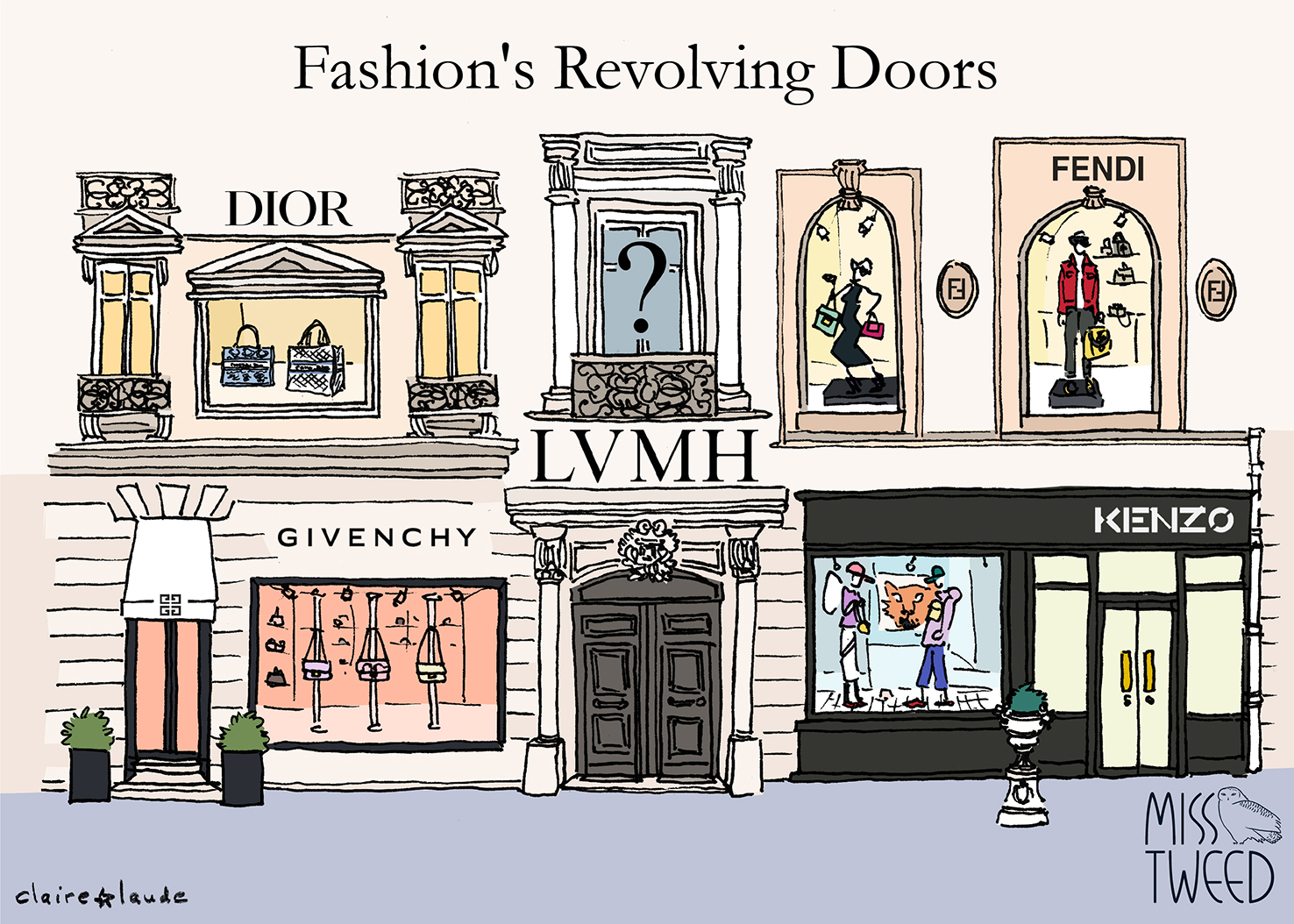
The departure of designer Hedi Slimane at Celine has yet to be announced but owner LVMH is not wasting any time looking for a replacement. The French group is in talks with several candidates. One of them is Alaïa’s popular creative director Pieter Mulier. If the Belgian designer gets the job, it would be great for Celine but disastrous for Richemont’s Alaïa, industry sources have said.
Celine is one of several LVMH fashion brands looking for a new creative director. Others include Fendi and Givenchy, industry sources say. Fendi’s womenswear creative director Kim Jones is on his way out and Givenchy has yet to find a replacement for Matthew Williams who left at the beginning of the year. There are question marks around Kenzo as designer Nigo has not created as much buzz and enthusiasm as expected and sales have yet to take off.
After Tunisia-born Azzedine Alaïa died in 2017, the French brand’s creative director remained in the hands of the historic design team, supervised by Carla Sozzani, chairman of the Alaïa Foundation and founder of the Milan multi-brand fashion store 10 Corso Como. Pieter Mulier took Alaïa’s creative reins in February 2021 and has successfully infused new life into the brand since.
Alaïa’s revenues, which remained modest for many years, are understood to have risen strongly thanks to Mulier’s cool designs. They are now close to €90-100 million, industry sources say, when they stood at around €65-70 million in 2022. The brand’s best-sellers include $1,290 crystal-embellished leather ballet flats which are regularly sold out on its website and at most multi-brand retailers. There are also the $990 heart-shaped crossbody handbags that made it to the top-10 hottest products of the Lyst index last year.
CONCERN
“People at Alaïa are worried about the possibility of seeing Mulier leave,” a senior industry source said. “It would be a shame for the brand as he’s done a fantastic job,” the source added. Mulier’s shows have been applauded by fashion critics and his designs have strengthened the brand’s appeal and widened its customer base. Mulier is a seasoned designer who worked for many years alongside fellow Belgian designer Raf Simons, now making wonders at Prada together with Miuccia Prada.
Mulier helped Simons launch his eponymous brand in 1995. He was his right hand at Jil Sanders, then at Christian Dior and finally at Calvin Klein. “At Dior, Pieter Mulier was very appreciated as he draws a lot. He is very talented and hard-working,” an industry source said. Hence, LVMH knows Mulier well and would be happy to hire him again. He would also be much easier to manage than Hedi Slimane, whose extravagant demands earned him the ire of LVMH CEO and controlling shareholder Bernard Arnault, as Miss Tweedreported last week.
Other designers are also being considered if Celine does not succeed in snatching Mulier away from Alaïa, industry sources have said.
Alaïa is one of Richemont’s smaller fashion brands. It has traditionally been run without much intervention from the Cartier owner. At Richemont, Alaïa sits alongside Chloé, Peter Millar and Delvaux. Last year, the Swiss group acquired the luxury shoemaker Gianvito Rossi, beating out competition from Renzo Rosso’s OTB, Miss Tweed was first to report. Fashion is not Richemont’s core business. The Swiss group’s strength is in watches and jewelry. Fashion features in the “other” category in its results together with real estate and other activities. Some analysts say this is designed to mask the poor performance of some of its fashion brands.
BIGGER BRAND
If Pieter Mulier joined LVMH, it would be a major step up. He would go from a small brand that is not its shareholder’s main focus to a label 20 times bigger owned by the industry’s No. 1 group in fashion. Celine now makes more than €2 billion in annual revenues.
It’s not clear what arguments Richemont Chairman Johann Rupert could find to retain Mulier. Rupert is not known to be passionate about fashion. The Richemont boss has never been spotted sitting in the front row of a fashion show. He did not even attend the 2020 extravaganza show for which 46 of the greatest designers produced a dress in honor of Alber Elbaz who passed away in April of that year. Nevertheless, if Alaïa lost Mulier, it would be a serious blow to the South African billionaire.
If Mulier were to leave Alaïa, it’s possible the designer may not be allowed to work for a rival brand for some time. Richemont most likely put a non-compete clause in his contract. Therefore, Slimane’s departure and Mulier’s arrival – if both were agreed – may not be announced for a while, industry sources predict.
FENDI
Change is also on the cards at Fendi. Kim Jones is expected to leave Fendi soon, as Miss Tweed reported in October. The brand’s sales have been stagnating in the past two to three years, industry sources have said.
Last year, LVMH held talks with former Gucci designer Alessandro Michele to replace Kim Jones, several sources close to the French group said. The Italian designer asked for huge amounts of money and wanted the brand to part ways with Fendi family members including Silvia Venturini Fendi and her daughter.
The Fendi matriarch is in charge of Fendi’s menswear and accessories and worked alongside the brand’s former star designer Karl Lagerfeld for five decades. Her daughter Delfina Delettrez Fendi has looked after the brand’s jewelry since 2020 and presented her first high jewelry collection in July last year. The two women are respectively the third and fourth generation of the Fendi family. This month, Michele started as Valentino’s creative director, replacing Pierpaolo Piccioli who left abruptly after 25 years.
“It would be sad for the fashion world if Pierpaolo decided to enjoy life,” one industry insider said. That’s unlikely to happen. Arnault is said to admire Piccioli’s talent and is keen to recruit him, most likely for Fendi, several industry sources have said.
If Piccioli became Fendi’s new creative director, he would give it a much more Italian and Roman identity. Fendi needs to reconnect with its Roman roots, fashion critics argue. As opposed to Kim Jones, who is British, Piccioli grew up and lives near Rome. He would understand what being Roman means in terms of attitude and fashion. Tapping into his vast knowledge of the city’s art and history, Piccioli could help Fendi build a strong Roman identity and celebrate in style its 100th anniversary next year.
However, Piccioli is great with haute couture and evening wear but not so strong in day ready-to-wear. Also, his latest bag collections for Valentino were not a huge success. That could be a concern when considering hiring him for Fendi, fashion head-hunters say.
Fendi was founded in 1925 by Adele and Edoardo Fendi as a specialized bag and fur workshop. LVMH acquired Fendi in 2000, when it had only a handful of boutiques.
In 2020, Kim Jones stepped into the big shoes of Lagerfeld a year after he passed away. Many fashion critics argue the British designer did not get Fendi. What he does is very elegant, luxurious and timeless, but it does not give you much emotion. Jones is also the creative director of Dior’s menswear, a big job for which he is getting more praise than for his work at Fendi.
When you walk into a Fendi boutique, everything shines. It’s clinically clean, like many of Jones’s designs. There are lots of sparkly products to choose from, but the atmosphere lacks the warmth and personality that a big luxury brand such as Fendi could have. Emotions – not sparkles – are what makes consumers pull out their credit card. This is particularly the case now that the industry is going through a slowdown and competition is as fierce as ever.
Fendi is first and foremost a provider of handbags and fur coats. Those are the areas on which its legitimacy as a luxury brand is based. But on the fur front, Fendi is playing it quiet in response to the industry’s anti-fur movement. On its website, there is no longer a fur section and it’s impossible to find any of the brand’s latest fur models online. These are only sold in boutiques.
There are also musical chairs at the management level at LVMH fashion houses. Charles Delapalme, currently head of retail at Dior, is expected to replace Serge Brunschwig as Fendi’s CEO. Dior has just hired Nicolas Baretzki as its new head of retail. Baretzki, ex-CEO of Richemont’s Montblanc, became the latest executive to migrate from the Swiss group to LVMH. Last year, the French group hired Benoit de Clerck, Chief Commercial Officer at Richemont’s Panerai, to lead LVMH watch brand Zenith.
GIVENCHY
Another LVMH brand looking for a new creative director is Givenchy. The French fashion brand founded by Hubert de Givenchy in 1952 has interviewed many people to replace Matthew Williams. But up until now, no one seems to fit the bill. Also, LVMH needs to decide what kind of Givenchy it wants: a couture or a more rock-chic brand.
Givenchy is a bit of a poisoned chalice, fashion experts say. Post-Hubert de Givenchy, who sold the brand to LVMH in 1988, it’s been through many designers, none of whom have been really true to the brand’s heritage. It went either extreme rock chic under Riccardo Tisci or an unconvincing mix between haute couture and studs under Clare Waight Keller. The latter was urged to keep the Riccardo vibe present, but it was not her. The couture side of the brand was applauded but the ready-to-wear ended up being slightly designed by committee, fashion critics said at the time. When Williams joined Givenchy in 2020, his mission was to bring back that cool streetwear sensibility that Tisci had introduced. But his work turned out to be just a lighter, more subdued version of Tisci.
One difficulty with Givenchy is that its heritage is not that easy to exploit and turn into silhouettes relevant for today’s world, industry specialists say. It is not like Yves Saint Laurent, where you have clear references such as the tuxedo, the Sahara jacket and other classics. Hubert de Givenchy is remembered as the designer whose little black dresses, advertised by his muse Audrey Hepburn, sold like hot cakes. But there is not that much else.
LVMH has already interviewed several candidates for Givenchy. These include the seasoned Haider Ackermann, who designed for the group’s luxury shoe brand Berluti. It has also considered the young Albanian-born, London-based Nensi Dojaka, who won the LVMH Prize in 2021 and is known for her “naked dressing,” industry sources have said. Sarah Burton, who left Alexander McQueen in September last year, is also said to have been interviewed but her style was considered to be too McQueen for Givenchy, fashion insiders said.
There is also Courrèges’s Nicolas di Felice, who has successfully resuscitated the brand owned by the Pinault family investment company Artémis. But di Felice is said to want to say at Courrèges for now and continue building the brand. Same for Julien Dossena, Paco Rabanne’s designer. Like di Felice, Dossena prefers to stay put. Another name in the hat is Martina Tiefenthaler, who was the right hand of Balenciaga’s Demna Gvasalia from the early days of his career and abruptly left the Kering brand earlier this year. “Martina is very highly regarded and could be a good fit for Givenchy,” one fashion head-hunter said.
And then there’s Kenzo. Japanese designer Nigo, who has been with Kenzo since September 2021, has won some applause, but his designs have not been a commercial success. He too will have to go at some point. The fashion merry-go-round never ends.