FT : India overtakes China in world’s biggest investable stock benchmark

India overtakes China in world’s biggest investable stock benchmark
Red-hot Indian equities propel country past China weighting in MSCI All-Country index

India has overtaken China’s weighting in one of the world’s biggest stock market benchmarks, as share sales and rising liquidity in Indian companies make the country more open to investors.

India’s share of the free-float, “investable”, version of the MSCI All-Country World index, which tracks almost all global stocks that can be bought on the open market, rose to 2.33 per cent this month, eclipsing China’s 2.06 per cent.

The shift makes India the sixth-largest weighting in an index that is dominated by US companies. It also reflects demand in India’s red-hot stock market, which is also unlocking shares for global investors to buy just as the Chinese economy slumps and fund managers dump China-related stocks.

“It is a natural evolution of the market,” said Vivian Lin Thurston, a portfolio manager at William Blair Investment Management.

“You have Indian equities performing strongly and Chinese ones lagging. There is a rebalancing happening as MSCI adds and drops names, so some of the Indian stocks that have improved liquidity get a bit more weight in the system.”

India’s blue-chip Nifty 50 index has hit record highs this year as the country’s economy registers the strongest GDP growth of any major economy and millions of middle-class households pile their savings into local mutual funds. Some $38bn of domestic money has flowed into Indian equities this year, exceeding the annual level of each of the past 16 years.

Indian companies have rushed to take advantage of the country’s soaring stock markets, with Ola Electric and mortgage provider Bajaj Housing Finance among the biggest initial public offerings so far this year.

More than $38bn has been raised on its equity market this year, the highest in Asia and more than double the amount over the same period a year ago, Dealogic data shows.

Earlier this month the free float of Indian stocks also supplanted Chinese counterparts as the largest country in the MSCI Emerging Markets investable index, at 22 per cent to 19 per cent.

When not adjusted for free float, China remains ahead of India in the closely watched MSCI Emerging Markets index, which does not include small-cap companies. But China has seen its share fall from 40 per cent in 2020 to a quarter while India’s has risen to a fifth from below 7 per cent 10 years ago.

Even so, China and India, and emerging markets as a whole, are still overshadowed by the bull run in US stocks, which make up two-thirds of the world index. About $4.6tn in assets were benchmarked to MSCI’s All-Country World Investable Market index as of the start of 2024.

“This is very meaningful,” said Martin Frandsen, global equity portfolio manager at Principal Asset Management.

“In India we have seen and recognised the significant improvement from a value creation perspective, we see significant innovation as in China, a lot of opportunities . . . to invest in some great companies.”

Goldman Sachs analysts expect the Nifty 50 to advance 8 per cent and reach 27,500 by the end of September 2025. Those gains will be fuelled by corporate earnings growth in its mid-teens, according to the US bank.

However some analysts are cautioning over valuations in the Indian market. Goldman strategists said the 12-month forward price/earnings for the MSCI India index have hit a record high of 24.7 — making it the most expensive it has ever been.

Thurston warned that the positions of China and India could reverse again if the “depressed” valuations of Chinese companies recovered in the future.

Despite lofty equity valuations, Rajat Agarwal, Asia equity strategist at Société Générale, said flows into India would probably continue amid a more favourable outlook for emerging markets with the US Federal Reserve expected to cut interest rates on Wednesday.

“There is no one on the street not saying that valuations in India are not high,” Agarwal added. But domestic “money is coming in regardless . . . in the near term the flow situation is not going to reverse unless we see some kind of an external shock”.

>>> US Gapping down

Gapping down
In reaction to earnings/guidance
:
  • GIS -0.7%
Other news:
  • CBUS -18.2% (stock offering)
  • CWST -4.2% (commences $400 mln stock offering)
  • MOD -1.8% (launches coolant distribution unit for data center industry)
  • MASI -1.7% (Leading Proxy Advisory Firm Glass Lewis Reiterates Recommendation That Masimo Shareholders Vote FOR Both of Politan's Independent Director Nominees)
  • PHR -1.6% (awarded a CDC research grant)
  • OGN -1.6% (Organon to acquire Dermavant from Roviant)
  • BOX -1% (prices offering of $400 mln of 1.50% convertible senior notes due 2029)

>>> US Gapping up

Gapping up
News:
  • LUNR +54.3% (wins NASA contract worth up to $4.82 bln)
  • APLT +40.9% (provides regulatory update on govorestat for the treatment of Classic Galactosemia)
  • IAUX +9.3% (names Richard Young as CEO)
  • AIOT +6% (acquires Fleet Complete)
  • IMUX +3.7% (Presents Key Vidofludimus Calcium Data at the 40th Congress of ECTRIMS, Highlighting Its Therapeutic Potential in Multiple Sclerosis)
  • BAK +2.9% (provides news clarifications)
  • TGTX +2.8% (reports new data for BRIUMVI (ublituximab-xiiy) demonstrated that 92% of patients with relapsing multiple sclerosis were free from disability progression after 5 years of treatment)
  • EWTX +2.6% (to discuss top-line data from Phase 1 and Phase 2 trials)
  • CMPO +2.5% (Resolute completes acquisition of majority interest)
  • ROIV +2.5% (Organon to acquire Dermavant from Roviant)
  • QTRX +2.2% (Director bought 47000 shares)
  • MNKD +2% (received clearance from Japan's Pharmaceuticals and Medical Devices Agency (PMDA) to initiate the Phase 3 study (ICoN-1) of Clofazimine Inhalation Suspension for the treatment of NTM lung disease)
  • GLNG +1.7% (signs EPC agreement with CIMC Raffles)
  • DNA +1.3% (announces the launch of Ginkgo Datapoints to usher in the next era of biotechnology by making the training of AI models easier and more efficient)
  • CRM +1.2% (CRM and NVDA to collaborate to develop AI capabilities for the enterprise)
  • BJ +1.1% (Director bought 2455 shares)
  • PPBT +1.1% (reported new positive biomarker findings for its lead oncology therapeutic candidate CM24)

>>> US Research Calls I

Research Calls I
  • Upgrades:
    • Ambac (AMBC) upgraded to Buy from Neutral at ROTH MKM; tgt raised to $15
    • Braskem SA (BAK) upgraded to Buy from Neutral at UBS
    • Extra Space Storage (EXR) upgraded to Buy from Hold at Jefferies; tgt raised to $204
    • GE HealthCare (GEHC) upgraded to Buy from Neutral at BTIG Research; tgt $100
    • Intercontinental Hotels Group (IHG) upgraded to Buy from Neutral at Goldman
    • NMI Hldgs (NMIH) upgraded to Outperform from Sector Perform at RBC Capital Mkts; tgt raised to $48
    • Sirius XM (SIRI) upgraded to Buy from Neutral at Guggenheim; tgt $30
    • SL Green Realty (SLG) upgraded to Neutral from Sell at Compass Point; tgt raised to $60
    • Ubisoft (UBSFY) upgraded to Outperform from Market Perform at BMO Capital Markets
    • V.F. Corp (VFC) upgraded to Overweight from Equal Weight at Barclays; tgt raised to $22
    • Victoria's Secret (VSCO) upgraded to Equal Weight from Underweight at Barclays; tgt raised to $25
  • Downgrades:
    • Edwards Lifesciences (EW) downgraded to Hold from Buy at Jefferies; tgt lowered to $70
    • Incyte (INCY) downgraded to Hold from Buy at Truist; tgt lowered to $74
    • Portland Gen Elec (POR) downgraded to Equal Weight from Overweight at Barclays; tgt raised to $49
    • ResMed (RMD) downgraded to Underperform from Peer Perform at Wolfe Research; tgt $180
  • Others:
    • Arm Holdings plc (ARM) initiated with an Outperform at William Blair
    • Beam Therapeutics (BEAM) initiated with a Hold at JonesResearch
    • BeiGene (BGNE) initiated with a Mkt Outperform at JMP Securities; tgt $288
    • Broadcom (AVGO) initiated with an Outperform at William Blair
    • Canaan (CAN) initiated with a Buy at B. Riley Securities; tgt $2
    • CervoMed (CRVO) initiated with a Buy at Chardan Capital Markets; tgt $55
    • Choice Hotels (CHH) initiated with a Sell at Goldman; tgt $105
    • Civitas Resources (CIVI) initiated with an Overweight at JP Morgan; tgt $67
    • Crescent Energy Company (CRGY) initiated with a Neutral at JP Morgan; tgt $12
    • Editas Medicine (EDIT) initiated with a Buy at JonesResearch
    • Halliburton (HAL) initiated with a Buy at DBS Group
    • Hilton Grand Vacations (HGV) initiated with a Sell at Goldman; tgt $31
    • Hilton (HLT) initiated with a Buy at Goldman; tgt $245
    • Hyatt Hotels (H) initiated with a Neutral at Goldman; tgt $151
    • ICON plc (ICLR) initiated with an Outperform at Leerink Partners; tgt $379
    • Inari (NARI) initiated with a Hold at Stifel; tgt $50
    • Intellia Therapeutics (NTLA) initiated with a Buy at JonesResearch
    • KKR (KKR) initiated with a Buy at HSBC Securities; tgt $148
    • Kodiak Gas Services (KGS) resumed with a Buy at BofA Securities; tgt $30
    • Marriott (MAR) initiated with a Buy at Goldman; tgt $267
    • Marriott Vacations (VAC) initiated with a Sell at Goldman; tgt $62
    • NVIDIA (NVDA) initiated with an Outperform at William Blair
    • OSI Systems (OSIS) initiated with an Overweight at Wells Fargo; tgt $170
    • Penumbra (PEN) initiated with a Buy at Stifel; tgt $238
    • Rhythm Pharmaceuticals (RYTM) initiated with a Buy at H.C. Wainwright; tgt $64
    • SLB (SLB) initiated with a Buy at DBS Group
    • Super Micro Computer (SMCI) initiated with a Buy at Needham; tgt $600
    • Talen Energy (TLN) initiated with a Buy at UBS; tgt $197
    • Travel + Leisure Co (TNL) initiated with a Neutral at Goldman; tgt $44
    • Wyndham Hotels & Resorts (WH) initiated with a Buy at Goldman; tgt $96

Electrek : Global wind turbine order intake reached new highs in H1 2024

Global wind turbine order intake reached new highs in H1 2024

Global wind turbine order intake reached new highs in H1 2024, with 91.2 gigawatts (GW) of activity, a 23% increase year-over-year, thanks to the Asia-Pacific region.

Globally, investment by wind energy developers in H1 2024 totaled $42 billion, a 3% increase year-over-year, according to new analysis from Wood Mackenzie. Much of that activity occurred in Q2, which saw 66 GW of wind turbine order intake, due in large part to demand in China’s northern region.


In fact, the Asia-Pacific region accounted for a whopping 85% of global intake in the first half of 2024. China saw 70 GW of orders for its domestic market and captured 5 GW of wind turbine orders abroad. Developers in India made great strides in the first half as well, yielding a 69% increase year-over-year.

India’s Envision was the leader for overall order intake, followed by China’s Windey and Goldwind, all with more than 12 GW of activity.

However, Western wind turbine OEMs struggled due to intensifying competition over more modest demand and contributed just 13% of global order intake in H1. In total, order intake outside of China decreased 16% (-2.3 GW) in the first half. Intake in the Americas and Europe dropped 42% year-over-year, with less than 10 GW combined ordered in H1.

“Chinese OEMs continue to break records for order intake on activity both domestically and aboard,” said Luke Lewandowski, vice president, global renewables research at Wood Mackenzie.

“Conversely, western OEMs are struggling to keep pace, challenged by China’s competitive advantages in pricing and availability. Soft demand in Western markets as well as policy uncertainty, inflation, and other cost pressures have also driven down activity in the US and Europe. China remains the undisputed leader in the industry.”

While global onshore order activity increased in the first half, the offshore sector struggled, with order intake decreasing 38% year-over-year through the first half (-4.1 GW) as challenging project economics have curbed the market.

“The offshore market has almost 30 GW of conditional orders globally, 21 GW of which are for projects in Europe and the US, but challenging economics continue to delay conversion into firm orders,” said Lewandowski.

Electrek : Lotus’ wild 200mph ‘Theory 1’ EV signals return to form for the brand

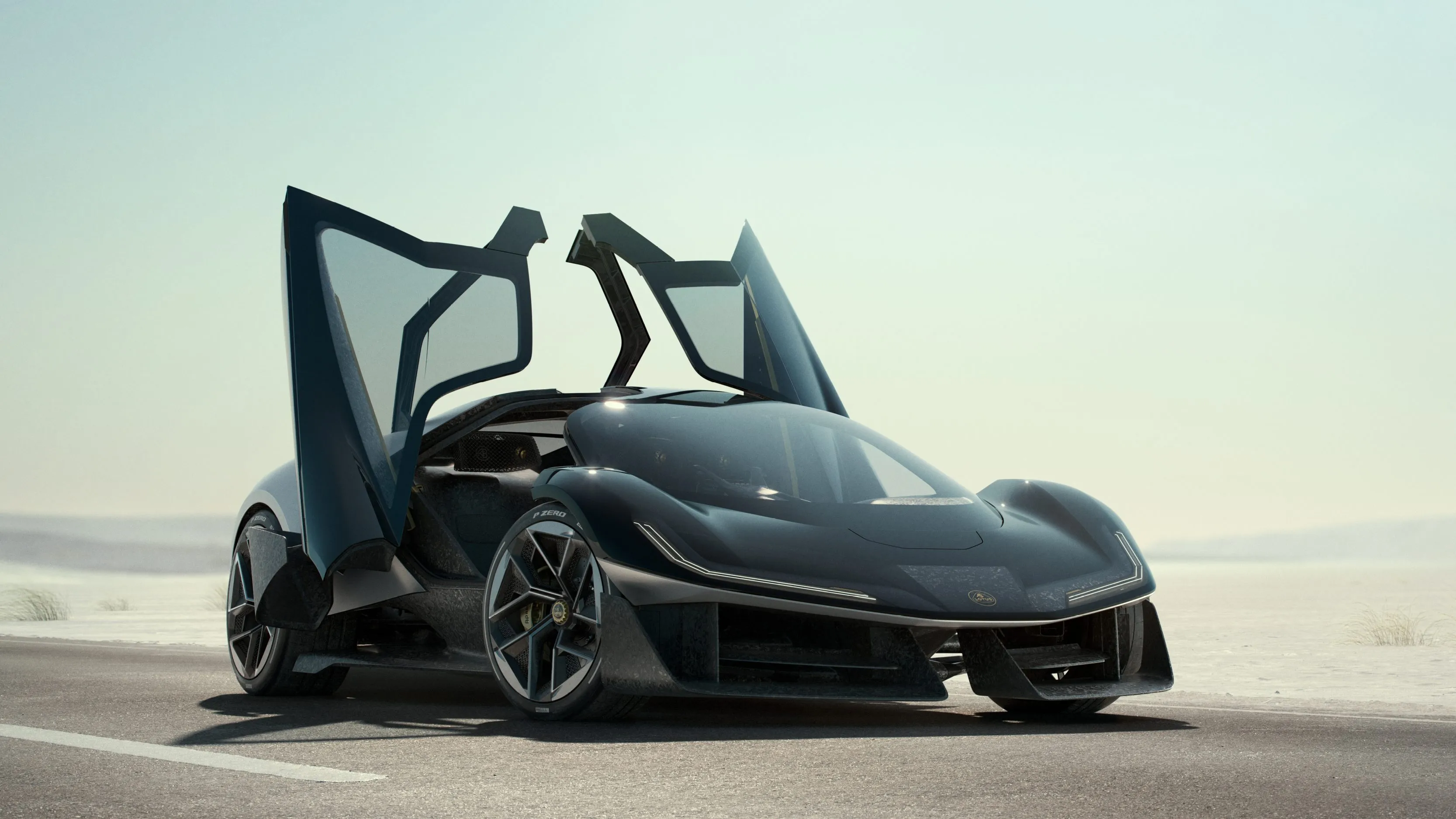
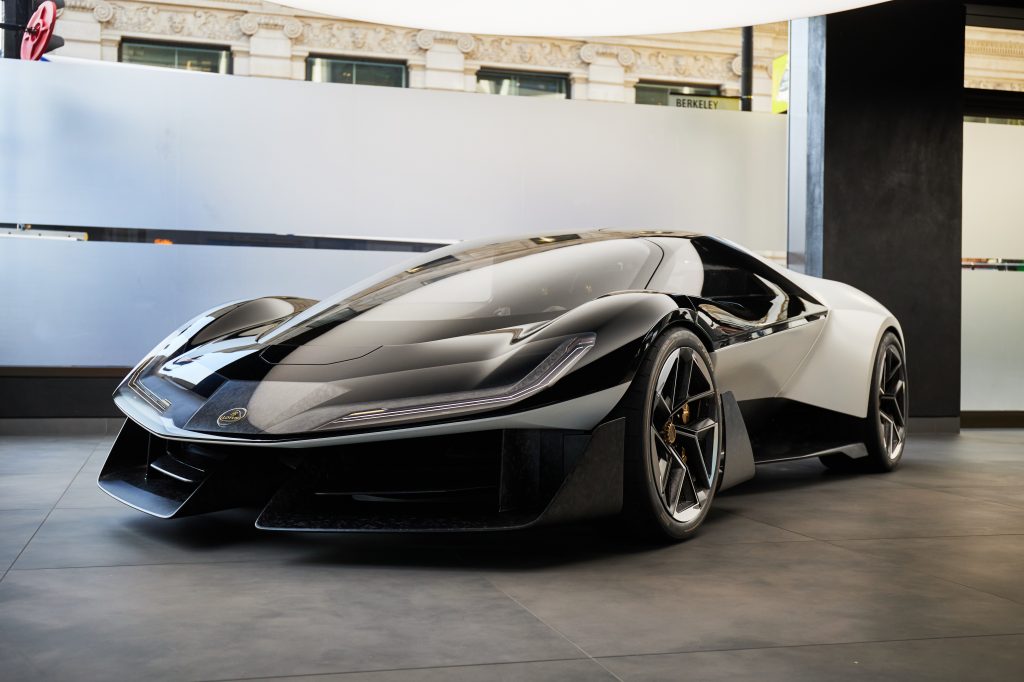
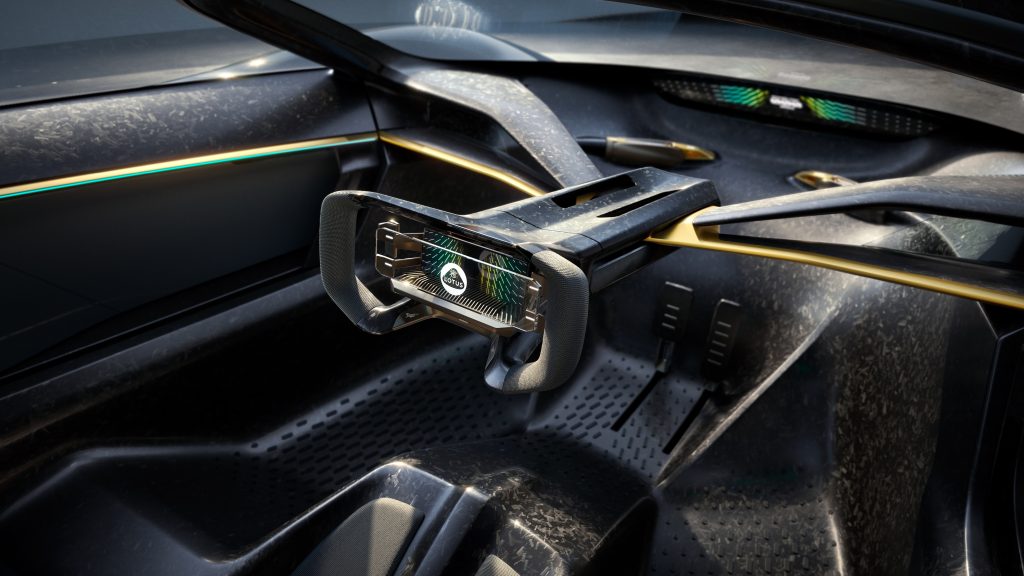
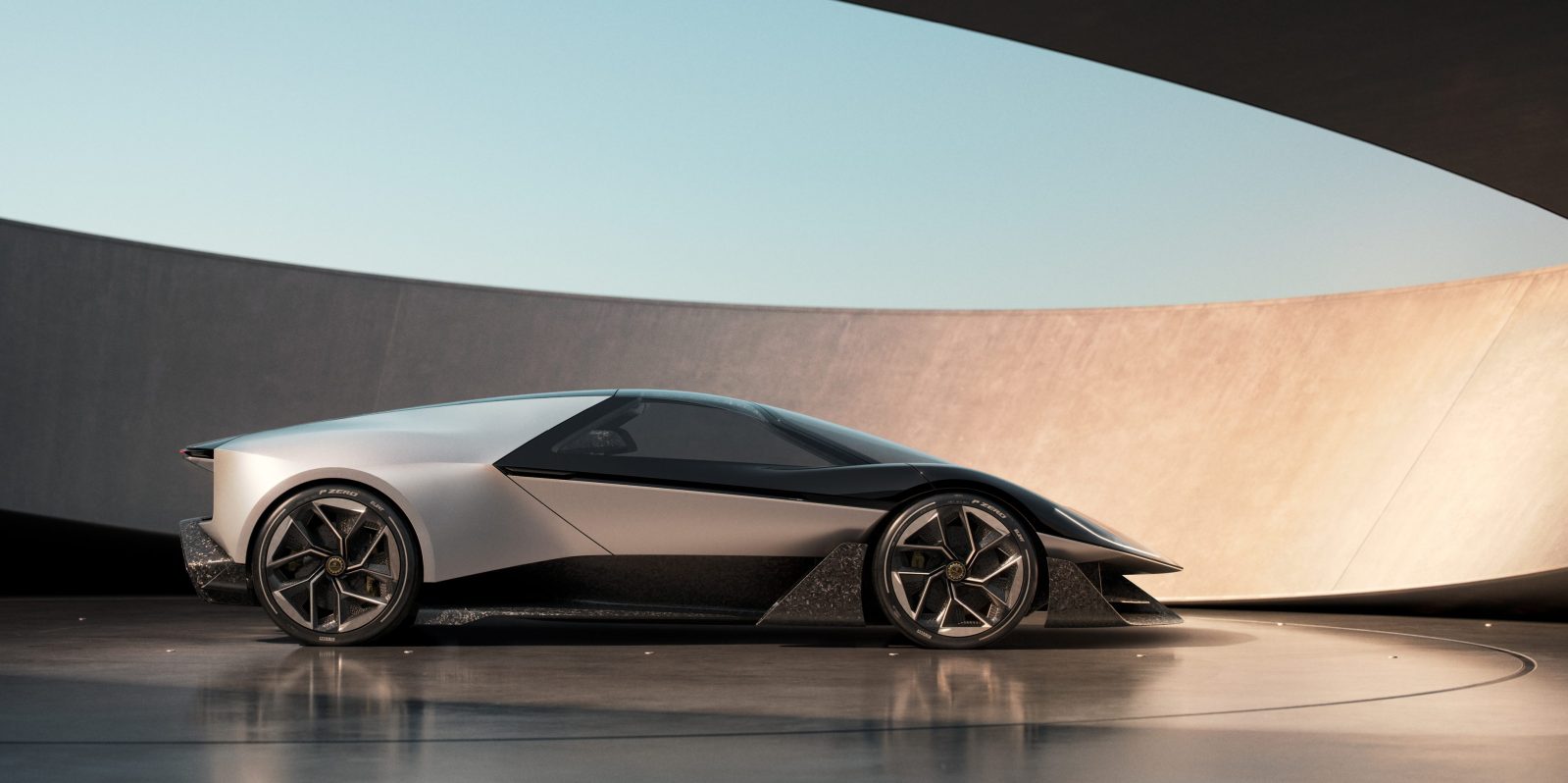
Lotus has unveiled a new EV concept which it calls “Theory 1,” a lightweight(-ish) electric sportscar concept inspired by the Lotus Esprit with nearly 1,000hp and capable of speeds up to 200mph.

Here at Electrek, we see and report on a lot of wild EV concepts. These concepts are often accompanied by long treatises on how the design incorporates various “core principles,” unnecessary branding of things that will never make it to production, and buzzwords aplenty.
In a way, the Theory 1 is no different. My eyes glazed over at the 2,000+ words in Lotus’ press release before reaching the table of technical specs.
And yet, there is still something here, because this is Lotus – a company with an incredibly significant motorsport heritage… and a significant electric car heritage too.
Lotus is the company that provided the lightweight “gliders” on which the original Tesla Roadster, the car that started the modern electric vehicle era, was built.
And lately, Lotus has gotten into electric cars on its own, with the $2million Evija hypercar and the consumer-focused Eletre SUV and Emeya Hyper-GT.
But you’ll notice – one of those things is not like the others. Despite being a company famous for its focus on small cars, owing to founder Colin Chapman’s theory to “simplify, then add lightness,” the Eletre and Emeya are both over 5,500lbs, more than twice the weight of the original Tesla Roadster.
And so, Lotus’ new Theory 1 – packed full of probably-unrealistic concept features, but also clearly going downmarket from the Evija’s eyewatering $2million pricetag – could signal somewhat of a return to form for the wayward small-car maker.
That’s because its curb weight is listed at a much more reasonable 1600kg, or 3,527lbs. This is still hefty compared to the absolute lightest vehicles on the road right now, but it’s on the lower end of most powerful sportscars available today (including lighter than the Evija), quite low compared to other EVs, and significantly less than some ridiculous gas-powered chonkers.
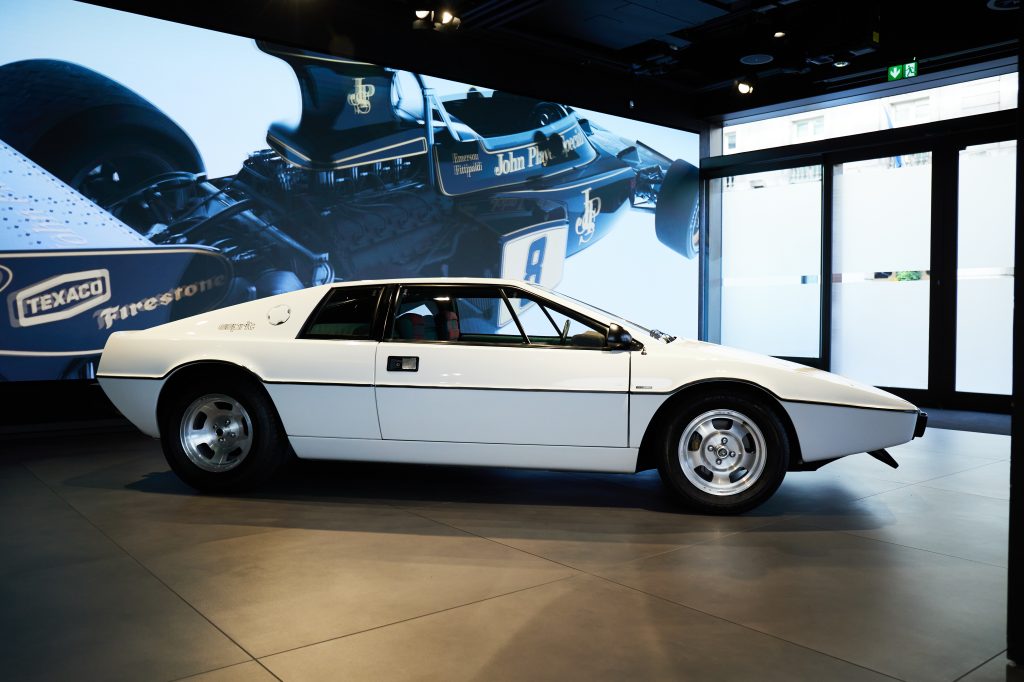
It’s also a lot more than the original Lotus Esprit which the Theory 1 takes inspiration from, which began at around 2,000lbs. But later versions of the same vehicle weighed as much as around 3,000lbs, not too far off from the Theory 1.
<button>
<button>
The Theory 1 next to the Lotus Esprit
In that relatively small package, Lotus claims it has fit some great performance specs.
Its 986hp powertrain is capable of sprinting 0-100km/h (62mph) in less than 2.5 seconds, with a top speed of 320km/h (198mph).
Energy comes from a 70kWh battery with a 250 mile range. This is a little smaller than some of the larger batteries we’ve seen around (the Eletre has a 112kWh battery, for example), but that’s the benefit of having a light, low-slung vehicle.

But specs don’t tell everything about how a vehicle feels to drive. And Lotus is promising to bring exceptional driving dynamics to this vehicle, through methods like including the motor and battery as stressed members and mounting the rear wing directly to the suspension assembly.
It also wants to use steer-by-wire, a technology which has been thought about for a long time but only recently has made its way into production vehicles, like the Lexus RZ and Cybertruck.
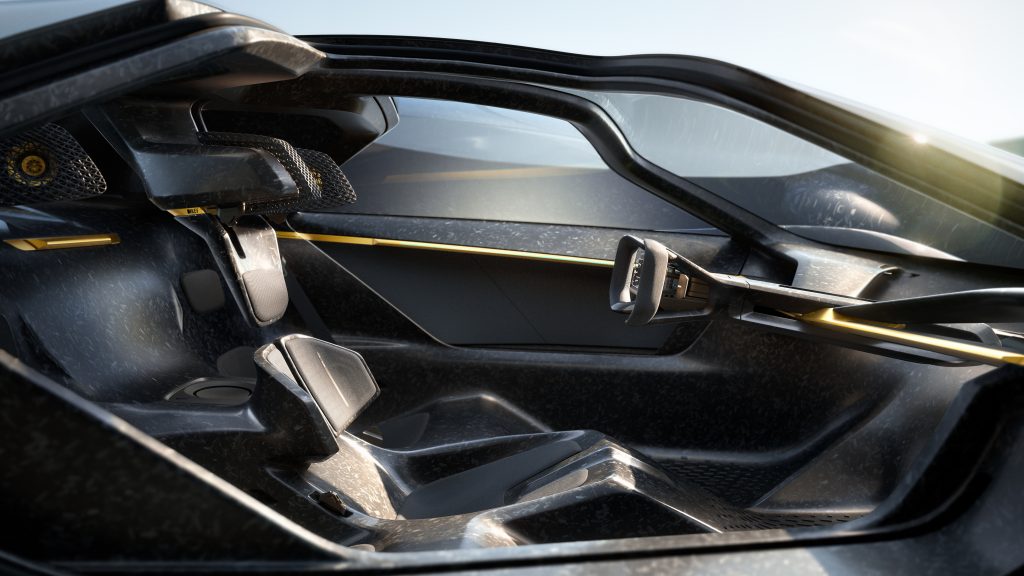
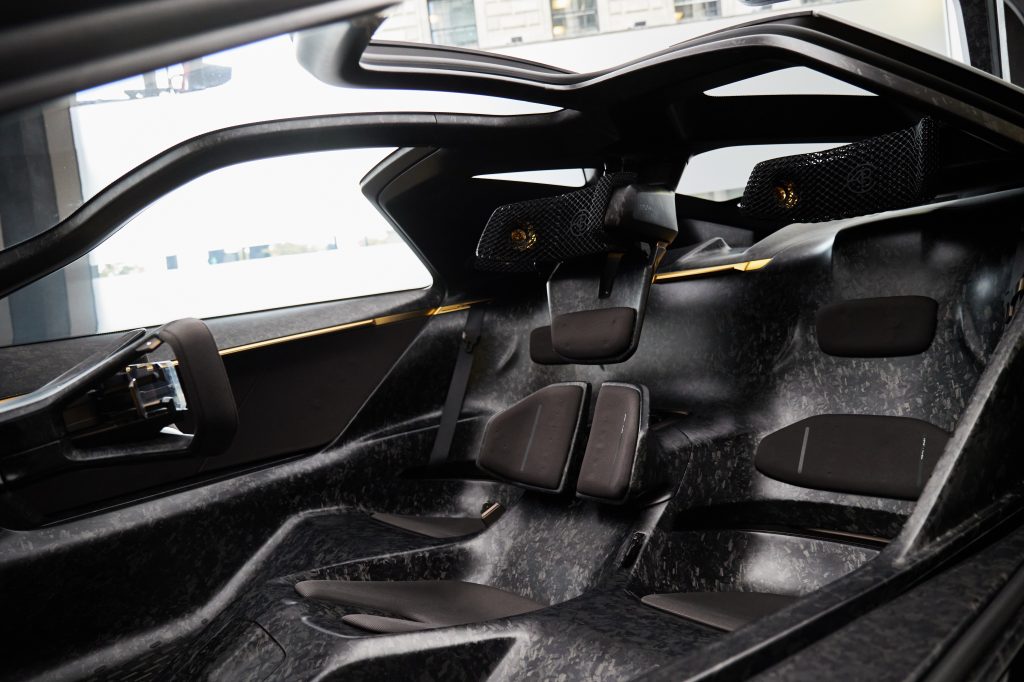
But perhaps the most striking part of the driver experience on the Theory 1 is its 3-seat design, seating the driver in the center of the vehicle, similar to the famed McLaren F1.
<button>
<button>
<button>
The car’s light weight comes from extensive use of advanced materials like carbon fiber and titanium, which are sure to boost the price of this vehicle if they make it to production. In that previously-mentioned 2,000 words, there’s plenty of talk about 3D printing and recycled materials as well.
But Lotus says that it wants to reduce the amount of “A-surface materials” – those you can touch – down to 10 or fewer, compared to the 100-or-so in most cars.
“There’s been this period of maximalism, and people having to do one-upmanship and go above, above, above. And I think we’ve reached that point where it plateaus in stylistic terms, and also in the demonstration of tech. We’re not in a crazy numbers race with this car.”
-Lotus design VP Ben Payne, as quoted by Wired
So the original Lotus philosophy of “simplify, then add lightness” is certainly present in this concept, signaling a return to form for the brand after a few years of wandering in the desert.
Finally, while we are just talking about a concept here, we’ve certainly seen plenty of EV concepts make their way into production in some way or another. Even particularly wild ones like the BMW Vision EfficientDynamics concept ended up being made into the BMW i8 sportscar.
So we might even see this Theory 1 show up on the road at some point. But, even if we don’t, at least it shows that Lotus is back to thinking about smaller cars (as they should have been all along…), and we’ll hopefully get a real EV sportscar out of them in a few years.

Electrek : BYD would still have the cheapest EV in the US, even with a 100% tari

BYD would still have the cheapest EV in the US, even with a 100% tariff

Even with the new 100% tariff on electric vehicles imported from China, BYD would still have the cheapest EV in the US. According to a new report, BYD’s lowest-priced EV would still undercut all US automakers at under $25,000.

After discontinuing the production of vehicles powered entirely by internal combustion engines in March 2022, BYD has been at the forefront of the industry’s shift to EVs.

However, BYD has been building its supply chain for much longer. The company began building lithium-ion batteries in 1996. BYD’s batteries powered Motorola and Nokia’s popular smartphones in the early 2000s.

Its early ventures into the battery industry helped BYD become the industry juggernaut it’s known as today.

Since releasing its breakthrough Blade EV battery in 2020, BYD has continued introducing more efficient, lower-cost tech to drive down prices.

BYD’s cheapest electric car, the Seagull EV, starts at under $10,000 (69,800 yuan) in China. Its affordable electric and hybrid models are squeezing gas-powered vehicles out of China’s auto market, especially from foreign automakers.

BYD has no plans to enter the US passenger vehicle market (it already sells electric buses), the company’s North American CEO Stella Li said. If it did, it could hold an advantage over US automakers.

According to AutoForecast Solutions CEO Joe McCabe (via Nikkei), BYD would still have the cheapest EV in the US, even with the new 100% tariff on Chinese electric vehicle imports.

The tariff will take effect on September 27 and is intended to “protect American manufacturers from China’s unfair trade practices,” according to a press release from The White House.

McCabe said BYD’s lowest-priced EV for the US would be $12,000. Even with a 100% tariff rate, BYD would have the cheapest EV in the US at under $25,000.

Tesla, which still holds a commanding lead (48% share in July) in the US EV market, has yet to break the $30,000 threshold.

Chinese automakers, like BYD, have an advantage with established supply chains, enabling lower prices.

Electric vehicles accounted for over 50% of passenger vehicle sales in China in July. In the US, EVs accounted for 8.5% of the light vehicle market during the same period, according to the latest S&P Global Mobility figures.


Chinese companies, including BYD and CATL, also dominate the global battery market. According to SNE Research, CATL (35.9%) and BYD (16.5%) led global EV sales in the second quarter based on shipment.

Through the first eight months of 2024, CATL accounted for 37.6% of the global EV battery market, while BYD took second with 16.1%.

Electrek’s Take
BYD is not planning to launch passenger EVs in the US, at least not in the near term. However, McCabe’s comments should spark concern among some US rivals.

As BYD continues launching lower-priced EVs with more range and advanced features, several US automakers continue delaying significant projects.

Ford canceled its three-row electric SUV, opening the door for overseas rivals like Kia and Hyundai to take advantage. GM is also pushing back its battery factory in Indiana and could turn to CATL for LFP batteries in the US, like Ford and Tesla.

The Information : Microsoft, BlackRock to Launch $30 Billion Fund to Invest in D

Microsoft, BlackRock to Launch $30 Billion Fund to Invest in Data Centers, Power for AI

Microsoft and BlackRock said Tuesday they are planning a $30 billion fund to develop data centers and power plants to power artificial intelligence. The fund would be one of the largest of its kind, though it isn’t clear how much Microsoft is contributing and shows how the company is enlisting another longtime real estate and data center investor, BlackRock, rather than go it alone as AI costs stack up.

Abu Dhabi-based investment firm MGX will also invest in the fund, and Nvidia will consult on the design of data centers built by the fund or the companies it backs, Microsoft and BlackRock said. (MGX has also been in talks to participate in OpenAI’s capital raise of up to $7 billion.)

The new fund, dubbed the Global AI Infrastructure Investment Partnership, will ultimately look to raise as much as $100 billion, including debt financing, and will “chiefly” invest in infrastructure located within the U.S., the companies said. The data centers will be “non-exclusive” and serve “a diverse range” of customers, the companies said.

The fund is the latest sign of Microsoft’s interest in new data centers and power sources needed to train and run large-scale AI models, such as those developed by OpenAI. Microsoft has already projected that it will spend more than $50 billion this year on capital expenditures, primarily for building data centers, and has discussed building a supercomputing data-center server cluster for OpenAI that could cost more than $100 billion. Numerous large AI data centers are under way in the continental U.S., according to the AI Data Center Database.

The Information : Nvidia Recently Discussed Acquiring Software Startup OctoAI fo

Nvidia Recently Discussed Acquiring Software Startup OctoAI for $165 Million

The Takeaway
• Deal adds to a string of small Nvidia acquisitions
• OctoAI’s service helps developers run open-source AI models faster
• It raised $132 million from investors including Tiger, Madrona

Nvidia has been in advanced talks to buy OctoAI, a Seattle-based startup that sells software to make artificial intelligence models run more efficiently, according to a message sent to shareholders. The purchase would add to a string of small AI startup acquisitions by the AI chip heavyweight, which is trying to strengthen its software and cloud-computing services while U.S. antitrust officials probe its activities.

Nvidia has proposed paying about $165 million for the company, before accounting for the company’s debt and other expenses, according to a document OctoAI sent to shareholders.

The price suggests that shareholders—especially employees—won’t get much of a payout. The company raised $132 million from investors including Tiger Global Management, Madrona Venture Group and Amplify Partners, ultimately fetching a valuation of about $900 million in 2021.

OctoAI CEO and co-founder Luis Ceze didn’t respond to a request for comment. A spokesperson for Nvidia declined to comment.

Nvidia has been buying small AI and cloud startups to make it less expensive and easier for developers to run AI models using Nvidia chips. One of the biggest criticisms of Nvidia’s chips is that because they are expensive and in high-demand, it’s difficult for companies to scale AI at a reasonable price.

Founded five years ago, OctoAI targets software developers who work on machine learning and has taken aim at one of the toughest problems associated with building applications that use AI: getting ML models to perform well across different types of processors. OctoAI does this by translating the models into code that different processors can handle. OctoAI says its software can help organizations launch machine-learning applications more quickly while also cutting the computing costs of running the models.

For engineers, OctoAI automatically tweaks models to run well on specific chips. It claims that its approach works better than the customized software major manufacturers develop for that purpose. One of Nvidia’s strengths is Cuda, its proprietary software for developing apps that use the company’s vaunted AI chips.

Formerly known as OctoML, the startup spun out of the University of Washington in 2019 by the creators of an open source project called Apache TVM. It originally focused on helping developers deploy machine learning models, but last year shifted its focus to selling a service that allows developers to tweak open-source or custom AI models quickly, regardless of what type of chips power the models. It generated revenue in the low-single-digit millions last year, company leaders told some employees, according to a person who heard the remarks.

OctoAI has worked closely with Amazon Web Services, Advanced Micro Devices and Qualcomm to help developers use those companies’ AI chips, which compete with Nvidia’s. That’s one reason the U.S. Department of Justice, which is examining other recent Nvidia acquisitions and other allegations against the company, might decide to examine the Nvidia-Octo deal if it closes.

OctoAI and Nvidia have a relationship too. This year Nvidia launched a software offering, known as Nvidia Inference Microservices, which is aimed at solving some of the problems OctoAI was focused on. Nvidia and OctoAI announced a collaboration earlier this year related to the NIMs service. Before that, the two companies worked closely together—for instance, Nvidia has previously given OctoAI early access to its cutting-edge chips so the startup could test how to run AI models on the chips effectively.

Nvidia earlier this year bought two small Israeli startups, Run:AI and Deci, which also aim to lower the cost of developing or running AI models that generate text, images and code.

Despite investor enthusiasm for startups involved in conversational artificial intelligence, some founders have struggled to stay afloat as competition rises. Major AI software startups such as Adept, Inflection and Character recently agreed to quasi-acquisitions with larger cloud companies.

Some arrangements, such as Google’s deal for chatbot startup Character, investors received more than double the money put in. But the acquisitions can leave little for employees.

In OctoAI’s case, common stock holders are only getting two cents for every share they own, according to merger documents. Ex-employees who exercised their vested options at higher price when they left the company would be looking at losses.

WWD : Chanel Buys Building on Avenue Montaigne in Paris

Chanel Buys Building on Avenue Montaigne in Paris
The French luxury group has acquired the location of its fashion, watches and fine jewelry boutique.


PARIS – Chanel said Wednesday it has bought the building housing its boutique on Avenue Montaigne for an undisclosed sum, as leading luxury brands continue to snap up real estate in a bid to secure prime locations for their brands.

The building at 42 Avenue Montaigne is home to a fashion, watches and fine jewelry boutique and offices, the French luxury brand said in a statement. Chanel has been in the building since 1983.

It was the target of a high-profile smash-and-grab robbery in June, during which robbers rammed the windows of the boutique with a vehicle.

The 6,500-square-foot Chanel store covers two floors and is designed to accommodate VIP clients with private salons located on the first floor. The building spans seven floors and three basement levels.

A protected property, it was built in 1965 by architects Roger Anger, Mario Heymann and Pierre Puccinelli, known for their creative approach using geometric plays, in this case a pleated bay window layout.

Announcing annual results in May, Chanel said it planned to ramp up capital expenditures by at least 50 percent this year from a record $1.23 billion in 2023.

“We will be really on the offensive in terms of possible real estate acquisitions, but we will do them at the right time at the right price,” chief financial officer Philippe Blondiaux told WWD at the time.

Chanel has doubled the size of its distribution network in the last five years. In 2024, it increased its network to 612 locations, with 47 net openings.

“The acquisition of 42 Avenue Montaigne follows other real estate purchases in 2023 in Paris and across other cities including London and Biarritz, important in Chanel’s history and heritage,” the brand said on Wednesday.

The battle for real estate in Paris has been compared to a game of Monopoly, with Avenue Montaigne one of its most prized locations.

Among others, LVMH Moët Hennessy Louis Vuitton in 2022 acquired the building housing its headquarters at number 22, while rival group Kering has bought the former home of the Canadian embassy across the street at number 35.