The S&P 500 is still significantly overpriced
Investors are yet to fully factor in tariffs and hits to AI and US exceptionalism
Despite signs of a slowing US economy, Donald Trump’s tariff plans and stultifying uncertainty, Wall Street analysts still expect the main US stock index to end 2025 just below 6,000 on average. That means the market projects the S&P 500 will rise by at least 5 per cent between now and December 31.
So this week, I’ll outline the case for why the market is wrong, and why the S&P 500 is more likely to end this year significantly below its current level of 5,525.
End-year stock market forecasts are ultimately underpinned by investors’ annual economic outlook and their assessment of structural drivers, such as artificial intelligence and US exceptionalism.
For 2025, analysts essentially expect the S&P 500 level to be broadly unchanged on last year. That is a notable markdown from the past two years of consecutive annual growth above 20 per cent. But is it still too optimistic?

Let’s begin with the economic fundamentals. Last month, I argued that America was heading for a recession. (This was based on economic weakness coming into Trump’s second term, the uncertainty of his policies, and the possibility of some import duties being implemented.) I appreciate that this isn’t Wall Street’s view, yet.
Analysts are more focused on actual tariff announcements. Indeed, since “liberation day”, consensus growth forecasts for 2025 have fallen and probabilities for a recession in the next 12 months have risen to 45 per cent. Most expect the US effective tariff rate (pre-substitution effects) to settle around 10 to 20 per cent this year. It is currently estimated at around 28 per cent, having started 2025 close to 2.5 per cent.
These forecasts seem reasonable: notably higher tariffs than last year and slower growth, even if there is no recession. However, the market is still pricing more optimistically than that.
“The information derived from risk assets doesn’t even suggest markets reckon a mild slowdown will take shape this year,” said Daniel Von Ahlen, a senior macro strategist at TS Lombard, utilising a simple regression model to estimate US growth forecasts from asset prices.

Expectations for corporate earnings this year remain too high. It is easier for Wall Street to make buy and sell decisions based on perceived risk-on or risk-off news items. Judging their impact on companies’ bottom lines can take longer.
“Typically earnings estimates decline during even mild recessions,” said Peter Berezin, chief global strategist at BCA Research. “But the market currently assumes nearer 10 per cent earnings growth over the next 12 months. That’s off last year’s peak profit margins no less.”
Analysts may be too optimistic about the ability of companies to pass through any tariff costs to consumers. The sectors that import the most — industrials, materials and consumer discretionary — also have limited pricing power, notes BCA Research’s US equity strategy team.
Assuming companies won’t be able to raise prices significantly, it shows Trump’s tariffs reducing S&P 500 net income margins by 2.2 percentage points. That would translate to a 19.2 per cent decline in S&P 500 earnings per share, all else equal (based on tariff rates at 10 per cent for all countries, Chinese import duties returning to their pre-retaliation rate of 54 per cent, and steel, aluminium and car-specific levies at 25 per cent.)
For measure, Goldman Sachs estimates that each 5 percentage point rise in the US tariff rate leads S&P 500 EPS to fall roughly between 1 to 2 per cent.

Whatever one’s tariff outlook, consensus forecasts for EPS to grow notably in 2025 appear at odds with the current economic environment: high uncertainty, weak consumer and investor confidence, and elevated import duties. (Scheduled vessels into the Port of Los Angeles are expected to drop significantly year on year in two weeks’ time.)
Earnings revisions are coming in rapidly now. The number of earnings downgrades by analysts for 2025 is ironically at recessionary levels, though the actual magnitudes of the downgrades remain relatively less significant. As earnings projections come down, prices will follow, as analysts calibrate valuations.
For measure, the forward price-to-earnings ratio (how much investors are willing to pay for each dollar of future earnings) is currently around 19. In the five years prior to the pandemic, it was closer to 17. And in all recessions since 1980, it has averaged around 10.
Using Goldman Sachs’ S&P 500 sensitivity matrix, a still modest forecast for EPS to grow by 3 per cent this year and forward P/E ratios to return to just above their pre-pandemic average would put the index nearer to 4,550.

Of course, it is possible for the S&P 500 to dodge such a hefty fall if structural factors provide buying impetus.
But first, the AI narrative is hitting roadblocks. DeepSeek’s low-cost model release in China put the spotlight on the billions being spent by US tech firms on AI capital. Trump’s trade announcements — including planned duties on Asian tech manufacturing hubs and chip export restrictions — have added further pressure.
“We’re still waiting for a ‘killer app’ that justifies the heavy capex taking place. The low barriers to building large language models also raise further questions over the revenue [the Magnificent Seven] can generate”, explains Hugh Grieves, a fund manager at Premier Miton Investors. “[They] are also only slowly assessing how tariffs impact their earnings”.
The stock prices of the Magnificent Seven tech businesses have dropped substantively since Trump’s inauguration. But analysts are unclear on what is being priced in. The companies account for one-third of the S&P 500’s market capitalisation. (They also skew net profit margin estimates for the whole stock market upward.) So selling them is an easy way to cut risk exposure as the news whipsaws.
Still, their forward P/E multiples remain above pre-pandemic levels (individually and collectively). Prices could drop further as their profitability is re-evaluated, both in terms of tariffs and AI hype.

Second, US exceptionalism. For years America has attracted capital by virtue of its deep liquidity, stability and the safe-haven status of its assets. This enabled the S&P 500 to grow beyond economic fundamentals.
But the narrative is weakening. In March, respondents to Bank of America’s Fund Manager survey slashed their US equity holdings by the most on record. Tariffs weigh disproportionately on America. Its companies are the greatest beneficiaries of the “Made in Asia” model, notes Matt King, founder of Satori Insights. (Retaliatory measures will hurt US firms too.)
Policy upheaval, radical uncertainty, rising financial stability risks and attacks on independent economic institutions (such as the US Federal Reserve most recently) make the US a less reliable place to park capital.
“The US has gone from the ‘cleanest dirty shirt’ to being one of the ugliest and yet still most expensive item cluttering the investment wardrobe,” says King. “Even after this year’s correction, US equities retain a significant exceptionalism premium trading on forward P/Es 50 per cent higher than non-US equities.”
This exposes America to further capital flight, depending on the attractiveness of opportunities abroad and Trump’s actions. Paradoxically, if the president’s term continues as it has started, the US will be more reliant on improved economic fundamentals to build buying momentum.

The S&P 500 has oscillated down around 10 per cent from its February peak. But the newsflow makes it difficult to know what has and hasn’t been priced in.
The constant churn of policy announcements, exemptions, postponements and denials mean investors re-price each day where they consider risk to be relative to the day before. This then shifts the goalposts for judging growth and profitability forecasts.
For all the noise, however, the market still seems positioned for a hopeful outcome. Stocks are not even priced right now for a mild downturn. “For the S&P 500 to rise to where the consensus is now, Trump would need to immediately roll back tariffs”, reckons Berezin.
Sure, recent climbdowns suggest the president can be turned somewhat. But by how much? And when? If most investors reasonably expect tariff rates to eventually settle at least several multiples higher under Trump than where they started 2025, they are yet to fully price that in, along with the lingering impact of economic uncertainty.
Wall Street’s earnings and growth projections have further to fall. As they do, markets may also further scrutinise the AI and US exceptionalism narratives. That’s why I fear the S&P 500 will end the year not with a 5 handle, let alone a 6 — but with a 4.
LNG companies say they cannot comply with Trump rules on Chinese ships
Industry says administration’s levies on foreign vessels will harm US plans for ‘energy dominance’
The liquefied natural gas industry has warned the Trump administration it cannot comply with new rules aimed at forcing them to use US transport vessels by imposing levies on Chinese-built ships docking at US ports.
It warns the rules published by US trade representative Jamieson Greer on April 17 could damage a $34bn a year export industry that is central to the president’s “energy dominance” agenda, according to lobbying letters sent by the American Petroleum Institute to the administration this week.
The new rules are part of US efforts to increase the pressure on China over what Washington argues are unfair trade practices, while boosting the domestic manufacturing of ships.
However, they have caused alarm among US exporters, who worry they will dramatically increase the cost of contracting vessels.
The LNG industry has already benefited from a three-year delay in the implementation of the rules to the sector, which is heavily reliant on Chinese and foreign-built vessels.
The USTR is also allowing LNG producers to gradually phase-in the use of US-built and flagged vessels over a 22-year period. US authorities could still order the suspension of LNG export licences if the terms of the new rules are not met.
But the API warns in letters to the US secretaries of energy and the interior that it is impossible for LNG producers to comply with the rules.
There are currently no US-built vessels capable of shipping LNG and no surplus capacity at US shipyards to build LNG carriers by the deadline of 2029, according to people briefed on the contents of the letters.
API warns the rules would compromise US producers’ ability to dominate the global LNG industry and cement America’s position as the global energy superpower.
This action against the industry could cause future US administrations to become creative and use similar trade instruments as a way to suspend export licences, the group argues.
Industry has also requested the administration exempt shipments of crude oil and refined products such as gasoline and liquefied petroleum gas from the maritime tariffs, noting such fees would disrupt a carefully balanced supply chain and hit industry competitiveness.
When asked about the letter, API told the Financial Times that it understood the need to curb discriminatory trade practices from China and increase US shipbuilding but had concerns about the rules.
“We will continue working with USTR and the Department of Energy in support of feasible and durable policies that benefit consumers and advance American energy dominance,” said Aaron Padilla, API vice-president of corporate policy, in a statement.
Charlie Riedl, executive director at the Center for LNG, an industry group, said the measures risk destabilising long-term contracts, raising costs for global buyers, and threatening America’s position as the leading LNG exporter.
“That’s why we have urged USTR to exempt LNG shipping and LNG carriers from this action entirely,” he said.
The US overtook Australia in 2023 to become the world’s biggest exporter, and last year shipped 11.9bn cubic feet a day of LNG — enough to satisfy the combined gas needs of Germany and France. The industry has ambitious plans to double exports by the end of the decade.
The new rules on Chinese-built, owned and operated vessels have sparked a wave of lobbying by US industry, including farmers and other exporters, who have warned it will push up freight costs.
Under the rules, the US will begin charging fees to vessel owners and operators from China of $50 per net ton beginning in 180 days, increasing by $30 per net ton over the following three years. Companies from elsewhere in the world operating Chinese-built ships would be charged a lower amount.
The oil and gas industry, which was a big donor to Trump’s election campaign, has so far enjoyed considerable success in winning concessions from the administration, including have oil and gas imports into the US excluded from tariffs.
Octopus-backed Fern explores push into UK mobile operations
Y Corporation could shake up market for mobile virtual network operators
A company backed by Octopus Group, the multibillion-pound fund that owns the eponymous energy company, is plotting the launch of a new mobile telecoms operator.
Y Corporation, a little-known mobile provider owned by Fern Trading — a subsidiary of Octopus’s investment arm — is understood to be exploring opportunities to offer virtual sim-only contracts to both businesses and consumers, in a move that could challenge industry incumbents such as BT-owned EE and Virgin Media O2.
The move could represent a significant shake-up to the UK’s mobile telecoms offering, which is dominated by the four network operators including soon-to-be-merged Vodafone and Three.
Fern has approached Three to explore the plans, with Y Corp already having an existing wholesale arrangement with the network operator, according to two people familiar with the situation. The plans were first reported in the Sunday Telegraph.
The Octopus-backed competitor would not use its own network infrastructure. Instead, it would be a mobile virtual network operator (MVNO), and piggyback on the existing network of another provider.
Under the terms of the Vodafone-Three merger, MVNOs with agreements to use Three’s network are entitled to the same deal being rolled over into the merged entity, which will become the UK’s largest mobile network upon the tie-up’s completion.
Octopus appointed Adam Dunlop, the former TalkTalk consumer chief, as a director in January to explore the plans, according to a person familiar with the group’s thinking.
Any new virtual operator will not use the Octopus brand, the person added.
The UK’s mobile market is split into two layers, with the four network operators being joined by a host of virtual network players, which often offer cut-price deals to consumers while utilising others’ network infrastructure.
However, many MVNOs are owned by the larger operators, including VMO2-backed Giffgaff and Vodafone subsidiary Voxi.
Karen Egan, head of telecoms at research firm Enders Analysis, said the hands of MVNOs had been strengthened over recent years due to the shift to sim-only services, struggling network operators “very keen to give them favourable terms”, and the cost of living crisis.
“Companies with existing strong retail distribution systems are particularly well positioned to perform strongly in the MVNO market,” she added.
Research from Enders showed that 2024 was the first year in history when the UK network operators lost contract subscribers, while by contrast MVNOs added 1.6mn.
Octopus Group, which was co-founded in 2000 by chief executive Simon Rogerson, now manages more than £12bn in assets, while its energy subsidiary surpassed British Gas in January to become the UK’s largest residential energy provider.
Octopus and Three declined to comment.
These GOP Lawmakers Could Sink Trump’s ‘Big Beautiful’ Tax Bill
As Congress returns, small blocs of Republican dissidents on SALT, Medicaid and other issues could thwart the GOP agenda
Key Points
- GOP aims to pass a tax and spending package by Memorial Day, facing intraparty disagreements over its multitrillion-dollar cost.
- Budget hawks insist on pairing tax cuts with at least $1.5 trillion in spending cuts, potentially targeting Medicaid.
- Some Republicans demand raising the state and local tax deduction cap, while others want to protect clean-energy investments made under the Inflation Reduction Act.
WASHINGTON—Republicans pushed President Trump’s “big, beautiful” tax and spending package closer to the finish line with votes earlier this month approving a budget framework. But as lawmakers return to work this week, hard intraparty fights remain in writing and ironing out the multitrillion-dollar package.
Most GOP lawmakers are on board with the broader plan to extend expiring pieces of the 2017 tax law, introduce new tax breaks such as “no tax on tips,” boost border spending and cut other government outlays. Speaker Mike Johnson (R., La.) wants to get the bill finished by Memorial Day. Still, fights are smoldering over the details, and several small groups of lawmakers have painted certain issues as nonnegotiable.
Republicans are using a process called budget reconciliation that requires a simple majority in both chambers, which allows them to pass the package without Democratic votes. With the Senate split 53-47 and a House divided 220 to 213, any small group of Republican dissidents can block the broader GOP agenda. Here is a look at key groups that could throw up roadblocks.
Deficit hard-liners
A group of so-called budget hawks have hinged their support of the president’s reconciliation bill on the idea that the tax cuts must be paired with significant spending cuts. These Republicans are willing to allow some deficit increases because they assume that economic growth will cover some of the costs. But they’ve indicated that—even though they’ve moved the process along so far—they aren’t automatic yes votes.
While government funding and federal spending battles often center around the pushback of members of the ultraconservative House Freedom Caucus like Reps. Chip Roy (R., Texas) and Andrew Clyde (R., Ga.), others are raising concerns as well. Rank-and-file Republicans like Reps. David Schweikert (R., Ariz.) and Lloyd Smucker (R., Pa.), a Budget Committee member, are among those also warning about a bill that would expand deficits too much.
It’s a tough balance to strike. The House’s budget calls for at least $1.5 trillion in spending cuts over a decade, with a goal of at least $2 trillion. The budget hawks say they’re going to insist that the final bill hits those targets. Cuts that deep could clash with the desires of others in the party who would be comfortable with smaller reductions. So far, Johnson has privately told GOP holdouts that he plans to stick to the House budget instructions that require a minimum of $1.5 trillion.
Medicaid defenders
One area likely to be targeted in the pursuit of steep spending cuts is Medicaid, a health insurance program that covers more than 70 million people who are low-income and is a big part of state budgets and the healthcare economy. There is a bloc of Republicans warning that deep reductions in coverage will hurt constituents and make GOP efforts to keep the House majority more difficult in 2026.
Such members include Reps. David Valadao (R., Calif.) and Rob Bresnahan (R., Pa.), who are both in battleground district seats. And in the Senate, Sens. Susan Collins (R., Maine), Lisa Murkowski (R., Alaska) and Josh Hawley (R., Mo.) have opposed deep cuts.
“The reality is Medicaid plays a huge role in my district,” said Valadao, whose constituency has among the highest levels of Medicaid recipients in the nation. Biden won the district by 13 points in 2020, while Trump won it by 5 points in 2024. Making sure that Medicaid “is sustainable and it is around to protect the most vulnerable is something that is first and foremost in my thought process” heading into a vote, he said.
Many Republicans in safe red districts also have among the highest number of Medicaid users nationwide, including Speaker Johnson as well as GOP Reps. Jay Obernolte of California, Clay Higgins of Louisiana, Hal Rogers of Kentucky and Eli Crane of Arizona, according to a list circulated among Republicans.
One open question is what lawmakers would consider a Medicaid cut. Despite Trump repeatedly vowing against slashing Medicaid benefits, Republicans could still opt to lower the program’s price tag by categorizing certain parts of the program spending as waste or abuse. They could also opt to impose work requirements on certain recipients, which would reduce the number of people on the rolls.
SALT caucus
A group of Republican lawmakers are vowing that their support for the Trump tax bill depends on raising the cap on state and local tax deductions, which was limited to $10,000 in 2017 as part of Trump’s tax law.
Most of these lawmakers hail from states that have higher costs of living and property taxes, like New York, New Jersey and California. Reps. Nick LaLota, Mike Lawler and Andrew Garbarino of New York, and New Jersey’s Jeff Van Drew and Tom Kean Jr. are among those pushing strongly to address the issue, with some threatening to withhold their support from the GOP package if the cap isn’t raised.
Some Republicans are suggesting the cap could be raised to $30,000 or more, but higher caps reduce revenue that could be used elsewhere.
“Our party needs Blue State Republicans’ votes to pass reconciliation,” LaLota said. “Our price will be a reasonable increase in the SALT cap— it’s a matter of fairness, political pragmatism, and simple vote math.”
Inflation Reduction Act protectors
Republicans whose states and districts received billions in funding that went towards clean energy projects through the Biden administration’s Inflation Reduction Act are also warning party leaders against clawing back this funding and limiting tax credits that provide incentives. Such a clawback could be used to help offset the cost of other tax cuts, and Trump has repeatedly vowed to repeal the law.
Recently, Murkowski and Sens. Thom Tillis (R., N.C.), John Curtis (R., Utah), and Jerry Moran (R., Kan.) sent a letter to Senate Majority Leader John Thune (R., S.D.) detailing the fallout if the buzzsaw comes for the Inflation Reduction Act-related investments.
“While we support fiscal responsibility and prudent efforts to streamline the tax code, we caution against the full-scale repeal of current credits, which could lead to significant disruptions for the American people and weaken our position as a global energy leader,” they wrote.
These senators joined nearly two dozen House Republicans who have argued in favor of preserving some of the Biden-era green energy tax credits. Those members include Garbarino as well as centrists like Reps. Don Bacon (R., Neb.), Jen Kiggans (R., Va.) and Mariannette Miller-Meeks (R., Iowa).
India Wants Its “Crimea” Back! Will Delhi Seize The Strategic Region “Gifted” To Pakistan 60 Years Ago? OPED
The Bible tells us that ‘the sins of the fathers are visited upon the children.’ In the wake of the recent terror attack in Jammu and Kashmir’s Pahalgam, this prophetic warning has come to remind Indians of their ‘historical mistake’ of ‘epic proportions’ 60 years ago, when New Delhi squandered on the negotiating table, the hard-fought battlefield victories in the strategic ‘Haji Pir Pass.’
The Haji Pir Pass, located in the formidable Pir Panjal range, connects Poonch in Jammu & Kashmir to Rawalakot in Pakistan-occupied Kashmir (PoK).
Situated at the commanding height of 2,637 meters (8,652 feet), the strategic pass overlooks the PoK valley and today serves as one of the main infiltration routes for Pakistani terrorists in the Kashmir valley.
India could have denied Pakistan its main infiltration route in J&K by keeping the Haji Pir Pass, substantially reducing Islamabad’s ability to foment trouble in India’s Jammu & Kashmir.
The Haji Pir Pass held other advantages for India: It significantly shortened the road distance between Poonch and Uri, from 282 km to 56 km, and would have provided India better connectivity between Jammu and Kashmir valley, improving military logistics and trade.
Before partition, the main road connecting Jammu valley with the Kashmir valley passed through Haji Pir. However, this route became unusable as Pakistan captured PoK including Haji Pir Pass in 1948.
The strategic Pass would also have provided India with easy access to much of the PoK, continuously reminding Pakistan of its precarious position there.
However, showing a tremendous lack of foresight, India squandered its battlefield gains at the negotiating table despite holding a stronger bargaining position and returned the Haji Pir Pass to Islamabad.
That ‘Original Sin,’ is still haunting India after three generations, and Pakistan continues to bleed India through a thousand cuts by using Haji Pir Pass for infiltration and terrorism in Kashmir.

Lt Gen Harbaksh Singh, Western Army Commander during the 1965 war, being shown around by Brig Bakshi.
Reviewing the lessons from the 1965 India-Pakistan War, Lieutenant General D B Shekatkar (retd) once remarked: “A lesson we need to learn is that if you start losing the gains of war at the negotiating table, they become a disincentive for future wars.”
As Lt Gen Shekatkar predicted, the foolish return of Haji Pir Pass at the negotiating table became a disincentive for India in future wars.
New Delhi failed to correct the historical wrong first in the 1971 war when India had a decisive upper hand, and again in the 1999 Kargil war, when the Indian armed forces had the battlefield initiative and momentum in their favor.
How India Went Deep Inside Enemy Territory To Capture Haji Pir Pass
Buoyed by the success of the 1948 India-Pakistan war, where Islamabad was able to capture nearly one-third of Kashmir, and India’s humiliating defeat in the 1962 Indo-China war, Pakistan once again thought of capturing the whole of Kashmir in 1965.
In August of that year, Pakistan’s President, Ayub Khan, sanctioned Operation Gibraltar to clandestinely infiltrate a large number of guerrillas into Kashmir to destabilize the region and eventually capture it with the help of the Pakistan Army.
Interestingly, President Ayub was hoping for a spectacular and swift victory. As he wrote while approving Operation Gibraltar: “As a general rule, Hindu morale would not stand more than a couple of blows delivered at the right time and place. Such opportunities should, therefore, be sought and exploited.”
However, contrary to what President Ayub expected, the local population of Kashmir did not rebel against India. By mid-August, India warned Pakistan that if infiltration does not stop, India will take the “fight to the other side.”
On 15 August 1965, the Indian Army crossed the Ceasefire Line (CFL) and captured three hills. A decision was also taken to capture the Haji Pir Bulge, as it was the main infiltration route used by Pakistan. The operation was codenamed Operation Bakshi.
Haji Pir Pass was dominated by the hill features of Bedori (3760m) on the east, Sank (2895m) on the west and Ledwali Gali (3140m) to the South-West, all of which required capture before tackling Haji Pir Pass. Bedori was approximately 14 km southeast of Uri and Haji Pir Pass, a further 10 km beyond Bedori.
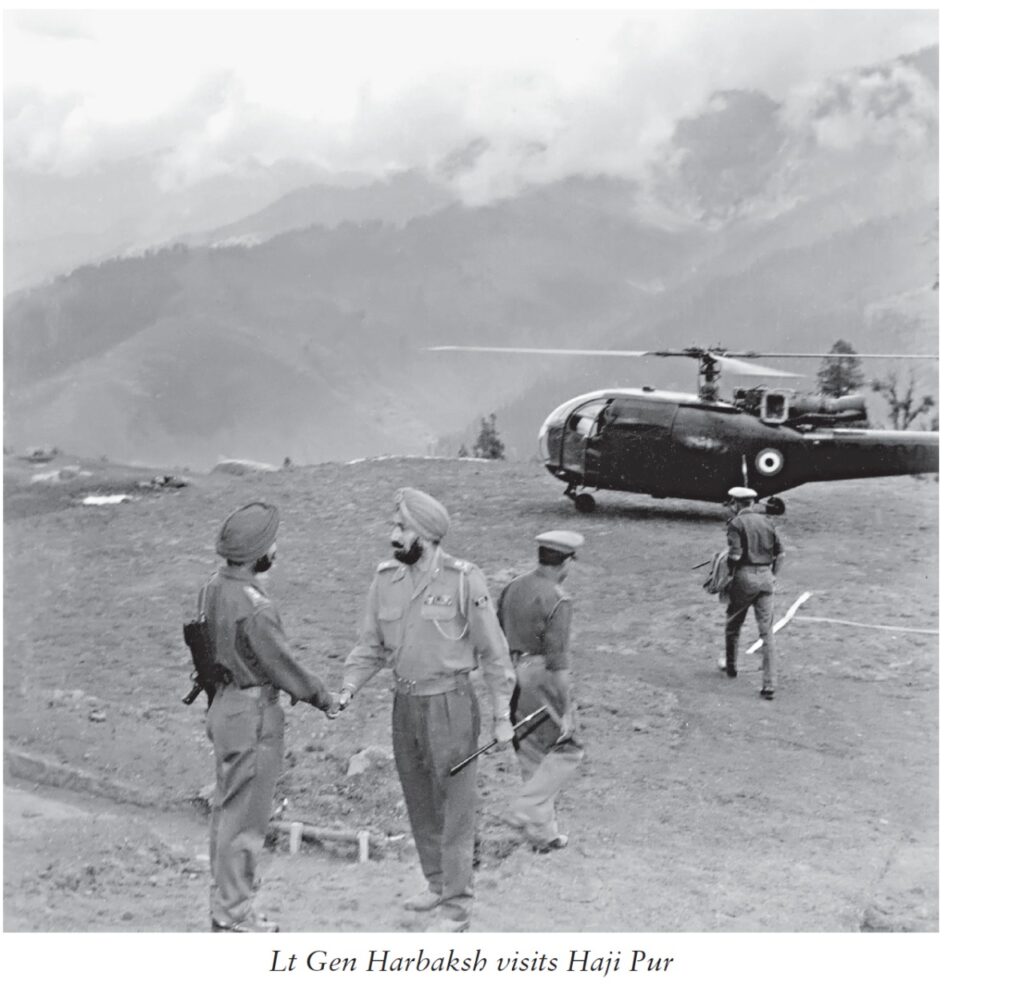
Lt Gen Harbaksh Singh, Western Army Commander during the 1965 war, visits Haji Pir. Credits – 1965: Turning the Tide.
The task of capturing Haji Pir Pass was given to 19 Infantry Division commanded by Major General SS Kalaan and the Corps reserve of 68 Infantry Brigade commanded by Brigadier ZC Bakshi.
On August 21, Brigadier Bakshi briefed his officers: “Gentleman, since 1947 we have been cribbing that government does not allow us to attack, go into offensive but this time, we have been given a clear mandate to capture Haji Pir at any cost. Where I say at any cost, a civilian may mean 100 per cent casualties, but I, as an Infantryman, say only when you have had 40 per cent casualties, come back to me; otherwise, press home.”
On August 26, 1 Para battalion moved towards Sank. They had to climb steep terrain under heavy rain. Pakistan’s positions were well defended. After capturing Sank, the Indian Army pressed further on Ledwali Gali, capturing it the next day.
The plan was to capture Bedori next. However, Brigadier Bakshi understood that by now Pakistan would have realized that Indians were pressing for Haji Pir Pass. So, he took a unilateral decision to go in straight for Haji Pir Pass.
Giving the task to Major Ranjit Singh Dayal, Brigadier Bakshi said: “If you win Haji Pir you will be a hero but if you can’t I will be arrested for taking a unilateral decision.”
Major Ranjit Singh Dayal trekked the whole night of August 27 in heavy rain and captured Haji Pir Pass on August 28, despite heavy odds. Pakistan tried to recapture the strategic pass on August 29, but Indian forces repelled those attacks.
A Historic Mistake Of ‘Epic Proportions’
What Pakistan could not win on the battlefield, it won at the negotiating table.
The Tashkent Agreement, signed on January 10, 1966, entailed the withdrawal of Indian and Pakistani forces to positions that existed before August 5, 1965. This status quo ante also included the return of the bravely fought Haji Pir Pass captured with considerable grit and determination.
Notably, India had captured 1,920 sq km of Pakistani territory, mainly the fertile land of Sialkot, Lahore, and Kashmir sectors, including the strategic Haji Pir Pass.
Pakistan had 550 sq km of Indian territory, mainly in the deserts opposite its Sindh province, and Chhamb in Akhnoor. Yet, despite holding almost four times more Pakistani land including in strategic areas like Haji Pir Pass and near Lahore, India did not get any advantages in Tashkent agreement.
The Hero of capture of Haji Pir, Lt Gen Ranjit Singh Dyal, awarded Maha Vir Chakra for his bravery and leadership in the operation, said in an interview in 2002, “The pass would have given India a definite strategic advantage … It was a mistake to hand it back… our people don’t read maps.”
Commenting on the Tashkent Agreement, Lieutenant General Dr D B Shekatkar told Rediff: “We don’t know what the reasons were that we gave back the Haji Pir Pass which was strategically very important. Today, the entire infiltration into Kashmir takes place from that area. If we had retained the post that we had captured, things could have been different. Haji Pir was given to Pakistan because of the Indian government’s magnanimity.”
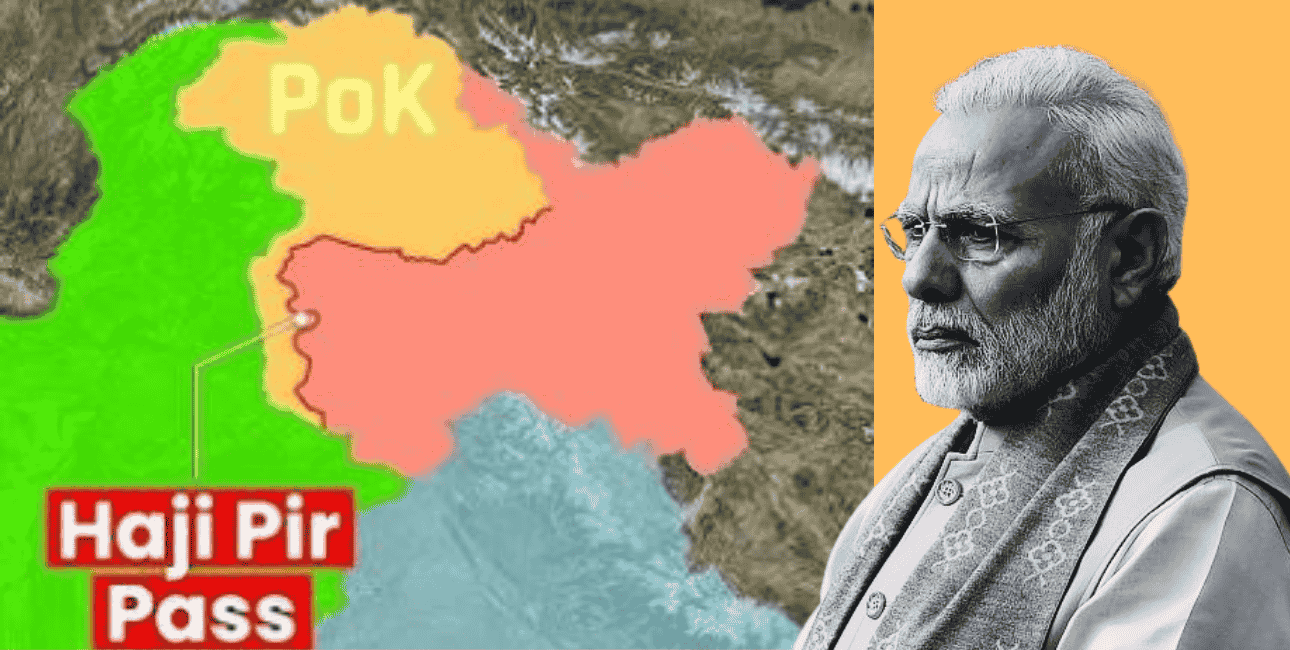
PM Modi and Haji Pir Pass on Map. Edited Image.
He also warned that losing the gains of war at the negotiating table becomes a disincentive for future wars. His warning was proved correct in 1971 when India once again lost the Chhamb sector, which Pakistan had occupied in the 1965 war but vacated as per the terms of the Tashkent agreement. However, India did not retake Haji Pir Pass.
Also, once again, despite having 93,000 Pakistani PoWs, India failed to press Pakistan to vacate the Chhamb sector. So effectively, while India won and returned Haji Pir Pass in 1965, Pakistan still occupies the Chhamb sector.
Pakistan has continuously used this same Haji Pir Pass for infiltration in India and supporting terrorism in Kashmir.
Regretting the Indian government’s mistake in 1965, India’s Defense Minister Rajnath Singh said in January this year that after the 1965 war with Pakistan, had the Indian government converted the “strategic advances” gained by military into “strategic advantages” on the negotiating table, the problem of cross-border infiltration would have been solved.
Speaking in Jammu’s Akhnoor at a function to mark Armed Forces Veterans Day on January 14, Rajnath said Indian forces had succeeded in unfurling the Tricolour at Haji Pir in 1965, and “if it was not returned to the negotiation table, the infiltration routes of militants could have been closed.”
India lost two historic opportunities in 1971 and 1999 to retake the Haji Pir Pass and permanently shut Pakistan’s main infiltration route into Kashmir.
In the wake of the latest terror attack, one thing is clear. For addressing a critical security lacuna in Kashmir, India must wrest back the control of its strategic Crimea (Haji Pir Pass) that New Delhi gifted to Islamabad in 1966. Just like the Soviet Union gifted Crimea to Ukraine in 1954, India gifted Haji Pir Pass to Pakistan in 1966. The time has come to correct that historical wrong.
India must get its Crimea back!
India “Beats” Pakistan In Nuclear Warheads For 1st Time In Over Two Decades Amid Boiling Tensions After Terror Attacks: FAS
India has quietly surpassed Pakistan in nuclear warhead numbers for the first time in over two decades, signaling a shift in South Asia’s strategic balance.
As tempers flare between two nuclear-armed neighbors, after a brutal terror attack in Kashmir that killed 26 tourists, South Asia edges dangerously closer to a potential military confrontation.
In the idyllic Baisaran Valley, terror struck with a cruelty that shattered Kashmir’s fragile calm. Pakistan-backed militants ambushed 26 unsuspecting tourists, staining the meadows of Pahalgam with blood and setting in motion a chain of events that now threatens to spiral far beyond the valley’s borders.
The Indian government’s response has been swift and unforgiving. Homes of suspected militants have been razed. Security forces stormed suspected hideouts. Hundreds of overground workers — civilians accused of aiding militants — have been rounded up for intensive interrogation, officials reported on Saturday.
Meanwhile, the Union Ministry of Information and Broadcasting has instructed media outlets to halt live broadcasts of military operations, aiming to safeguard both operational security and public order.
But Kashmir’s agony is only the beginning of a much larger, far graver crisis. As New Delhi points an accusing finger squarely at Islamabad, blaming Pakistan for harboring and enabling terror networks, diplomatic relations between the two nuclear-armed neighbors are unraveling with frightening speed. Pakistani diplomats have been expelled. Borders sealed. Water-sharing agreements suspended.
South Asia stands once again on the edge of a knife.
Dangerous Nuclear Reality
Just as tensions erupt, another unsettling development demands attention: the balance of nuclear power between India and Pakistan has shifted.
According to the latest Status of World Nuclear Forces report released by the Federation of American Scientists (FAS), India now possesses roughly 180 nuclear warheads, surpassing Pakistan’s estimated 170.
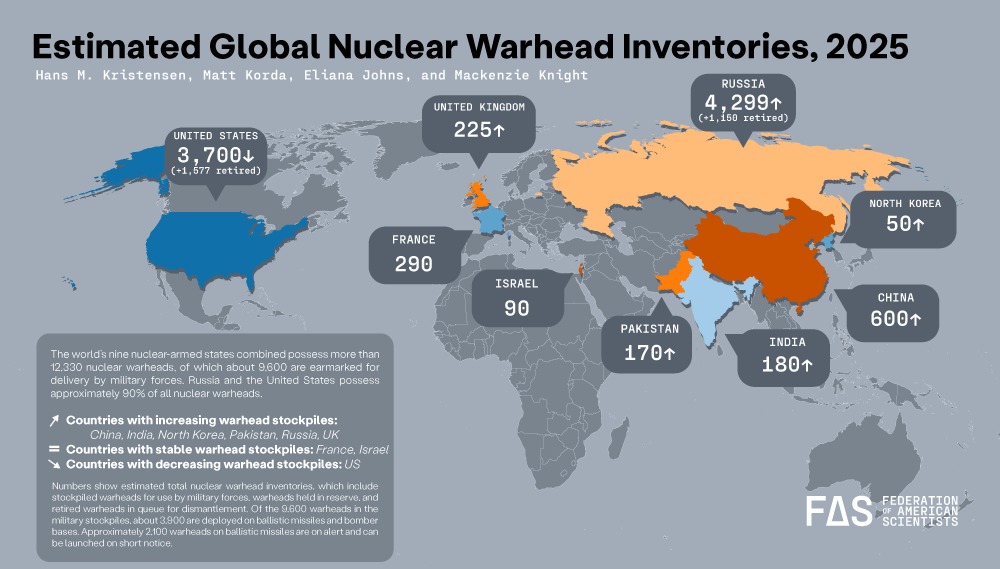
Via: FAS
It’s the first time in over two decades that India has surpassed its rival in nuclear stockpile size, signaling a subtle yet critical shift in South Asia’s strategic landscape.
This shift had been foreshadowed by the Stockholm International Peace Research Institute (SIPRI) in its 2024 report, which estimated India’s stockpile at around 172 nuclear warheads — narrowly surpassing Pakistan’s count of 170.
India’s nuclear journey began in 1974, when it conducted its first nuclear test, emerging as the sixth country in the world to demonstrate nuclear capability. Pakistan followed nearly a quarter-century later, conducting its own tests in 1998 in response to India’s moves, locking both countries into a delicate and volatile nuclear competition.
For much of the past two decades, Pakistan maintained a slight numerical advantage, in part by developing tactical nuclear weapons designed to offset India’s superior conventional forces.
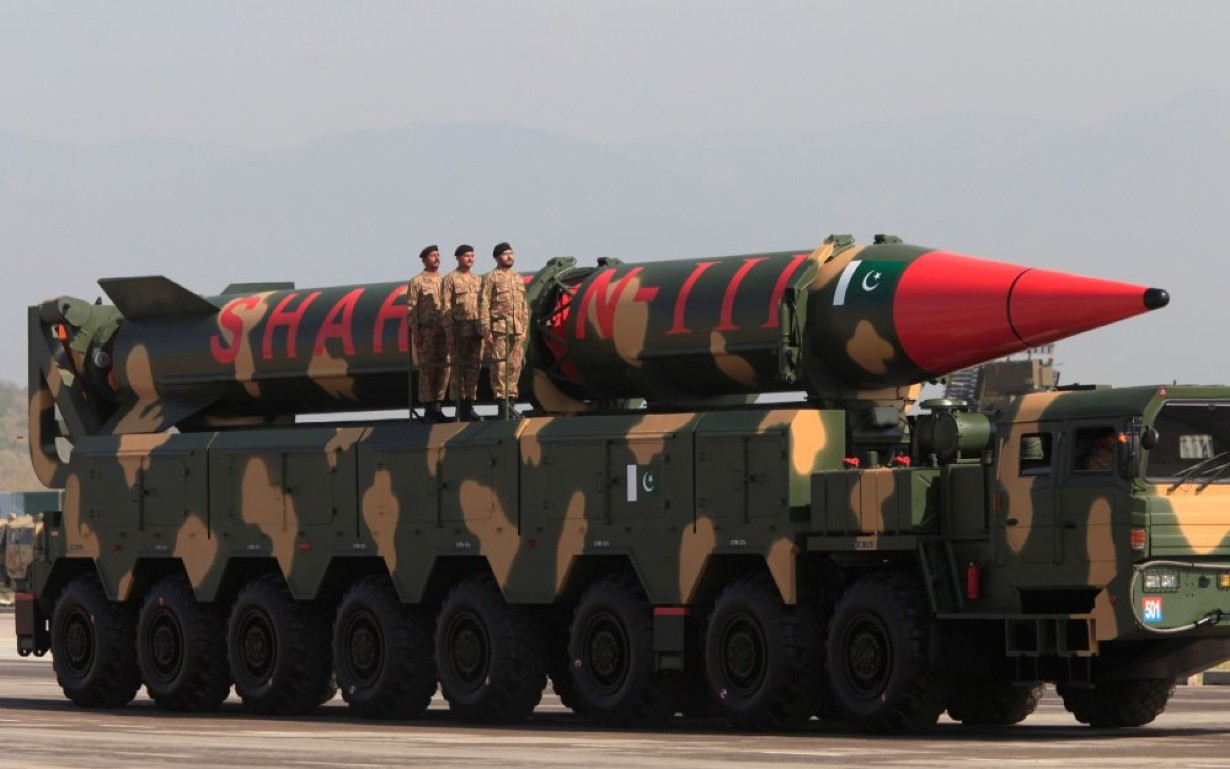
Pakistan nuclear weapon /File Image
But New Delhi’s nuclear modernization drive, particularly the successful test of its Agni-5 ballistic missile armed with Multiple Independently Targetable Reentry Vehicles (MIRVs) earlier this year, dramatically increases its nuclear reach and flexibility. MIRV technology enables a single missile to strike multiple targets — a major leap in offensive capability, complicating the strategic calculus not only for Pakistan but also increasingly for China.
Both India and Pakistan are now racing to develop MIRV capabilities, opening a new and more volatile chapter in their nuclear rivalry — one defined by speed, sophistication, and the terrifying potential for miscalculation.
The Gulf In Military Power Grows Wider
The shifting nuclear balance is accompanied by another, even starker disparity: defense spending.
India’s defense budget for 2025–26 has increased to an estimated $79 billion, a nearly 10% rise from the previous year. Pakistan’s budget, by contrast, struggles at around a mere $8 billion. In simple terms, India now spends nearly ten times more than Pakistan on its military.
This financial muscle translates directly into hardware and capabilities. India has expanded its arsenal with Rafale fighter jets, Russian-made S-400 air defense systems, and a sweeping modernization of its Army, Navy, and Air Force.
Meanwhile, Pakistan, heavily burdened by maintaining a large standing army and a credible nuclear deterrent, is increasingly forced to pick and choose among its modernization needs, stretching limited resources ever thinner.
India’s deepening conventional superiority, paired with its growing nuclear capabilities, is reshaping the regional balance of power, leaving Pakistan more reliant than ever on asymmetric strategies and its nuclear deterrent to offset the widening gap.
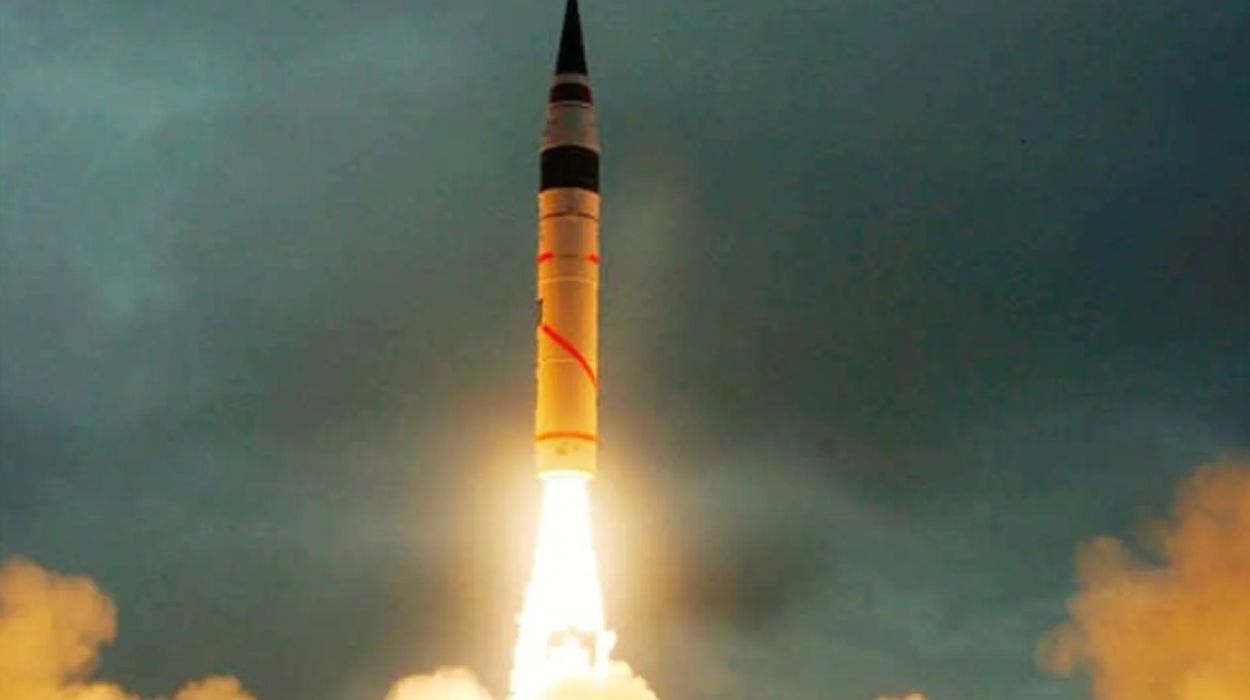
File Image: India’s Agni Nuclear Missile
The Specter Of Escalation
The Pahalgam massacre has unleashed a tide of rage and retribution. Yet the true danger lies not just in India’s muscular response, but in the volatile nuclear backdrop against which it unfolds.
India’s nuclear policy, formally centered on a “No First Use” policy, has shown signs of flexibility in recent years. Senior Indian leaders have hinted that a major terrorist attack, particularly one linked to Pakistan, could trigger nuclear retaliation under certain circumstances, especially if chemical or biological weapons are involved.
Meanwhile, India’s pursuit of a fully operational nuclear triad, the ability to launch nuclear strikes from land, sea, and air, gives it unprecedented options for response and deterrence.
Longer-range missiles like Agni-V and the upcoming Agni-VI are designed not just for Pakistan, but to hold Chinese cities at risk — another sign that India’s strategic horizons are expanding.
While India actively participates in international non-proliferation initiatives, such as the Missile Technology Control Regime (MTCR), and seeks membership in the Nuclear Suppliers Group (NSG), it remains outside the Nuclear Non-Proliferation Treaty (NPT) and the Comprehensive Test Ban Treaty (CTBT). Its nuclear policy remains very much its own — flexible, opaque, and tailored to its unique regional challenges.
A Fragile Region In A Volatile World
At a time when the Israel-Gaza war continues to rage in the Middle East and the Russia-Ukraine conflict grinds on in Europe, the emergence of yet another flashpoint in South Asia is deeply concerning.
The international system is already stretched thin, with major powers preoccupied and diplomatic resources strained.
In such an environment, the risks of miscalculation and escalation become even higher, especially between nuclear-armed states like India and Pakistan, whose historic mistrust and unresolved disputes could easily magnify a local incident into a larger crisis.
At this fragile moment, strategic patience, robust crisis management, and backchannel diplomacy are more critical than ever.
Panic in Pakistan as India vows to cut off water supply over Kashmir
LATIFABAD, Pakistan/NEW DELHI, April 27 (Reuters) - Spraying pesticides on his parched vegetables one street away from the Indus River, Pakistani farmer Homla Thakhur is worried about his future. The sun is at its peak, the river is running very low, and India has vowed to cut supplies upstream after a deadly militant attack in Kashmir.
"If they stop water, all of this will turn into the Thar desert, the whole country," said Thakhur, 40, before heading back to the river to refill the tank for the spray gun.