It was a good start for the stock market today and that was about it. The major indices hit their best levels of the session within fifteen minutes of the opening bell and then spent the rest of the morning retracing those gains. The afternoon session produced a half-hearted rebound try, yet the major indices couldn't stake a position on positive ground when the closing bell rang.
Overall losses were modest in scope, which isn't bad given the scope of Friday's gains. However, with the presumed buying catalyst of a weakening dollar in place, more M&A activity, and a surprise announcement from Hewlett-Packard (HPQ 36.87, +1.67) that it is going to split into two companies in an effort to bolster shareholder value, there was likely some disappointment that the stock market didn't do any better than it did.
The quick inclination to sell into the opening strength left buyers on guard that the de-risking move seen at the end of the third quarter may not have yet run its course.
The latter consideration along with technical resistance for the S&P 500 at the 1980 level, a stunning bankruptcy protection filing from GT Advanced Technologies (GTAT 0.80, -10.25), which supplies sapphire glass to Apple (AAPL 99.62, unch), and the underperformance once again of the Russell 2000 (-0.9%) helped keep buying interest in check.
The main pockets of weakness in the market were found in the biotech, transport, and semiconductor spaces. Word from Sunesis Pharmaceuticals (SNSS 1.46, -5.18) that a Phase 3 trial it was conducting failed to meet its primary endpoint sucked the momentum out of the biotech space; Ebola concerns once again weighed on the transports; and a 4.0% drop in Micron (MU 32.57, -1.37) after reports said Samsung is planning to invest close to $15 billion in a new semiconductor plant pressured the Philadelphia Semiconductor Index (-0.8%).
Separately, the energy sector (+0.1%) had a roller-coaster day of trading, vacillating with oil prices, which dipped below $89/bbl before finishing the day at $90.57/bbl.
The rebound in oil prices coincided with a break lower in the U.S. Dollar Index (85.71, -0.98) in afternoon trading. The greenback was weak throughout the session, yet its losses accelerated in the afternoon action on what was considered to be a profit-taking move following a huge run in the third quarter.
Stock sector moves were pretty limited in scope to both the upside and the downside. The biggest winner was the telecom services sector (+0.4%) while the biggest loser was the consumer discretionary sector (-0.6%). The limited moves fit the standing of the S&P 500 at the closing bell.
There wasn't any economic data out of the U.S. today, but resonating in the background was a report that the World Bank cut its 2014 and 2015 GDP views for China and news that German factory orders declined 5.7% in August.
Notwithstanding the limited change in the S&P 500, the CBOE Volatility Index (VIX 15.29, +0.74) jumped 5.1% on Monday.
- Nasdaq Composite +6.7% YTD
- S&P 500 +6.3% YTD
- Dow Jones Industrial Average +2.5% YTD
- Russell 2000 -5.9% YTD
- VNDA Oct 11 calls are seeing interest with the underlying stock 4% lower (volume: 3660, open int: 150, implied vol: ~109%, prev day implied vol: 94%)
- HOG Oct 62.5 calls are seeing interest with relative strength in the underlying stockfollowing RBC upgrade (volume: 2260, open int: 2110, implied vol: ~24%, prev day implied vol: 22%) -- co is confirmed to report earnings Oct 21 before the open (outside of Oct expiration).
- PWE Mar15 6 puts (volume: 11.7K, open int: 310, implied vol: ~53%, prev day implied vol: 44%) -- one 5K transaction traded on the offer. Co is expected to report its next quarter early November.
- ALTR Oct 34 puts (volume: 6360, open int: 320, implied vol: ~26%, prev day implied vol: 22%) -- co is confirmed to report earnings Oct 23 after the close (outside of Oct expiration).
- OLED Nov 30 puts are seeing interest following electronic display peer GTAT bankruptcy news (volume: 5080, open int: 50, implied vol: ~57%, prev day implied vol: 53%) -- more than 3K traded in single transaction near offer. OLED is expected to report earnings early November.
Last May, I covered the work of Defense Distributed with regard to its building of tools for individuals to 3D-print their own firearms in the post. Meet “The Liberator”: The World’s First Fully 3D-Printed Firearm, In it, I noted:
3D-printing, like decentralized crypto currencies, have the potential to change the world in which we live in extraordinary ways. Ways that are almost inconceivable at this point given we are so early in the game. More than anything else, these technologies can empower the individual like never before, and I think that is generally a very good thing.
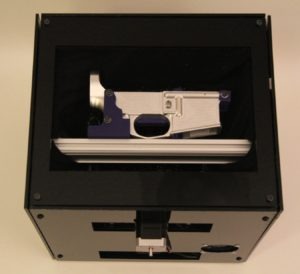
While all sixteen pieces of the Liberator were printed in ABS plastic, the $1,200 computer-controlled (CNC) milling machine called the “Ghost Gunner,” is capable of automatically carving polymer, wood, and metal in three dimensions. More from Wired:
Americans want guns without serial numbers. And apparently, they want to make them at home.
On Wednesday, Cody Wilson’s libertarian non-profit Defense Distributed revealed the Ghost Gunner, a $1,200 computer-controlled (CNC) milling machine designed to let anyone make the aluminum body of an AR-15 rifle at home, with no expertise, no regulation, and no serial numbers. Since then, he’s sold more than 200 of the foot-cubed CNC mills—175 in the first 24 hours. That’s well beyond his expectations; Wilson had planned to sell only 110 of the machines total before cutting off orders.
While the Ghost Gunner is a general-purpose CNC mill, capable of automatically carving polymer, wood, and metal in three dimensions, Defense Distributed has marketed its machine specifically as a tool for milling the so-called lower receiver of an AR-15, which is the regulated body of that semi-automatic rifle. The gun community has already made that task far easier by selling so-called “80-percent lowers,” blocks of aluminum that need only a few holes and cavities milled out to become working lower receivers. Wilson says he’s now in talks with San Diego-based Ares Armor, one of the top sellers of those 80-percent lowers, to enter into some sort of sales partnership.
The sales numbers for the Ghost Gunner may be far smaller. But at $1,200, every sale helps fund the activities of Defense Distributed. “I’ve never felt more optimistic about the ability of Defense Distributed to become an installed part of the future, and to help create an expansion of the second amendment,” he says. “There’s hope that Defense Distributed can become a significant civil liberties organization…That’s the ambition, the wildest dream of this entity, to have a marked material effect like that.”
Now here’s the Ghost Gunner in all its YouTube video glory:
Long-time readers of Liberty Blitzkrieg will know that I am a huge supporter of gun rights. While I am personally not a gun enthusiast in my own life, I recognize the right of my fellow citizens to be armed. While many people like to blindly push for gun control, it would be mush wiser for Americans to focus on “war control.” That is, stopping our own government from consistently, aggressively and unconstitutionally unleashing violence on populations all over the world, particularly the Middle East.
I find it the height of hypocrisy when politicians constantly using our nation’s blood and treasure to bomb and murder civilians all over the world, get up on podiums to stress the importance of disarming peaceful civilians due to a few random school shootings (as tragic as they are). When the U.S. government becomes Switzerland, then we can talk gun control. The biggest criminals, murders and war-profiteers around are at the top of the U.S. government and the military-industrial complex, and they’re doing it with our tax dollars. So if you want a more peaceful world, let’s start there.
For more of my thoughts on gun control read: How to Spot a Hypocrite in the Gun Debate and Other Reflections on Newtown
If 3D-printing of firearms isn’t your thing, check out: 3D Printing Entire Homes and Neighborhoods May be Just Around the Corner
In Liberty,
Michael Krieger
2014-10-06 18:00:45.141 GMT
By Aoife White
Oct. 6 (Bloomberg) -- Telecommunications operators could
charge higher prices for higher speed under new net-neutrality
rules, says Andrus Ansip, the EU’s vice-president-designate for
the digital single market.
* “Higher speed for a higher prices is acceptable but not at
the expense of others, not at the expense of those whose
speed is already low,” he says
* Refers to Google antitrust case, says it can be impossible
for small businesses to gain visibility in search-engine
results
* Says he wants EU governments and lawmakers to finalize data-
protection rules in first six months of new commission
mandate due to start on Nov. 1
* On right to be forgotten, says balance must be found between
freedom of expression and protection of privacy
* Says he wants to abolish roaming fees for “normal phone
use"; also wants to abolish ‘‘geoblocking’’ or blocking
Internet traffic based on user’s location
* Ansip speaks at hearing with EU lawmakers who must confirm
his appointment
* Ansip’s new role would oversee regulation for
telecommunications, data protection, copyright and
cybercrime
* Previously Estonia’s prime minister
* SEE: EU Data-Protection Rules Steered by Estonia’s Ansip:
Juncker NSN NBOUQX6K50XU <GO>
For Related News and Information:
First Word scrolling panel: FIRST<GO>
First Word newswire: NH BFW<GO>
To contact the reporter on this story:
Aoife White in Brussels at +32-2-237-4329 or
awhite62@bloomberg.net
To contact the editor responsible for this story:
Peter Chapman at +32-2-285-4318 or
pchapman10@bloomberg.net
Last May, I covered the work of Defense Distributed with regard to its building of tools for individuals to 3D-print their own firearms in the post.