(BFW) Sika CEO Says Can’t Implement Saint-Gobain’s Goals: NZZaS


Sika CEO Says Can’t Implement Saint-Gobain’s Goals: NZZaS
2014-12-21 09:23:27.611 GMT


By Giles Broom
(Bloomberg) -- Sika’s management can’t understand Saint-
Gobain’s goals for business, plans can’t be implemented, CEO Jan
Jenisch is cited as saying in interview in NZZ am Sonntag.
* Sika to finish 2014 with double-digit growth,“good” profit
margin
* NOTE: Sika Family Seeking to Oust Board Members Opposing
Sale


For Related News and Information:
First Word scrolling panel: FIRST<GO>
First Word newswire: NH BFW<GO>

To contact the reporter on this story:
Giles Broom in Geneva at +41-22-317-9212 or
gbroom@bloomberg.net
To contact the editor responsible for this story:
Mark Bentley at +49-699-204-1262 or
mbentley3@bloomberg.net

Wiwo : ECB Vice Constancio warns of 'dangerous vicious circle "

ECB Vice Constancio warns of 'dangerous vicious circle "

Oil prices steadily falling stir at the European Central Bank, the fear of deflation. ECB Vice Constancio warns of a "dangerous vicious circle".

"In the short term this creates a not an easy situation for us," admitted ECB Vice President Vitor Constancio an interview with Business Week. "We now expect a negative inflation rate in the coming months. That's one thing that has to look at each central bank very closely."

The original estimate of the ECB inflation for 2015 from 0.7 per cent is already out of date for the ECB Vice. "Since the drafting of these projections, oil prices have fallen by a further 15 percent." The ECB must now prevent a downward spiral. It threatens "a dangerous vicious circle of falling prices, rising real wages, falling profits, shrinking demand and prices continue to fall," warned the ECB Vice-President. "The economy would slip into recession." Currently, many experts predicted that the economic slowdown will continue in the euro zone by 2018. Constancio: "Until then, so there is downward pressure on inflation expectations."

Currently, the euro-zone but location is not in deflation. "A few months with negative inflation rates mean deflation. These negative inflation rates must be over a longer period of time," said Constancio. "If it is only a temporary phenomenon, then I see no danger begin. Deflationary tendencies when the company and the people change their behavior and postpone investments and expenses."

There is also a risk of deflation does not consist in all euro area countries. "In countries such as Spain and Ireland, whose economy is slowly recovering, increasing productivity. This creates scope for wage increases, which counteract the threat of deflation," Constancio said the former President of the Banco de Portugal was.

In the fight against deflation, the ECB had to use all possible resources, including the controversial purchase of government bonds, which had recently criticized Bundesbank President Jens Weidmann. "We need to use all monetary policy instruments at our disposal," Constancio said. "Is basically quantitative easing, everyone is talking about now, nothing more than a traditional open market operation, ie about the possibility of a central bank, securities, government bonds, to buy in the secondary market or sell to control the monetary base. This is perfectly legal. And what is legal, we do not exclude. " There is nevertheless at the ECB "not an obsession, necessarily to buy government bonds."

Constancio sees no danger bubble in the stock and real estate markets

The European Central Bank keeps warnings of a bubble in the financial markets is unfounded. "In the US, the price-earnings ratio of the shares is somewhat higher than the historical average -. But not in Europe here I do not see any significant overvaluation of equity markets," said ECB Vice President Vitor Constancio in an interview with Business Week. "Even in corporate bonds, we can not recognize such overvaluation." Similar to the situation in the real estate markets is. In some euro area countries, prices have risen in recent years significantly, such as Belgium and Ireland. In Belgium, the national supervisory authorities had already responded and increased capital requirements for mortgage loans. In Ireland there are now more stringent capital requirements. "Overall, I see no danger for Europe a new house price bubble," said Constancio.

Special Situations: Carrefour Bingo 1: Eur 24.3 - target remains North of

Special Situations: Carrefour Bingo 1:  Eur 24.3 - target remains North of 40 - BUY re-iterated

Special Situations: Carrefour (CA FP)

trade action flash – bingo 1: monetization of Brazil – BUY again

CA FP: EUR 24.3; target: Eur 40+

December 19, 2014

Carrefour announced it was selling 10% of its Brazilian business to Abilio Diniz for BRL20.4bn.  The figure is within our expected range particularly given the depreciation of the Reais vs. Euro (10%).  As we had been arguing forcefully since Mr. Plassat was appointed CEO, the Carrefour Brazil business, one of the group’s main assets, is being monetized with a clear price tag put on it.  That Mr. Diniz bought the stake is no surprise either.  This is what we had written in our April 16, 2012 report:

“Carrefour has the ability to price some of its most important assets via partial IPOs, spin-offs (it did it already with its Spanish discount chain, returning more than Eur 2bn to shareholders). In particular, it could list its Brazilian business, or issue tracking shares for it, or even possibly sell it to Abilio Diniz when he is cashed out of CBD by Casino (or more likely a combination of IPO with Diniz taking a significant stake).”

Our scenario for Carrefour is unfolding exactly as we thought.  Mr. Diniz is taking a substantial stake that he can increase to 16%.  No doubt that the IPO will come in due course, in particular when the Brazilian market returns to a more bullish stance. The fact Mr. Diniz is becoming a significant shareholder is extremely good news for Carrefour. He is one of Brazil’s most emblematic business leader, having built the country’s largest and most successful supermarket chain (Pao de Acucar – PCAR4 BZ) and sold it to Casino.

With Brazil partially done, we continue to think that Carrefour’s next major restructuring news will be the monetization of its huge real estate portfolio.  Our target remains North of Eur 40.

As an aside, we recommend to close the short Casino stub we had recommended as a hedge in our May 9 2014 report.  The stub value (Casino ex Pao de Acucar and Mercyalis) went down by over 20% since then.


>>> The Biggest Economic Story Going Into 2015 Is Not Oil


The Biggest Economic Story Going Into 2015 Is Not Oil

Isn’t it fun to just watch the market numbers roll by from time to time as you go about your day, see Europe markets up 3%+, Dubai 13%, US over 2% (biggest two-day rally since 2011!), and you just know oil must get hit again? Well, it did. WTI down another 3%+. I tells ya, no Plunge Protection is going save this sucker.
And oil is not even the biggest story today. It’s plenty big enough by itself to bring down large swaths of the economy, but in the background there’s an even bigger tale a-waiting. Not entirely unconnected, but by no means the exact same story either. It’s like them tsunami waves as they come rolling in. It’s exactly like that.
That is, in the wake of the oil tsunami, which is a long way away from having finished washing down our shores, there’s the demise of emerging markets. And I’m not talking Putin, he’ll be fine, as he showed again today in his big press-op. It’s the other, smaller, emerging countries that will blow up in spectacular fashion, and then spread their mayhem around. And make no mistake: to be a contender for bigger story than oil going into 2015, you have to be major league large. This one is.
The US dollar will keep rising more or less in and of itself, simply because the Fed has ‘tapered QE’, and much of what happened in global credit markets, especially in emerging markets, was based on cheap and easily available dollars. There’s now $85 billion less of that each month than before the taper took it away in $10 billion monthly increments. The core is simple.
This is not primarily government debt, it’s corporate debt. But it’s still huge, and it has not just kept emerging economies alive since 2008, it’s given them the aura of growth. Which was temporary, and illusionary, all along. Just like in the rest of the world, Japan, EU, US. And, since countries can’t – or won’t – let their major companies fail, down the line it becomes public debt.
One major difference from the last emerging markets blow-up, in the late 20th century, is size: emerging markets today are half the world economy. And they’re about to be blown to smithereens. Sure, oil will play a part. But mostly it will be the greenback. And you know, we can all imagine what happens when you blow up half the global economy …
Erico Matias Tavares at Sinclair has a first set of details:
There are some signs of trouble in emerging markets. And the money at risk now is bigger than ever. The yield spread between high grade emerging markets and US AAA-rated corporate debt has jumped, almost doubling in less than three weeks to the highest level since mid-2012.


MSCI Emerging Markets Index and Yield Spread between High Grade Emerging Markets and US AAA Corporates: 14 March 2003 – Today. Source: US Federal Reserve.

This means that the best credit names in emerging markets have to pay a bigger premium over their US counterparts to get funding. When this spread spikes up and continues above its 200-day moving average for a sustained period of time, it is typically a bad sign for equity valuations in emerging markets, as shown in the graph above. One swallow does not a summer make, but it is worthwhile keeping an eye on this indicator.


As yields go up the value of these emerging market bonds goes down, resulting in losses for the investors holding them. The surge of the US dollar in recent months could magnify these losses: if the bonds are denominated in local currency they will be worth a lot less to US investors; otherwise, the borrowers will now have to work a lot harder to repay those US dollar debts, increasing their credit risk. Any losses could end up being very significant this time around, as demand for emerging markets bonds has literally exploded in recent years.


Average Annual Gross Debt Issuance ($ billions, percent): 2000 – Today. Source: Dealogic, US Treasury. Note: Data include private placements and publicly-issued bonds. 2014 data are through August 2014 and annualized.

As the graph above shows, the issuance of emerging market corporate debt has risen sharply since the depths of the 2008-09 financial crisis.These volumes are very large indeed, and now account for non-trivial portions of investors’ and pension funds’ portfolios worldwide.


As a result, emerging markets corporations are now leveraged to the hilt, easily exceeding the 2008 highs by almost a multiple to EBITDA. And why not? With foreign investors desperate for yield as a result of all the stimulus and money printing by their central banks, they were only too happy to oblige. And they were not alone. Governments in these countries were also busy doing some borrowing of their own, as their domestic capital markets deepened.


[..] foreign investors have also piled into locally denominated bonds of emerging markets governments. Countries like Peru and Latvia now have over 50% foreign ownership of their bonds. [..] But there are big speculative reasons behind the recent money flows going into these countries – which could reverse very quickly should the tide turn. [..]


If investors end up rushing for the emerging markets exit for whatever reason, with this unprecedented level of exposure they might be bringing home much more than a bruised ego and an empty wallet. For one, European banks are hugely exposed to emerging markets. Any impairment to their books would likely make any new lending even more difficult, at a time when there is already a dearth of non-government credit in Europe.


And if emerging economies falter, where will the growth needed to repair Western government and private balance sheets come from? It used to be said that when the US economy sneezes the rest of the world catches a cold. Now it seems all we need is a hiccup in emerging markets.

That’s what you get when emerging markets are both half the global economy AND they’ve accomplished that level off of ultra-low US Fed interest rates and ultra-high US Fed credit ‘accommodation’. All you have to do when you’re the Fed is to take both away at the same time, and you’re the feudal overlord.
Our favorite friend-to-not-like Ambrose Evans-Pritchard does what he does well: provide numbers:
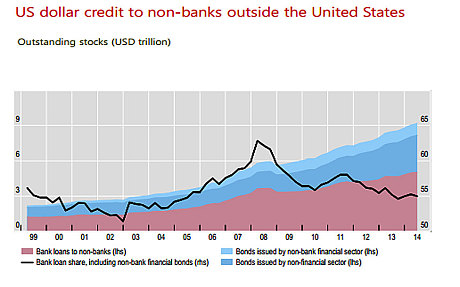
The US Federal Reserve has pulled the trigger. Emerging markets must now brace for their ordeal by fire. They have collectively borrowed $5.7 trillion in US dollars, a currency they cannot print and do not control. This hard-currency debt has tripled in a decade, split between $3.1 trillion in bank loans and $2.6 trillion in bonds. It is comparable in scale and ratio-terms to any of the biggest cross-border lending sprees of the past two centuries.


Much of the debt was taken out at real interest rates of 1% on the implicit assumption that the Fed would continue to flood the world with liquidity for years to come. The borrowers are “short dollars”, in trading parlance. They now face the margin call from Hell as the global monetary hegemon pivots. The Fed dashed all lingering hopes for leniency on Wednesday. The pledge to keep uber-stimulus for a “considerable time” has gone, and so has the market’s security blanket, or the Fed Put as it is called. Such tweaks of language have multiplied potency in a world of zero rates.


Officials from the BIS say privately that developing countries may be just as vulnerable to a dollar shock as they were in the Fed tightening cycle of the late 1990s, which culminated in Russia’s default and the East Asia Crisis. The difference this time is that emerging markets have grown to be half the world economy.Their aggregate debt levels have reached a record 175% of GDP, up 30 percentage points since 2009.


Most have already picked the low-hanging fruit of catch-up growth, and hit structural buffers. The second assumption was that China would continue to drive a commodity supercycle even after Premier Li Keqiang vowed to overthrow his country’s obsolete, 30-year model of industrial hyper-growth, and wean the economy off $26 trillion of credit leverage before it is too late. [..]


Stress is spreading beyond Russia, Nigeria, Venezuela and other petro-states to the rest of the emerging market nexus, as might be expected since this is a story of evaporating dollar liquidity as well as a US shale supply-glut.


[..[ the Turkish lira has fallen 12% since the end of November. The Borsa Istanbul 100 index is down 20% in dollar terms. Indonesia had to intervene on Wednesday to defend the rupiah. Brazil’s real has fallen to a 10-year low against the dollar, as has the index of emerging market currencies. Sao Paolo’s Bovespa index is down 23% in dollars in 3 weeks.

The slide can be self-feeding. Funds are forced to sell holdings if investors take fright and ask for their money back, shedding the good with the bad. Pimco’s Emerging Market Corporate Bond Fund bled $237m in November, and the pain is unlikely to stop as clients discover that 24% of its portfolio is in Russia.


One might rail against the injustice of indiscriminate selling. Such are the intertwined destinies of countries that have nothing in common. The Fed has already slashed its bond purchases to zero, withdrawing $85bn of net stimulus each month. It is clearly itching to raise rates for the first time in seven years. This is the reason why the dollar index has jumped 12% since May, smashing through its 30-year downtrend line, a “seismic change” in the words of HSBC. [..]


World finance is rotating on its axis, says Stephen Jen, from SLJ Macro Partners. The stronger the US boom, the worse it will be for those countries on the wrong side of the dollar.


“Emerging market currencies could melt down. There have been way too many cumulative capital flows into these markets in the past decade. Nothing they can do will stop potential outflows, as long as the US economy recovers.
Hold it there for a moment. I don’t think it’s the US economy (its recovery is fake), it’s the US dollar.
Will this trend lead to a 1997-1998-like crisis? I am starting to think that this is extremely probable for 2015,” he said.


This time the threat does not come from insolvent states. They have learned the lesson of the late 1990s. Few have dollar debts. But their companies and banks most certainly do, some 70% of GDP in Russia, for example. This amounts to much the same thing in macro-economic terms. Private debt morphs into state debt since governments cannot allow key pillars of their economies to collapse.


These countries have, of course, built $9 trillion of foreign reserves, often the side-effect of holding down their currencies to gain export share. This certainly provides a buffer. Yet the reserves cannot fruitfully be used in a recessionary crisis because sales of foreign bonds automatically entail monetary tightening. [..]


.. these reserves are a mirage. If you deploy them in such circumstances, you choke your own economy unless you can sterilize the effects. [..]


Investors are counting on the European Central Bank to keep the world supplied with largesse as the Fed pulls back. Yet the ECB could not pick up the baton even if it were to launch a blitz of quantitative easing, and there is no conceivable consensus for action on such a commensurate scale.


The world’s financial system is on a dollar standard, not a euro standard. Global loans are in dollars. The US Treasury bond is the benchmarks for global credit markets, not the German Bund. Contracts and derivatives are priced off dollar instruments. Bank of America says the combined monetary stimulus from Europe and Japan can offset only 30% of the lost stimulus from the US.
What more can I say? This is the lead story as we go into 2015 two weeks from today. Oil will help it along, and complicate as well as deepen the whole thing to a huge degree, but the essence is what it is: the punchbowl that has kept world economies in a zombie state of virtual health and growth has been taken away on the premise of US recovery as Janet Yellen has declared it.
It doesn’t even matter whether this is a preconceived plan or not, as some people allege, it still works the same way. The US gets to be in control, for a while, until it realizes, Wile E. shuffle style, that you shouldn’t do unto others what you don’t want to be done unto you. But by then it’ll be too late. Way too late.
As I wrote just a few days ago in We’re Not In Kansas Anymore, there’s a major reset underway. We’re watching, in real time, the end of the fake reality created by the central banks. And it’s not going to be nice or feel nice. It’s going to hurt, and the lower you are on the ladder, the more painful it will be. Be that globally, if you live in poorer countries, or domestically, if you belong to a poorer segment of the population where you are. In both senses, the poorest will be hit hardest.
It’s the new model along which the clowns we allow to run the show, do so. Unless ‘we the people’ take back control, it’s pretty easy to see how this will go down.
*  *  *
Still not convinced... Barclays notes this is already one of the worst sell-offs in EM credit since the crisis...

WSJ : China’s Xiaomi Raises Over $1 Billion in Investment Round

China’s Xiaomi Raises Over $1 Billion in Investment Round
Funding Values the Chinese Smartphone Maker at More Than $45 billion, a Source Says

HONG KONG—Xiaomi Corp. is raising more than $1 billion in its latest round of funding, valuing the fast-growing Chinese smartphone maker at more than $45 billion and making it one of the most valuable technology startups in the world, a person familiar with the matter said.

The round, which could close as early as Monday, is led by All-Stars Investment, a tech investment fund run by former Morgan Stanley analyst Richard Ji, the person said. Other participants in the round include Russian investment firm DST Global and Singapore sovereign-wealth fund GIC, which are both already shareholders of Xiaomi.

Yunfeng Capital, a private-equity firm affiliated with Alibaba Group Holding Ltd. Executive Chairman Jack Ma , is also participating in the round.

A Xiaomi spokesman declined to comment.

The $45 billion-plus valuation puts Xiaomi above most other Silicon Valley and Asian technology startups. Earlier this month, U.S. ride-sharing service Uber Technologies Inc. said a new round of funding valued it at $41 billion.

The surge in Xiaomi’s valuation over the past year indicates just how high expectations are as the company expands its business outside China, mainly in emerging markets where there is robust demand for inexpensive smartphones. In its previous round of funding in August 2013, Xiaomi was valued at $10 billion.

Xiaomi, founded by Lei Jun in 2010, has grown rapidly to become the top-selling smartphone vendor in China by offering affordable phones with features rivaling high-end models. Xiaomi phones come with its own customized version of Google Inc. ’s Android operating system, and the company frequently updates the software based on requests from users.

In the second quarter, Xiaomi overtook Samsung Electronics Co. as China’s biggest smartphone maker by shipments for the first time, according to research firm Canalys. This year, Xiaomi expects to sell 60 million units globally, up from 18.7 million in 2013.

Barron's : While Markets Struggled, Some Picks Scored

While Markets Struggled, Some Picks Scored
Europe lagged in 2014, but Fiat Chrysler tore up the track, Rocket Internet lifted off, and Zalando zoomed.

Dow Jones Global Indexes|Global Stock Markets

There’s no getting away from it—Europe was a disappointment for investors in 2014.

Hamstrung by an economy that never took off, and with the carrot of quantitative easing dangled tantalizingly by the European Central Bank but just out of reach, the markets failed to make much headway through the year.

Some stock markets, like Germany’s, are ending the year within touching distance of all-time highs, while others, like France’s, are a long way off their peak. Bond yields are at record lows. German sovereign bonds with a 10-year maturity offered a coupon last Friday of just 0.59%.

Importantly, the euro has begun to weaken. With the prospect of higher interest rates in the U.S., the dollar has finally begun to strengthen—much to the relief of euro-zone economies, which can benefit from a weaker common currency. The euro has lost more than 11% in value against the dollar in 2014, and was trading Friday at $1.22.

The currency’s decline has been positive, but more needs to be done to kick-start economic activity. Observers are looking to the ECB to outline a program for purchasing assets—QE—sometime in the first quarter of 2015.

Europe’s rebound from the financial crisis has continued, albeit at a crawl. The euro-zone economy is forecast to grow at a slower-than-expected 0.8% in 2014.

THE THREAT OF DEFLATION that has hung over the region this year won’t go away; the euro zone’s inflation rate in October was just 0.4%. The sharp decline in oil prices in recent weeks will bring it down further.

Economies that are heavily dependent on oil production have been hit hard by the drop in the price of crude. Russia is in meltdown, battling to defend its currency and its markets. It raised interest rates a whopping 650 basis points, or 6.5 percentage points, to 17%, last week, but the ruble still ended the week lower.

Despite a strong performance from the British economy, projected to grow 3% in 2014, the U.K.’s benchmark FTSE-100 index is down 2.6% this month, even after rebounding 3.9% last week.

The Stoxx Europe 600 index, the performance benchmark for the European Trader, has scratched out a modest gain of 3.7% in 2014, mostly due to a 3% rise last week. One or two bad days could push the index back into the red before the year is over.

It’s the same story for some of Europe’s biggest markets. While Germany is up just 2.5% in 2014, reaching a new closing high earlier this month, France is down 1.3%.

Growth in corporate earnings looks set to come in shy of expectations, despite a weaker currency, lower bond yields, lack of wage growth, and lower commodity prices. Lackluster growth didn’t help with stock-picking, which was much more difficult than in 2013, when European stocks rose a robust 17%. The more challenging environment in 2014 is reflected in our performance over the past 12 months. There have been plenty of hits, but a few more misses than we would have liked.

Fiat, or Fiat Chrysler Automobiles (ticker: FCA.Italy) as it is now called, has blazed a trail since it was recommended here Jan. 6. The stock is up 39% and still has plenty of gas for 2015. At just 10.4 times next year’s projected earnings, Fiat Chrysler’s valuation doesn’t look stretched.

Tech stocks were also good performers. Rocket Internet (RKET.Germany), which operates a platform for identifying and building online business models, and fashion retailer Zalando (ZAL.Germany), have climbed about 20% in value since their initial public offerings at the start of the fourth quarter. Rocket Internet seems capable of reaching a higher altitude, but investors may want to pocket their gains from Zalando.

Telecommunications-network equipment provider LM Ericsson Telefon (ERIC-B.Sweden) has added about 17% since Feb. 3, when it was tipped here. At 15.7 times forecast 2015 earnings, Ericsson looks like relatively good value compared with rivals Nokia (NOK1V.Finland) and Alcatel-Lucent (ALU.France), which trade at multiples of about 20.

Packaging company DS Smith (SMDS.UK) has notched a 21% gain since it was recommended here Aug. 11, on the premise that it deserved to be treated as a consumer-products play. DS Smith is still below its 52-week high, and at 12.6 times projected earnings for 2015, it looks inexpensive.

National Bank of Greece (ETE.Greece), which also has American depositary receipts that trade in New York under the symbol NBG, was our most costly mistake. Since the bank was featured here in June, its value has been halved, hurt by weaker-than-expected earnings and political upheaval.

Our tips in the retail sector also enjoyed mixed fortunes. Wm Morrison Supermarkets (MRW.UK) is off 17% since March, as the shakeout in the U.K. supermarket industry continues, while Belgium’s Delhaize Group (DELB.Belgium) is up 12% since April.

Barron's : In Asian Markets, Easy Money and Reform Produce Winners

In Asian Markets, Easy Money and Reform Produce Winners
Central banks in China and Japan pumped money into their economies to restart growth, affecting Asian markets. New leaders in India and Indonesia gave hope of better governance.

Investors can’t fight the People’s Bank of China or the Bank of Japan any more than they can the Federal Reserve. Asia’s two biggest central banks, together with several reform-minded politicians, were the most influential forces shaping the region’s stock-market performance in 2014.

Shanghai’s shares hadn’t done a thing since 2011, but started to awaken in September, when the People’s Bank injected 500 billion yuan ($80 billion) into the banking system. Most of the market’s big gains came after Nov. 21, when the central bank, worried that economic growth would fall below its 7.5% target, cut its benchmark interest rates for the first time since 2012. Investors who held the Deutsche X-trackers Harvest CSI 300 China A-Shares fund (ticker: ASHR) ended the year with a 45.6% return.

I underestimated the powers of Chinese President Xi Jingping. My worst call of this past year was on Macau’s gambling stocks, which I recommended in late April. Xi’s anti-corruption drive has been forceful and China’s high-rollers have stayed away from the tables. Las Vegas Sands (LVS) and MGM Resorts (MGM) are down 26% and 19%, respectively, since. I also took seriously Xi’s pledge to export China’s engineering expertise to emerging markets. In November I argued that the best way to play Xi’s “Built in China” initiative was railway-construction stocks. So far at least, that’s worked out with China Railway Construction (1186.Hong Kong) leaping ahead 12% in just a few weeks.

THE BANK OF JAPAN undertook unprecedented monetary ease, expanding its balance sheet by over 30% this year and adding money at an annual pace of 80 trillion yen ($670 billion) to spur growth. As a result, the yen is down 11.7% against the dollar, repeatedly testing 120 per dollar, a level last seen in 2007. As I noted in November, U.S. investors should steer clear of perennial favorites like Honda Motor (7267.Japan) because the yen’s decline would overwhelm any gains. Honda is off 15% since, in dollar terms.

Tokyo’s massive easing upended one of my predictions from a year ago: that the export-oriented north of Asia would benefit most from a steady U.S. recovery. Instead, Japan’s weak currency toppled Korea, whose currency rose by 7.7% versus the yen. The iShares MSCI South Korea Capped ETF (EWY) is down 13% this year. On the plus side, Korean cosmetics maker Amorepacific (090430.Korea), which I backed in May, has rallied more than 50% since because of its success in China.

Searching for growth, investors piled into the more expensive south—the Philippines as well as India and Indonesia, which have risen 21%, 29%, and 20%, respectively, in 2014. The Philippines is the second-fastest-growing emerging market in Asia after China. The other two countries voted in reformist leaders—Narendra Modi in India and Joko Widodo in Indonesia—who seem intent on fulfilling campaign promises of better governance.

When investors were getting impatient with Indonesia’s congressional politics in mid-October, I suggested patience. The two banks I recommended, PT Bank Rakyat Indonesia (BBRI.Indonesia) and PT Bank Negara Indonesia (BBNI.Indonesia), rose more than 10% in dollar terms afterward. Both India and Indonesia are at the bottom of their business cycles and desperately need investment; economic reform can carry them a long way.

Barron's : 5 Oils to Buy ( CVX, EOG, OXY, RDSA, SLB)

5 Oils to Buy
Oil’s plunge has created an opportunity to buy quality stocks on the cheap: Chevron, Royal Dutch, Occidental, EOG, and Schlumberger.

Oil prices have been cut in half since the summer, falling to $56.52 a barrel on Friday from a high of $107.26 in June. The pain among oil producers has also been harsh in an otherwise rising stock market. Shares of oil and gas producers are down 29% from the June high, according to Standard & Poor’s, while the S&P 500 has moved up 6%. Some highly leveraged producers could be in jeopardy if the price of crude stays low (see “High Debt” table).

Big integrated energy companies, such as Royal Dutch Shell (ticker: RDSA), ExxonMobil (XOM), and Chevron (CVX), have held up far better, supported by their lush dividend yields, which now range between 3% and 6%. But even among this group, not all are created equal.

We surveyed the oil patch to find the most attractive investment opportunities among large producers and integrated oils, paying special attention to pristine balance sheets and operating costs. They include Royal Dutch and Chevron, among the super majors; Occidental Petroleum (OXY), and EOG Resources (EOG). Schlumberger (SLB), the gold standard among oil-services companies, also made the cut, offering investors a rare chance to buy the high-quality stock on the cheap.

WHILE OIL PRICES could eventually rise from a current mid-$50s levels, they will remain volatile. What’s more, the stocks don’t appear to be trading on fundamentals alone. The group rebounded last week despite the continued slide in the price of crude, a result, some analysts said, of likely short-covering in anticipation of a rally. Oppenheimer analyst Fadel Gheit warned against bottom-fishing amid the volatility, stating in an e-mail, “At the current oil prices, ALL oil stocks are overvalued by historical metrics, as they are currently reflecting $70 to $80 oil.”


The supply-demand imbalance causing the drop in the price of crude doesn’t look like it will sort itself out in the short run. Oil demand is poised to fall below its historic growth rate this year and next, while supply shows no signs of declining. Saudi Arabia has maintained production amid the drop in prices, and even offered discounts to some customers; the country is keen to show the world it still controls the price and availability of oil.

There are few signs that U.S. production, which has grown 90% in the past six years, will slow in the near term; analysts don’t expect it to fall until 2016 at the earliest. The interim period is likely to see some of the riskier companies either go out of business or be purchased in fire-sale deals.

With the smaller explorers and producers “you’re gambling on their survivability,” says Christian Ledoux, senior portfolio manager and director of equity research at South Texas Money Management. “A lot of them won’t be able to explore profitably.”

There is reason for optimism. Some observers, even ones who helped guide Barron’s cover story predicting the oil plunge (“Here Comes $75 Oil,” March 31), don’t expect oil to stay below $60 for long, even if it temporarily slips below $40. Citigroup’s head of global commodity research, Edward Morse, believes $90 will become the new ceiling for oil, whereas it had been the floor for several years. Others agree that the price will eventually rebound, with oil probably trading around $70 or $75 on average over the next two years. Most shale projects, which account for about half of U.S. production, remain profitable when oil prices are $70, although there is wide variation by project.

“This is a temporary condition,” says Lori Heinel, the chief portfolio strategist at State Street Global Advisors. “We don’t think the long-term price of oil is south of $60.”

THE FIRST PLACE to look when oil prices fall is often the super majors, large integrated oil companies that tend to fall less dramatically than smaller producers. Each of these companies -- ExxonMobil, Royal Dutch, BP (BP), ConocoPhillips (COP), Chevron, and Total (TOT) -- has made dividends a priority, and is unlikely to cut them during the turmoil ahead. But two, Royal Dutch and Chevron, offer better value than others.

Investors have seldom gone wrong buying ExxonMobil on the dip, but the shares, down just 10% since June, haven’t fallen as far as competitors. Its purchase in 2010 of gas explorer XTO made its production more heavily weighted to natural gas, which could remain depressed longer than oil. We also took a pass on ConocoPhillips, which spun off its refining and chemicals operations in 2012, making it slightly more vulnerable to the pullback. And while BP looks inexpensive -- and sports a 6% dividend yield -- it carries more debt than competitors. A legal decision related to its 2010 Gulf spill could result in fines as high as $18 billion. Total also carries a higher percentage of debt than its rivals.

As a general rule, patience makes sense in volatile times. And we were admittedly early two months ago when we recommended wading back into oil stocks (“12 Ways to Play the Energy Slump,” Oct. 27).

Large oil stocks, which have rallied 10% from Monday’s low, could fall again before they turn around. But at current prices, they still offer a cheap entry point for investors.

Our 5 Favorites
Royal Dutch and Chevron have fortress-like balance sheets, high yields, and resilience to swings in the price of oil. Occidental has a 3.8% yield and is buying back 10% of its stock. EOG is self-funding and its break-even price is less than $60 a barrel, among the lowest in the industry. And Schlumberger, the gold standard in the oil-services industry, could gain market share when oil prices revive.

ROYAL DUTCH BOASTS a 5.5% dividend yield, and few investors believe the payout is in jeopardy, given the $19 billion in cash on its balance sheet. That alone should whet investors’ appetites. Royal Dutch stock has fallen 17% since oil peaked. The company has acknowledged that its earnings are sensitive to oil prices, saying in October that every $10 drop in oil prices this year will sap $3.2 billion in annual profits. That’s significant but not crippling to a company that’s expected to earn $21.5 billion, or $7.31 a share, in 2014. Royal Dutch has a market value of $219 billion, second only to ExxonMobil’s $397 billion.

CEO Ben van Beurden, who took over in January, is intent on cutting costs and growing free cash flow, even at the expense of production growth. The company sold more than $11 billion in assets this year, including much of its U.S. shale portfolio, and is on track to reduce its oil and gas production by about 11% this year, according to Gheit. That puts it in a stronger position as the downturn sets in.

“It headed into this downturn as one of the few oil majors with noticeable momentum from restructuring, which should help it during this period,” says Jason Clark, a senior portfolio manager at AFAM Capital.

“All of the European big energy companies have easy-to-articulate problems. Investors tend to do better when they are buying things with problems that are well-known. Plus, yields are double that of their U.S. peers,” says Bryce Fegley, analyst at Saturna Capital.

Worth noting, the Royal Dutch A shares are taxed in the Netherlands, while the B shares ( RDSB ) are not.

CHEVRON ALSO STANDS out among the U.S. oil stocks because of its high dividend yield -- 3.8% at current prices. And investors are confident the payout isn’t going anywhere. “It’s at a multidecade high, and this is a company that doesn’t cut its dividend,” says Ledoux, the Texas money manager.

High Debt
The five oil and gas producers below have some of the highest net debt-to-capital ratios in the industry, which prove problematic if oil prices stay low.

Company Ticker Recent Price Market Val (bil) Net Debt /Capital
Ultra Petroleum UPL $15.38 $2.4 115.0%
EXCO Resources XCO 2.48 0.7 90.3
Halcon Resources HK 2.07 0.9 68.7
W&T Offshore WTI 7.14 0.6 68.1
Energy XXI EXXI 3.16 0.3 65.2
Source: Bloomberg
The company has spent heavily on capital projects, including a $54 billion liquefied natural gas project in Australia, and is expected to post negative $4.7 billion in free cash flow next year. But that project was 87% complete as of October and should start operating in mid-2015.

Free cash flow could turn positive again in 2016. In the meantime, Chevron has a comfortable cushion, as net debt makes up just 6% of its total capital. And it could pay off most of that debt today with its $14.5 billion in cash. Chevron is the least expensive of the U.S. super majors on a price/earnings basis, trading at 14.3 times expected 2015 earnings. Its downstream assets, including marketing and refining operations, can also buffer losses in oil production.

WHILE MANY SMALLER oil and gas producers appear risky, Occidental, with a $63 billion market value, came into the downturn well-positioned. The company is clearly exposed to falling oil prices, but it’s got one of the cleanest balance sheets in the industry, generating more than enough free cash flow last year alone to pay off its entire net debt. The stock yields 3.5%, and Sterne Agee analyst Tim Rezvan expects the company to continue to raise the dividend even during the oil slump. Management also plans to buy back about 9.8% of its shares, which are trading near a two-year low.

“A $6 billion repurchase should not be overlooked, and is likely to help set a floor value for shares at/near the current level, with crude at about $57 a barrel,” Rezvan wrote last week in upgrading the shares to Buy. He sees shares rising to $94 from a recent $81.52.

EOG, ONE OF the most successful shale drillers, also looks like a value at these prices, after seeing its shares fall 20% since June. EOG has chosen its drilling spots carefully, and its average break-even price is among the lowest in the industry -- less than $60 a barrel, according to Morningstar analyst Mark Hanson. Its balance sheet, with net debt at just 19% of total capital, beats peers like Continental Resources (CLR), which carries net debt of 53%.

EOG has “probably the best management team in Houston,” says Jeff Bellman, an analyst at TIAA-CREF Asset Management who says the company is one of his favorites. “EOG has one of the few business models that can grow within its cash flow, while some shale producers are hurting because they overspent and now have leveraged balance sheets.”

Although EOG’s dividend yield, at 0.7%, is skimpy for an oil producer, the company raised it twice in 2014, while remaining financially conservative. It plans to fund its dividend and capital expenditures internally, instead of raising debt. For now, it makes sense for EOG to invest its earnings right back into production, because the company’s shale plays are particularly lucrative, even at low oil prices.

“EOG has significant reinvestment opportunities in the Eagle Ford, Bakken, and Delaware Basin that can generate after-tax rates of return of 100% or greater at $80 [a barrel]” writes Gheit. “At $40 oil it can still achieve a 10% direct after-tax rate of return in the Eagle Ford, the Bakken Three Forks, and the Delaware plays.”

INVESTORS ARE WARY of oil service stocks, and with good reason. Oil producers are looking for ways to cut capital expenses, and could take an ax to their shale-drilling and offshore budgets in the coming months. “As a group they could see 15% to 20% capex cuts,” says Tim Parker, an energy specialist at T. Rowe Price.

After a 20% decline since June, Schlumberger is trading at 15.9 times forward earnings expectations, below its average multiple of 16.9. Although it has increased its bets on North American shale drilling, and could be vulnerable, Schlumberger has chosen its exposure carefully and should have protection in the downturn.

In our cover story this summer, we said shares of the $49 billion in revenue company, then $106, could rise 50% or more (“Right on Target,” Aug. 18). Now $87.52, the stock looks like an even bigger bargain.

Investors are comfortable with the company’s balance sheet, and its commitment to return capital. Schlumberger bought back 1% of its shares in the last quarter alone and has raised its dividend three years in a row; shares now yield 1.8%, more than Halliburton (HAL) and Baker Hughes (BHI). When the merger of those two competitors closes, Schlumberger should be well-positioned, some analysts say.

“Once markets recover, the company could see better margins and pricing power internationally, as well as improving market share,” says Dimitry Dayen, an analyst at asset manager ClearBridge Investments.

There’s still plenty of risk in oil stocks, and investors who get in now could see the group fall before it turns around. But by focusing on the best in the business, you can establish a position that will likely pay off for years to come.

(BFW) Pfizer Takeover of AstraZeneca ‘Challenging,’ Soriot Tells Times


Pfizer Takeover of AstraZeneca ‘Challenging,’ Soriot Tells Times
2014-12-20 09:55:54.911 GMT


By Alex Morales
(Bloomberg) -- Financial case for Pfizer’s potential bid
“more challenging” now than 6 months ago because of U.S.
changes to “tax inversion” laws, AstraZeneca CEO Pascal Soriot
says in interview w/ Times.
* Under old rules, U.S. co. could change tax domicile if
merger partner held 20% of co.; U.S. changing that to 40%,
Times says
* Soriot: “To achieve that is very challenging -- the price
to pay for AstraZeneca would have to be very high”
* Soriot says $45b revenue “achievable” by 2023; requires
AstraZeneca to be “smart, fast and lucky”
* NOTE: 6-month cooling off period after Pfizer’s failed bid
ended Nov. 26, meaning co. can bid again


For Related News and Information:
First Word scrolling panel: FIRST<GO>
First Word newswire: NH BFW<GO>

To contact the reporter on this story:
Alex Morales in Lima at +44-20-7330-7718 or
amorales2@bloomberg.net
To contact the editor responsible for this story:
Reed Landberg at +44-20-7330-7862 or
landberg@bloomberg.net

>>> Weekly Update (51)

Weekly Market Update: Turbulence Sets Up Santa Claus Rally


The risk-off tone seen in markets last week lingered early this week with crude prices still sinking and the Russia's situation worsening. But by midweek authorities in Moscow took dramatic action to gird the ruble while oil prices, and probably more importantly the oil related stocks were helpfully stabilizing. Heading into Wednesday's FOMC meeting investor risk appetite appeared to be building; which was evident in narrowing junk bond spreads and the stabilization of several emerging market currencies, most notably the ruble. That afternoon the FOMC gave an upbeat assessment of the economy and replaced the "considerable time" component of its statement with a pledge to be "patient in beginning to normalize monetary policy." This cemented expectations that Fed remains on course for a mid-2015 rate lift off. Thursday saw the S&P 500 have its best day in more than a year and the Dow surged 400 points. US Treasury yields lifted post-FOMC and the curve steepened as the long end underperformed. There was some slightly better preliminary German and Euro Zone manufacturing PMI data, and the German December ZEW survey was much better than expected, providing a slight glimmer of hope for Europe as well. Stocks put in yet another V-shaped bottom, and for the week the DJIA rose 3%, the Nasdaq added 2.4%, and the S&P500 gained 3.4%, leaving the broad index back near all-time highs.

Oil seemed to find a short-term floor this week, as WTI pivoted around $56 for most of the week after marking a fresh multi-year low below $54 on Tuesday. Brent crude notably dropped below $60 but was back above the key psychological level by week's end. Nevertheless, crude is still on track to record its fourth consecutive weekly decline, and OPEC continues to signal it is comfortable with letting the rout run awhile longer. In public statements, Gulf OPEC members said they can wait for a long time for prices to stabilize. The Saudi Oil Minister said it would be difficult if not impossible for OPEC and Saudi Arabia to cut production, though he felt certain that the current oil market issues are "temporary" and caused in part by market speculators.

Russia entered full-blown crisis mode this week as continued oil declines kept hammering the ruble. Last week's 100 bps rate hike did little to stem the slide in the ruble, and on Monday USD/RUB rose another 10%, to above 66. This prompted another surprise Russia Central Bank move, this time a massive 650 bps hike of its key rate to 17%. This momentarily knocked USD/RUB back down to 58, but then the pair rapidly jumped on Tuesday to as high as 78, prompting a real sense of panic. The Russian Finance Ministry intervened with some FX purchases, but more importantly threatened fresh "measures" to stabilize the ruble while also ruling out capital controls. Further interventions and news that the government and the central bank had agreed to vaguely outlined "measures" seem to have stabilized the currency around 60 to the dollar.

Note that in the search for reasons behind the chaos in Russia, more analysts are pointing to oil giant Rosneft's sale of 625 billion rubles in new bonds last Friday - a deal worth $10.9 billion at the time - to help repay a $7 billion loan by December 21st. State banks bought the bonds, which were then deposited at the Russia Central Bank, and analysts suggest this big infusion of freshly-minted rubles was the proximate cause of the panic, aided and abetted by the continuing slide in oil.

Switzerland surprised markets on Thursday with an unscheduled policy adjustment, nudged in part by massive safe-haven flows from the Russian crisis as well as Europe's continuing troubles. The Swiss central bank moved to negative interest rates, widening its three-month Libor band to -0.75% to +0.25% from 0.00-0.25% prior. The move to charge banks for overnight deposits should help to crimp a recent rise in the safe-haven Swiss franc, which has appreciated markedly in recent weeks amid Russia's currency crisis and the ECB's moves toward deflation and sovereign QE. Note that the effective date of the rate cut, January 22nd, is also the date of the next ECB policy meeting.

FedEx lost as much as 5% after missing top- and bottom-line expectations by a hair in its second quarter earnings on Wednesday morning. Oracle gained 10% on Thursday thanks to excellent guidance for third quarter and showing more evidence that its cloud strategy is working. Red Hat earnings also benefited from the industry migration toward the cloud, sending its shares up 10% on Friday.

The US Financial Stability Oversight Council voted 9-1 on Thursday to designate MetLife as a 'systemically important' financial institution (SIFI) on Thursday. In naming the insurance giant a potential danger to the financial system, regulators aired concerns that in a crisis, the company could be forced to dump a large amount of bonds at fire-sale prices. The council also served notice on the asset management industry, from BlackRock and Fidelity to large mutual funds or managers inside large insurance firms, warning that their potential risks to financial stability are now under close scrutiny.

Shanghai Composite trading remained a one-way street with the 4th consecutive week of solid gains, taking the mainland index to a 4-year high above 3,100. China HSBC flash manufacturing PMI for December fell into contraction for the first time in 7 months at 49.5, below the 49.8 consensus, although the bulk of the decline was due to a faster rate of decrease in input and output prices. The housing market correction eased off, as November new home prices fell 0.6% against October's drop of 0.8%. Money market rates also hit 10-month highs on short-term demand for cash ahead of upcoming IPO offerings, while offshore Yuan moved to 5-month lows on broad-based dollar strength.

In Japan, the ruling LDP party got the mandate it sought to proceed with Abenomics with an overwhelming victory in the Lower House elections on Sunday, comfortably retaining a 2/3rd supermajority. PM Abe cheered the support, pledging to continue his reforms with the focus on boosting wages in 2015. Moody's, which recently cut Japan's rating, acknowledged the election results were important for Japan's credit standing. In a surprise move on Friday, the BoJ raised its assessment on industrial production, exports, and housing investment, while subsequent commentary from Governor Kuroda maintained that CPI is still on track to hit the 2% inflation target. Yen weakness associated with the post-FOMC rise in US yields was also instrumental in helping the Nikkei225 to pull out of a nose-dive and it registered a 1.4% gain for the week, as USD/JPY reclaimed some ground lost in the outside bearish reversal of last week.