(The Street) Biogen Caused Biotech Collapse but Might Also Lead Stocks Higher

Biogen Caused Biotech Collapse but Might Also Lead Stocks Higher -- > Link to article :http://bit.ly/1LjM4JD

BOSTON (TheStreet) -- Investors are hurling insults at Hillary Clinton and Martin Shkreli for triggering the steep decline in biotech stocks, but Biogen (BIIB - Get Report) CEO George Scangos deserves as much or more of the blame.
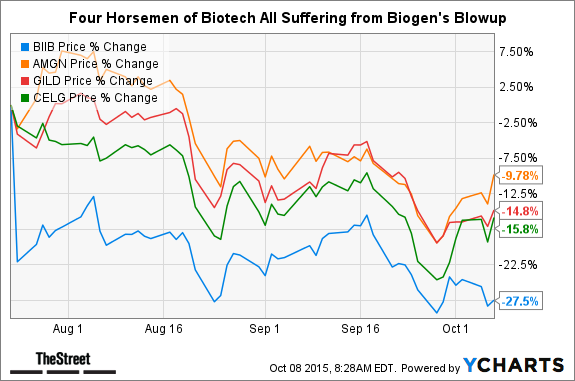
Biogen, on July 24, slashed earnings and revenue guidance for the rest of the year, blaming weak sales of its key multiple sclerosis drugs. Biogen lost $20 billion in market value the day after the second-quarter earnings disaster, but the ripple effect was felt across all biotech stocks. Investors' confidence in the ability of large-cap biotech companies to grow earnings and sales into perpetuity was shaken. Strong second quarter earnings from Celgene (CELG - Get Report) , Amgen (AMGN - Get Report) and Gilead Sciences (GILD - Get Report) were overshadowed by Biogen's blow-up.
The iShares Nasdaq Biotechnology ETF (IBB) closed at an all-time high on July 20, four days before Biogen slashed its financial forecasts. The fund's been on a downhill run ever since. The political and media firestorm over drug pricing followed by calls for greater regulation accelerated the selloff in biotech stocks in September, but the decline really started with Biogen in July.


STOCKS TO BUY: TheStreet Quant Ratings has identified a handful of stocks with serious upside potential in the next 12-months.


If Biogen put biotech investors in a funk, is there anything the company can do to brighten the mood? The question gets put to the test on Oct. 21, when Biogen reports earnings for the third quarter. It's fitting Biogen will be the first of the large-cap biotech companies to address investors during the third-quarter earnings season.
Most important for Biogen will be to demonstrate stability in its multiple sclerosis drug franchise, starting with Tecfidera, the key profit and revenue driver for the company. The current third-quarter consensus estimate for worldwide sales of Tecfidera is about $885 million, or essentially flat on a quarter-over-quarter basis. Widely disseminated data on U.S. prescription volume suggest Tecfidera could deliver actual sales slightly higher than expectations.
"People want to know that the quarter is OK and Tecfidera is not getting worse," said RBC Capital biotech analyst Michael Yee, speaking on a weekly video he sends to investor clients.
If Biogen pulls off a clean third-quarter earnings performance, Yee believes the stock recovers and moves higher because 2016 is busy with important study results for key drugs in the company's pipeline. A buoyant Biogen could help lift the rest of the biotech sector.

But Yee's game plan doesn't address Biogen's central role in the current controversy over prescription drug prices. One way Biogen boosts profits is by raising the price of its decades-old multiple sclerosis drug Avonex every year, sometimes twice a year. Avonex now costs more than $60,000 a year, up from less than $10,000 a year when it was first approved in 1996. Newer, more effective multiple sclerosis drugs have reached the market recently, including Biogen's own Tecfidera, but the company and its competitors continue to raise the price of their older drugs in lockstep with each other.
Biogen CEO Scangos has been very vocal criticizing Shkreli, the CEO of Turing Pharmaceuticals, for raising the price of an old infectious disease drug by 5,000%. But investors will be listening on the Oct. 21 conference call to hear what, if anything, Scangos says about Biogen's own drug-pricing decisions, or if he concedes changes need to be made.
Drug pricing "will be the first or second question asked, guaranteed, so it's better if they address the issue proactively," said Barclays biotech analyst Geoff Meacham. "Biogen has the opportunity to give generalist investors some comfort if they explain how the company is developing innovative drugs that are deserving of higher prices."

>>>US Gapping Up

Gapping up
In reaction to strong earnings/guidance/SSS
: WGBS +17.8%, MG +16%, EDUC +9.2%, RELL +5.2%, ZUMZ +3.8%, NXTD +2.9%, RECN +1.9%, DB +0.6%, (announces anticipated Q3 charges - rebounding from yday's sell-off), CONN +0.4%

M&A news: JMG +42.2% (to be acquired by Gannett (GCI) for $12 per share), BMR +8.2% (to be acquired by Blackstone (BX) for $23.75/share in an $8 bln deal), EMC +4.2% (in talks to merge with Dell, according to the WSJ), CC +3.6% (pollo Global Management (APO) may consider an offer to acquire CC, according to Bloomberg), ECA +2.7% (to sell its Denver Julesburg Basin assets in Colorado for ~$900 mln), TLN +2.1% (agrees to sell three Pennsylvania power plants, with 996 MW of capacity, for $1.51 bln in cash)

Select metals/mining stocks trading higher: AU +3.8%, BHP +2.5%, MT +1.9%, BBL +1.6%, FCX +1.5%, CLF +1.4%, VALE +0.8%


Other news: GBSN +40.9% (submits its Shiga Toxin Direct Test to the FDA for 510(k) clearance following the successful completion of a clinical trial that met all of Great Basin's clinical objectives), SD +16% (announces it will repurchase $100 mln of its senior unsecured notes for $30 mln in cash, and exchange $300 mln of senior unsecured notes for convertible notes ), NBIX +15.6% (announces that NBI-98854 showed a statistically significant reduction in tardive dyskinesi, during a Kinect 3 clinical trial), CDTI +14.6% (Clean Diesel Technologies and PACCAR (PACR) sign multi-year Distribution Agreement for DuraFit), NVLS +11.8% (announced positive Phase 1b results for N91115 in patients with Cystic Fibrosis), OGXI+11.1% (announces the EMA supports plans for prospectively defining poor prognostic subpopulation in Ph 3 AFFINITY trial), LL +8% ( reaches a settlement with the DOJ related to compliance with the Lacey Act, regarding the protection of plants, fish and wildlife ), BTX +6.3% (OncoCyte subsidiary filed Registration Statement with the SEC in connection with co's planned distribution OncoCyte common stock to holders of BioTime), MBLX +4% (announces $20 million common stock purchase agreement with Aspire Capital Fund), INTL +3.1% (to replace AMSG in the S&P SmallCap 600), RAX +2.1% (cont strength), SNDK +2.1% (cont strength, rumored to be takeover target earlier this week), SLRC +1.7% (announces a $30 million repurchase program), ASML +1.7% (still checking), ALKS +1.7% (favorable commentary on Wednesday's Mad Money), FCAU +1.3% (confirms new tentative agreement with the UAW ), AMSG +1.2% (to replace CNW in the S&P MidCap 400), RBA +1% (reported September gross auction proceeds)

Analyst comments: QLYS +6.2% (upgraded to Outperform from Neutral at Credit Suisse), TLYS +4.6% (upgraded to Buy from Neutral at B. Riley & Co), LOCO +3.4% (initiated with a Buy at Sun Trust Rbsn Humphrey), NAVI +3.1% (upgraded to Buy from Neutral at Goldman), PAY +2.4% (upgraded to Strong Buy from Outperform at Raymond James), NKE +0.6% (upgraded to Buy at DA Davidson)

>>>US Gapping down

Gapping down
In reaction to disappointing earnings/guidance
: CSII -15%, HLIT -4.9%, DPZ -4.6%, EXFO -1%

Select financial related names showing weakness: NBG -3.5%, CS -2.5% (Financial Times reporting that bank may look to unveil a new capital raise plan in the next two weeks). ING -1.4%, RBS -0.7%

Other news: ORIG -16% (co announced an update on its fleet, stating 'the market continues to remain challenging due to the massive spending cuts initiated by the oil companies'), PIP -9.9% (announced oral arguments in SIGA's appeal and PharmAthene's cross-appeal have concluded), GLBL -5.3% (SunEdison (SUNE) terminates deal to acquire six operating hydro-electric and wind projects located in Peru; the projects would have been transferred to Global), SHAK -5% (files ~26.160 mln share Class A common stock shelf offering by selling stockholders), NEWT -3.4% (to launch a public offering of 2 mln shares of common stock), ETSY -2% (Amazon (AMZN) launched its news Handmade at Amazon store), SMG -1.1% (priced $400 mln of 6.000% senior notes due 2023)

Analyst comments: GRPN -2.1% (initiated with an Underperform at Cowen), TUP -1.5% (downgraded to Underperform from Neutral at BofA/Merrill)

WSJ : FedEx’s Fred Smith Says M&A Drive Will Continue

FedEx’s Fred Smith Says M&A Drive Will Continue

Slowing industrial shipping demand is leading companies to seek growth through acquisition, package company chief says

The rapid pace of mergers and acquisitions in transportation and logistics should continue in the near term as companies try to make up for slow growth by buying new business, FedEx Corp. Chairman and Chief Executive Fred Smith said Wednesday.

“I think you will see a significant amount of M&A driven by low growth,” Mr. Smith said at the Journal of Commerce Inland Distribution Conference. “The reality is that a lot of people get put under a lot of pressure when growth slows down. Growth hides a lot of sins and covers up a lot of inefficiencies.”


FedEx is in the process of acquiring Dutch parcel firm TNT Express NV after buying third-party logistics firm GENCO earlier this year. United Parcel Service Inc. this summer acquired freight broker Coyote Logistics, while XPO Logistics Inc. has undertaken a string of recent acquisitions, most recently Con-way Inc.

Much of the transportation industry has experienced lower or flat growth in freight demand this year as industrial production has slipped. Mr. Smith attributed the pullback to reduced spending on both oil and natural gas production, as well as an “echo” of the slowdown at West Coast ports and harsh winter weather earlier this year. He said many shippers ordered too much to prevent disruption, and that inventory levels remain high. He thinks some of this should “bleed off” in the near term.

One sector not slowing down is FedEx’s bread-and-butter package business.

Mr. Smith said e-commerce is booming, driving growth in parcel shipments and leading to the expectation of another record peak holiday season. But he said carriers face new logistical challenges from online sales because they push larger packages into delivery systems and bring more residential deliveries that are more costly to handle than business-to-business deliveries.

“If you go into a FedEx Ground facility these days, you will be amazed by the kayaks and tires and all sorts of things that don’t go through the automated sorting systems,” Mr. Smith said.

Same-day delivery will remain a niche business area because of the costs involved, he said.

While same-day delivery has worked in areas like New York City in the past, that is due to a very low labor cost. “If you can get filet mignon for $5 versus $30, you’re going to eat a lot more filet,” Mr. Smith said.

Mr. Smith said he expects more technological advances to come to the transportation industry, including autopilot for trucks and other safety features that should make operations safer.

Drones will also be used at some point, but he said there are significant safety concerns that must be addressed first.

“I think it’s a great idea to use drones, and I think they will be used,” Mr. Smith said. But he cautioned that the devices are potentially lethal. “The worst thing about things that fly…is that they hit the ground in an uncontrolled manner.”

FT : Credit Suisse prepares substantial capital raising


Tidjane Thiam, Credit Suisse’s new chief executive, is preparing to launch a substantial capital raising when he unveils his strategic plan for the bank in two weeks’ time, according to people briefed on the plan.
While not specifying an amount, they pointed to a poll published last week by analysts at Goldman Sachs concluding that 91 per cent of investors expect the Swiss bank to raise more than SFr5bn in new equity.

The capital is likely to be used to absorb losses triggered by a faster restructuring of the Swiss group, the people said. But Credit Suisse will also need higher capital ratios to comply with toughening demands from regulators.
The Swiss authorities are expected to announce an increase of minimum capital ratios over the coming months, which could prove more challenging for the bank than its better capitalised local rival, UBS. Credit Suisse’s common equity tier one capital ratio of 10.3 per cent compares with UBS’s 13.5 per cent.
Mr Thiam, who took over in the summer, recently brought forward the announcement of his new strategy to October 21 from the end of the year.
His strategy is expected to shift the bank’s focus away from volatile investment banking operations and towards private banking and Asian markets.
The former head of Prudential, the UK insurer, is also keen to establish a substantial in-house asset management operation. Investors say he has hinted at consolidating that shift with an acquisition, though he has signalled he has cooled on the idea of a deal in the short term.
Mr Thiam is known to be wary about the large amounts of capital required by many areas of investment banking. Bankers said that could lead to a significant reduction of some of the group’s fixed-income businesses, traditionally a core operation.
But colleagues believe Mr Thiam is enthusiastic about the bank’s activities in equities, in which it has traditionally been underweight. He sees the business of managing stock market listings and raising equity for clients as a powerful engine for expanding into emerging markets.
Having set Asian growth as a priority at Prudential, Mr Thiam is expected to set himself a similar objective at Credit Suisse, putting a particular emphasis on China.
His plans are also set to involve deeper cost-cutting through increased investment in technology — an area where analysts say the Swiss bank has lagged behind competitors.

Some of Credit Suisse’s less profitable activities look set to be axed, including its US broker-dealer unit, though the bank is expected to show a strong commitment to its broader presence in the US.
The October 21 plan is expected to involve decentralising some operations and streamlining Credit Suisse’s management structure. The group’s previous practice of having divisions run by two or even three co-heads is likely to be dropped, people familiar with the process said. One person said the bank would move to a structure of regional heads across business lines.
In Switzerland, there are fears that the restructuring could lead to sweeping job cuts in its home market. But people familiar with Mr Thiam’s thinking said he will seek to allay such concerns by signalling a commitment to expanding the bank’s position in Switzerland.
However, the new chief executive has scotched rumours he would like to buy local rival Julius Baer, making it clear internally that such a combination would make no sense.