FT : Isis Inc: how oil fuels the jihadi terrorists
Isis Inc: how oil fuels the jihadi terrorists

Jihadis’ oil operation forces even their enemies to trade with them
O

n the outskirts of al-Omar oilfield in eastern Syria, with warplanes flying overhead, a line of trucks stretches for 6km. Some drivers wait for a month to fill up with crude.

Falafel stalls and tea shops have sprung up to cater to the drivers, such is the demand for oil. Traders sometimes leave their trucks unguarded for weeks, waiting for their turn.

This is the land of Isis, the jihadi organisation in control of swaths of Syrian and Iraqi territory. The trade in oil has been declared a prime target by the international military coalition fighting the group. And yet it goes on, undisturbed.

Oil is the black gold that funds Isis’ black flag — it fuels its war machine, provides electricity and gives the fanatical jihadis critical leverage against their neighbours.

But more than a year after US President Barack Obama launched an international coalition to fight Isis, the bustling trade at al-Omar and at least eight other fields has come to symbolise the dilemma the campaign faces: how to bring down the “caliphate” without destabilising the life of the estimated 10m civilians in areas under Isis control, and punishing the west’s allies?

The resilience of Isis, and the weakness of the US-led campaign, have given Russia a pretext to launch its own, bold intervention in Syria.

Despite all these efforts, dozens of interviews with Syrian traders and oil engineers as well as western intelligence officials and oil experts reveal a sprawling operation almost akin to a state oil company that has grown in size and expertise despite international attempts to destroy it.

Minutely managed, Isis’ oil company actively recruits skilled workers, from engineers to trainers and managers.

Estimates by local traders and engineers put crude production in Isis-held territory at about 34,000-40,000 bpd. The oil is sold at the wellhead for between $20 and $45 a barrel, earning the militants an average of $1.5m a day.

“It’s a situation that makes you laugh and cry,” said one Syrian rebel commander in Aleppo, who buys diesel from Isis areas even as his forces fight the group on the front lines. “But we have no other choice, and we are a poor man’s revolution. Is anyone else offering to give us fuel?”

Oil as a strategic weapon

Isis’ oil strategy has been long in the making. Since the group emerged on the scene in Syria in 2013, long before they reached Mosul in Iraq, the jihadis saw oil as a crutch for their vision for an Islamic state. The group’s shura council identified it as fundamental for the survival of the insurgency and, more importantly, to finance their ambition to create a caliphate.

Journey with a barrel of Isis oil

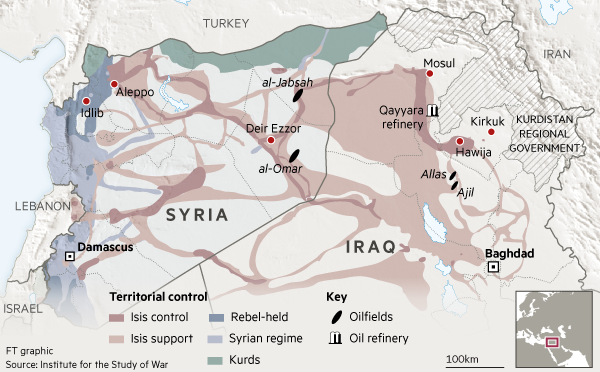
Isis oil map

Selling crude is Isis’ biggest single source of revenue.

Follow the progress of a barrel of oil from extraction to end user to see how the Isis production system works, who is making money from it, and why it is proving so challenging to disrupt

View graphic

Most of the oil Isis controls is in Syria’s oil-rich east, where it created a foothold in 2013, shortly after withdrawing from the north-west — an area of strategic importance but with no oil. These bridgeheads were then used to consolidate control over the whole of eastern Syria after the fall of Mosul in 2014.

When it pushed through northern Iraq and took over Mosul, Isis also seized the Ajil and Allas fields in north-eastern Iraq’s Kirkuk province. The very day of its takeover, locals say, militants secured the fields and engineers were sent in to begin operations and ship the oil to market.

“They were ready, they had people there in charge of the financial side, they had technicians that adjusted the filling and storage process,” said a local sheikh from the town of Hawija, near Kirkuk. “They brought hundreds of trucks in from Kirkuk and Mosul and they started to extract the oil and export it.” An average of 150 trucks, he added, were filled daily, with each containing about $10,000-worth of oil. Isis lost the fields to the Iraqi army in April but made an estimated $450m from them in the 10 months it controlled the area.

While al-Qaeda, the global terrorist network, depended on donations from wealthy foreign sponsors, Isis has derived its financial strength from its status as monopoly producer of an essential commodity consumed in vast quantities throughout the area it controls. Even without being able to export, it can thrive because it has a huge captive market in Syria and Iraq.

Indeed, diesel and petrol produced in Isis areas are not only consumed in territory the group controls but in areas that are technically at war with it, such as Syria’s rebel-held north: the region is dependent on the jihadis’ fuel for its survival. Hospitals, shops, tractors and machinery used to pull victims out of rubble run on generators that are powered by Isis oil.

“At any moment, the diesel can be cut. No diesel — Isis knows our life is completely dead,” says one oil trader who comes from rebel-held Aleppo each week to buy fuel and spoke to the Financial Times by telephone.

A national oil company

Isis’ strategy has rested on projecting the image of a state in the making, and it is attempting to run its oil industry by mimicking the ways of national oil corporations. According to Syrians who say Isis tried to recruit them, the group headhunts engineers, offering competitive salaries to those with the requisite experience, and encourages prospective employees to apply to its human resources department.

A roving committee of its specialists checks up on fields, monitors production and interviews workers about operations. It also appoints Isis members who have worked at oil companies in Saudi Arabia or elsewhere in the Middle East as “emirs”, or princes, to run its most important facilities, say traders who buy Isis oil and engineers who have worked at Isis-controlled fields.

Some technicians have been actively courted by Isis recruiters. Rami — not his real name — used to work in oil in Syria’s Deir Ezzor province before becoming a rebel commander. He was later contacted by an Isis military emir in Iraq via WhatsApp.

“I could choose whatever position I wanted, he promised me,” he said. “He said: ‘You can name your salary’.” Sceptical of the Isis project, Rami ultimately turned down the offer and fled to Turkey.

Isis also recruits from among its supporters abroad. In the speech he gave after the fall of Mosul, Isis leader Abu Bakr al-Baghdadi called not only for fighters but engineers, doctors and other skilled labour. The group recently appointed an Egyptian engineer who used to live in Sweden as the new manager of its Qayyara refinery in northern Iraq, according to an Iraqi petroleum engineer from Mosul, who declined to be named.

The central role of oil is also reflected in the status it is given in Isis’ power structures.

The group’s approach to government across the territories it controls is highly decentralised. For the most part, it relies on regional walis — governors — to administer territories according to the precepts laid down by the central shura.

However, oil — alongside Isis’ military and security operations and its sophisticated media output — is centrally controlled by the top leadership. “They are organised in their approach to oil,” said a senior western intelligence official. “That’s a key centrally controlled and documented area. It’s a central shura matter,” he added, referring to Isis’ ruling “cabinet”.

Until recently, Isis’ emir for oil was Abu Sayyaf, a Tunisian whose real name, according to the Pentagon, was Fathi Ben Awn Ben Jildi Murad al-Tunisi, and who was killed by US special forces in a raid in May this year. According to US and European intelligence officials, a treasure trove of documentation relating to Isis’ oil operations was found with him. The documents laid bare a meticulously run operation, with revenues from wells and costs carefully accounted for. They showed a pragmatic approach to pricing too, with Isis carefully exploiting differences in demand across its territories to maximise profitability.

Oversight of the oil wells is carefully controlled by the Amniyat, Isis’ secret police, who ensure revenues go where they should — and mete out brutal punishments when they do not. Guards patrol the perimeter of pumping stations, while far-flung individual wells are surrounded by protective sand berms and each trader is carefully checked as he drives in to fill up.

At the al-Jibssa field in Hassakeh province, north-eastern Syria, which produces 2,500-3,000 bpd, “about 30-40 big trucks a day, each with 75 barrels of capacity, would fill up”, according to one Hassakeh oil trader.

Isis’ distribution network

But the biggest draw is al-Omar. According to one trader who regularly buys oil there, the system, with its 6km queue, is slow but market players have adapted to it. Drivers present a document with their licence plate number and tanker capacity to Isis officials, who enter them into a database and assign them a number.

Most then return to their villages, shuttling back to the site every two or three days to check up on their vehicles. Traders say that towards the end of the month, some people come back and set up tents to stay close to their trucks while they wait their turn.

Once in possession of al-Omar’s oil, the traders either take it to local refineries or sell it on at a mark-up to middlemen with smaller vehicles who transport it to cities further west such as Aleppo and Idlib.

Isis’ luck with oil may not last. Coalition bombs, the Russian intervention and low oil prices could put pressure on revenues. The biggest threat to Isis’ production so far, however, has been the depletion of Syria’s ageing oilfields. It does not have the technology of major foreign companies to counteract what locals describe as a slow drop in production. Isis’ need for fuel for its military operations means there is also less oil to sell in the market.

For now, though, in Isis-controlled territory, the jihadis control the supply and there is no shortage of demand. “Everyone here needs diesel: for water, for farming, for hospitals, for offices. If diesel is cut off, there is no life here,” says a businessman who works near Aleppo. “Isis knows this [oil] is a winning card.”

Additional reporting by Ahmad Mhidi, an independent journalist based on the Turkish border and Geoff Dyer in Washington

>>> Ducati and Lamborghini not up for sale

Ducati and Lamborghini not up for sale

Ducati, an Italian motorcycle maker, is not to be put up for sale by parent German car manufacturer Volkswagen, Italian language daily Il Sole 24 Ore reported. The report cited sources who said that Rupert Stadler, CEO of Volkswagen subsidiary Audi had denied in a letter sent to Italian employees that Ducati and luxury Italian car manufacturer Lamborghini are up for sale.

A number of major US-based private equity firms were examining the possibility of a bid for Ducati, previous reports claimed.

Ducati closed 2014 with revenues of EUR 462.2m, an EBITDA of EUR 86.65m, a net debt of EUR 6.5m and a profit of EUR 27.46m, the report added. Analysts have given Ducati an enterprise value of EUR 1.2bn.

Il Sole 24 Ore

>>> AB InBev could be forced to divest Grolsch UK, Peroni UK, Distell, Efes, Int

AB InBev could be forced to divest Grolsch UK, Peroni UK, Distell, Efes, Interbrew Italia and Dutch brands

Anheuser-Busch InBev may need to make further asset disposals worth almost USD 7bn, to appease regulators worldwide as it takes over rival brewing group SABMiller, The Sunday Telegraph reported. If the regulators prove demanding, the combined group may be forced to divest its interests in Turkey-based brewer Efes, Interbrew Italia, Grolsch and Peroni beers in the UK and its beer brands in the Netherlands and China, the report said.

The 24% Efes stake could be worth USD 1.25bn, Interbrew Italia and the Dutch brands USD 400m, the UK beer brands USD 1bn and the 49% stake in the China-based CR Snow brewing business USD 3.1bn, the report said, citing estimates from Berenberg analysts.

AB InBev is believed already to have contacted China Resources Enterprise to gauge the Chinese state-owned group’s interest and measure its response to the SABMiller merger, the item reported.

Berenberg believes AB InBev may also seek a buyer for the USD 750m stake SABMiller owns in the South Africa-based wine producer Distell, the item reported, adding that additional smaller sales or licensing agreements are also likely.

AB InBev has already agreed a USD 12bn sale of SABMiller’s 58% interest in US-based MillerCoors to joint venture partner Molson Coors, the item noted.

Sunday Telegraph

>>> Barrons Summary: positive on EMR and GWR

Barrons Summary: positive on EMR and GWR 

Cover story: The stance of Donald Trump and some other Republican presidential candidates on China is wrong; If Trump were elected and imposed tariffs, he would risk a protectionist war similar to the one that led to the Great Depression; Contrary to Trump's statements, the renmimbi is fundamentally overvalued, not undervalued. 

Features: 1) Positive on EMR: Company's move to spin off its network-power unit and divest some of its industrial-automation business will end up cutting sales but significantly boosting profitability; 2) Positive on NVDA, BBY, CTXS, TXN, DO, MSFT, CBG: Seven companies had big upside surprises in their latest quarterly reports and likely will see better days ahead, though investors should do more research before buying; 3) Positive on GWR: Small railroad stands to benefit if CP and NFKS merger, since they would likely have to divest some of their routes to meet antitrust requirements. 

Tech Trader: Cautious on Match Group: Dating site being spun off from IACI will face questions about the sustainability of its business model and growing competition from new online rivals. 

Trader: While many investors expected an end-of-year market flourish, says Terry Sandven of U.S. Wealth Bank Management, "the Santa rally actually happened in October"; Positive on CRC, MUSA, PSXP, PSX, MPC: Refinery spinoffs have been winners despite lower oil prices, partly because they benefit from lower feedstock costs and have been better able to showcase their value; Cautious on BHI: Shares could gain about 27% if a merger with HAL is approved, but "there is too much uncertainty here to take that bet." ETF Special Report: Marco Cortazzo of Macro Consulting Group, Richard Bernstein of Richard Bernstein Advisors, Bill Greiner of Mariner Wealth Advisors, and Bob Smith of Sage Advisory Services share their insights into bond ETFs (Positive on HYG, PFF, CSJ, HYD, ISTB, SUB, SMMU, BSCI, IBMG, IBCC). 

Profile: Sandy Rufenacht, head of Aquila Three Peaks Capital Management, seeks to determine how much free cash flow a company can generate 12 months ahead (top ten holdings: SCI, AMSG, CCK, SLGN, NLSN, PF, FIS, SEE, ARMK, LVLT). 

Interview: Jim Rogers, international investor, says he has slowed down his investment activity, and says he sees limited opportunities in many markets and thinks mounting worldwide debt and too much easy money will lead to a global bear market.

Follow-Up: Positive on WY: Merger with PCL will create the country's largest private landowner, positioning the timber giant for long-term growth as the housing market improves; Positive on RELY: Recent drop in share price of aluminum recycler and acquisition-oriented firm has seen a drop in its share price, creating a good entry point for investors; Cautious on SUNE: Following another quarter of losses, company's "baroque business strategy" seems harder to justify, and shares could fall from $5 to $2. 

European Trader: Positive on Bayer: German life-science company "is reorganizing and retrenching" and has a strong pipeline of drugs that are likely to boost margins and earnings. 

Asian Trader: Positive on BIDU: Investors aren't giving the Chinese Internet search giant enough credit for its efforts to build an "online-to-offline" service, which promises to disrupt sectors such as travel agencies and restaurants.

Emerging Markets: Frontier markets such as Vietnam and Pakistan offer potential for investors, with smaller companies especially worthy of attention. 

Commodities: Raw-sugar futures have risen by almost 50% since late August, and could keep going up amid continuing erratic weather in Brazil. 

CEO Spotlight: NDAQ chief executive Bob Greifeld presides over "an increasingly high-tech company, one that has been transformed under his watch" with 25 markets across the world for stocks, derivatives, currencies, equities, commodities, and private companies. 

Streetwise: If industrials were truly in a recession, profits should be declining, but they aren't; Among chief executives who have been in top positions in at least two other companies and who beat the S&P 500 and its peers during those tenures are LMCA's John Malone, TSLA's Elon Musk, DD's Ed Breen, and TPX's Scott Thompson.

Telegraph : Fresh doubts over Shell and BG merger as Qatar sells £1bn stake

Fresh doubts over Shell and BG merger as Qatar sells £1bn stake

The Qatar Investment Authority has sold 43m shares in BG Group and a further 24m shares in Shell

The Qatar Investment Authority has offloaded shares in Shell and BG worth nearly £1bn in recent weeks, raising fresh questions over whether the oil­giants’ proposed mega-merger has the support of major shareholders.
The sovereign wealth fund, led by Sheikh Abdullah bin Mohammed AlThani, a member of the Qatari royal family, has sold around 43m shares in BG Group, worth roughly £550m, and a further 24m shares in Shell, with a value of approximately £421m.
The sell-off, over a period of less than three weeks between the end of October and the first week of November, will be a blow to Shell’s chief executive, Ben van Beurden.
The Dutchman has had to fend off persistent questions about the logic of pressing ahead with Shell’s mammoth £43bn takeover of BG Group despite the dramatic slump in the price of oil.

The QIA is one of Shell’s biggest investors, with a 4.88pc stake, and also holds a 1.76pc stake in BG. Qatar is also one of the world’s biggest producers of liquid natural gas, meaning its support for the bumper tie-up will be of huge importance to both sides.
Analysts at Olivetree Financial said: “The market is concerned that these sales have been discriminatory towards BG, and therefore suggesting some underlying reason which might be worrying for the fate of the transaction.”
Sources close to the deal sought to play down the significance of Qatar’s share sell-off, arguing that it has been driven by the Gulf state’s attempts to free up cash in the face of big losses on positions in other large European companies.
The QIA has taken big hits on its stakes in the troubled German carmaker Volkswagen, where it is one of the largest shareholders, and in Glencore, the mining giant.
The value of those two holdings has plummeted by billions of dollars in recent months as Qatar’s infrastructure bill for hosting the football World Cup in 2022 piles up.
However, while sources close to the QIA declined to comment on the Shell and BG share sales, they played down suggestions that one of the world's largest sovereign wealth funds needed to raise cash. Although it's recent paper losses have been large, they are relatively minor when compared to the size of the QIA's fund, estimated to be around $250bn.
Royal Dutch Shell has seen its share price slump by 25pc since April, when the oil major unveiled its bid for BG. Shares in BG Group have fallen 17pc over the same period.
Mr Van Beurden originally said for the deal to work, the oil price needed to be $67 a barrel in 2016, $75 in 2017 and $90 by 2018. Brent crude is currently hovering around $43 a barrel.

>>> Ericsson has been seen as a takeover candidate by Cisco for the last year -

Denied by Cisco

Ericsson has been seen as a takeover candidate by Cisco for the last year - It has been denied y Cisco

Cisco, the California-based network equipment manufacturer, has been eyeing up the Swedish telecom technology company Ericsson, as a takeover candidate for the last year, according to Dagens Industri.

The Swedish business daily reported that Ericsson and Cisco announced on Monday that the two companies have entered into a strategic collaboration regarding IP technology. The paper reported however, citing unnamed sources, that Cisco and Ericsson have also been in secret talks for the past year about a possible takeover but have so far been unable to agree. The paper wrote further that Cisco Chairman John Chambers' visit to Stockholm earlier this week was not only to present the IP collaboration but also to discuss the possibility of making an offer for Ericsson. One source commented that Cisco does not wish to make a hostile offer but that this may not always be the case.

The paper wrote that Ericsson's Chairman Leif Johansson is concerned about Cisco's takeover interest and will likely find it difficult to defend Ericsson if an offer is made. A source commented that Johansson defended the UK pharmaceutical company AstraZeneca when it received an offer from American Pfizer but that the AstraZeneca situation was different as the UK company was clearly more valuable as an independent company. The source added that this is not the case for Ericsson as a takeover offer from Cisco will likely be higher than Ericsson's independent value.

The item noted that Ericsson has strong shareholders in the Swedish investment companies, Investor with 21.5% and Industrivarden with 15.3%, and the success of a possible offer will depend very much on them. The paper speculated that Investor will be tougher to convince while there are already indications that Industrivarden might wish to sell its stake. However, to avoid criticism for not ensuring Ericsson remains Swedish, Industrivarden would best sell its stake only if a potential offer is a good one and preferably if Investor also sells.

The paper wrote that Ericsson has a market cap of around SEK 260bn (EUR 27.8bn) while the much larger Cisco is worth SEK 1,200bn (EUR 129bn).

Meanwhile, the paper speculated in a separate piece that there are several reasons why Cisco would wish to acquire Ericsson. The article noted that as the internet, data and telecom integrate further, the companies need to be able to offer its clients both IP and mobile networks. The paper wrote that Chinese Huawei already does and Finnish Nokia and French Alcatel will do once their deal concludes. The item wrote that the strategic collaboration between Cisco and Ericsson will make them a force to be reckoned with in this regard but that partnerships are risky and pointed out Ericsson's failed earlier partnerships with Juniper, HP, Sony and STMicroelectronics. The paper wrote further that Ericsson's shareholders are losing patience with the Swedish company's weak growth, profitability and returns.

However, the paper also speculated that Cisco and Ericsson's collaboration will serve as a poison pill against other possible bidders.

The original articles appeared in print, Pages 6-7.
Dagens Industri