(BFW) France’s ARCEP Wants End to Free-Orange Network Sharing

--> Link to original press Release : http://bit.ly/1ZjTxMe

PARTAGE DE RÉSEAUX MOBILES
L'ARCEP met en consultation publique un projet de lignes directrices sur l'itinérance et la mutualisation des réseaux mobiles
Paris, le 12 janvier 2016
L'ARCEP soumet à consultation publique son analyse
La loi pour la croissance, l'activité et l'égalité des chances économiques, publiée le 7 août 2015, a conféré un nouveau pouvoir à l'ARCEP : celui de demander à des opérateurs la modification de leurs contrats de partage de réseaux mobiles, notamment lorsque cela est nécessaire à la réalisation de ses objectifs de régulation.
Afin de donner de la visibilité au secteur sur les conditions dans lesquelles elle entend mettre en œuvre son nouveau pouvoir, l'ARCEP soumet aujourd'hui à consultation publique un document de travail comprenant un projet de lignes directrices sur le partage de réseaux mobiles, accompagné de premières analyses sur les contrats existants. Y sont notamment identifiées les évolutions qui apparaissent a priori souhaitables dans les accords de partage de réseaux mobiles existants. Les acteurs intéressés sont invités à commenter ces éléments d'ici le 23 février 2016. Le document sera également transmis pour avis à l'Autorité de la concurrence. Les premières analyses présentées sont ainsi susceptibles d'évoluer en fonction des réponses à ces consultations.
L'ARCEP souligne que le document qu'elle met en consultation publique aujourd'hui a été élaboré en prenant en compte la structure actuelle du marché à quatre opérateurs de réseaux mobiles en métropole. Les premières analyses présentées pourraient ainsi être modifiées en cas d'évolution de la structure du marché.
L'extinction progressive des accords d'itinérance
Aujourd'hui, deux grands contrats de partage de réseaux mobiles existent en métropole.
Premièrement, un accord d'itinérance 2G/3G permet aux clients de Free Mobile d'accéder au réseau d'Orange, avec cependant une couverture et une qualité moindres que pour les clients d'Orange. Si cette prestation s'est justifiée pour accompagner l'entrée d'un quatrième opérateur de réseau mobile, elle ne saurait a priori être pérenne. En parallèle du déploiement du réseau de Free Mobile, la trajectoire d'extinction de l'itinérance devrait désormais être prévue. L'ARCEP envisage à ce stade que le processus d'extinction débute rapidement, sans attendre la fin du contrat existant. Pour les services haut débit (équivalent 3G), l'ARCEP estime que l'extinction devrait se terminer à une date évaluée à ce stade entre la fin 2018 et la fin 2020. Pour les services voix, SMS et bas débit (équivalent 2G), qui ont une importance moindre dans la dynamique d'investissement, l'extinction pourrait être effective à une date évaluée à ce stade entre le début 2020 et la fin 2022.
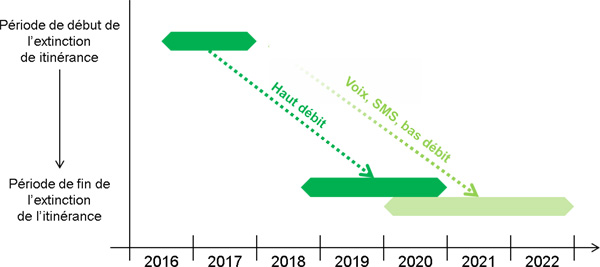

Trajectoire d'extinction de l'itinérance de Free Mobile, soumise à consultation publique
Deuxièmement, SFR et Bouygues Telecom ont établi un accord visant à mutualiser leurs réseaux 2G/3G/4G sur une large partie du territoire. L'ARCEP souhaite s'assurer que ce vaste accord permette bien, comme les deux opérateurs l'ont indiqué, d'améliorer la couverture et la qualité des services pour les utilisateurs. De plus, cet accord inclut une prestation d'itinérance 4G pour les clients de SFR sur une partie du réseau de Bouygues Telecom. Au regard de l'importance, pour la dynamique du marché, des investissements dans les infrastructures 4G, l'ARCEP appelle à fixer précisément la fin de l'itinérance très haut débit (équivalent 4G), à une date évaluée à ce stade entre fin 2016 et fin 2018.
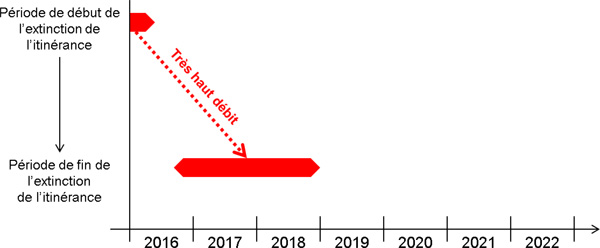

Trajectoire d'extinction de l'itinérance de SFR, soumise à consultation publique
Au stade de la présente consultation publique, l'ARCEP laisse ouvertes les dates précises de fin qu'elle recommande pour les prestations d'itinérance. Elle appelle les acteurs intéressés à indiquer les dates qui leur semblent justifiées, a priori au sein des trois intervalles qu'elle a pré-identifiés.

>>> US After Hours Summary: ICLD +4.6%, ACST +4.4%, IRG +2.0%, PRGS +1


After Hours Summary: ICLD +4.6%, ACST +4.4%, IRG +2.0%, PRGS +1.7%, TREE +1.6% following earnings/guidance

After Hours Gainers:

Companies trading higher in after hours in reaction to earnings/guidance:  ICLD +4.6%, ACST +4.4%, IRG +2.0%, PRGS +1.7%, TREE +1.6%

Companies trading higher in after hours in reaction to news:  BIOL +10.9% (entered into a development and distribution agreement with IPG Photonics Corporation's (IPGP) medical laser division), MET +7.1% (planned to pursue the separation such as public offering, spin-off, or sale of a substantial portion of its U.S. Retail segment), ARNA +5.1% (Co and Boehringer Ingelheim to conduct joint research to identify drug candidates targeting an undisclosed G protein-coupled receptor), ICLD 10.9% (CEO releases letter to shareholders; expects to see continued growth in 2016), YUM +3.4% (reported China December comps +1% YoY; sees Q4 China comps at +2%).

After Hours Losers:

Companies trading lower in after hours in reaction to earnings/guidance:  F -3.9%, CSX -2.5%, WBMD -1.5%

Companies trading lower in after hours in reaction to news:  KBIO -53.2% (will withdraw its appeal of the Nasdaq decision of to delist shares), FXCM -11.6% (reports December and Q4 metrics; Says ongoing sales process may not be completed in Q1 as previously indicated).

>>> US CLose : Dow +0.72% S&P +0.82% Nasdaq +1.03% Russell+0.28% VIX 22.19 (-8.7

Closing Market Summary: Indices Rally Into Close

The stock market ended its volatile Tuesday affair on a positive note, with the S&P 500 advancing 0.8%. The stock market fixated on oil prices today after mostly quiet overseas sessions. Despite the moderate advance, the rally remained muted for most of the day thanks to ongoing commodity concerns. The tech-heavy Nasdaq (+1.0%) outperformed the benchmark index and the Dow Jones Industrial Average (+0.7%).

Oil rested on its overnight low until reports of a terrorist attack in Turkey pushed the energy-component higher. WTI crude was able to mount a rally into the U.S. open, but was unable to maintain that momentum. Declines in oil were mirrored across equities for the most of the day as WTI crude ended its pit session lower by 3.1% at $30.44/bbl. However, the energy component climbed in electronic trade and the stock market rallied alongside. 

On the leaderboard, technology (+1.2%), health care (+1.2%), consumer discretionary (+1.0%), and industrials (+0.7%) lead the pack. On the flipside, energy utilities (-0.5%), telecom services (-0.4%), materials (+0.2%), energy (+0.4%), and consumer staples (+0.5%) underperformed. 

In the heavily-weighted technology sector, large-cap components saw relative strength with increased buying interest following the recent selloff. Cornerstones,  Alphabet (GOOGL 745.34, +12.27), Facebook (FB 99.37, +1.86), and Apple (AAPL 99.96, +1.43) sported advances between 1.5% and 1.9%. Elsewhere in the space, the high-beta chipmakers ended in liine with the broader market, evidenced by the 0.8% gain in the PHLX Semiconductor index. Inside the index Intel (INTC 32.68, +0.62) outperformed with a gain of 1.9% thanks to resumed coverage at JPMorgan Chase with an 'Overweight' designation. 

Looking at the consumer discretionary space, large-cap constituents there also showed relative strength with Starbucks (SBUX 59.46, +1.64) rising 2.8% after the company announced that it's on pace to have 2000 stores in China after looking to add 500 in 2016. Other influential sector members like Disney (DIS 101.46, +1.54) and Netflix (NFLX 116.58, +1.61) added 1.5% and 1.6%, respectively. 

Switching to health care , the insurance sub-sector lead the space with Anthem Inc. (ANTM 135.60, +7.24), UnitedHealth Group (112.26, +2.68), and Aetna (AET 109.15, +4.08) outperforming with gains between 2.5% and 5.6%. Elsewhere in the group, biotechnology paced the advance evidenced by the 1.6% gain in the iShares Nasdaq Biotechnology ETF (IBB 296.21, +4.52).

Treasuries ended just below their highs with the 10-yr yield slipping seven basis points to 2.10%.

Trading volume remained heavy with more than a billion shares changing hands at the NYSE floor once again.

On the economic front, the November Job Openings and Labor Turnover Survey showed that job openings increased to 5.431 million from October's revised 5.349 million figure (from 5.383 million).

Tomorrow, the weekly MBA Mortgage Index will be released at 7:00 ET while the Federal Reserve's January Beige Book and the December Treasury Budget will cross the wires at 14:00 ET.

  • Russell 2000 -8.1% YTD
  • Nasdaq  -6.4% YTD 
  • S&P 500 -5.2%
  • Dow Jones Industrial Average -5.2%

>>> Street Insider: Exclusive: Printing services company Lexmark considers

(Reuters) - Printing services company Lexmark International Inc (NYSE: LXK) is considering the possibility of divesting its hardware and software assets separately to revive interest in its sale process, according to people familiar with the matter.
The deliberations come after Lexmark held discussions with several potential buyers about the sale of the entire company that have yet to result in offers that would be line with its valuation expectations, the people said this week.
Private equity firms are now having conversations with Lexmark about acquiring either its hardware or software assets, the people said. The company has yet to make any decision on a way forward, the people added.
The sources asked not to be identified because the details of the sale process are confidential.
"Lexmark does not intend to comment on the exploration process or disclose further developments until the board approves a specific transaction or otherwise concludes the exploration of strategic alternatives," the company said in a statement.
Lexmark, which has a $1.74 billion market capitalization, announced in October that it was exploring strategic alternatives, including a sale, and had hired Goldman Sachs Group Inc (NYSE: GS) as an adviser.
Over the past few years, Lexmark has sought to diversify and aggressively bought up software assets to bulk up its services catering to business customers. Last year it bought Kofax Ltd for about $1 billion, a company which provides data services to financial, insurance and healthcare companies.
At the time, Lexington, Kentucky-based Lexmark said the deal would double the size of its enterprise software unit to a $700 million business.
Lexmark's software can scan everything from spreadsheets to medical images, and provides services to banking, healthcare, insurance and retail companies. While the software business has a higher growth rate, it represents a small portion of revenue compared to the hardware business.

(Reporting by Greg Roumeliotis and Liana B. Baker; Editing by Chris Reese)

NY Post : Bewkes nixes HBO spinoff but open to Time Warner sale

Bewkes nixes HBO spinoff but open to Time Warner sale

Time Warner boss Jeff Bewkes told investors in a series of closed-door meetings Monday that he’s against a sale or a spinoff of HBO but hinted he would entertain a sale of the New York media giant, The Post has learned.

Bewkes said splitting off HBO or the Turner Broadcasting cable-TV business doesn’t make sense in a media world where increasingly scale matters, according to sources briefed on the meetings.

“Splitting up can destroy value,” he told an investor in one meeting, citing the breakup of Viacom as an example. Viacom shares have struggled since Sumner Redstone split up his media empire a decade ago.

But Bewkes played coy when asked about a sale of Time Warner, saying he wanted to “increase shareholder value,” sources said.

A spokesman for Time Warner didn’t immediately return a call seeking comment.

Bewkes is sitting down with investors as pressure builds to boost the company’s share price. Activists are circling Time Warner again, a decade after it beat back a bid by Carl Icahn to break up the company.

The Post reported Sunday that two of the media giant’s largest longtime investors are running out of patience and would support a sale or a breakup of the company.

Time Warner is worth $100 broken up — more than its current share price, according to one analyst. Shares were up around 2.5 percent at $71.31 in trading Tuesday afternoon.

Icahn told CNBC Monday he owns no shares of Time Warner, home to cable networks like TBS and TNT and the Warner Bros. film studio.

In December, however, a mystery buyer bought $100 million worth of Time Warner call options, which give the purchaser the right to buy shares at a set price in the future, one source noted.

This means Icahn or another investor could hold those options while claiming not to own Time Warner shares.