SCMP : A year after China returns rocks from moon’s far side, debate rages over

A year after China returns rocks from moon’s far side, debate rages over ancient crater
Chinese scientists believe samples found by Chang’e-6 mission answer central question in lunar science, but some in the West have doubts

A year after China returned the first rock samples from the moon’s far side, scientists are debating whether the mission has answered a central question in lunar science – and whether the country’s rising scientific dominance is challenging who gets to tell the story of the moon’s past.
While a team of Chinese researchers believes they may have nailed down the age of the moon’s largest and oldest crater – a colossal impact basin that could hold clues to the early solar system – other scientists, mostly from the West, remain unconvinced.
Some say the ancient rocks may have come from a different impact and were tossed to the landing site. Others suggest the rocks may not have come from an impact at all, but from magma that cooled slowly underground.

“I don’t think the 4.25-billion-year age is 100 per cent certain, but it’s the most credible number we have so far – more reliable than model-based crater counting or meteorites with unknown origins,” said planetary scientist Yang Wei of the Institute of Geology and Geophysics in Beijing.

“It’s based on the only direct evidence we’ve ever collected and measured from the South Pole-Aitken (SPA) basin,” said Yang, who was not directly involved in the study but coordinates a nationwide research effort that gave select teams early access to samples from the Chinese lunar mission Chang’e‑6.

The findings, which he described as the most important among a collection of five papers submitted to the journal Nature for peer review last September, were rejected twice by a review panel dominated by Western scientists.

The paper was later published in National Science Review, a China-based journal. Four others, which detailed the lunar far side’s chemistry, water content and its volcanic and magnetic history, appeared in Nature’s print edition this week.

A Chinese scientist familiar with the review process, who requested anonymity due to the sensitivity of the matter, said he felt some Western scientists were not ready to accept that Chinese researchers might solve such an important scientific problem.

“They didn’t want China to be the one to pin down the age of the SPA basin. Maybe it stings a little,” the scientist said. “But it doesn’t matter. The paper is published, and time will tell.”

In the National Science Review study, researchers from the Chinese Academy of Sciences focused on norite, a type of rock made of two common lunar minerals.

Radiometric dating revealed two distinct age groups of norite particles in Chang’e-6 samples. One was about 3.87 billion years old, consistent with known impact events like Apollo or Schrödinger. The other was much older: 4.25 billion years.

The researchers argued that this older group was likely to have come from the formation of the SPA basin, since the samples were collected from within that basin and no older impact signals were detected. “Our preferred SPA impact age of [around 4.25 billion years] is broadly consistent with crater-counting age estimates from previous studies,” they wrote.

Clive Neal, a planetary geologist at the University of Notre Dame, said the rocks were likely misidentified – not true norites, but impact melts with a similar mineral make-up.

He also noted that the 4.25-billion-year age was significantly younger than what crater-counting models and radiometric data from SPA-linked meteorites had suggested. Neal said the team may have uncovered evidence of a major impact – possibly the one that created the Apollo basin, a crater believed to have formed after the SPA.

Qian Yuqi, a planetary geologist at the University of Hong Kong, said the 4.25-billion-year age was “very close to the lower limit of the SPA basin’s possible age”.

According to a paper Qian and colleagues published in early 2024, extensive intrusive magmatism – a slow, underground process where magma hardens without erupting – is common in the SPA basin. That means the rocks analysed by the Chinese team may not have come from an impact at all.

The five papers emerging from Chang’e‑6 sample analyses revealed a previously untold chapter of the moon’s history – one that, according to Yang, began more than 4.2 billion years ago when a 500km-wide (310-mile) asteroid slammed into the lunar far side.

The impact carved out a colossal basin and melted part of the moon’s deep interior, forming what the researchers call the SPA impact melt rock.

That rock told a story not just of ancient violence, but of surprising resilience. Even after the moon’s mantle was stripped of water and key elements, it somehow erupted again 2.8 billion years ago – possibly triggered by a sudden reawakening of the moon’s magnetic field. “Our work has just started,” Yang said.

Following the Chang’e‑6 mission’s return of nearly 2kg (4.4lbs) of samples from the moon’s far side, the China National Space Administration announced plans to open access to international researchers.

While it may take time to prepare the portions for global distribution, the move could allow for independent testing of one of lunar science’s biggest questions.

SCMP : What are China’s plans for deep space exploration … and beyond?

What are China’s plans for deep space exploration … and beyond?
The United States has long held the lead in the space race, but the Chinese programme is catching up fast


The US Senate has approved an extra US$10 billion for Nasa’s Artemis moon exploration programme, giving a major boost to contractors such as Boeing.
While many see it as a domestic win over newer space players including SpaceX, it also signals the Trump administration’s determination to stay ahead of China in an intensifying space race.
Here we look at how China is expanding its deep-space ambitions, from putting astronauts on the moon to returning rocks from Mars, and how it is posing the most serious challenge to US space leadership in 60 years.
Will the next words spoken on the moon be in Mandarin?
Possibly.

China aims to land two astronauts on the moon before 2030, with all major hardware now in prototype development and large-scale testing.
The Chinese programme’s Mengzhou crew capsule passed a critical safety test just last month, and the Long March-10 moon rocket could make its maiden flight as early as next year. China is also developing the Lanyue lunar lander and the Wangyu spacesuit, both undergoing trials.
Nasa still leads on paper, with Artemis III targeting a crewed landing no earlier than 2027. But the mission faces big technical hurdles. In particular, its massive lunar lander – a modified SpaceX Starship – requires in-orbit refuelling, something that has not been done before.

In congressional testimony in February, Dan Dumbacher, a former senior Nasa official, called the Artemis timeline “very suspect”.
“The probability of the United States safely landing humans on the moon by 2030, with the current plan, is remote at best,” he warned.

China’s Shenzhou-20 crew to test superconductors, install debris defences on space station
How serious is China about building a base on the moon?
Very serious.
China aims to build a permanent base called the International Lunar Research Station (ILRS) near the moon’s south pole by 2035, and the planning is already under way.
In 2023, more than 100 researchers from universities, laboratories, and space companies gathered in the central city of Wuhan for the first major planning meeting. Since then, a team has worked out how to bake lunar bricks using simulated soil and sent them to China’s Tiangong space station for testing under extreme space conditions.
China hopes to make its first real brick on the moon in 2028, during the Chang’e-8 mission. A team in the central province of Anhui has built a 3D printer that uses concentrated sunlight to melt lunar soil into bricks that are strong enough for roads and buildings. They have also developed a prototype to extract water ice, using a bundle of tiny drill needles to heat the lunar soil, release vapour and collect it.
Architects in China have proposed various concepts for the research station, including bases on the open lunar surface, at the bottom of craters, and in underground lava tubes. Each features multiple linked modules and is meant to support three to four astronauts during short-term stays.

Space race elevates Asia in new world order
Will China beat Nasa to the next big discovery beyond the moon?
Possibly – at least when it comes to bringing back rocks from Mars.
China’s Tianwen-3 mission, now in development, aims to collect and return at least 500 grams of Martian samples by 2031.
The plan involves two spacecraft. One will land on Mars to drill, scoop and deploy a drone to grab rocks nearby. The collected material will then be launched into orbit, where a second spacecraft will rendezvous, capture the container, and bring it back to Earth.

That timeline puts Nasa at a clear disadvantage. The US began collecting samples on the red planet with its Perseverance rover in 2021, but the return mission has been plagued by ballooning costs and major delays, with no final plan or launch date in sight.
There is also a real possibility that China could overtake the US in solar system exploration. Nasa’s science programme is facing deep budget cuts, putting missions to Venus, Jupiter, near-Earth asteroids, and even the distant Kuiper Belt at risk – including some that are already in space.
China, meanwhile, is forging ahead. It recently launched Tianwen-2, a mission to collect samples from a near-Earth asteroid, and is planning Tianwen-4, which will target Jupiter and Uranus for a rare leap into the outer solar system.

Private Chinese space rocket crashes and explodes after accidental launch during test
Will China take the lead in building the infrastructure that deep space depends on?
Probably.
China has already made history by deploying the first relay satellite, called Queqiao, in a special halo orbit beyond the moon. From that position, it enables continuous communication between Earth and China’s Chang’e-4 spacecraft – the first to make a soft landing on the moon’s far side.
Its successor, Queqiao-2, launched earlier this year, is even more capable. Operating in a highly elliptical lunar orbit, it is designed to support up to 10 missions operating on the lunar far side simultaneously.
Looking ahead, Chinese scientists have proposed building a BeiDou-like navigation and communication system for the moon and deep space.
The plan is for 20 to 30 satellites to be placed in various orbits around Earth, the moon, and in between, which will provide high-bandwidth communication and real-time navigation services for a moon landing, moon base construction, and even a crewed landing on Mars.
While Nasa and its partners are focused on building the Gateway lunar station, China is seizing the initiative to create the critical infrastructure that deep-space exploration will rely on in decades to come.

SCMP : US puts jet-drone teams to bigger test in race with China for air suprema

US puts jet-drone teams to bigger test in race with China for air supremacy
American air force fighters work with uncrewed Valkyries to see how well they integrate

Amber Wangin Beijing
Published: 6:00am, 12 Jul 2025Updated: 6:25am, 12 Jul 2025

The US military has raised the difficulty level with a coordination test of its crewed fighters and “loyal wingman” drones as it races against China towards the next frontier of air dominance.
Chinese military observers said the People’s Liberation Army was matching the United States in this technology.
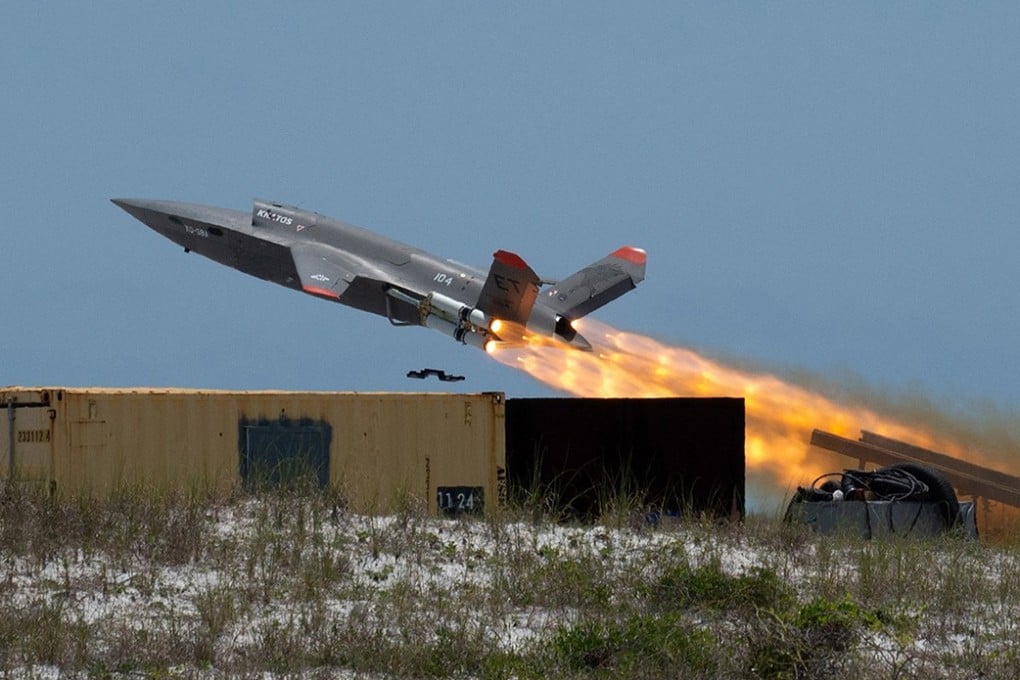
The Air Force Research Laboratory said earlier this month that pilots operating an F-16C Fighting Falcon and an F-15E Strike Eagle each controlled two XQ-58A Valkyrie drones in an air combat training exercise.


The exercise was a test of real-time integration between crewed and semi-autonomous systems, according to the laboratory, which is the US Air Force’s main scientific research and development centre.

Taiwan agrees to buy 1,000 killer drones from US one day after PLA blockade drills
Built by defence firm Kratos, the drone first flew in 2019 as part of the air force’s push to explore the “loyal wingman” concept in which uncrewed aircraft are directed by crewed fighters.
While the Valkyrie has previously flown with different types of crewed fighters, analysts said the most recent test was more complex, with a formation that could be scaled up.
“This kind of simulated combat drill is a logical next step, given that the Valkyrie has been flying for quite a while now,” said Fu Qianshao, a Chinese military aviation analyst.
“Commanding and controlling two drones at once raises the difficulty substantially – it demands more attention from the pilot, greater tactical judgment, and the ability to maintain broader battlefield awareness.
“We are also working on similar technologies in China, although there has been little public reporting on it. China’s loyal wingman drones capabilities are on par with the United States.”
The US Air Force described the exercise as a “major leap” in human-machine teaming, referring to the Valkyries as “autonomous collaborative platforms”. The goal is to integrate such platforms into future air combat scenarios, reducing pilot workload while improving situational awareness and combat effectiveness.

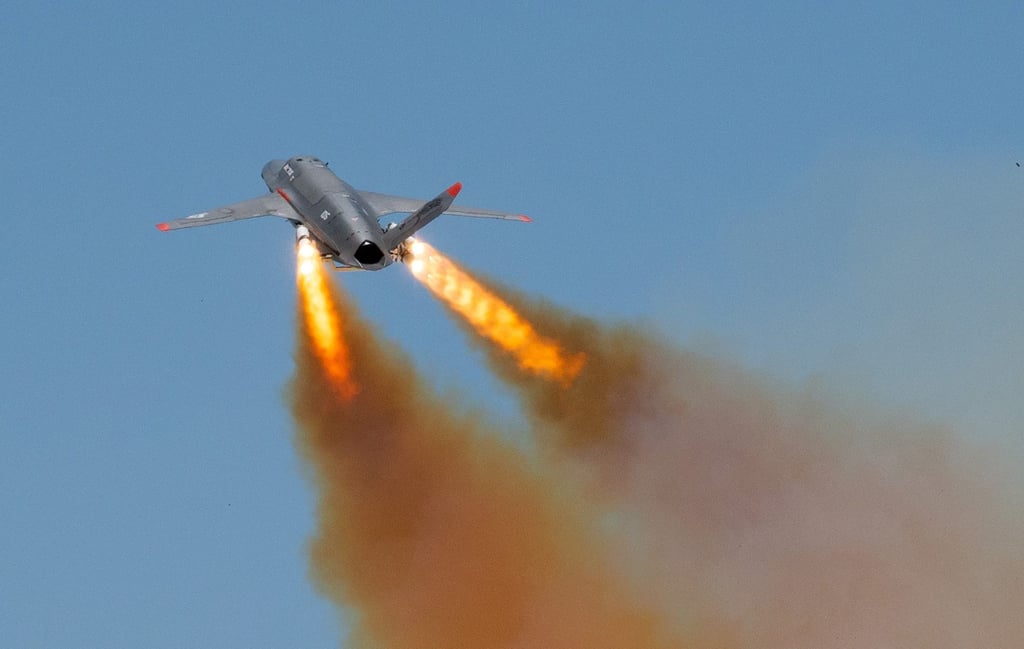
The Valkyrie is a low-cost, long-range, high-speed drone designed for a variety of missions including strike, intelligence-surveillance-reconnaissance, electronic warfare, decoy operations, and communications relay, according to media reports.
As early as 2020, an F-22 Raptor and an F-35A Lightning II were seen flying in formation with a Valkyrie.
The Valkyrie is a low-cost, long-range, high-speed drone designed for a variety of missions. Photo: Air Force Research Laboratory

In 2024, the US Marine Corps tested the Valkyrie in a loyal wingman role alongside their F-35B stealth fighters. The drone also proved its ability to launch smaller uncrewed systems during another test.
The drone is 30 feet (9.1 metres) long with a 27-foot wingspan; and has a dry weight of 2,500lbs (1.13 tonnes), a Mach 0.72 cruise speed, and a maximum range of about 3,000 nautical miles, according to media reports.
Chinese military analyst Song Zhongping said such tests showed how drones, under the control of crewed fighters, could effectively extend the operational reach of crewed aircraft.
“This is essentially a method to extend the combat radius of a fighter jet by using drones under its control,” Song said.
“China’s newest fighter jets already have this ability,” he said, adding that teaming with drones was becoming standard for both fifth- and sixth-generation aircraft.
Earlier this month, new images of China’s two-seat variant of the J-20 stealth fighter emerged online. Defence watchers say the second seat is intended for a mission systems officer to control loyal wingman drones.

State broadcaster CCTV has shown footage of the J-20 flying in formation with three GJ-11 stealth drones – evidence that China is actively experimenting with crewed-uncrewed teaming.
Song added that China’s sixth-generation fighters, which reportedly made their first flights late last year and have since undergone multiple rou

WSJ : As Tesla Stumbles, SpaceX’s Finances Go From Strength to Strength

As Tesla Stumbles, SpaceX’s Finances Go From Strength to Strength
Musk’s rocket-and-satellite powerhouse uses technological edge to boost revenue and win customers

  • SpaceX has several thriving businesses, in contrast with some of Elon Musk’s other struggling ventures.
  • Starlink’s global expansion helps drive SpaceX’s revenue, and reaches millions of users.
  • Starship faces setbacks with repeated failures, pressuring SpaceX amid NASA’s reliance and financial implications.

Collapsing electric-vehicle sales, political fallout and an AI chatbot publishing antisemitic posts—much of Elon Musk’s business empire is in disarray.

But the executive’s rocket-and-satellite company remains as dominant as ever, riding high on the strength of technologies that rivals haven’t mastered and deep relationships with U.S. government officials.

Privately held SpaceX has been working on a sale of employee shares that would value it at $400 billion, up 14% from six months ago, according to people familiar with the situation. Bloomberg reported earlier on the new valuation.

Musk, who controls SpaceX with a more than 40% stake, recently projected close to $16 billion in revenue at the company this year. That would be up more than three times versus 2022. Its Starlink satellite business has stoked those gains with a rapid global expansion.

Meanwhile, SpaceX is sitting on more than $3 billion in cash, which has helped the company to expand without raising new capital, people familiar with the matter said.

SpaceX has carved out powerful positions on several fronts. Its launch division frequently handles high-stakes government and commercial missions. The company has reeled in major wins through Starshield, a national-security satellite effort. Starlink, a huge satellite-internet network, now has around 8,000 satellites speeding through low-Earth-orbit.

“I hope others can catch up. Competition is good for industries,” SpaceX President Gwynne Shotwell said at an investor event in November. “On launch, and both satellite production and deployment, we are ahead.”

One of the big questions right now at SpaceX is Starship, the vehicle Musk has said would reach Mars years ago. Engineers and technicians are wrestling with repeated failures of the experimental rocket, including an explosion last month in Texas that shook homes miles away.

The company has also been plunged into fights between President Trump and Musk, the most recent of which followed the executive’s promise to start a new political party. Trump has threatened to cut billions of dollars in contracts between the government and Musk-tied businesses, a move that would roil SpaceX.

SpaceX didn’t respond to a request for comment.

SpaceX operates a vehicle, called Crew Dragon, that is the only U.S. spacecraft flying astronauts to and from the International Space Station. That dependency generated anxiety inside the National Aeronautics and Space Administration when Musk briefly threatened to cancel the ship as he fought with the president last month.

Starlink’s new connections
A growing part of the Texas-based company’s financial power is rooted in Starlink.

The satellite network providing high-speed internet connections is used by everyone from the Ukrainian military to campers streaming television shows in the wilderness.

Earlier this month, the company said it was connecting more than six million people around the world through Starlink. A Starlink business covering the company’s international side, along with some U.S.-related sales, saw 2024 revenue nearly double to $2.7 billion from the year earlier, according to a company document viewed by The Wall Street Journal.

“In the context of a satellite industry that does not grow fast, this is amazing growth,” said Tim Farrar, an analyst who has long tracked satellite operators.

While Tesla sales have shrunk dramatically across Europe, Starlink continued to grow, with revenue shooting up to $744 million in 2024, from $367 million the previous year, according to the document viewed by the Journal. Across Africa, a nascent market, revenue topped $100 million, up from about $19 million.

Starlink is poised to continue pulling in customers overseas, at least for now.

Shotwell, who has talked about winning a 3% share of the global broadband market for Starlink, recently met with officials about starting service in India, according to posts she and an Indian government minister recently put up on X. SpaceX has long viewed India as crucial for Starlink, given its massive population and growing economy.

Starlink still faces many challenges. The company is able to charge much more for monthly service in wealthier countries than developing markets, but most of the population in places like the U.S. live in areas where traditional internet access is available at cheaper costs.

User terminals for the service are also expensive. A recent search for U.S. addresses showed costs at $349 for that equipment, and Farrar, the satellite-industry analyst, estimates the company must subsidize their costs to spur consumer access. Starlink isn’t allowed to offer service in China, one of the largest international markets.

Getting Starship on track
SpaceX’s dominant businesses provide a big cushion for the company as it grapples with one of the toughest challenges in its more than two-decade history: making Starship work.

The company eventually wants to stop producing its current fleet of rockets and vehicles entirely, switching over to Starship, current and former employees have said. Getting there is proving tougher than many at the company expected.

The complex vehicle has failed during three consecutive flight tests this year. Last month, a Starship spacecraft exploded during an engine test on the ground, leaving equipment destroyed and a test site unusable.

The setbacks ramp up pressure on SpaceX as it pours billions into the Starship program. NASA is depending on the rocket to handle planned astronaut moon-landing operations, and the company’s own plans to fly huge Starlink satellites on the vehicle are in limbo.

While Starship is on the ground, the company is limited in its ability to generate revenue from it and fully take advantage of infrastructure supporting the rocket.

That is something SpaceX is all too aware of. In a court filing last year, SpaceX fought an injunction that sought to restrict Starship launches from Texas, warning of the financial hit if it couldn’t fly the vehicle.

“Each day that SpaceX is unable to perform its Starship-Super Heavy launch operations will cost SpaceX millions of dollars,” the company said in the filing.

FT : A potential earthquake for multiclub ownership

A potential earthquake for multiclub ownership

All for nothing? Crystal Palace won the FA Cup earlier this year © PA Wire/PA Images
Yesterday Uefa issued its long-awaited ruling on whether Crystal Palace would be allowed to compete in next season’s Europa League. The decision to eject the Premier League team is a bitter blow for fans, players and shareholders, and is likely to have ramifications across European football.

The south London club qualified after winning the FA Cup, the first major trophy in its history. But celebrations were cut short when Uefa raised concerns about the club’s ownership structure.

At the time, John Textor’s Eagle Football Holdings held around 43 per cent of Palace (a stake since sold to New York Jets owner Woody Johnson). Eagle also owns Olympique Lyonnais, who qualified for the Europa League thanks to a last-minute goal on the final day of the season.

Uefa decided the two clubs breached rules on multiclub ownership as of the March 1 deadline. Then, Palace were in the FA Cup’s fifth round, long shots to win. Lyon were facing provisional relegation from Ligue 1 due to financial problems that would have barred them from Europe.

Textor and fellow shareholders — Apollo co-founder Josh Harris, Blackstone executive David Blitzer and chair Steve Parish — argued there was no conflict. Textor, they said, lacked decisive influence. Uefa disagreed.

The rules aim to stop two clubs under the same control from meeting in Uefa competitions — a moot point now that Textor has exited Palace. But the March 1 deadline for ownership changes has been upheld.

The verdict (appealable to the Court of Arbitration for Sport) follows previous rulings ejecting a Mexican club from the Club World Cup and an Irish one from the Europa Conference — both upheld by CAS.

These moves mark a tightening of the rules, with serious implications for multiclub ownership.

Owners must now decide by February which club(s) to place in a blind trust, the short-term fix for managing conflicts.

They might even start planning which team to push towards which competition — potentially compromising domestic leagues. Uefa may have protected its tournaments’ integrity, but opened a can of worms at home.

The broader question is whether this will cool interest in multiclub investment. The impact will be felt far beyond south London.

FT : Can Apple deliver on F1’s American dream?

Can Apple deliver on F1’s American dream?

Apple’s bid to show live Formula 1 races in the US is a major boost for the sport. As Scoreboard went to press, a person with knowledge of the matter said that the tech company looked increasingly likely to win the rights.

But picking the streamer — just as F1 tries to mastermind the next phase of its growth strategy in a country it is starting to crack in a meaningful way — is not without risk.

Apple, which co-produced the summer blockbuster F1 (the movie starring Brad Pitt) is challenging Disney’s ESPN, the existing broadcast partner, for the rights. The pressure is on F1 to convert its growing popularity in the US into a more lucrative media rights deal rather than just hype.

The timing is also key, with talks taking place between the release of the hit film and the arrival of US marque Cadillac on the grid in 2026.

Wall Street is watching closely. Analysts at Citi have previously estimated that F1’s next US broadcast deal could be worth $121mn a year. Two people involved in the process say it could be worth about that or up to $150mn, well above the $85mn a year currently paid by ESPN. One person cautioned that F1 is yet to make a final call.

But there’s more to factor in than just cash. F1 is still focused on growing its audience in the US — and Apple has limited reach compared to other networks and platforms. Concerns have also been raised that not many fans are watching Major League Soccer on AppleTV. Then there’s the matter of whether F1 can negotiate a deal that allows it to continue showing live races on its own streaming app, F1 TV.

Could Apple’s keen interest bring ESPN back to the table? As cord-cutting transforms the media rights market in the US, the Disney-owned network has so far adopted a tough negotiating stance.

While F1’s audiences on ESPN have doubled since 2018 to an average of 1.1mn viewers a race, the pace of growth stalled in 2024. ESPN had an exclusivity period last year to negotiate with F1 but the talks ended without a deal.

For F1 executives, the choice of broadcast partner in the US is set to be a pivotal moment in the sport’s American story. Going with Apple would be a gamble.

FT : Italian court confirms UniCredit must exit Russia to complete BPM takeover

Italian court confirms UniCredit must exit Russia to complete BPM takeover
Ruling is blow to chief executive Andrea Orcel, but Meloni’s government defeated on other conditions it demanded

An Italian court has confirmed that lender UniCredit must comply with a government demand to exit from Russia if it wishes to complete the takeover of rival Banco BPM, in a blow to chief executive Andrea Orcel.

The request by Giorgia Meloni’s government is “totally legitimate” and “there can be no doubt about the fact it is proper”, the court ruled.

But it partially upheld an appeal by UniCredit on other measures demanded by Rome as conditions of the takeover.

In the landmark ruling, published on Saturday, government prescriptions on BPM’s post-merger loan-to-deposit ratio and the maintenance of the two lenders’ project finance portfolios in Italy were struck down.

It is the first time the administrative court has ruled against any requirements imposed by the government on a strategic takeover deal, and the judges’ decision cancels the existing text of the government’s decree altogether.

Orcel had previously warned that the deal could fall apart if the government did not relax its requirements.

It was not immediately clear whether either side in the case would appeal further, or whether the government would redraft its decree to take into account the judges’ decision.

That leaves the deal in limbo. The BPM offer period, which has already been extended once due to the court case, ends on July 23. If the government does not rewrite its decree, UniCredit could ask for the deadline to be extended, or one of the parties could appeal against the court’s decision; the deadline could also be suspended by the regulator.

BPM said in a statement it was pleased with the outcome of the appeal and called on UniCredit to “clarify its intentions” on the takeover.

UniCredit did not immediately comment on the decision. UniCredit’s board is due to meet in the coming days, according to people familiar with the matter.

UniCredit is Italy’s second-largest lender. It launched concurrent takeover bids for BPM and Germany’s Commerzbank last year.

It has significantly reduced its exposure to Russia since the country’s full-scale invasion of Ukraine in 2022 but remains one of two European lenders to operate a local subsidiary.

Orcel has so far refused to exit the country altogether to avoid incurring a balance sheet hit. The exit would have to be authorised by Russian authorities.

>>> Weekend Papers Summary

FINANCIAL TIMES
-US stocks' record highs are obscuring the risks Donald Trump poses to the world's largest economy, according to big investors and senior bankers who have warned over growing "complacency" in the markets. Senior executives from Amundi and JPMorgan Chase have said buoyant markets are pricing in too much confidence that the US president will back down from policies most likely to threaten the country's financial stability. Vincent Mortier, chief investment officer of Amundi, referred to a narrative espoused on Wall Street that 'Trump always chickens out'. JPMorgan chief executive Jamie Dimon echoed this sentiment, noting that "unfortunately, I think there is complacency in the market." The S&P 500 share index has surged about 30% from an April low, rebounding since Trump paused the sweeping tariffs he announced during his "liberation day" event. Equities have generally shrugged off Trump's latest batch of tariff threats against large global economies.
-Trump has relaunched his trade war by imposing a 50% tariff on copper imports and considering a 200% levy on pharmaceutical goods. He also threatened Canada with 35% tariffs and put EU nations on notice to expect similar announcements. Trump's letters have set new levies between 25 and 40% for countries like Japan and South Korea, while granting the world another three-week extension to strike deals. These letters were sent to just over 20 countries, including South Africa, Thailand, Tunisia, and Bangladesh. Countries that do not receive letters will have to pay a higher blanket rate of 15-20%, up from 10%. However, the brinkmanship of Trump's threats has been undermined by the difficulty of reaching limited trade deals.
-A preliminary report into Air India flight 171's fatal crash last month has revealed that the engines briefly cut off seconds after take-off. The Air Accident Investigation Bureau reported that the aircraft reached the necessary speed to lift off, but fuel flow switches to the two engines transitioned from "run" to "cut-off" position. The pilots were asked why they cut off, and the engines lost thrust, leading one pilot to declare "mayday, mayday, mayday." Aviation experts have said it is difficult for pilots to inadvertently move fuel switches. The crash occurred on June 12, following the take-off of a Boeing Dreamliner 787-8 from Ahmedabad to London Gatwick airport. The crash killed 241 people on board and 29 on the ground.
-Elon Musk's xAI is set to raise $200B in a deal, a 10 times increase from its early last year value. The fundraising, which could begin next month, would be its third large share sale in less than two months. The deal would also increase xAI's valuation from $18B in its "series B" fundraising in May 2024. The company recently released the fourth model of its Grok chatbot, which posts on Musk's social media platform X, following its controversial post on X. The new fundraising is expected to target a valuation between $170-200B, with Saudi Arabia's sovereign wealth fund, PIF, expected to play a significant role. PIF holds an indirect interest in xAI through its stake in Kingdom Holdings Company, which has invested $800M in the company.
-The Pentagon is urging Japan and Australia to clarify their roles in the event of a war between the US and China over Taiwan. Elbridge Colby, under-secretary of defense for policy, has been pushing the issue in meetings with Japanese and Australian defense officials. The push is his latest attempt to convince US allies in the Indo-Pacific to enhance deterrence and prepare for a potential war over Taiwan. Colby's discussions with allies include efforts to persuade allies to raise defense spending amid rising concern about China's threat to Taiwan. The request for commitments related to a war over the island is a new demand from the US. However, the US does not provide a blank cheque guarantee to Taiwan.
-The US state department has announced plans to fire over 240 foreign service employees, including senior officials, following a Supreme Court decision allowing the Trump administration to proceed with job cuts across federal agencies. The move will affect 246 foreign service employees and 1,107 civil service employees with assignments in the US, according to the American Foreign Service Association (AFSA). Notifications are already being sent to affected employees, and they will be placed on administrative leave for a 120-day period before formally losing their jobs. The lay-offs are part of a broader reorganization of the state department, aiming to eliminate about 15% of its workforce.
-President Donald Trump has expressed frustration with Russian President Vladimir Putin for failing to negotiate an end to the three-year war he launched with Ukraine. Trump has pledged to provide additional weapons, including Patriot air defense systems, to Ukraine, and has expressed willingness to impose tougher sanctions against Moscow. He has also promised to issue a "major statement" on the war in Ukraine on Monday. Trump's ire represents a significant shift in tone from the White House, which previously blamed Ukrainian President Volodymyr Zelenskyy for the conflict. Trump's comments on the Russian drone attack in Ukraine highlight his frustration with Putin's inaction in talks to end the war.
-Brussels is proposing a levy on large European companies to generate new funding streams for the EU's €1T-plus common budget. The corporate resource for Europe, outlined in a draft European Commission proposal, will be unveiled next week but requires unanimous support from member states. The annual tax would apply to companies with turnover exceeding €50mn, regardless of their headquarters. A bracket system would require higher contributions from groups with the highest net revenues. Other revenue-raising measures include the EU taking a share of higher tobacco excise duties, charging for non-recycled electronic waste, and a handling fee for long-distance ecommerce packages, primarily targeting imports from China.
-Kraft Heinz, a packaged foods company, is considering a break-up a decade after Warren Buffett and 3G Capital merged the two brands. The decision comes after the company, known for Heinz Ketchup and Kraft Macaroni & Cheese, said it was considering several options to reverse its persistent underperformance. One plan being considered is spinning off much of its traditional grocery portfolio into a standalone company, while the remaining part, including Heinz condiments, Grey Poupon mustard, and a broader range of sauces, could be set for faster growth due to changing consumer tastes. Executives believe that two separate companies could ultimately be worth more than Kraft Heinz's $31B market value. No final decision has been made, and it is still possible the company would sell some assets and remain as a single entity.
-Police have raided the party's headquarters and office in an investigation into allegations it illegally financed recent campaigns by borrowing from supporters to evade legal caps on donations. This comes amid the controversy surrounding France's three-time presidential candidate, Emmanuel Macron, who was convicted of embezzling EU funds in March and sentenced to a five-year election ban. Le Pen maintains her innocence and is appealing the verdict, but it has weakened her leadership of the far-right party, as her right-hand man, party chief Jordan Bardella, will run in her place if she cannot. Le Pen's state of mind was revealed in an interview with conservative magazine Valeurs actuelles magazine.

NEW YORK TIMES
-Trump's supporters claim he is a top dealmaker, but for now, more trading partners have received stiff tariffs than trade deals. Even when Trump strikes trade deals, double-digit tariffs are often left in place, with more levies on foreign products on the way. The belief, promoted by Trump himself, was that he was using his tariffs as a lever to crack open foreign markets and deliver dozens of deals that would increase U.S. exports and help American businesses flourish abroad. However, three months later, that optimism is being replaced by doubts that Trump's goal is ever to strike the kind of trade deals that would open up markets.
-Kerrville, a city of 25,000, has become a hub for search and recovery efforts along the Guadalupe River. While some parts of the city have largely escaped the worst of the flood's damage, the city water plant has sustained significant damage, causing residents to rely on well water for the next few weeks. Dozens of houses were destroyed in the streets nearest to the river. Police officers evacuated 200 people from homes and vehicles. Many people remain missing from at least one campground at the city's edge. In one harrowing rescue, a police officer wrapped a garden hose around his waist to serve as an anchor, while two other officers waded into the surging water to rescue two trapped people.
-The FBI is using polygraphs to test officials' loyalty, with some senior officials being asked if they said anything negative about the director, Kash Patel. This is part of the FBI's broader crackdown on news leaks, reflecting the director's awareness of how he is publicly portrayed. Since taking office, the bureau has significantly increased the use of the lie-detector test, subjecting personnel to questions as specific as whether they have cast aspersions on Patel himself. The number of officials asked to take a polygraph is in the dozens, though it is unclear how many have specifically been asked about Patel. Former bureau officials say the moves are politically charged and highly inappropriate, underscoring an alarming quest for fealty at the FBI, where there is little tolerance for dissent. Disparaging Patel or his deputy, Dan Bongino, could cost people their jobs.
--President Trump and his aides have shifted their focus from recommending the elimination of the Federal Emergency Management Agency (FEMA) to overhauling it, despite previous statements that the agency was bloated and ineffective. As the administration grapples with the deadly flooding in Texas, they are now focusing on the need for the federal government to effectively respond to disasters. The director of the Office of Management and Budget, Russell T. Vought, stated that the president will continue to ask tough questions from all of his agencies. This has added confusion about the future of FEMA, which is struggling with the loss of top officials, including Cameron Hamilton, who criticized the agency's importance in communities during times of need.
-Texas officials are facing scrutiny for refusing to fund early warning systems for flash floods, a common issue in areas with frequent, intense rainfall. The floods that killed at least 121 people, including 36 children, were a result of inadequate forecasting and communication. Experts argue that accurate forecasting alone is not enough to prevent calamity, and both rich and poor countries have struggled with funding for systems that either fail or create false alarms, eroding public confidence.
-A federal judge in California has halted the Trump administration from making indiscriminate immigration arrests in the Los Angeles area and from denying detainees the right to legal counsel. The temporary restraining orders, issued by Judge Maame E. Frimpong, rebuke tactics used by federal agents during immigration raids. The orders directed agents to stop racial profiling and mandated the federal government to ensure detainees have access to legal counsel. The judge argued that the federal government would have the court believe none of these tactics are happening.
-Measles cases in the US reached a record high, prompting Democrat Senator Chuck Schumer to call on health secretary Robert F. Kennedy Jr. to declare the virus a public health emergency. The minority leader argued this was necessary to control the rapid resurgence of the highly contagious virus. With 1,288 cases in 2025, the majority of cases have been linked to the Southwest outbreak, which began in a Mennonite community in West Texas and spread to Oklahoma and New Mexico. There are no immediate plans to declare a public health emergency.
-Google has acquired the leaders of Windsurf, a start-up that developed an AI-powered computer programming tool, in a $2.4B deal. The move is part of tech companies' battle to acquire AI talent, deepening Google's AI engineering bench and securing a point against OpenAI, one of its biggest challengers. OpenAI was in talks to acquire Windsurf in a $3 billion deal, but talks broke down due to concerns about information sharing with Microsoft. Under Google's agreement, Windsurf's CEO, Varun Mohan, and co-founder Douglas Chen will join Google DeepMind, along with several research and development employees.

NEW YORK POST
-President Trump has granted Immigration and Customs Enforcement (ICE) agents "Total Authorization" to arrest violent protesters following a California cannabis farm raid that resulted in rocks being thrown at federal law enforcement vehicles. Trump praised the officers for their bravery and ordered Secretary of Homeland Security and Border Czar to instruct all ICE, Homeland Security, or other law enforcement officers to stop their cars and arrest the protesters using whatever means is necessary. The incident shows disrespect for law and order.
-FBI Deputy Director Dan Bongino has reportedly resigned after a heated exchange with Attorney General Pam Bondi over the Trump administration's handling of the Jeffrey Epstein investigation. The heated exchange led to Bongino taking a personal day and considering resigning after fewer than four months in his job. Both parties have publicly stated that an internal review of the Epstein file yielded no smoking-gun information about his death, high-powered associates, or sickening crimes. A Justice Department official said that FBI Director Kash Patel might follow Bongino out the door, as both have fought for transparency.