>>> Mercedes home batteries are a potential rival for Tesla’s Powerwall

The batteries developed for the high demands of all-electric Mercedes-Benz cars are finding a new application as in-home energy storage units. Sound familiar? Yeah, it’s a lot like the Tesla Powerwall.

Mercedes-Benz parent company Daimler AG announced that the storage units are being manufactured by its subsidiary Deutsche ACCUMOTIVE (Daimler has a real love of all caps). The batteries are being sold, installed and supported by partners like utility and solar tech companies. That makes sense, because the storage units are usually installed along with solar panels. The units are already available in Germany, and Mercedes says it will be expanding the program internationally.

Up to eight of the columnar 2.5 kWh lithium-ion battery modules can be combined, with a maximum capacity of 20 kWh all together. According to Mercedes, this is enough to capture surplus solar power for later use with “virtually no losses.” The price of the units hasn’t been disclosed, since it can include several components: the unit itself (or two or three), maybe some photovoltaic panels and the installation.

Deutsche ACCUMOTIVE has been making units like this since 2015 for industrial uses. The systems were designed to be scalable; thus the quick entry into the private home market. Daimler is banking on its energy storage subsidiary in a big way — it’s invested more than $500 million in a second battery factory at the Deutsche ACCUMOTIVE site that will begin operating in the summer of 2017.

As a comparison, the Tesla Energy Powerwall serves the same purpose, with arguably more style. The Powerwall has 6.4 kWh of energy storage “for daily cycle applications,” according to the website. Like the Mercedes units, these can be installed in multiples for solar systems that need to store more energy. We do know how much the Powerwall costs — $3,500. We also know that demand was high, with a reported 38,000 reservations when the Powerwall was announced last year. That level of demand seems to leave plenty of room for a competitor like Daimler AG to jump in with its road-tested battery technology this year.

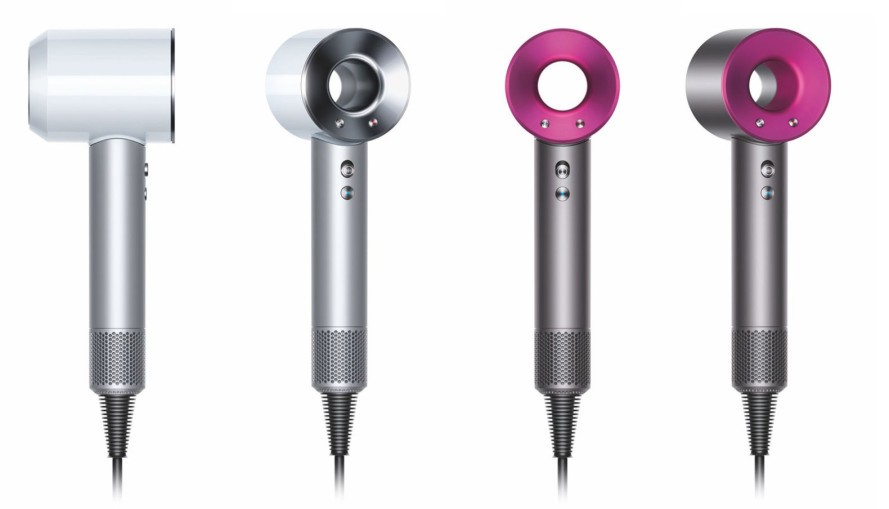
(TechCrunch) A Dyson engineer explains why the company spent $71 million and fou

A Dyson engineer explains why the company spent $71 million and four years developing a high-tech hair dryer
Hair dryers are everywhere. Bathrooms. Gym locker rooms. Open a drawer in your hotel room — boom, free hair dryer. It usually requires a lot to get me to really notice a hair dryer. But Dyson has succeeded, and all it took was $71 million and four years of development.
It’s a logical progression, really. Between its vacuum cleaners, bladeless fans and the hand dryer ominously known as the “Airblade,” which makes moisture wish it had never been condensated, the British company has really made a name for itself moving air around.
The new Dyson Supersonic applies that knowledge to the beauty category, filtered through the company’s strict quality control. That sort of focus on high-end engineering doesn’t come cheap — to Dyson or the consumer. When the Supersonic launches in September, it’ll run a cool (read: hot) $400.
I’ll be the first to admit that I’m not the target audience. I get a pretty good dry from a towel or a brisk walk. I solicited a response from a long-haired colleague who was somewhat skeptical about the product’s ability to fully deliver on its pricey promise, but added that if it is indeed as silent as the company claims, there’s potential appeal for saloons and mothers of small children. Librarians with damp hair might get on-board, as well.
Dyson’s long search for the hair-drying Holy Grail goes a ways toward explaining the premium price tag. As Tom Crawford, the Head of Product Development for New Categories told TechCrunch, “When Dyson goes into a new category, we always think about how we can make it better. Part of that challenge is making sure we invest in the right technology and testing to do so. The first part of this was to learn the science of hair. How to test it, how to make it repeatable, and then how to measure it. We built our own state of the art laboratory dedicated to investigating the science of hair.”
Dyson’s not messing around
hair
here. According to Crawford, the company spent a staggering £40,000 ($58,000) on hair tresses alone. “We carried out tests on a variety of real hair types in order to get a full understanding of its performance,” he explains. “A single hair tress costs between £12 and £20, depending on the length of hair we are using. On average, Dyson engineers used 40 hair tresses for every test — so that’s up to £780 a test and 640 inches of hair.”


That’s a lot of money for a lot of hair. But he insists that the space was long overdue for an overhaul.
“The traditional hair dryer design hasn’t changed in more than 60 years,” says Crawford. “Conventional hair dryers often have large motors, and because of their size they have to be put in the head of the machine. As a result, they can be bulky, and they can blast air at extreme temperatures, all with the risk of hair being sucked into the filter and being trapped. We created a Dyson digital motor V9 just for this machine.”
And sometimes a hair dryer isn’t a hair dryer. Hey, we wouldn’t have memory foam or freeze-dried ice cream if NASA weren’t so obsessed with going to the boring old moon.
“Dyson will always invest in new technologies, even when we aren’t sure of their application yet. Sometimes we see a bit of technology working in one application and wonder whether that might solve a problem in another,” explains Crawford.
“That’s exactly how our Airblade technology was born. Dyson engineers were exploring new ways to use our digital motor with an air knife — forcing high-speed air through minuscule apertures. It wasn’t working. But then one day, someone’s hands happened to be wet and the air knife dried them brilliantly. Our motor technology paired with other breakthrough technology has helped us create our very first hair dryer. Just imagine what it could create in five years.”
Whatever it is, wetness clearly doesn’t stand a chance.

Barron's : Icahn: ‘There Will Be a Day of Reckoning Unless We Get Fiscal Stimulu

Billionaire hedge fund manager Carl Icahn said on CNBC that’s he’s entirely out of Apple (AAPL), voicing concern about potential for China to potentially impede Apple from selling its products there in the future. Barron’s Tiernan Ray has the details.

But Icahn went on to say that he’s mightily skeptical of the broader stock market; in fact, he said that he’s been shorting. Still, Icahn said that recently beaten down commodity stocks could have farther to run. He admitted that the “huge” short position hasn’t been working well, of course, since the S&P 500 is up nearly 10% over the past three months. Icahn told CNBC’s Scott Wapner that he still owns Chesapeake Energy (CHK), Freeport-McMoRan (FCX) and CVR Energy (CVI).

“I still am extremely cautious about the market,” he said. The reason is the “experiment” of easy-money at the Federal Reserve and overseas’ central bankers embarkation into negative interest rates. He warned of “tremendous bubbles.” He also called for unity in Congress to support fiscal stimulus, that is some combination of government spending or tax cuts: “There will be a day of reckoning unless we get fiscal stimulus.” He went on: “Congress has been in this massive gridlock, obsessed with this deficit [even though] you’re don’t have inflation and you are the reserve currency in the world.”

Hard to peg the market’s move to Icahn in particular, but the SPDR S&P 500 (SPY) plunged to session lows immediately afterward. It’s currently down 0.9%.

BArrons :Schwab’s Liz Ann Sonders: Should We Sell Stock in May?

Schwab’s Liz Ann Sonders: Should We Sell Stock in May?
Since 1950 the S&P 500 has returned 1.3% during May through October versus 7.1% November through April.
As April comes to a close, investors are again wondering whether to “sell in May and go away.”
Investors will also be hearing a lot about the Dow’s new “Golden Cross,” which is generally a bullish sign for stocks.
Our conclusion is that signals are mixed and now is not the time to take on undue risk.
We are in that “season” when you will hear a lot about whether it’s appropriate this year to “sell in May and go away,” which is one of the most time-honored market adages, and for good reason. Since 1950, nearly all of the Standard & Poor’s 500’s gains have occurred between October and April.
The mean return since 1950 for the S&P 500 during May through October was 1.3%; while for November through April it was 7.1%. [Editor’s note: Investors can get exposure to the S&P 500 via the SPDR S&P 500 ETF ( SPY ) or the Schwab S&P 500 Index Fund ( SWPPX )]
The “strategy” did not work for the three years from 2012-2014, or for the five years from 2003-2007, when there were gains between May and October in each year. In addition, as you can see in the table below, there is a meaningful difference between how the market performs from a seasonal perspective in secular bull or secular bear markets.
Average gains and the percent of positive cases have been higher in secular bulls than in secular bears (even if they are still lower than in the November through April period).

Source: Ned Davis Research (NDR), Inc. (Further distribution prohibited without prior permission. Copyright 2016 Ned Davis Research, Inc. All rights reserved.) as of October 31, 2015.

Ostensibly supporting the bull case as we head toward May, is another market metric which will undoubtedly get some attention this week. The Dow Jones Industrial Average just experienced a so-called “Golden Cross.” This is a technical term used to describe the 50-day moving average crossing above the 200-day moving average as both moving averages are rising. This just occurred again and it’s the first Golden Cross for the Dow since Jan. 2, 2012. It’s generally seen as a very bullish indicator for stocks…but is it?
Bespoke Investment Group (BIG) took a look at the past 50 years to see how the market fared in the aftermath of Golden Crosses. The data show that performance following Golden Crosses was no better than the performance over any random time period. It was up exactly half the time over the next month and three months; while returns and probabilities did increase for the six-month period.
If you are looking for the glass-half-full perspective, do note that the Dow performed very well following the last two Golden Crosses in October 2010 and January 2012; while the Dow was positive in the six months after the last seven Golden Crosses as well.
Another feat by the market last week was the continued improvement in market breadth (which has been much healthier than other rallies over the past year). Last week, the Financial sector finally regained its 200-day moving average, which now puts all 10 S&P 500 sectors above their 200-day moving averages.
The recent streak of over a year without all 10 sectors above their 200-day moving averages simultaneously is rare. According to Bespoke Investment Group, there have only been four previous streaks of a year or more since 1990; and two of those were coming out of major bear markets. This sign of improving breadth was an extremely bullish signal in three of the past four instances (1993 had mixed results).
The net is that there are competing forces at work for the market at present. From the February low, the market has rallied sharply, which has triggered indicators like the Golden Cross. Bespoke looked back over the Dow’s entire history to find times when the Dow closed at a 52-week low at some point in the prior three months, then rallied at least 13% over a 50-day period. The last two times this occurred were in October 2011 and November 2015—both marked short-term highs in stocks.
However, the current experience is unusual because it’s the second occurrence within a year. The other times that happened (November 1900, October 1921, July 1932 and November 2001), stocks did markedly better.
To me, these conflicting forces suggest maintaining our “neutral” rating on U.S. stocks. That means investors should remain at their strategic equity allocation, but be extra mindful of adopting rebalancing strategies in the interest of risk control

>>> LUX IM +2% - see comments below - numbers tonight

Luxottica: Vian; reflexive in 2016, but the beginning of the second storey
(ANSA) - MILAN, April 29 - "In 2016 we have a more 'thoughtful attitude, more' attentive, but the beginning of the year is proceeding according to plan." Cosi 'the CEO of Luxottica, Massimo Vian, who still remembers how "for us the beginning of the year and' generally very indicative: the crucial months are May, June and July and we look carefully at the products to be launched for the summer. "
Responding to the shareholders in the group in Milan, the chief administrator specifies that "to date there are no ongoing talks or negotiations" for the possible acquisition of the German Zeiss Essilor or French, "which for us are" suppliers. "Our partnership with Intel and 'solely on the research and development and we are thinking whether to insert the word' Intel Inside 'on the glasses that use this technology as it does on computers," says Vian. (HANDLE).

Luxottica: Vian; in 2016 riflessivi, ma inizio secondo piani
(ANSA) - MILANO, 29 APR - "Nel 2016 abbiamo un atteggiamento piu' riflessivo, piu' attento, ma l'inizio anno procede secondo i piani". Cosi' l'amministratore delegato di Luxottica, Massimo Vian, che ricorda comunque come "per noi l'inizio di anno e' in genere poco indicativo: i mesi cruciali sono maggio, giugno e luglio e noi guardiamo con attenzione ai prodotti da lanciare per l'estate".
Rispondendo agli azionisti all'assemblea del gruppo a Milano, l'amministratore delegato specifica che "ad oggi non sono in corso discorsi o trattative" per l'eventuale acquisizione della tedesca Zeiss o della francese Essilor, "che per noi sono fornitori". "La partnership con Intel e' esclusivamente di ricerca e sviluppo e stiamo pensando se inserire la dicitura 'Intel Inside' sugli occhiali che usano tale tecnologia come avviene nei computer", conclude Vian. (ANSA).