The question of how Brexit would affect the UK economy is one of the crucial issues in the campaign ahead of Thursday’s historic
EU referendum.
But millions of words on the topic — including economists’ majority view that leaving the bloc would slow the country’s growth and the Leave campaign’s counterarguments that Britain would prosper outside the EU — could be replaced by seven charts.
These sum up the arguments over what breaking up with Brussels would really mean for jobs, growth and public finances.
The EU has been good for Britain
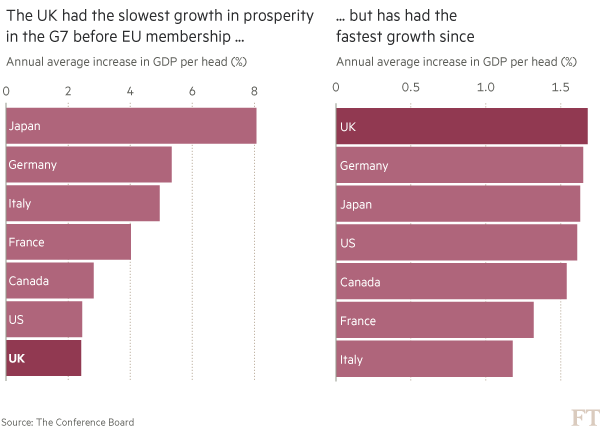
The UK used to be the sick man of Europe. Its annual growth in prosperity has improved from bottom of the league among the G7 leading economies before it joined the European Economic Community to top spot in the 43 years after 1973. This does not prove that becoming a member improved Britain’s international performance. It does, however, allow the Remain campaign to argue that membership did not prevent UK national renewal.
Alternative explanation:
Economists from the Leave side would point out that the absolute growth rates were lower after 1973 than before and that the main reason for Britain’s improved performance was Margaret Thatcher’s reforms, not EU membership.
Assessment
Splitting correlation from causation is difficult. All countries’ growth slowed after the postwar surge petered out. But, given the dramatic improvement in Britain’s position, it is nearly impossible to argue that the EU stood in the way of Britain pulling up its socks. In the most detailed assessment to date, professor Nick Crafts of Warwick university, Britain’s leading economic historian, estimates that the EU directly raised UK prosperity by about 10 per cent, largely due to increased competition and better access to the single European market.
What trade deals would replace EU membership?
What would a new ministry of trade have to do after the country broke off with the EU to replace current trading relationships? Sign a deal with the remaining 27 members of the EU, come to an arrangement with about 50 additional countries with which the EU has preferential deals, or all the remaining 161 members of the World Trade Organisation?
Having started the campaign suggesting that the country could maintain access to the European single market, the Leave campaign now emphasises that the UK could still trade with the continent under WTO rules and eventually strike a bilateral deal with the bloc — one that did not involve being part of the EU’s custom union. Such an accord is likely to take years to negotiate, say experienced trade negotiators. Barack Obama, US president, has also cautioned that Britain would be “at the back of the queue” for a US-UK trade deal.
Alternative explanation
The Leave campaign says the UK does not need trade agreements to trade. It adds that Germany and other countries running trade surpluses with the UK would eagerly seek a preferential deal and the UK could be much more nimble in negotiating deals with other countries.
Assessment
Leave is right that trade deals are not necessary for trade. But such agreements do set the rules for commerce and protect Britain and UK companies from disputes and arbitrary actions from other countries. Leaving the EU would require a mammoth negotiation process, since Britain could not even guarantee to be able to trade securely under WTO rules, since it does not have its own schedule of tariffs, commitments on services and agricultural subsidies. Without this, Britain would be left vulnerable to legal action under WTO dispute settlement rules.
Could Britain cut migration significantly?
Britain’s net migration stood at 333,000 in 2015, the second highest figure on record and more than three times David Cameron’s 2010 pledge to bring the figure down to the tens of thousands. Net immigration from EU countries, particularly central and eastern European member states, rose rapidly after their accession to the EU in 2004 and more recently when citizens of Bulgaria and Romania acquired the right to work and settle in the UK. Only by leaving the EU can the government reduce the numbers of EU migrants.
Alternative explanation
EU migrants tend to be young and are likely to be employed. They contribute more to the UK public finances than they take out and much more than UK born citizens. And their numbers appear to be plateauing, now that the initial surge from Romania and Bulgaria has abated.
Assessment
Even if EU net migration was cut to zero, Britain would have far more migrants from non-EU countries than the prime minister’s tens of thousands pledge. As long as Britain’s economy is doing well internationally, it attracts immigrants.
Do migrants reduce UK wages?
The chart shows the change in the share of EU immigrants for every local area in the UK (left to right) and the change in local wage levels (up and down). There is no correlation, indicating that areas with high levels of immigration do not have lower wage growth. There is no indication that immigration reduces wages.
A Bank of England study found a small effect on the lower paid, with a 10 percentage point rise in the share of low-skilled migrants reducing wages of the lower paid by 2 per cent. But the increase in EU migration share has been only about 2 percentage points between 2008 and 2015, suggesting the effect on low pay is about a cut of 0.4 per cent over seven years.
Alternative explanation
While the Leave campaign has grossly exaggerated the very small measured effect of migration on low skill wages, there is a question whether normally high growth areas should be expected to have had larger increases in wages. This could explain why there is no positive correlation in the chart between areas of high immigration and higher wage rises.
Assessment
The available evidence suggests EU migration does not cut people’s pay, even for the low paid. But there is a possibility that it allows employers to increase employment in high demand areas without raising pay but allowing EU migration to be a buffer.
Are EU regulations a yoke around the neck of the UK economy?
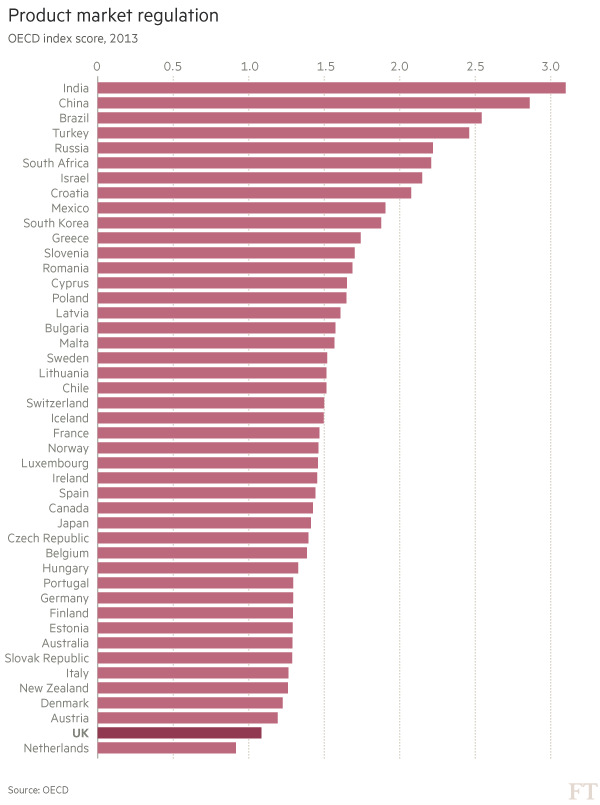
Evidence that EU regulations stifle British creativity, innovation, competition and growth is thin on the ground. The OECD assesses that the UK has the second lowest level of product market regulation among its members, just below the Netherlands. There is no figure for the US in 2013.
The differences between EU member states in this measure and in assessments of labour market regulation suggests that, far from harmonising practices across member states, Brussels’ rules allow countries to maintain their own rules to have highly or lightly regulated economies.
Alternative explanation
Leave campaigners say that even these regulations are too many and should not be set for the whole single market. They think that British regulations would be better and even less onerous on business.
Assessment
Britain has a good record in international league tables and by far the most costly regulations are not shown here, such as rules governing planning and the use of land. There is no guarantee that if Britain repatriated regulatory activity from Brussels, the rules would not get worse. Such repatriation would itself be a massive bureaucratic undertaking. It would be better to improve the regulatory environment where Britain has always been in control, but failed to take action.
What about the £350m a week sent to Brussels?
This figure — widely promoted by the Leave campaign — is not correct. When pushed, the Leave campaign accepts that Britain’s net contributions are much lower after the rebate secured by Margaret Thatcher and payments to farmers, poorer regions and science. Britain does, however, make net contributions to the EU budget of £8.5bn in 2015, about £163m a week. This would be saved once the UK had left the EU and Britain would get to choose how it spent the money currently allocated for farmers and others by common EU rules.
Alternative explanation
A net contribution of £8.5bn is roughly £1 out of every £100 the British government spends every year, so any savings will be small. The Institute for Fiscal Studies and others have pointed out that if leaving the EU implies slower growth, the net saving would be wiped out through lower tax revenues and higher benefit spending — even if the growth reduction was merely 0.6 per cent. The IFS estimated that if the economic assessments of Brexit were accurate, leaving the EU would cost UK taxpayers between £20bn and £40bn a year.
Assessment
There is no doubt that the effect of EU membership on national income is more important for the UK public finances than the annual membership fee. This is the dominant issue and a small hit would leave Britain’s public sector worse off.
Put it all together economists. What do you get?
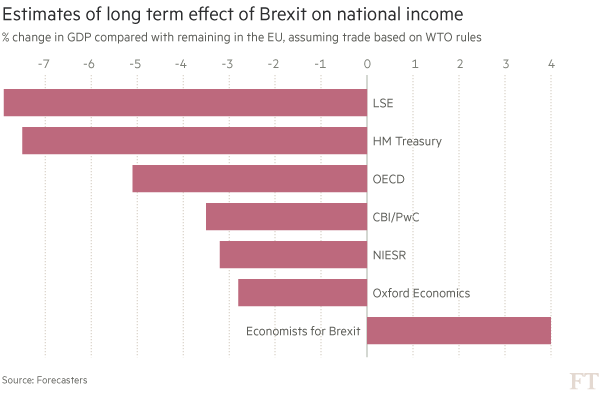
Brexit hurts. The main groups of economists who have published studies in the campaign use different models and different data but speak with more unanimity on this subject than on any other. Erecting trade barriers with the EU would hit prosperity, which is not easily replaced by greater free trade elsewhere. Leaving the bloc would afford the country little additional regulatory freedom and there could be long-term consequences from the short-term upheaval of Brexit. Economists overwhelmingly think leaving the EU is bad for the UK economy.
Alternative explanation
One group — economists for Brexit — believes Britain’s economy will be stronger if it adopts unilateral free trade, dropping all barriers on imports and letting other countries decide whether to maintain tariffs on British exports. This diverts all trade away from the EU, lowers prices and produces gains
Assessment
The economists for Brexit are out on a limb, both because of their desire for unilateral tariff reduction and due to their assessment of the benefits. Many other economists say the model the group uses is far removed from the real world and is not related to real current data on trade patterns.
Rarely has there been such a consensus among economists, as there is on the damage that Brexit would wreak on the British economy. The warning may turn out to be wrong — but it is difficult to ignore.