(BFW) Gundlach to Sell European Stocks Friday on ‘Bremain’: Reuters

Gundlach says considering selling European equities on 'Bremain' vote

NEW YORK (Reuters) - Jeffrey Gundlach, the chief executive officer at DoubleLine Capital, said Wednesday that his firm is considering selling its position in European equities early Friday on a "Bremain" vote that keeps Britain in the European Union.
Gundlach, who oversees $100 billion at the Los Angeles-based DoubleLine, also said the Tesla-SolarCity deal is "a complete confidence destroyer" for Tesla (NASDAQ:TSLA) shareholders.

>>> US Close Dow -0.27% S&P -0.17% Nasdaq -0.22% Russell -0.42%

Closing Market Summary: Stocks Slip as Investors Eye Brexit Vote

The stock market ended the midweek affair on a lower note as investors showed caution ahead of the United Kingdom's referendum vote regarding membership in the European Union. Contributing factors impacting today's trade included a downturn in oil and divided sector leadership between the heavily-weighted health care (+0.3%) and technology (-0.4%) sectors. The Dow Jones Industrial Average (-0.3%) finished the session behind both the Nasdaq Composite (-0.2%) and the S&P 500 (-0.2%).

Equity indices began the day on a higher note as investors responded to a positive bias in global equity markets. Global bourses ticked up overnight as investors looked to largely even polls between the "Brexit" camps and an uptick in crude oil. However, support from the oil pit faded through the session as the Department of Energy's weekly inventory report surprised to the downside. The stockpile data showed below-consensus results for crude oil (-0.91 million barrels; estimate: -1.67 million) and gasoline (+0.62 million barrels; estimate: -0.32 million) inventories. As a result, WTI crude finished its pit session lower by 1.3% ($49.12/bbl; -$0.65).

The S&P 500 (-0.2%) decoupled from oil in the first hour of trade as the heavyweight health care sector (+0.3%) climbed the leaderboard. The rally in the countercyclical sector took root after the Center for Medicare and Medicaid Services reported that spending levels did not exceed targets, which in turn did not trigger cost-cutting provisions in the program. The resulting strength in the health care sector helped the benchmark index briefly clear resistance at the 2095 price level, notching a session high at 2099.71.

The major averages pared gains in the early afternoon, which corresponded to both the close of trade in Europe and the release of a new Brexit poll. The polling data indicated that the "Leave" camp held a one-point lead over the "Remain" camp. The S&P 500 (-0.2%) drifted through the afternoon and eventually revisited its low in the final hour of trade. Seven sectors finished in the red with commodity-sensitive energy (-0.6%) trailing utilities (-0.5%) and technology (-0.4%) in the back of the pack. On the flipside, health care (+0.3%), telecom services (+0.2%) and materials (+0.1%) outperformed.

In the influential technology sector (-0.4%), software and cloud names demonstrated relative weakness as Adobe Systems (ADBE 94.01, -5.71) sank 5.7%. The stock was pressured after cautious guidance overshadowed better-than-expected results. Fellow software name Red Hat (RHT 79.75, -0.64) lost 0.8% ahead of this evening's quarterly report. Elsewhere, HP (HPQ 12.61, -0.72) fell 5.4% after its revised guidance for the quarter failed to impress.

The Dow Jones Industrial Average (-0.6%) underperformed after component FedEx (FDX 156.51, -7.44) slid 4.5%. The company reported top- and bottom-line beats for the quarter, but failed to show the impact of its recent TNT Express acquisition. Trucking names were also pressured in the index, as an earnings warning from Covenant Transport (CVTI 18.34, -3.63) weighed on the sub-group.

Biotechnology outperformed in the health care space (+0.3%), evidenced by the 0.7% gain in the iShares Nasdaq Biotechnology ETF (IBB 256.56, +1.77). The ETF trimmed its monthly loss to 8.3% as the Medicare decision eased pressure regarding the group's drug-pricing. In the broader sector, Humana (HUM 187.67, -2.40) and Anthem (ANTM 128.72, -2.73) underperformed after members of the U.S. Senate called on the Department of Justice to block large health insurance mergers.

The U.S. Dollar Index (93.76, -0.25) ended off its session low as the greenback lost ground to the pound, yen, and euro. The dollar/yen pair finished lower by 0.3% (104.42) while the euro gained 0.5% against the buck (1.1298). Separately, the cable gained 0.3%, settling at 1.4703.

The Treasury complex ended its day higher with the yield on the 10-yr note slipping three basis points to 1.68%.

Today's participation was below the recent average as fewer than 804 million shares changed hands on the NYSE floor.

Today's economic data included the weekly MBA Mortgage Index, the FHFA Housing Price Index, and Existing Home Sales for May:

  • The weekly MBA Mortgage Index showed a seasonally adjusted increase of 2.9% in mortgage applications.
  • The FHFA Housing Price Index for April rose 0.2%, which followed an increase of 0.8% in March.
  • Existing home sales in May increased 1.8% month-over-month to a seasonally adjusted annual rate of 5.53 million (consensus 5.50 mln) from a downwardly revised 5.43 million (from 5.45 mln) in April.
    • The month of May marked the strongest pace of home sales since February 2007.
    • There were gains in all regions, with the exception of the Midwest, which saw sales drop 6.5% to an annual rate of 1.30 million.
    • Sales increased 4.1% in the Northeast, 4.6% in the South, and 5.4% in the West.
  • The most striking statistic out of the report was the 4.7% increase in the median existing home price for all housing types to $239,700.
    • That surpassed the peak median sales price of $236,300 last June and marked the 51st consecutive month of year-over-year gains.
    • Total housing inventory at the end of May increased 1.4% to 2.15 million existing homes for sale, but at the current sales pace, that left unsold inventory unchanged at a 4.7-month supply.
    • A 6.0-month supply is typically seen during normal periods of buying and selling.
    • The uptick in existing home sales has been helped by the increase in home equity, which has afforded homeowners increased move-up capability.
    • However, the increase in home prices, limited supply, and student loan debt repayment obligations have continued to compress buying activity among first-time buyers, who accounted for 30% of existing home sales in May versus 32% in April.
  • In a sign of the competitive times for buyers, properties typically stayed on the market for 32 days in May, down from 39 days in April and 40 days a year ago.
    • That is the shortest time on market since the National Association of Realtors began tracking this measure in May 2011.

Tomorrow's economic data will include weekly initial claims (consensus 273k) and New Home Sales for May (consensus 560k), which will be released at 8:30 ET and 10:00 ET, respectively. 

  • Nasdaq Composite -3.5% YTD 
  • Russell 2000 +1.1% YTD
  • Dow Jones +2.0% YTD
  • S&P 500 +2.0% YTD

FT : US to hike duties on Chinese steel to over 500%

US to hike duties on Chinese steel to over 500%

The US will slap duties of more than 500 per cent on imports of certain steel products from China after a ruling that the influx of Chinese steel has hurt the US industry.

Wednesday’s ruling by the International Trade Commission, an independent government agency, follows a recommendation by the US Commerce Department in May for heavy duties to be imposed on imports of cold-rolled steel products from China and Japan.

The anti-dumping case brought by the US industry last year is one of three that Washington is considering this summer and comes amid a growing row between the US and China over steel, reports Shawn Donnan in Washington.

It also comes as the EU is considering whether to bow to Beijing’s demands and grant it “market economy” status in the World Trade Organisation.

The issue is a hugely popular one in rust belt states, particularly in an election year.

Senator Rob Portman, who is fighting a tough battle for re-election in Ohio, claimed on Wednesday that his testimony to the ITC had helped secure the ruling.

“Ohio steelworkers produce the highest quality steel in the world, and yet they are facing a crisis,” said Portman. “Nearly 1,500 Ohio steelworkers were laid off last year through no fault of their own. Today the ITC recognized exactly what I told them: that unfair, dishonest practices from competitors in China and Japan are hurting our communities. Today’s ruling is the next step in leveling the playing field, and it is a big win for Ohio steelworkers.”

>>> Aveva unlikely to face Schneider reapproach in absence of board change

Aveva unlikely to face Schneider reapproach in absence of board change
Schneider Electric [EPA:SU] would only reapproach Aveva [LON:AVV] if it underwent a board change, and is not expected to make a third attempt in the meantime after talks broke down last week, a source familiar with the situation said.

Schneider wants to add to its industrial software business and so is looking elsewhere for suitable targets, this source said.

The structure of the deal – which relies on Aveva purchasing assets including Invensys from Schneider – means it would be very difficult for Schneider to go hostile, the first source and a banker following the situation said. Schneider has not made attempts to talk directly with Aveva shareholders, a second source close to the situation said.

Aveva is very unlikely to engage with Schneider Electric again unless it substantially reduces the structural complexity of a deal, the first source, the banker and a person familiar with the situation said.

The parties have been in frequent contact since their first attempt to agree a reverse takeover ended in December, the two sources close to the deal said.

Schneider approached Aveva to discuss deal terms this month, but as the proposal was almost identical to the one made last year, Aveva very quickly decided against engagement, the first source and person said. Aveva is not looking to sell, the person added.

The July 2015 agreement would have seen Aveva acquire select Schneider industrial software assets, including Invensys. Schneider would have paid GBP 550m for new Aveva shares to own a 53.5% stake in the enlarged group.

Minor amendments were made in the renewed talks to take into account the parties’ financial performance since July, but the structure did not change, the first source said.

Aveva considered the risk in completing a complex two-step transaction as too high, the person and banker following the deal said. Aveva would also have had to shoulder a portion of the costs of integrating assets including Invensys, they said.

Aveva is not expected to face widespread calls to engage from shareholders, the banker following the situation said. One or two of the larger shareholders could apply pressure but there are no well-known activist investors with large holdings on its register at the moment, the banker noted.

Aveva declined to comment. Schneider did not respond to a request for comment.

(ZH) Something Strange Emerges When Looking Behind The "Brexit" Bookie Odds

Something Strange Emerges When Looking Behind The "Brexit" Bookie Odds


Two days ago we pointed out something surprising: according to Ladbrokes' head of political betting, Matthew Shaddick, the key catalyst that moved bookie odds on Monday morning, the first day after the suspended campaign in the aftermath of Jo Cox murder was resumed, "we took a £25,000 bet on Remain this morning which helped move the odds in their direction."This in turn unleashed a global asset surge, as markets rebounded on expectations the Leave campaign was losing momentum, even as actual polls - still neck and neck - did not validate such an observation.
Earlier today, Bloomberg confirmed as much:


Investors are piling money into bets on a victory for the “Remain” campaign, led by Prime Minister David Cameron. The pound has surged to a five-month high and European stocks just posted their biggest three-day gain in almost a year, with the U.K.’s benchmark index erasing its monthly decline. Bookmakers have shortened their odds on a vote to stay.

Polls, meanwhile, say the race is too close to call after a swing toward the “Leave” campaign came to an apparent halt last week following the murder of Labour Party lawmaker Jo Cox, a supporter of staying in the EU.

“Rising anticipation that ‘Remain’ will win the vote is driving the market,” said John Plassard, a senior equity-sales trader at Mirabaud Securities in Geneva. “Even if polls are close, people are paying more attention to the bookmakers because that was a much better predictor in past referendums.”
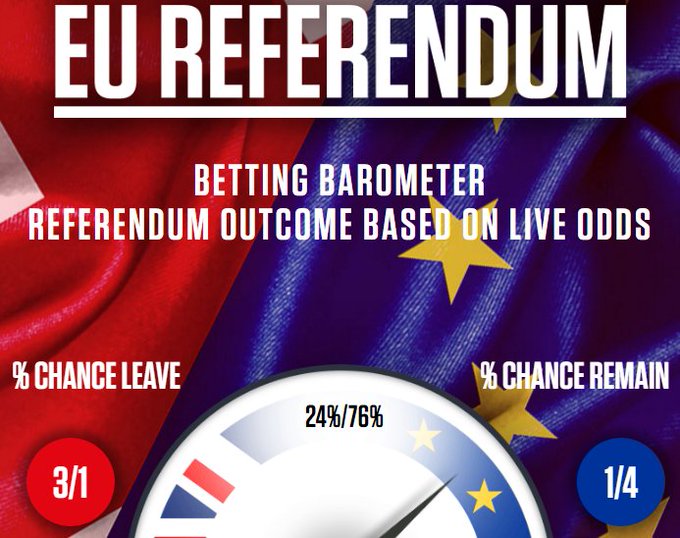
Talking to CNBC, Shaddik quantified the latest odds, which not surprisingly, put Remain's chances of success some three times greater than those of Leave: "at the moment, the odds are suggesting there is a 76 percent chance the U.K. will vote to stay in the European Union",once again caveating that this is "despite the polls still showing this is more or less a dead heat."
But is that really the case?
When one looks at the actual dynamics within the bookies, an odd divergence emerges. As Shaddick said, when looking at the underlying flows determining bookie odds, there is a very clear divergence when it comes to number of bets versus the amount of any given bet: "Although Ladbrokes has received a higher volume of bets to leave the EU, those making a punt on remain were placing higher financially larger. Shaddick revealed the average stake on a bet to remain was £450, compared to £75 on a bet to leave."

In other words, a few large bettors are skewing the bookie odds dramatically in the favor of Remain, even as the mass of bettors is betting on Leave, albeit with smaller cash amounts. Another way of putting it: a substantially outsized influence by a wealthy minority over the poor majority, just like in every other aspect of life.
Moments ago Ladbrokes confirmed as much when it pointed out that while the probability of Brexit remains at only 24%, two thirds or 62% of all bets being placed today are for Leave, the same as yesterday.

In a tweet, Ladbrokes also noted the stark divergence in bet sizes which is prompting the skew in the line, which while modestly less than what Shaddick told CNBC, still showed the average Remain vote as 5x greater than Leave:


One simple, if very cynical explanation, is the following: wealthy financial entities, including local banks and rich individuals, all of whom have an interest in keeping the UK in the EU and preserving the status quo, are placing far larger bets, even if their number is ultimately far lower than the number of people betting on Brexit. And in yet another case of reflexivity, with the public seeing that "Remain" is winning based on bookie odds, it is shifting popular sentiment toward Remain, even as the vast majority of bets is actually for Leave.
To be sure, none of this is broken down when either the investing or general public see the bookie odds: they just note 76% chance of Leave, when in reality almost two thirds of bookie bettors are voting to Leave, despite not having nearly the financial capacity to offset the bookie line as a result of the few massive bets being placed on the other side.
Of course, the actual referendum is a democratic, and popular one, not one where the rich can influence or buy votes, and as such far more important is not the skew to the Brexit or Bremain line due to outsized bets, but the actual number of bets in any direction. As such, it would be certainly useful to the British voting public to know not just the bottom line odds, but how they got to where they are, which as Ladborkes admits, it "has received a higher volume of bets to leave the EU."
Substantially larger in fact, some 62% to 38%, which also explains the dramatic divergence between the neck and neck polling and the actual Brexit odds which see Remain winning with whopping 76% odds. Because it is those 38% supports of Remain, whose outsized bets are driving not only the reported odds, but also global market sentiment.
The real question is whether that same wealthy minority which is influencing bookie odds will also be able to manipulate the final Referendum outcome in less than 24 hours.
WSJ : Italy’s 5 Star Movement Calls for Euro Referendum

Italy’s 5 Star Movement Calls for Euro Referendum

Antiestablishment party says country needs to consider alternatives to single currency

Fresh from its victory over the weekend in the Rome mayoral race, Italy’s antiestablishment 5 Star Movement has called for a national referendum on whether the country should do leave the euro.

“The euro as it exists today doesn’t work and we need to consider other alternatives such as a euro 2 or alternative currencies,” Luigi Di Maio, a party leader in the lower house of parliament, said Tuesday night on a television talk show.

Although Italian referendums can’t change international treaties—a victory for those voting to leave the euro wouldn’t have any legal standing—it would put pressure on the government to act. Italian Prime Minister Matteo Renzi and his Democratic Party have never called into question Italy’s participation in the European single currency.

In addition to winning the mayoral race in Rome, the Italian capital and the country’s largest city, the 5 Star Movement won in 18 of 19 other runoff races where it had a candidate that made it through the first round of voting. Until now the upstart political party formed seven years ago has won municipal elections only in relatively small cities and towns.

Participating in the euro has lowered Italy’s borrowing costs on its massive public debt by allowing access to much lower interest rates than the country had before the arrival of the single currency, but detractors say it has also led to inflation and doesn’t allow national policy makers to enact a monetary policy tailored to the country’s needs.

Mr. Di Maio, a vice president in the lower house of parliament and one of the 5 Star Movement’s most important leaders, didn’t call for Italy to leave the European Union, but he praised those supporting the U.K. movement to leave the bloc.

>>> US Gapping down

Gapping down
In reaction to disappointing earnings/guidance
: SITE -12.5%, CVTI -5.6%,ADBE -4%, HPQ -2.8%, FDX -1.9%, IDCC -0.9%

M&A news:TSLA -11.5% (Tesla makes offer to acquire SolarCity in exchange for Tesla common shares)


Other news: QEP -6.3% (commences 20 mln common share public offering),INO -5.4% (unfavorable commentary on Tuesday's Mad Money), UAM -4.2% (prices offering of $100 mln of Convertible Senior Notes due 2021; agrees to stock repurchase), TTM -2% (still checking), COT -1.8% (prices public common share offering on a bought deal basis), ETE -1.7% (slightly pulling back following yesterday's strength), PNFP -1.5% (Avenue Financial shareholders approve proposed merger with Pinnacle Financial Partners - merger is expected to close on or about July 1)

Analyst comments: ACAD -1.8% (downgraded to Neutral from Buy at BofA/Merrill), MCD -0.9% (downgraded to Neutral from Buy at Nomura)

>>> US Gapping up

Gapping up
In reaction to strong earnings/guidance
: WGO +7.4%, LZB +3.2%, KBH +1.2%

M&A news: SCTY +13.8% (Tesla (TSLA) makes offer to acquire SolarCity in exchange for Tesla common shares (proposal represents a value of $26.50 to $28.50 per share)

Select EU financial related names showing strength: CS +1.8%, DB +1.8%,RBS +1.5%, HSBC +1.4%

Select metals/mining stocks trading higher: SBGL +3.3%, RIO +2.1%, CLF+1.6%, FCX +1.4%, BBL +1.4%, IAG +1%, BHP +0.8%

Select solar related names showing strength after TSLA/SCTY news: VSLR+4%, FSLR +1.9%, CSIQ +1.6%

Other news: SUNW +17.2% (announces $24 mln in new commercial orders),PSTI +11.6% (presents positive data from preclinical studies of its PLX-PAD cells indicating increase regeneration of muscle tissue and reduce inflammation and cell death), PBMD +11.2% (presents initial safety data from Phase IIb Clinical Trial of IMP321), EBIO +6.4% (continuation of yesterday afternoon's strength), PRTK +2.8% (prices upsized 4.25 mln common stock offering at $13.00/share), PWE +2.1% (Penn West Energy announces Competition Act Clearance to Complete Sale of Saskatchewan Assets; expects to be fully in compliance with all of financial covenants at the end of Q2 and the remainder of 2016), AVXL +2.1% (confirms Orphan Designation for Anavex 2-73 indicated for the treatment of infantile spasms), SGY +1.8% (extending this week's move higher (up more than 50% on the week)), ECA +1% (agrees to sell its Gordondale assets in northwestern Alberta to Birchcliff Energy for a total cash consideration of CAD 625 mln)

Analyst comments: UIS +3.1% (initiated with a Buy at SunTrust), PCLN +2% (upgraded to Overweight from Equal Weight at Barclays), GFI +1.7% (upgraded to Outperform at RBC Capital Mkts on valuation and H2 catalysts)