Britain is sailing into a storm with no one at the wheel
IT WAS a troubling exchange. On live television Faisal Islam, the political editor of SkyNews, was recounting a conversation with a pro-Brexit Conservative MP. “I said to him: ‘Where’s the plan? Can we see the Brexit plan now?’ [The MP replied:] ‘There is no plan. The Leave campaign don’t have a post-Brexit plan…Number 10 should have had a plan.’” The camera cut to Anna Botting, the anchor, horror chasing across her face. For a couple of seconds they were both silent, as the point sunk in. “Don’t know what to say to that, actually,” she replied, looking down at the desk. Then she cut to a commercial break.
Sixty hours have gone by since a puffy-eyed David Cameron appeared outside 10 Downing Street and announced his resignation. The pound has tumbled. Investment decisions have been suspended; already firms talk of moving operations overseas. Britain’s EU commissioner has resigned. Sensitive political acts—the Chilcot report’s publication, decisions on a new London airport runway and the renewal of Britain’s nuclear deterrent—are looming. European leaders are shuttling about the continent meeting and discussing what to do next. Those more sympathetic to Britain are looking for signs from London of how they can usefully influence discussions. At home mounting evidence suggests a spike in racist and xenophobic attacks on immigrants. Scotland is heading for another independence referendum. Northern Ireland’s peace settlement may hang by a thread.
But at the top of British politics, a vacuum yawns wide. The phones are ringing, but no one is picking up.
Mr Cameron has said nothing since Friday morning. George Osborne, the chancellor of the exchequer, has been silent. (This afternoon I texted several of his advisers to ask whether he would make a statement before the markets open tomorrow. As I write this I have received no replies.) The prime minister’s loyalist allies in Westminster and in the media are largely mute.
Apart from ashen-faced, mumbled statements from the Vote Leave headquarters on Friday, Boris Johnson and Michael Gove have also ducked the limelight; Mr Johnson is meeting friends and allies today, June 26th, at his house near Oxford in what are believed to be talks about his impending leadership bid. Neither seems to have the foggiest as to what should happen next. Today Mr Gove’s wife committed to Facebook the hope that “clever people” might offer to “lend their advice and expertise.” And Mr Johnson’s sister, Rachel, tweeted: “Everyone keeps saying ‘we are where we are’ but nobody seems to have the slightest clue where that is.”
Ordinarily the opposition might take advantage of the vacuum: calling on the government to act, offering its own proposals, venturing a framework. But Labour has turned in on itself, a parade of shadow ministers resigning this afternoon in what seems to be a concerted coup attempt against Jeremy Corbyn, the party’s useless leader. In a meeting tomorrow Tom Watson, the party’s deputy leader, is expected to call on Mr Corbyn to quit. Of the need for stability and leadership following Thursday’s vote the party has little to say.
No one seems capable of stepping forward and offering reassurance. The Leavers, who disagreed on what Brexit should look like, do not think it is their responsibility to set out a path. They reckon that falls to Number 10 (where they have appeared in public, it has mostly been to discard the very pledges on which they won the referendum). Number 10, however, seems to have done little planning for this eventuality. It seems transfixed by the unfolding chaos; reluctant to formulate answers to the Brexiteers’ unanswered questions. As Mr Cameron reportedly told aides on June 24th when explaining his decision to resign: “Why should I do all the hard shit?”
This could go on for a while. The Conservative leadership contest will last until at least early October, perhaps longer. It may be almost as long until Labour has a new chief, and even then he or she may be a caretaker. The new prime minister could call a general election. It might be more than half a year until Britain has a leader capable of addressing the myriad crises now engulfing it.
The country does not have that kind of time. Despite arguments for patience from continental Anglophiles, including Angela Merkel, the insistence that Britain immediately invoke Article 50 of the Lisbon Treaty, launching exit negotiations that can last no longer than two years, is hardening. Soon it may be a consensus. Britain could be thrust into talks under a lame-duck leader with no clear notion of what Brexit should look like or mandate to negotiate. All against a background of intensifying economic turmoil and increasingly ugly divides on Britain's streets. The country is sailing into a storm. And no one is at the wheel.
RTRS - K&S AG SDFGn.DE SAYS IN BUSINESS UNIT SALT LOWER PRE-BUYING SALES FOR DE-ICING PRODUCTS LED TO A SIGNIFICANT VOLUME DECLINE PRIMARILY IN NORTH AMERICA
RTRS - K&S AG SDFGn.DE SAYS REASONS FOR DEVIATION ARE A SIGNIFICANTLY LOWER AVERAGE SELLING PRICE IN POTASH AND MAGNESIUM PRODUCTS BUSINESS UNIT (Q2/15: EUR 310 PER TON)
K+S SIEHT Q2 EBIT 1 VON ETWA 10 MIO € vs 107 exp....
Uber positions its China app as more than a ride-hailing service
Uber China is repositioning itself as an all-in-one solution for transportation, food and entertainment. At TechCrunch Shanghai, Uber China VP of Operations and Regional General Manager of Central China Kate Wang showed off Uber’s new vision for China — one that includes two new offerings, UberLIFE and Uber + Travel, which will roll out across China this year.
All-in-one solutions are something the Chinese market demands. That’s what WeChat, the hot messaging app that sees 697 million active users worldwide every month, is all about. In addition to messaging, the app offers voice and video calling, payments, shopping, games and more. It seems that Uber, which has been blocked on WeChat, is taking a page or several from WeChat’s playbook. It’s worth noting that WeChat is owned by Tencent, which is an investor in Uber’s biggest rival, Didi Chuxing, formerly known as Didi Kuaidi.
In an analysis of data, Uber figured out that people still look at the Uber app for an additional 90 seconds when they’re in the car, so Uber wants to give people more to do when they’re inside the app. With Uber Life, passengers will get served up a digital magazine of sorts to connect them to sports events, art events, plays and other things going on in their local cities. Uber Life is intended to help people “live a better a life” and ultimately spend more time within Uber’s app.
“This reminds us that Uber is a global service serving global citizens,” Wang said. “It is rooted in each of the cities.”
With Uber+Travel, Uber can tap into its network of partners throughout the world to offer more of a seamless travel experience. Last year, Uber filed a patent for something called Uber Travel, which recommends travel itineraries. Wang also spoke about UberPASS, a package of rides that you can buy to use in different cities.
Earlier this month, Uber said it’s on course to become China’s most popular ride service within a year. Uber first entered China about two years ago, while Didi has been operating in China for four years. Since launching in China, Uber’s footprint has expanded from ten to sixty cities. Now, Wang said, Uber’s goal is to transform itself from a player in the car-hailing market “to a commerce service that understands life and a proper life.”
Policy makers in AXJ have signaled their readiness to act if needed. We think they will act first to stabilise financial conditions before responding with fiscal and monetary easing to mitigate downside risks to growth.
* Policy makers have signaled their readiness to act: Since the results of the UK
referendum were announced on 24th June, policy makers across the region
issued statements to reassure markets that they were closely monitoring
developments, while at the same time pledging to act to stabilise markets and
stand ready to provide liquidity as needed. In this report, we detail the possible
policy responses, by country. Specifically we address the questions of (1) What is
the current policy stance? (2) What are the tools available? and (3) What will be
the likely policy response?
* Increased external headwinds to region's growth outlook: Increased uncertainty
in the external environment due to UK's vote should add to downward pressures
on growth and inflation in the region. Principal channels of transmission should
be via trade and financial channels. Moreover, as we will likely enter a period of
profound and protracted uncertainty, we think the concern will be that
headwinds to the region's growth persist longer.
Within the region, we think Hong Kong, Singapore, and Malaysia will rank as
those which are most exposed, while the economies of Thailand, Indonesia,
Taiwan, Korea and China would be moderately exposed and India and Philippines
would be least exposed on a relative basis. Taking these channels into
consideration, we expect AXJ real GDP growth to be impacted by 20bps in 2016
and 30bps in 2017 in a medium stress scenario. In a high stress scenario, in which
higher uncertainty affects business confidence even more, we would expect an
impact of 30bps in 2016 and 50bs in 2017.
* How will policy makers respond?: As it is, policy makers are already on a path of
gradual easing. As the immediate impact should be felt mostly via the financial
channel, we think near-term focus of policy makers will be to mitigate adverse
impacts on financial conditions. Specifically, we expect policy makers to introduce
liquidity injections measures such as open market operations and reserve
requirement ratio cuts. If growth headwinds persist, we expect policy makers to
respond first with fiscal easing, particularly if the capital flows situation remains
volatile; central banks may be constrained in cutting interest rates immediately
as that could add to depreciation pressures. Once the constraint of volatile
capital flows and tighter liquidity conditions is lifted, central banks should move
to cut interest rates, although we do not expect an aggressive response.
That kind of news could weight on the sector Smith & Nephew (SMIN LN) as the model is changing completly...I will be very carefull on that.
The recent ubiquity of 3D printers and innovations in prosthetic design, manufacturing and distribution offer a viable solution for the millions of people living with limb loss around the world. In the United States alone, close to 200,000 amputations are performed each year, yet, with prosthetics priced from $5,000-$50,000, having one can almost be considered a luxury.
Traditionally, the process of getting a prosthetic limb can take anywhere from weeks to months. Because prosthetics are such personal items, each one has to (or should) be custom-made or fit to the needs of the wearer. However, as 3Dprinters become more affordable, with some available for less than $200, the possibility of anyone being able to design and print a prosthetic limb in their home or local community is rapidly becoming a reality.
To fully appreciate the cost of prosthetic limbs, we can look at the economics of a family with a child in need. On average, each prosthetic has a lifespan of five years, and when considering younger children who are growing every day and are prone to breaking things, more frequent replacements are required.
Once you calculate the price of the prosthetic and its subsequent replacements, the total lifetime cost could place a considerable amount of strain on a family’s finances. Not to mention, it is also almost impossible to get insurance companies to cover that cost annually — CNN recently reported a new Medicare proposal that would limit access to limbs (currently, there are 150,000 amputees in the system).
The democratization of prosthetic design and creation through 3D printing enables millions of people around the world to reap the benefits of the newly popularized manufacturing technology. Open-source initiatives such as The Enable Community Foundation let anyone with a 3D printer customize and create a prosthetic hand. Those on the Enable team, a global network of passionate volunteers, are using 3Dprinting to give the world a helping hand, and it only costs $50.

Enable’s “Raptor Reloaded” prosthetic hand in action.
In the near future, prosthetics will be seamlessly integrated into people’s everyday lives with minimal effort. New 3D scanning and body modeling technologies from companies such asBody Labs enable people to 3D scan their limbs and have prosthetics modeled after them, making for more natural fitting and appearance.

A 3D laser scanner allows for the creation of a digital 3D model that can be used to design and 3D print a prosthetic limb.
Technological developments from innovators such as Hugh Herr of MIT have introduced new abilities, including propulsion systems, integrated sensors and sophisticated algorithms that work together to automate more natural joint movement. The development of predictive movement for prosthetics will make it so people won’t have to think hard about controlling the device. Soon, prosthetics will move with more fluidity to mimic natural movement, and people will be able to control them in part with their brains and bodies through direct natural touch input systems.
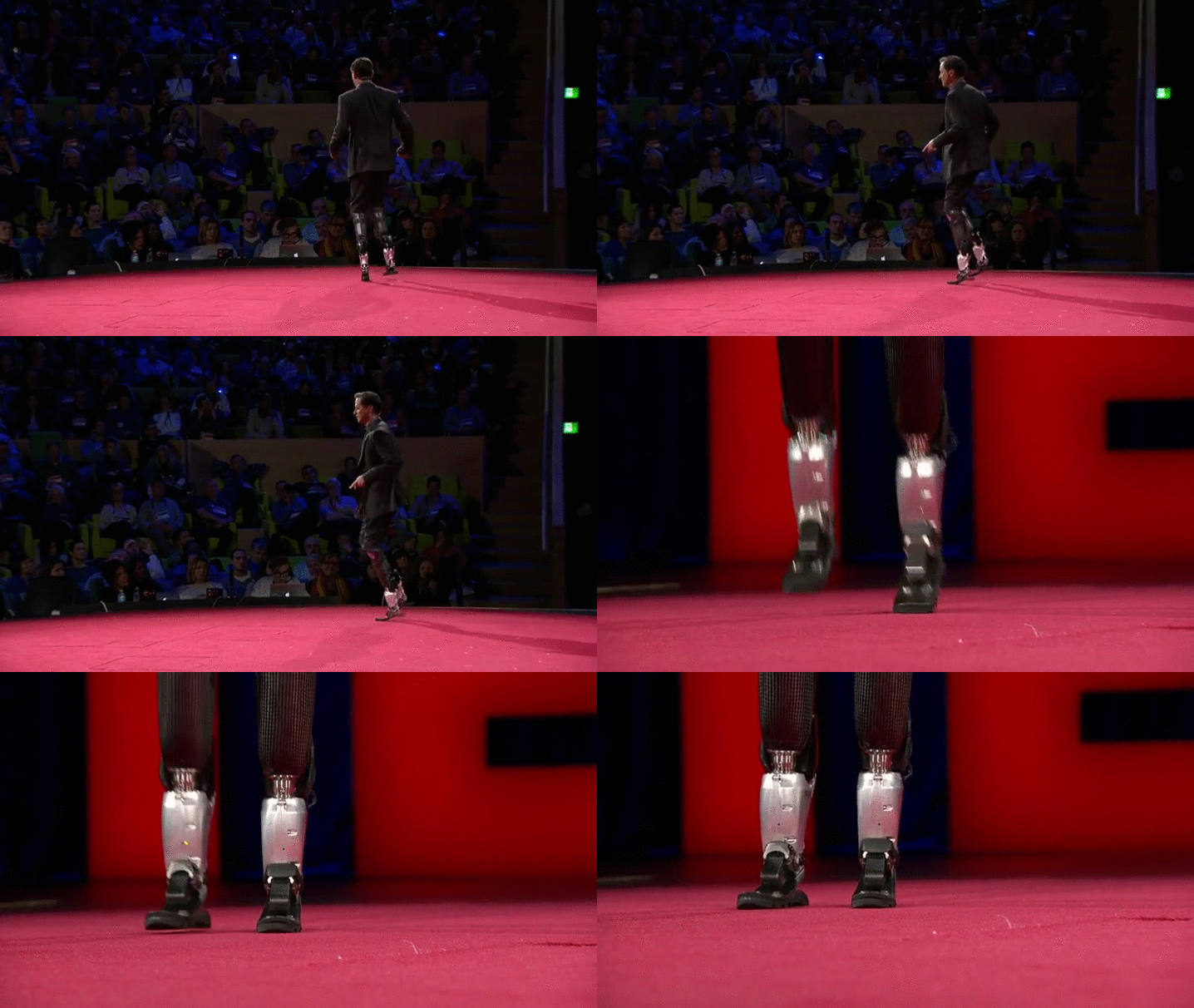
MIT’s Hugh Herr, demonstrating his prosthetic legs’ ability to simulate an in-place running gait.
Furthermore, 3D printers are becoming compatible with many new materials, like lightweight titanium, increasing durability and strength. Prosthetics will also become more comfortable by using multi-material 3D printing methods to create more natural sockets that better interface with the human body. Imagine if wearing a prosthetic felt like wearing that horribly uncomfortable pair of shoes that now lives in the back of your closet…
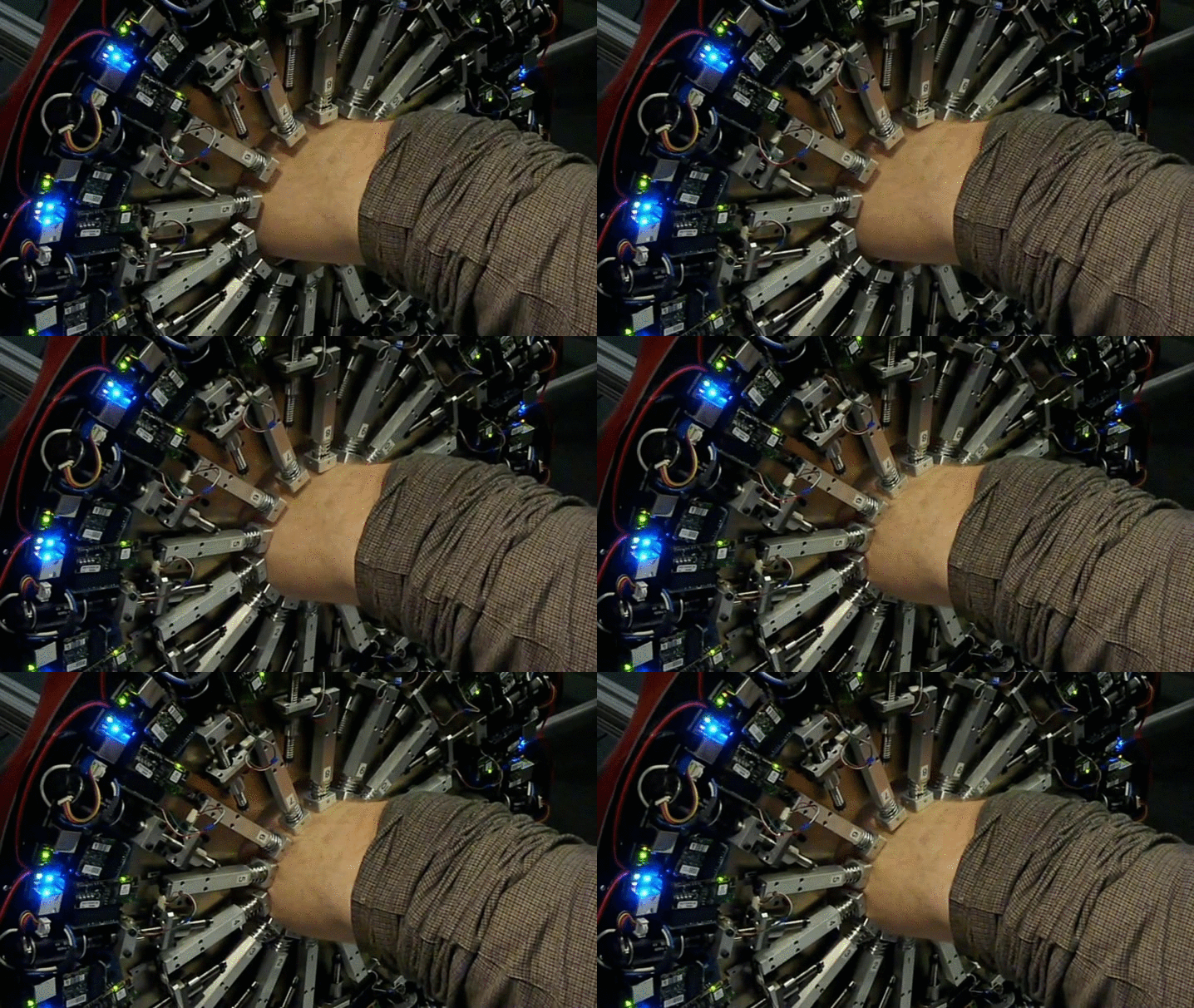
A custom-built machine within Hugh Herr’s lab that measures the “tissue compliance” of a limb. This enables the design and 3D printing of a prosthetic socket that can be both soft and hard, making for a more natural and comfortable fit.
Time is relative. A week is a longer time in politics than it is Housebuilding. We may start the week with many political uncertainties, but we remain certain that there is a fundamental shortage of housing. In this note we have recast our downside scenario to reflect the potential impact of Brexit, whilst our PT's reduce we remain bullish on the longer term fundamentals. We are not changing estimates at this time.
Time is relative. A week is a longer time in politics than it is Housebuilding. We may start the week with many political uncertainties, but we remain certain that there is a fundamental shortage of housing. In this note we have recast our downside scenario to reflect the potential impact of Brexit, whilst our PT's reduce we remain bullish on the longer term fundamentals. We are not changing estimates at this time.
RTRS - JAPAN GOVT, RULING BLOC CONSIDER EXPANDING PLANNED STIMULUS PACKAGE TO MORE THAN 10 TRLN YEN-SOURCES