FT : Bain Capital tables rival €3.6bn bid for Stada

Bain Capital tables rival €3.6bn bid for Stada
German generic drugs maker enters structured bidding process after third bid

Bain Capital has made a €3.6bn offer to buy Stada, as the bidding war between private equity firms for the German maker of generic versions of drugs such as Viagra nears its climax.

The offer from the US-based buyout group values shares in Stada at €58 a share and comes two days after its rival Advent International also submitted an offer at that level, according to people close to the situation.

The differences between the two offers could put pressure on Stada’s board to make a decision in the next 48 hours because Advent’s offer, which is fully financed and includes a dividend payment to Stada shareholders, has a Monday deadline.

The Bain Capital offer does not come with a deadline, which may be preferable to the Stada board as they continue to receive interest from other parties. However, it also does not include the dividend payment, worth roughly €0.75, and is not yet fully financed.

The bids come two weeks after the Financial Times revealed that a third private equity firm, Cinven, had kicked off the battle with a €56 a share bid. Reuters subsequently linked Bain Capital to a €58 a share offer

Stada said on Saturday that it had now entered into a structured bidding process to ensure that all bidders received the same level of information. It confirmed three bidders had been invited to conduct due diligence.

It said: “In the interest of all shareholders and stakeholders of the company, further potential for value enhancement shall be presented in this process in order to be reflected in possible offer prices. Moreover, the value of the strategic concepts of the interested parties as well as their willingness to grant protective mechanisms for stakeholders will also be examined.”

Stada and Bain declined to comment on the Bain bid.

The bidding war follows a year-long campaign to improve Stada’s governance and profitability by one of its largest shareholders, the relatively unknown German activist investor Active Ownership Capital. The buyout groups believe there is further room for cost cutting and operational improvement at the drugmaker after years of poor management, marking a rare opportunity in Europe to find a takeover asset of scale.

Moreover, there appears to be limited interest from strategic bidders for Stada, allowing the private equity firms to compete in and auction where they will not get out bid by a company already operating in the segment that can afford to pay more because of synergy possibilities.

In its pitch to speed up the auction, Advent said it would boost the company’s growth by investing in new products and commit to keeping Germany as its industrial base. It also said it had no intention to sell or split off significant parts of the business.

Stada was founded in Dresden in 1895 as a pharmacists’ co-operative and is one of the last independent manufacturers of generics and non-prescription medicines. Its board has been dominated by doctors and pharmacists, something that critics have argued has resulted in it lacking the international experience needed to expand the business.

Matthias Wiedenfels, who in May took over from Stada’s longstanding chief executive Hartmut Retzlaff, admitted at the August shareholder vote that previous actions by the company had cost it “growth, profitability and also credibility”.

Shares in Stada, which are trading at their highest levels on record, closed at €57.74, giving it a market value of €3.58bn.

CNBC - Buffett slams Wall Street 'monkeys', says hedge funds, advisors have cost

Buffett slams Wall Street 'monkeys', says hedge funds, advisors have cost clients $100 billion

Warren Buffett on Saturday devoted more than four pages of his 29-page annual shareholder letter to criticism of active managers on Wall Street, excoriating what he perceived as exorbitant fees they charge for returns that fail to live up to lofty assumptions.
Meanwhile the legendary stock picker extolled the virtues of passive investing and its advantages for regular investors. The 'Oracle of Omaha' even compared active managers to monkeys, and estimated that financial advisors, in their futile search for ways to beat the market, had cost clients $100 billion in wasted fees in the last 10 years.
"When trillions of dollars are managed by Wall Streeters charging high fees, it will usually be the managers who reap outsized profits, not the clients," stated the widely-read letter released on Saturday morning. "Both large and small investors should stick with low-cost index funds."

'The results were dismal'
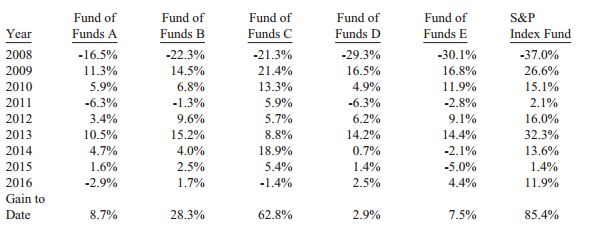
Buffett started this critical section of the letter with an update on a 10-year wager against Wall Street's active management he made nine years ago, with the proceeds going to a charity. This is how the billionaire described his original challenge:
"I publicly offered to wager $500,000 that no investment pro could select a set of at least five hedge funds – wildly-popular and high-fee investing vehicles – that would over an extended period match the performance of an unmanaged S&P-500 index fund charging only token fees. I suggested a ten-year bet and named a low-cost Vanguard S&P fund as my contender. I then sat back and waited expectantly for a parade of fund managers – who could include their own fund as one of the five – to come forth and defend their occupation. After all, these managers urged others to bet billions on their abilities. Why should they fear putting a little of their own money on the line?"
To his surprise, only one person stepped up to take the other side of the bet: Protégé Partners' Ted Seides, a 'fund of funds' manager. According to the bet, Seides selected five funds of hedge funds, whose results after fees would be averaged and compared to Buffett's selection, a Vanguard S&P index fund.
Here's what happened, according to the letter:
"The compounded annual increase to date for the index fund is 7.1%, which is a return that could easily prove typical for the stock market over time...The five funds-of-funds delivered, through 2016, an average of only 2.2%, compounded annually. That means $1 million invested in those funds would have gained $220,000. The index fund would meanwhile have gained $854,000."
In fact, none of the basket of funds came even close, according to Buffett:
"The results for their investors were dismal – really dismal. And, alas, the huge fixed fees charged by all of the funds and funds-of-funds involved – fees that were totally unwarranted by performance – were such that their managers were showered with compensation over the nine years that have passed," Buffett wrote. "As Gordon Gekko might have put it: 'Fees never sleep.'"
Investors seem to be heeding Buffett's anti-active advice, as more than $20 billion flowed out of U.S. active equity funds in January despite a rising stock market, according to Morningstar. In the last 12 months, more than half a trillion dollars have flowed into passive funds, while active funds have experienced outflows, Morningstar's data showed.
In his letter, Buffett criticized how the whole Wall Street complex is still set up to send pension funds, endowments and other investor types into under-performing active vehicles. He claimed that the wealthy investor classes are getting ripped off the most:
"In many aspects of life, indeed, wealth does command top-grade products or services. For that reason, the financial 'elites' – wealthy individuals, pension funds, college endowments and the like – have great trouble meekly signing up for a financial product or service that is available as well to people investing only a few thousand dollars. This reluctance of the rich normally prevails even though the product at issue is –on an expectancy basis – clearly the best choice. My calculation, admittedly very rough, is that the search by the elite for superior investment advice has caused it, in aggregate, to waste more than $100 billion over the past decade. Figure it out: Even a 1% fee on a few trillion dollars adds up. Of course, not every investor who put money in hedge funds ten years ago lagged S&P returns. But I believe my calculation of the aggregate shortfall is conservative."
Buffett stated that he knows of only 10 managers that he spotted early on who could outperform the S&P 500 over the long term, and they did so. He acknowledged there are more out there who may be able to beat the market, but they are the clear exception.
"Further complicating the search for the rare high-fee manager who is worth his or her pay is the fact that some investment professionals, just as some amateurs, will be lucky over short periods," Buffett wrote.
"If 1,000 managers make a market prediction at the beginning of a year, it's very likely that the calls of at least one will be correct for nine consecutive years. Of course, 1,000 monkeys would be just as likely to produce a seemingly all-wise prophet. But there would remain a difference: The lucky monkey would not find people standing in line to invest with him."
The billionaire heaped praise on Jack Bogle, the founder of the Vanguard Group who started the first index fund 40 years ago.
"If a statue is ever erected to honor the person who has done the most for American investors, the hands down choice should be Jack Bogle," the letter stated. "In his early years, Jack was frequently mocked by the investment-management industry. Today, however, he has the satisfaction of knowing that he helped millions of investors realize far better returns on their savings than they otherwise would have earned."
"He is a hero to them and to me," Buffett added.

>>> Vodafone might announce joint venture - speculative report

Vodafone might announce joint venture - speculative report
25 FEB 2017
Vodafone Group [LON:VOD], an FTSE-100 telecoms company, might disclose a cross-border joint venture, according to speculation cited by a market report in The Daily Telegraph. The newspaper did not cite a source for the rumour.
Vodafone’s share price closed 0.6p up at 202.85p in London on Friday, 24 February, giving the company a market capitalisation of GBP 53.99bn (EUR 63.73bn).

Barron's : LafargeHolcim Shares Could Rally 25%

LafargeHolcim Shares Could Rally 25%
The cement giant has been a roll, thanks to cash generation and stronger markets. Returning cash to shareholders could help, too.

LafargeHolcim ’s shares have jumped more than 50% since Barron’s wrote a positive piece on the global cement and aggregates giant a year ago (“European Cement Giant LafargeHolcim Looks Rock-Solid,” Feb. 20, 2016). The stock, now 55.65 Swiss francs ($55.24), could rally another 25% if management maintains its focus on capital discipline and keeps a pledge to return more cash to shareholders.

LafargeHolcim (ticker: LHN.Switzerland), based in Jona, Switzerland, could also get a lift from an upturn in global cement markets in 2017. HSBC forecasts cement volumes will be “meaningfully higher” this year in emerging markets, North America, and Europe, the first time since 2008-09 that all three regions could be headed in the same direction. LafargeHolcim might be a big beneficiary of a U.S. construction boom inspired by the policies of President Donald Trump.

HSBC analyst John Fraser-Andrews expects LafargeHolcim to have a free-cash-flow yield of more than 12% by 2019, up from a projected 6.6% last year. The company could have an estimated CHF1.97 billion in surplus cash in 2018-19, which could help fund a planned CHF1 billion stock buyback and special dividends, together totaling 6% of its market capitalization.

LafargeHolcim management, led by CEO Eric Olsen, has wrung synergies ahead of schedule from the 2015 merger of France’s Lafarge and Switzerland’s Holcim. The company achieved its 2016 synergy goal of CHF450 million in the third quarter, and then added another CHF100 million to the annual target.

LafargeHolcim is expected to report next week that it earned CHF1.49 billion, or CHF2.52 a share, for 2016, on revenue of CHF27.43 billion. Earnings could rise to CHF3.06 a share this year, and CHF3.88 in 2018, buttressing the case for more stock market gains.

Barron's : Nestlé Shares Could Rise by 16%

Nestlé Shares Could Rise by 16%
It’s a high-quality company that is trading cheaply because of political and economic worries in Europe.

Swiss food and beverage giant Nestlé was speedily forgiven last week for serving up a disappointing set of year-end results, as investors focused instead on its good prospects in a currently tough market.

Consumer-goods companies are no longer the investment darlings they used to be. Sharp competition from smaller, upstart players that have been able to respond quickly to changing consumer patterns has contributed to pricing pressure and driven down margins. Low inflation and weak economic growth have also taken a toll.

Nestlé (ticker: NESN.Switzerland), the sector’s biggest player by revenue—with big brands such as Nescafé, Kit Kat, Nespresso, and Maggi—has suffered setbacks beyond these more general trends. Currencies have been a particular issue. Some of its foreign earnings come from sometimes volatile emerging markets and are translated into a Swiss franc that has been very strong since the country’s central bank stopped capping its value against the euro in early 2015.

Then, in the middle of 2015, its Maggi instant noodles were banned in India—where they accounted for around a third of the company’s sales—when food-safety inspectors claimed they contained high levels of lead. Tests carried out later showed the noodles were safe. Sales resumed but left the company with the challenge of rebuilding its market share in the country.

In dealing with the sector’s structural problems, Nestlé’s U.S. rival Procter & Gamble (PG) has something of a head start, reporting better-than-expected organic growth for 2016 as it continues with a long-running restructuring plan. Meanwhile, Anglo-Dutch consumer-goods giant Unilever (UL) aims to cut costs as it seeks ways to lift margins. It has also launched a business review aimed at proving to shareholders that it was right to rebuff a $143 billion takeover bid from Kraft Heinz (KHC) last week.

In 2016, Nestlé’s sales rose 0.8% to 89.5 billion Swiss francs ($88.40 billion), slightly below consensus expectations of a 1% increase and with currency losses shaving 1.6% off the overall figure.

Its latest earnings release was the first for new CEO Mark Schneider, who took the reins in January. He used the opportunity to jettison the company’s long-term 5% to 6% organic sales growth target, which it had missed in each of the past four years. Organic sales growth for 2016 of 3.2% was below consensus forecasts of 3.4% and Nestlé’s own guidance of 3.5%—itself the product of a downgrade in October.

For 2017, the company reckons organic growth should be 2% to 4%, while trading operating profit is likely to be capped by restructuring costs. Organic sales exclude currency swings, acquisitions, and disposals.

While none of that may seem particularly encouraging, analysts were impressed by Schneider’s clear determination to shake up the company and improve profitability. It might have been the motivation behind his appointment, which surprised those who expected Nestlé to stick with its habit of placing internal candidates in the top job. Schneider previously headed German health-care company Fresenius (FRE.Germany) and should be well placed to assist Nestlé in adapting to growing consumer demand for healthier foods.

Rob Lutts, chief investment officer at Salem, Mass.–based Cabot Wealth Management, recommends that U.S. investors have a broad-based exposure to European equities and says Nestlé is a good example of the sort of stock he likes. It’s a high-quality company with strong franchises and excellent long-term earnings power that is trading cheaply because of political and economic worries in Europe.

“The challenges Europe has had over the last three years or four years have really permeated their way into everybody’s thinking about all those investments,” Lutts says.

NESTLÉ STOCK FELL by around 1% on the day its earnings were published, but it has since recovered. It now stands more than 1.5% higher than at the market close ahead of the results. It trades at a price/earnings ratio of 26.9 against estimated 2017 earnings, in line with both P&G and Unilever.

Bryan Garnier analyst Virginie Roumage rates Nestlé shares a Buy, with a CHF86 fair-value target, giving the stock upside of more than 16%. She says fourth-quarter earnings were disappointing, but adds: “This is a satisfactory performance given the increase in investments and restructuring costs related to the cost-savings program [which doubled to CHF300 million in 2016].”

Berenberg analyst James Targett isn’t quite so upbeat about the stock’s prospects, but also has it as a Buy, with a CHF82 price target. He says the company’s 2% to 4% organic growth guidance for this year reflects the sector’s uncertain pricing outlook, but he is impressed with the new CEO.

“He came across well, addressing directly the key topics for investors,” Targett says, calling it “reassuring” that he is committed “to reaccelerating organic growth, cutting costs, growing margin, and limiting financial ‘surprises’ to the market, with no plans to move Nestlé aggressively toward pharmaceuticals.” Nestlé closed Friday at CHF74.50.

WSJ : Wireless Players Tout 5G as They Await Next Smartphone Wave

Wireless Players Tout 5G as They Await Next Smartphone Wave
What to expect at the annual Mobile World Congress in Barcelona

While U.S. wireless carriers battle each other by pushing unlimited data plans riding on their vaunted 4G networks, an annual industry gathering in Barcelona next week will be looking to the future.

The more than 100,000 attendees won’t be able to walk very far without seeing or hearing about 5G, the next generation of wireless technology that is still years away, with uses not yet entirely understood.

Missing from the show is Apple Inc.—a perennial no-show—but also absent is any significant new device launch, in contrast to the past three years when Samsung Electronics Inc. used the event to introduce the latest iteration of its flagship Galaxy smartphone. Reeling from a high-profile recall last year, Samsung is planning to unveil its next flagship smartphone in late March.


In recent years, Facebook Inc. Chief Executive Mark Zuckerberg has addressed the crowd at Mobile World Congress, often playing down tension between giant internet companies and the telecom operators. This year, the highest-profile keynote speaker from Silicon Valley is Netflix Inc.’s CEO Reed Hastings, an advocate of “net neutrality” regulations at a time when the majority of mobile data traffic is video. Such regulations require broadband providers to treat all internet traffic equally; the Donald Trump administration’s new point man for telecommunications regulation, Federal Communications Commission Chairman Ajit Pai, is a critic of the rules.

While carriers tout that 5G tests are producing blazing speeds— AT&T Inc. has projected speeds of 10 to 100 times faster than typical 4G connections—the first standards for the platforms won’t likely be set until next year.

And although limited exhibitions will happen— KT Corp. has long planned to have 5G running when South Korea hosts the Winter Olympics a year from now—real 5G deployments aren’t likely until 2020.

“There will be lots of 5G talk,” said Jan Dawson, chief analyst at Jackdaw Research. “It’s mostly about marketing and positioning at this point.”

Last week, both AT&T and Verizon Communications Inc. highlighted their latest testing of 5G technology, working with equipment makers Nokia Corp. and Ericsson AB. AT&T has hit speeds of 14 gigabits per second in lab tests, and plans trials for later this year. Verizon said it would use 5G technology to deliver home broadband to test customers in 11 U.S. markets by midyear.

The positioning is important for some companies that are looking to get a better foothold in the mobile market. Intel Corp., long dependent on personal computer sales, has stressed this opportunity. At an analyst meeting earlier this month, CEO Brian Krzanich mentioned the term “5G” on 19 different occasions.


“If we don’t hit 5G now, I believe, actually over the next 18 months, we’ll not be in a leadership position,” Mr. Krzanich said.

Unlike previous network overhauls, the shift to 5G technology will bring the network closer to users. It runs on smaller antennas that can attach to lampposts rather than huge towers, shortening the distance signals are transmitted. The change will require massive infrastructure spending: Accenture estimates U.S. operators alone could spend $275 billion over seven years to implement 5G.

Aside from faster speeds, 5G technology will drive down the latency, or the speed at which two devices communicate, to allow almost instantaneous reactions. This would be crucial in uses such as the operation of driverless cars.

Cable companies in the U.S. see an opening for 5G to use their extensive wireline networks. Charter Communications Inc. CEO Tom Rutledge said on a recent conference call that it is “becoming increasingly obvious that our network is the future of communications as new standards like 5G are being developed.”

How these networks are built will also depend on who is building them at a time when many people expect consolidation in the telecom and media sectors to ramp up. For example, Verizon has shown interest in buying Charter, the Journal has reported, in a deal that might affect both companies’ approach to 5G.

“What does the world look like after the next wave of consolidation,” said Blair Levin, a former Federal Communications Commission official who headed up the agency’s 2010 National Broadband Plan. “Technology matters a lot, but the market structure is also pretty important.”

FT : Nick Train: Why I’m still holding Pearson

Nick Train: Why I’m still holding Pearson
The British Buffett disciple has acquired something of a cult following

Nick Train, one of Britain’s best-known fund managers, has acquired something of a cult following among retail investors and financial advisers in the UK.

In the three weeks after meeting Mr Train, I come across two PR executives, one asset management chief executive and several friends who confide they have invested a chunk of their personal savings in his funds.

Mr Train ranks among a small number of British fund managers who have come close to gaining household-name status due to their purist approach to investing.

The others, which include Neil Woodford and Richard Buxton, also endorse the buy-and-hold strategy advocated by Warren Buffett, the legendary investor: buy a small number of high-quality stocks and hang on to them.

Mr Train arguably takes this philosophy to an extreme.

The Oxford university history graduate, who co-founded his company in a small, unheated flat in the London district of Kensington 17 years ago, has not removed a stock from his £3.2bn UK equity fund since 2013.

The last company he dropped — Marston’s, the brewery — is not one he is comfortable discussing. His company holds around 55 companies across three funds.

Mr Train and his business partner, Michael Lindsell, admit that observers question how they fill their days, given their low portfolio turnover.

While many fund managers justify their high fees by emphasising how much time they spend meeting company executives every year, Mr Train describes such meetings as an industry “fetish” and keeps them to a minimum.

“[Meeting company management] allows the industry to say there is something they do that the ordinary investor can’t do. But the truth is that there is no correlation between access to company management and superior investment performance, there just isn’t,” he says.

Speaking from the company’s offices in St James’s Park, Mr Train says much of his time is instead spent reading, and highlights a pair of bookshelves in his conference room that he refers to as his library.

The library includes Capital in the Twenty-First Century, Thomas Piketty’s examination of wealth inequality, Lean In, Sheryl Sandberg’s feminist bestseller, and Too Big to Fail, Andrew Ross Sorkin’s depiction of the events that led to the financial crisis.

“Very, very early on, before I started applying for jobs, I had a dim understanding that this was a job where you got paid for reading the newspaper, and it just seemed not like real work. As a historian, that’s interesting,” he says.

New hires at Lindsell Train are told to read The Warren Buffett Way, Robert Hagstrom’s in-depth account of the so-called Oracle of Omaha’s career and investment approach. A special subsection of the library is dedicated to books about Mr Buffett, who Mr Train clearly reveres.

“One of our favourite Warren Buffett quotes is ‘the ideal holding period for an investment is forever’, and we are doing our level best to try and put that into practice,” he says.

“People do [question] what we do, and an answer might be we read these books. We read a prodigious amount, both about our companies but also about industries, about financial history and the career paths of other, much more successful investors than us. We want to understand the people who are really good at this and how they have done it.”

Mr Train and Mr Lindsell are clearly already good at what they do. Their investment trust, Lindsell Train, has been the best-performing trust in the UK over the past 10 years, according to Quoted Data, the research company. A £1,000 investment in the trust one decade ago would have grown to more than £7,000 today.

Lindsell Train’s funds also routinely feature in lists put forward by influential research groups and investment platforms such as Hargreaves Lansdown, Morningstar and Which Investments of the most-popular or best-performing products.

The hype around the company has helped its assets grow nearly 40 per cent last year, to £9bn — its fastest annual growth rate.
But Lindsell Train has come under pressure in recent months. Last year Mr Train’s UK equity fund was up 11 per cent, but underperformed its benchmark for the first time in five years. The company’s £2bn global equity fund also underperformed its benchmark.

Pearson, the UK-listed publishing business that used to own the Financial Times, has been a persistent thorn in the side of both funds. Last month Pearson’s shares fell 30 per cent in one day after the company issued a profit warning and signalled it would cut its dividend in 2017.

In Mr Train’s latest letter to investors, he said he was “mortified” by the heavy losses Pearson incurred last month. The Lindsell Train investment trust, which is also exposed to Pearson, was the worst-performing trust in January in price terms, figures from Quoted Data show.

Mr Lindsell hints that if the problems at Pearson continue, the company could find itself in the unusual position of being removed from the asset manager’s funds.
Mr Train seems torn over how to respond to the problems facing Pearson, and whether the company, whose share price has nearly halved over the past five years, is capable of turning things around.

“We think about that [holding] carefully,” he says. “We are pretty stubborn, but we have got to ask ourselves if this company can deliver real returns over a 20-year period. If its competitive position has changed, or there is new technology that has undermined its market position, that is when we get worried.”

Although he has far bigger stakes in other global conglomerates, such as Diageo, the distiller, Unilever, the British-Dutch consumer goods company, and Nintendo, the Japanese games company, he has held on to Pearson for nearly 10 years, and is reluctant to give up on the publisher.

“It is idle to pretend that we are satisfied with the investment return [Pearson has] not achieved for our clients over the holding period,” he says. “For very understandable reasons, it is an extremely unloved company. But the history of other companies that have made a successful transition from analogue to digital [shows that process can be] hugely rewarding for shareholders, so we’ll see.”

(ZH) Meet China's Biggest Oil Trader: At 39, He Generated $38 Billion In Revenue

Meet China's Biggest Oil Trader: At 39, He Generated $38 Billion In Revenue - http://bit.ly/2mo9eXr


Ye Jianming isn’t a name that rings many bells... yet. But, according to SCMP, it will, considering what he’s achieved so far in a country where the state firms take all. As Fortune recently wrote, when it ranked Ye #2 in its "40 Under 40" list, he runs a $42-billion-a-year oil business in China, (No. 229 on the Fortune Global 500), yet few in China know anything about the mysterious tycoon or the firm he created, CEFC.


Ye bought a collection of oil ­assets in his twenties and ­secured loans from state-owned banks to expand abroad, a privilege for a private company. CEFC has oil agreements in Kazakhstan, Qatar, Abu Dhabi, and Chad and has gone into ventures with state-owned giants to transport oil to China, making him a rare powerful private player aligned with the Chinese government.
Little else is known about Ye: as of this moment, he is the sole private entrepreneur to win a stake in an Abu Dhabi onshore oil concession (whose lifespan is 40 years) with 4%. British Petroleum and China National Petroleum Corp got 10% and 8% respectively.
Why would state giants like CNOOC and Sinopec Group tolerate that? Simple: Ye holds a “full” licence in China’s financial industry – covering insurance, brokerage, banking, trusts, commodities and asset management, alongside state-owned Citic Group and China Everbright Holdings. Yet what’s so different here from the hundreds of firms that are queuing up for an insurance license?
Well, the money helps: his empire, CEFC China Energy, has seen its revenue double to 263 billion yuan (US$38.3 billion) between 2012 and 2015, becoming the largest oil trader in China. That was before the company won a lucrative permit to import oil.
But most important and puzzling of all - according to SCMP - Ye is only 39 years old.
Ye is now venturing into Hong Kong. Last week, he announced the HK$600 million acquisition of listed Runway Global with the intention to make it a financial conglomerate. In October 2016, he paid HK$1.4 billion (US$180 million) for three floors at the Convention & Exhibition Centre in Wanchai. Before putting a price tag on Ye and Runway, one question needs to be satisfied. How did he manage all this? Or rather, who is he?
It’s a mystery.
Ye Jiangming, the 39-year-old CEO of CEFC China Energy
He calls himself Ye Jianming. Mainland media found a different name. He said he started as a forest police officer in a tiny town in Fujian. Local journalists said he was a carpenter. He told Fortune Magazine his business took off in 2006 after buying oil trader Xiamen Huahang at auction, which was once owned by smuggling king Lai Changxing. He was then only 27. He said he was funded by investors in Hong Kong and Fujian.
Domestic newspapers questioned how Xiamen Huahang, which is owned by the Fujian government, was linked to Lai’s circle and ended up in auction. It’s the same dark cloud surrounding almost every high-flying private player from China.
Yet what makes Ye different is the structure of his company; it’s that of a state firm. The company has a Communist Party Committee, a Disciplinary Committee and a Youth League. It boasts a middle management that largely consists of party members. It set up two think tanks in Hong Kong – China Energy Fund Committee that sponsors events and research advocating China’s territorial claims, and the China Institute of Culture, that pledges its support for Taiwan’s reunification with mainland China.
Add to this a Czech news report that Ye was a deputy secretary general with close associations to the People’s Liberation Army, and speculation runs wild: CEFC is a shadow state firm set up to win deals in sensitive areas; CEFC is a business of the People’s Liberation Army; or Ye is the grandson of revered Marshall Ye Jianying. Ye denied any army links.
No less puzzling is its financing, that doesn’t quite seem to match its fame and connections.
On December 15, its Hong Kong subsidiary borrowed HK$600 million from state-owned Huarong International Financial Holdings to pay for the Convention Centre office. It’s paying 7.5% interest – triple what other commercial banks charge.
On February 18, Huarong said it loaned US$45 million (HK$349 million) to CEFC to fund its US$880 million investment in the Abu Dubai oil concession. That is conditional on CEFC signing a letter of intent with the Hainan branch of the State Development Bank for a loan to pay off the difference. Huarong is charging 8% interest – plus 1% transaction fee – rising to 12% in case of extension beyond six months. That’s almost double the prevailing bank rate.
Ye is also borrowing to acquire Runway. Guotai Junan will provide HK$320 million, or 53% of the acquisition cost. There is no information on whether Ye will pledge his controlling stake in Runway for that loan.
None of these amounts are Big Money. A better question is why a company as "strong" as CEFC, has to rely on loans, which charge far greater than market interest rates, rather than choose cheaper, prevailing market rates at commercial banks.
* * *
While the question swirl, perhaps some answers can emerge in his background.
In a recent piece, Fortune profiled how over the course of just one week last fall, CEFC China Energy became Prague’s hottest investor, buying the Czech Republic’s top soccer club, Slavia Prague; a Czech publishing house; a couple of Renaissance-era historic buildings; one of the country’s oldest breweries; and biggest of all, a controlling interest in Prague’s J&T Finance Group, making CEFC the first private Chinese company to own a European bank. The company’s spending totaled $1.5 billion when all was said and done.
The shopping spree played out against a noteworthy political backdrop. The Czech Republic’s leftist government was encouraging Chinese investment. And China was launching diplomatic efforts to expand its world influence by reviving the old Silk Road trading route through Central Asia into Europe.
CEFC may be privately owned, but in Prague it was a cog in the Chinese government’s plan, and happy to be. In fact, aligning itself with the government has been central to the company's strategy to become China’s newest oil power. CEFC ranks #229 on the Global Fortune 500 list, with $42 billion in revenue in 2015, double its 2012 total.
Its global reach has continued to grow: CEFC now owns a couple thousand European gas stations, many bought from Kazakhstan's state oil company, along with a one-million-ton oil storage system in Spain and France that expands China’s connections with the world oil supply.
Behind the strategy is CEFC’s founder, Ye Jianming, who ranks at No. 2 on the Fortune 40 Under 40 list this year, thanks largely to his company's remarkable recent rise. “We closely follow the national strategies. So we‘ll map out our corporate strategy according to the national ones,” Ye told Fortune this September, in his first interview with a Western media outlet. He speaks matter-of-factly, describing CEFC’s plans the way an American CEO might on a roadshow with investors.
* * *
The 39-year-old Ye stands out as much for the intrigue around him as for his success. He bought oil assets in China while only in his twenties, rarely makes public appearances, and avoids the typical lubricants of Chinese business, alcohol and smoking. Reporters and researchers have also raised questions about about ties between Ye and CEFC and nationalistic elements of China's People's Liberation Army — connections that can confer power and prestige in China, but can make for awkward optics in the eyes of potential partners overseas.
Ye's rise illustrates in vivid terms how tightly aligned China’s government and private companies continue to be, especially when doing business offshore, and also how similar the country’s private companies can look to their state-backed competition.
Ye doesn’t seek publicity for that, he says. He feels more comfortable staying home studying Confucius or Buddhism than attending business dinners, which he avoids by sending lieutenants in his place. He has black eyes, a strong rectangular face free of wrinkles, and swept-back black hair. He speaks quietly and punctuates the end of sentences with a brief silence before a concluding, Ahh.
Ye founded CEFC in his twenties. After a brief stint with the forest police in his home southern province, Fujian, he says he bought oil assets from auction once owned by a businessman named Lai Changxing, who fled to Vancouver in 1999 to avoid arrest after authorities discovered that he ran a large smuggling ring. (Lai was eventually convicted and sentenced in China for smuggling and bribery.) Ye got the funds for the purchase from wealthy investors in Hong Kong and Fujian, a province with a reputation for producing astute businesspeople. Ye pitched to those investors an oil business that would operate alongside China’s state oil companies, in the gaps those companies left open.
At the time, China was hungry for crude, but its state-backed companies were having difficulty closing some deals abroad. The optics of China’s state-backed giants marching into a country to buy and extract oil weren’t great for central Asian politicians. This paved the way for private, under-the-radar firms like Ye’s, which can strike oil deals in Europe and the Middle East where SOEs would bring political liabilities.
CEFC has signed agreements for oil rights or done deals in Kazakhstan, Qatar, Russia, Chad, Angola, and Abu Dhabi, and gone into ventures with China’s state-owned giants to transport oil and gas back to China. CEFC doesn't have the right to sell directly in China, so it either stores the oil or sells it to the market through one of China's SOEs.
After several years of economic malaise in Europe following the 2008 global banking crisis, European energy assets started coming up for sale. “They decided to sell their refineries and gas stations," Ye says. "This wouldn’t happen in China. In China, oil exploration, refining and sales are all monopolized by the SOEs.” CEFC is building an energy storage and logistics system in Europe from its second headquarters in the Czech Republic to create an exchange between China, Europe and the Middle East. That, in turn, serves China’s ambitions to have overseas storage locations connected with world markets. The alignment with Beijing has paid off. CEFC’s won a license to import crude into China in the last year, a potentially lucrative venture. China is the world’s second-largest consumer of crude behind the U.S., but declining profits and margins at the country’s oil SOEs are increasing the pressure for reform.
* * *
CEFC says almost two thirds of its $42 billion in revenues last year came either from the agreements it has with foreign governments to oil rights, the oil and gas transportation networks it runs, or its oil storage business. Its Singapore-based oil-trading desk is also one of the biggest affiliated with a Chinese company. “The Chinese government now wants to reform, and they are inviting independent companies to play a bigger role in the industry,” says Oceana Zhou, a writer at commodities research firm Platts.
Ye’s seldom-used office in Shanghai includes traditional and modern Chinese touches: a three-foot lounging Buddha statue on his desk; an expressionist Mao painting; President Xi Jinping’s framed calligraphy from his time leading Ye's home Fujian province 15 years ago. The office also has three separate desk phones, including a clunky red phone that appears similar to a “red machine,” an encrypted phone service used by the country's largest state-owned companies to keep their conversations secure from prying foreign intelligence agencies. (The company says this phone is actually tied to CEFC’s internal executive line.)
And then there are the military connections.
CEFC’s culture emphasizes military-style regimentation and promotion. In the past, it hired former military officers as consultants and managers. CEFC’s hiring of former military brass and its Communist Party influences can be interpreted a couple different ways. In one, CEFC is a de facto tool for the state to cut deals around the world, which would make it one of many Chinese private companies expanding abroad with the help of unclear government relationships. In the second, CEFC really is a private player, but casts itself as close to the government because it's good for business.
The second explanation appears more probable, though conversations with Ye don't do much to clarify the blurry lines. Ye says CEFC may not even be an oil company in the future, and might instead focus on its fledgling investment bank division, which already has investments in the energy sector. Such a strategy would explain CEFC’s Czech investments. But those same investments were also in tandem with the government’s $4 trillion One Belt One Road foreign investment program.
“We have to look at geopolitics,” Ye says. “If one day the Czech Republic goes against China, we need to pull back our investments to rethink our strategies there.”
In late 2016, Ye also opined on the outcome of the US election: “Once Madame Hillary steps into her office, because she is anti-Russia … oil prices will be coming down,” he says. “Because Mr. Trump is pro-Russia ... if he’s elected the oil price will go up.”
So far, the latter has failed to materialize.
At times, having close links to the government has created tensions for Ye. CEFC runs a think tank called China Energy Fund Committee. One of its analysts was Dai Xu, a former senior air force colonel. Writing under the pen name Long Tao in 2011, Dai advocated using force in the South China Sea, a hot-button issue in those contested international waters, where half a dozen countries claim territorial rights.
But it is Ye’s own potential military ties that have generated the most intrigue. After CEFC’s weeklong investing spree in the Czech Republic, Czech news organizations reported finding an old biography listing Ye as deputy secretary general of an association close to the People’s Liberation Army. That group, the China Association for International Friendly Contact (CAIFC), bills itself as a forum to connect high-level military and political figures in China with those abroad. But it is essentially an influence and propaganda platform, writes Washington, D.C.-based researcher Mark Stokes of the Project 2049 Institute. Stokes says that related departments engage in political warfare, including spreading propaganda and recruiting potential intelligence sources, to serve goals including China’s ultimate aim of reunifying China and Taiwan.
A connection to this group would cast a shadow over the perception of Ye and CEFC in some countries where the company operates. But in conversation with Fortune, Ye denies having such ties. He says he was invited to become a director on CAIFC, but declined. He believes CEFC’s smaller partners in China have tried to inflate his role with the government for their own benefit, which is why his name appeared in the old biographies.
“Actually," he says, "I’ve received invitations from the People’s Congress, the People's Political Consultative Conference, associations related to foreign affairs, the institute of international relations in China….all to undertake some role or duty in their organization.” He says he declined all the invitations.Even without such ties, CEFC's close alliance with the government is likely to continue to generate concern as the company grows. China’s desire to hoard crude oil for its strategic purposes is no secret. And the fresh-faced Ye has positioned himself in the middle of China’s economic and political desires — the exact place he wants to be.
With China set to dominate the global oil market, having surpassed the US as the world's biggest importer of oil, not to mention Ye's grand ambitions to gradually roll up the financial world with Beijing's backing, keep a close eye on the low-profile 39-year old who is quietly becoming one of China's most important people.