
Apple may still be claiming that sales of its Apple Watch are “doing great,” but overall, the wearable device category is failing to grow at the rates forecasted earlier. According to a new report from eMarketer, wearables like Apple Watch and Fitbit were expected to grow more than 60 percent year-over-year from 2015 to 2016. However, the firm is now cutting that estimate down to just 25 percent growth this year.
“Smartwatches in particular,” the report said, “have failed to impress customers.”
Unlike other device categories, wearable devices have struggled to gain traction beyond early adopters. And with smartwatches, consumers struggle to find a reason to buy.
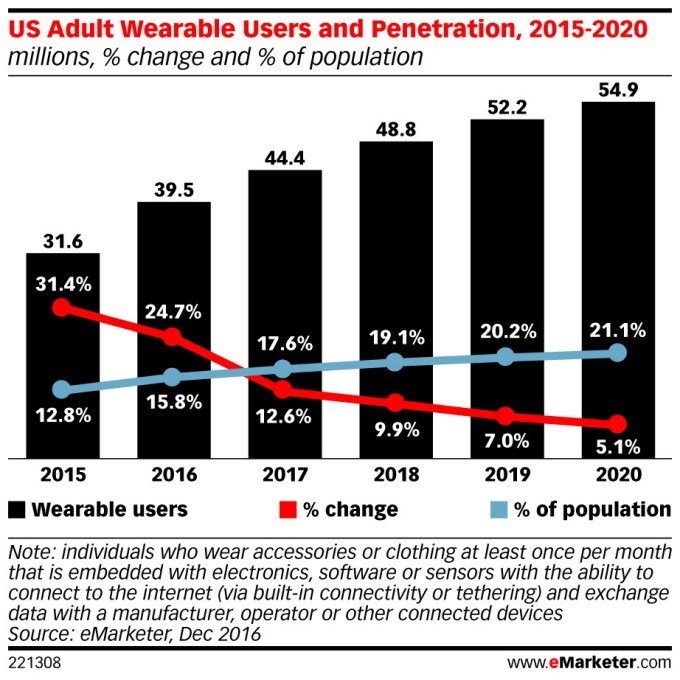
eMarketer analyst Nicole Perrin pointed out that before Apple Watch arrived on the scene, fitness trackers dominated the space. Today, fitness and health tracking remain one of the key selling points for the new crop of wearable devices, Apple Watch included.
But Apple hasn’t convinced everyone that a smartwatch is something they need, especially given the higher prices compared with standard fitness trackers for the watch’s enhanced functionality.
“Without a clear use case for smart watches—which have more features than fitness trackers, but significant overlap with smartphone functionality—the more sophisticated, expensive devices have not caught on as quickly as expected,” said Perrin in the report.
The firm estimates that 39.5 million U.S. adults will use a wearable device with internet connectivity at least once per month. However, this is much less than the 63.7 million eMarketer predicted back in October 2015. Use of wearable devices will only reach 15.8 percent of the population, and is only expected to grow to 21.1 percent by 2020.
eMarketer isn’t the only firm noting the troubles in the wearable market. This month, IDC reported smartwatch numbers were on the decline, with Apple dropping to fourth place after a 71 percent year-over-year decline in total shipments. Fitbit instead won the category with 23 percent of the market and 5.3 million units shipped in the quarter.
But even Fitbit could be struggling. New reports indicate that Fitbit’s Charge 2 may not be selling as quickly as expected, based on channel checks that found its inventory to be “particularly bloated,” along with weak demand for its Flex 2.
In addition, IDC had said this past October that smartwatch sales were tanking, with total shipments down 51.6 percent from the same time last year.
Apple had responded to IDC’s latest report not with hard numbers, but by touting the Apple Watch’s success as compared with its own prior sales. Apple CEO Tim Cook said that Apple Watch sales hit a record during the first week of holiday shopping, and that the current quarter is on track to be the best yet.
It’s not surprising that the Apple Watch sold better than before during the 2016 holidays – after all, this is the time of the year where people tend to increase their spending. Plus, Apple released a new version of its smartwatch ahead of the holiday season which likely contributed to the bump.
But that bump may not save the wearable category as a whole.
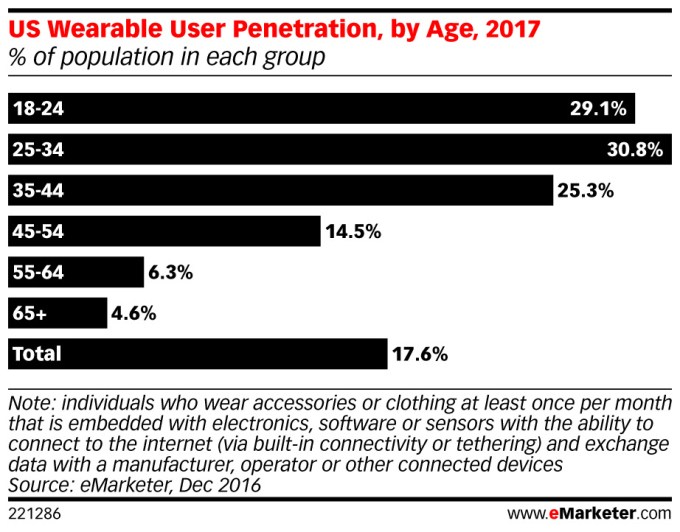
eMarketer’s new report also noted that younger people are more interested in wearables, as around 30 percent of those 18 through 34 will be wearable users in 2017 – a figure that’s 17.6 percent higher than the overall population.
Wearable early adopters also skewed male, until the shift toward fitness trackers, the report also found. By 2018, more wearable users will be female, it’s now forecasting.
Dong Energy, which hit the stock market only in the summer of this year, has lifted its profit guidance for 2016.
The Danish group said it thinks it will make an operating profit of DKr24bn (€3.23bn) to DKr25bn this year, up from a previous range of DKr20bn to DKr23bn, triggered by an agreement to sell half of Race Bank, a UK offshore wind farm project, to Macquarie. It has also been helped by a “strong performance” and cost cuts in its oil and gas division.
CEO Henrik Poulsen said:
We have had a really good year in DONG Energy and made significant strategic and operational progress in all business units. We have continued the green transformation and seen significant growth in our operating profit. All business units have delivered better than expected or to the high end of our expectations, and the divestment of 50% of the Race Bank Offshore Wind Farm has triggered the increase in our EBITDA guidance.
Gapping down:
Earnings/guidance: FINL -14.1%, SCS -9.5%, LNN -3.8%, ACN -3.3%, FDX -2.5%
Other news:
- XGTI -55.0% (prices approx. $10 mln offering of Class A and Class B Units, Class A Units were priced at $2.00)
- MACK -19.9% (stops the Phase 2 HERMIONE study of MM-302 in HER2-positive metastatic breast cancer patients who had previously been treated with trastuzumab, pertuzumab and ado-trastuzumab emtansine)
- AAAP -4.6% (FDA has issued a complete response letter regarding the NDA for Lutathera for the treatment of gastroenteropancreatic neuroendocrine tumors)
- SBGL -2.6% (still checking)
- FL -2.1% (FINL earnings read-through)
- DKS -1.2% (FINL earnings read-through)
- UPS -1.2% (FDX earnings read-through)
- TWTR -1.2% (CTO Adam Messinger to leave the company)
Analyst actions:
- NYCB -1.7% (downgraded at Raymond James, Morgan Stanley, FBR & Co following terminated merger with AF)
Early pre-market gappers
Gapping up: CALA +18.0%, INVN +16.8%, LXRX +12.6%, WGO +6.9%, BCEI +5.8%, ERJ +5.5%, GST +5.3%, CLLS +3.9%, GTE +3.1%, DEPO +2.7%, NKE +2.6%, CBD +2.6%, JCP +2.8%, SDRL +2.2%, AU +2.1%, WTI +2.0%, FRO +2.0%, STO +1.9%, MNST +1.9%, LPI +1.7%, DRYS +1.7%, AUY +1.6%, VALE +1.5%, WLL +1.5%, NBR +1.5%, QGEN +1.3%, PAYX +1.2%, BP +1.1%, TOT +1.1%.
Gapping down: XGTI -55.0%, MACK -19.9%, FINL -14.1%, SCS -9.5%, AAAP -4.6%, LNN -3.8%, ACN -3.3%, SBGL -2.6%, FDX -2.5%, FL -2.1%, EBAY -2.1%, NYCB -1.7%, CS -1.4%, MTL -1.3%, DKS -1.1%.
up:
Gapping up
Earnings/guidance: WGO +6.9%, NKE +2.6%
M&A news:
- INVN +16.8% (TDK Corporation to acquire INVN for $13.00/share in cash)
Select small cap oil & gas names seeing early bid: BCEI +5.8%, GST +5.3%, GTE +3.1%, SDRL +2.2%, WTI +2.0%, FRO +2.0%, LPI +1.7%, WLL +1.5%, NBR +1.5%
Other news:
- TINY +22% (light volume; announced a proposed strategic restructuring)
- CALA +18.0% (co and Bristol-Myers Squibb (BMY) announce a clinical trial collaboration to evaluate Bristol-Myers Squibb's Opdivo in combination with Calithera's CB-839 in patients with clear cell renal cell carcinoma)
- LXRX +12.6% (reports 'positive' top-line results in second pivotal phase 3 study for sotagliflozin in patients with type 1 diabetes; study met its primary endpoint)
- GLBS +7.9% (provided an update regarding its proposed $5 mln private placement and conversion of outstanding loans)
- ERJ +5.5% (creates a new business unit dedicated to services and support)
- TIG +3.3% (Takeda (TKPYY) exercises option to make a EUR 10 million equity investment)
- DEPO +2.7% (still checking)
- CBD +2.6% (still checking)
- JCP +2.8% (still checking)
- DRYS +1.7% (still checking)
- VALE +1.5% (co agreed with BHP Billiton Brasil Ltda. (BHP) and Samarco Mineração S/A (Samarco) a non-binding term sheet outlining the general terms and conditions for the use of Vale's Timbopeba pit)
Analyst actions:
- MNST +1.9% (upgraded to Buy from Hold at Jefferies)
- STO +1.9% (upgraded to Buy from Neutral at UBS)
- BP +1.1% (upgraded to Buy from Neutral at UBS)