WSJ : Old-Line Companies Like Wal-Mart and GM Acquire Taste for Tech Startups

Old-Line Companies Like Wal-Mart and GM Acquire Taste for Tech Startups
Silicon Valley upstarts are courted by retail, manufacturing companies seeking new growth

In late 2015, a commuter-shuttle startup caught the attention of Ford Motor Co.executive John Casesa, who runs global strategy for the auto maker. The startup, called Chariot, was growing fast and had an interesting crowdsourced reservation model, a staffer told him, suggesting a meeting.
One year and a $65 million deal later, the San Francisco van service is owned by the Detroit giant—part of an acquisition-fueled push into new areas as an uncertain and perhaps driverless future looms.
“We are in an era in our industry where M&A will be a frequently used instrument,” Mr. Casesa said.

For much of the past half-century, U.S. corporations in industries from manufacturing to retail generally eschewed Silicon Valley startups, instead choosing to build their own new products or buy established companies.
But a combination of factors—fear of seeing business disrupted, struggles to find new growth, changes that require new skills—are leading more of these companies to hunt for tech deals.
In recent months, a burst of old-line companies have swallowed tech upstarts, including Wal-Mart Stores Inc.’s $3.3 billion purchase of web-discount retailer Jet.com Inc., General Motors Co.’s more than $1 billion acquisition of self-driving tech company Cruise Automation and Unilever PLC’s $1 billion purchase of online razor seller Dollar Shave Club.
Nontech companies spent nearly $10 billion buying venture-backed U.S. startups this year, nearly double the amount last year and the highest total in at least five years, according to PitchBook.
Venture-capital investors and analysts expect a flurry of deals in 2017, particularly given that funding is harder to come by in the private and public markets.
Good software is “becoming the oxygen” for established companies, said Barry Jaruzelski, a principal at PricewaterhouseCoopers LLP who focuses on research and development and technology. “People are saying, ‘I need to acquire.’ ”
The result is that Silicon Valley conferences, networking events and office buildings are gradually being infiltrated by the old guard of retail, manufacturing, insurance and other traditional sectors.
ENLARGE

New venture-capital arms of large corporations seem to sprout up every few months, enabling their executives to mingle and hunt for partnerships and acquisitions. Entrants this year include Campbell Soup Co., Kellogg Co., JetBlue Airways Corp. and Airbus Group SE, the last two located in Silicon Valley.
Rich Wong, a partner at Accel Partners, an investor in Jet.com, said that until recently potential buyers for startups were generally confined to giants in the tech space, like Oracle Corp. and Microsoft Corp.—so much so that traditional companies in a startup’s sector didn’t come up as candidates.
Accel Partners recently counseled the founders of its invested startups to become more familiar with these older companies, an apparent gesture to the disdain startup founders often express about their corporate counterparts.
But these generally cautious corporate buyers face a dilemma: Startups typically carry high valuations that are largely a product of excitement around their growth potential. That makes them extremely expensive based on traditional metrics like revenue—and therefore inherently risky bets that can be tough for shareholders to stomach.
Wal-Mart has a market capitalization about 65 times that of what it paid for Jet.com, and it has roughly $480 billion in revenue compared with what it said was $1 billion in annualized revenue for Jet.com.
But Wal-Mart is facing ever-more competition from Amazon.com and other retailers, and executives at the company have said Jet.com will allow them to expand their e-commerce at a much faster rate.
For these older companies buying startups, “generally speaking, you are overpaying for assets right now,” said Jason Gere, a consumer-products analyst at KeyBanc Capital Markets. The deals often are a bet on the future as they try to connect with a younger generation, he said. “They’re hoping that what they’re doing is creating another avenue for growth.”

Another option is to write smaller checks, making earlier bets on young companies like Ford did with Chariot in September.
Scotts Miracle-Gro Co., the 148-year-old lawn-products company based outside Columbus, Ohio, wanted more tech-focused products and gadgets to help with lawn care, but quickly realized it would have to look outside its ranks for help, said Peter Supron, the company’s chief of staff.
“To the best of our knowledge, we don’t have an electrical engineer doing electrical engineering in the company,” he said.
After charting out the lawn-care startup landscape and many flights to Southern California—where many are located—Scotts bought two startups this month. One, called Blossom, helps make a digitally connected sprinkler system, and the other, PlantLink, makes sensors that tell gardeners when to water. Both are small acquisitions—under $10 million, Mr. Supron said—but they saved Scotts the headache of building products on its own.
“These startups can get there faster and cheaper than us,” he said.

WSJ : Nestlé Turns to New CEO to Boost Health Push

Nestlé Turns to New CEO to Boost Health Push
Health-care veteran Ulf Mark Schneider takes reins as company works to boost its medical-foods business

After decades of trying to push into healthier foods, Nestlé SA is elevating a new chief executive—plucked straight from the health-care industry—to kick its effort into higher gear.
Ulf Mark Schneider, 51 years old, takes the reins at Nestlé on Jan. 1. He spent the past 13 years heading German health-care giant Fresenius SE, which runs hospitals, makes medical equipment and supplies drugs and nutritional products.
Nestlé, the world’s largest packaged-food company by revenue, is tapping that experience as it works to reinvigorate its drive to diversify away from the slower-growing food and beverage products—like Stouffer’s frozen TV dinners, KitKat chocolate bars and Nescafé instant coffee—that have long been its mainstay.

PepsiCo Inc., General Mills Inc., Kraft Heinz Co. and others have pumped money into creating healthier products, or reformulating existing ones to make them less bad for you, with mixed results. So has Nestlé, but the company has simultaneously taken a more radical path: For years, it has also been investing in a bevy of health-care firms in an effort to profit from the intersection of food and pharmaceuticals.
ENLARGE

Nestlé, which declined to comment for this article, also declined to make Mr. Schneider available to comment.
In September, Nestlé agreed to buy a British maker of a device to treat dysphagia, a swallowing disorder. Earlier in the year, it teamed up with a U.S. biotech to develop products aimed at restoring bacterial balance in the digestive system. It is also expanding aggressively into “medical foods,” intended to help prevent, treat or manage conditions like metabolism issues, cancer and obesity.
The effort has stretched back decades—Nestlé made its first health-care-nutrition investment in 1986—but it has gained more prominence in recent years. In 2010, Nestlé promised to “be a pioneer in the new industry that we are helping to shape in the space between a fast-moving consumer-goods company and a pharma company.” It created a separate health-science division the next year and since has made a series of acquisitions aimed at beefing it up. But so far, these haven’t delivered significant sales increases.
Last year, Nestlé health-science revenue was about 2 billion Swiss francs ($1.95 billion), or just 2.25% of overall revenue. The unit absorbed Nestlé’s prior health-care-nutrition business, which had sales of 1.6 billion francs in 2009, but is distinct from the much-larger general nutrition business.
ENLARGE

Despite an array of bets in fields like oncology and depression, the health-science unit has no blockbuster products. Its biggest revenue generator is Boost, a flavored protein drink, rather than any of its disease-focused products, according to a person familiar with the matter.
Critics have said Nestlé doesn’t disclose enough about the business and its trajectory. “This is something of a black box to us,” said RBC Capital Markets analyst James Edwardes Jones.
Shares of Nestlé have declined 1.7% so far this year.
Nestlé’s elevation of a health-care veteran, in Mr. Schneider, could help. He will take direct control of Nestlé’s health-sciences and skin-health units.
His financial record at Fresenius—before becoming CEO, he was CFO of its medical-care business—also could help Nestlé win over investors long accustomed to poor communication by management and thin margins.
Nestlé recently warned it would miss its own sales-growth target for the fourth straight year.
The company’s earnings-before-interest-and-tax margin is forecast to rise by just 0.57 percentage points between fiscal 2016 and 2018, compared with estimates of 4.58% for Kraft Heinz, 2.43% for Mondelez International Inc. and 1.56% for Kellogg Co., according to Jefferies LLC.
Investors hope this will change under Mr. Schneider who at Fresenius was known for his deal making and cost-cutting. Fresenius shares rose 1,246% during his CEO tenure. He is credited with boosting revenue through geographic expansion and a number of big acquisitions. Mr. Schneider “really knows the details and can communicate and explain it all in an easy-to-understand way,” said Marcus Luttgen, a portfolio manager at Alecta Pension Insurance Mutual, which holds shares in Fresenius and Nestlé.

Mr. Schneider has been working at the company since September learning the ropes. He is the youngest pick for the top job in 50 years and the first outsider CEO since 1922.
Mr. Schneider has already been suggesting new cost-savings initiatives, according to a person familiar with the plans, and pushing to accelerate existing cost-cutting measures—like centralizing companywide purchasing.
But Mr. Schneider lacks experience dealing with food and beverages, still Nestlé’s biggest businesses. He will be stepping up to manage a company significantly bigger than his old firm, with almost twice as many markets. Nestlé has 335,000 employees and sells products in 189 countries, compared with Fresenius’s 220,000 employees and operations in 100 countries.
“Nestlé has some material structural growth problems on things like U.S. prepared meals, ice cream, coffee and confectionery that have manifested themselves in its consistent guidance misses,” said Jefferies analyst Martin Deboo. Mr. Schneider, he said, will jump-start growth only by “moving the needle on brands like Nescafé and Maggi, not by repositioning Nestlé as a health company.”

FT : Economists expect euro to fall to dollar parity in 2017

Economists expect euro to fall to dollar parity in 2017
Respondents in FT poll confident on eurozone but fear for Trump policies

The euro is on course to hit parity with the dollar for the first time in more than 14 years, helping the eurozone maintain its recovery by making exports more competitive, according to a Financial Times poll of economists.

More than two-thirds of the 28 experts polled said the dollar would attain the same value as the euro during the course of the year, buoyed by higher US interest rates, in accordance with president-elect Donald Trump’s plans to shift from monetary to fiscal stimulus.
The economists expressed relative confidence that after a year of upsets — including Mr Trump’s election and Britain’s vote to leave the EU — the eurozone would avoid major shocks.
But they also worried about Mr Trump’s policies once in office and what they saw as low-probability, high-risk, possibilities, such as a victory for the far-right Marine Le Pen in France’s presidential elections next year.
The single currency traded at $1.05 on Thursday evening — far below its 2008 peak of $1.5979. It has not fallen to $1 or below since December 2002, the year euro notes and coins were introduced.
While some EU countries, such as Italy, have cheered on the euro’s fall in value, precisely because of its impact on exports, the currency’s recent weakness and the low interest rate policy that underpins it, is much more controversial in Germany, the eurozone’s economic powerhouse.
Throughout 2016, the single currency has lost 4 per cent against the dollar, with many market participants expecting further weakness as US interest rates head upwards.
Most economists polled said the US central bank would raise rates at least twice next year after a 25 basis point increase this month.
“Higher rates in the US will raise the attractiveness of European exports and help the ECB’s goal of achieving higher inflation,” said Danae Kyriakopoulou, head of research at Omfif, a forum for central bankers. “But they risk causing problems to emerging markets with vulnerable external balances.”
By contrast with Mr Trump’s plans for a big infrastructure spending plan to boost the economy, the eurozone is likely to still rely on the European Central Bank, which the economists believed would keep to existing plans to roll out its landmark quantitative easing package.
More than three-quarters of those polled said the ECB would stick to its plan to buy €780bn in mostly government bonds to lift growth and inflation. The central bank is now buying €80bn worth of bonds a month, but, in accordance with a decision this month, will trim that figure to €60bn from March.
“The ECB is likely to play it safe, but the risk of a policy mistake has increased slightly following the December 2016 decision to scale down the pace of QE,” said Frederik Ducrozet, economist at Pictet Wealth Management.
On average, economists expected eurozone growth of 1.47 per cent and inflation of 1.26 per cent next year. Twenty-six of 28 respondents said the recovery would outlast 2017.
“The weak euro, expansionary monetary policy and the absence of fiscal consolidation will be supportive [of the eurozone’s recovery],” said Peter Bofinger, a professor at the University of Würzburg.
However, those polled acknowledged threats from the uncertain political climate and the problems of Italian banks.
“Italy is today the most fragile economy in the eurozone with low potential growth, one of the highest public debt levels, a high stock of non-performing loans and a weak banking sector,” said Laurence Boone, chief economist at Axa Group. “As well as an institutional framework which makes reforms difficult to get through.”
Highlighting another possible disruptive factor, almost 43 per cent of those polled said they expected a hard Brexit — a clean break between the UK and the EU — with just 14 per cent expecting a soft Brexit.
While most did not expect to see a win for Ms Le Pen in next year’s French election, many said if she did prevail it would weigh on the economy by fuelling the climate of uncertainty. Some said it would trigger an existential crisis for the euro.
“By raising the possibility of ‘Frexit’, Le Pen will naturally lead to an intensification of political uncertainty not just in France but across the region as a whole, and at the minimum dampen euro area investment and consumer spending in the short term,” said Chris Williamson, chief business economist at IHS Markit.
Some expressed concern over whether Mr Trump would follow through on his incendiary campaign rhetoric with policies to match. “[The impact of a Trump presidency] is ambiguous,” said John Llewellyn, a partner at Llewellyn Consulting. “The dollar’s strength would be positive for the eurozone’s economy. But protectionism, global uncertainty and financial volatility would not be.”

>>> US Gapping Up

A few European telecom/communication network names are trading higher: MBT +2.2%, ERIC +2.1%, VOD +0.7%
Select financial related names showing strength: DB +1.7%, SAN +1.2%, HSBC +0.9%, RBS +0.7%, PUK +0.5%, UBS+0.3%, CS +0.3%, ING +0.2%, BAC +0.6%
Select large pharma names are trading higher: MYL +2% (launched generic version of Janssen's Concerta tablets), SNY +1.4%, SHPG +1.4%
Metals/mining names trading higher: GFI +2.2%, MT +1.9%, AUY +1.7%, RIO +1.5%, AG +0.9%, AU +0.7%
Other news:
  • MRNS +25% (thinly traded and ticking higher after the FDA granted orphan designation for ganaxolone for the treatment of Fragile X Syndrome)
  • CO +16.1% (ticking higher; Golden Meditech Holdings enters into a sale and purchase agreement with Nanjing Yingpeng Huikang Medical Industry Investment Partnership regarding the disposal of their entire equity stake in the co which represents 65.4% equity interest in CCBC on a fully diluted basis, for total cash consideration of RMB 5.764 bln)
  • ANY +11.8% (continued strength),
  • KOOL +4% (following 35%+ move higher in Thursday)
  • ALV +2.4% (ahead of CES conference -- plans to reveal 'Learning Intelligent Vehicle')
  • IHG +2.2%, LUX +1.5%, SNN +0.9% (still checking)
  • NVDA +1.6% and AMD +1.5% (after recouping Thursday's early losses and closing near highs)
  • ICON +1.3% (Sharper Image brand to ThreeSixty Group for $100 mln in cash),
  • MBLY +1.2% (continued strength; also Mobileye N.V. and Lucid MOtors announce collaboration to enable autonomous driving capability on Lucid vehicles),
  • X +1.1% (announces third-party iron ore pellet sales agreements)
Analyst comments:
  • CEMP +5.8% (rebounding -- was upgraded to Equal-Weight from Underweight at Morgan Stanley)
  • TSLA +0.6% (named Top 2017 Pick at at Robert W. Baird)
  • YNDX +0.2% (ticking higher; initiated with a Outperform and $26 at Credit Suisse)

>>> US Gapping Down

M&A related:
  • CAB -7.1% (Cabela's & Bass Pro receive request for second request from the Federal Trade Commission relating to their pending merger)
Other news:
  • INNL -49.7% (received FDA Refusal to File letter for XARACOLL - its product candidate for postsurgical pain treatment; downgraded to Neutral from Buy at Janney; downgraded to Mkt Perform at FBR & Co; downgraded to Mkt Perform from Mkt Outperform at JMP Securities),
  • GEVO -8.5% (announces 1-for-20 reverse stock split),
  • DKS -0.2% (light volume - CAB sympathy)

(Vox.com) Brain activity is too complicated for humans to decipher. Machines can

Brain activity is too complicated for humans to decipher. Machines can decode it for us.
Why we need artificial intelligence to study our natural intelligence

Over the past several years, Jack Gallant’s neuroscience lab has produced a string of papers that sound absurd.
In 2011, the lab showed it was possible to recreate movie clips just from observing the brain activity of people watching movies. Using a computer to regenerate the images of a film just by scanning the brain of a person watching one is, in a sense, mind reading. Similarly, in 2015, Gallant’s team of scientists predicted which famous paintings people were picturing in their minds by observing the activity of their brains.
This year, the team announced in the journal Nature that they had created an “atlas” of where 10,000-plus individual words reside in the brain — just by having study participants listen to podcasts.
How did they do all this? By using machine learning tools — a type of artificial intelligence — to mine huge troves of brain data and find the patterns of brain activity that predict our perception.
The goal here isn’t to build a mind-reading machine (although it’s often confused for that). Neuroscientists aren’t interested in stealing your passwords right out of your head. Nor are they interested in your darkest secrets. The real goal is a lot bigger. By turning neuroscience into a “big data” science, and using machine learning to mine that data, Gallant and others in the field have the potential to revolutionize our understanding of the brain.
The human brain, after all, is the most complicated object we know of in the universe, and we barely understand it. The wild idea of Gallant’s lab — an idea that could lift the field of neuroscience out of its infancy — is this: Maybe we have to build machines to figure out the brain for us. The hope is if we can decipher the intensely intricate patterns of the brain, we can figure out how to fix the brain when it’s suffering from disease.

The functional MRI — the main tool we use to peer into and analyze the function of the brain and its anatomy — has only been around since the 1990s, and it gives us only a cruddy view.
To put that view into perspective, the smallest unit of brain activity an fMRI can detect is called a voxel. Usually, these voxels are smaller than a millimeter cubed. And there might be 100,000 neurons in a voxel. As University of Texas neuroscientist Tal Yarkoni put it to me, fMRI is “like flying over a city and seeing where the lights are on.”
A basic fMRI scan.
Traditional fMRI images can show where broad areas crucial to a behavior exist — for instance, you can see where we process negative emotions, or the areas that light up when we see a familiar face.
But you don’t know exactly what role that area plays in the behavior or whether other, less active areas play a crucial role as well. The brain isn’t like a Lego set, with each brick serving a specific function. It’s a mesh of activity. “Every area of the brain will have a 50 percent chance to be connected to every other area in the brain,” Gallant says.
That’s why simple experiments — to identify a “hunger” area or a “vigilance” area of the brain — can’t really yield satisfying conclusions.
“For the last 15 years, we’ve been looking at these blobs of activity and thinking that’s all the information that’s there — just these blobs,” Peter Bandettini, chief of the department on fMRI methods at the National Institute of Mental Health, told me in July. “And it turns out every nuance of the blob, every little nuance of fluctuation, contains information about what the brain is doing that we haven’t really tapped into completely yet. That’s why we need these machine learning techniques. Our eyes see the blobs, but we don’t see the patterns. The patterns are too complicated.”
Here’s an example. The traditional view of how the brain processes language is that it takes place in the left hemisphere, and two specific areas — Broca’s area and Wernicke's area — are the centers of language activity. If those areas are damaged, you can’t produce language.
But Alex Huth, a postdoc in Gallant’s Lab, recently showed that’s too simplistic an understanding. Huth wanted to know if the whole brain was involved in language comprehension.
In an experiment, he had several participants listen up to two hours of the storytelling podcast The Moth while he and colleagues recorded their brain activity in fMRI scanners. The goal was to correlate distinct areas of brain activity with hearing individual words.
That produces an enormous amount of data, more than any human can possibly deal with, Gallant says. But a computer program trained to look for patterns can find them. And the program Huth designed was able to reveal an “atlas” of where individual words “live” in the brain.

“Alex’s study showed huge parts of the brain are involved in semantic comprehension,” Gallant says. He also showed that words with similar meanings — like “poodle” and “dog” — are located near one another in the brain.
So what’s the significance of a project like this? In science, prediction is power. If scientists can predict how a dizzying flurry of brain activity translates to language comprehension, they can build a better model of how the brain works. And if they can build a working model, they can better understand what’s happening when the variables change — when the brain is sick.
What is machine learning?
“Machine learning” is a broad term that encompasses a huge array of software. In consumer tech, machine learning technology is accelerating by leaps and bounds — identifying learning how to “see” objects in photos, for instance, at near human levels. Using a machine learning technique called “deep learning,” Google’s Translate service has gone from a rudimentary (often humorously so) translation tool to a machine that can translate Hemingway in a dozen languages with a style that rivals the pros.
But on the most basic level, machine learning programs look for patterns — what’s the likelihood that X variable will correlate with Y.
Typically, machine learning programs need to be “trained” on a data set first. In training, these programs look for patterns in the data. The more training data, typically, the “smarter” and more accurate these programs become. After training, the machine learning programs are given brand new sets of data they’ve never seen before. And with those new sets of data, they can start to make predictions.
A good simple example is your email’s spam filter. Machine learning programs have scanned enough pieces of junk mail — learning the patterns of language contained within them — to know a piece of spam when they see a new email.
Machine learning can be very simple programs that just calculate mathematical regressions. (You remember those from middle school math, right? Hint: It’s about finding the slope of a line that explains the patterns of a smattering of data points.) Or it can be like Google DeepMind, which feeds off millions of data points and is the reason why Google was able to build a computer to beat a human at Go, a game so complicated that its board and pieces have more possible configurations than there are atoms in the universe.
Neuroscientists are using machine learning for several different ends. Here are the two basic ones: encoding and decoding.
With “encoding,” machine learning tries to predict the pattern of brain activity a stimulus will produce.
“Decoding” is the opposite: looking at areas of brain activity and predicting what the participants are looking at.
(Note: Neuroscientists can use machine learning on other forms of brain scans — like EEGs and MEGS — in addition to fMRI.)
Brice Kuhl, a neuroscientist at the University of Oregon, recently used decoding to reconstruct faces that participants were looking at from fMRI data alone.
The brain regions Kuhl targeted in the MRI have been long known to be related to vivid memories. “Is that region representing details of what you saw — or just [lighting up] because you were just confident in the memory?” Kuhl says. That the machine learning program could predict features of the face from the brain activity in that region suggests that’s where the information on the “details of what you saw” lives.
The top row are the original faces in Kuhl’s study. The second two rows are guesses based on the activity in two different regions of the brain. The reconstructions are far from perfect, but they do convey basic details of the original faces — information on gender, skin tone, and smile come through.
The Journal of Neuroscience
Similarly, Gallant’s experiment to predict what works of art participants were thinking about unveiled a small secret about the mind: We activate the same brain areas to remember visual features as we do when we’re seeing them.
The neuroscientists I spoke to all said that machine learning isn’t revolutionizing their field drastically yet. The big reason why is that they don’t have enough data. Brain scans take a lot of time and are very costly, and studies typically use a few dozen participants, not a few thousand.
“In the ’90s, when neuroimaging was just taking off, people were looking at category-level representation — what part of the brain is looking at faces versus words versus houses versus tools, large-scale questions,” says Avniel Ghuman, a neurodynamic researcher at the University of Pittsburgh. “Now we’re able to ask more refined questions. Like, ‘Is this memory someone is recalling right now the same thing they were thinking about 10 minutes ago?’”
This progress is “is more evolutionary than revolutionary,” he says.
Neuroscientists hope machine learning could help diagnose and treat mental disorders
To this day, psychiatrists can’t put a patient in an fMRI and determine if she has a mental disorder like schizophrenia from brain activity alone. They have to rely on clinical conversations with the patient (which has great value, no doubt). But a more machine-driven diagnostic approach could differentiate one form of the disease from another, which could have implications for treatment. To solve this, Bandettini at NIMH says neuroscientists will need to be able to access huge 10,000-subject databases of blobs — fMRI scans.
Machine learning programs could mine those data sets looking for telltale patterns of mental disorders. “You can then go back and start using this more clinically — put a person in a scanner and say, ‘Based on this biomarker that was generated by this 10,000-person database, we can now make the diagnosis of, let’s say, schizophrenia,’” he says. Efforts here are still preliminary, and have not yet yielded blockbuster results.
But with enough understanding of how the networks of the brain work with one another, it could be possible “to design more and more sophisticated kinds of interventions to fix things in the brain when they go wrong,” Dan Yamins, a computational neuroscientist at MIT, says. “It might be something like you put an implant into the brain that corrects Alzheimer’s in some way, or corrects Parkinson’s in some way.”
Machine learning could also help psychiatrists predict how an individual patient’s brain will respond to a drug treatment for depression. “Right now psychiatrists have to guess which medication is likely to be effective from a diagnostic point of view,” Yamins says. “Because what presents symptomatically is not a strong enough picture of what’s happening in the brain.”
He stressed that this may not happen until well into the future. But scientists are starting to think through these problems now. The journal NeuroImage just devoted a whole issue to papers on predicting individual brain differences and diagnoses from neuroimaging data alone.
It’s important work. Because when it comes to health care, prediction offers new paths for treatment and prevention.
Machine learning could predict epileptic seizures
With epilepsy, patients never know when a debilitating seizure will strike. “It’s a huge impairment in your life — you can’t drive a car, it’s a burden, you don’t participate in everyday life as you would,” Christian Meisel, a neuroscientist at the National Institutes of Health, tells me on a recent afternoon. “Ideally you would have a warning system.”
Treatment options for epilepsy aren’t perfect either. Some patients are medicated with anti-convulsants 24/7, but those drugs have serious side effects. And for some 20 to 30 percent of epileptics, there’s no drug that works for them.
Prediction could change the game.
If epileptics knew a seizure was imminent, they could at least get themselves to a safe place. Prediction could also change treatment options: A warning could cue a device to give a patient a fast-acting epileptic drug, or send an electrical signal to stop the seizure in its tracks.
This is an EEG — electroencephalogram — Meisel shared of an epileptic patient. “There's no seizure there,” Meisel says. “The question is, though, is this activity one hour away from a seizure, or is it more than four hours away?”
It would be very hard for a clinician to predict, “if not impossible,” he says.
But information about a coming seizure may be hidden in that flurry. To test this possibility, Meisel’s lab recently took part in a contest hosted by Kaggle, a data science community hub on the web. Kaggle provided months and years’ worth of EEG recordings on three epilepsy patients. Meisel used deep learning to analyze the data and look for patterns.
How good is it at predicting seizures based on EEG scans in the lead-up to one? “If you have a perfect system that predicts everything, you get a score of 1,” Meisel says. “If you have a random system that flips a coin, you get a 0.5. We get a 0.8 now. This means we’re not at perfect prediction. But we’re much better than random.” (That sounds great, but this approach is more theoretical than practical for now. These patients were monitored by intercranial EEG, an invasive procedure.)
Meisel is a neurological theorist, drafting models for how epileptic seizures grow from small pockets of neural activity to total debilitating storms. He says machine learning is becoming a useful tool to help him refine the theory. He can include his theory in the machine learning model and see if that makes the system more predictive or less predictive. “If it works, then my theory is right,” he says.
For machine learning to really make a difference, neuroscience will need to become a big data science
Illustration by GraphicaArtis/Getty Images
Machine learning won’t solve all the big problems in neuroscience. It may be limited by the quality of data coming in from fMRI and other brain scanning techniques. (Recall that fMRI paints a fuzzy picture of the brain, at best.) “If we had an infinite amount of imaging data, you would not get perfect prediction because those imaging procedures are very imperfect,” Gael Varoquaux, a computational scientist who has developed machine learning toolkits for neuroscientists, says.
But at the very least, the neuroscientists I spoke to were excited about machine learning because it makes for cleaner science. Machine learning combats a problem called “multiple comparison problem,” wherein researchers essentially go fishing for a statistically significant result in their data (with enough brain scans, some region is bound to “light up” somewhere). With machine learning, either your prediction about brain behavior is correct or it’s not. “Prediction,” Varoquaux says, “is something you can control.”
A big data approach also means neuroscientists may be able to start studying behavior outside the confines of the lab. “All of our traditional models of how brain activity works are based on these very artificial experimental settings,” Ghuman says. “We’re not entirely clear that it works the same way when you get to the real-world setting.” If you have enough data on brain activity (perhaps from a wearable EEG monitor) and behavior, machine learning could start to find the patterns that connect the two without the need for contrived experiments.
And there’s one last possibility for the use of machine learning in neuroscience, and it sounds like science fiction: We can use machine learning on the brain to build better machine learning programs. The biggest advance in machine learning in the past 10 years is an idea called “convolutional neural networks.” This is what Google uses to recognize objects in photos. These neural nets are based on theories in neuroscience. So as machine learning gets better at understanding the brain, it may pick up new tricks and grow smarter. Those improved machine learning programs can then be turned back on the brain, and we can learn even more about neuroscience.
(Researchers can also pull insights from machine learning programs trained to reproduce a human behavior like vision. Perhaps in learning the behavior, the program will reproduce the way the brain actually does it.)
“I don’t want people to think we’re suddenly going to get brain-reading devices; that’s not true,” Varoquaux says. “The promises are to get richer computational models to better understand the brain. I think we’re going to get there.”

(TechCrunch) 2016 and the year ahead

2016 and the year ahead
This past year was a big one for internet attacks, encryption, blackouts, speed and IoT, and 2017 is positioned to bring even more headlines for each of these. As Cloudflare prepares for the coming year, we made some predictions about what’s next for the future of the internet.
But first, let’s review what we saw as a result of the widespread use and abuse of the internet in 2016.
In both Gabon and Gambia, internet connectivity was disrupted during elections. The contested election in Gambia started with an internet blackout that lasted a short time. In Gabon, the internet shutdown lasted for days. Even as we write this, countries like DR Congo are discussing blocking specific internet services, clearly forgetting the lessons learned in these other countries.
DDoS attacks continued throughout the year, hitting websites big and small. In March, we saw weekend DDoS attacks that were peaking at 400 Gbps, and in December, we saw a new pattern of attackers treating attacks as a regular job to be performed from 9 to 5.
In addition to real DDoS, there were also empty threats from a group calling itself Armada Collective and demanding bitcoin for sites and APIs to stay online. Another group popped up to copycat the same modus operandi.
The Internet of Things became what many had warned it would become: an army of devices used for attacks. A botnet army of IoT cameras and a major attack took out DNS service provider Dyn.
Non-DDoS attacks continued apace with hacks that need WAF protection like httpoxy and ImageTragick causing disruption for unprotected sites. And TLS experienced yet another attack called DROWN.
As the web has become more encrypted, the need to optimize TLS and TCP together has become more important.
But it wasn’t all doom and gloom. IPv6 saw significant mobile traffic and suddenly felt absolutely real. Apple announced that iOS apps must support IPv6-only networks and major ISPs started prioritizing IPv6 traffic. TLS 1.3 went live to dramatically simplify and improve the security of the internet.
And the internet got a lot faster with widespread support for HTTP/2, including Server Push and WebP conversion. As the web has become more encrypted, the need to optimize TLS and TCP together has become more important and Cloudflare helped contribute to increased security with Origin CA, HTTPS Everywhere and giving protected WebSockets to everyone.
The year ahead
Our team, comprised of engineers, programmers, cryptographers and hackers, took a look into a virtual crystal ball and came up with our predictions for 2017. Here’s what we think the year ahead will have to offer.
1Tbps DDoS attacks will become the baseline for “massive attacks”
Four years ago, we illustrated a blog post about a 65Gbps DDoS with a picture of the band Massive Attack. The following year, Massive Attack were back illustrating a 300Gbps attack; as internet speeds have gone up worldwide, so have DDoS sizes. In 2016, we’ve sporadically seen 1Tbps DDoS attacks reported from various service providers. We believe that in 2017, the baseline for a massive attack will be 1Tbps (and we hope that Massive Attack’s 2016 song releases presage a 2017 album).
The internet will get faster yet again as protocols like QUIC become more prevalent
Although HTTP/2 has a large effect on web performance, it also depends on the TCP protocol for connections, which can cause performance problems on lossy networks. Google has been experimenting with a protocol called QUIC, which uses UDP instead of TCP. We expect such UDP-based web protocol experiments to continue and become mainstream.
IPv6 will become the de facto for mobile networks and IPv4-only fixed networks will be looked upon as off

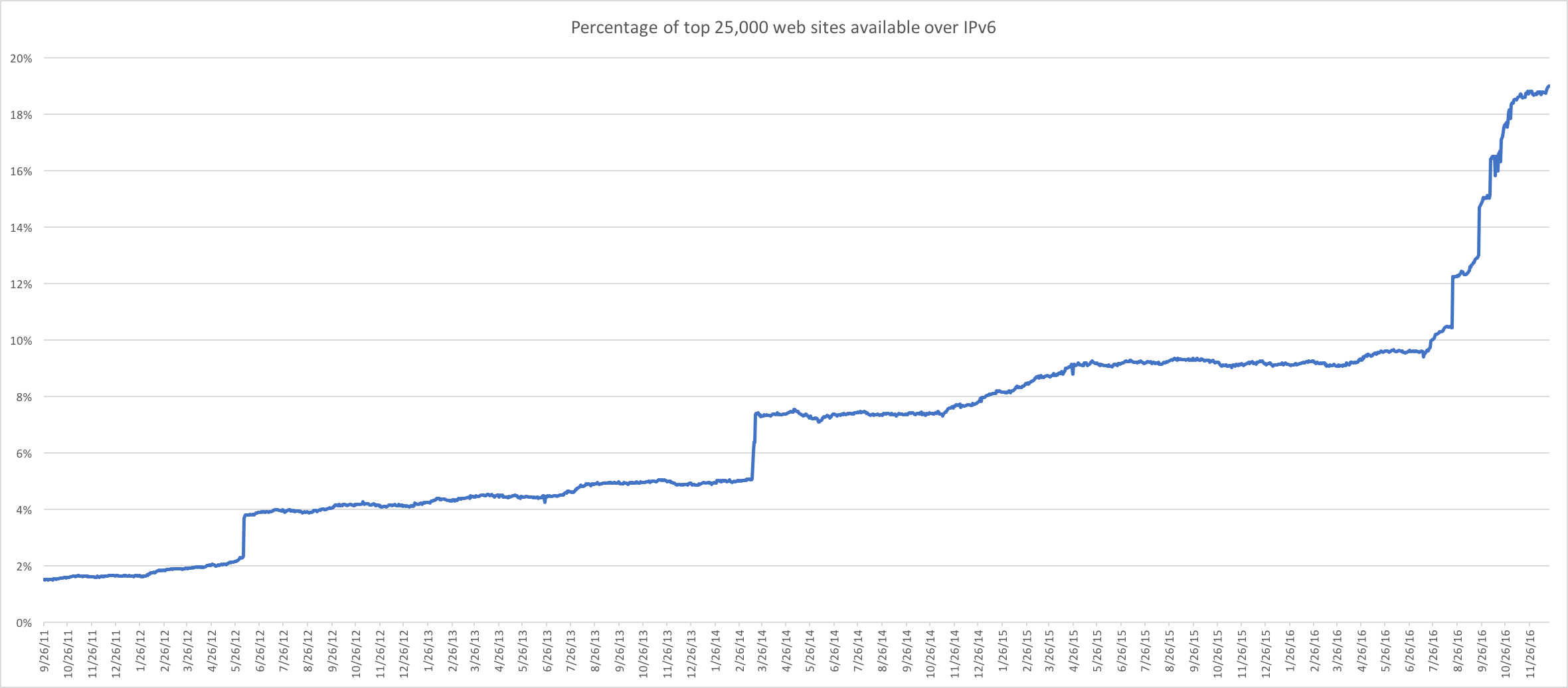
Our data says IPv6 is 27 percent faster, Facebook says 10 to 15 percent faster, LinkedIn says between 10 to 40 percent faster for mobile. Regardless of which numbers you believe, it’s clear that IPv6 provides a speed advantage. At the same time, ISPs and mobile networks are pushing for greater deployment of IPv6, and we expect IPv6 to be the norm in 2017 for all networks. Specifically for mobile networks, we believe IPv4 will be deprecated.
This chart shows the percentage of top 25,000 websites (according to Alexa) that are available over IPv6:
Based on data collected by Dan Wing.
A SHA-1 collision will be announced
Back in 1996, potential collisions in MD5 were identified, but it wasn’t until 2005 that actual collisions were demonstrated. At the time, the death of both MD5 and SHA-1 were predicted. MD5 is now seen as cryptographically useless and has even been used in malware to forge a certificate.
Since 2005, bad news about collision resistance in SHA-1 has been gathering and we predict that an actual collision will be computed in 2017.
Layer 7 attacks will rise but Layer 6 won’t be far behind
When people think of DDoS attacks, they are typically thinking of volumetric attacks against layers 3 and 4 (such as SYN floods). We believe that Layer 7 attacks (particularly against the HTTP and DNS protocols) will continue to rise in 2017 as attackers look for smart ways to knock web applications offline beyond simply volumetric attacks.
At the same time, Layer 6 attacks against the TLS protocol will make an appearance. We have already seen such attacks in the past (attacks that were designed to consume server CPU by asking for slow or complex cryptographic operations) and smart attackers will continue their search for any weakness in a web application or protocol implementation.
Mobile traffic will account for 60 percent of all internet traffic by the end of the year

The number of mobile internet users surpassed fixed internet users back in 2014, and today more than 80 percent of internet users own a smartphone, while 89 percent of their mobile time is spent using apps.

This means that acceleration and protection of APIs (that are used by apps for their internet connectivity) is essential and trends indicate that mobile traffic will be 60 percent of all internet traffic this year. This switch to mobile puts more emphasis on optimized web experiences and robust APIs than before.
The security of DNS will be taken seriously
The attack on Dyn’s DNS service showed how an often overlooked piece of the internet, the Domain Name System, is critical to its functioning. Much of the news around DDoS attacks until the Dyn attack was focused on attacks on websites and networks. With this realization that DNS is critical, its security will be taken seriously in 2017, and the protection of DNS infrastructure and servers will become a business necessity.
At the same time, the open nature of DNS will come into focus and DNSSEC will take on a greater role in securing DNS responses from attack.

(Rue89.com) Quand on demande à Google si l’Holocauste a bien eu lieu...

Quand on demande à Google si l’Holocauste a bien eu lieu...
Revoilà le déjà vieux serpent de mer. Dans la tempête des Fake News et à l’ère de la post-vérité, Google, ou plus précisément son algorithme, est accusé de mettre en avant des résultats de recherche antisémites ou négationnistes. Ce n’est pourtant pas la première fois que « Google cache des juifs... » ni que les algorithmes font preuve de racisme ou que les « intelligences artificielles » s’essaient au fascisme.

En quelques mots la clé de ces problèmes est la suivante : les algorithmes produisent une forme de déterminisme (dans la sélection des informations et les choix, nos choix, qui en découlent). Ce déterminisme s’inscrit dans un régime de vérité différent selon chaque plateforme, et quels que soient les différents régimes de vérité des différentes plateformes, tous donnent une prime à la tyrannie des agissants (cf les travaux de Dominique Cardon).

Et il n’y a qu’une seule solution pour régler ce problème de déterminisme algorithmique et de biais dans les résultats de recherche : remettre de l’entropie et de la décentralisation en créant un index indépendant du web.

Or donc à a question : « L’holocauste a-t-il eu lieu ? » posée (en anglais) à Google, apparaît en premier un site néo-nazi (Stormfront) qui publie un article clickbait intitulé : « Les 10 meilleures raisons pour lesquelles l’holocauste n’a jamais eu lieu » (vous pouvez cliquer tranquille le lien précédent pointe vers un article du Guardian qui raconte l’histoire, pas vers le site néo-nazi).

Quand on tape « nazi »...

Vous avez 2 minutes ? OK. Quand j’explique à mes étudiants de DUT infocom l’histoire des algorithmes et des outils de recherche et que nous nous interrogeons sur la notion de « pertinence » et de « popularité », je leur donne tout le temps le même exemple. Sur le moteur Google américain, la requête « nazi » donne comme premier résultat le site du parti nazi américain.

La même requête (« Nazi ») mais sur la version allemande du moteur, donnait pendant très longtemps comme premier résultat le site du musée de l’holocauste (elle donne aujourd’hui uniquement une compil des pages Wikipédia sur le nazisme).

Capture d'écran
Capture d’écran
Une même requête, un même algorithme, aucune intervention manuelle sur les résultats de recherche et pourtant deux premiers liens parfaitement antagonistes : le parti nazi américain et le site du musée de l’holocauste.

Fin de la démonstration, mes étudiants ont compris que la notion de « pertinence » était totalement subjective, que la notion de « popularité » disposait de biais culturels, historiques et législatifs (le parti nazi est légal aux Etats-Unis), et que le déterminisme algorithmique était lui-même contraint par un déterminisme culturel. Et que tout cela allait donner un cours très intéressant ; -)

« J’ai réussi à faire ce que Google disait être impossible »

Et donc aujourd’hui, quand on pose la mauvaise question (l’holocauste a-t-il eu lieu ?) à un moteur de recherche dont le business algorithmique est de donner une prime aux agissants et à la « popularité », et le parti nazi en particulier et la fachosphère en général étant passés maîtres dans l’art d’agir et de créer des polémiques, on obtient en premier une réponse qui explique les 10 bonnes raisons pour lesquelles l’holocauste n’a jamais eu lieu.

Une journaliste du Guardian a parfaitement bien résumé tout le cynisme de l’affaire (et sa résolution) dans l’article intitulé « Comment virer les sites négationnistes des premières places de Google ? En payant Google. » Eh oui. Je vous en traduis l’essentiel :

« J’ai réussi à faire ce que Google disait être impossible. Moi, une journaliste sans aucune connaissance informatique, j’ai réussi à changer l’ordre des résultats de recherche de Google sur la requête “est-ce que l’holocauste a vraiment eu lieu ?” [...] J’ai viré Stormfront du haut de la liste. J’ai inséré un résultat issu de la page Wikipédia sur l’Holocauste. J’ai remplacé un mensonge par un fait. »

Vérité à vendre

Comment ? En jouant avec la régie publicitaire Adwords et en achetant un lien payant (la page Wikipédia sur l’Holocauste) pour l’ensemble des requêtes négationnistes mentionnant l’holocauste. Coût de l’opération : entre 24 et 289 livres sterling. Business As Usual. Le journalisme a un prix.

« Si vous ne voyez plus ce lien sponsorisé c’est que je n’ai plus d’argent. Chaque clic me coûte 1,12 livres et j’ai une limite journalière de 200 livres. »

Deux cent fois la vérité par jour. Si quelqu’un a décidé d’acheter cette vérité. Pour les milliers d’autres requêtes quotidiennes sur l’Holocauste, il faudra se satisfaire des 10 meilleurs raisons pour lesquelles il n’a pas eu lieu. Et l’article de conclure en citant Danny Sullivan :

« Google a modifié son algorithme pour récompenser les résultats populaires par rapport à ceux faisant autorité. Pour la seule raison que cela rapport davantage d’argent à Google. »

Et quand ce n’est pas l’Holocauste qui n’a pas eu lieu, le Knowledge Graph de Google nous affiche un « feature snippet » qui à la question « Les noirs sont-ils intelligents ? » répond qu’il s’agit à n’en pas douter de « la race la moins intelligente » (double sic).

L’algo barre en couille

Et l’on pourrait multiplier les exemples, ces derniers temps, de ce qui est perçu comme un total barrage en couille de l’algorithme mais qui n’est que la démonstration qu’il remplit parfaitement l’office qui lui a été assigné : rapporter davantage d’argent à Google.

On en pensera ce qu’on voudra mais cette énième démonstration devrait achever de convaincre ceux qui ne l’étaient pas encore que toute notion d’éthique à l’échelle de ce plateformes est, sinon superfétatoire, à tout le moins soluble dans leur modèle économique. Ce qui revient donc au même.

Viennent ensuite deux autres problèmes distincts : celui de la confiance que nous accordons à ces résultats de recherche, et celui de la responsabilité des plateformes dans l’affichage de ce genre de résultats.

Concernant la confiance, factuellement elle est croissante (toutes les études montrent que nous accordons toujours davantage de crédits aux résultats de recherche issus du web, à concurrence directe de ceux venant de la télé, de la radio ou de la presse) et cette confiance s’éduque.

Google Bombing

C’est donc aux acteurs du monde éducatif de construire un enseignement citoyen autour de la confiance que l’on est en droit d’accorder à des résultats de recherche passés au filtre algorithmique. C’est à dire d’expliquer comment fonctionnent les algorithmes, leurs régimes de vérité, leurs logiques de viralité.

Concernant la responsabilité des plateformes, c’est une plaisanterie. Je veux dire que, à l’exception notable de la pédophilie et dans une moindre mesure de l’appel explicite au terrorisme, c’est une plaisanterie que de croire que les plateformes prendront leurs responsabilités.

Il n’est qu’à voir, à l’occasion de cette nouvelle affaire, comment a réagi Google, expliquant qu’ils ne voulaient pas faire de business avec les sites négationnistes (ce qui n’a pas empêché le journaliste du Guardian d’acheter ce mot-clé ...), et expliquant selon une ligne qui n’a pas bougé depuis les premiers Google Bombing que ces résultats de recherche ne reflétaient pas les opinions de Google et qu’il n’y avait pas d’intervention humaine dans leur algorithme, et qu’ils étaient désolés (et que bien sûr sans aucune intervention manuelle ils vont quand même nettoyer à la main les suggestions ou résultats les plus mauvais pour le Business).

Délit d’entrave à l’IVG

On a beaucoup parlé du récent débat tendant à étendre le délit d’entrave à l’IVG aux sites « pro-life » se présentant comme des sites « officiels ». Sur Rue89, Nicolas Falempin a publié un texte qui met le doigt là où ça fait mal : « Pénaliser la désinformation c’est pénaliser l’information » dans lequel il explique que si c’est aujourd’hui les sites pro-life qui sont visés, le précédent ainsi créé pourrait ouvrir la voie à toutes les dérives et à toutes les formes de censure.

Il s’agit là d’un vieux serpent de mer, au moins aussi vieux que celui sur la liberté d’expression et le 1er amendement de la constitution américaine.

Permettez-moi de vous parler (encore) de mes cours en DUT infocom. Lorsque j’aborde avec mes étudiants de 2ème année les questions de référencement, de fonctionnement des moteurs de recherche et de culture numérique, je prends systématiquement le même exemple. Celui de l’avortement.

J’explique aux étudiants que dans le cadre de la régie publicitaire de Google, aux Etats-Unis, le lobby chrétien pro-life avait investi massivement dans une campagne de liens sponsorisés contre l’avortement. Ainsi, lorsque l’on tapait une requête liée à l’interruption volontaire de grossesse, on se trouvait alors avec des liens sponsorisés uniquement en faveur du lobby pro-life, lesquels liens sponsorisés étaient agrémentés d’images absolument dégueulasses de foetus ou d’embryons après un avortement.

La tentation du marché

Suite à la polémique qui suivit, Google prit alors deux décisions : d’abord il décida d’interdire l’insertion d’images dans les liens sponsorisés, et ensuite il modifia les Guidelines desdits liens sponsorisés en interdisant d’y pratiquer toute forme de prosélytisme :

« Ainsi, la promotion du contenu suivant n’est pas autorisée :

Contenu incitant à la haine, à la violence, au harcèlement, au racisme, à l’intolérance sur la base de l’orientation sexuelle, des convictions religieuses ou politiques, ou relatif à toute organisation prônant de tels actes
Contenu susceptible de choquer ou de répugner. »
Deux hypothèses s’offrent à nous aujourd’hui.

Soit nous laissons les grandes plateformes, seules, définir elles-mêmes les règles, et le risque - déjà largement avéré et observé - est que le « code » l’emporte définitivement sur la « loi ». Cette solution est naturellement extrêmement dangereuse car la tentation du marché (pour lesdites plateformes) supplantera toujours les questionnements éthiques et sociétaux (cf toute la première partie de ce billet sur la question de l’holocauste).
Soit le législateur intervient pour dire, non pas ce que les plateformes doivent faire, mais le cadre dans lequel elles peuvent le faire. C’est la raison pour laquelle je suis plutôt favorable à l’extension du délit d’entrave à l’IVG aux sites web tout en restant un farouche défenseur de la liberté d’expression.
Tromperie explicite

Je vous explique. Ce qui - à mes yeux - serait une forme de censure inacceptable serait d’interdire, au nom d’une quelconque « morale », à certains sites d’exister et d’être référencés. Si cela devait advenir alors Nicolas Falempin aurait raison d’indiquer que « pénaliser la désinformation c’est pénaliser l’information ».

Mais ce que vise cet amendement est - me semble-t-il - différent : il ne s’agit pas d’interdire une opinion mais de pénaliser ce que je qualifierai de « tromperie explicite », c’est à dire que des sites religieux pro-life se fassent passer pour des sites d’informations « officiels » sur la question de l’avortement. Et là encore, dans le champ de la santé publique, il ne s’agit que d’accompagner juridiquement des décisions qui ont déjà été prises par le moteur de recherche à l’encontre d’annonceurs qui avaient diffusé du contenu « trompeur, factuellement incorrect et imprécis. »

Cette législation n’invente donc rien, elle accompagne une réalité déjà en place. Mais elle inscrit aussi cette réalité dans le droit et ne la laisse pas à la seule discrétion des règles actionnariales qui régissent les grandes plateformes. Elle offre ainsi un recours et une garantie supplémentaire aux victimes de ces sites de désinformation, mais aussi, et c’est là l’essentiel me semble-t-il, aux associations ou aux organismes d’état en charge de repérer et de dénoncer ces sites de désinformation.

Il faut créer un index indépendant du web

Enfin, si son grand mérite est d’acter que des sites explicitement trompeurs puissent être juridiquement sanctionnables, son plus grand échec est de ne rien prévoir à l’encontre des plateformes qui affichent ces sites au même niveau que ceux du planning familial. Qu’un algorithme sur le mot-clé IVG soit incapable d’établir une différence de traitement entre un site du lobby pro-life et un site du planning familial est un problème équivalent au fait qu’un article du parti nazi américain puisse apparaître comme premier résultat de recherche à une question sur l’existence de l’holocauste.

Et donc on boucle sur la première partie de ce billet. Sans trouver de solution ? Si, la solution existe. Au risque de me répéter :

« Les algorithmes produisent une forme de déterminisme (dans la sélection des informations et les choix, nos choix, qui en découlent). Ce déterminisme s’inscrit dans un régime de vérité différent selon chaque plateforme, et quels que soient les différents régimes de vérité des différentes plateformes, tous donnent une prime à la tyrannie des agissants. Et il n’y a qu’une seule solution pour régler ce problème de déterminisme algorithmique et de biais dans les résultats de recherche : remettre de l’entropie et de la décentralisation en créant un index indépendant du web. »

Faute d’y parvenir, il ne nous restera qu’à tondre les algorithmes à la Libération.

Femmes françaises accusées de collaboration tondues lors de l'épuration à la Libération en France, Paris, été 1944
Femmes françaises accusées de collaboration tondues lors de l’épuration à la Libération en France, Paris, été 1944 - CC-BY-SA 3.0
C’est important et urgent

Cet index indépendant du web n’est pas une lubie de chercheur. Ni une nouvelle utopie solutionniste. L’enjeu est bien plus important et urgent qu’il n’y paraît. Pour s’en convaincre il faut relire les 14 points caractéristiques du fascisme selon Umberto Eco. Parmi lesquels ceux-ci :

1. Appeal to social frustration. « One of the most typical features of the historical fascism was the appeal to a frustrated middle class, a class suffering from an economic crisis or feelings of political humiliation, and frightened by the pressure of lower social groups. »

2. The obsession with a plot. « The followers must feel besieged. The easiest way to solve the plot is the appeal to xenophobia. »

3. Selective populism. « There is in our future a TV or Internet populism, in which the emotional response of a selected group of citizens can be presented and accepted as the Voice of the People. »

4. Ur-Fascism speaks Newspeak. « All the Nazi or Fascist schoolbooks made use of an impoverished vocabulary, and an elementary syntax, in order to limit the instruments for complex and critical reasoning. »

« Appel à la frustration sociale »,
« obsession du complot »,
« populisme sélectif »,
« novlangue appauvrie et à la syntaxe élémentaire ».
Ces quatre traits sont aussi (je n’ai pas dit uniquement, j’ai dit « aussi »), ces quatre traits sont aussi les traits les plus saillants de la viralité, ceux dont le déterminisme algorithmique se satisfait le plus, ceux capables de faire du déterminisme algorithmique une arme de destruction matheuse (Weapon of Maths Destruction).

Une forme de totalitarisme

Et puis bien sûr il faut aussi et surtout relire Hannah Arendt pour se souvenir que le totalitarisme commence très exactement lorsque la prévisibilité ou la prédictibilité supposée des faits permet de les remplacer par la construction d’une fiction disposant d’une adhésion et d’une « confiance » supérieure à l’expérience sensible.

« La prétention de tout expliquer… promet l’explication totale du passé, la connaissance totale du présent et la prévision certaine de l’avenir. [...] Dans leur prétention de tout expliquer, les idéologies ont tendance à ne pas rendre compte de ce qui est, de ce qui naît et meurt… La pensée idéologique s’affranchit de toute expérience dont elle ne peut rien apprendre de nouveau, même s’il s’agit de quelque chose qui vient de se produire. Dès lors, la pensée idéologique s’émancipe de la réalité que nous percevons [...] et affirme l’existence d’une réalité plus vraie qui se dissimule derrière les choses sensibles. »

Jusqu’à parvenir à ce point où l’idéologie va totalement couper « les masses » du « monde réel » :

« [Elles] ne croient à rien de visible, à la réalité de leur propre expérience. Elles se laissent convaincre, non par les faits, même inventés, mais seulement par la cohérence du système dont ils font partie. »

Vous avez dit... post-vérité ?

Oui il y a un vrai risque de bascule dans une forme de totalitarisme. Oui « les plateformes » et « leurs algorithmes » sont, dans l’analyse de cette possible bascule, un horizon qu’il faut saisir et analyser. Non il ne s’agit pas d’un horizon lointain mais d’une dystopie possible pour 2017.

Oui j’espère que cette idée d’un index indépendant du web, que je pense être la seule solution possible et raisonnable, fera des émules et débouchera sur des états généraux du web indépendant. Rapidement.