FT : Profit warnings from UK companies forecast to rise in 2017

Profit warnings from UK companies forecast to rise in 2017
Report by EY suggests 2016 figures ‘flattered to deceive’

Profit warnings by UK listed companies tailed off towards the end of 2016, reflecting relative economic stability after the Brexit vote, but 2017 could be much tougher for British groups, according to a report by EY, the accounting firm.

Quoted British companies issued 73 profit warnings in the last three months of 2016 compared with 100 during the same period in 2015, said the EY report.

With Britons having voted in a referendum in June last year to leave the EU, the number of warnings in the second half of 2016 “reflects relative stability in both the UK and global economy”, added EY.

Alan Hudson, EY’s head of restructuring in the UK, said: “The headline numbers show the UK economy weathering the initial impact of the Brexit vote remarkably well.” However, he added: “We expect 2017 to be . . . much tougher.”

Since the start of 2017 there has already been a marked uptick in companies prompting analysts to rein in earnings forecasts.

These include BT, Pearson, Next, Bovis Homes, Premier Foods and Lamprell. “There have been 21 profit warnings in the first 25 days of January this year compared with 15 in the first 25 days of 2016,” said EY.

The fall-off in profit warnings in the last quarter of 2016 compared with the corresponding period in 2015 “flattered to deceive”, said Mr Hudson.

Warnings at the end of 2015 jumped following the collapse in the oil price. The overall figures in 2016 also masked a stark divergence between midsized companies in the FTSE 250 and the 100 largest companies in the FTSE 100.

The number of profit warnings from FTSE 100 companies fell from 16 in the first half of 2016 to seven in the second half. By contrast, the number of warnings by FTSE 250 companies rose from 23 in the first half to 31 in the second half.

According to EY, the fourth quarter of 2016 marked a three-year high in the number of warnings from midsized FTSE 250 companies.

In part, this was because of rising costs, as a result of sterling’s weakness against other currencies since the Brexit referendum.

Many companies are struggling with uncertainty over pricing, and 27 per cent of the profit warnings by UK companies in the fourth quarter of 2016 were linked to cancellations and contract delays. None of these pressures are easing off, said EY.

Retailers and support services companies issued more profit warnings than groups in other sectors last year.

There was a sharp rise in repeat warnings. Half of the companies that issued warnings during the fourth quarter of 2016 had done so before last year.

Essentra, Cobham and Mitie have issued several warnings in the past year.

(TechCrunch) Apple has allegedly begun removing Iranian iOS apps from the App st

Apple has allegedly begun removing Iranian iOS apps from the App store

Reports coming out of Iran suggest that Apple has allegedly started removing iOS apps originating from the country’s startups and developers. Prior to this, Apple had, in a limited manner, opened up its App Store to Iranians in September 2016 and appeared to be gradually lifting some of the limitations, periodically, since then.

According to credible tech news site Techrasa, the biggest Iranian e-commerce service, Digikala, which has millions of users, had its app removed from the App Store just a few days ago.

While there is no official App Store available for the territory of Iran, many companies registered their apps as being outside of Iran to be able to get onto the store.

Digikala uses the Shaparak payment system which is completely isolated from international systems, so would in theory not contravene Apple’s T&Cs.

In addition, several banks in Iran have apps for the iOS platform which are often side-loaded onto phones.

Iranians are ‘gadget-mad’, with an estimated 40M smartphones in the country, of which there are an estimated 6M iPhones. The population is around 82 million, with an average age of under 30 years old. Reportedly, around 100,000 iPhones are smuggled into the country every month. Obviously this leads to an equally large market for after-sale services and accessories. In other words, if Apple could fully engage with the market, they would find it a highly lucrative one.

However the Iranian Transactions and Sanctions Regulations issued by the U.S. Department of the Treasury puts blocks on this market. According to Techrasa, Apple has sent the following to Iranian startups attempting to upload apps:

“Unfortunately, there is no App Store available for the territory of Iran. Additionally, apps facilitating transactions for businesses or entities based in Iran may not comply with the Iranian Transactions Sanctions Regulations (31CFR Part 560) when hosted on the App Store. For these reasons, we are unable to accept your application at this time. We encourage you to resubmit your application once international trade laws are revised to allow this functionality.”

TechCrunch has reached out to Apple for comment and will update this post if we get a response.

>>> Market Review – Risk/Reward (Real Inv. Advice)

Market Review – Risk/Reward
Since the November election of Donald Trump, the investing landscape has gone through a dramatic change of expectations with respect to economic growth, market valuations and particularly inflation. As I noted two weeks ago, there is currently “extreme positioning” in many areas which have historically suggested unhappy endings in the markets. To wit:
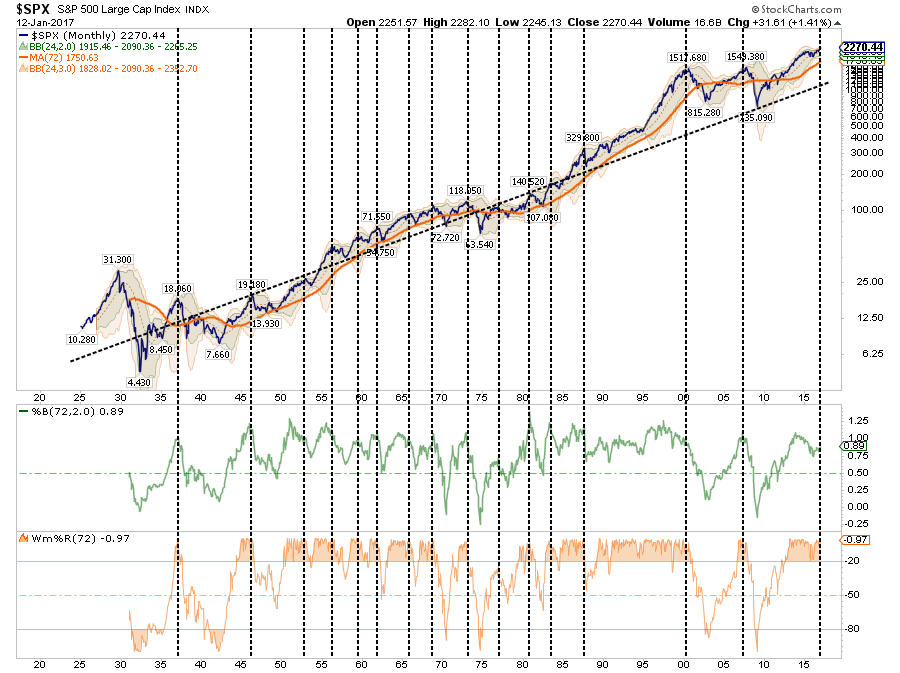
Much like a ‘rubber band,’ prices can only be stretched so far before having to be relaxed to provide the ability to be stretched again.
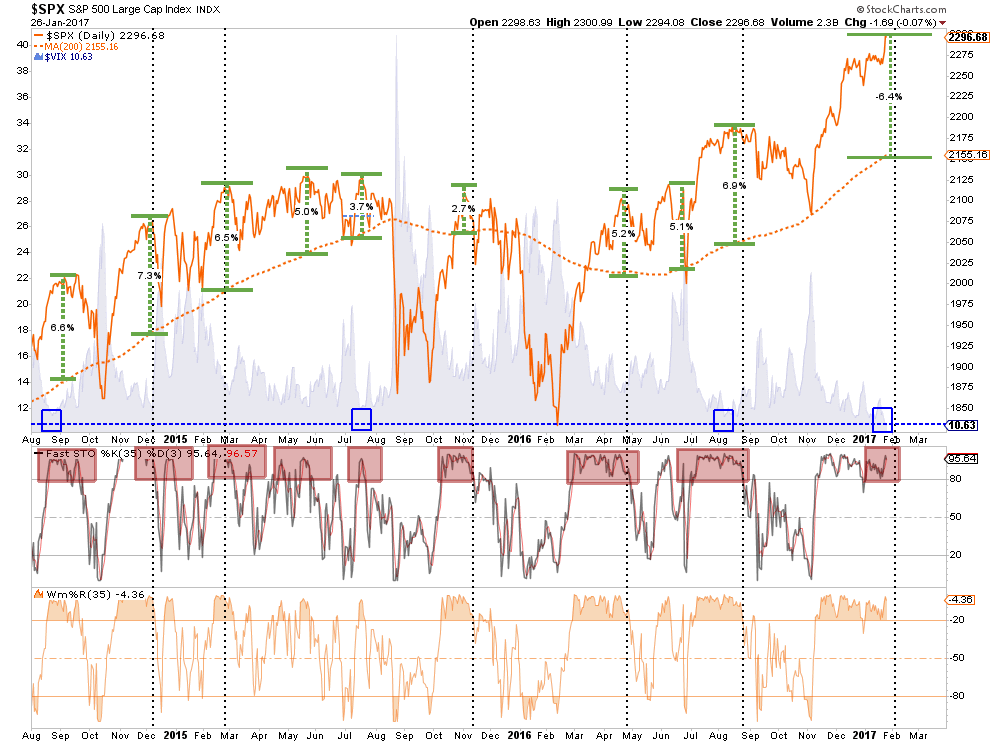
The chart below shows the long-term trend in prices has compared to its underlying growth trend. The vertical dashed lines show the points where extreme overbought, extended conditions combined with extreme deviations in prices led to a mean-reverting event.”
We can also witness the rather extreme extension of prices above the 200-dma. Such extensions, which are always combined with extreme overbought conditions, have typically not lasted long and have been a good indication to take profits in the short-term. This provides some opportunity to invest capital following a correction to some level of support.

Buy The Dip? Probably.
HedgEye had a good note on why the market keeps going up against what we would deem to be rational behavior:
“How does the rate of change of volatility (VIX) affect what’s getting “expensive” and “cheap”?
I think about that in terms of the volatility of volatility. It’s something you can readily measure and map with futures and options data.
Looking at the S&P 500’s (SPY) realized volatility, for example:
  1. 30-day realized volatility has been smashed to 6.6%
  2. But, at 8.7%, implied volatility is trading at +29.2% premium
  3. On a TTM z-score that implied volatility premium is +0.44x”
“So that keeps telling me that the highest probability outcome remains for lower-highs and lower-lows in VIX.
And that keeps happening in a US Equity market that is often called “expensive” (it is), but doesn’t get cheaper. Maybe someone from the orthodoxy of macro “valuation” experts can chime in on why this is happening.
I think it’s because consensus continues to position for a correction that would be deemed “rational”, as opposed to buying all dips in an irrationally profitable position that’s been complimented by prevailing growth and inflation conditions.
Can the U.S. stock market get more expensive? Absolutely.”
A “buyable correction” would suggest a correction back to recent support levels that keep the overall “bullish trend” intact.
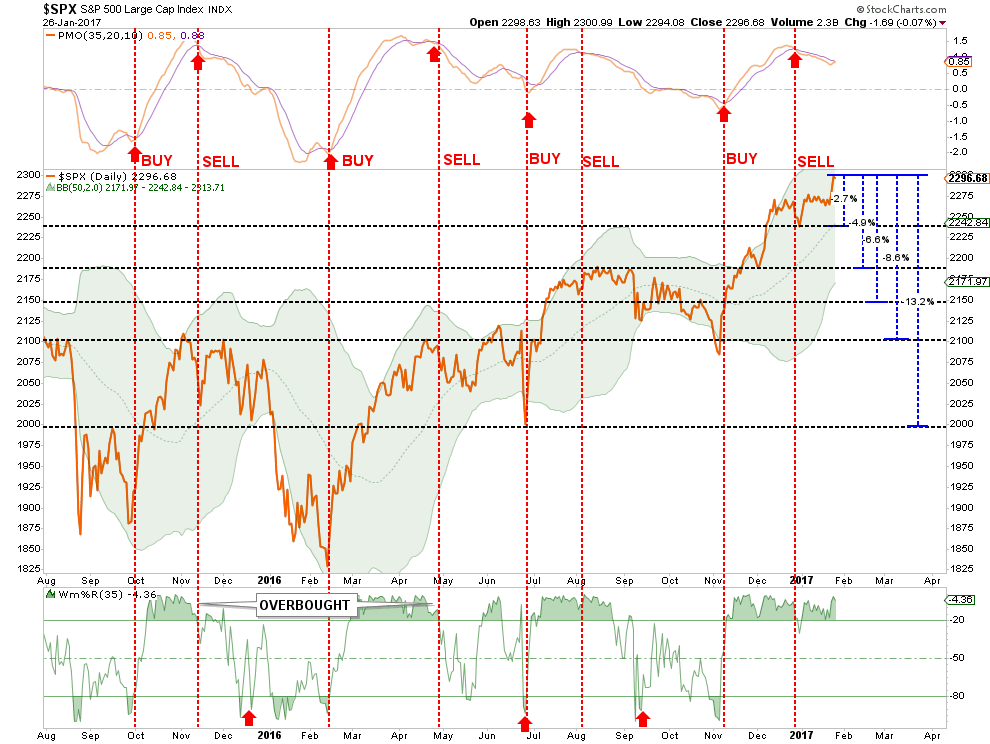
The chart below shows the recent advance of the market has gotten to extremely overbought conditions on a short-term basis and the ‘sell signal’ noted at the top of the chart, combined with the extreme overbought condition at the bottom, suggest a potential correction could take the market back to 2200. Also, note the negative divergence of the PMO oscillator despite the advance in the market.
While such a correction would be relatively minor in the short-term, it would also violate the bullish uptrend that has held since the 2016 lows.
However, putting this into an actual loss perspective, the following chart details specific support levels back to the psychological level of 2000. A violation of the 2000 level and we are going to start discussing the potential for a more severe market correction.
A violation of initial support level sets up corrections of 4.9%, 6.6%, 8.6% and 13.2% from the recent highs. With bullishness running at highs, and cash allocations at lows, the risk of a short-term reversal is high.
However, I am certainly not discounting the short-term ability for the markets to move higher as discussed in “2400 or Bust!.” This is particularly the case if fiscal policy is actually implemented, earnings improve more than expected or additional monetary policy is introduced. But it is the risk of loss that currently outweighs the reward.
However, there is another more extreme view that was put out by Matrix Trade yesterday:
“For the last seven years, we have tracked both the DJIA and SPX with very similar bull markets in both 1929 and its copy 1987 {made famous by Paul Tudor Jones using very similar technology for arguably one of the greatest trades of all time}. The US markets have now entered the last but most aggressive phase of the uptrend where sentiment takes over and where perma-bears give up all hope. They are now finally right in principle but not timing nor extent”
“We had wondered what would trigger such aggressive strength and volatility… until November 9th, 2016 when Donald Trump was elected. The subsequent change in the market dynamic not only provides the reasons for this move but also provides a very clear date from which to countdown very similar blowouts. As we have target areas for both percentage and a timeline to count up or down and indeed different indices to compare we will continue to monitor the price action exactly in line with these famous historic blowouts and crashes. Good Luck !”
Like a dealer at a poker table enticing players into a game:
“Step right up, place your bets and take your chances.”

Another Reason Not To Sell Bonds…Yet
As I penned last weekend:
“If the market corrects, OR the economy hits a speed bump, OR something happens in the Eurozone, OR…OR…OR…the covering of short positions in bonds will cause an extremely fast drop in yields.
Sure, anything can happen. If yields on the 10-year Treasury break above 3% it will be coincident with a sharp rise in consumer spending, wages, inflationary pressures that are broad based and surging economic growth. In such a case it will make sense to reduce bond holdings in favor of equities.
However, given the fact we are already in the 3rd longest economic expansion in history, combined with the second highest levels of valuation on stocks, the odds of such an outcome are extremely low.”
But here is another reason to stay long bonds.
Currently, as noted by ZeroHedge on Friday:
“With political and economic policy uncertainty at record highs and equity market valuations near record highs, we have one question: which market – interest rates or stocks – is right about ‘risk’ ahead?”
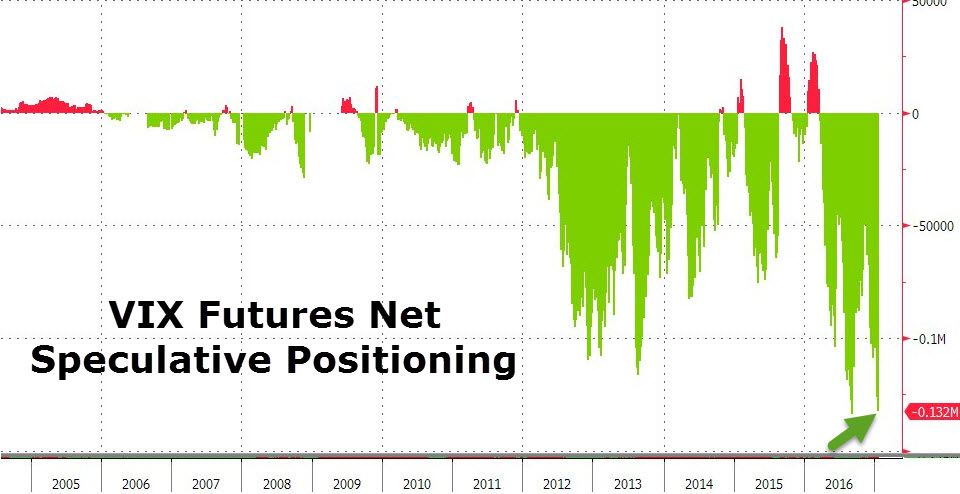
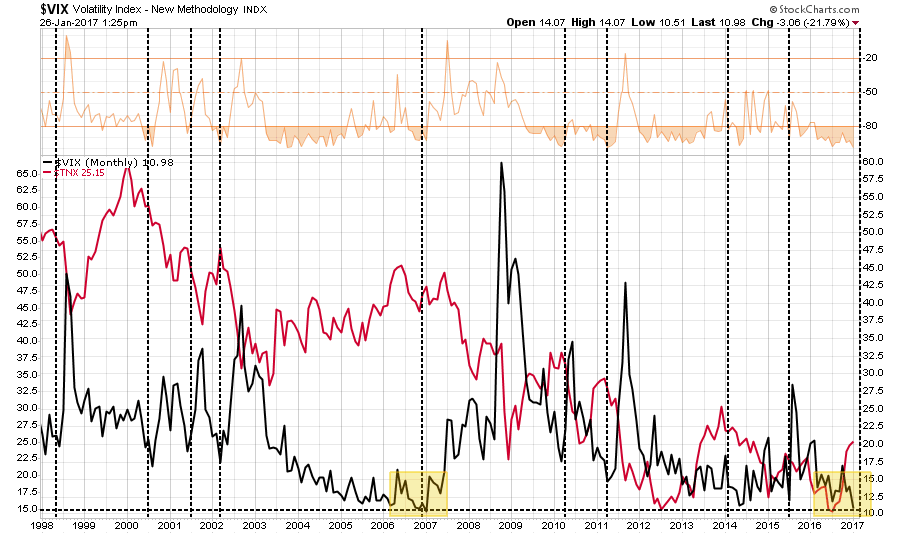
Currently, there are record shorts on volatility which suggest there is little expectation of a market correction currently. In other words, everyone is now on the long-side of the proverbial “boat.”
So, why own bonds?
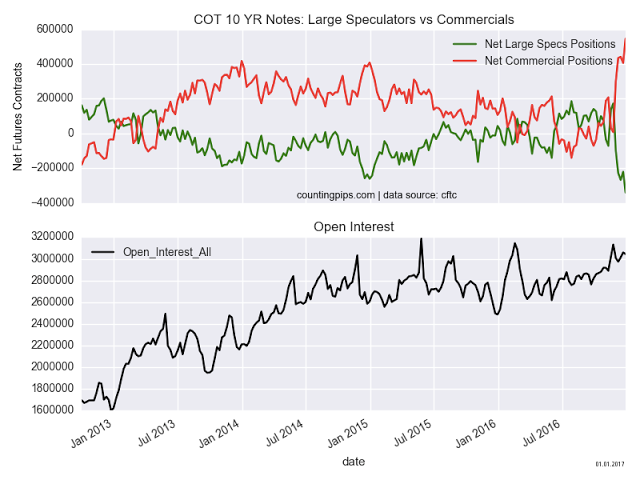
As shown in the chart below, interest rates are negatively correlated to the volatility index. With the extreme net short positioning in bonds, a market correction would spark a rotation from “risk” to “safety” pushing rates towards 2%. However, such a reversal would also trigger a panic-driven short-covering trade which would likely push rates even lower towards 1.5%.
That thought was also discussed recently at the Macro Man blog:
“We still think that Mr. Bond will have a soft landing this time. In fact, now that the Inaugural is behind us, with all of its ‘Sound and Fury signifying nothing’, Mr. Market will likely undertake a more cerebral evaluation of the likelihood of 4, 5 and 6% US GDP in 2017.
A renewed safe haven bid for Mr. Bond and other fixed income assets seems certain before long,as Real Money and commercials have increased their net longs. The speculative community remains extremely short bonds, providing a mechanism to accelerate any recovery in fixed income once it gathers speed, eventually forcing a surprising number of concealed shorts to return to a more neutral positioning in Treasuries.”
Currently, we remain long bonds as a hedge until the abnormalities are reversed.

Sector By Sector
Let’s take a quick look at the 9-major sectors of the S&P 500 to determine the overall strength of the bullish bias.
ENERGY
The OPEC oil cut will likely fail in the next two months particularly as the ramp up in protection continues in the Permian Basin. The Saudi’s are only going to give up so much “market share” before returning back to full production.
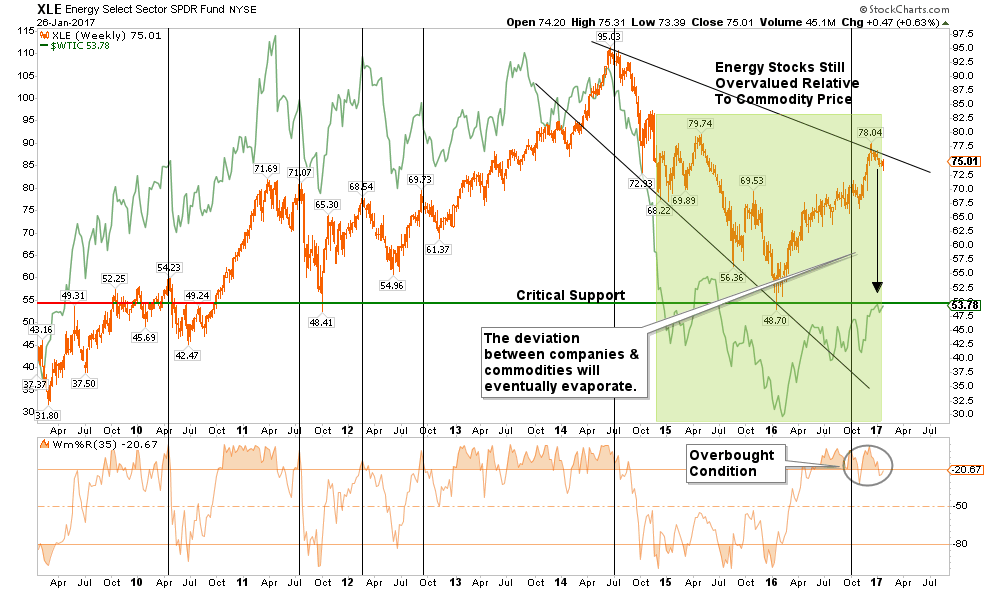
Like the extreme “short positioning” on the VIX and Treasuries, speculators are extremely net long in oil contracts. There is an extremely high probability the supply increase that is currently happening will not only cap oil price temporarily but will likely push oil prices lower in the months ahead.
Energy companies remain extremely overvalued and disconnected relative to the underlying commodity price. When the next economic recession hits, energy-related equities will likely once again recouple with its base commodity.
HEALTH CARE
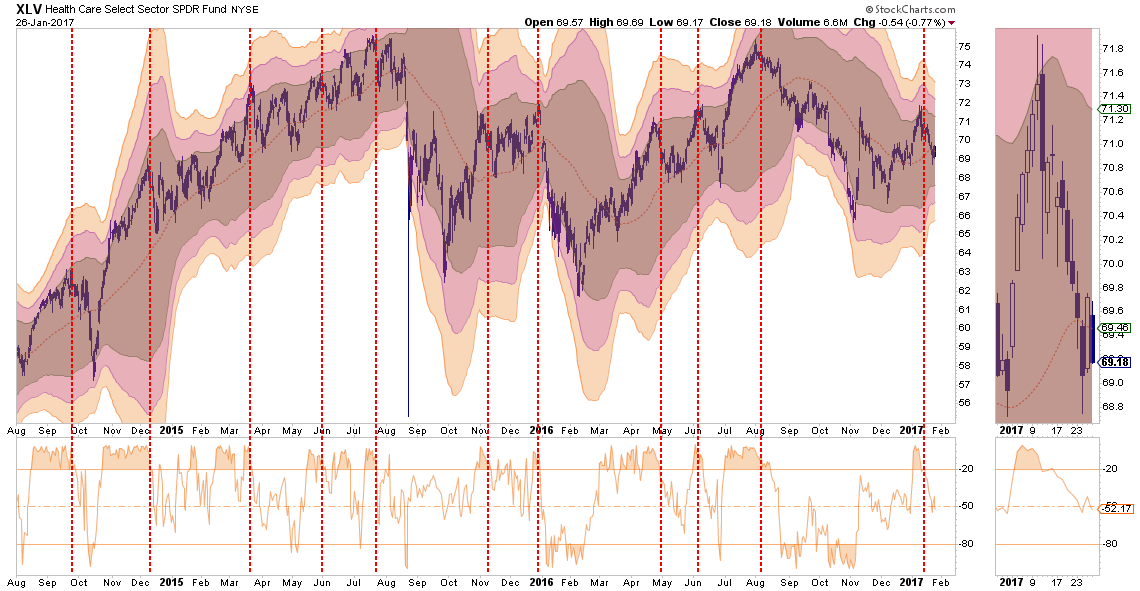
The healthcare sector has been a laggard as of late and continues to struggle with the unknown of what is going to happen with the health care system overhaul under President Trump. With the sector very currently correcting from an overbought condition, there is not a reasonable risk/reward setup currently in the sector.
Current holdings should be reduced to under-weight for now as there is not a good stop-loss setup currently available.
FINANCIALS
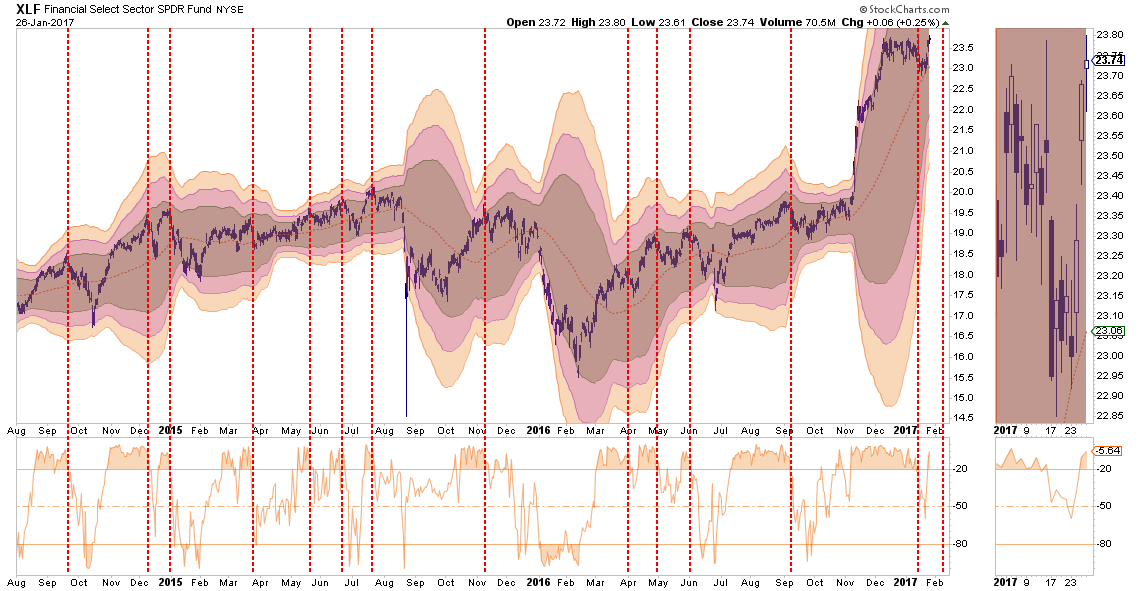
Financials continue to be the leader with respect to overall relative performance. There is a tremendous amount of exuberance being built into Financials which makes this sector ideal for reducing back to portfolio-weight, taking profits and setting a stop-loss at $22.50
INDUSTRIALS
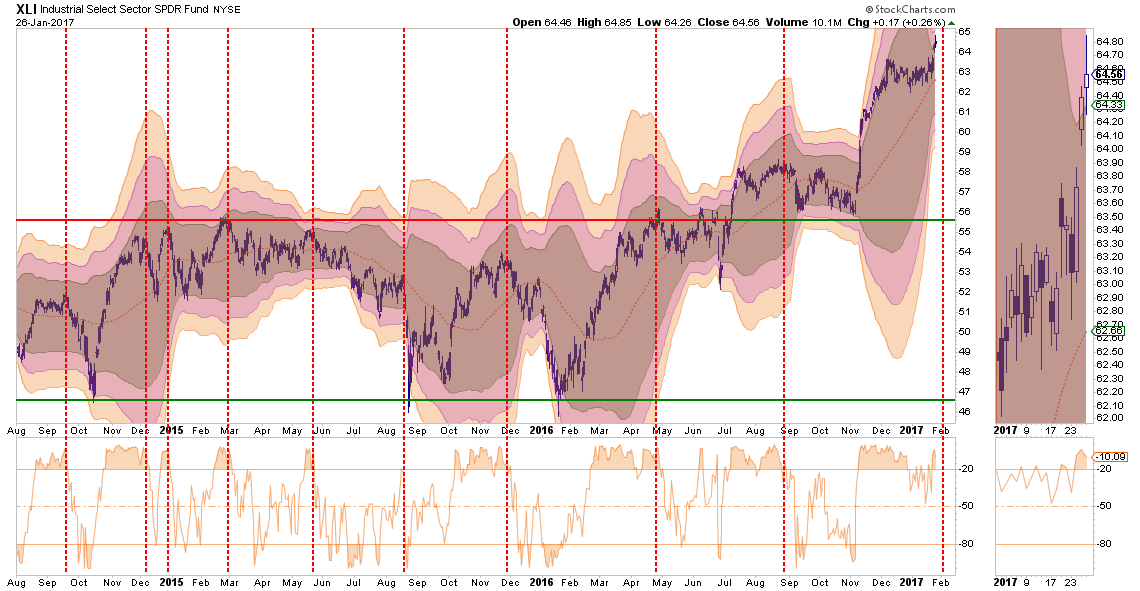
Industrial stocks, because of the dividend yield, have been a big beneficiary of the “yield chase” previously. Now, like Materials, they are the subject of the “Make America Great Again” infrastructure trade. However, this sector is directly affected by the broader economic cycle which continues to remain weak.
While the sector broke out to new highs, there is not a good risk/reward setup as there is a long way to a good stop level at $50. I would reduce holdings back to portfolio weight for now and take in some of the gains.
MATERIALS
As with Industrials, the same message holds for Basic Materials, which are also a beneficiary of the dividend / “Make America Great Again” chase. This sector should also be reduced back to portfolio weight for now with stops set at the lower support lines $49.50.
UTILITIES
Utilities have been picking up performance over the last couple of weeks as money begins to rotate back into “safety” plays of bonds and interest rate sensitive sectors. Stops should be set on current holdings at the lower support levels $47.50 for now and a break above resistance should set the sector up for a further advance.
STAPLES
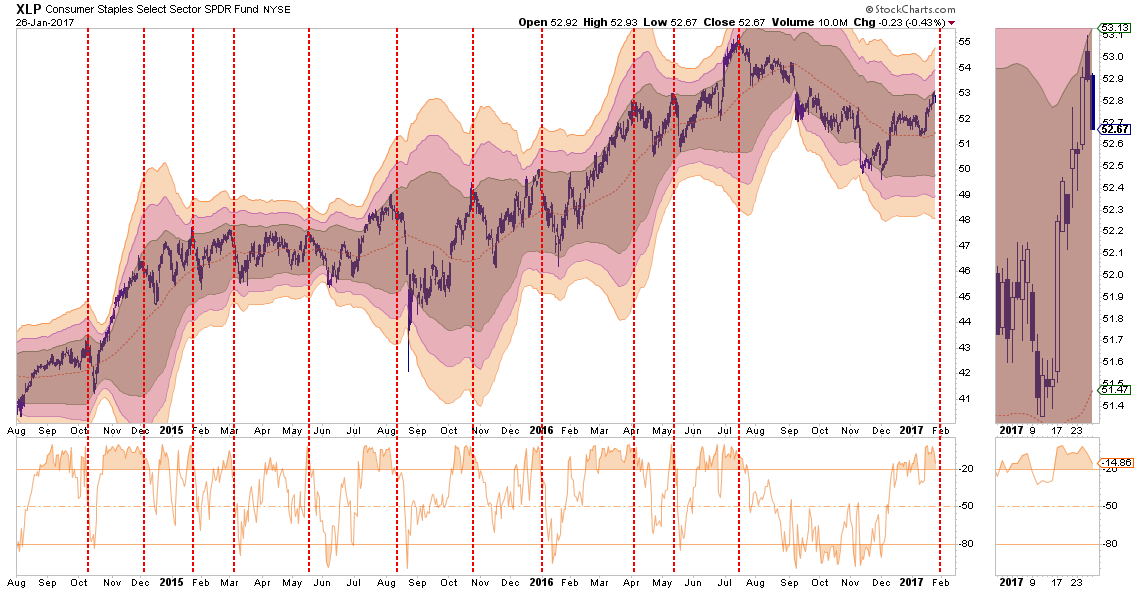
Staples, have recovered as of late and are now back to extreme overbought, along with every other sector of the market. Set stops at $52 for now and look for a correction that does not break support to increase exposure to the sector.
DISCRETIONARY
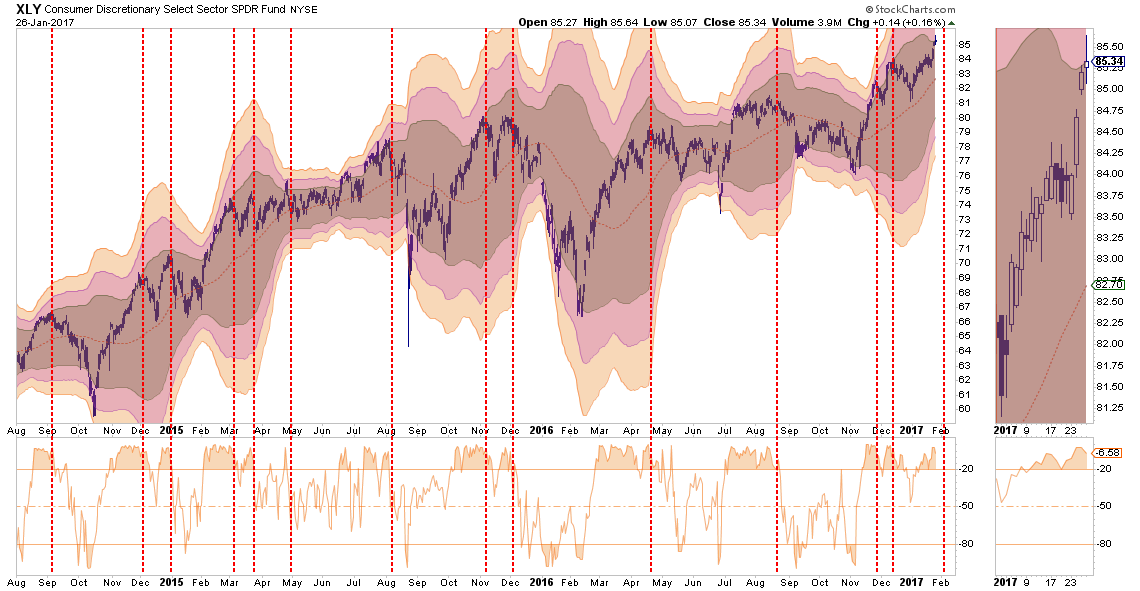
Discretionary has been running up in hopes the pick-up in consumer confidence will translate into more sales. There is little evidence of that occurring. Portfolio weightings should be trimmed back to underweight at the current time with stops set at $81. With many signs the consumer is weakening, caution is advised and stops should be closely monitored and honored.
TECHNOLOGY
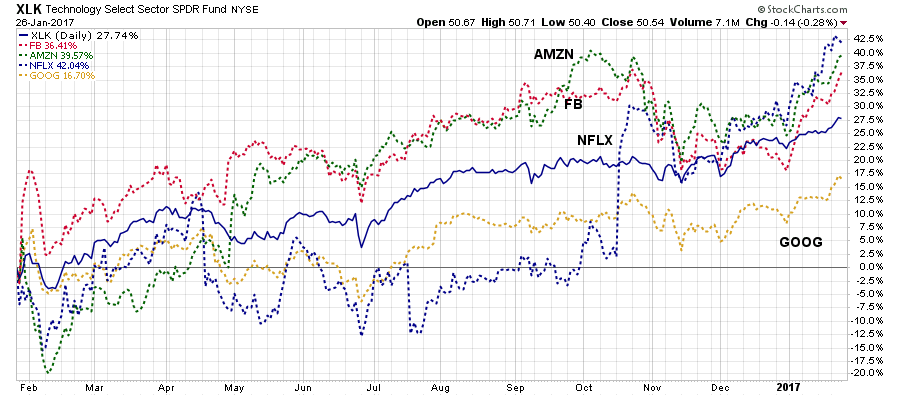
The Technology sector has been the “obfuscatory” sector over the past couple of months. Due to the large weightings of Apple, Google, Facebook, and Amazon, the sector kept the S&P index from turning in a worse performance than should have been expected prior to the election and are now elevating it post election.
The so-called FANG stocks (FB, AMZN, NFLX, GOOG) continue to push higher, and due to their large weightings in the index, push the index up as well.
The sector is extremely overbought and stops should be moved up to $48 where the bullish trend line currently resides. Weighting should be revised back to portfolio weight.
EMERGING MARKETS
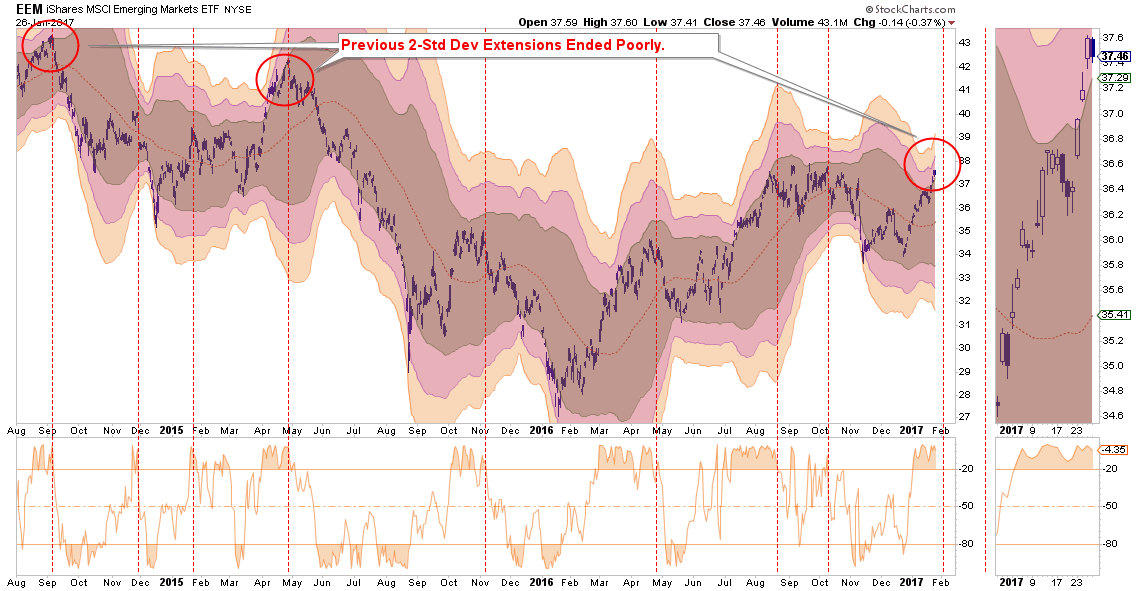
Emerging markets have had a very strong performance as of late and are now 3-standard deviations above the mean which is “rarefied air.” The strengthening of the US Dollar will weigh on the sector and will only get worse the longer it lasts. With the sector overbought, the majority of the gains in the sector have likely been achieved. Profits should be harvested and the sector under-weighted in portfolios. Long-term underperformance of the sector relative to domestic stocks continues to keep emerging markets unfavored in allocation models for now.
INTERNATIONAL MARKETS
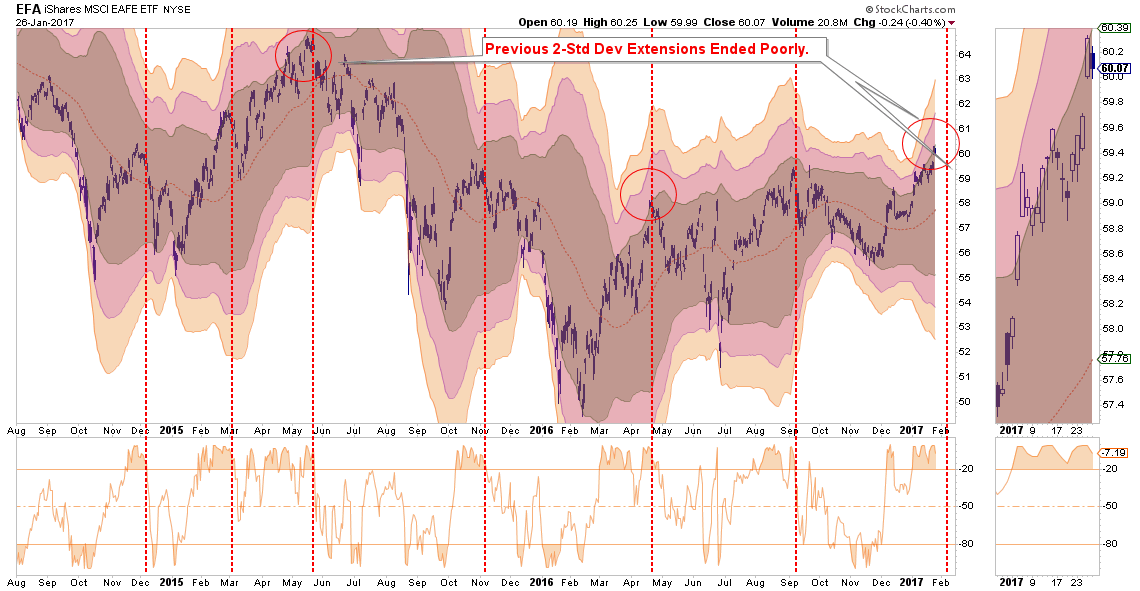
As with Emerging Markets, International sectors also remain extremely overbought and unfavored in models due to the long-term underperformance. Underweight the sector, take profits, and focus more on domestic sectors for now.
DOMESTIC MARKETS
As stated above, the S&P 500 is extremely overbought, extended and exuberant. However, while a “buy signal” is currently in place, a sell signal registered from such a high level has previously coincided with bigger corrections.
Caution still advised for now.
SMALL CAP
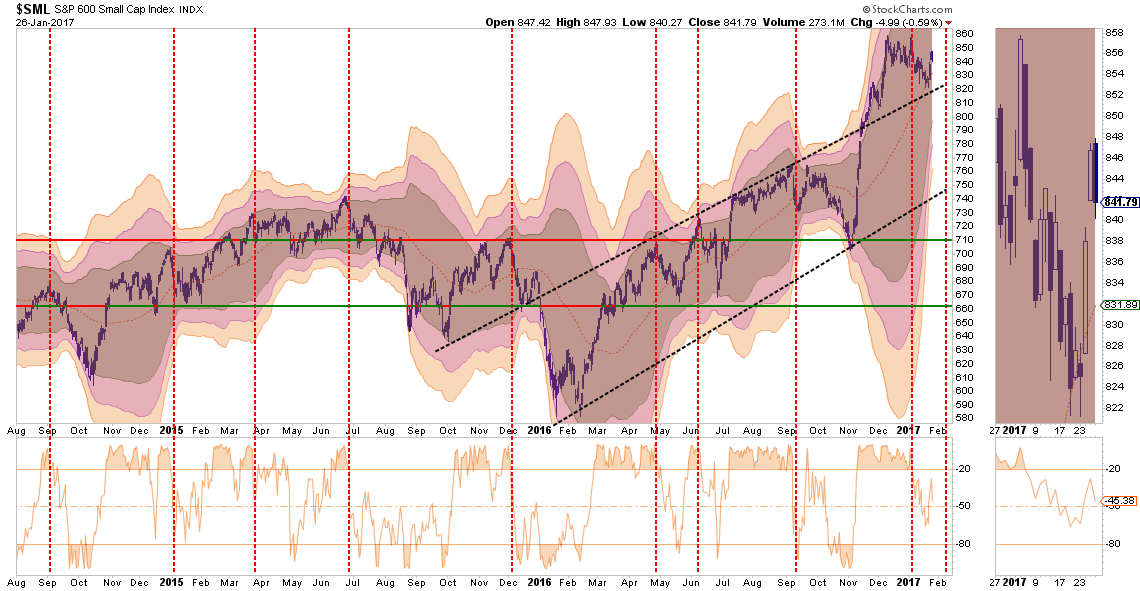
Small cap stocks went from underperforming the broader market to exploding following the Trump election. With the index bouncing off the bullish uptrend line recently, a break out to new highs could signal a continued move higher.
Currently, small caps are between overbought and oversold which suggests the current corrective process is likely not complete yet. Reduce exposure back to portfolio weight for now and carry a stop at $820.
MID-CAP
As with small cap stocks above, mid-capitalization companies having a rush of exuberance. However, Mid-caps currently remain extremely overbought. Reduce exposure back to portfolio weight for now and carry a stop at $1660.
REIT’s
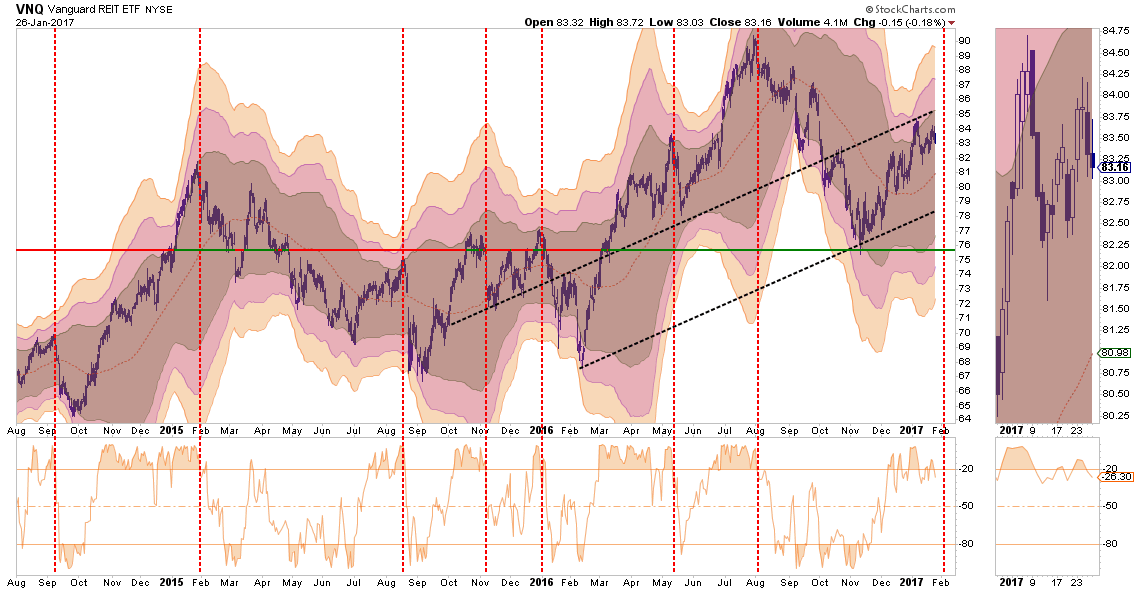
REIT’s had been under pressure heading into the election. However, since then there has been a nice reversal of performance for the sector. However, when rates begin to reverse as “risk” rotates back into “safety,” the risk-reward setup to add REIT’s to portfolios is positive. Positions can be added on a pullback to support at $81 with a stop set at $78.
>>> Veneto Banca and BPV boards to meet on 31 January to discuss merger plan - r

Veneto Banca and BPV boards to meet on 31 January to discuss merger plan - report (translated)
29 JAN 2017
The boards of directors of Veneto Banca and Banca Popolare di Vicenza (BPV), the Italian lenders controlled by Italian bank rescue fund Atlante, will discuss a merger on 31 January, Italian language daily Il Sole 24 Ore reported.
The boards will also attempt to refine the capitalisation requirements in the light of the fact that the two banks will be writing down and spinning off their non-performing loans that are estimated to have a gross value of EUR 9bn.
The top management of both banks will fly to Frankfurt on the same day to discuss their proposals with the European Central Bank, the unsourced article noted.
The total recapitalisation for the merger is likely to come in at EUR 2.5bn but could become even higher
The original article appeared in print; Page 4

FT : French mobile groups’ bundling trend risks harm, watchdog warns

French mobile groups’ bundling trend risks harm, watchdog warns
Cost of buying TV content is a danger to network investment, says head of Arcep

The head of the French telecoms regulator has warned that the growing trend for mobile operators to offer bundles of telecoms and TV services across Europe risks harming investment in their networks.

“If telecom operators are massively investing in content . . . there’s a high risk that this deters investment in telecom networks in France,” Sébastien Soriano, chairman of Arcep, told the Financial Times.

“I would prefer to hear them with a clearer message of investing in fibre, in 4G, in 5G, than this kind of permanent discussion about content.”

Mr Soriano’s comments come as the country’s four telecoms operators — Orange, SFR, Bouygues and Iliad — weigh up the benefits of owning and creating TV content, including exclusive sports rights, that can be broadcast over their broadband and mobile networks.

These operators have been locked in a price war since 2012, when Xavier Niel’s Iliad launched its mobile service, Free. Content is seen as a potential means to differentiate from competitors, improve average revenue per user and reduce the churn rate — a measure of customer loss — although the cost of doing so can be expensive.

Convergence of media and telecoms is a strategy backed in particular by SFR, the French telecoms provider owned by cable entrepreneur Patrick Drahi’s investment vehicle Altice

Altice announced in December that it would offer eight entertainment channels to customers of its network. SFR is fighting to keep customers after losing 2.5m subscribers since it was bought from Vivendi just over two years ago.

Orange owns sports rights and OCS (previously known as Orange Cinéma Séries) — TV content also available for subscribers of other providers. Orange chief executive Stéphane Richard said in December he was also open to buying leading French pay-TV channel Canal Plus, which is owned by Vivendi.

Vivendi, under the control of billionaire Vincent Bolloré, is building a European media content business across France, Italy and Spain. As part of this plan, Vivendi has built up stakes in Telecom Italia and Italian broadcaster Mediaset.

Bouygues, owner of French television channel TF1, and Iliad have an open model of allowing clients to access as wide a range of content as possible without a premium on exclusivity.

Mr Soriano said that a good solution to the price war should be differentiation by networks, rather than differentiation by content.

He added: “A really bad scenario for us would be a scenario where two players would be engaged in media differentiation strategies. Then there’s a high risk that the market goes to a duopoly, which for us is terrible. Duopolies are very hard to regulate.”

Mr Soriano said that Arcep, which concentrates on ensuring France’s telecoms providers continue to invest in infrastructure, was largely powerless to prevent convergence, and that if the trend developed, a new regulatory framework might be needed.

He said: “My main concern is that we don’t go further on this telecom media story. For the moment there are no big problems — but please could we just stay at this point.”

Arcep ruffled feathers earlier this month when commenting on Orange’s investment in fibre networks. It said that “Arcep will work to prevent any obstructive behaviour from Orange”.

>>> Agent Provocateur lender Barclays prepares to take control; Endless and Alte

Agent Provocateur lender Barclays prepares to take control; Endless and Alteri Investors interested in takeover - report

Agent Provocateur’s lender Barclays is poised to take control of the UK-based lingerie retailer unless a buyer is found within days, The Sunday Times reported. The newspaper cited City sources speaking this weekend for the information.
Agent Provocateur’s owner, the private equity firm 3i [LON:III], began a sale process for the retailer this month, the item said. However, some of the bids that have been submitted are believed to be lower than the retailer’s GBP 30m (EUR 35.1m) debt, the report said, adding that 3i is looking to secure a slightly higher price.
Interested parties include the turnaround specialist Endless and Alteri Investors, which has backing from the buyout group Apollo Global Management, according to the newspaper.
The entrepreneur Theo Paphitis, owner of rival lingerie retailer Boux Avenue, has been approached regarding a deal, the item added.
It is expected that 3i and Barclays will choose a couple of preferred bidders this week, the article said.
The restructuring firm Alix Partners is set to advise the firm in the event that Barclays takes control, according to the report.
3i last week described Agent Provocateur’s trading in December as “subdued,” the newspaper said. The item added that the accountancy firm KPMG is reviewing Agent Provocateur’s accounts.
Background:
The Financial Times reported on 3 January that 3i had hired the investment bank Rothschild to advise on a potential sale process for Agent Provocateur and that Alix Partners was advising 3i on options to improve the retailer’s performance.

FT : Goldman Sachs chief Blankfein takes Theresa May to task on Brexit

Goldman Sachs chief Blankfein takes Theresa May to task on Brexit
Head of US bank warned about threat to London at private Davos meeting

Goldman Sachs’ chief executive has emerged as a thorn in the side of UK prime minister Theresa May, warning that European financial centres could challenge London unless her government gives more priority to the City in Brexit negotiations.

The stance was evident when Mrs May met Wall Street bosses at the World Economic Forum in Davos 10 days ago to discuss her strategy for leaving the EU, according to several people briefed on the closed-door meeting.

Lloyd Blankfein, head of the US investment bank for over a decade, asked Mrs May where financial services ranked in her top three priorities for Brexit, according to the people.

“Blankfein talked tough,” said one of the people. “He said there was no reason why European financial centres can’t set up as effective rivals.”

The Goldman boss mostly asked questions of Mrs May, and delivered them in a light-hearted way, the people said. Despite the cordial mood, some Wall Street bosses in the room detected a deeper concern about the UK’s position in Mr Blankfein’s comments. “There was a particular exchange between them,” said one person.

Goldman was one of the biggest donors to the Remain campaign in last June’s referendum and employs about 6,000 staff in the UK, its main European operation. Mr Blankfein has expressed bemusement to colleagues over how Mrs May appears to treat finance like any other industry, despite its major contribution to the UK economy and its exchequer.

Bankers looked on enviously in October when Mrs May gave Nissan a guarantee that its terms of trade would not be hurt by Brexit, winning a commitment from the Japanese carmaker to expand production at its plant in Sunderland.

Mrs May’s meeting with Wall Street executives came only hours after her address to the Davos elite, outlining plans for the UK to “step up to a new leadership role” in the global economy after Brexit and remain a “great global trading nation”.

Some foreign bank bosses were still reeling from an earlier speech by her in London, in which she confirmed for the first time that the UK would not be staying in the EU’s single market or customs union. City bankers fear this outcome could cut them off from EU clients.
A number of financiers spoke publicly at Davos about their plans to move thousands of jobs out of London as they prepared for a “hard Brexit”, including the heads of HSBC, UBS and JPMorgan Chase.

Mr Blankfein told Bloomberg TV that his bank was already “slowing down” its recent shift of resources to the UK because of the referendum decision. He said immigration had to be Mrs May’s “declared priority” but he believed “the financial services industry is so important to the British economy . . . so that will become an important priority”.

Also meeting Mrs May in Davos were Larry Fink of BlackRock, Stephen Schwarzman of Blackstone, James Gorman of Morgan Stanley, Brian Moynihan of Bank of America and Jamie Dimon of JPMorgan. All parties declined to comment.

Several of the executives came away from the event impressed by Mrs May’s grasp of the detail about how the City could be affected by Brexit. “She is on top of her brief,” said one person involved.

The prime minister also had a one-to-one meeting with Mr Schwarzman to discuss the best way to approach Donald Trump, ahead of her meeting with the new US president last Friday.

The Blackstone boss chairs Mr Trump’s new strategic and policy forum, which provides the president with advice from US business leaders.

>>> Punch Taverns suitor Emerald Investment Partners continues to seek financial

Punch Taverns suitor Emerald Investment Partners continues to seek financial backing for bid - report

Punch Taverns' [LON:PUB] suitor Emerald Investment Partners is still seeking financial backing for a takeover offer for the UK-based pubs operator, The Sunday Times reported, citing city sources for the information.
Emerald faces a deadline of Friday, 3 February, to secure bid financing, the item said.
Punch Taverns’ board has already recommended a 185p per share takeover bid from the Netherlands-based brewing company Heineken [AMS:HEIA], the item noted. Punch’s three largest investors have committed to sell their stakes to Heineken unless a rival bidder submits an offer of 200p per share or higher, the article added.
It is thought that Emerald’s founder Alan McIntosh has sounded out several possible bid partners, including the Irish cider company C&C Group [LON:CCR], the report continued.
Talks are ongoing this weekend, the item said, adding that a late bid could yet be submitted.
Punch Taverns shareholders are due to vote on Heineken’s offer on 10 February, according to the report.
As previously reported, Heineken is bidding jointly with Patron Capital for Punch Taverns.
Punch Taverns’ share price closed 1p down at 192p in London on Friday, 27 January, giving the company a market capitalisation of GBP 426m (EUR 499m).

FT : Former Och-Ziff London partner charged by SEC

Former Och-Ziff London partner charged by SEC
Two ex-hedge fund executives accused of violating anti-corruption law

Two former Och-Ziff executives have been charged with directing a scheme to win the hedge fund business in at least five African countries by paying “tens of millions of dollars” in bribes to government officials.

The Securities and Exchange Commission on Thursday filed a civil suit accusing Michael Cohen, 45, and Vanya Baros, 44, of violating the Foreign Corrupt Practices Act and misrepresenting their African deals to investors over a five-year period beginning in 2007.

The two men “executed a sprawling scheme involving serial corrupt transactions and bribes paid to high-ranking government officials” in Libya, Chad, Niger, Guinea and the Democratic Republic of Congo, the SEC alleged.

“Cohen and Baros were the masterminds of Och-Ziff's bribery scheme that improperly used investor funds to pay bribes through agents and partners to officials at the highest levels of foreign governments,” said Kara Brockmeyer, chief of the SEC’s FCPA unit.

The complaint says that Mr Cohen, a former London-based Och-Ziff partner, “spearheaded and participated in all of the corrupt transactions” while Mr Baros, a former analyst in the fund’s European office, participated in “multiple” illicit deals.

The SEC moves come four months after Och-Ziff paid $413m to settle related SEC charges and a subsidiary pleaded guilty to criminal violations as part of a deferred prosecution agreement with the US Department of Justice. Two of the company’s most senior executives also settled charges, including founder David Och, who paid $2.2m without admitting wrongdoing.

While US authorities have stepped up anti-bribery enforcement and have vowed to prosecute executives along with corporations, charges against individuals remain rare. The DoJ did not announce any criminal charges on Thursday against the pair. The SEC said it is seeking monetary penalties and unspecified additional remedies.

Mr Cohen’s attorney, Ronald White of Morrison Foerster, said: “Michael Cohen has an unblemished reputation built over the course of a career spent creating value for Och-Ziff’s investors. Mr Cohen has done nothing wrong and is confident that when all the evidence is presented it will be shown that the SEC’s civil charges are baseless.”

Mr Baros’s attorney, Mark Cohen, said: “Vanya Baros is a highly respected professional with an exemplary record of service and integrity. The allegations in the SEC’s complaint about Mr Baros are without basis. When the facts come out, it will be clear that Mr Baros did nothing wrong.”

Working through agents with “reputations for engaging in unsavory business practices”, Mr Cohen and Mr Baros used investors’ money rather than Och-Ziff’s own capital to bribe government officials, the complaint says.

In 2007, Mr Cohen funnelled more than $3m in bribes to Libyan officials, including a son of former Libyan leader Muammer Gaddafi, to secure a $300m investment from the Libyan Investment Authority (LIA) into the Och-Ziff hedge funds, the complaint says. The Gaddafi relative is not named in the complaint, but has been identified in separate court proceedings as Seif al-Islam Gaddafi, once regarded as his father’s heir apparent.

Mr Cohen also invested $40m of Och-Ziff funds in a Libyan real estate deal that involved Gaddafi’s son and thus enjoyed government backing. To gain access to the deal, which was virtually guaranteed to be profitable, Mr Cohen paid “a bogus $400,000 ‘deal fee’ to an entity controlled by” the leader’s son, the complaint says.

In early 2007, as Mr Cohen began meeting Libyan officials, he emailed a co-worker about the outlook in the North African country. The “[m]eetings are amazing. They [the LIA] have 77 billion, half in cash, and no idea who to give it to . . . I haven’t been this excited in a while,” Mr Cohen wrote in an email quoted in the complaint.

The complaint details six transactions that enforcement officials label “corrupt,” including deals involving mining assets in South Africa and the DRC. The SEC also accuses the two men of skirting Och-Ziff’s internal controls so that their bribes would be booked as legitimate business expenses.

Allegations of corruption in Africa have dogged Och-Ziff, one of the world’s largest hedge fund managers, since it disclosed it was under investigation in 2014. Och-Ziff’s assets under management fell to $33.5bn at the end of last year from a peak of $47.5bn in 2014.

Och-Ziff’s willingness to ink deals in Africa distinguished it from more conservative rivals. But prosecutors said the fund violated anti-corruption laws in the bargain. At the time of the September settlement, Mr Och described the conduct as “inconsistent with our core values and not representative of our hundreds of employees worldwide”.