FT : US haul from credit crisis bank fines hits $150bn

US haul from credit crisis bank fines hits $150bn
Reckoning continues 10 years after housing downturn became market meltdown

Financial institutions have paid more than $150bn in fines in the US relating to the credit crisis, passing a significant milestone a decade after it became clear American subprime woes had become a global problem.

Ten years ago this week, France’s BNP Paribas barred investors from accessing money in funds with subprime mortgage exposure, citing a “complete evaporation of liquidity”. The date — August 9, 2007 — is pegged by many as the moment the financial crisis began.

Financial institutions have largely recovered from the Great Recession that followed, but the crisis profoundly reshaped economies and markets, and the effects on politics and society are still being felt. Dealing with banks’ alleged misdeeds from the era also remains unfinished business.

The public outcry for accountability ushered in an era where the US government was willing to penalise financial institutions sharply, yet most crisis-related actions were civil rather than criminal. Much of the public remained unsatisfied because few bankers went to prison.


A trio of multibillion-dollar settlements with European banks this year has netted $19bn for the Department of Justice and regulators, including $5.5bn paid by RBS of the UK last month — taking the total over the landmark figure.

A single bank, Bank of America, has paid more than one-third of all recoveries to US authorities, according to an analysis by the Financial Times. Its $56bn in settlements with state and federal regulators and the DoJ cover its own mortgage sales and actions by two companies it acquired, subprime mortgage lender Countrywide and broker Merrill Lynch. 

JPMorgan Chase, which acquired Bear Stearns and Washington Mutual, has paid the second-largest amount, with $27bn in fines and relief.


The FT analysis of fines against banks, rating agencies and other institutions covers conduct ranging from the faulty underwriting of mortgages, improper foreclosure practices and discriminatory lending to the mismarking of auction rate securities. The bulk of the $150.1bn total — $89.1bn — was to settle allegations that institutions misled buyers of securities backed by mortgages.

New cases related to the crisis are still being filed and investigations continue, suggesting the $150bn total could grow. Barclays is fighting a DoJ lawsuit alleging it misled buyers of mortgage-backed securities. 

“You can argue that the fines are too high or too low. Nobody would argue that the non-compliance behaviour needs to be addressed,” said Gerold Grasshoff, a senior partner with Boston Consulting Group.


Prosecutors have demanded guilty pleas from banks for crimes ranging from money laundering to violations of US sanctions law. Including those settlements, financial institutions have paid more than $321bn worldwide from 2007 until the end of 2016 for all types of misdeeds, according to a report by Boston Consulting. 

“We expect fines and penalties by regulators in Europe and Asia to rise in coming years,” the report concluded.

Some authorities have said the lack of cases against top Wall Street executives reflects the difficulty in proving criminal intent, since they were often several levels removed from the fraud or insulated by lawyers. Others suggest the DoJ was unwilling to pursue cases they might not win. 


“Our nation cannot afford to take our eye off the ball when it comes to crime or other illegal practices inside banks that require law enforcement response,” said Christy Goldsmith Romero, the inspector general of Sigtarp, the federal agency overseeing government bailout funds. 

“If a corporation is engaged in illegal practices they should not be able to buy themselves out of accountability. The recoveries are important because there must be a cost,” Ms Goldsmith Romero added. “DoJ has to be willing to step outside of its comfort zone. They have to be willing to put the evidence in the hands of the jury.”
Barron's : Local EM Debt a Good Bet Amid Bubbling Bonds

Local EM Debt a Good Bet Amid Bubbling Bonds
For once, the greenback may not be the most secure place if interest rates rise sharply.

Fed up with miserly returns on treasury bills and investment-grade corporate bonds, individual investors are nudging into an asset class until now seen as too risky: bonds that emerging-market nations issue in their own currency. The largest exchange-traded fund in the area, iShares JPMorgan EM Local Government Bond, has doubled in size this year to nearly $7 billion, and many mutual fund managers report that their assets have risen by 15% to 20%.

The allure of local-currency debt is clear: yields that average north of 6% on five-year paper. The catch is that you reap those yields in rupees, pesos, reais, or whatever. That has been a boon lately, as soft currencies at last rebound against a less-than-almighty dollar. The iShares ETF (ticker: SEML.UK) has returned more than 12% year to date. The longer-term record is less comforting: down a total of 7% over the past five years. Any hawkish clearing of the throat from the Federal Reserve could end the uptick, or so it would seem.

Yet major investors are optimistic on local debt, at least relative to a bubbling bond universe. “Fixed income isn’t particularly attractive right now,” says Steven Oh, global head of credit and fixed income at Pinebridge Investments in New York. “But EM local currency is the best of an unattractive lot.”

THE BULLISHNESS RESTS on two assumptions. First, President Donald Trump’s economic agenda will continue to go nowhere, spelling continued weakness in the dollar. Candidate Trump promised aggressive antitrade measures and domestic pump-priming through tax cuts and infrastructure spending, which were supposed to spur inflation and rate hikes. That sent the greenback soaring after his November election, to a 15-year high against a trade-weighted index by year end. The dollar has given back those gains and more. “Trumponomics has been neutralized both from the trade side and the fiscal-stimulus side,” says Gorky Urquieta, who helps manage $13.5 billion in emerging market debt at Neuberger Berman. “We’re looking for further revaluation from the dollar supercycle.” Translation: Neuberger has been shifting from Eurobonds into local-currency paper, betting on further greenback depreciation.

The second premise is that emerging markets are getting stronger after years of limping export earnings and widening current-account deficits. Gross-domestic-product growth across the developing world should accelerate this year for the first time since 2013, the World Bank predicts. Commodity prices have stabilized, and exporters from Russia to Chile have made currency adjustments. Overindulgent importers like India and Brazil have all but balanced their accounts. Inflation is subsiding, and central banks are cutting interest rates, a positive backdrop for bond buyers even as the U.S. and Europe look to raise rates. “The fundamental drivers are much improved over the past few years, which allows central bankers to step away from emergency policy,” says Andrew Keirle, who manages the $327 million T. Rowe Price Emerging Markets Local Currency Bond fund (PRELX) in London. “The building isn’t on fire anymore.”

The experts do add some warning labels to their enthusiasm for local-currency debt. Most importantly, be prepared to ride out some bumps. “This is a complex, volatile asset class,” Pinebridge’s Oh says. “You don’t want to be the tourist money that rushes for the exits at a technical reversal.”

A storm may be brewing for bonds globally, as former Fed Chairman Alan Greenspan recently warned. But when it breaks, a yield of 6% or 7% denominated in the baht or rupiah could look quite attractive.

NY Post : Chinese firm’s trader linked to unmasking of Bloomberg chat users

Moataz Abed, the trader who seems to have been in contact with an e-mail address that blasted out a list of anonymous Bloomberg chat participants, works at Noble Group, a China-based energy trading company that has tried to root out names of unidentified analysts, The Post has learned.

In 2015, publicly traded Noble sued rival Iceberg Research, which had put out a series of reports critical of Noble. The Iceberg analysts were not identified in the reports.

The Noble suit claimed that former Noble employees, then working for Iceberg, were trying to bring down Noble’s stock price.

Abed was e-mailed from an address belonging to Janus Henderson, a London asset manager from whose e-mail the unmasked list seems to have been sent. It’s unclear what connection the two have. Reps for both companies didn’t return requests for comment.

No one has accused Abed or anyone at Janus Henderson of any wrongdoing. Abed didn’t return an e-mail and Bloomberg chats seeking comment.

Chat room participants are warned that their identities aren’t completely anonymous. Before signing up, users have to agree to terms that include a warning highlighted in red.

The metals chat included participants from all over the world — from major hedge funds like Balyasny to pension funds in California and Rhode Island.

Eight participants were from Goldman Sachs, the firm with the highest number of anonymous users, records indicate.

NY Post : Leon Black’s Apollo Global sued over alleged fraud

Leon Black’s Apollo Global Management conspired to swipe a $20 million stake in a Dutch logistics company held by a group of former executives, a lawsuit filed in a Florida federal court contends.

Apollo pulled off the alleged fraud in 2013 by arranging a debt-for-equity restructuring of the then-struggling Ceva without notifying the management of the Netherlands company, the suit claims.

The private equity firm bought up a chunk of Ceva’s discounted debt before pulling the trigger on the debt-equity swap, according to court papers.

The restructuring allowed Apollo to maintain ownership of the Ceva — but left the equity held by the executive worthless. Since the former brass were left out of the debt-swap, their $20 million stake in Ceva went up in smoke, court papers allege.

The suit, filed in a Jacksonville court, names Apollo plus senior partner Gareth Turner and former principal Mark Beith.

For Apollo the timing of the new suit may not be ideal.

Presently, French company SNCF Geodis is in talks to buy Ceva in a deal that could leave Apollo’s pockets stuffed with profits, sources familiar with the situation said.

Apollo jumped into the logistics business in 2007 when it bought two companies, TNT Logistics for $1.9 billion, and Eagle Logistics for $2 billion. It combined the two and named the new entity Ceva.

Black’s PE firm then offered Ceva brass the chance to purchase shares in the combined entity, telling them, “Apollo and Management will be aligned to share in value creation,” the suit alleges.

At one point when Ceva was struggling financially, Morgan Stanley, working for the logistics company, produced a Jan. 28, 2013, report that indicated Ceva’s value could be as high as $3.75 billion — an amount high enough to satisfy debt obligations and provide value to equity holders, the suit alleges.

Yet, Ceva, instead of exploring a sale or an IPO, decided Morgan Stanley’s findings were “flawed and inconclusive,” the suit alleges.

The debt-for-equity swap followed.

The executive found out about their suddenly worthless stock in a letter: “In light of . . . Ceva’s financial condition, we have been advised that it is unlikely that there will be any recoveries for shareholders,” the letter said, according to the suit. “The directors regret having to write you with this information.”

Apollo declined comment.

Recode.net : Snap stock is up after the world’s biggest ad buyer said it will sp

Snap stock is up after the world’s biggest ad buyer said it will spend even more money on Snapchat
WPP says it plans to double spending on Snap ads this year.


Sir Martin Sorrell to the rescue!

Snap investors received some good news on Friday courtesy of one of the world's biggest ad buyers.

WPP CEO Martin Sorrell, whose firm manages billions of dollars in advertising budgets, told CNBC that WPP plans to double its spending on Snapchat ads this year.

Sorrell said WPP will spend about $200 million with Snapchat, which is much less than the firm spends with others like Google or Facebook, but still significant for Snap. If $200 million is double what WPP spent last year, that means the agency was responsible for roughly 25 percent of all of Snap's sales in 2016.

The fact that they are increasing that spend is a good sign for Snap investors. Snap stock is up almost 4 percent on the day.

Snap has had a rough year. After a seemingly successful IPO in early March, the company's stock is near an all-time low thanks to a less-than-stellar first quarter and increased competition from Facebook and Instagram.

In fact, Sorrell's comments came less than 48 hours after CNBC published a story claiming ad buyers were rapidly losing interest in Snap. Not all ad buyers, apparently.

So this is a bright spot for Snap, even if only temporarily. Snap reports Q2 earnings next week.

Update: Cheddar’s Jon Steinberg pointed out that Sorrell has talked about this spending jump before on Cheddar. Wall Street must have missed it, forgotten, or just appreciated the reminder on Friday. The stock is now up more than 4.5 percent.

TechCrunch : Now it’s Snapchat copying Facebook’s ads Power Editor (finally)

Now it’s Snapchat copying Facebook’s ads Power Editor

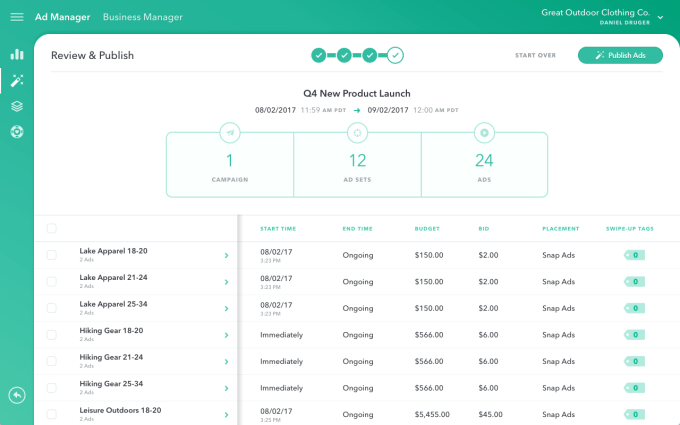
Snap Inc desperately needs ad revenue to redirect its sinking share price. So after a year of getting mercilessly copied by Facebook, Snapchat is returning the favor by launching its take on the Facebook ads Power Editor. This new “Advanced Mode” for its Snapchat Ads Manager lets big advertisers rapidly deploy complex ad campaigns with tons of creative variants.
By allowing big ad agencies and brands to efficiently target, test and update their ad campaigns, they may be willing to spend more money on Snap. While the benefits won’t kick in in time for Snap’s pivotal Q2 earnings call next week, Advanced Mode could help the upstart put a dent in the Google/Facebook ad duopoly down the line.
Snap launched its self-serve Ads Manager in May, and added vertical video creation tool Snap Publisher in July. With the addition of Advanced Mode, advertisers will be able to:
  • Automate multiple ad campaigns with a permutation builder so they can quickly create hundreds of ad creative and targeting variants
  • Utilize Snap spreadsheets for bulk design and editing of campaigns
  • Save targeting audiences to use on future campaigns
  • Employ performance metrics that can be grouped and ordered by different metrics with data exportation
  • Automate campaign naming
Snap also got an ads boost today that has perked up its share price when the world’s largest ad agency WPP’s CEO Martin Sorrell told CNBC that WPP was doubling its Snap ad buy from $100 million in 2016 to $200 million in 2017. Though he contextualized that, noting that WPP will spend $2 billion on Facebook ads this year, and had previously told online video news channel Cheddar about the increased buy.
Facebook debuted its Power Editor in 2011 (which I covered the launch of because I’ve been doing this forever). It was the last piece of its ads suite that started with direct ad sales, then self-serve ads and then a self-serve API. Snap launched direct ad sales in 2014, then an Ads API in 2016, before testing its self-serve tool in May, and now launching Advanced Mode.

The Facebook Ads Power Editor

Snapchat Ads Manager’s Advanced Mode
The similarities in strategy aren’t too surprising considering Snap’s first COO Emily White was recruited from Facebook-owned Instagram, and it later hired Facebook Audience Network head Sriram Krishnan to work on its ad tools.
These Advanced Mode tools could help Snapchat get to the ad load and scale necessary to monetize its slow-growing audience. If it can’t add tens of millions of new users per quarter, Wall Street will want it to prove it can earn a higher average revenue per user. That means squeezing as much money as it can from each user with these improved ad targeting options.
While Facebook might be running Snap’s product playbook, Snap is making progress by running Facebook’s monetization playbook.