>>> ACS looking for partners to contribute EUR 6bn to counter offer for Abertis

ACS looking for partners to contribute EUR 6bn to counter offer for Abertis - report (translated)
23 JUL 2017
Actividades de Construccion y Servicios [BME:ACS] (ACS) will only present a counter offer for Abertis [BME:ABE] if it finds partners that can contribute at least EUR 6bn to the total EUR 17bn the company would need for the transaction, El Mundoreported, citing sources from the construction company.
Even though the company confirmed on 21 July that it is studying the possibility to bid for Abertis, ACS is still far from presenting a specific proposal, according to the sources consulted by the Spanish-language paper.
ACS Corporate Director General Angel Garcia Lozano, who is leading the transaction, considers the company should not contribute with more than EUR 11bn, a figure that would ensure the company being Abertis main stakeholder. His intention is to find investment funds which could contribute with the remaining EUR 6bn to carry out the transaction, El Mundoexplained.
In fact, it could finally not be necessary to reimburse the complete amount, since the company led by Florentino Perez expects La Caixa to keep being Abertis shareholder (it currently holds a 22% stake), the item pointed.
ACS has paid off a great part of its debt in the last years and wants to study this transaction thoroughly. Therefore the company will probably postpone a final decision to the end of the summer, according to the paper.
Markets already expressed concerns about the effects the transaction could have on ACS and the price of its shares dropped over a 6% after the stock market regulator CNMV requested the company to confirm it was considering to counter offer for Abertis, El Mundo added.
As to other possible bidders, last week airports operator Aena [BME:AENA] made public it had been studying the possibility to present a counter-offer for Abertis, but its main shareholder Enaire finally ruled out this possibility.
In relation to Atlantia's intention to present an offer for Abertis, Spain's Minister of Economy Luis de Guindos declared on 21 July that the government's strategic interest in Abertis does not necessarily mean that the buyer must be a Spanish company.
Link to original source.

(BFW) Asda Is Said to Look at GBP4.4b Takeover of B&M: Sunday Times

https://www.thetimes.co.uk/edition/business/asda-eyes-4-4bn-bid-for-b-m-qqp7f0lpf (subscription required) Asda is exploring a £4.4bn takeover of B&M, the fast-growing discount retailer run by billionaire brothers Simon and Bobby Arora.
Britain’s third-biggest supermarket chain is understood to be in the early stages of assessing a bid for B&M, which is chaired by the former Tesco boss Sir Terry Leahy. It would be the latest in a series of surprising swoops by the leading grocers, which are trying to diversify away from food and fill space in their out-of-town stores as the German discounters Aldi and Lidl eat into their market share.

Sainsbury’s bought the catalogue retailer Argos for £1.4bn last year and is in talks to acquire the convenience store chain Nisa for £130m. Tesco faces a lengthy competition inquiry to complete its £3.7bn acquisition…
Want to read more

FT : Orange no longer banking on telecoms for growth

Orange no longer banking on telecoms for growth
Chief executive plans online bank this year as French telco revenues are stunted

In a sign that the French telecoms scene is stagnating in terms of growth and consolidation opportunities, Stéphane Richard, chief executive of its biggest operator, is banking on another industry to boost earnings: financial services.

Later this year, Orange will roll out an online bank that seeks to take advantage of new legislation making it easier for consumers to change their provider. Mr Richard says the new venture “is based on a belief that in our core business — which is providing connectivity services both in fixed and mobile — it would be very difficult in coming years to find growth, because we are in a business which is highly regulated and highly competitive.”

Orange increased revenues by just 0.6 per cent last year, after they fell 0.1 per cent in 2015 and dropped 2.5 per cent in 2014. 

The financial services launch has been postponed from July in order to prolong the testing phase. The idea is that it will be a full-service bank, offering consumers everything from payment services to insurance and savings. But analysts are sceptical that it can have much of an influence on the bottom line.

”I think it’s quite a good sideline, but I don’t think it will ever be that big for them,” says Simon Weedon, an analyst at Citigroup. “Banking probably doesn’t have the inherent stickiness for the core product that cross-product sales within telecoms do.”

The move into banking comes as Orange continues to face fierce competition from telecoms rivals in its domestic market, where repeated attempts at pushing through consolidation have failed. Mr Richard, a long-time advocate of fewer players in the French telecoms sector, now believes that any deals are off the table in the short term. 

He says: “The authorities are against it, President Macron is not a big fan of consolidation,” and, predominantly, “each of the players that could enter into a consolidation game today have a different agenda.”


Performance at Bouygues, which Orange was going to buy for €10bn in cash and shares in April last year, has picked up — taking pressure off it to sell. Mr Richard says: “The only deal that might be imagined in France . . . will be between Bouygues and Altice, and this seems to be very unlikely to happen.”

As consolidation has floundered, competition among telecoms providers has turned to a new battleground: content. They are investing in it as a way of differentiating themselves in their push to add and retain clients, and increase average revenue per user.

Altice, the second largest operator, has been spending a fortune, including snapping up rights for the Uefa Champions League and Europa League for the 2018 to 2021 seasons. For its part, Orange has been more cautious. It announced this month it had strengthened its commercial ties with Vivendi’s pay-TV unit CanalPlus — stopping short of buying the stake in CanalPlus that had been previously mooted.

Mr Richard says: “I am still sceptical about the value that a telco can really create from massive investments in content, especially when it is about buying sports rights at extravagant prices. Because what we see today is a bubble and is an incredible inflation of prices in sports rights.”

He adds: “The money that you put on content, you cannot put it on networks. Either you invest massively in fibre to the home, or you invest massively in the content. We have made a clear choice to focus our investments into the networks.”

Last month, analysts at Berenberg downgraded Orange to sell from hold, noting that “competition on the French telecoms market is fierce and consolidation hopes have faded”. The note said that rivals Bouygues and Iliad have “higher growth prospects” while “Orange faces structural issues in its B2C, B2B and wholesale businesses in France that only consolidation and a complete reconfiguration of the cost base could ultimately address.”

Another challenge has been Orange’s stake in BT, whose share price is at its lowest level since 2013, following an accounting scandal in Italy and a subsequent profit warning in January, combined with falling demand in the public sector.

Orange announced last month it would be cutting its exposure to BT, where it owns a stake following the sale in 2014 of EE, the mobile operator that was co-owned by the French group. 

“We are disappointed about the share price and upset about the troubles and the operational troubles at BT, especially in Italy, but also in the B2B business globally,” says Mr Richard. 

“But at the same time, I think BT is a solid company, has great assets and should recover.”

Orange and Mr Richard face uncertainty regarding the role of the French state in the company. President Macron indicated during his election campaign he may look to sell down government stakes in companies, while Mr Richard’s position as effectively one of France’s most senior public servants comes up for potential renewal next year.

He has had seven years as CEO, but says around 10 are needed to “implement real change and transformation”. And he views any state divestment as more likely in the medium rather than short term.

“For a state to be, at the same time, the regulator, the industrial organiser and a shareholder of one of the players, it’s always difficult,” he says.

FT : Investors look to European earnings to reignite equities rally

Investors look to European earnings to reignite equities rally
Analysts predict first full year of earnings expansion for 6 years

Investors are looking to a slew of quarterly earnings from more than 100 European companies this week to help reignite a rally in the region’s equity markets that has stalled over the past couple of months.

Total, Peugeot and Airbus are among the leading companies that will report over the next five days, as a quarterly earnings season that analysts predict will be the best second quarter of the past six years gets into gear.

Confidence in the trajectory for European equities was bolstered after the region’s companies delivered 25 per cent profit growth in the first quarter. Money managers’ appetite for the region’s equities was further amplified after Emmanuel Macron’s French presidential victory eased fears about the spread of populism across the continent.

However, while the Stoxx Europe 600 is up almost a quarter since its low in the aftermath of Brexit, the rally has flagged since early May as renewed strength in the euro has sapped momentum.

The benchmark for European equities has fallen 4 per cent since touching its high for the year on May 10, while the S&P 500 has advanced almost 3 per cent over the same period.


If second-quarter European earnings do deliver the double-digit profit growth that analysts forecast, it will keep the region’s companies on course for the first full year of earnings expansion for six years, according to Jonathan Stubbs, a strategist at Citigroup. The consensus among analysts is for an 11 per cent year-on-year increase in earnings for Stoxx 600 companies, according to JPMorgan.

“Europe has been the relative laggard in equity terms but it is very much in catch-up mode, with positive earnings growth and earnings estimate upgrades,” Mr Stubbs said.


With US stocks setting new records last week, there are already some signs of a rotation into European equities in the hope the market finds fresh impetus. Flows into European stocks last week reached more than $3bn, their highest level since Mr Macron’s presidential victory, according to data provider EPFR.

Mislav Matejka, a strategist at JPMorgan Chase, said earnings growth in the eurozone was set to surpass that of the US both this year and next, while the region’s price/earnings ratio was “fair value” relative to other world regions.

FT : Franco-German fighter jet plans threaten to leave UK grounded

Franco-German fighter jet plans threaten to leave UK grounded
Brexit raises questions over Britain’s role in European defence projects

When German chancellor Angela Merkel and French president Emmanuel Macron unveiled plans for closer defence co-operation between their two countries this month, including the development of Europe’s next generation fighter jet, there was a stark omission: the UK. 

Even though Britain is co-operating with France on a €2bn demonstrator for a future generation combat drone, it will not — for now, at least — have any say in early plans for Europe’s newest fighter project. The programme will be “under the direction” of France and Germany. 

Britain has long been a key partner on European defence projects, from the Panavia Tornado in the 1970s to the more recent Eurofighter Typhoon fast jet and the A400M military transport aircraft. The need to collaborate and share the costs of big procurement projects has intensified as modern equipment becomes more complex and expensive.

Now, however, its decision to quit the EU — as well as the UK’s increasing propensity to buy kit from the US — has raised questions over its role in future European defence projects.

“The UK is sending massively mixed messages about the importance that it puts on Europe as a whole, but especially in defence,” says Francis Tusa, editor of Defence Analysis, citing the UK’s absence from some recent joint exercises in Europe. “This is leading to more and more countries in Europe saying, ‘well, if you’re not interested, we’ll look to work with those that are’.”

Executives from BAE Systems, which with France’s Dassault Aviation is the lead industrial partner on the drone technology demonstrator — referred to in defence circles as an “FCAS” — are nonchalant about the development. 

“We don’t feel threatened by it,” Chris Boardman, BAE’s head of military air, told reporters gathered the following day at the Royal International Air Tatoo at RAF Fairford, the industry’s summer festival of warplane aerobatics. “I would like to see how . . . the concept that France and Germany are talking about matures. One way or other the UK will have an involvement.” 

But the question is to what degree, say observers. Will the UK be involved at the all-important planning stages of the project, which shape capabilities, and dictate, in turn, where the expertise and work will be located? 

There are also concerns over whether any duplication between the two projects could put the Franco-British collaboration at risk, in particular as both are likely to involve Dassault, which refused to comment. 

The FCAS project, combining capabilities on Britain’s Taranis demonstrator and France’s Neuron, is seen by many in the defence sector as critical to sustaining the UK’s competence in high-end aerospace skills and technology. Production of the Eurofighter Typhoon could end unless it wins big orders, while all but one of the air platforms highlighted in the UK’s 2015 defence review are designed and built abroad.

BAE has 15 per cent by value of the UK’s newest fighter — the F-35 — but that is a Lockheed Martin-led programme where the most sophisticated technology has been developed in the US. Without a new indigenous air combat programme, key UK expertise could evaporate, some industry executives warn. 

Drawing firm conclusions from the vague declaration last week is difficult. There was no detail on whether the plan was for manned or unmanned aircraft, and no funding was committed. 

The British government is sceptical that the Franco-German declaration will amount to much in practice. It views the proposals as expensive, with officials noting that the only commitment is to develop “provisional road maps”.

European defence industry executives and military officials describe it as a “political statement of ambition” rather than a concrete decision to press ahead on a joint programme. 

It was motivated as much by a desire to see Franco-German defence collaboration move forward in the wake of Brexit, as by the respective needs of Germany to start thinking about a replacement for its ageing fleet of Tornados and of France, in the longer term, for its Rafale fighters. 

“We were asked to input but we didn’t know what was going to happen,” one European executive said of the announcement. It was a surprise even to Airbus, which has been studying next generation aerial combat systems for the German military, when “this actually popped up”, he added. 

This has lent weight to those who argue the declaration was an opportunistic attempt to press the UK to commit itself more fully to European defence collaboration post-Brexit. 

French officials argue there is no reason for the UK to feel excluded. The FCAS programme was the result of a bilateral treaty signed in 2010, covering a very specific unmanned capability while the German project is about European collaboration, said one. Non-EU members have often participated in European defence procurement programmes, the official said, and France’s desire to continue collaborating with Britain remained strong. 

Yet, at a time when almost every western nation is struggling to fund the multibillion-dollar investment required for the most advanced military procurement programmes, the signals being sent by Paris and Berlin were clear, say industry sources. 

One continental European industry executive said: “It is about Europe saying, ‘all these follow on programmes, we will do them ourselves.’ No one will say no to the UK [if it wants to join in], but this is clearly going to be Franco-German led.”

FT : Carillion and NCC have fallen into textbook traps of expansion

Carillion and NCC have fallen into textbook traps of expansion
Both will be case studies of how missteps can turn big companies into small ones

Companies such as Carillion and NCC should abandon their high-flown references to tomorrow in their mission statements. 

Carillion promises to “make tomorrow a better place” but the Wolverhampton-based construction group is struggling to make it through today. Cyber security specialist NCC talks of “securing tomorrow, today” but last week laid bare the chasm at its foundations. 

The two businesses are in very different markets. Carillion manages hospitals and ministry of defence military bases, and has just won a contract to help build the High Speed 2 rail link to Birmingham. NCC advises companies, many of them FTSE 100 and Fortune 500 groups, on defence against the dark arts of malware and ransomware.

The group, formerly known as the government’s National Computer Centre, calculates that 90 per cent of businesses will experience cyber security threats. It is big in a market that couldn’t be more cutting edge. The construction industry is just cut-throat.

But both NCC and Carillion have fallen into textbook traps of expansion by acquisition, over-optimism at the top and accounting practices that have allowed them to borrow from tomorrow by booking revenues early. Both will end up as case studies of how management missteps can turn big companies into small ones. 

This month Carillion, which uses thousands of sub-contractors, has written off nearly £850m in assets, scrapped its dividend, and waved goodbye to its chief executive. Its shares have fallen two-thirds, valuing the group at about £300m, or approximately half its net debt. A year or so ago, the group was worth more than £1.2bn.

Carillion, the builder of Tate Modern gallery, has been caught in a vice of mis-priced contracts, late payments and rising costs compounded by heavy borrowings against an asset-light balance sheet. Onlookers now fret that debt could rise to £900m in a year and wonder how they missed the signs. There are questions whether Carillion booked revenues on long-term contracts too soon and over its use of supply-chain finance to put off paying creditors. The group has called in bankers and accountants to review options. The market is braced for fire sales, rights issues and possibly a debt-for-equity swap.

Meanwhile, NCC’s new chairman Chris Stone, whisked in this spring to sort out the Manchester group after profit warnings and the abrupt departure of the previous top brass, last week announced nearly £70m in exceptionals and writedowns, and £55m in pre-tax losses in the year to May.

Shares in NCC have nearly halved in a year valuing it at £500m. In early 2016, it was a FTSE 250 company worth more than £1bn. 

Mr Stone also listed a litany of accounting goofs that would make a trainee bean counter blush.

In their rush to turn the small Manchester company into a big one, NCC’s former bosses paid too much for acquisitions that they failed to integrate. They took on too many new staff before knowing there was enough work to keep them busy, and moved into swanky offices. They alienated key customers, including the Dutch government, and lost contracts they assumed were in the bag. The company also booked revenues early, didn’t account for holiday pay properly and bungled the paper work so that dividends were paid unnecessarily out of non-distributable reserves.

Mr Stone and Brian Tenner, interim chief executive, have now corrected the “schoolboy errors” and plan to straighten out NCC’s “spaghetti-like” organisation. They talk of imposing new disciplines on employees, encouraging them to bill their hours properly and cross-sell services more efficiently.

NCC’s biggest fault, Mr Stone concludes, was in failing to put structures in place that could cope with the group’s expansion. “The exciting stuff is winning new clients and making acquisitions,” he says. “But you have to invest in all the dull stuff that makes everything work.

“Where we are different is that change has not been forced upon us by mounting losses, a stretched balance sheet, technological obsolescence or a sudden shrinking in our markets.”

NCC is generating cash and its net debt at £44m — slightly more than 1.5 times earnings before exceptionals and other nasties — is manageable. It needs to double profit margins to justify shares trading at a whopping 25 times forecast earnings. But the dividend should be safe. 

That is not true of Carillion whose pension deficit and net debt are together about four times the group’s equity. Carillion’s tomorrow looks altogether less assured. 

FT : EU collusion probe threatens German carmakers’ ‘credibility’

EU collusion probe threatens German carmakers’ ‘credibility’
Industry battered by VW emissions scandal faces fresh allegations

A new EU competition investigation into alleged market abuse by Germany’s top carmakers threatens the credibility of the entire industry, a German minister has warned, after Brussels confirmed it was probing suspected collusion on technology.

If proven, the allegations could plunge an industry already battered by Volkswagen’s emissions-cheating scandal into a fresh crisis.

The European Commission said it had received information on the alleged collusion, which it was currently assessing. It said it was “premature at this stage to speculate further.”

The statement appeared to be partial confirmation of a report in Germany’s Der Spiegel magazine over the weekend that authorities were investigating evidence that the biggest German carmakers had been colluding on technology for decades.

The magazine said all the big German carmakers — Volkswagen, Audi, Porsche, BMW and Daimler — had since the 1990s been meeting in secret working groups to agree on costs for components and the choice of suppliers. The discussions allegedly covered technology from petrol and diesel engines to brakes, clutches and transmissions.

The companies, whose shares tumbled on Friday as the Spiegel allegations trickled out, declined to comment.

One of the most striking revelations in the Spiegel report concerned AdBlue, the liquid urea solution used to neutralise emissions from diesel cars. Der Spiegel said the groups all agreed to use small AdBlue tanks in their cars: larger ones would have done a better job but would have been more expensive. However, the volume of AdBlue in the smaller tanks turned out to be insufficient to cleanse the emissions.

Der Spiegel cited a legal document that it said VW had handed to the EU competition authorities and said Daimler had filed a similar document in Brussels. The magazine said the allegations could turn into one of the biggest antitrust cases in German economic history.

Arndt Ellinghorst, an analyst at Evercore, said that if the alleged collusion were proven, the carmakers could face fines totalling “several hundred millions or even low billions”, depending on the EU’s interpretation of the “duration and gravity” of the infringement.

A person familiar with the workings of VW told the Financial Times that the carmaker was undertaking a wide compliance sweep across the organisation last year when it uncovered the evidence of possible collusion. VW told EU authorities about it in mid-2016, this person said.

VW faces a bill of $24bn in North America alone after it admitted in September 2015 to installing illegal software that served to understate harmful emissions in official tests.

Brigitte Zypries, German economics minister, said she took the Spiegel allegations “very seriously”. She said they needed to be looked into “without respect to persons or companies”.

“What’s at stake here is nothing less than the credibility . . . of the whole German car industry. Without comprehensive clarification, confidence cannot be restored,” Ms Zypries said. She added that all the carmakers implicated in the allegations would be “well advised to fully co-operate with the authorities and ensure transparency”.

NY Post : Jack Ma’s acquisition of MoneyGram could be blocked

Jack Ma’s acquisition of MoneyGram could be blocked

The co-chair of an influential Capitol Hill commission on China believes the US should block the controversial acquisition of MoneyGram by Jack Ma’s Ant Financial.

Rep. Chris Smith (R-NJ), the co-chair of the Congressional-Executive Commission on China, thinks Washington should not allow Ant Financial to gain control over MoneyGram and its 30,000 US locations because it is 15 percent owned by Beijing, he told The Post.

“[MoneyGram] would give the Chinese government significant access to information on financial markets as well as the financial dealings of US citizens,” Smith said in his first comments against the $1.2 billion deal.

The acquisition is currently being reviewed by Congressional Committee on Foreign Investment in the United States, or CFIUS.

The committee will make a recommendation to President Trump, who would need to be the one to block the deal.

“It’s a bad deal for US consumers and a good one for the Chinese government — the deal should be quickly rejected by CFIUS,” Smith said.

“Smith’s statement is pretty significant,” said a lawyer who specializes in CFIUS matters and is not involved in the case.

Rep. Smith who co-chairs the 16-person China commission with Sen. Marco Rubio (R-FL) said Ma buying MoneyGram “has serious implications for US national and economic security, not the least of which is that the Chinese government owns 15 percent of Ant.”

There has long been CFIUS concern about the Chinese gaining a foothold in the US financial services space.

Meghan Gavigan, a spokesperson for Ma, flatly rejected Smith’s premise.

“Ant Financial is a private company that is not controlled by the Chinese government,” she said. “A handful of state-owned or affiliate funds (similar to pension funds) have invested in Ant Financial. These non-controlling, passive investors own a de minimis percentage. None of these entities have any participation on Ant Financial’s management or board.”

Dallas-based MoneyGram’s shareholders on May 16 approved the sale to Ant for $18 a share.

Smith’s contention that Ant’s purchase of MoneyGram would give Beijing access to information on the financial markets is “ludicrous,” said Michael Freitag, a MoneyGram spokesman.

“The vast majority of remittance transfers require only a name, address and date of birth,” he said. “It is simply ludicrous to assert that any party, including the remittance company itself, would obtain ‘significant access to information on financial markets.’”

Ma, meanwhile, on Monday had dinner with Commerce Secretary Wilbur Ross at the cabinet member’s Washington, DC, house, the Washington Post reported.

Commerce holds one of nine CFIUS votes.

The lawyer that focuses on CFIUS said the optics of Ross meeting with Ma — even if they did not discuss MoneyGram — are bad.

Gavigan emphasized that the Ant Financial boss’s visit to DC had “nothing to do with lobbying for MoneyGram or anything else.”

CFIUS has until late September to make its recommendation to Trump.

MoneyGram shares on Friday closed down 1.7 percent, to $16.56 — more than 7 percent short of Ant’s $18 a share offer

NY Post : Norovirus confirmed in person who got sick at Chipotle

Norovirus confirmed in person who got sick at Chipotle

A person who reported eating at a Chipotle in northern Virginia has tested positive for norovirus. But health officials say that’s not yet enough to determine the cause of the roughly 60 reported illnesses it has identified.

The location in Sterling, Virginia, was temporarily closed for cleaning this week after customers reported symptoms that Chipotle said were consistent with norovirus.

That sent shares of the restaurant chain down, underscoring how vulnerable its reputation remains almost two years after an E. coli outbreak that sent its sales plunging.

Norovirus is a leading cause of illnesses from contaminated food, and infected employees are a frequent source of the outbreaks. Symptoms include vomiting, diarrhea and nausea. Overall, one out of six Americans get sick each year by consuming contaminated food or drinks, according to the Centers for Disease Control and Prevention.

The Loudoun County Health Department in Virginia, outside Washington, D.C., says it is still awaiting further test results that should be available early next week. David Goodfriend, director of the health department, says that having another person test positive for norovirus would be a “very strong indication” that norovirus was behind the illnesses.

The health department says it has identified about 60 sickened people who said they ate at the Chipotle in question.

Chipotle Mexican Grill Inc. has stressed the safety measures it has taken to prevent such occurrences or respond quickly when they do happen. But its image is still fragile, and the chain was dealing with more bad publicity Thursday after mice fell from the ceiling in a Dallas location. Chipotle says it was an “extremely isolated incident,” and that the mice got in the restaurant because of a structural gap in the building. It said the gap has been fixed.

Shares in Chipotle fell 4.5 percent to close at $356.05, their lowest point since April 2013. The shares had been above $390 on Tuesday.

Forbes.com : The Shocking Doomsday Maps Of The World And The Billionaire Escape

The Shocking Doomsday Maps Of The World And The Billionaire Escape Plans

When I wrote my first article on billionaire bunkers years ago, I never would have imagined how quickly our world was changing. Our lives are in a constant state of flux, the political situation aside, our earth is rapidly changing. Between the increase of bizarre weather patterns hitting the earth, and recent major volcanic activity, now more than ever our focus is on our planets future.

In the early 1980's, spiritual visionaries and futurists provided clues to our changing planet. Often dismissed as crazy prophets, their thoughts for a new world were quickly ignored and laughed at. Gordon-Michael Scallion was a futurist, teacher of consciousness studies and metaphysics and a spiritual visionary. In the 80's he claims to have had a spiritual awakening that helped him create very detailed maps of future world, all stemming from a cataclysmic pole shift. The result, while not based on any science, nonetheless provides a vivid and compelling picture of an Earth ravaged by flooding.

Scallion believed that a pole shift would stem from global warming, nuclear activity, and the misuse of technology. Another theorist and psychic Edgar Cayce predicted a 16 to 20 degree shift, while Scallion predicted a 20-45 degree shift. Cayce predicted that when both Mt. Etna volcano in Italy and Mt. Pelee in Martinique erupt together, there will be approximately 90 days to evacuate the west coast before the massive flood claims the coastline.

But the most compelling argument is that an asteroid or comet collision with earth could cause the entire planet to shift its axis of rotation.

According to a NASA report, “Many doomsday theorists have tried to take this natural geological occurrence and suggest it could lead to Earth's destruction. But would there be any dramatic effects? The answer, from the geologic and fossil records we have from hundreds of past magnetic polarity reversals, seems to be 'no.' There is nothing in the millions of years of geologic record to suggest that any of the doomsday scenarios connected to a pole reversal should be taken seriously.”

I recently spent the day at the NASA Jet Propulsion Laboratory in Pasadena where the NEOWISE Mission has become the official asteroid hunter. According to Amy Mainzer (JPL, NEOWISE principal investigator), the mission has discovered 250 new objects including 72 near-Earth objects and four new comets. They have the task of documenting potentially hazardous near-Earth objects.

NASA has even created an Asteroid watch website with detailed listings of discovered objects as well as a detailed Impact risk chart which lists the year 2020 as the earliest increased activity risk.

During the Obama administration, plans were developed for NASA to launch a robotic probe in 2021 toward a near-Earth asteroid; the current target is a 1,300-foot-wide (400 m) rock called 2008 EV5. According to John Holdren, then director of the White House's Office of Science and Technology Policy, “After it arrives at the asteroid, the spacecraft will pluck a boulder off its surface and then fly along with the space rock for a while, investigating the potential of a deflection strategy known as the "enhanced gravity tractor." The probe will then head back toward Earth, eventually placing the boulder in orbit around the moon. Astronauts aboard NASA's Orion space capsule will visit the rock in the mid-2020s.

While smaller asteroids can do great damage on a local scale, experts think that space rocks must be at least 0.6 miles wide to threaten human civilization. NASA scientists estimate that they have found at least 90 percent of these enormous, near-Earth asteroids, and none of them pose a threat for the future.

I spoke with Professor Donald L. Turcotte, an expert in planetary geology at the University of California Davis, Earth and Planetary Science Department, he tells me that the predictions of earthquakes causing a planetary shift and coastal flooding is for the most part nonsense. However, he did say it is far more likely an asteroid hit would cause a polar shift. This could ultimately lead to cataclysmic change and a map similar to Scallions original vision.

With all of this knowledge of future mapping, do the world’s financial leaders know something we don’t? Consider how many of the richest families have been grabbing up massive amounts of farmland around the world. All property is far away from coastal areas, and in locations conducive to self-survival, farming and coal mining.

It appears that dry territories in the United States such as Montana, New Mexico, Wyoming and Texas are all very popular regions for the wealthiest individuals. Billionaires such as John Malone (currently the largest landowner in America, owns 2,200,000 acres including Wyoming and Colorado), Ted Turner (2,000,000 acres in Montana, Nebraska, New Mexico and North Dakota), Philip Anschultz (434,000 acres in Wyoming), Amazon’s Jeff Bezos (400,000 acres in Texas) and Stan Kroenke (225,162 acres in Montana) all have amassed major land. Upon further research, many billionaires are preparing for future escape plans with “vacation homes” in remote locations. Many of them also have their private planes ready to depart at a moment’s notice.

Even a wealthy member of the Mormon church, David Hall reportedly has plans for 20,000 person self-sustained communities throughout the country, including the first in Vermont with a recent 900-acre farmland purchase. The communities will be called NewVistas.

Internationally, moguls in Australia and New Zealand have been snapping up farmland at record paces. The interest in cattle, dairy and agricultural farms are all proving tempting for self-sustained survival. But more importantly the wealthy are preparing for safe escape havens, stockpiling real estate in dry areas and moving away from the old-school approach of storing food and water. Money and precious metals will be useless, as self sustainable territory will become the new necessary luxury. Many have installed helipads on their properties for easy access and many are buying up Silos and bunkers around the world.

So, in the event of a post asteroid apocalypse, where are the safest territories in the world? According to several prognosticators and much criticized theorists, here is the detailed list of predicted land changes based on geological positioning. All post polar shift predictions are based on theories from Gordon-Michael Scallion, Edgar Cayce and others, and should not be construed as fact.

Africa

Africa will ultimately be divided into three parts. The Nile will widen significantly. A brand new waterway will split the entire area, from the Mediterranean Sea towards Gabon. As the Red Sea enlarges, Cairo will ultimately disappear into the sea. The majority of Madagascar will also be taken by the sea. New land will then rise in the Arabian Sea. A new landmass will develop to the north and west of Cape Town, and new mountain ranges will be emerge above ground in the area. Lake Victoria will merge with Lake Nyasa and flow into the Indian Ocean. Central eastern Africa’s coast-lines will be completely inundated by water.


Asia
This heavily seismic region will have the most severe and dramatic Earth changes. Land will be inundated from the Philippines to Japan, and north to the Bering Sea, including the Kuril and Sakhalin Islands. As the Pacific Plate shifts its position nine degrees, the islands of Japan will eventually sink, leaving only a few small islands. Taiwan and most of Korea will be completely lost to the sea. The entire coastal region of China will be pushed inland hundreds of miles. Indonesia will break up, however some islands will remain and new land will emerge. The Philippines will disappear completely beneath the sea. Asia will lose a significant amount of its land mass through these dramatic changes, however entirely new land will eventually be created.
Matrix Institute
Future map of India and surrounding areas by Gordon-Michael Scallion
India
Due to extreme land buckling and lowering the elevation of the country, the population of India will be told not to seek higher ground within the interior country, but to head to the Himalayas, to Tibet and Nepal and China or the higher mountains that are officially with Indian territory.
Matrix Institute
Future map of Northern Europe by Gordon-Michael Scallion
Antarctica
Antarctica will become fertile, soil rich and farming territory. New land will be created from the Antarctic Peninsula to Tierra del Fuego, and east towards South Georgia Island.
Matrix Institute
Future map of Australia and New Zealand by Gordon-Michael Scallion
Australia
Australia will lose nearly twenty-five percent of its land due to coastal flooding. The Adelaide area will become a new sea all the way north towards Lake Eyre. The Simpson and Gibson Deserts will eventually become fertile, farming land. Entirely new communities will develop between the Great Sandy and Simpson Deserts and new refugee settlements will be created in Queensland. New land will also be created off the coast.
New Zealand
New Zealand will grow in size, and will once again join the land of old Australia. New Zealand will quickly become the glory land, and ultimately become one of the safest areas in the entire world.
Matrix Institute
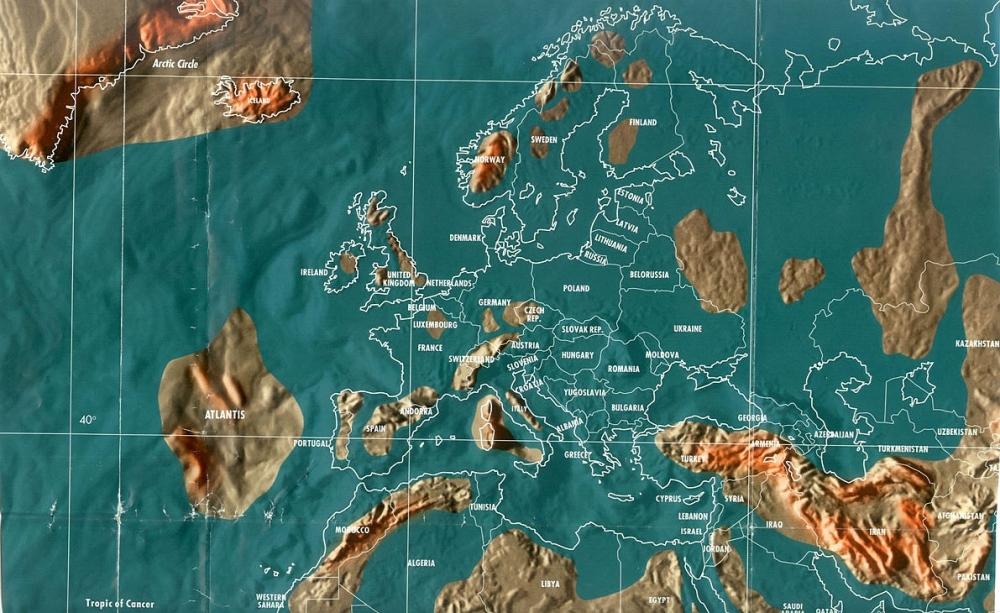
Future map of Europe by Gordon-Michael Scallion
Europe
Europe will experience the fastest and most serious Earth changes. Most of Northern Europe will sink beneath the sea, as the tectonic plate underneath it collapses. Norway, Sweden, Finland, and Denmark will be all disappear and will ultimately create hundreds of small islands.
Most of the United Kingdom, from Scotland to the English Channel, will disappear beneath the sea. Several small islands will remain. Major cities like London and Birmingham will be among the remaining islands. Much of Ireland will disappear beneath the sea, except for the higher ground areas.
Russia will be separated from Europe by an entirely new sea when the Caspian, Black, Kara, and Baltic Seas combine. The new sea will stretch all the way to the Jenisej River in Siberia. The areas climate will remain safe, leaving Russia to supply most of Europe's food. The Black Sea will merge with the North Sea as well, leaving Bulgaria and Romania completely under water.
Certain areas of western Turkey will go under water, creating a new coastline from Istanbul to Cyprus. Much of central Europe will sink and most of the land between the Mediterranean Sea and the Baltic Sea will be completely lost underwater.
The majority of France will go under water, leaving an island in the area surrounding Paris. A completely new waterway will then separate Switzerland from France, creating a line from Geneva to Zurich. Italy will be entirely divided by water. Venice, Naples, Rome and Genoa will sink below the rising sea. Higher elevations will be created as new islands. New lands will rise from Sicily to Sardinia.
Matrix Institute
Future map of North America by Gordon-Michael Scallion
North America
Canada
Parts of the Northwest region will be pushed in almost two hundred miles. Regions in Quebec, Ontario, Manitoba, Saskatchewan, and areas of Alberta will become the refugee / survival center of Canada. Most migrations into the region will arrive from British Columbia and Alaska.
United States
As the North American Plate buckles, the new Islands of California will be created with almost 150 islands. The West Coast will recede east towards Nebraska, Wyoming and Colorado.
The Great Lakes and the St. Lawrence Seaway will join and continue through the Mississippi River to the Gulf of Mexico. All coastal areas from Maine to Florida will be taken over by water and pushed inland for miles.
Mexico
Most coastal areas of Mexico will be inundated far inland. The California Baja coast will ultimately become a series of islands. Much of the Yucatan Peninsula will be lost to the rising waters.
Central America and the Caribbean
Central America will sink and will be reduced to a series of islands. Higher elevations will be considered safe. A new waterway will eventually develop from the Bay of Honduras to Salinas, Ecuador. The Panama Canal will ultimately become cut off with no access.
South America
In South America, heavy earthquake and volcanic activity will take place. Venezuela, Colombia, and Brazil will be taken over by water. The Amazon Basin area will become a huge inland sea. Peru and Bolivia will be sink with rising waters.
Salvador, Sao Paulo, Rio de Janeiro and parts of Uruguay will sink below the sea, and so will the Falkland Islands. An entirely new sea will rise to take over much of central Argentina. A huge landmass, which will include another new inland sea will develop and join up with the land of Chile.
Matrix Institute
Future map of South America by Gordon-Michael Scallion