(ZH) : Manhattan Office Bubble Fizzles Without Big Chinese Buyers

Manhattan Office Bubble Fizzles Without Big Chinese Buyers

Sales volume in Q3 plunges 67% from a year ago.
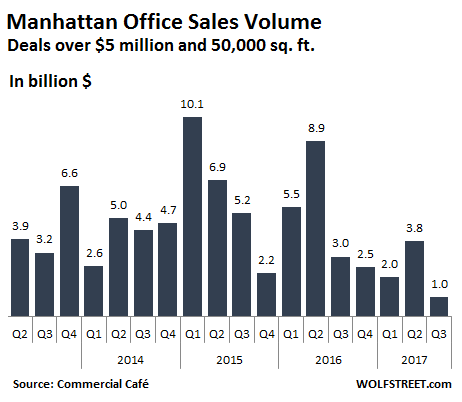
Manhattan, the biggest most expensive trophy market in the US for commercial real estate, used to be particularly appealing to exuberant foreign investors, such as Chinese conglomerates. But in the third quarter, sales volume of large office properties (minimum $5 million and 50,000 sq. ft.) plunged 67% year-over-year to $991 million, the lowest in five years. It was down 90% from the peak in Q1 2015.


“Q3 2017 might signal a return to normalcy for the highly sought-after Manhattan market,” the report by Yardi Systems’ Commercial Café commented.
This chart shows the dollar sales volume of large office properties. The $991 million in Q3 is rounded up to $1 billion:

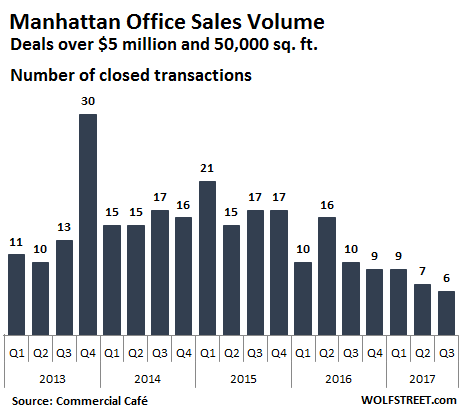
The number of closed deals plunged 40% to just six transactions, according to Commercial Café. That’d down 71% from the peak in Q1 2015:
The average price per square foot fell 19% year-over-year and is down 32% from the peak in Q1 2016, but is up from Q1 2017 and about flat with Q3 2015.
As this chart shows, the average price per square foot varies based on a number of factors, including seasonality, but with a trend since the peak in Q1 2016 that doesn’t look promising:

FT : UBS to move 250 London staff because of Brexit

UBS to move 250 London staff because of Brexit
Number expected to be lower than 1,000 initially feared

UBS could move as few as 250 people from London as a consequence of Brexit, lower than the 1,000 it initially feared, because it thinks it will be able to keep many of its back and middle office functions in the City, according to people familiar with the situation.

Sergio Ermotti, the bank’s chief executive, said on Friday that it was becoming “more and more unlikely” that UBS would have to move as many people as it initially thought, because of “regulatory and political clarifications” in recent months.

He did not specify how many of its 5,000 London workers were now likely to move, or what the regulatory and political clarifications were.

A person familiar with UBS’s discussions said that the figure moving now looked closer to the 250 range, and that the clarifications were that UBS expects to be able to book its trades “back to back” in London and another EU location.

Under such an arrangement, trades for UBS’s EU clients would initially be booked in UBS’s EU entity and then offset in the bank’s London entity, where the risk would be managed.

That would mean that back and middle office functions, such as trade processing and risk, could be shared between the two entities and would remain in London.

The person stressed that there was no final decision, and that things could still change as the UK and the EU go through protracted exit negotiations.

A UBS spokesperson said: “Our plans and target operating model are not finalised, so any staff numbers or further details are pure speculation at this point.”

The EU’s banking watchdog, the European Banking Authority, has warned that it will not allow banks to use shell companies in EU countries to retain single market access for businesses that remain in effect UK-based.

The bank has not yet picked a final location for the investment bankers and support people who will move and is still deliberating between Frankfurt, Amsterdam and Madrid.

Mr Ermotti said on Friday that a decision would be taken in a “few weeks”, but insiders said there would not be a public announcement.

Other banks have also subsequently signalled far lower Brexit departure numbers than were initially feared. Citi, for example, said in July that it would add 150 jobs in its Frankfurt hub in the initial phase of its Brexit transition.

With less than 18 months to go until Brexit, most investment banks have applied for the licences they will need for their post-Brexit businesses and some have already begun taking on new property leases in Frankfurt, Paris and Dublin.

Many are adopting a phased approach, moving as few people as they can during what they hope will be a transition period of several years, before deciding on longer term structures.

FT : KKR Europe chief looks to French deals as Brexit looms

KKR Europe chief looks to French deals as Brexit looms
Head of private equity group has moved from London to Paris and likes Macron reforms

The European head of KKR has said the US private equity group is more cautious about doing UK deals because of worries over Brexit, and is likely to invest more in France, attracted by the optimism generated by President Macron.

Johannes Huth moved from London to Paris earlier this year because of Brexit as well as for personal reasons. He said in a rare interview that the extra risks created by Brexit would be a factor when considering new UK investments at KKR. The group has $153bn of assets under management and orchestrated some of Europe’s biggest buyouts, including that of pharmacy chain Alliance Boots.

Mr Huth told the Financial Times that KKR has been buying UK businesses with significant exposure to foreign markets and therefore benefiting from the weaker pound.

He said: “Are we going to properly do our work and make sure that we take the uncertainty and the variety of factors into account? Absolutely. Brexit adds an extra layer, Catalonia adds an extra layer if you want to buy a business in Barcelona.”

Britain’s vote to leave the EU has pushed many Europeans to weigh up their future in the UK. In addition, earlier this year, the government abolished non-dom status for anyone living in Britain for at least 15 of the past 20 years, limiting their ability to keep offshore income out of the UK’s tax net.

All of this comes as President Macron sets out to overhaul France’s labour laws and tax regime to make it more attractive and business-friendly. The new government is scrapping the wealth tax on everything apart from property assets, and is trying to lure foreigners with its own non-dom regime.

“I am fascinated with what’s happening in France: I think Macron is a very positive influence in that country,” said Mr Huth, a German national who had been running KKR from London for nearly two decades before his move.

He added: “I was a strong Remainer and quite involved in the campaign. I was disappointed with the outcome.

“I hope there will be more business for us in France as that economy is picking up and maybe repeating the German transformation that we saw after Schröder.

“I think it will be useful to be a little bit more present there than doing that from [London].”

Mr Huth’s comments came after KKR bought two UK-headquartered businesses at the start of the year — chemicals distributor A-Gas and specialist holidays firm Travelopia. Both have meaningful exposure outside the UK.

His views come as KKR is getting ready to raise up to €5bn from investors in Europe in a flagship fund at the start of next year.

FT : Amex chief Chenault earns rewards worth $370m over 17-year tenure

Amex chief Chenault earns rewards worth $370m over 17-year tenure
Credit card company’s returns fare worse than S&P 500 over period

Kenneth Chenault will walk away from American Express having pocketed more than $370m during his 17-year tenure, a period in which the shares have returned more than the financial sector but less than the wider stock market.

Data provided to the Financial Times by the pay consultants Equilar lay bare the wealth that Mr Chenault has accumulated from running the US credit card group.

Mr Chenault, 66, this month called time on the longest spell by a chief executive at a Dow Jones Industrial Average company, saying he planned to retire early next year.

His time at the top has also been among the most lucrative in corporate America, and some governance experts have frowned upon the company’s remuneration practices. Since he took the helm, Mr Chenault has realised stock options totalling $150m as well as at least $104m in share awards.

He has also netted $24m in salary, $76m in annual bonuses and $16m in other forms of remuneration. Perks include a company aircraft, although in 2010 the board capped his annual usage at a value of $200,000.

Last year, Mr Chenault was handed a $17m pay deal, tied in part to the company’s future performance. That was down about a fifth from the prior year, and was among his more modest annual hauls. Despite the cut, he was still the 99th highest paid chief executive of a listed US company that year, according to Equilar.

American Express declined to comment on Mr Chenault’s pay during his tenure.

Mr Chenault became chief executive in January 2001 and chairman three months later. He led the company’s recovery from the September 11 terrorist attacks, in which 11 of its employees were killed.

The son of a dentist and Harvard Law School graduate went on to steer American Express through the 2008 crisis and kept his job in its aftermath. More recently he has sought to keep Amex cards in customer wallets at a time of intensifying competition.

Executive pay has been in the spotlight at Amex, whose biggest shareholder is Warren Buffett’s Berkshire Hathaway. In a “say on pay” ballot this year, 27 per cent of shareholder votes were cast against the company.

The proxy voting group ISS raised a series of concerns. Conditions attached to bonuses were not “particularly rigorous”, it said.

Investors who bought shares when Mr Chenault became chief executive have made a return, including reinvested dividends, of 166 per cent. Investors would have done better had they instead invested in the S&P 500 index of US stocks, which has generated a 181 per cent return during the Chenault era.

The financial sector, whose returns were damaged by the 2008 banking collapse, saw returns of 66 per cent in the same period. 

The pay figures exclude the realised value of Mr Chenault’s vested stock awards before 2006, when the company was not required to publish that. They also exclude his tally for 2017, which the company has yet to disclose.

Barron's : Reinventing Telecom

Reinventing Telecom
A proposed index overhaul could affect everything from sector funds to ETFs that track the S&P 500.

As anyone with a smartphone knows, the lines separating telecom, media, and technology companies blurred a long time ago. S&P Dow Jones Indices is now contemplating changes in the components of the 11 industry sectors that make up the Standard & Poor’s 500 index, the most popular U.S. stock-market benchmark.

“Telecom has totally changed, and the index has to change,” says Howard Silverblatt, S&P Dow Jones Indices’ senior index analyst.

The implications for investors could be significant. Reassigning companies to different sectors would affect the holdings of the sector-specific exchange-traded funds that track the index—and actively managed funds whose managers strive to hew closely to the S&P 500’s sector weightings. Even managers free from benchmark restraints can’t ignore the changes.

“There are going to be a lot of managers who have to change their portfolios, depending on the new sector divisions,” says Michael Lippert, a portfolio manager at Baron Capital.

The S&P telecom sector, once home to 14 companies, now holds only four: Verizon Communications (ticker: VZ), AT&T (T), CenturyLink (CTL), and Level 3 Communications (LVLT). The last two announced a merger last year and are awaiting regulatory approval.

S&P Dow Jones and MSCI, the other prominent equity-index creator, announced in July that they are seeking investor commentary about proposed changes to the telecom sector—including renaming it “communications services” and expanding it to include three industry groups: telecommunication services, media and entertainment, and consumer internet and digital services.

The language of the S&P/MSCI proposal cites the inclusion of social-media and search-engine companies in the reconfigured sector, which strongly suggests that Facebook (FB) and Alphabet (GOOGL)—currently components of the information-technology sector—are prime candidates for reassignment.

Other companies that might be moved from their current homes into communications services include Alibaba Group Holding (BABA) and Netflix (NFLX), from the tech and consumer-discretionary sectors, respectively.

S&P Dow Jones plans to make its next announcement in November, although implementation probably won’t occur this year. The creation of a new classification for real-estate-related stocks, implemented in 2016, took nearly two years.

IRONICALLY, A REASSIGNMENT of Facebook and Google parent Alphabet could result in the de-FANGing of the information-technology sector. The two are half of a quartet of highflying tech stocks whose other members include Netflix and Amazon.com (AMZN), also a consumer-discretionary component.

Booting Facebook and Alphabet from tech would impact ETFs such as Technology Select Sector SPDR (XLK), Vanguard Information Technology (VGT), and Fidelity MSCI Information Technology Index (FTEC), which would have to sell the stocks, notes Todd Rosenbluth, senior director of ETF and mutual fund research at CFRA. “Any changes could have big implications for sector ETFs offered by iShares, Vanguard, State Street Global Advisors, Guggenheim, Fidelity, and others,” he says.

BlackRock, which owns the iShares franchise, declined to comment on possible changes, while a spokesman for State Street, sponsor of the SPDR ETFs, said the company “plans to participate in the upcoming consultation process.”

Brian Wieser, of Pivotal Research, argues that Facebook and Google have more in common with media owners than tech stocks because they all compete for ad sales and consumer attention. He argues that stocks such as Nielsen Holdings (NLSN), Adobe Systems (ADBE), and Salesforce.com (CRM) also belong in the new communications-services sector, as they are more like ad and media businesses than their current sector cohorts.

The creation of an expanded communications-services sector would also alter the sector weightings of the S&P 500, affecting actively managed funds whose portfolios closely mirror the index. Telecom services accounts for 1.9% of the index; consumer discretionary, 11.8%; and tech, 23.7%.

Barron's : The Bull Case for a Slumping Shire

The Bull Case for a Slumping Shire
The Irish pharma has struggled against generic pressures and rising competition. But the bear case may be too extreme.

Irish pharmaceutical giant Shire has seen its shares slump this year, turning in one of the worst performances among United Kingdom-listed blue chips.

The bear case may have some cracks in it, however, according to Alec Walsh, a co-manager for the Harding Loevner International Equity Portfolio fund, which holds Shire (ticker: SHP.UK). He sees the FTSE 100 component’s shares getting their groove back, and his contrarian take is worth hearing out. “Shire is one that’s misunderstood by investors,” he tells Barron’s.

One plank in the bears’ platform that Walsh questions is the looming threat from Swiss rival Roche Holding’s (ROG.Switzerland) move into hemophilia. Roche is developing a hemophilia drug called ACE 910 that appears likely to win regulatory approval in the U.S.in February, and investors seem to be betting that Shire will lose business in a big way—and quickly. Not Walsh. “This is a market where people have bleeding episodes, and if they’re under control, they don’t switch their therapies,” he says. He believes a switch will occur more gradually.

Other Shire watchers agree. Shire’s share price implies the loss of its entire hemophilia franchise by 2018’s third quarter, say RBC analysts in a note. But, they add, it’s important to wait for data from a key ACE 910 trial. Shire’s hematology business is a big contributor, providing about 20% of 2016’s $11.4 billion in Shire revenue.

Shire has also been weighed down by generic pressures on its attention-deficit business, adding to the erosion that already has occurred, for example, from knockoff versions of Adderall. Walsh, on the other hand, emphasizes that generics for the company’s ADHD drugs won’t fully hit until 2023.

“Their long-acting ADHD drugs are holding their market share, and in fact that’s a market that’s growing,” he adds. Beyond new prescriptions for pediatric patients, about 8% to 10% of such patients continue using such drugs in adulthood, notes Walsh. These drugs are part of Shire’s neuroscience business, which accounted for about 22% of 2016 revenue, and has been viewed by Shire’s CEO, Flemming Ørnskov, as a spinoff candidate.

Other positives are Shire’s diverse product lineup following last year’s debt-financed, $32 billion buyout of U.S. biotech Baxalta, as well as its strong pipeline, according to RBC, which has an Outperform rating on the stock and a price target of $213 for its U.S. shares, implying a gain of roughly 50%. “The announcement of a new, well-respected CFO before year end should help improve investor confidence,” the RBC team adds. Some investors might also be heartened by reports that U.S. activist investor Sachem Head Capital has become a shareholder and is pushing for more radical moves than just spinning off the neuroscience operations.

“It’s a stock that’s loathed,” admits Walsh. Shire’s U.K.-listed shares have lost nearly a quarter of their value this year. Despite that, analysts on average see a buying opportunity. Of 26 teams covering the stock, 77% rate it Buy, and the average price target is 52 pounds ($66), implying a rally of more than 40%. Shire is trading at nine times forward-year estimated earnings, well below its peers, according to FactSet. AstraZeneca’s (AZN.UK) price/earnings ratio is 18, Novartis’ (NOVN.Switzerland) is 16, and Allergan’s (AGN) is 11.

On Friday, Shire’s stock closed higher as investors focused on quarterly results that featured better-than-expected adjusted earnings and a reaffirmed full-year outlook.

While Walsh is a Shire bull, he admits drugmakers don’t have a lot of pricing power. “Basically, you’ve got to come up with a new therapy that really advances the standard of care, and then you can charge a premium price,” he says. “You can’t raise prices in most markets after that.”

But another stock his fund holds—Sonova Holding (SOON.Switzerland)—can charge more over time. “Sonova introduces a new line of technologically advanced hearing aids every two years, and they boost prices every two years,” he says. “A hearing aid typically lasts five or six years, and when it’s time to replace one, the new version is noticeably better, so users tend to accept the higher price.”

Buyers of Sonova’s stock have to pay a bit of a premium, but its multiple is around that of its peers. Shares trades at about 24 times forward-year earnings, while Danish players William Demant Holding (WDH.Denmark) and GN Store Nord (GN.Denmark) are at 23 and 21, respectively.

IN EUROPEAN MARKETS last week, the main stock gauges mostly gained ground, as the European Central Bank made its long-awaited move to reduce its bond-buying program. The ECB will halve its monthly bond-buying purchases starting in January, dropping them to €30 billion ($34.8 billion). But it also extended the program to at least September 2018, describing it as “open ended,” and pushing back against the characterization of the policy as tapering. “The ECB wants to start as cautiously as possible,” said Carsten Brzeski, an ING economist, in a note. “It is like stealing away from a party through the back yard hoping no one will notice.”
>>> In Shocking, Viral Interview, Qatar Confesses Secrets Behind Syrian War

In Shocking, Viral Interview, Qatar Confesses Secrets Behind Syrian War


TwitterFacebookReddit

A television interview of a top Qatari official confessing the truth behind the origins of the war in Syria is going viral across Arabic social media during the same week a leaked top secret NSA document was published which confirms that the armed opposition in Syria was under the direct command of foreign governments from the early years of the conflict.
And according to a well-known Syria analyst and economic adviser with close contacts in the Syrian government, the explosive interview constitutes a high level "public admission to collusion and coordination between four countries to destabilize an independent state, [including] possible support for Nusra/al-Qaeda." Importantly, "this admission will help build case for what Damascus sees as an attack on its security & sovereignty. It will form basis for compensation claims."

A 2013 London press conference: Qatari Prime Minister Sheikh Hamad bin Jassim bin Jabr Al Thani with U.S. Secretary of State John Kerry. A 2014 Hillary Clinton email confirmed Qatar as a state-sponsor of ISIS during that same time period.
As the war in Syria continues slowly winding down, it seems new source material comes out on an almost a weekly basis in the form of testimonials of top officials involved in destabilizing Syria, and even occasional leaked emails and documents which further detail covert regime change operations against the Assad government. Though much of this content serves to confirm what has already long been known by those who have never accepted the simplistic propaganda which has dominated mainstream media, details continue to fall in place, providing future historians with a clearer picture of the true nature of the war.
This process of clarity has been aided - as predicted - by the continued infighting among Gulf Cooperation Council (GCC) former allies Saudi Arabia and Qatar, with each side accusing the other of funding Islamic State and al-Qaeda terrorists (ironically, both true). Increasingly, the world watches as more dirty laundry is aired and the GCC implodes after years of nearly all the gulf monarchies funding jihadist movements in places like Syria, Iraq, and Libya.
Since 2013 The Intercept (+WaPo?) hid NSA docs showing Saudi ordering 'rebel' attacks on Damascus. Now released. https://theintercept.com/2017/10/24/syria-rebels-nsa-saudi-prince-assad/ …
NSA Document Says Saudi Prince Directly Ordered Coordinated Attack By Syrian Rebels On Damascus
“Light up Damascus," the Saudi prince told Syrian rebels, as they grew increasingly reliant on foreign support.
theintercept.com

  • 157157 Replies

  • 2,7292,729 Retweets

  • 2,8642,864 likes

The top Qatari official is no less than former Prime Minister Hamad bin Jassim bin Jaber al-Thani, who oversaw Syria operations on behalf of Qatar until 2013 (also as foreign minister), and is seen below with then-Secretary of State Hillary Clinton in this Jan. 2010 photo (as a reminder, Qatar's 2022 World Cup Committee donated $500,000 to the Clinton Foundation in 2014).

In an interview with Qatari TV Wednesday, bin Jaber al-Thani revealed that his country, alongside Saudi Arabia, Turkey, and the United States, began shipping weapons to jihadists from the very moment events "first started" (in 2011).
Al-Thani even likened the covert operation to "hunting prey" - the prey being President Assad and his supporters - "prey" which he admits got away (as Assad is still in power; he used a Gulf Arabic dialect word, "al-sayda", which implies hunting animals or prey for sport). Though Thani denied credible allegations of support for ISIS, the former prime minister's words implied direct Gulf and US support for al-Qaeda in Syria (al-Nusra Front) from the earliest years of the war, and even said Qatar has "full documents" and records proving that the war was planned to effect regime change.
"We argued over the prey and that prey run away".Ladies and Gentleman: To these people #Syria #Assad was nothing but a f....ing hunting game https://twitter.com/walid970721/status/923825448324345858 …

  • 22 Replies

  • 3232 Retweets

  • 2222 likes

According to Zero Hedge's translation, al-Thani said while acknowledging Gulf nations were arming jihadists in Syria with the approval and support of US and Turkey: "I don't want to go into details but we have full documents about us taking charge [in Syria]." He claimed that both Saudi Arabia's King Abdullah (who reigned until his death in 2015) and the United States placed Qatar in a lead role concerning covert operations to execute the proxy war.
The former prime minister's comments, while very revealing, were intended as a defense and excuse of Qatar's support for terrorism, and as a critique of the US and Saudi Arabia for essentially leaving Qatar "holding the bag" in terms of the war against Assad. Al-Thani explained that Qatar continued its financing of armed insurgents in Syria while other countries eventually wound down large-scale support, which is why he lashed out at the US and the Saudis, who initially "were with us in the same trench."
In a previous US television interview which was vastly underreported, al-Thani told Charlie Rose when asked about allegations of Qatar's support for terrorism that, "in Syria, everybody did mistakes, including your country." And said that when the war began in Syria, "all of use worked through two operation rooms: one in Jordan and one in Turkey."
Below is the key section of Wednesday's interview, translated and subtitled by @Walid970721. Zero Hedge has reviewed and confirmed the translation, however, as the original rush translator has acknowledged, al-Thani doesn't say "lady" but "prey" ["al-sayda"]- as in both Assad and Syrians were being hunted by the outside countries.

#Qatar's ex PM says that Qatari support for jihadists including Nusra in #Syria was in coordination w/ KSA, Turkey & the US via @BBassem7

  • 4444 Replies

  • 753753 Retweets

  • 514514 likes

The partial English transcript is as follows:


"When the events first started in Syria I went to Saudi Arabia and met with King Abdullah. I did that on the instructions of his highness the prince, my father. He [Abdullah] said we are behind you. You go ahead with this plan and we will coordinate but you should be in charge. I won’t get into details but we have full documents and anything that was sent [to Syria] would go to Turkey and was in coordination with the US forces and everything was distributed via the Turks and the US forces. And us and everyone else was involved, the military people. There may have been mistakes and support was given to the wrong faction... Maybe there was a relationship with Nusra, its possible but I myself don’t know about this… we were fighting over the prey ["al-sayda"] and now the prey is gone and we are still fighting... and now Bashar is still there. You [US and Saudi Arabia] were with us in the same trench... I have no objection to one changing if he finds that he was wrong, but at least inform your partner… for example leave Bashar [al-Assad] or do this or that, but the situation that has been created now will never allow any progress in the GCC [Gulf Cooperation Council], or any progress on anything if we continue to openly fight."
As is now well-known, the CIA was directly involved in leading regime change efforts in Syria with allied gulf partners, as leaked and declassified US intelligence memos confirm. The US government understood in real time that Gulf and West-supplied advanced weaponry was going to al-Qaeda and ISIS, despite official claims of arming so-called "moderate" rebels. For example, a leaked 2014 intelligence memo sent to Hillary Clinton acknowledged Qatari and Saudi support for ISIS.
The email stated in direct and unambiguous language that:


"the governments of Qatar and Saudi Arabia, which are providing clandestine financial and logistic support to ISIL and other radical Sunni groups in the region."
Furthermore, one day before Prime Minister Thani's interview, The Intercept released a new top-secret NSA document unearthed from leaked intelligence files provided by Edward Snowden which show in stunning clarity that the armed opposition in Syria was under the direct command of foreign governments from the early years of the war which has now claimed half a million lives.
The newly released NSA document confirms that a 2013 insurgent attack with advanced surface-to-surface rockets upon civilian areas of Damascus, including Damascus International Airport, was directly supplied and commanded by Saudi Arabia with full prior awareness of US intelligence. As the former Qatari prime minister now also confirms, both the Saudis and US government staffed "operations rooms" overseeing such heinous attacks during the time period of the 2013 Damascus airport attack.
No doubt there remains a massive trove of damning documentary evidence which will continue to trickle out in the coming months and years. At the very least, the continuing Qatari-Saudi diplomatic war will bear more fruit as each side builds a case against the other with charges of supporting terrorism. And as we can see from this latest Qatari TV interview, the United States itself will not be spared in this new open season of airing dirty laundry as old allies turn on each other.

WSJ : Akzo Nobel in Merger Talks With Axalta

Akzo Nobel in Merger Talks With Axalta
Combined company would have added scale to win better pricing for raw materials

Akzo Nobel AKZOY 0.69% NV and U.S. rival Axalta Coating Systems Ltd. AXTA 16.97% are considering a possible merger of equals that would create a multibillion-dollar coating and paints giant, according to a person familiar with the matter.

The possible deal under consideration would involve the Dutch paint company first proceeding with its existing plans to spin off its speciality chemicals business and distributing proceeds to shareholders, the person said.

While preliminary talks about a possible deal have previously been reported, it wasn’t clear that they centered on structuring the deal as a merger of equals.

The combined company would have added scale to generate better pricing for raw materials, eliminate overlapping operations and gain new customers to help revive profit growth. Coatings are used to prevent corrosion and improve durability across a range of sectors such as the automotive, electronics, mining and marine industries.

The talks are at an early stage and could collapse before a deal is reached, according to the person familiar with the matter.


A merger of equals typically involves companies with a similar market value. The deals are structured through a share swap and shareholders of neither company receive any significant premium for their stock. This type of structure would be crucial in an attempt by Akzo to win support from its shareholders, some of whom have been concerned that the Amsterdam-based company could seek a major acquisition, potentially paying a big premium, to protect itself against an unwanted suitor.

Earlier this year, Elliott Management Corp., the well-known activist investor and one of Akzo’s biggest shareholders, mounted a bold public-relations and legal campaign to force Akzo into unwanted sale talks with its U.S. paints rival PPG Industries Inc. The $28 billion takeover attempt ultimately failed. In August, Elliott and Akzo reached a truce over the Dutch company’s alternative plan to separate its specialty-chemicals business and distribute the proceeds to shareholders to generate value for investors.

Currently, Akzo has market value of about $22.6 billion, compared with Axalta’s value of about $8.1 billion. That gulf in valuation precludes a merger of equals and would instead require Akzo paying a takeover premium to acquire Axalta. By selling or spinning off the specialty chemicals business first as a condition to a deal with Axalta, Akzo’s market value would likely fall more closely in line with its Philadelphia-based rival. Some analysts estimate the specialty chemicals business could be worth up to $10 billion, which would no longer be reflected in Akzo’s market capitalization after the spinoff.

Akzo has stressed that its plan to spin off the chemicals business and distribute the proceeds to shareholders remains on track.

Even with the spinoff of the specialty chemicals business, Akzo could face difficulty getting its shareholders to support an Axalta deal because the merger would make it more expensive than it otherwise would be for a potential suitor.

On Friday, Swiss chemicals company Clariant AG and U.S.-based Huntsman Corp. ended their proposed $15 billion merger after Clariant’s largest shareholder, activist investor White Tale Holdings opposed the deal. That led some analysts to speculate that Clariant is now a prime takeover target in the consolidating chemicals sector.

That said, talks of a possible merger between Akzo and Axalta may appeal to shareholders as the companies seek ways to boost slumping profits, allowing it to cut costs and potentially broaden its customer base.

For the third quarter, Akzo reported a 13% drop in adjusted operating profit, hurt in part by higher raw material costs and sluggish demand from the marine industry. Axalta’s adjusted net income fell 20% over the same period amid lower volumes in North America and higher raw material costs.